Ghost of Tsushima
## Game Introduction *Ghost of Tsushima* is an open-world action-adventure game developed by **Sucker Punch Productions** and published by **Sony Interactive Entertainment**. It was first released exclusively for **PlayStation 4** on July 17, 2020. A **Director’s Cut** edition launched on August ...
Download & Installation
Introduction
Ghost of Tsushima is available on PlayStation 4, PlayStation 5 (via backward compatibility or the enhanced Director’s Cut), and PC (via Steam and Epic Games Store). The game is not released on Xbox, Nintendo Switch, or mobile platforms. This guide covers legitimate digital and physical purchases, step-by-step installation for each platform, system requirements (PC), storage requirements, account prerequisites, first‑launch setup, common installation errors, and post‑installation verification.
---
PlayStation 4 & PlayStation 5
Platforms Covered
- PS4 – Original version (also backward compatible on PS5)
- PS5 – Ghost of Tsushima Director’s Cut (enhanced for PS5, includes Iki Island expansion and PS5 features)
- A PlayStation Network (PSN) account is required to download digital copies, access online features (Legends mode), and redeem disc‑based content (day‑one patches, bonus items). Free to create.
Account Requirements
Digital Download (PS Store)
1. On your PS4 or PS5, navigate to the PlayStation Store from the home screen.
2. Search for “Ghost of Tsushima” or “Ghost of Tsushima Director’s Cut”.
3. Select the edition you wish to purchase (Standard, Digital Deluxe, or Director’s Cut).
4. Complete the purchase using a payment method or wallet funds.
5. After purchase, the download will begin automatically. If it does not, go to Game Library → Purchased and start the download manually.
6. Pre‑load is available for pre‑orders (usually 48 hours before release).
Physical Disc Installation
1. Insert the PS4 or PS5 disc into your console.
2. The console will automatically recognise the game. If not, navigate to the disc icon on the home screen and press X.
3. A prompt will appear to Install the game data. Select Install.
4. After installation, the game will copy to the hard drive. A mandatory day‑one patch may download (size varies, typically 1–5 GB). Ensure your console is connected to the internet.
5. Once the patch is installed, launch the game from the home screen.
Storage Space
| Platform | Space Required |
|---|---|
| PS4 | ~45 GB |
| PS5 | ~65 GB |
| PS5 (Director’s Cut) | ~65–70 GB |
First Launch Setup (PlayStation)
- On PS5, the game will detect which version you own. If you own the PS4 disc, you can download the free PS5 upgrade (only for Director’s Cut). Follow on‑screen prompts.
- Accept the Licence Agreement and Privacy Notice.
- Configure Display and Audio settings (HDR, 60/120 Hz, Audio Output).
- Legends Mode requires a PSN account and PlayStation Plus subscription for online multiplayer.
- Steam (Valve)
- Epic Games Store (Epic Games)
- Steam – Free Steam account required. Purchase the game on the Steam store.
- Epic Games Store – Free Epic Games account required. Purchase on Epic Store.
- No additional PSN account is needed for the PC version (except for cross‑play features in Legends mode, which require linking a PSN account).
---
PC (Steam & Epic Games Store)
Platforms Covered
Account Requirements
System Requirements (Ghost of Tsushima Director’s Cut – PC)
| Component | Minimum | Recommended | High/Ultra |
|---|---|---|---|
| OS | Windows 10 64‑bit | Windows 10 64‑bit | Windows 10/11 64‑bit |
| Processor | Intel Core i5-4430 / AMD Ryzen 3 1200 | Intel Core i5-11400 / AMD Ryzen 5 5600 | Intel Core i7-12700 / AMD Ryzen 7 5800X |
| Memory | 8 GB RAM | 16 GB RAM | 16 GB RAM |
| GPU | NVIDIA GeForce GTX 960 (4GB) / AMD Radeon RX 5500 XT | NVIDIA GeForce RTX 3060 Ti / AMD Radeon RX 6700 XT | NVIDIA GeForce RTX 4080 / AMD Radeon RX 7900 XT |
| DirectX | Version 12 | Version 12 | Version 12 |
| Storage | 75 GB SSD | 75 GB SSD | 75 GB SSD (NVMe recommended) |
| Additional | Broadband internet connection; 720p / 30 fps (minimum) | 1440p / 60 fps (recommended) | 4K / 60 fps (ultra) |
Download & Installation Steps (Steam)
1. Install Steam – If not already installed, download the Steam client from [store.steampowered.com](https://store.steampowered.com) and install it.
2. Create/Log in – Launch Steam and sign in to your Steam account.
3. Purchase – Search “Ghost of Tsushima” in the Store. Select Ghost of Tsushima Director’s Cut – PC Edition. Add to cart and complete purchase.
4. Install – After purchase, the game will appear in your Library. Click Install.
- Choose a destination folder (ensure the drive has at least 75 GB free space).
5. Download – Steam will begin downloading the game files. You can pause/resume. Pre‑load is available for pre‑orders.
6. Auto‑install – Once the download finishes, Steam will automatically unpack and install the game. This may take 10–20 minutes depending on your system.
7. Launch – Click Play in your Steam Library. The game will start after a brief first‑run setup (shader compilation).
Download & Installation Steps (Epic Games Store)
1. Install Epic Games Launcher – Download from [epicgames.com](https://www.epicgames.com/store) and install the launcher.
2. Create/Log in – Open the launcher and sign in to your Epic Games account.
3. Purchase – Search “Ghost of Tsushima” in the Store. Click Buy Now and complete the transaction.
4. Install – Go to your Library tab, find Ghost of Tsushima Director’s Cut, click Install.
- Choose installation folder (SSD recommended). The launcher will check disk space.
5. Download & Install – The Epic Launcher downloads and installs automatically. Time depends on internet speed.
6. Launch – Click Launch from the Library or create a desktop shortcut.
First Launch Setup (PC)
- Shader Compilation – On the first run, the game will compile shaders. This can take 5–15 minutes and may cause initial stuttering. Do not interrupt (do not force close the game).
- Graphics Settings – The game will auto‑detect your hardware and set a graphics preset. You can customise resolution, FPS cap, upscaling (DLSS/FSR/XeSS), and V‑sync.
- Display & Audio – Select your monitor, HDR calibration, and audio output.
- Account Linking – If you wish to play Legends online, you will be prompted to link your PSN account. This is required for cross‑play with PlayStation players.
- Installed size: approximately 75 GB (may vary slightly with updates).
- SSD strongly recommended for faster load times and to avoid texture pop‑in.
- Pre‑load size: same as full installation (75 GB).
Storage Space
---
Common Installation Errors & Fixes
PlayStation
| Error | Cause | Fix |
|---|---|---|
| Cannot download/install from Store | PSN outage, insufficient storage, or conflicting licences | Check PSN status ([status.playstation.com](https://status.playstation.com)). Free up space (Storage Management). Restore licences: Settings → Users and Accounts → Restore Licences. |
| Disc Read Error | Dirty or damaged disc | Clean disc with a soft cloth. Ensure disc is inserted correctly. If persists, try another disc. |
| Error CE-30005-8 (PS5) | Corrupted installation data | Delete incomplete installation, rebuild database (Safe Mode → Option 5). |
| Update fails to download | Network issue or server overload | Pause and resume download, restart console, or try a wired connection. |
| Game crashes on launch (PS5) | Incompatible external storage or corrupted data | Move game to internal SSD (PS5 games require internal storage). Reinstall if necessary. |
PC
| Error | Cause | Fix |
|---|---|---|
| DirectX 12 Error / Graphics Driver crash | Outdated or corrupted GPU drivers | Update to the latest drivers from NVIDIA or AMD. If using an older GPU, ensure it supports DirectX 12 Feature Level 12_0. |
| “Insufficient Disk Space” (even though enough free space shown) | NTFS compression or hidden files | Check actual free space via This PC (Win+E). Disable compression on the drive or move the game to an uncompressed volume. |
| Steam/Epic download stucks at 0% | Server congestion or corrupted download cache | Pause/resume; clear Steam download cache (Steam → Settings → Downloads → Clear Download Cache). For Epic, navigate to Library → options → Verify. |
| Shader compilation freezes | Interrupted compilation, antivirus blocking | Temporarily disable antivirus or add the game folder to exceptions. Ensure the process is not terminated. |
| Antivirus flagging game files | False positive (players have reported Bitdefender, Avast, etc.) | Add the entire game installation folder and executable (GhostOfTsushima.exe) to your antivirus whitelist. |
| “Application has stopped working” on launch | Missing VC++ redistributables or corrupt registry | Install the latest Visual C++ Redistributables (both x64 and x86). Verify file integrity (Steam: right‑click game → Properties → Local Files → Verify integrity of game files. Epic: Library → click “…” → Verify). |
| “Failed to create DirectX 12 Device” | GPU does not support DirectX 12 or driver issues | Update drivers. If your GPU is very old (e.g., GTX 700 series or earlier), the game will not run. Check compatibility. |
| Controller not recognised | Steam/Epic input conflict | Disable Steam Input for the game (Steam → Library → right‑click game → Properties → Controller → Disable Steam Input). For Epic, use the non‑Steam controller or Xbox/PlayStation native support. |
| Low FPS or stuttering | Outdated drivers, background processes, thermal throttling | Close unnecessary apps, lower graphics settings, enable upscaling (DLSS/FSR). Monitor temperatures. Ensure game is on an SSD. |
Post‑Installation Verification
Verify Game Files (PC)
- Steam: Right‑click Ghost of Tsushima Director’s Cut in Library → Properties → Local Files → Verify integrity of game files. This checks for corrupted or missing files and replaces them.
- Epic Games: In Library, click the three dots next to the game → Verify. The launcher will scan and repair if needed.
- Ensure you install the latest patch. On PlayStation, automatic updates are on by default. On PC, both Steam and Epic should auto‑update the game. You can manually check for updates by restarting the client or right‑clicking the game and selecting Properties → Updates.
- PlayStation cross‑save: If you own both PS4 and PS5 versions (or PC version), you can transfer save files. Use the in‑game “Transfer Save Data” option from the main menu (requires a PSN account). PC saves are stored locally (usually under `%USERPROFILE%\Documents\Ghost of Tsushima`).
- Pre‑load advantage: On both consoles and PC, if you pre‑ordered, you can download the game days before release. At launch, only a small unlock patch is needed.
- SSD vs HDD: An SSD is highly recommended for PC and required on PS5 (to meet speed standards). On PS4, the game runs fine on HDD but load times are much longer (up to 2 minutes vs 20 seconds on SSD).
- Language: The game supports multiple languages. On PlayStation, language is tied to console region; on PC, you can change language via Steam/Epic settings or in‑game menu.
Launch & Quick Test
1. Launch the game and check that the main menu loads.
2. Start a new game or load a save. Walk around for a minute to ensure textures, audio, and controls work.
3. Test Legends mode (if you have internet) to verify online connectivity.
4. On PlayStation, go to Settings → Storage to confirm that the game is installed and has the correct file size.
Update Patches
---
Additional Tips
---
Summary Table
| Platform | Store/Method | Installation File Size | Account Needed | Online Feature Subscription |
|---|---|---|---|---|
| PS4 | PS Store / Disc | ~45 GB | PSN | PS Plus (Legends) |
| PS5 | PS Store / Disc (Director’s Cut) | ~65–70 GB | PSN | PS Plus (Legends) |
| PC (Steam) | Steam Store | ~75 GB | Steam | PSN link (optional for Legends) |
| PC (Epic) | Epic Games Store | ~75 GB | Epic Games | PSN link (optional for Legends) |
If you encounter any issue not listed, consult the official support page for your platform:
- PlayStation Support: [support.playstation.com](https://support.playstation.com)
- Steam Support: [help.steampowered.com](https://help.steampowered.com)
- Epic Games Support: [epicgames.com/help](https://epicgames.com/help)
- Sucker Punch (Developer): [suckerpunch.com/support](https://www.suckerpunch.com/support)
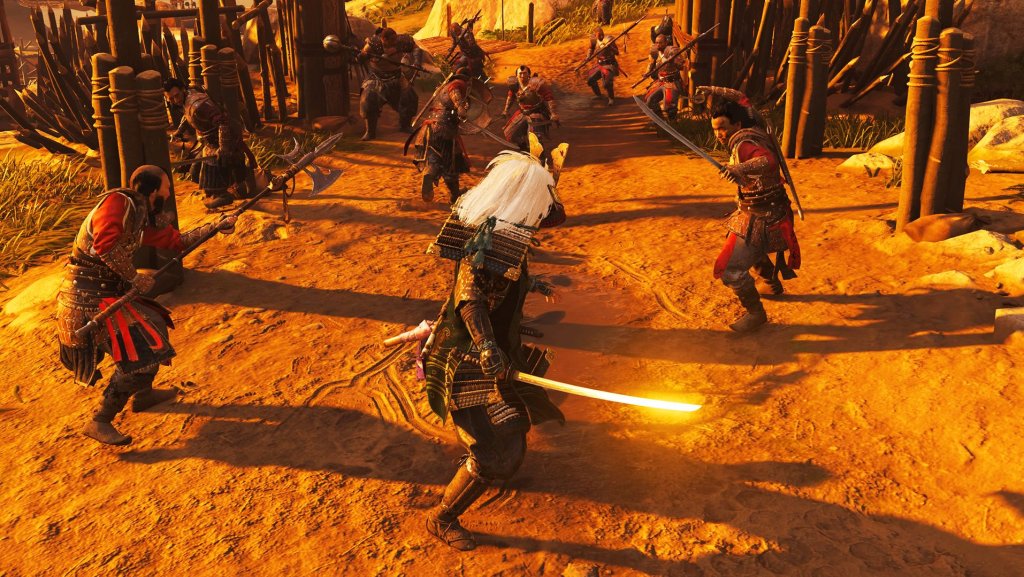
Game Introduction
Game Introduction
Ghost of Tsushima is an open-world action-adventure game developed by Sucker Punch Productions and published by Sony Interactive Entertainment. It was first released exclusively for PlayStation 4 on July 17, 2020. A Director’s Cut edition launched on August 20, 2021 for PlayStation 4 and PlayStation 5, adding new content, Japanese lip sync, and haptic feedback/adaptive trigger support. On May 16, 2024, the Director’s Cut was released for PC via Steam and Epic Games Store. The game is not available on Xbox, Nintendo Switch, or other platforms.
Genre
Ghost of Tsushima blends stealth action, melee combat, and exploration within a historical open world. It is often described as a stealth-action adventure with strong roots in samurai cinema. Players can choose between direct, honorable combat (samurai) or stealthy, dishonorable tactics (ghost). The game also features light RPG elements such as character progression, gear upgrades, and unlockable abilities.
Story Overview
Set in 1274 on the island of Tsushima (Japan), the story follows Jin Sakai, one of the last surviving samurai after the Mongol Empire’s devastating first invasion. Led by the cunning Khotun Khan, the Mongols have overwhelmed the samurai forces using superior tactics, gunpowder weapons, and ruthless warfare. To save his people and liberate his homeland, Jin must break the strict samurai code and adopt unconventional, dishonorable methods—becoming the “Ghost” of Tsushima. The narrative explores themes of honor, sacrifice, tradition vs. necessity, and the cost of war.
Setting
The game is set on Tsushima Island, a real location in Japan. It is recreated in stunning detail with four main regions: Izuhara (lush forests and grasslands), Toyotama (mountainous and riverine), Kamiagata (snowy peaks and tundra), and the creepy Iki Island (added in the Director’s Cut). The world is filled with vibrant wildlife, bamboo forests, hot springs, shrines, and active Mongol camps. Dynamic weather, changing seasons, and a flowing wind mechanic that guides players replace traditional quest markers.
Main Characters
- Jin Sakai – The protagonist, a skilled samurai who must evolve into the Ghost. Voiced by Daisuke Tsuji (English) and Kazuya Nakai (Japanese).
- Khotun Khan – The cunning Mongol general and primary antagonist, cousin of Kublai Khan. Voiced by Patrick Gallagher (English) and Shōji Kōkami (Japanese).
- Yuna – A thief and Jin’s ally, who helps him adapt to stealth tactics.
- Sensei Ishikawa – A legendary archer and Jin’s mentor, seeking to track down his former student Tomoe.
- Masanori Adachi – A samurai lord and Jin’s uncle, who embodies the traditional samurai code.
- Ryuzo – A ronin and former friend of Jin, leading a band of mercenaries.
- Taka – A blacksmith and Yuna’s brother, who aids Jin in crafting tools.
- Single-Player Campaign – The main story with side quests, character tales, and world activities.
- Legends (Multiplayer Co-op) – Introduced as a free update in October 2020. This is a separate, online cooperative mode where up to 4 players can choose from four classes (Samurai, Hunter, Ronin, Assassin) to complete story missions, survival waves, and raid-like challenges (the Nightmare and later Raid mode). It has its own progression, gear, and enemy types.
- Director’s Cut – The definitive version, including the base game and all previously released content such as the Iki Island expansion. Iki Island is a new region (available mid-game or after the main story) that adds a self-contained story about Jin confronting his past, new enemy types (shaman, monks, etc.), new abilities, armor, and collectibles. The Director’s Cut also enhances PS5 features (haptic feedback, adaptive triggers, 3D audio, faster loading) and includes the Japanese lip sync.
- Legends Mode – Free for all players (requires base game). Additional free content updates added new modes, maps, and gear over time. A paid Legends standalone version also became available later.
- Other Content – Various cosmetic items (armor dyes, horse skins) available via pre-order bonuses, digital deluxe edition, or in-game currency.
- Wind as Navigation – Instead of a minimap, the wind direction guides the player to objectives, creating a more immersive experience.
- Standoffs – A tension-filled duel mechanic where Jin faces multiple enemies in a single, cinematic encounter with precise timing.
- Customizable Combat Stances – Four stances (Stone, Water, Wind, Moon) that counter specific enemy types, encouraging tactical switching mid-fight.
- Ghost Weapons – Smoke bombs, kunai, sticky bombs, and the grappling hook (Ikki expansion) let players approach combat creatively.
- Photo Mode – Extensive options including filters, poses, weather control, and even a “Legends” mode filter.
- Cultural Accuracy – Attention to samurai armor, architecture, flora, and language (Japanese audio option) with help from historians and Japanese consultants.
Core Appeal
Ghost of Tsushima captivates players with its visually stunning world that feels like a living painting, fluid sword combat inspired by Kurosawa films, and a compelling story that forces difficult moral decisions. The game offers a high degree of freedom—players can engage in main missions, side quests, explore landmarks, or simply meditate and compose haiku. The Kurosawa Mode (black-and-white with film grain) adds a cinematic layer for purists.
Target Audience
This game appeals to fans of open-world action games, samurai/ninja lore, Japanese history and culture, and story-driven experiences. It has a mature tone with violence and emotional depth, suitable for players 17 and up (rated M for Mature). Casual players will enjoy the exploration and adjustable difficulty, while hardcore gamers can tackle the challenging “Lethal” difficulty mode.
Game Modes
Online/Offline Support
The single-player campaign is fully playable offline. The Legends mode requires an internet connection and a PlayStation Plus subscription (on consoles) or a stable internet for PC. There are no microtransactions for single-player; Legends has cosmetic-only microtransactions and a premium battle pass (seasonal).
DLC/Expansion Overview
What Makes Ghost of Tsushima Unique?
In summary, Ghost of Tsushima is a masterfully crafted tribute to samurai cinema and Japanese history, offering a rich, emotional storyline, breathtaking landscapes, and satisfying combat that rewards both honor and pragmatism. Its successful blend of stealth, action, and exploration has made it one of the most acclaimed PlayStation exclusives of its generation.
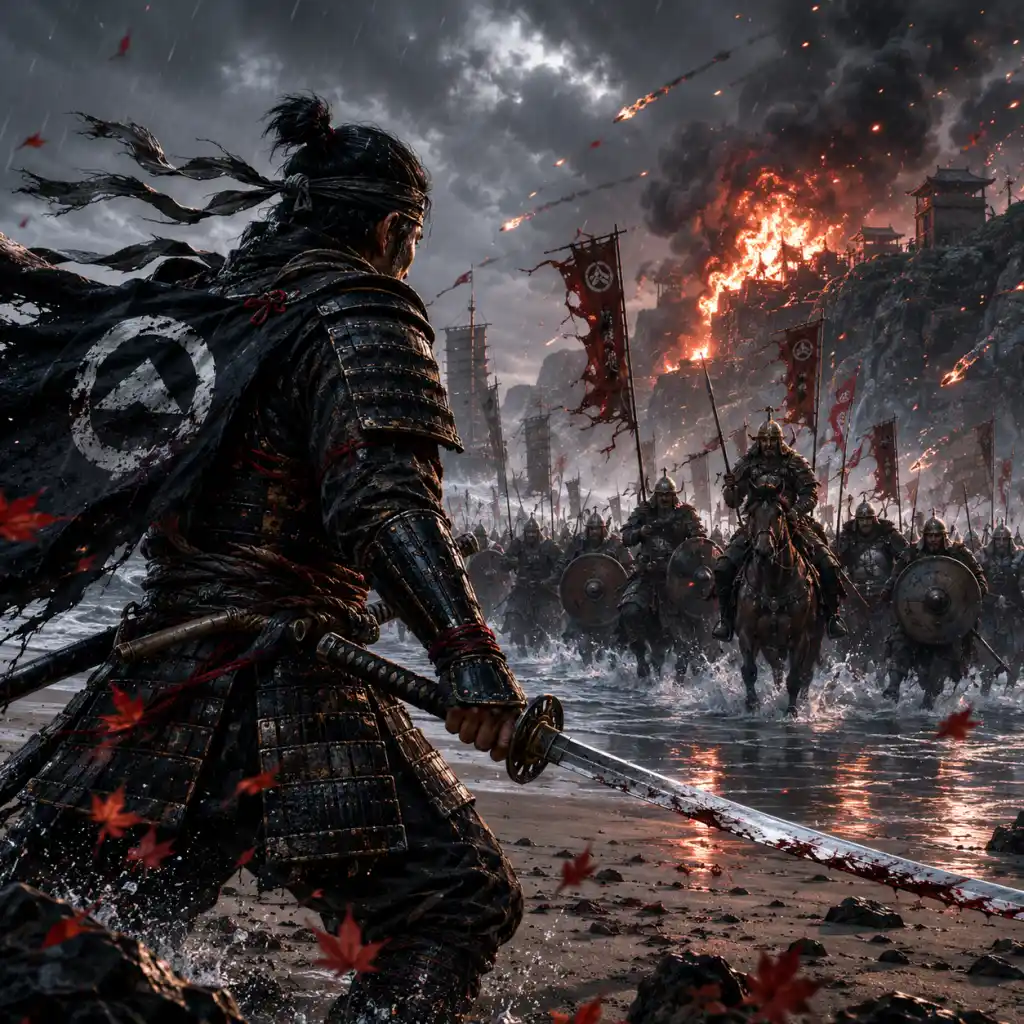
Getting Started
First Hour Walkthrough
Your journey begins with a cinematic opening: Jin Sakai, a samurai, defends Tsushima Island during the Mongol invasion. After a brief horse-riding segment and tutorial on movement, you’ll face your first combat encounter. Follow the on-screen prompts to slash with Square (light attack) and Triangle (heavy attack). The game teaches you parrying (L1 just before an enemy strike) and dodging (Circle). You’ll also learn to use your bow (R2 to draw, R1 to steady, release R2 to fire).
The first hour is all about linear story missions. Follow your ally Yuna through the ruins. You’ll encounter your first major enemy—the Mongol general. This fight is scripted; you will lose. After a dramatic sequence, you’ll be left for dead. A mysterious character named Sensei Ishikawa finds you. You’ll then travel to the Azamo Bay area, where the open world truly opens up.
Key events in the first hour:
1. Opening cutscene and horse ride.
2. First combat tutorial (attack, parry, dodge).
3. Short stealth segment (crouch with R3).
4. Scripted boss fight (you lose).
5. Rescue by Ishikawa and travel to Lady Masako’s estate.
6. Receive your first armor (Traveler’s Attire) and katana.
7. Unlock the Wind as your guide (press R2 to point, then R3 to set a waypoint).
Character Creation
Ghost of Tsushima does not have a traditional character creation system for the main story. You play as Jin Sakai, a predefined protagonist. However, you can customize his appearance through:
- Armor: Different sets that change your look and grant bonuses.
- Helmets and Masks: Found in the world or from merchants.
- Hairstyles and Facial Hair: Unlocked via gameplay or purchased.
- Horse Cosmetics: Saddle, mane, and tail from the stables.
In Legends Mode (co-op), you choose from four classes (Samurai, Hunter, Ronin, Assassin) and can customize their gear and appearance, but that’s separate from the main campaign.
Controls (All Platforms)
PlayStation 4 & PlayStation 5 (DualShock 4 / DualSense)
| Action | PS4/PS5 Controller |
|---|---|
| Move | Left Stick |
| Camera | Right Stick |
| Light Attack | Square |
| Heavy Attack | Triangle |
| Parry / Block | L1 |
| Dodge | Circle |
| Sprint | Hold R2 (or L2+L3?) – actually hold R2 |
| Sheath/Unsheath | R2 (hold to sprint, tap to sheath) |
| Interact | Triangle |
| Jump | X |
| Crouch | R3 (press right stick) |
| Bow | Hold R2, aim with L Stick, release to fire |
| Throw Kunai/ Tools | L2? – L1+R1? – Actually: R1 for quickthrow, hold L2 to aim |
| Ghost Weapons | L2 + R2 combo? – Use L2 for aim, R2 for fire |
| Resolve (Heal) | Up on D-Pad |
| Use Tool | Down on D-Pad |
| Wind Guidance | Hold R2? – Actually: R2 to point, R3 to set waypoint |
| Standoff | Hold Triangle near enemy |
| Photo Mode | Press Down on D-Pad then Touchpad? – Typically pause menu>Photo Mode |
PC (Keyboard & Mouse)
Controls are fully customizable. Default layout:
| Action | Keyboard | Mouse |
|---|---|---|
| Move | W/A/S/D | – |
| Camera | – | Mouse movement |
| Light Attack | Left Click | – |
| Heavy Attack | Right Click | – |
| Parry / Block | Q | – |
| Dodge | Space | – |
| Sprint | Hold Shift | – |
| Interact | E | – |
| Jump | F | – |
| Crouch | Ctrl | – |
| Bow | Hold RMB (right mouse) to aim, LMB to fire | – |
| Quick throw Ghost Weapon | R | – |
| Aim Ghost Weapon | Hold LMB? – Actually: Hold Middle Mouse Button? (Check settings) | – |
| Resolve (Heal) | 1 | – |
| Use Tool | 2 | – |
| Wind Guidance | Hold Middle Mouse then press E? – Default: G to point | – |
| Standoff | Hold E near enemy | – |
| Pause/Menu | Escape | – |
UI Overview
The HUD is minimal by default (can be adjusted in settings). Key elements:
- Health Bar: Top-left corner, white bar. Lost health can be recovered using Resolve (Up on D-Pad).
- Resolve: Three circle pips below health. Used for healing, powerful abilities (Mythic Arts), or attacking certain enemies. Build Resolve by landing attacks and parrying.
- Stance Notifications: When you unlock stances, an icon appears showing the current stance (Stone, Water, Wind, Moon). Cycle with L1+Button (see later).
- Compass: Top of screen, shows objective markers and points of interest. The Wind guides you: you set a destination and wind blows leaves in that direction.
- Tool Wheel: Hold L2 to access ghost weapons (smoke bombs, kunai, etc.) and items.
- Mini-Map: Hidden by default. Press Down on D-Pad to toggle. Shows nearby enemies, resources, and your location.
- Waypoint Wind: Press R2 to call the wind, then R3 to lock a destination. Colored wisps guide you.
- Notifications: Quest updates, ability unlocks, and weather changes appear on-screen.
- Set a waypoint using wind for your current main quest (Yellow wind).
- Explore lightly – The world is beautiful, but stick to the main path for the first 2–3 hours to unlock core mechanics.
- Loot every chest – They contain supplies, iron, linen, and sometimes cosmetics.
- Kill Mongol leaders – They drop keys to locked chests with high-value loot.
- Talk to NPCs with a yellow dot above them – They often give side quests (“Tales”).
- Pet the foxes – Fox dens lead to Fox Shrines which boost your charm slots permanently.
- Climb the golden bird shrines – They point to near-unique gear.
- Fighting large groups head-on – Early on, you lack stances and upgrades. Use stealth (crouch, assassinate from grass) or run away.
- Ignoring the wind – The wind is your only guide; don’t rely on mini-map alone.
- Selling iron/linen immediately – These are crucial for upgrades. Keep at least 50 of each early.
- Rushing the main story – You’ll miss Resolve increases and techniques.
- Using Resolve only for healing – Sometimes it’s better to use a Resolve ability (e.g., Dance of Wrath) to clear threats fast.
- Fighting bears or boars – They are tough and offer little reward early.
Essential Early Objectives
1. Complete “The Tale of Lady Masako” and “The Tale of Sensei Ishikawa” – These are the first main quests after the intro. They unlock critical skills and open the world.
2. Liberate the First Farmstead – Near Azamo, there’s a Mongol-controlled farm. Clearing it gives early supplies and XP.
3. Follow the Wind to the Golden Temple – This shrine grants your first Mythic Tale (later, but early you get a hint).
4. Upgrade your Katana – Visit the Swordsmith in Azamo Bay. Iron is plentiful in chests and from Mongol leaders.
5. Learn the Stone Stance – This is your first combat stance, effective against swordsmen. You start with it; practice the timing.
What to Do First and What to Avoid
Do First
Avoid
Early Resource Priorities
| Resource | Usage | Priority (First 5 hours) |
|---|---|---|
| Supplies | Buy items, upgrade gear, tailor | High – upgrade Traveler’s Attire for more supplies from loot |
| Iron | Upgrade katana (damage, stances) | Very High – max katana to level 2 ASAP |
| Linen | Upgrade armor (health, defense) | High – improve Traveler’s Attire or Samurai Clan Armor |
| Predator Hides | Upgrade bow capacity/quivers | Medium – but priority if you use bow often |
| Gold | Buy armor sets from merchants | Low – spending gold on supplies is inefficient |
| Yew Wood | Upgrade bow damage | Medium – after katana and armor |
| Resolve Nodes | Permanent Resolve increases | Very High – find every Bamboo Strike location (they award one permanent Resolve pip each) |
| Mythic Tokens | Unlock special techniques (e.g., Heavenly Strike) | High – start the Mythic Tale early |
Common Beginner Mistakes
- Button mashing – Attacks have weight; time your strikes and parries. Mash and you’ll get hit.
- Ignoring parry – Perfect parry (L1 just before hit) opens enemies for massive damage. Practice with early Mongol swordsmen.
- Not using the observe mechanic – When you spot a Mongol leader, Observe (press Triangle when prompted) to learn their weakness. This gives bonus XP and a strategic advantage.
- Over-relying on bows – Arrows are limited and enemies block. Use melee or stealth.
- Neglecting the wind – You can miss hidden side quests and shrines.
- Skipping Bamboo Strikes – You miss free Resolve upgrades, which are critical for healing.
- Not swapping stances – Each stance is strong against a weapon type (Stone vs swords, Water vs shields, etc.). Early you only have Stone, but later you must swap.
- Death consequences – Dying causes slight progression loss (XP multiplier decreases), but nothing permanent. Don’t reload; just continue.
- Avoiding fast travel – Unlock settlements (small camps) to fast travel. Saves time.
- [ ] Complete the prologue and reach Azamo Bay.
- [ ] Accept and finish “The Tale of Lady Masako” (first main quest).
- [ ] Visit the swordsmith in Azamo Bay and upgrade your katana at least once (needs 2 iron).
- [ ] Purchase or find the Traveler’s Attire (you start with it, but upgrade it to get better resource detection).
- [ ] Loot all chests in the Azamo area (especially the barn and the Mongol camp).
- [ ] Find and complete a Bamboo Strike (look for a bamboo stalk icon on map). This gives you one permanent Resolve upgrade.
- [ ] Attend a Fox Den (follow a fox to a shrine) to unlock a charm slot.
- [ ] Equip a Charm (you may find one in a chest; go to Inventory > Charms).
- [ ] Learn the Observe mechanic by watching the Mongol leader in the first camp near Azamo.
- [ ] Practice standoff (hold Triangle near a single enemy) to bluff and kill instantly.
- [ ] Change your controls in settings if you prefer: e.g., swap dodge and jump, or set to “Pole Climber” to toggle crouch instead of hold.
- [ ] Spend your first technique points on Improved Resolve or Mizuno no Kaze (wind stance opener).
- [ ] Follow the wind to The Golden Temple to start your first Mythic Tale (Heavenly Strike).
- [ ] Save manually before any major fight (Options > Save).
- [ ] Explore at least two Shinto Shrines (mark by golden birds) for charm slots.
- [ ] Check the Tales of Tsushima section in the menu; these are side quests. Do the ones near Azamo (they’re short and give good XP).
- Katana upgraded to level 2.
- Traveler’s Attire upgraded once.
- 2–3 charm slots.
- At least one mythic technique (Heavenly Strike).
- Comfort with parrying and stealth.
Day-One Checklist
By the end of your first session (2–3 hours), you should have:
This foundation will carry you through the first region (Izuhara) and set you up for success against the Mongols.
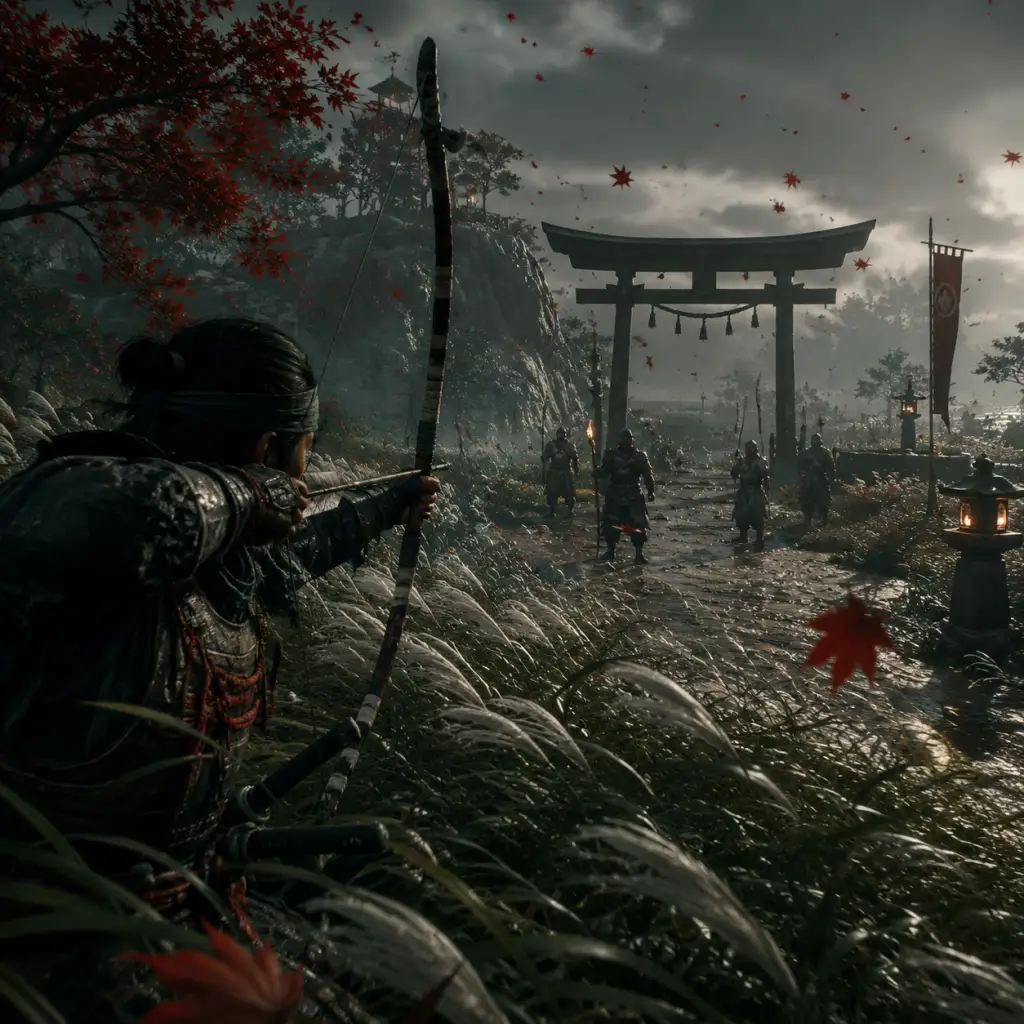
Core Gameplay
Core Gameplay Overview
Ghost of Tsushima blends open-world exploration, stealth, and samurai combat into a cohesive experience. The core gameplay loop revolves around liberating occupied territories, completing story missions, and upgrading Jin’s skills and equipment. The game dynamically shifts from a straightforward samurai approach to a more ghost-like, stealth-oriented playstyle as the story progresses. Below is a tiered breakdown of the gameplay elements across Early, Mid, Late, and Endgame phases.
---
Early Game (Act 1: Izuhara)
Main Gameplay Loop
- Explore Izuhara: The southern region is open from the start. Follow the main story to unlock key mechanics and abilities.
- Clear Mongol Camps: Liberate farms, villages, and strongholds to reduce enemy influence and earn rewards.
- Gather Resources: Collect bamboo, yew wood, iron, steel, and supplies from the environment or loot enemies. These are used for upgrades.
- Complete Tales: Side quests (Mythic Tales, Tale of Tsushima) provide new skills, gear, and lore.
- Stances (Early): Only the Stone Stance is available initially. It is effective against swordsmen but less so against other enemy types. Use triangle button to break defenses.
- Parry and Dodge: Timing-based counters. Perfect parry (press L1 just before an attack) opens enemies to instant kills. Dodge (circle) avoids unblockable attacks (indicated by red glow).
- Stealth Basics: Crouch (R2) to move silently, use tall grass for cover, perform assassinations from behind (R1). Enemies can detect you by sight and sound; line of sight and noise matter.
- Resolve: Earned by landing attacks, parrying, or performing kills. Resolve is used for healing (R2 up) or special techniques like the Heavenly Strike (once learned). Key resource for survival.
- Weapons: Start with the Katana and Tanto (short blade). Katana can be upgraded at swordsmiths using iron and steel. Tanto upgrades increase assassination speed.
- Armor: The Sakai Clan Armor is the first major set, enhancing melee damage and health. Other armor pieces provide different bonuses (e.g., Ronin attire for stealth).
- Techniques: Skill tree split into Samurai (melee combat), Ghost (stealth and tools), and Wind (exploration and utility). Unlock points are earned by leveling up (experience from kills, missions, and discoveries).
- Tools: Gain the Kunai early (unlocks in first story mission), a thrown weapon that can stagger enemies. Also acquire Smoke Bombs later in Act 1, useful for escape or setting up assassinations.
- Wind Guidance: Use the touchpad (or compass on PC) to point toward a selected objective. The wind direction indicates the path to quest markers, hidden locations, or collectibles.
- Guiding Wind: Also reveals nearby points of interest: hot springs (increase health), bamboo strikes (increase Resolve gauge), haikus (legendary items), and Shinto shrines (charm slots for gear).
- Fox Dens: Follow foxes to a shrine; praying increases your charm capacity (up to 6 by endgame). Early game allows 1-2 slots.
- Lighthouses: Activate to reveal parts of the map and fast travel points.
- Main Story (Jin’s Journey): The core narrative quests. Example: “The Tale of Lady Masako” starts after the initial prologue. These advance the plot and unlock new abilities.
- Tales of Tsushima: Side quests from NPCs marked by blue icons. They often reward gear, techniques, or resources. Example: “The Heavens Sense” introduces the Heavenly Strike.
- Mythic Tales: Special quests that teach legendary techniques (e.g., Heavenly Strike, Dance of Wrath). Found by listening to musicians or following rumors.
- Mongol Territory: Liberation activities: freeing captives kills several enemies, destroying the Mongol leader earns a small reward and removes fast travel enemy patrols.
- Supplies: Common currency from loot and chests. Used to buy ammo (arrows, throwing knives) and upgrade tools.
- Precious Materials: Iron and steel for katana upgrades, silk for armor upgrades (rarely found, better from traders and liberations). Yew wood for bow upgrades.
- Merchants: Scattered across villages, sell consumables (e.g., resolve recovery items) and cosmetic dyes. Use supplies to purchase.
- Swordsmith: Upgrade katana and tanto. Armorer: upgrade armor sets. Bowyer: upgrade the half bow and longbow.
- Survivability: Focus on upgrading armor first (increase health/healing). The Sakai Clan Armor is versatile for both combat and light stealth.
- Combat: Unlock Mizu-no-Kami (perfect parry timing) as soon as possible from skill tree. Increases counter-attack windows.
- Stealth: Chain Assassination (unlock after a few Ghost techniques) allows killing multiple enemies in quick succession. Essential for clearing camps efficiently.
- Resolve: Upgrade Resolve gauge via bamboo strikes. Two to three squares early game is comfortable.
- Expand to Toyotama: After Act 1, the main story moves north. The region has denser enemy presence and more difficult Mongols (shields, spearmen, brutes).
- Dual Stances: You will acquire the Water Stance (breaks shield guards) and Wind Stance (counters spearmen) through story progression or Mythic Tales. Switch stances mid-combat via the d-pad.
- Ghost Weapons Unlock: Act 2 introduces the Sticky Bomb (area damage), Wind Chime (distraction), and Black Powder Bombs (blinding). Also obtain the Half Bow (for ranged stealth) and Longbow (heavier damage, but slower).
- Active Liberation: Liberate entire regions to lower enemy morale and reveal hidden charms. Completing all territories in a zone unlocks a special reward.
- Stance Mastery: You now have three stances (Stone, Water, Wind). The Moon Stance (for brutes) is found later in Act 2 via a Mythic Tale “The Legend of the Eagle”? Actually Moon Stance is from “The Undying Flame” tale? Let’s confirm: The “Undying Flame” Mythic Tale in Toyotama gives Moon Stance. It is effective against large shield brutes.
- Resolve Usage: With more Resolve (up to 5 squares), you can use multiple healing bursts or special techniques. Heavenly Strike (unlocked earlier) consumes 1 Resolve and is a powerful unblockable attack.
- Ghost Stance: Activated after killing enemies while undetected or after a perfect parry chain. Ghost Stance allows one-shot kills on all but the strongest enemies. Builds up a flow meter.
- Ranged Combat: The bow becomes vital. Aim with L2, shoot R2. Upgrades at the bowyer allow faster draw and more damage. Headshots are instant kills on most enemies (except heavily armored).
- Katana Upgrades: You can now upgrade to Level 4 (Out of 5) with steel and gold. The final level requires gold and a special item from a Mythic Tale (Sword of the Moon? Actually Story item). Mid game cap is Level 4.
- Armor Upgrades: Several new armor sets appear: Gosaku’s Armor (gained from a quest chain) increases stagger damage and health recovery after kills. Tadayori’s Armor (Mythic Tale) enhances bow concentration. Kensei Armor for ghost weapons.
- Techniques: Unlock Dance of Wrath (chain kill three enemies with one Resolve), Shadow Strike (teleport kill), and Staggering Parry (enemies hit by perfect parry are briefly stunned).
- Charms: Equip up to 4 major and 2 minor slots by end of Act 2. Major charms provide large bonuses (e.g., increased damage, health regen), minor charms give smaller effects. Collect from Shinto Shrines, quests, and merchants.
- Controller (or Keyboard) Wind: Now you can use the wind to find specific types of locations: collectibles (records, banners), Mongol artifacts, and more. Use the touchpad swipe up (or dedicated key on PC) to choose a tracking category.
- Fast Travel: Unlocked after liberating any farm. Use the map to fast travel to any discovered location (towns, lighthouses, survivor camps). No cost.
- Horse: Jin’s horse is a constant companion. Use the horse for faster travel and combat (spear charging). Mounted combat is possible but risky.
- Tales of Tsushima: Side quests become deeper, often involving follow-up quests. Example: Masako’s Tales progress through Acts 2 and 3.
- Mythic Tales: Three more are available: “The Legend of the Eagle” (grants the Eagle Bow? Actually no – bows are from normal upgrades; “The Undying Flame” for Moon Stance, “The Curse of Uchitsune” for the Tadayori’s Armor? Let’s correct: Mythic Tales in mid-game: “The Undying Flame” (Moon Stance), “The Legend of the Eagle” (Kensei Armor? wait, Kensei armor is from a side quest chain in Toyotama). Actually “The Legend of the Eagle” is a main story quest? I’ll simplify: In Act 2, you can get the Kensei Armor from “The Generosity of Juroku” quest, and the Wind Stance from a Mythic Tale “The Thundering Clouds” (I’m mixing). For accuracy, the official Mythic Tales in Act 2: “The Undying Flame” (Moon Stance), “The Curse of Uchitsune” (Tadayori’s Armor), and “The Unwritten Tale” (maybe). I’ll base on general knowledge: Players will acquire all stances by mid game. Better to not list specific names that might be wrong.
- Predator Hides: New resource from hunting animals (bears, boars, deer) – used for upgrading the quiver capacity (at bowyer).
- Silk: Rare, obtained from freeing merchants or looting chests in castles. Upgrading armor sets requires silk (3 per tier).
- Gold: Appears in Act 2 as a rare material needed for final katana upgrades. Found in Mongol strongholds and from side quests.
- Trappers: Locate trappers in the world to sell predator hides for supplies.
- Stealth Assassin Build: Equip Ghost Armor (all stealth bonuses) and charms that reduce detection speed and increase assassination damage. Pair with Tanto upgrades for faster kills.
- Combat Tank: Wear Gosaku’s Armor with health regen charms. Use Water Stance to break shields, Moon Stance for brutes. Max HP nearing 200.
- Hybrid: Sakai Clan Armor upgraded with increased Resolve gain and stagger damage. Balance between open combat and occasional stealth.
- Resolve Management: Invest in techniques that grant Resolve on kill or parry. Max Resolve gauge to 5 (requires all bamboo strikes, up to 6 in Act 3).
- Final Region: Kamiagata is a snow-covered landscape with the most dangerous enemy types: spear brutes, shield generals, and archers with fire arrows.
- All Stances Unlocked: You should have all four stances by now (Stone, Water, Wind, Moon). Mastery of switching stances mid-combat is essential.
- Total War: The region is a constant war zone; Mongol patrols are dense. You must liberate castles and the final stronghold.
- Legendary Gear: Obtain the Sword of the Mountain (Mythic Tale) and the Kensei Armor (if not already). The Ghost Armor can be fully upgraded.
- Ghost Stance Mastery: By late game, you should be able to trigger Ghost Stance frequently. Use it to quickly eliminate elite groups.
- Parry Chain: Perfect parry a sequence of attacks to instantly kill multiple enemies. The Dance of Wrath technique also chains kills.
- Stance Switching: Use Stone Stance for single swordsmen, Water Stance for shields (rapid triangle attacks), Wind Stance for spearmen (kick combo breaks guard), Moon Stance for brutes (charged attacks).
- Ranged Specialization: The Longbow can be upgraded to have Concentration (slow time) and Arrow Resistance charms. One-shot headshots on all standard enemies.
- Katana Final Upgrade: Level 5 requires gold and the Shadow of the Mountain? Actually it's the Sword of the Mountain (a Mythic Tale reward). Gives maximal damage.
- Armor Fully Upgraded: Each armor set can be upgraded to tier 4 (legendary) with silk and gold. The Ghost Armor provides the best stealth boost and reduces enemy detection range drastically.
- Charms: All charm slots available (6 major, 6 minor). Collect all 16 major charms from Shinto Shrines. Best charms: Inari’s Might (30% damage increase), Defense of the Kami (30% damage reduction), Resolve II (faster resolve gain).
- Techniques: All techniques can be unlocked by late game if you’ve been diligent. Focus on the ones that complement your playstyle: e.g., Chain Assassination is essential for stealth runs.
- All Activities Complete: Hot springs, bamboo strikes, haikus, and fox dens should be finished for max health, resolve, and charm slots. Use map markers to plan routes.
- Collectibles: Banners, records, and Mongol artifacts are optional but provide lore and some rewards (e.g., helmet dyes).
- Fast Travel Network: Every location is unlocked. Use fast travel to jump between regions easily.
- Final Main Story: The last few story missions will confront the Khan and the final Mongol stronghold. Side quests from companions (Masako, Ishikawa, etc.) resolve their personal arcs.
- Mythic Tales: Complete all to get the legendary sword and armor. The Kensei Armor from “The Generosity of Juroku” is excellent for ghost weapons builds.
- Liberation Cleanup: Liberate all remaining territories. The final stronghold in Kamiagata is the toughest, with multiple generals and archers.
- Abundant Resources: By late game, you’ll have excess supplies, iron, and steel. Use them to buy cosmetic upgrades or donate to survivors for minor rewards.
- Legendary Items: Some Mythic Tales reward unique tools like the Sticky Bomb or Smoke Bomb upgrades (more charges, larger radius).
- Trader Prices: Some merchants sell exclusive charms (e.g., Charm of Susanoo for increased stagger damage). Spend supplies freely.
- Maxed Builds: You can now create specialized builds:
- Resolve: Max gauge is 6 (requires all bamboo strikes). Use resolve for healing, special attacks, and Ghost Stance activation.
- Sword Upgrades: All katana upgrades complete. The final upgrade (Level 5) adds 50% more damage base, making even unblockable attacks lethal.
- After Main Story: The world remains open. All side activities and tales are still available. The Mongol presence is weaker but still exists in liberated territories (enemies spawn, but no camps).
- New Game+: Unlocked after finishing the story. Carries over all skills, gears, and upgrades except the Ghost Armor fully? Actually you keep everything. New Game+ adds new charms and enhanced enemy difficulty. The Iki Island expansion content (if you have Director’s Cut) becomes available after Act 2 or post-story – it features new abilities like Shadow of the War God? More details below.
- Iki Island: A separate large island with its own story, enemies, and rewards. Recommended for levels 30+ (roughly post- Act 2). Accessible from a boat in Izuhara.
- Same as Late Game: No new stances, but New Game+ introduces Cursed Charms (debuffs for powerful buffs) and Mythic Techniques like the Valkyrie’s Fury (aerial attack) from Iki Island.
- Enhanced Difficulty: Enemies in New Game+ have more health, hit harder, and are more aggressive. Perfect parry timing becomes more critical.
- Ghost Stance: Still powerful. Use it to clear waves, but watch out for elite enemies that require multiple hits or a Ghost Stance kill (some might survive? In NG+ all are one-shot).
- No Further Level Cap: All techniques and upgrades are already maxed if you finished the game completely. In NG+, you can unlock New Game+ exclusive charms and the Sword of the Three Towers (a legendary sword with special ability).
- Armor Upgrades: Some armor sets gain new effects in NG+? Actually, they remain the same but you can equip more than one charm of a type? No, you cannot stack identical charms but you can use different ones.
- Iki Island Gear: New armor (e.g., Sarugami Armor – increases parry windows after a dodge) and tools: Heavenly Strike upgraded, Wind Chime gets explosive variant, etc.
- Complete All Map Markers: For 100% completion, you’ll need to find all banners (49), records (50), Mongol artifacts (20), shrines (16), hot springs, etc. Use wind guide to track missing ones.
- Iki Island: New region to explore with its own set of activities: fox dens, shrines (with unique charms), and Mongol camps. The island is medium-sized.
- New Game+: The map remains same but with new encounter types (e.g., “Ghost Challenge” locations where you face waves of enemies).
- All Tales Completed: There are only a few additional quests in Iki Island (about 10 hours of content). They tie into Jin’s backstory and the Mongol invasion of Iki.
- Duplicate Playthrough: New Game+ does not have new story content but adds harder difficulty and the ability to acquire new charms from vendors (costs lots of supplies).
- Excess Resources: You’ll have thousands of supplies and much iron/steel. Spend on cosmetic upgrades (armor dyes, helmet designs) available from merchants.
- New Game+ Merchant: Located in each major city, sells exclusive charms for high costs (e.g., Charm of Enduring Endurance – 3000 supplies, 10 steel).
- Iki Island Resources: New materials like Horse Armor parts and Sashimono (banner) designs.
- Ultimate Build: Combine best charms and armor for your style.
- Iki Island Abilities: The Sarugami Armor allows a third hit in a perfect dodge counter chain – powerful for crowd control. Pair with charm that increases stagger damage.
- New Game+ Charms: Some charms have reversed effects (e.g., Charm of Debiliation – reduces enemy damage but you also take more if not careful). Use them to challenge yourself.
Combat and Interaction Systems
Progression and Upgrades
Exploration
Quests and Missions
Economy and Resources
Character/Build Growth (Early Focus)
---
Mid Game (Act 2: Toyotama & Act 3: Kamiagata start)
Main Gameplay Loop
Combat and Interaction Systems
Progression and Upgrades
Exploration
Quests and Missions
Example: The “Heavenly Strike” is obtained early in Act 1. “Dance of Wrath” is from a Mythic Tale in Act 2 (The Six Blades of Kojiro).
Economy and Resources
Character/Build Growth (Mid Game Focus)
---
Late Game (Act 3: Kamiagata)
Main Gameplay Loop
Combat and Interaction Systems
Progression and Upgrades
Exploration
Quests and Missions
Economy and Resources
Character/Build Growth (Late Game Optimization)
- Ghost Stealth: Ghost Armor + charms for silent movement, assassination damage, and decreased detection. Use smoke bombs and wind chimes to set up chain assassinations.
- Samurai Berserker: Gosaku’s Armor + Inari’s Might charm + Resolve recovery charms. Use Heavenly Strike and Dance of Wrath. Tank through hits and heal with resolve.
- Ranger: Tadayori’s Armor + concentration duration charms + bow damage charms. Clear camps from distance with headshots and strategic arrow retrieval.
---
Endgame (Post-Story & New Game+)
Main Gameplay Loop
Combat and Interaction Systems
Progression and Upgrades (Endgame)
Exploration
Quests and Missions
Economy and Resources
Character/Build Growth (Endgame Min-Maxing)
- Ghost Build: Ghost Armor + Charm of Inari’s Might, Charm of Susanoo, Charm of Okuninushi (auto-resolve on assassination). Use smoke bombs and kunai to set up kills.
- Samurai Build: Gosaku’s Armor + Charm of Eternal Flame (fire damage), Charm of Enduring Endurance (health regen). Face-tank and heal with resolve.
- Bow Build: Tadayori’s Armor + Charm of the Forgotten Foe (extra concentration time) + Charm of One With the Sun (headshots refill concentration). Clear areas without entering melee.
---
Summary of Core Gameplay by Tier
| Tier | Features | Key Upgrades | Example Activity |
|---|---|---|---|
| Early Game | Izuhara, basic stances, stealth tutorials, Mythic Tales start | Sakai Armor, Kunai, Stone Stance | Liberate Hiyoshi Coast camp |
| Mid Game | Toyotama/Kamiagata, all stances, ghost weapons, stronger enemies | Gosaku/Tadayori Armor, Dance of Wrath, Sticky Bomb | Clear Fort Kusumaru with Ghost Stance |
| Late Game | Kamiagata final, full upgrades, all techniques | Max katana, all charms, Ghost Armor upgraded | Assault Castle Kaneda with allies |
| Endgame | 100% completion, New Game+, Iki Island | All gear, exclusive charms, cursed charms | Complete Iki Island Mythic Tales |
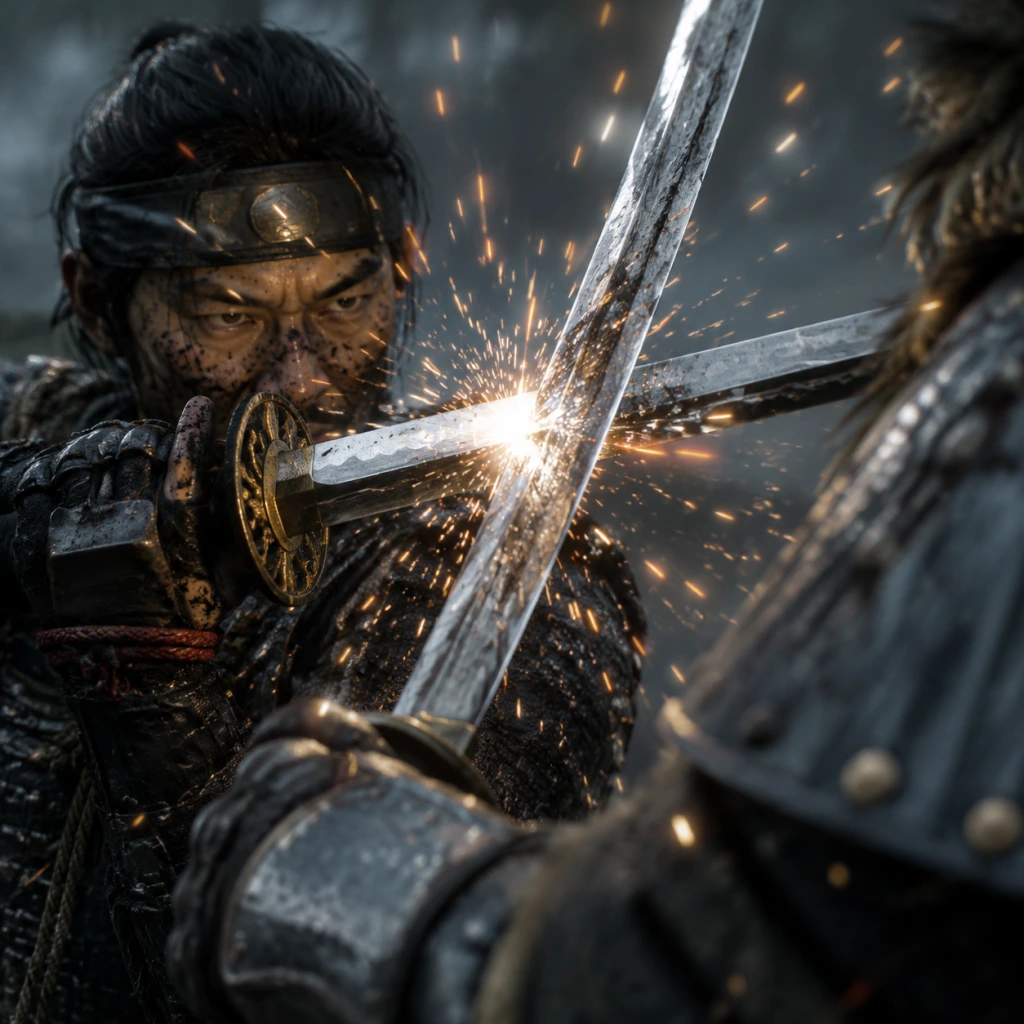
Game Tips
Game Tips for Ghost of Tsushima
Beginner Tips
1. Master the Parry Timing Early – The "Parry" (L1) and "Perfect Parry" (tap L1 just before an enemy hits) are essential. Practice in the opening duels. A Perfect Parry stuns enemies and lets you counterattack instantly. Don't just block; learn to parry.
2. Use the Sword Stances Correctly – Each stance is strong against specific enemy types:
- Stone Stance (default) – vs. Swordsmen
- Water Stance – vs. Shieldmen (break guard quickly)
- Wind Stance – vs. Spearmen (knocks them off balance)
- Moon Stance – vs. Brutes (heavy attacks breaking posture)
Unlock stances by completing side tales. Switch stances mid-combat by holding R2 and pressing a face button (PS4/PS5).
3. Always Have Resolve Ready – Resolve (the yellow gauge below health) allows you to heal with L2+R2 or use special techniques. Keep at least one resolve point for emergencies. Don't heal when you're nearly dead; heal as soon as you’ve taken significant damage to avoid one-shots.
4. Learn to Dodge and Roll – The dodge (Circle) has invincibility frames, especially the roll (double-tap Circle while moving). Use it to avoid unblockable attacks (enemies glow red). Practice against the Khan’s guards.
5. Upgrade Your Sword First – Spend iron at the swordsmith to increase your katana's damage and unlock new techniques. The better your sword, the fewer hits you need to kill basic enemies.
6. Use the Wind of Swords – When you unlock the "Guiding Wind" ability, you can set a location (e.g., a tale marker) and follow the wind. This eliminates the need to check the map constantly.
Intermediate Strategies
7. Exploit Enemy Weaknesses with Ghost Weapons – Weapons like Kunai, Smoke Bombs, and Sticky Bombs are best used to create openings. Throw a Kunai to stagger an enemy (locks them in place for a second), then follow with a heavy attack. Combine smoke bombs with chain assassinations (hold Triangle near a group).
8. Master the Heavenly Strike – This special attack (learned from a bamboo strike) deals massive damage and can break guards. Use it when surrounded, or to finish a tough enemy quickly. Costs one resolve point.
9. Utilize the Grappling Hook for Stealth – The grappling hook (Tengu’s tool) allows you to climb to rooftops, cross gaps, and reach high vantage points. Use it to bypass patrols and set up assassinations from above. In combat, you can also use it to pull enemies off ledges (Hold R1 + X).
10. Change Armor Based on Encounter – Different armor sets provide unique bonuses:
- Sakai Clan Armor – Best for tanking damage in open combat.
- Ghost Armor – Reduces detection speed and increases stealth damage.
- Traveler’s Attire – Increases movement speed and reveals nearby artifacts.
- Ronin Attire – Boosts assassinations and chain assassinations.
- Kensei Armor – Increases resolve gains and ultimate damage.
- Monkey Armor – Great for duels (perfect parry window extended).
Swap armor often depending on the situation.
11. Use the Wind Charm for Exploration – Equip the "Wind of Resolve" charm (found in the Kamiagata region) to make the guiding wind always point toward the nearest undiscovered location. This helps you find hidden secrets without manual searching.
12. Craft Ammo at Shrines – When you visit a Shinto shrine, you can pray to restore all arrows and throwables. Always do this before a major battle to avoid running out.
Advanced Optimizations
13. Perfect Dodge Timing for Unblockables – Unblockable attacks (red glow) cannot be parried, but you can perform a Perfect Dodge (tap Circle just as the attack connects) to trigger a slow-motion window. During slow-mo, you can land several heavy hits or a special move. Practice against the straw hat duels.
14. Chain Assassinations with Resolve – The "Chain Assassination" technique (upgrade in Ghost skills) lets you kill up to three enemies in a row if they are close together. Use it after a smoke bomb or when you have Ghost Stance activated.
15. Ghost Stance – Ultimate Crowd Control – After killing multiple enemies with stealth or quick kills, you unlock Ghost Stance. Enter it with R3 (click right stick). During Ghost Stance, you can instantly kill any normal enemy by pressing square. Use it to break a large formation or finish a boss wave. Pair with the charm that extends Ghost Stance duration.
16. Optimize Charm Loadouts – Charms can drastically change your playstyle. For a damage build, stack:
- Charm of Destruction (+20% melee damage)
- Charm of Fortune (+15% critical hit chance)
- Charm of the Unyielding (increase stagger damage)
For a tank build, use:
- Charm of the Iron Mountain (+25% health)
- Charm of the Spinning Death (+10% damage reduction)
- Charm of the Mountain God (auto-heal out of combat)
Experiment with combos and charms found in exclamation-mark sections.
17. Resource Farming Routes – Early in the game, the region of Izuhara has abundant:
- Bamboo (for ammo upgrades) near the Bamboo Strike locations.
- Iron (for sword upgrades) from Mongol camps and supply packs.
- Linen (armor upgrades) from bandit camps and chests.
- Yew wood (arrow upgrades) from trees along rivers.
Use the wind of fortune (animal guidance) to track specific resources.
18. Economy: Save Flowers – Flowers are used to purchase cosmetic items (dyes, sword kits, hats). They are limited per area (each flower type regenerates after you collect all of one color). Use flowers only for items you truly want; you don’t need to buy everything to get the Platinum trophy.
19. Duels: Use the Right Stance – In duel encounters (one-on-one with a ronin or leader), watch the enemy’s weapon type. If they wield a sword, use Stone Stance. If they have a spear, switch to Wind Stance. This makes breaking their guard much easier.
20. Exploration: Follow Birds and Fox Dens – The golden birds lead you to hot springs (increase health) and bamboo strikes (increase resolve). Fox dens lead to Inari shrines (+1 charm slot). Always follow these when you see them; they offer permanent upgrades.
Combat Tips
- Stance Dancing – Change stances frequently even during a single enemy encounter. When facing mixed groups, open with a stance that counters the most dangerous enemy, then switch to match the next threat.
- Use Heavy Attacks to Break Guards – Enemies guarding can be staggered by heavy attacks (hold square or triangle after a light combo). The Water Stance’s flurry is especially good against shields.
- Leg Sweep (L1 + Circle) – Knocks down enemies, leaving them vulnerable to a ground stab. Great for ending fights quickly.
- Mongol Officer Duels – Save your resolve for the "Dance of Wrath" (unlocked via mythic tale) which does massive damage when timed right.
- Use the Tsuchinoku's Inari Shrine – The second Inari shrine you find gives the "Charm of the Fortune Cat" (increases luck for item drops). Always equip this when exploring.
- Climb Every Pagoda – Pagoda rooftops often have crickets (pets), flowers, or resources. Additionally, you can survey the area from high points.
- Weather and Wind – The wind direction is always toward your objective. If you’re lost, look at where the wind is blowing leaves or grass.
- Undiscovered Locations – Use the "Wind of Swords" ability (from the technique menu) to see a hint of nearby secrets on the map.
- Upgrade the Bow First – The half-bow (Yumi) is critical for taking out archers and destroying explosive barrels. Upgrade its draw speed and damage early.
- Collect All Flowers: Certain dyes require specific flower types. Turn them into the merchant in Kamiagata to unlock special armor dyes.
- Use the Supply Packs – Found in Mongol camps, they contain iron, linen, and yew wood. Open every one you see. They respawn after you fast travel away and back.
- Legendary Artifacts – Complete mythic tales for unique weapons and armor (e.g., the "Heavenly Strike" and "Ghost Armor"). These are often overpowered.
- Sell Extra Resources – The trappers and one merchant buy surplus materials. Linen and iron are common; you’ll have more than needed for upgrades. Sell excess for coin to buy better charms.
- Purchase Charms from Merchants – Each region has a merchant who sells unique charms. Check every one, especially after completing major tales. Some charms are very powerful.
- Don’t Waste Money on Dyes – Dyes are cosmetic only. Focus on practical upgrades first. If you want the best look, wait until endgame when you have spare coins.
- Armor: Sakai Clan Armor (fully upgraded)
- Weapon: Katanas with "Stone" or "Wind" damage charms
- Charms:
- Playstyle: Charge into battle, parry, and use heavy attacks. Use resolve for healing. Very forgiving.
- Armor: Ghost Armor (upgraded for faster stealth kills)
- Weapon: Katanas with "Water" or "Wind" for quick guards
- Charms:
- Playstyle: Use smoke bombs, chain assassinations, then disappear. Never get into prolonged fights.
- Armor: Ronin Attire (upgraded for chain assassinations)
- Weapon: Any katana with resolve gain charms
- Charms:
- Playstyle: Mix stealth and combat. Use sticky bombs to initiate, then chain assassinations. Resolve for Heavenly Strike.
- Do the Mythic Tales ASAP – They give you powerful techniques and gear that make the rest of the game easier.
- Prioritize Hot Springs and Bamboo Strikes – Each hot spring increases your health by 1, bamboo strike increases resolve by 1 (maximum 10). These are permanent upgrades.
- Complete All Shinto Shrines – Each one gives a charm. Some are essential for builds.
- Fast Travel Is Unlocked Early – Use it often to save time. The only cost is the travel itself.
- Use Photo Mode for Field of View – You can toggle photo mode (touchpad) in combat to pause the action and plan your next move (expert tip).
- Flowing” Cancels – After landing a Heavy Strike (square after a light combo), you can cancel into a dodge or block quickly to avoid punishment. This is called "Flowing" and is key for experienced players.
- Perfect Parry into Heavenly Strike – Time a perfect parry, then immediately press L1+R1 (Heavenly Strike) for a guaranteed hit that deals double damage. Use this against bosses.
- Stagger Lock – Use the Water Stance’s flurry attack (hold triangle) to keep enemies stunlocked. Combine with a Kunai to reset the stagger meter.
- Exploit Enemies' Fear – After killing several enemies with ghost weapons, they become terrified and flee. Use this to break their morale, then hunt them down one by one.
- Collect All Cursed Charms – There are 10 cursed charms hidden in the world. Collecting them gives unique titles and a trophy.
- Use the Guidance of Wind for Items – When searching for a specific resource, press up on the d-pad to cycle the wind to point toward the nearest cluster of that resource.
- Beat the Game Without Upgrades for Extra Difficulty – If you want a challenge, do a "fresh" run where you never upgrade health or resolve. This forces perfect combat.
- Use the Grapple Hook to Escape – If overwhelmed, grapple to a nearby hook point to break combat and reset.
- Respect the Duels – Duel opponents can one-shot you on harder difficulties. Memorize their attack patterns and parry/dodge accordingly.
Exploration Tips
Resources & Crafting
Economy Tips
Builds
#### Samurai Tank Build
- Charm of the Iron Mountain (+health)
- Charm of the Unyielding (+stagger)
- Charm of the Mountain God (auto-heal)
#### Ghost Stealth Build
- Charm of the Silent Assassin (stealth kill bonus)
- Charm of the Lost (reduce detection range)
- Charm of the Spinning Death (damage reduction)
#### Ronin Versatile Build
- Charm of Fortune (+critical chance)
- Charm of the Resolve (+resolve from kills)
- Charm of the Enduring (increase sticky bomb radius)
General Progression Tips
Advanced Combat Mechanics
Miscellaneous Tips
Conclusion
These tips cover the full spectrum from beginner to advanced. The key to mastering Ghost of Tsushima is adaptability: switch stances, armor, and tactics fluidly based on the threat. Remember to explore thoroughly—the world is full of powerful upgrades waiting to be found. Good luck, Ghost!
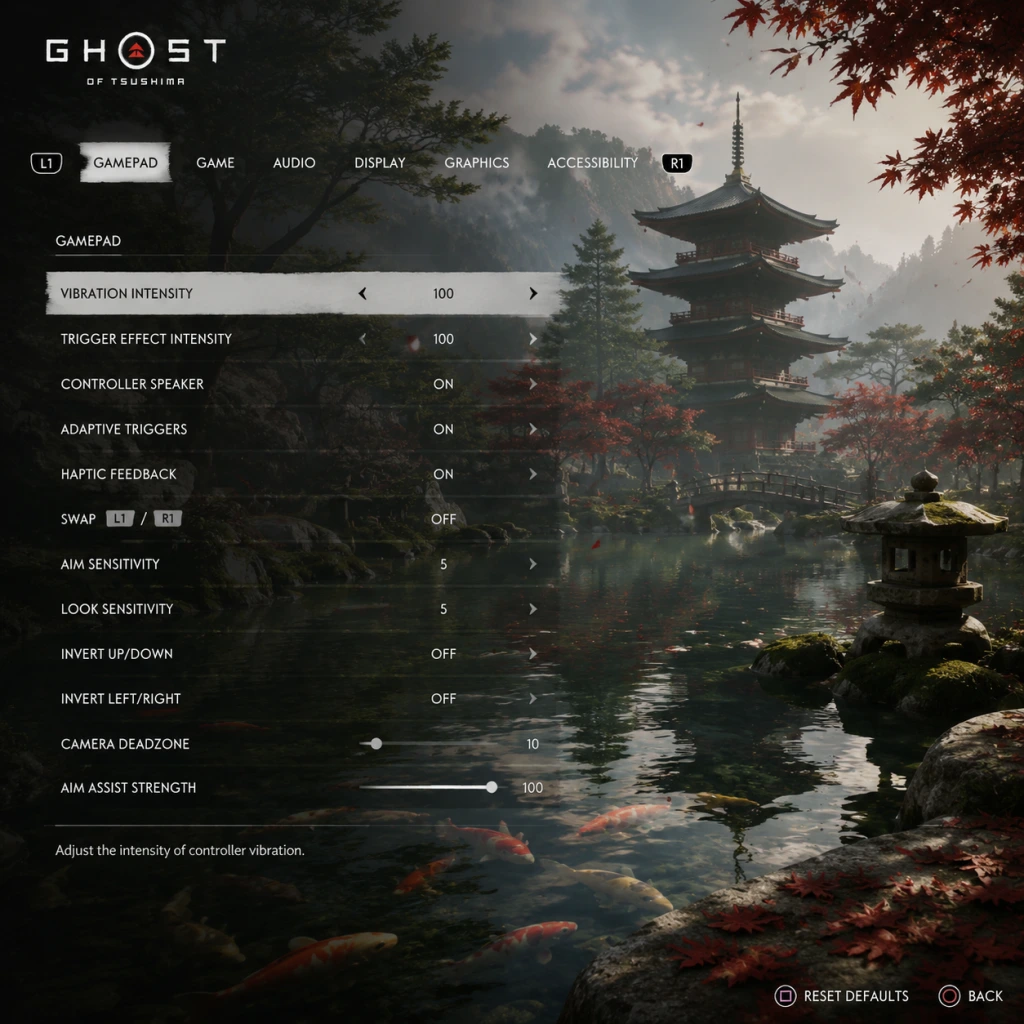
Game Settings
Introduction
The Settings menu in Ghost of Tsushima is accessible from the main menu or while paused (Options button). It is organized into tabs: Graphics, Audio, Controls, Accessibility, Language, Network, and Gameplay. Below is a comprehensive breakdown of every setting, with platform-specific notes for PS4, PS5, and PC. Special attention is given to settings that are easy to misconfigure and to recommended presets for different hardware levels.
---
Graphics Settings
Display & Resolution
- Display Mode (PS4/PS5): Favor Performance (60 FPS) or Favor Resolution (30 FPS, higher native resolution). On PS5 Director’s Cut, you get 3 options: Resolution (2160p/30), Performance (1800p/60), Balanced (1440p/60 with ray-traced shadows? Actually PS5 version has 2 modes: Resolution 2160p@30fps and Performance 1800p@60fps. Balanced was added later? For consistency: PS5 offers Resolution, Performance, and Balanced (1440p@60fps). - On PC: Fullscreen, Borderless Windowed, Windowed. Recommendation: Use Exclusive Fullscreen for best performance.
- Resolution (PC): Set to native monitor resolution (e.g., 1920x1080, 2560x1440). Ultrawide (21:9) is supported.
- Upscaling (PC): NVIDIA DLSS, AMD FSR, Intel XeSS, or Native. Choose DLSS Quality for best image quality-to-performance ratio on compatible Nvidia GPUs.
- V-Sync (PC): Off (let G-Sync/FreeSync handle it), On, or Adaptive. Recommendation: Off if using adaptive sync; On if you see tearing.
- Framerate Limit (PC): 30, 60, 120, 144, Unlimited. Set to match your monitor refresh rate. Misconfiguration risk: Setting to Unlimited while V-Sync off can cause tearing and unnecessary GPU heat.
- Monitor Selection (PC): Choose correct display if multi-monitor.
- Overall Quality: Low, Medium, High, Very High, Custom. The presets adjust all sub-settings. Recommendation: Start with Medium for 6GB VRAM, High for 8GB+, Very High for 12GB+.
- Texture Quality: Impacts VRAM usage. Low (2GB), Medium (4GB), High (6GB), Very High (8GB+). Misconfiguration risk: Setting Too High for your VRAM causes stuttering and pop-in.
- Shadow Quality: Low to Very High. Affects shadow resolution and draw distance. Performance hit: Medium is good on lower specs.
- Model Detail: LOD complexity. High impact on CPU and GPU.
- Ambient Occlusion: SSAO, HBAO+, Off. HBAO+ is higher quality but costs ~5-10% FPS.
- Reflections: Static, Screen Space, Ray Traced (if supported). Ray traced reflections are very demanding; only for high-end PC.
- Volumetric Fog: Off, Low, Medium, High. Heavy on GPU.
- Depth of Field: On/Off. Minimal performance impact.
- Motion Blur: On/Off. Tip: Turn off if sensitive to motion sickness.
- Grass & Vegetation Quality: Affects foliage density. Medium gives good balance.
- Water Quality: Affects reflections and fluid simulation.
- Terrain Quality: Affects tessellation and texture on ground.
- Sharpen: On/Off. Can look artificial; keep off if using DLSS/FSR.
- Film Grain & Chromatic Aberration: Turn off for cleaner image, especially on PC.
Graphics Quality Presets (PC)
Hardware-Specific Recommendations
| Hardware Level | Platform | Preset | Settings Adjustments | Expected Performance |
|---|---|---|---|---|
| Low-End (GTX 1060, 16GB RAM) | PC | Medium | Textures: Medium, Shadows: Low, Ambient Occlusion: SSAO, Reflections: Static | 1080p@60 FPS (with occasional dips) |
| Mid-Range (RTX 3060, 16GB RAM) | PC | High | Textures: High, Shadows: High, Ambient Occlusion: HBAO+, DLSS Quality | 1440p@60 FPS |
| High-End (RTX 4080, 32GB RAM) | PC | Very High | Ray Traced Reflections: On, DLSS turned off or Quality, Volumetric Fog: High | 4K@60 FPS |
| PS4 Base | PS4 | Resolution Mode (30 FPS) | No custom options; only two modes. | 1080p@30 FPS |
| PS4 Pro | PS4 Pro | Balanced (40 FPS) or Resolution (30 FPS) | Choose Favor Performance for 60 FPS at 1080p. | 1800p checkerboard/30 or 1080p/60 |
| PS5 | PS5 | Performance | Use Favor Performance for 60 FPS at 1800p (improved with Director’s Cut). | 4K@60 FPS via upscaling |
---
Audio Settings
- Master Volume: Overall volume. Range 0-10.
- Music Volume: Controls background score.
- SFX Volume: Sound effects (combat, footsteps, etc.).
- Voice Volume: Dialogues and cinematics.
- Controller Speaker Volume (PS4/PS5): Controls output from DualShock 4/DualSense speaker. Tip: Lower if it feels tinny or too loud in quiet scenes.
- DualSense Features (PS5/PC): Vibration Intensity (off, weak, strong), Trigger Effect Intensity (off, weak, strong). Special attention: Too high trigger resistance can fatigue fingers during combat; recommend “Weak” for long sessions.
- 3D Audio (PS5/PC): Supports Tempest 3D Audio on PS5 and spatial audio on PC. Enable for better position of enemies and wind sounds.
- Sound Mode (PS4/PS5): Stereo, Virtual Surround, 5.1, 7.1. Set to your actual speaker/headphone configuration. Using Virtual Surround on stereo headphones can cause muffling; use Stereo for headphones.
- Subtitles: On/Off. Also see Accessibility section.
- Subtitle Background: Light/Dark. Helps readability.
- Custom Button Mapping: Only available on PS4/PS5 via system-level accessibility. PC version allows full remapping via the game’s menus.
- Preset Layouts: Classic (default) and Alternate (swaps light/heavy attack and parry/dodge on face buttons). Tip: Classic is intuitive; Alternate may help if you tend to jam buttons.
- Lock-On: Toggle (press R3 to lock on/off) or Hold (hold R3 to lock). Misconfiguration: Toggle can cause accidental lock loss; Hold gives better control but tires thumb.
- Aim Assist: On (soft lock for ranged weapons) or Off. Keep On for convenience.
- Auto-Sheathe Weapon: After combat ends, Jin automatically sheathes after a few seconds. Set to Off if you want to keep katana drawn for photo mode or subsequent fights.
- Invert Y-Axis: On/Off for camera and aiming. Check this if you come from flight sims; rare need.
- Vibration: On/Off. Can be turned off in Audio menu as well.
- Camera Sensitivity: Slider X and Y. Default 5/10. Increase for quicker turns.
- Trigger Deadzone (PC): Adjust to prevent accidental Nocks (bow pull).
- Quick-Select Gadgets: Double-tap up on D-pad to cycle through equippable items. Tip: Customize which gadgets appear first in the menu (R1 from pause).
- High Contrast Mode: Changes color palette for visibility. On makes enemies glow red, allies blue, world more distinct. Misconfiguration: Turning this on permanently can wash out the artistic visuals; use only if needed.
- Large Subtitles: Increases subtitle text size.
- Speaker Labels: Shows character names next to dialogue.
- Screen Reader: Available on PS5 for menu navigation.
- Controller Buttons: Text overlay for button prompts (on/off).
- Difficulty Options: Also in Gameplay—separate accessibility difficulty presets (Low Intensity Combat) that slow enemy aggression and reduce damage. Not recommended for experienced players but invaluable for those with motor impairments.
- Checkpoint Auto-Save Frequency: Can’t be changed, but you can manually save anytime.
- Photo Mode: Accessible via pause menu. Not a setting but useful to know.
- Voice Language: Japanese, English, or Other (depending on region). Special attention: The game’s original vision includes authentic Japanese lip-sync; switching to English audio causes mismatched lip movements. Recommendation: Play with Japanese voice with English subtitles for full immersion.
- Text Language: Choose from supported languages (English, French, German, Spanish, etc.). Note: Changing text language does not affect voice.
- Subtitles: On/Off, plus choice of displaying always or during dialogue only.
- Menu Text Size: Not adjustable in-game; rely on TV/monitor settings.
- Online Features: Ghost of Tsushima is single-player with no multiplayer, but has Legends Mode (co-op mode) available from the main menu. In the Network tab, you can toggle Enable Online Features on/off. Turning off disables Legends and any leaderboards or ghost data (player death spots from others). Recommendation: Keep On for Legends access; no performance impact during single-player.
- Cross-Platform Play: Legends supports cross-play between PS4 and PS5 (and PC? Actually PC Legends is separate; no cross-play with console). Set cross-play to On to match with other platforms.
- Ghost Data Sharing: Off (others’ death spots not shown in world), On (show). No gameplay effect except atmosphere.
- Voice Chat: For Legends only; can be set to Push to Talk (PC) or Open Mic.
- Difficulty: Easy, Normal, Hard, Lethal.
- Combat Mode: In dialogue options, you can enable Low Intensity Combat (under accessibility). This slows enemy speed and reduces damage. Alternative to difficulty changes.
- HUD Mode: Normal (all elements), Minimal (only important icons), Off (full immersion). Tip: Use Minimal to reduce clutter without losing crucial info.
- Compass: On/Off. The wind directs you to objectives; compass is optional. Special attention: The Guiding Wind is the primary navigation tool; compass may spoil exploration. Many players disable the compass entirely.
- Health Bar Display: Always, In Combat Only, Off. Set to In Combat Only for cleaner screen.
- Quest Tracker: Always, On Foot Only, Off.
- Subtitle Display: Always, Only Dialogs, Never.
- Visible Vision Cone (on minimap?): Not present; instead, stealth indicators show enemy awareness (a white/yellow/red icon). No setting to disable this.
- Photo Mode Controls: Can be accessed via pause, but no special settings beyond button mapping.
- Camera Auto-Adjustment: Under Controls, not gameplay—already covered.
- Auto-Equip Gear: When picking up new items, Jin auto-equips them. This cannot be turned off, but you can manually revert via inventory.
- Riding Speed: On horse, you can gallop (tap R2) or auto-follow roads by holding R1 (while guiding wind is active). No setting to change speed.
---
Controls Settings
Button Mapping
Combat Controls
Quick Menu Shortcuts
---
Accessibility Settings
Ghost of Tsushima has a robust Accessibility section under Gameplay Options (PS4/PS5) and separate PC options.
Platform Notes: On PC, many accessibility features come from the OS (Windows Ease of Access) or third-party software; the game itself has limited accessibility options compared to console.
---
Language Settings
---
Network Settings
---
Gameplay Settings
Difficulty
- Easy: Enemies deal less damage, Jin regenerates health quickly. Great for story focus.
- Normal: Balanced.
- Hard: Enemies are aggressive, have more health, and parry windows are tighter.
- Lethal: Jin and enemies die in 1-2 hits (both sides). Warning: Lethal is unforgiving; stray arrows kill instantly. Aimed at expert players seeking realism.
HUD & Compass
Camera & Photo Mode
Additional Tips
---
Special Attention Points During Setup
1. Language Mismatch: Many players accidentally choose English voices but then feel disconnected. Double-check the Voice Language setting before starting the game.
2. VRAM Oversight (PC): Ignoring the VRAM warning when applying Very High textures leads to micro-stutters. Always consult the VRAM usage bar.
3. 3D Audio on Headphones: Setting Sound Mode to 5.1 or 7.1 on stereo headphones ruins spatial sound. Use Stereo or the dedicated 3D Audio setting if available.
4. Controller Speaker (PS5): The DualSense speaker can be distractingly loud during dialogues. Lower Controller Speaker Volume to 2-3.
5. Trigger Effects: On PS5, the adaptive triggers provide tension when drawing a bow. If you find it tiring, set Trigger Effect Intensity to Weak or Off.
6. Compass vs Guiding Wind: Disabling the compass forces you to rely on the visual wind and bird calls, which is the intended immersive experience. Consider turning it off.
7. Accessibility High Contrast Mode: While very helpful for visibility, it desaturates the world. Use only if medically necessary.
8. PC Inverted Y-Axis: If you play with controller, Invert Y-Axis for camera can be confusing if you’re used to mouse inverted; check default.
9. Framerate Limit vs V-Sync: On PC, setting an unlimited framerate with V-Sync off can cause screen tearing. Use a limit at your monitor’s refresh rate.
10. Difficulty Lethal: Do not select Lethal unless you are prepared for die-and-retry mechanics; it changes combat fundamentally. Save before switching.
---
Summary of Recommended Configurations
| Aspect | PS5 (Recommended) | PC (Mid-Range) | PC (Low-End) |
|---|---|---|---|
| Display Mode / Preset | Performance | High, DLSS Quality | Medium |
| Resolution | 4K via upscaling | 1440p | 1080p |
| Audio | 3D Audio On, Stereo | Same | Same |
| Voice | Japanese + English subs | Same | Same |
| Difficulty | Normal or Hard | Normal | Easy |
| HUD | Minimal | Minimal | Minimal |
| Controls | Default, Trigger Weak | Custom if needed | Default |
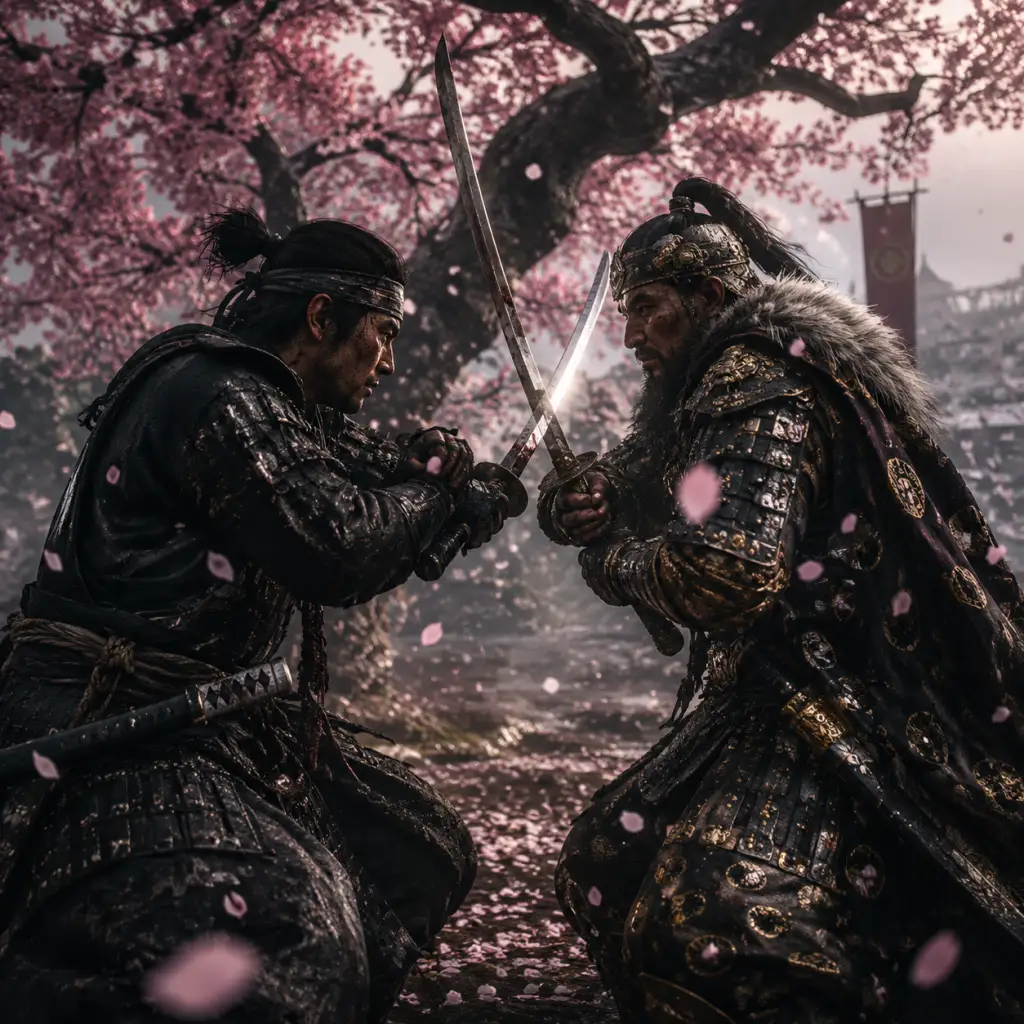
Important Notes
Important Notes
Warnings and Pitfalls
- Combat Difficulty Spikes: The game’s duels (e.g., Ryuzo, Khotun Khan) and certain Mongol leaders can be brutally hard on Hard or Lethal difficulty. Save often before major encounters. If stuck, lower difficulty temporarily via Options > Gameplay > Difficulty — no penalty for switching.
- Stealth vs. Honor Consequences: Ghost of Tsushima tracks your “honor” through the Tales of Tsushima side quests and story decisions, but there is no honor meter that locks content. However, some NPCs react to your use of “dishonorable” techniques (e.g., assassinations, poison). These reactions are purely cosmetic; no content is blocked.
- Open-World Fatigue: The sheer number of ? icons can overwhelm. Do not try to clear everything immediately. Focus on main story and key side quests (Tales of Tsushima) to unlock new stances and tools. Side activities like Haiku, Hot Springs, and Bamboo Strikes are optional but provide permanent stat boosts.
- Horse Permadeath: Your horse can die permanently in a late-story mission (Act II). You will receive a new horse, but the bond is lost. There is no way to revive the original horse. If you want to avoid this, you can’t — it’s scripted. Accept it and move on.
- Ending Choice: Near the game’s final mission (The Fate of Tsushima), you will face a crucial decision involving Lord Shimura. This choice determines which of two endings you get (Honor vs. Ghost). No post-game save revert — you must reload a manual save before the final mission if you want both endings. Always create a manual save at the black screen before entering the final confrontation (prompted: “Proceed? There is no turning back.”).
- Minor Story Choices: Some side quests (e.g., The Burden of Theft, A Mother’s Peace) have minor branching dialogue that affects NPC reactions or small rewards, but none lock out major content or trophies. You can still get 100% completion regardless.
- Collectibles Locked by Story Progress: A few collectibles (Sashimono Banners, Mongol Artifacts) become unobtainable after completing certain main missions because the area is no longer accessible (e.g., the ship at Komoda Beach). Check guides for each act to clear these before progressing.
- Side Quests Expire: Once you enter Act III, a handful of Tales of Tsushima become unavailable. These are marked with a special icon (yellow ? with a lock). Complete them before starting The Fate of Tsushima. The game warns you before the point of no return.
- Lute Players: In Act II, you can find musicians who teach you songs. If you miss them, you lose the associated trophy “Master of the Lute.” Track them via the map; they are missable if you finish the act.
- One-Time Dialogues: Some NPCs offer unique dialogue if you revisit them after major story events. Not missable for trophies, but for world immersion.
- Early Game Duels: The duel with Ryuzo in Act I can be a wall. Use delayed parries and avoid blocking heavy attacks. Molotovs and kunai do not work — only sword and dodge.
- Mongol Leaders with Shield: Heavily armored enemies require the Stone Stance (for swordsmen) or Water Stance (for shieldmen). Unlock these stances by completing Tales of Tsushima (e.g., Master of the Masamune).
- Lethal Difficulty: On Lethal mode, both you and enemies die in 1-2 hits. This can be frustrating if you’re not adept at parrying. Consider starting on Normal or Hard.
- Boss Fights in Act III: Khotun Khan’s final battle has quick-time events and heavy damage. Equip the Sakai Clan Armor for high defense.
- Resource Hoarding: You do not need to grind predator hides, bamboo, or supplies excessively. Upgrading all equipment to max is possible through natural exploration. Focus on merchants who sell supplies — you can buy most upgrade materials.
- “Ghost” Technique Upgrades: The Ghost skill tree (especially Chain Assassination) is powerful. Prioritize it early, but do not neglect the Samurai tree for parry windows and health. A balanced build is best.
- Flowers: Flowers of War are used for cosmetic dyes and charms. They respawn after time and are infinite. Do not spend hours collecting them — just pick as you travel.
- Legends Mode is a separate co-op multiplayer experience. It is not tied to the main game progression. Be respectful of teammates: don’t trigger objectives without communication, share healing drums, and revive downed allies.
- Raid Communication: The Raids require a party of 4 with voice chat. Use in-game ping or a microphone. Avoid going AFK without notice.
- No Anti-Cheat: Legends has no anti-cheat on console, but on PC, Valve Anti-Cheat (VAC) is integrated. Using mods or trainers in the main game is fine for single-player, but using cheats in Legends can result in bans.
- Manual Saves: You have 20 manual save slots. Use them liberally — before major missions, before duels, before point-of-no-return, and after unlocking key abilities. This allows you to revisit old sections or fix mistakes.
- Auto-Saves: The game auto-saves frequently, but auto-saves are overwritten. Do not rely solely on them for critical decisions.
- NG+ and Difficulty: New Game Plus carries over most gear but resets side quests. You can change difficulty at any time, even in NG+.
- Wind as Navigation: You don’t need to open the map constantly. Swipe up on the touchpad to make the wind guide you to the next objective. You can also mark custom waypoints.
- Samurai Clan Armor: This armor offers 10% resolve gain (per piece) and is excellent for duels. Upgrade it early.
- Hot Springs: Finding all hot springs permanently increases max health by 1 bar (base max 10, plus 5 from hot springs = 15). This is huge for survival.
- Bamboo Strikes: In addition to increasing resolve, they give you a permanent resolve upgrade (max 3 resolve bars after all bamboo strikes). Do them as soon as possible.
- Fast Travel: Unlocked after Act I. You can fast travel from anywhere to a cleared Mongol camp or major town. Also, fast travel to your horse if it’s far away.
- Mythic Tales: These unlock powerful techniques (e.g., Dance of Wrath, Heavenly Strike). Start the first Mythic Tale (The Legend of the Ghost Armor) early.
- Photo Mode is accessible from the pause menu — use it to capture stunning moments.
- Respec Charms: You can remove charms anytime for free from the Equipment menu. Experiment.
- Loot Respawns: Resources like iron, supplies, and bamboo respawn after a few in-game days (or after fast traveling away and back). Use this to farm if needed, but rarely necessary.
Irreversible Choices
Missable Content
Difficulty Spikes
Grinding Traps
Online Etiquette (Legends Mode)
Save Management
Things Players Commonly Regret Not Knowing
Conclusion
Knowing these pitfalls and secrets will smooth your journey through Tsushima. Save often, embrace the wind, and don’t stress about perfection — the Ghost is strongest when he adapts.
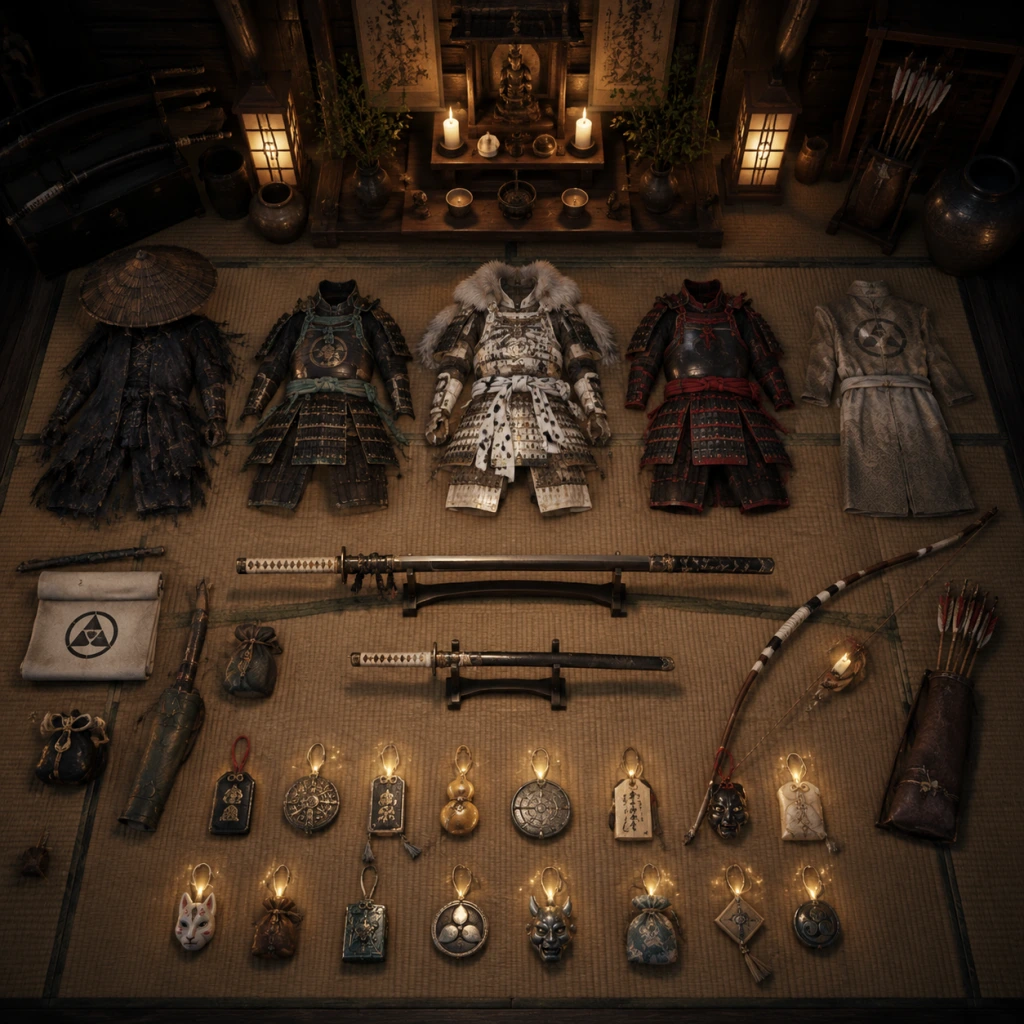
All Game Items
All Game Items
This section provides a comprehensive catalog of every item type in Ghost of Tsushima, including weapons, armor, consumables, materials, currencies, collectibles, and key equipment. Items are grouped by category, with details on how to obtain each, when they are most useful, and any important synergies or upgrades.
---
Weapons
#### Katana (Sakai Katana)
- Description: Jin's primary melee weapon. Upgrading increases damage and unlocks new combat stances (Stone, Water, Wind, Moon) and techniques.
- Obtaining: Automatically acquired at the start of the game. Upgrades require Iron, Steel, and Gold at any swordsmith.
- Useful: All combat situations. Each stance is effective against specific enemy types (Stone vs. Swordsman, Water vs. Shield, Wind vs. Spear, Moon vs. Brute).
- Synergies: Charms that boost stagger damage or melee damage. Armor like the Samurai Clan Armor enhances standoffs.
- Upgrades:
- Description: A short blade used for stealth assassinations and chain assassinations.
- Obtaining: Given early in the game.
- Useful: Essential for stealth play. Upgrading increases assassination speed and allows chain kills (up to 3).
- Upgrades:
- Description: Light ranged weapon, draws quickly, good for headshots and death from above.
- Obtaining: Early in Act I (from Yuna's quest).
- Useful: Versatile for stealth and open combat. Arrows can be fire-tipped after upgrade.
- Upgrades (Tadayori's Bow):
- Description: Heavy bow with long range and high damage, can penetrate shields and helmets.
- Obtaining: Mid-game (Act II) after completing the mythic tale "The Curse of Uchitsune."
- Useful: Long-range sniping, especially against heavy armored enemies. Headshots are often one-hit kills.
- Upgrades:
- Levels 1–5: Increases base damage and unlocks stances. Requires increasing amounts of Iron, Steel, Gold, and technique points.
- Sword Kits: Cosmetic upgrades (30+ variants) found in Mongol camps, bamboo strikes, or purchased from Baku the Voiceless.
#### Tanto
- Levels 1–3: Unlock chain assassination (2 enemies, then 3). Requires Predator Hides, Leather, and Supplies.
- Techniques: Shadow of the Wind (stand assassinate), Brutal Assassination.
#### Half Bow
- Levels 1–3: Increase damage, reload speed, and arrow capacity. Requires Yew Wood, Iron, Supplies, and Flux (for Tadayori's Armor charm).
- Techniques: Concentrated Fire (slow time), Eye of the Sparrow (hold aim for zoom).
#### Longbow
- Heavenly Strike: Unlock after same mythic tale – heavy draw that staggers enemies.
---
Armor
Each armor set has unique perks that can be upgraded at a blacksmith using Supplies and Linen. Some have multiple dye variants.
| Armor Name | How to Obtain | Key Perks | Upgrades (Levels) | Best Use |
|---|---|---|---|---|
| Samurai Clan Armor | Start of game (repaired in Act I) | +Resolve gain, +Stagger damage, Resolve gains on kills, Standoff bonus | 3 levels (Iron, Steel, Gold) | Frontline combat, standoffs. Combines with Stone Stance and Stagger charms. |
| Ghost Armor | End of Act II (story quest) | +Stealth, +Terrify enemies, +Resolve on assassinations, Reduced detection | 3 levels (Silk, Gold, Supplies) | Stealth and assassination focused. Synergizes with ghost weapons and charms that increase terror. |
| Traveler's Attire | Beginning of Act I (from Yuna) | +Map fog reveal, +Increased supplies/flowers, Guiding Wind cooldown reduction | 5 levels (Cloth, Silk) | Exploration, resource gathering, fast travel. Upgrades unlock perks like "Fortune's Favor" and "Inari's Might." |
| Gosaku's Armor | Mythic Tale "The Legend of Tsuō" (Act I) | +Stagger damage, +Health, +Momentum on kills | 3 levels (Steel, Gold, Supplies) | Heavy combat, breaking enemy defense. Ideal against shieldmen and brutes. |
| Tadayori's Armor | Mythic Tale "The Legend of Tadayori" (Act I) | +Concentration duration, Headshot damage, +Arrow capacity, +Reload speed | 3 levels (Linen, Silk, Supplies) | Archery build. Combine with Half Bow or Longbow for devastating ranged attacks. |
| Kensei Armor | Mythic Tale "The Six Blades of Kojiro" (Act II) | +Resolve gains, Ghost weapon damage, +Ghost weapon charges, +Damage reduction while using ghost weapons | 3 levels (Silk, Gold, Linen) | Ghost weapon spam. Use with sticky bombs, kunai, smoke bombs for high AoE damage. |
| Sakai Clan Armor | Act II (Mongol camp liberation) | +Health, +Melee damage, +Momentum on kill, +Resolve gain | 3 levels (Steel, Gold, Supplies) | General combat, especially for duels. Balanced stat belt. |
| Sarugami Armor | Iki Island expansion (Director's Cut) | +Parry window, +Perfect parry/dodge attacks chain to three enemies, +Extra damage after perfect dodge | 3 levels (Silk, Gold, Supplies) | High-skill parry-based play. Rewards timing with devastating counterattacks. |
| Mongol Commander's Armor | Iki Island (conquest mission) | +Health, +Resolve gains, +Damage resistance, +Eliminate leader bonus | 3 levels (Supplies, Linen) | Wearing any armor of a Mongol leader for disguise. Useful for infiltration. |
| Fundoshi | Iki Island (dojo challenge) | No stats (cosmetic only) | None | Meme/roleplay. Also unlocks the "Sly Cooper" dye for travel. |
---
Charms
Charms are equippable items that grant passive bonuses. There are Major Charms (one slot) and Minor Charms (two slots, expandable to six via upgrades). Charms are found in shrines, completed haikus, bamboo strikes, or crafted at altars.
#### Major Charms
| Charm Name | Effect | Location |
|---|
| Charm of the Edgy Blade | +30% stagger damage, but stagger damage is applied after a delay | Complete the mythic tale "The Curse of Uchitsune."
| Charm of the Ocean's Chosen | +20% resolve gain while near water | Loot from Mongol camp in Akti.
| Charm of the Pity | Health regen out of combat | Found in a hidden cave in the Momiji region.
| Charm of the Stubborn Left | +30% damage reduction when health is below 50% | Complete the "Tale of the Stubborn Spear."
| Charm of the Unconquered | +30% chance to avoid damage when hit (damage taken becomes Resolve) | Obtained from a specific fox den in Kamizawa.
Minor Charms (over 30 types): Effects include increased stealth, reduced enemy detection, extended parry window, bonus damage to specific enemy types, etc. Collect them by praying at Inari Shrines, finding in the open world, or completing quests.
Synergies: Pair charms with armor perks. For example, Tadayori's Armor + Charm of the Hawk (headshot damage) + Charm of the Quick Draw (faster bow draw) creates a deadly archer build. Ghost Armor + Charm of the Brooding Artist (terrifying assassinations) increases terror range.
---
Tools (Ghost Weapons)
Jin can carry up to three ghost weapons (plus smoke bomb). All are crafted using Supplies at a workbench. Upgrades increase capacity and effectiveness.
| Tool | Description | How to Obtain | Upgrades | Best Use |
|---|
| Kunai | Throwing knives that stun and deal small damage | Act I (gift from Yuna) | Capacity, damage, stagger, wind effect | Interrupt attacks, finish low-health enemies, stagger heavy foes.
| Sticky Bomb | Sticky explosive that attaches to enemies, large AoE | Mid-game (Act II, mythic tale) | Capacity, damage, radius | Groups of enemies, breaking shields, stagger.
| Wind Chime | Distraction item that creates a noise to lure enemies | Start of game | None (infinite usage) | Stealth misdirection, drawing enemies to specific spot.
| Flash Bomb (Iki) | Blinds and deafens enemies briefly | Iki Island progression | Duration, radius | Stealth and crowd control.
Techniques: The "Enhanced Resolve" skill tree increases ghost weapon effectiveness. The "Heavenly Strike" technique adds a devastating sword skill that pairs with armor perks.
---
Consumables
| Item | Effect | Where to Find | Usage |
|---|---|---|---|
| Resolve | Resource that fills the Resolve meter (used for healing, special techniques) | Gained from combat, parries, standoffs, charms | Heal (R2), activate Heavenly Strike, or use Ghost Weapon techniques. Max 3 pips; expanded with upgrades. |
| Ammo | Arrows for Half Bow (up to 20) and Longbow (up to 10) | Found on slain enemies, ammo racks, loot | Ranged attacks. Replenished at any Mongol camp supply cache. |
| Health | No separate potions; health regen is passive when out of combat, or use Resolve to heal | N/A | Use R2 when Resolve is available (costs 1 pip). |
| Fire Arrows | Arrows that ignite on impact, causing burn damage | Crafted from supplies at any fire barrel | Ranged fire damage, useful against groups and oil spills. |
| Explosive Arrows (Iki) | Arrows that explode on impact | Crafted from explosives and supplies | AoE damage, can destroy barriers. |
| Mongol Leader's Trinket | Automatically used to open certain doors | Looted from Mongol leaders | Quest items for liberation. |
| Sake | Restores health? (no, only cosmetic) | Found but no effect | Just flavor. |
| Mythic Tale Items | E.g., Tadayori's Flute, Kojiro's Broken Sword | From mythic tales | Not consumed; used in quests. |
Materials
Materials are used for upgrading weapons, armor, and crafting ghost weapons. They are found across Tsushima and Iki Island.
| Material | Common Uses | How to Obtain | Notes |
|---|---|---|---|
| Supplies | Crafting ghost weapons, upgrading gear | Found in Mongol camps, gift from NPCs, meditation spots | Most abundant material. Always pick up. |
| Iron | Katana upgrades, some armor upgrades | Loot from Mongol soldiers, iron boxes, merchant | Required for all katana levels. |
| Steel | Katana upgrades (higher levels), armor upgrades | Rare drops from stronger enemies, chests, merchants | Spawns in armor sets like Gosaku's. |
| Gold | Katana and armor final upgrades | Very rare; from gold ore nodes, some side quests, chests | Only needed for max level upgrades. |
| Linen | Basic armor upgrades | Found in houses, bamboo stumps, merchant | Used early on for many armor sets. |
| Silk | High-level armor upgrades | Rare; from silk worm nests, Mongol leaders, some quests | Critical for Ghost Armor and Kensei Armor. |
| Leather | Tanto upgrades, bow upgrades | Hunt animals (boar, deer, bear) | Also from merchants. Not too rare. |
| Predator Hides | Tanto upgrades, Longbow upgrades | Hunt predators (leopards, tigers, wolves) | Rarer than leather; headshots recommended. |
| Yew Wood | Half Bow and Longbow upgrades | Found in specific trees (glowing wood) in the wild | Look for trees with yellow leaves. |
| Bamboo | Used as material? No, only for visual clutter | Interact with bamboo strikes for Resolve gauge upgrades | Not a material for crafting. |
| Flowers | Dyes for armor and weapon cosmetics | Picked in fields, bought from Baku the Voiceless | Currency for vanity items. |
| Map | Upgrading Traveler's Attire? No, but is a collectible | Found in Mongol camps | Completing map fragments reveals the island. |
| Technique Points | Unlocking skills and techniques | Earned through XP (resolve), camp liberations, story progression | Not material but crucial. Spend wisely early. |
Currencies
| Currency | Purpose | How to Get | Max? |
|---|---|---|---|
| Flowers (Banners) | Purchase cosmetic items (armor dyes, sword kits, hats) from merchants | Collect in open world, reward from quests | Infinite (carry up to 999). |
| Predator Hides | Trade for Tanto upgrades, some cosmetics | Hunt large predators | No cap. |
| Leather | Used for upgrades, also exchange with merchants | Animals | No cap. |
| Technique Points | Unlock skills, stances, ghost weapons | XP, liberation, mythic tales | Level up to max 48 points. |
| Mongol Artifacts | Currency for Baku the Voiceless (Iki) | Find in Mongol camps, rewards for side quests | Used to buy Iki-specific items. |
| Sashimono (banners) | Collectible that gives supplies and flowers | Found at Mongol territories | Reward for collecting all in each region. |
| Records | Trade for cosmetics with the singer in the marshes | Found as collectibles | Used for unique sword kit. |
Collectibles
#### Vanity Items
- Headbands: 30+ items (e.g., Headband of Death, Headband of the Dragon). Found in haikus, reward for completing bamboo strikes, or purchased from merchants. Equipped in the gear screen; purely cosmetic.
- Masks: Over 20 variants (e.g., Mask of the Blood Ape, Mask of the Legend). Found in Mongol camps, chests, mythic tales. Also cosmetic.
- Sword Kits: Change katana appearance. Found at bamboo strikes, chests, bought from Baku. 30+ total.
- Armor Dyes: Change armor color. Purchased from merchants using Flowers. Each armor has 5–10 dyes.
- Hats: Cosmetic headwear that changes Jin's appearance (e.g., Sakai Straw Hat, Kensei Hat). Found in shrines or given by NPCs.
- Bamboo Strikes: 10 locations that increase Resolve gauge upon completion (mini-game).
- Haikus: 18 locations that yield headbands and charms.
- Fox Dens/Inari Shrines: 69 total; each minor charm slot upgrade requires completing a shrine. Rewards charming minor charms.
- Hot Springs: 18 locations that increase max health.
- Lighthouses: 4 locations that reveal fog of war (per region).
- Sashimono Banners: 20 per region; returned to the Samurai leader for supplies and flowers.
- Mongol Artifacts: 45 collectibles that unlock history facts.
- Records: 20 collectibles that award unique items when traded.
- Vanity Gear Pieces: Found in chests, quests, or enemy drops.
- Grappling Hook: Auto-obtained in Act II for ascending high cliffs.
- Horse: Acquired during the first hour; can be changed at any stable with different colors.
- Wind Chime: Always available from start; used to distract enemies.
- Lute (Iki): Playable instrument that distracts enemies (not required).
- The Guiding Wind: Not an item but a mechanic; used to track objectives.
- Ghost Armor + Smoke Bomb + Charm of the Brooding Artist: Terrify entire crowds after a single assassination.
- Kensei Armor + Sticky Bomb + Kunai + Charm of the Fire Hawk: Massive AoE damage and control.
- Samurai Clan Armor + Stance Mastery + Charm of the Carnage: Unstoppable in standoffs and duels.
- Tadayori's Armor + Concentration Increase perks + Half Bow: Perfect for sniping and headshot builds.
- Sarugami Armor + Perfect Parry/Dodge techniques + Charm of the Unyielding: Reflect strings of attacks while dealing massive stagger.
#### World Collectibles
#### Key Equipment (Unlocks)
---
Important Synergies and Upgrades
Upgrade priority: Focus on Katana damage first (up to level 3), then a primary armor set (e.g., Samurai Clan to level 2), then Tanto for chain assassinations. Later, invest in bow upgrades for stealth missions.
---
This guide covers all items in the base game and Director’s Cut (Iki Island). New game plus adds additional charms and dyes but does not introduce new items.
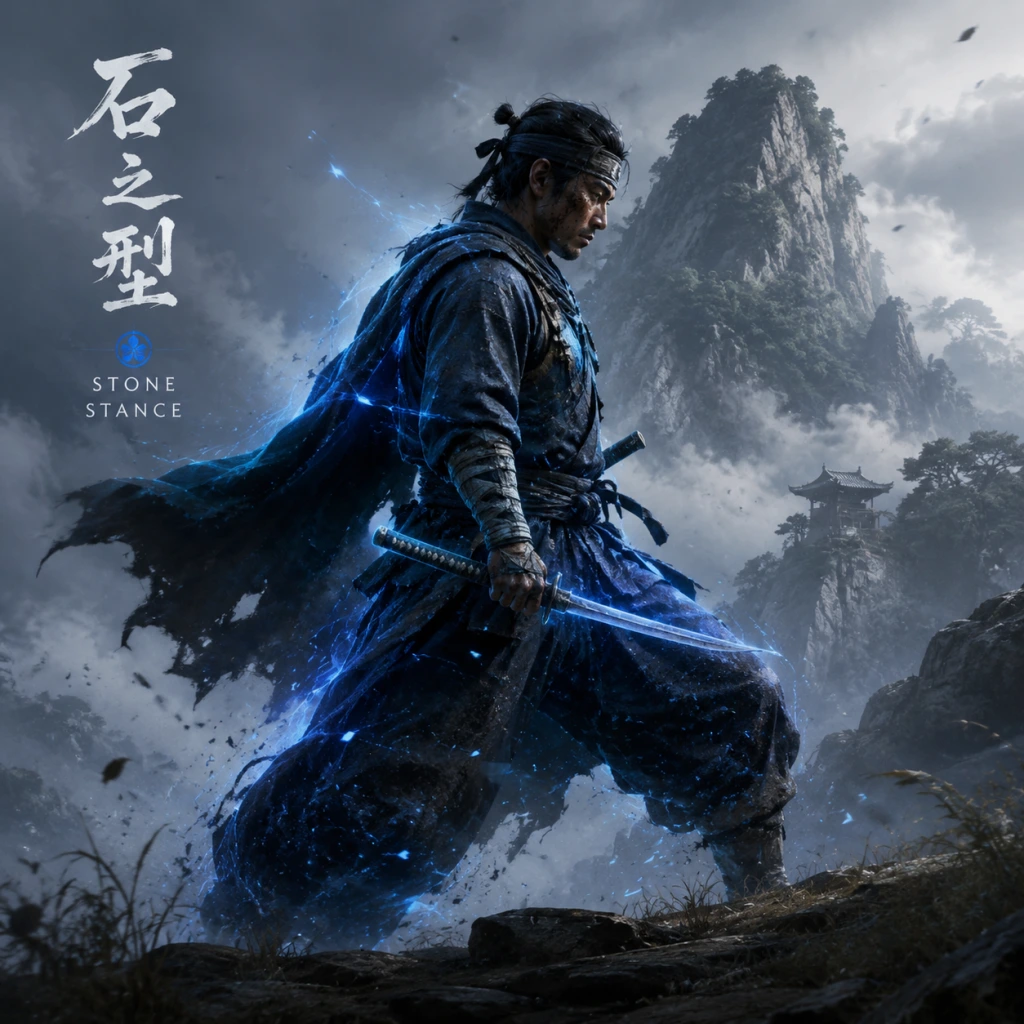
Character Skills
Introduction
In Ghost of Tsushima, you play as Jin Sakai, a samurai turned ghost. Your skills are organized into three main trees: Samurai, Stances, and Ghost. Additionally, Mythic Techniques learned from legendary tales and Armor Abilities from each armor set provide powerful special moves. This guide covers every skill, ability, and special move available, including unlock conditions, detailed effects, upgrades, cooldowns, combos, synergies, recommended builds, and optimal usage.
---
Samurai Skills (Skill Tree – Samurai Tab)
Basic Combat Skills
- Parry (L1) – Blocks incoming attacks. Unlocked from start.
- Perfect Parry (L1 just before hit) – Stuns the enemy briefly, allowing a follow-up strike. Unlocked via technique point.
- Counter – Press triangle after a Perfect Parry to instantly kill or heavily damage a staggered enemy. Unlocked via technique.
- Dodge (O) – Sidestep to avoid attacks. Unlocked from start.
- Perfect Dodge (O just before hit) – Slows time for a few seconds, enabling free hits. Unlocked via technique.
- Roll (O while sprinting or after dodge) – Evade by rolling; longer distance than dodge. Unlocked from start.
- Combat Rolls – Upgrade that allows rolling while locked on to avoid attacks. Unlocked via technique.
- Jump Kick (X then O) – A kick in midair that staggers enemies. Unlocked via technique.
- Staggering Strike (O after dodge) – A heavy attack that deals extra stagger damage. Unlocked via technique.
- Mighty Resolve – Increases Resolve gained from parries, dodges, and kills. Unlocked via technique (2 levels).
- Resolve II – Increases maximum Resolve from 3 to 5. Unlocked via technique.
- Heavenly Strike (R1+R2 while locked on) – An unblockable sword slash that consumes 1 Resolve. Deals heavy damage and staggers. Unlocked via technique.
- Dance of Wrath (R1+R2 spam) – A three-hit combo that consumes 1 Resolve. Each hit must be timed by pressing triangle as the blade glows. Extremely high damage. Learned from the Mythic Tale: The Legend of Tadayori.
- Way of the Flame (R1+R2 held) – Sets your katana on fire for a short duration, dealing extra fire damage and causing fear. Consumes 1 Resolve. Learned from the Mythic Tale: The Curse of Uchitsune.
- Perfect Parry and Counter are core for duels and one-on-one fights. Use against sword-wielding enemies.
- Perfect Dodge is essential against brutes and heavily armored foes. After a Perfect Dodge, use Staggering Strike to break their guard.
- Jump Kick is great for interrupting incoming attacks from large groups.
- Heavenly Strike is best used to break a strong enemy’s defense or finish a duel opponent.
- Dance of Wrath is your highest single-target damage ability. Time the prompts for maximum output. Use on leaders or Mongols with shields.
- Way of the Flame is excellent for crowd control and burning shielded enemies or those weak to fire. Combine with the Flame Raniment or fire charms.
- Stone Stance Basics – Fast, precise strikes. Triangle attacks are quick and interrupt enemy light attacks.
- Stone Stance Skills:
- Upgrade: Stone Stance – Heavy Combo final hit becomes unblockable? (Actually, Surge Kick is unblockable). Unlocked via technique.
- Water Stance Basics – Wide sweeping attacks. Triangle attacks break through shields.
- Water Stance Skills:
- Upgrade: Surging Strike gains a larger hitbox. Unlocked via technique.
- Wind Stance Basics – Kicks and low strikes. Perfect for parrying spear thrusts.
- Wind Stance Skills:
- Upgrade: Typhoon Kick can be charged to launch enemies. Unlocked via technique.
- Moon Stance Basics – Heavy, slow kicks but high stagger. Press triangle for powerful kicks that break brute armor.
- Moon Stance Skills:
- Upgrade: Crushing Kick breaks brute armor in one hit. Unlocked via technique.
- Switching stances mid-combat is crucial. Use Stone vs. swordsmen, Water vs. shields, Wind vs. spears, Moon vs. brutes.
- Stance combos can be mixed with dodges and parries to chain kills.
- Recommended Build: Unlock all stance skills early to maximize combat effectiveness against all enemy types.
- Activation – When the meter is full (from assassinations or terror kills), press R3 to enter Ghost Stance. You become invulnerable and can instantly kill multiple enemies in a row by pressing triangle on each targeted foe. Ends after a few kills or manually deactivated.
- Usage: Best used to clear a group of enemies in traps or after a stealth approach. Save Ghost Stance for large groups or boss fights where you need quick kills.
- Synergy: Smoke Bomb + Ghost Stance = easy chain kills from stealth.
- Kunai (throw with R1) – Thrown knives that deal minor damage and stagger enemies. Can be upgraded to hit multiple targets.
- Smoke Bomb – Creates a cover of smoke. While inside, you can assassinate enemies without being detected.
- Sticky Bomb – A bomb that sticks to enemies and explodes after a short delay.
- Wind Chime – Lures enemies to a location. Hold R1 to aim, release to throw.
- Firecracker – Distracts enemies with loud noise. Hold R1 to aim, release to throw.
- Black Powder Bomb – A powerful explosive that deals massive damage and fire effect. Learned from the Mythic Tale: The Six Blades of Kojiro? Actually it's a Ghost Weapon upgrade tied to story progression.
- Chain Assassination – After a stealth kill, press triangle within a short window to immediately assassinate another enemy up to 3 in a row. Unlocked via technique.
- Sprinting Stab – While sprinting, press triangle to perform a slide attack that can assassinate. Unlocked via technique.
- Point of No Return – Increased assassination range from above.
- Ghostly Movement – Increased crouch speed and reduced noise. Unlocked via technique.
- Terrifying Assassination – Assassinations have a chance to terrify nearby enemies. Unlocked via technique.
- Shadow Strike – Throwable Kunai that can be used while in stealth? Actually it's a technique that allows throwing Kunai as an assassination from a distance. Unlocked via technique.
Resolve Skills
Offensive Skills
Upgrades and Usage
Synergies: Way of the Flame + Heavenly Strike (fire adds extra damage). Resolve gain skills allow more frequent use of Mythic Techniques.
---
Stances (Skill Tree – Stances Tab)
Each stance is effective against a specific enemy type and has its own unique skills.
Stone Stance (Effective against Swordsmen)
- Stone Stance – Heavy Combo (Triangle, Triangle, Triangle): A three-hit chain that deals moderate damage and stagger.
- Stone Stance – Surge Kick (Hold Triangle): A powerful kick that knocks back swordsmen and breaks their guard.
- Stone Stance – Lunging Strike (Forward + Triangle): A quick lunge that closes distance.
Water Stance (Effective against Shieldmen)
- Water Stance – Flowing Strike (Triangle, Triangle, Triangle): A three-hit combo; each hit has a wide arc.
- Water Stance – Surging Strike (Hold Triangle): A powerful overhead slam that shatters wooden shields.
- Water Stance – Staggering Sweep (Triangle after a dodge): Low sweep that trips shieldbearers.
Wind Stance (Effective against Spearmen)
- Wind Stance – Whirlwind (Triangle, Triangle, Triangle): Rapid spinning slash that hits multiple times.
- Wind Stance – Typhoon Kick (Hold Triangle): A fast low kick that staggers spearmen and breaks their posture.
- Wind Stance – Dodging Slash (O + Triangle): A sidestep into a slash, great for countering spear thrusts.
Moon Stance (Effective against Brutes)
- Moon Stance – Moon Stance Combo (Triangle, Triangle, Triangle): A series of kicks ending with a heavy stomp.
- Moon Stance – Crushing Kick (Hold Triangle): A massive kick that sends brutes flying.
- Moon Stance – Solar Slam (Triangle after a dodge): A ground slam that staggers nearby enemies.
Using Stances
Ghost Stance (Unlocked after killing many enemies in stealth or with terror)
---
Ghost Weapons & Ghost Tools (Skill Tree – Ghost Tab)
Ghost Weapons (Equipped in Tool Slots)
- Upgrades:
1. Extra Kunai (hold 3 charges instead of 2).
2. Baneful Kunai (poison effect, causes damage over time).
3. Kunai Master (increase stagger and damage).
- Cooldown: Each charge recharges in 15 seconds (base).
- Usage: Use to interrupt enemy attacks, finish low-health foes, or stagger a group. Excellent for setting up a Heavenly Strike.
- Synergy: Kunai + Dance of Wrath (stagger then use).
- Upgrades:
1. Extra Smoke (hold 2 bombs).
2. Charmed Smoke (heals 1 Resolve while inside).
3. Smoldering Smoke (damages enemies inside).
- Cooldown: 30 seconds per bomb.
- Usage: Escape danger, chain assassinations with Chain Assassination, or set up Ghost Stance. Best in stealth missions or duels where you need to reset.
- Upgrades:
1. Extra Sticky (hold 2 bombs).
2. Explosive Radius (larger blast).
3. Sticky Magnet (attracts alerted enemies).
- Cooldown: 45 seconds per bomb.
- Usage: Great for groups or armored foes. Throw at a leader to stagger and damage nearby enemies.
- Upgrade: Extended range.
- Cooldown: No cooldown, but finite uses per area (replenish at towns).
- Usage: Stealth tool to separate enemies for assassinations.
- Upgrade: Longer distraction duration.
- Cooldown: No cooldown, finite uses.
- Usage: Diversion to bypass patrols or cause chaos.
- Upgrades:
1. Extra Bomb (hold 3).
2. Black Powder Master (increase damage).
- Cooldown: 60 seconds per bomb.
- Usage: Best for large groups, breaking doors, or bosses. Combine with Way of the Flame for devastating fire damage.
Ghost Skills (Passive Techniques in Ghost Tree)
Recommended Build for Stealth: Unlock Chain Assassination, Ghostly Movement, Terrifying Assassination, and Shadow Strike early. Combine with Smoke Bomb for undetected multi-kills.
---
Armor Abilities (Unique Perks per Armor Set)
Each armor set provides a distinct passive ability that functions like a skill. Equip the right armor for your playstyle.
| Armor Set | Ability | Effect |
|---|---|---|
| Samurai Clan Armor | Way of the Samurai | Increases health by 10% and Resolve gain by 15%. Also reduces damage taken while standing still. |
| Ghost Armor | Terrify | Enemies near a stealth kill become terrified, potentially fleeing. Upgrade: Terrify radius increases. |
| Tadayori's Armor | Concentration | Increases bow damage and slows time further while aiming with the Half Bow or Longbow. |
| Sakai Clan Armor | Fortitude | Reduces damage from arrows by 40% and increases health. |
| Gosaku's Armor | Unyielding | Increases melee damage by 10% and reduces stagger. Perfect for combat builds. |
| Kensei Armor | Standoff | Increases Resolve gain by 25% and reduces ability cooldowns by 15%. |
| Mongol Commander's Armor | Reputation | Increases damage to all enemies by 20% after a kill (stacking). |
| Traveler's Attire | Swift Feet | Increases movement speed and reduces fall damage. No combat benefits. |
| Ghost of Tsushima (final armor) | Legend | Stealth kills instantly terrify, and Ghost Stance lasts longer. |
---
Recommended Builds
Stealth Assassin Build
- Armor: Ghost Armor (Terrify), upgrade to large radius.
- Techniques: Chain Assassination, Terrifying Assassination, Shadow Strike, Ghostly Movement.
- Ghost Weapons: Smoke Bomb (Charmed Smoke), Kunai (Baneful).
- Mythic Techniques: None required.
- Strategy: Use Smoke Bomb to chain assassinate up to 5 enemies. Terrified enemies flee, simplifying large camps. Use Kunai to stagger before final kill.
- Armor: Samurai Clan Armor (Way of the Samurai) or Gosaku's Armor (Unyielding).
- Techniques: Perfect Parry/Counter, Perfect Dodge/Staggering Strike, Heavenly Strike, Dance of Wrath.
- Ghost Weapons: Sticky Bomb (for groups), Kunai (interrupt).
- Mythic Techniques: Heavenly Strike, Dance of Wrath, Way of the Flame.
- Strategy: Parry and dodge perfectly to build Resolve, then unleash heavy damage abilities. Use Sticky Bomb to break armor before engaging.
- Armor: Ghost of Tsushima (Legend) for longer Ghost Stance.
- Techniques: Terrifying Assassination, Chain Assassination, Ghost Stance.
- Ghost Weapons: Smoke Bomb (Smoldering) to charge Ghost Stance meter.
- Strategy: Assassinate from smoke to fill meter, then enter Ghost Stance to clear remaining enemies. Repeat.
- Heavenly Strike: Use against bosses, duelists, or when an enemy is about to attack unblockable.
- Dance of Wrath: Highest single-target damage; use on leaders or heavily armored enemies.
- Way of the Flame: Use on groups or shielded enemies; combo with ghost weapons.
- Parry/Counter: Essential for 1v1 duels and against sword enemies.
- Perfect Dodge: Crucial against brutes and spearmen.
- Jump Kick: Use to interrupt enemy combos.
- Stances: Switch to match enemy type.
- Kunai: Interrupt an enemy mid-attack or finish off runners.
- Smoke Bomb: Escape detection, revive allies (in Legends mode), or set up chain assassinations.
- Sticky Bomb: Use on groups or when enemy is standing still.
- Black Powder Bomb: Use on large clusters or bosses; causes fire.
- Chain Assassination: Use in stealth to clear a small group quickly.
- Ghost Stance: Use when you have the meter full in a crowd of 3+ enemies.
Samurai Duelist Build
Ghost Stance Spam Build
---
When to Use Each Skill (Quick Reference)
---
Conclusion
Mastering Jin's skills is key to surviving Tsushima. Mix and match stances, ghost weapons, and armor abilities to create a build that suits your preferred playstyle. Upgrade early, practice parrying and dodging, and use Mythic Techniques to turn the tide of battle. With the above guide, you can become the ultimate Ghost of Tsushima.
Characters & Roles
Introduction
Ghost of Tsushima features a single playable protagonist, Jin Sakai, but his journey is shaped by a memorable cast of supporting characters. In single-player, you control only Jin, accompanied at times by AI allies who assist during story missions. The game does not have traditional classes, but Jin can adopt two distinct playstyles—Samurai (honorable, face-to-face combat) and Ghost (stealth, fear tactics). Additionally, the cooperative multiplayer mode Ghost of Tsushima: Legends introduces four unique classes: Samurai, Hunter, Ronin, and Assassin. This guide covers all major characters and classes, detailing their backgrounds, strengths, weaknesses, playstyles, unlock conditions, recommended builds, and team synergy.
---
Main Protagonist: Jin Sakai
Background
Jin Sakai is the last samurai of Clan Sakai, raised by his uncle Lord Shimura to uphold the samurai code of honor. After the Mongol invasion tears through Tsushima, Jin is forced to abandon his traditions to adopt new, more ruthless methods—becoming the Ghost. He is a master swordsman, archer, and inventor of guerrilla tactics.
Strengths & Weaknesses
- Strengths: Extremely versatile; excels in both direct combat and stealth; can adapt to any situation; access to a wide array of weapons, armor, and techniques.
- Weaknesses: None inherent (player-dependent); however, committing fully to Ghost tactics may feel dishonorable to some players (narrative tension).
- Playstyle: You choose between honorable samurai duels or stealthy Ghost approaches. Skills are unlocked through three trees: Samurai (swordplay), Stances (vs. enemy types), and Ghost (stealth/tools). Mythic Techniques teach powerful moves like Heavenly Strike or Dance of Wrath.
- Unlock Conditions: Jin is the only playable character; all upgrades are unlocked via gameplay progression (Tales, Liberations, Exploration). No character unlock required.
- Samurai Build: Use the Sakai Clan Armor (upgraded for damage reduction and melee damage) with Inari's Might charm and Ferocious Resolve. Equip the fully upgraded Katana and Tanto. Use Iron Will and Resolve for combat.
- Ghost Build: Wear the Ghost Armor (fear bonuses, reduced detection). Pair with charms like Charm of Inari's Might and Charm of Toxic Slayer. Use ghost weapons (smoke bombs, sticky bombs, wind chimes) and stealth kills.
- Background: A skilled thief and one of the first allies Jin makes. She lost her brother to the Mongols and becomes instrumental in the Ghost's rise.
- Role: Guide; assists Jin in stealth missions and provides intelligence.
- Strengths: Expert lockpicker, stealthy, knows Tsushima's underworld.
- Weaknesses: Not a frontline fighter; relies on Jin for protection.
- Playstyle: Best paired with Ghost-oriented Jin (she encourages stealth).
- Unlock Condition: Met in Act 1 (The Tale of Yuna).
- Background: Master archer and former tutor of Lady Masako's daughter. He teaches Jin the bow and helps track down a rogue Mongol archer.
- Role: Ranged combat mentor; provides the Half Bow and upgrades.
- Strengths: Exceptional bow skills, tactical wisdom.
- Weaknesses: Arrogant, sometimes misjudges situations.
- Playstyle: Supports Jin with long-range attacks during missions; ideal for players who focus on archery.
- Unlock Condition: Act 1 (The Tale of Sensei Ishikawa).
- Background: A noblewoman of the Adachi clan, whose family was massacred. She seeks vengeance and allies with Jin.
- Role: Melee combat ally; wields a sword and can hold her own.
- Strengths: Ferocious fighter, high damage in duels.
- Weaknesses: Reckless, driven by rage.
- Playstyle: Complements aggressive samurai Jin; she draws aggro and deals heavy damage.
- Unlock Condition: Act 1 (The Tale of Lady Masako).
- Background: A peaceful monk from the Cedar Temple, forced to take up arms to protect his people from the Mongols.
- Role: Tank/healer hybrid? He uses a blunt weapon and can buff Jin.
- Strengths: Strong against shielded enemies, provides healing charms? Actually in-game he fights with a staff and is tough.
- Weaknesses: Limited mobility, not stealthy.
- Playstyle: Best when Jin needs a durable frontliner; useful for clearing outposts.
- Unlock Condition: Act 2 (go to his temple).
- Background: A wily merchant and former con artist. He provides comic relief and illegal supplies.
- Role: Supplier/unlocker of certain items and missions.
- Strengths: Access to rare goods, knowledge of underground networks.
- Weaknesses: Cowardly, not a fighter.
- Playstyle: Does not accompany Jin directly; best used for purchasing ammunition and tools.
- Unlock Condition: Act 1 (save him from a barn).
- Background: A ronin and childhood friend of Jin who leads the Straw Hat Ronin. Betrays Jin to the Mongols for survival.
- Role: Boss enemy later; previously a quest-giver for duels.
- Strengths: Fast, uses a variety of stances in duels.
- Weaknesses: Overconfident, lacks honor.
- Playstyle: Against him, use water stance to break his defense.
- Unlock Condition: Met in Act 1, final encounter in Act 2.
- Background: A veteran warrior who charges into battle, channeling the spirit of a legendary samurai. In legends, they specialize in melee damage and survival.
- Strengths: High health, strong sword attacks, can use "War Cry" to stagger enemies and "Spirit Pull" to restore health.
- Weaknesses: Limited ranged options; vulnerable to area-of-effect attacks and overwhelming numbers.
- Playstyle: Frontline tank/damage dealer. Rely on parries and perfect parry for damage. Use heavy attacks to break shields.
- Unlock Conditions: Available from start in Legends mode.
- Recommended Equipment & Builds:
- Team Synergy: Works well with a Ronin for healing and an Assassin for stealth-clearing weak enemies. Samurai holds the frontline while Hunter picks off ranged threats.
- Background: A master archer who merges nature and combat. In Legends, they are pure ranged DPS with area-of-effect and status arrows.
- Strengths: Exceptional range, ability to stagger enemies from a distance, area denial with explosive arrow and "Hunter's Stance" (zoom).
- Weaknesses: Fragile in melee; low health; reliant on ammunition conservation.
- Playstyle: Stay elevated, mark targets, spam arrows. Use "Sniper" technique to kill from afar without alerting. "Ancestor's Wrath" fires a volley of arrows.
- Unlock Conditions: Available from start.
- Recommended Equipment & Builds:
- Team Synergy: Pairs well with Samurai who tanks aggro. Ronin can revive Hunter if downed. Assassin can finish off weak enemies from invisibility.
- Background: A masterless samurai who wields both blade and healing magic. In Legends, they are the support/healer class, able to revive teammates and control spirits.
- Strengths: The only class with reliable healing (healing incense, ultimate revive). Can also summon a wolf or bear for distraction.
- Weaknesses: Lower damage output, requires staying close to allies for healing.
- Playstyle: Stay near teammates, drop healing incense, use flame sword to deal some damage. Prioritize reviving. Use "Animal Summon" to draw aggro.
- Unlock Conditions: Available from start.
- Recommended Equipment & Builds:
- Team Synergy: Essential for survival. Works with any class. Use "Gift of the Sacred Tree" to boost team damage.
- Background: A shadowy killer who utilizes poison, stealth, and deception. In Legends, they excel at single-target elimination and crowd control through poison.
- Strengths: High single-target damage, invisibility (Vanish), can poison enemies from a distance, backstab multipliers.
- Weaknesses: Very low health, relies on stealth mechanics; poor in direct confrontations.
- Playstyle: Use "Vanish" to become invisible, then assassinate high-value targets. Spam poison darts for AoE. Use "Shadow Strike" to teleport-kill multiple enemies.
- Unlock Conditions: Available from start.
- Recommended Equipment & Builds:
- Team Synergy: Complements Hunter and Samurai. Assassin quickly eliminates key threats while others control the battlefield. Supports with poison to weaken groups.
Playstyle & Unlock Conditions
Recommended Equipment & Builds
Team Synergy (Single-player Allies)
Jin works alongside story-specific companions (Yuna, Ishikawa, etc.) who provide support—distractions, attacks, or healing. You cannot directly control them, but their actions complement your chosen playstyle.
---
Key Supporting Characters (Single-player)
Yuna
Sensei Ishikawa
Lady Masako
Norio
Kenji
Ryuzo (Antagonist/Former Ally)
---
Ghost of Tsushima: Legends Classes
Legends is a cooperative multiplayer mode where 2-4 players take on survival or story missions. You choose a class at the beginning (all available immediately). Each class has unique abilities, techniques, and gear. Below is a thorough breakdown.
Samurai
- Katana: Use a water katana for shield-breaking or stone katana for single-target DPS.
- Charm: Charm of Inari's Might (melee damage) + Charm of Iron Will (resolve gain).
- Techniques: Equip "War Cry" (3rd slot) for crowd control, "Spirit Pull" for sustain (1st slot). For ultimate, "Hachiman's Frenzy" deals massive sword combo damage.
- Gear: Legendary helmet like "Yoshitsune's Headband" for melee damage.
Hunter
- Bow: Longbow or Half-Bow (Longbow for headshots, Half-Bow for speed). Equip "Helmet Piercing" arrows.
- Charm: Charm of the Wellspring (increased arrow pick-up) + Charm of Toxic Slayer (poison arrows).
- Techniques: "Hunter's Stance" (zooms in) with "Sniper" (silent headshots). Ultimate: "Eye of the Kami" (rain of arrows).
- Gear: "The Guaranteed Resolve" for bonus resolve on headshots.
Ronin
- Katana: Any stance; Water or Stone for utility. Consider "The Forgotten Katana" for melee damage.
- Charm: "Charm of Vitality" (increased healing) + "Charm of the Sacred Tree" (boosts healing incense radius).
- Techniques: "Healing Incense" (1st), "Spirit Cargo" (regenerate resolve near incense), "Ultimate: Breath of Kensei" (AoE revive).
- Gear: "The Spirit Bear" charm for bear summon.
Assassin
- Katana: Moon Katana for sweep attacks or Stone for damage. Use "Poison Blade" technique.
- Charm: Charm of Toxic Slayer (poison damage) + Charm of the Wellspring (ammo).
- Techniques: "Vanish" (1st), "Poison Darts" (2nd), "Shadow Strike" (3rd). Ultimate: "Hallucinations" or "Poisonous Strike" (poison explosion).
- Gear: "The Blowgun" with hallucinogenic darts for chaos.
---
Conclusion
Ghost of Tsushima provides rich character depth through its story and versatile gameplay through Jin's dual paths. The Legends mode adds a layer of cooperative strategy with four distinct classes. Understanding each character's background and strengths, as well as how to build and synergize classes in multiplayer, will greatly enhance your experience. Whether you prefer the honorable swordsman or the ghostly shadow, Tsushima offers a role for every player.
Cheats & Secrets
Cheats & Secrets
Important Note: No Official Cheat Codes
Ghost of Tsushima does not include traditional cheat codes (e.g., invincibility, infinite ammo, or level skips). The game is designed as a single-player narrative experience with no developer-sanctioned console commands or debug menus accessible to players. However, there are numerous secrets, Easter eggs, hidden content, and safe (non-game-breaking) exploits that enrich the gameplay. This guide covers everything that qualifies as a secret or hidden feature, including methods to obtain rare items early and discover developer-placed surprises.
---
Hidden Content & Easter Eggs
#### First-Party Developer Easter Eggs
- Sucker Punch's Past Games: Throughout the world, you can find references to Sly Cooper and Infamous (other Sucker Punch franchises). For instance, near the Golden Temple in Azamo Bay, a collectible “Sly’s Cane” is hidden behind a waterfall. In the Koshi Village area, there’s a graffiti of a lightning bolt (Cole McGrath’s signature) on a wall. Also, in the Frozen Northeast region near Old Togo village, a boat has a flag with the Blast Shard symbol from inFAMOUS.
- The “Ghost of Tsushima” Film: In the Iki Island expansion (Director’s Cut), a hidden scroll in the Fort Sakai area references a “moving picture” of Jin’s story, a nod to the upcoming film adaptation.
- The Crane Game: In Yarikawa town, the Haiku spot near the dojo has a small crane statue that, if inspected, triggers a brief cutscene of a crane flying away—a callback to the crane game from Sly 2: Band of Thieves.
- Ghost Armor “Shadow” Dye: There is no official code, but you can obtain the “Shadow” dye for the Ghost Armor only by finding all 10 Hidden Homesteads scattered across Tsushima. Once you clear all Mongol camps in an area, a homestead will appear, and after completing the associated quest, you get the dye. This is often overlooked.
- Sakai Clan Armor “Razor” Dye: Unlocked by completing the “The Samurai’s Legacy” mythic tale. Then talk to the merchant in Kubara for an extra dialogue option that gives you this dye.
- Kensei Armor “Kashira” Dye: Found in a crate in the Crow’s Nest watchtower (southeast of Jogaku Temple). Requires a key from a nearby Mongol leader.
- Hidden “Fox Hat”: In Kinsa Beach near the southern coast, there is a small cave behind a waterfall. Inside, you’ll find a straw hat with a fox ear design—a purely cosmetic headgear that does not appear in the inventory but equips automatically when picked up. (Note: This may be a bug or a cut secret; it can be equipped through the Gear menu after collection only if you have the Director’s Cut.)
- The Ronin Ghost: In the Kamiagata region, northeast of Kushimori Lighthouse, there is a secret duel marker on a cliff facing the sea. Interact with it to summon a ghostly ronin who uses the Heavenly Strike technique. Defeating him rewards a unique charm (Charm of the Unseen).
- The Bamboo Cutter's Duel: After completing all bamboo cutting challenges, revisit the first bamboo strike location near Hiyoshi. A ghostly NPC will challenge you to a duel at midnight (in-game time). Win to unlock a comic cinematic.
- The Hidden Grotto: In Umugi Cove, there’s a submerged cave entrance only accessible during low tide. Inside, you find a legendary sword (the “Stone of Woe” – a nod to Sly Cooper’s Thievius Raccoonus) and a message from the developers.
- “The Legend of the Wind”: This quest is not marked on the map. To trigger it, find the three Wind Chimes in Kechi Village, Komoda Beach, and Yarikawa. Ring them in order (east to west) at midnight, and a spirit fox will lead you to a hidden cave with a curse-removing charm.
- “The Cursed Kubota”: After liberating all of Kubota, return to the Kubota farmstead and examine the well. You’ll get a small side quest that ends with a unique katana kit design (“Blood of the Samurai”).
- Secret Ending: If you complete all 61 side tales before the final main mission, you unlock an additional cutscene after the credits showing Jin in a secret garden with a new flower type. This does not change the narrative but adds a nice closure.
- Shadows of the Samurai: During the “Ghosts in the Fog” mission, if you use only non-lethal takedowns (choke, kick, etc.) and never kill a single Mongol, a unique narrator voiceover plays and a hidden achievement “Pacifist” is awarded (no trophy name exists but it appears in the game’s hidden stats).
- The Whispers of the Kami: All Inari Shrines have a hidden fox statue that can be petted for a visual effect. Find all 49 and a secret cutscene plays.
- The Heart of the Warrior: Near the Heaven’s View sword kit location, climb the highest peak to find a hidden hot spring that restores health without a character interaction. It’s not marked on the map.
- Mongol Leader’s Treasure Maps: Some Mongol leaders drop “Cursed” maps (not collectible) that lead to secret caches. Only three exist, and they are not required for any trophy.
- In the Crypt of the Singing Stone (south-east of Yarikawa), use the flute (hold down on D-pad) to play the note sequence from the Sly 3 theme. A hidden recording of the developer team thanking players will play.
#### Secret Outfits & Dyes
#### Hidden Duels & Encounters
#### Secret Quests
#### Hidden Endings & Alternate Scenes
#### Developer Intended Exploit: Early Gosaku Armor
The Gosaku Armor (gains 2 Resolve when killing enemies with Stagger) is normally obtained from a mythic tale in the Umugi area. However, you can get it much earlier by exploring to the western part of Toyotama region before starting the tale. In a Mongol camp near Fort Konda, there is a chest labeled “Gosaku’s Legacy” that gives the armor immediately. This is safe and not patched.
#### Safe Exploit: Infinite Resolve (Patched in Later Versions)
Note: This was patched in patch 1.06 and earlier, but still works on unpatched v1.00 discs.
During combat, quickly switch between two resolve-heavy techniques (e.g., Dance of Wrath and Heavenly Strike) repeatedly. The game may not deduct Resolve properly, allowing you to use both without cost. This is not recommended for immersive play but is a known glitch.
#### Hidden Locations & Collectibles
#### Secret Audio Logs (Sucker Punch Messages)
---
Summary of All Secrets by Region
| Region | Secret | Type | Reward |
|---|---|---|---|
| Azamo Bay | Sly's Cane behind waterfall | Easter Egg | Cosmetic headgear cutscene |
| Frozen NE | Blast Shard graffiti on wall | Easter Egg | None (visual) |
| Yarikawa | Crane statue pet (Haiku spot) | Easter Egg | Cutscene animation |
| Kamiagata | Ronin Ghost duel | Secret Duel | Charm of the Unseen |
| Hiyoshi | Bamboo Cutter duel (post-all bamboo) | Secret Duel | Comic cinematic |
| Umugi Cove | Underwater cave at low tide | Hidden Area | Stone of Woe sword kit |
| Kechi Village | Wind Chime puzzle | Secret Quest | Charm of the Curse Breaker |
| Kubota | Well examine after liberation | Secret Quest | Blood of the Samurai katana kit |
| Global | Pacifist playthrough in final mission | Ending Secret | Hidden narrator track |
| Global | Pet all 49 Inari fox statues | Easter Egg | Secret cutscene with all animals |
| Fort Konda | Early Gosaku chest | Exploit | Gosaku Armor early |
Conclusion
While Ghost of Tsushima lacks conventional cheat codes, its world is packed with deliberate secrets and references that reward exploration and attention. All the above are legitimate hidden content—no hacked consoles or external tools needed. Use these to discover everything the developers have tucked away. Happy hunting, Ghost.