Prison Architect
## Game Introduction **Prison Architect** is a deep, top-down management simulation game developed by **Introversion Software** and published by **Paradox Interactive**. The game was first released in **Early Access** on **Steam** for **Windows** on **September 25, 2012**, and officially launched v...
Download & Installation
Introduction
This guide covers the official, legitimate methods to download and install Prison Architect on all major platforms. The game is available as _Prison Architect_ (base game) and often bundled as _Prison Architect: Total Lockdown_ or included with DLCs. All instructions assume you own a valid license or have purchased the game.
Download Sources
PC
- Steam – Primary platform. Search the Steam Store for _Prison Architect_.
- Epic Games Store – Periodically available for free; check your library.
- GOG – DRM-free version via GOG Galaxy.
- Microsoft Store – Windows 10/11 version (Xbox Play Anywhere supported).
- PlayStation 4/5 – PlayStation Store. Search _Prison Architect_.
- Xbox One / Series X|S – Microsoft Store on console.
- Nintendo Switch – Nintendo eShop.
- iOS – App Store on iPhone/iPad.
- Android – Google Play Store. Note: Mobile versions are simplified ports with touch controls.
Consoles
Mobile
System Requirements (PC)
These apply to the Steam/Epic/GOG versions. Console requirements are built-in.
Minimum
| Component | Requirement |
|---|---|
| OS | Windows 7 (64-bit) |
| CPU | Intel Core 2 Duo 2.4 GHz / AMD Athlon 64 X2 2.4 GHz |
| RAM | 4 GB |
| GPU | NVIDIA GeForce 8800 GT / AMD Radeon HD 4850 (512 MB VRAM) |
| DirectX | Version 9.0c |
| Storage | 2 GB available space |
Recommended
| Component | Requirement |
|---|---|
| OS | Windows 10 (64-bit) |
| CPU | Intel Core i5-2500K / AMD FX-8120 |
| RAM | 8 GB |
| GPU | NVIDIA GeForce GTX 760 / AMD Radeon R9 270X (2 GB VRAM) |
| DirectX | Version 11 |
| Storage | 2 GB SSD recommended (or larger with DLCs) |
Storage Space
- PC: ~2 GB base game. With all DLCs (_Total Lockdown_ bundle), ~4–5 GB.
- PlayStation: ~1.5–2 GB.
- Xbox: ~1.5–2 GB.
- Nintendo Switch: ~1.2 GB (requires microSD if internal storage full).
- iOS/Android: ~800 MB–1 GB.
- Steam: Steam account and client.
- Epic Games: Epic Games account and launcher.
- GOG: GOG account and GOG Galaxy client (optional).
- Microsoft Store: Microsoft account (Xbox One/Series requires Xbox Live account; free for multiplayer, but no online features needed for single-player).
- PlayStation: PlayStation Network account.
- Xbox: Xbox Live account (Gold not required).
- Switch: Nintendo Account.
- Mobile: Apple ID or Google account.
- Language Selection: Choose from available languages (English, French, German, Spanish, etc.).
- Tutorial: The game offers a tutorial campaign (recommended for new players). Select Tutorial from the main menu.
- Graphics Settings (PC): If performance issues occur, go to Options > Graphics and adjust resolution, vsync, anti-aliasing.
- Controls: On PC, keyboard/mouse are standard. On console, you can remap controls in settings. On mobile, touch controls are fixed but accessible.
- Save Game: Ensure automatic saves are enabled. On PC, they save to a local folder.
Account Requirements
Step-by-Step Installation
PC – Steam
1. Install the Steam client from [store.steampowered.com](https://store.steampowered.com).
2. Log in with your Steam account.
3. Click Store and search _Prison Architect_.
4. Purchase (or redeem if already owned) and click Add to Library.
5. Go to your Library, find _Prison Architect_, and click Install.
6. Choose installation directory (default is fine) and click Next.
7. Wait for download and automatic installation.
8. Click Play once ready.
PC – Epic Games Store
1. Download the Epic Games Launcher from [epicgames.com](https://epicgames.com).
2. Log in to your Epic account.
3. In the launcher, go to Store and search _Prison Architect_.
4. Click Get or Buy (if free, click Add to Library).
5. Go to Library, click _Prison Architect_, then Install.
6. Choose path and confirm.
7. After download, click Launch.
PC – GOG Galaxy
1. Install GOG Galaxy from [gog.com](https://gog.com).
2. Log in to your GOG account.
3. Go to Library and locate _Prison Architect_ (if purchased).
4. Click Install and select options (e.g., no Galaxy client optional; offline installer also available).
5. Follow prompts. Installation may require .NET Framework (auto-installed).
6. Launch from Galaxy or desktop shortcut.
PC – Microsoft Store
1. Open the Microsoft Store app on Windows 10/11.
2. Search _Prison Architect_.
3. Click Buy (or Install if already owned).
4. Sign in with your Microsoft account if prompted.
5. Wait for download; it appears in your Start menu.
6. Launch from Start or the Store.
PlayStation 4/5
1. Turn on console and connect to the internet.
2. Go to PlayStation Store from the home screen.
3. Search _Prison Architect_.
4. Select the game and choose Add to Cart then Proceed to Checkout.
5. Confirm payment (if any).
6. After purchase, select Download.
7. The game installs automatically. You can monitor progress from Downloads.
8. Once installed, it appears in your game library. Launch from there.
Xbox One / Series X|S
1. From the home screen, go to Store.
2. Search _Prison Architect_.
3. Select the game and click Install (or Buy first).
4. Sign in with Xbox Live account when prompted.
5. The download begins. You can see progress under My games & apps > Manage > Queue.
6. After installation, the game tile appears in My games & apps. Launch it.
Nintendo Switch
1. Connect Switch to the internet.
2. From the HOME menu, select Nintendo eShop.
3. Log in with your Nintendo Account.
4. Search _Prison Architect_.
5. Select the game, then Proceed to Purchase (or Download if already bought).
6. Confirm payment.
7. The download starts automatically. You can check progress by tapping your user icon.
8. Once done, the game icon appears on the HOME menu. Launch it.
iOS (iPhone/iPad)
1. Open the App Store.
2. Tap the Search tab and type _Prison Architect_.
3. Tap Get (price displayed) and authenticate with Face ID/Touch ID or Apple ID password.
4. The app downloads and installs automatically.
5. Tap Open to launch. Note: The mobile version is a separate app (_Prison Architect Mobile_).
Android
1. Open Google Play Store.
2. Search _Prison Architect Mobile_.
3. Tap Install (or the price button).
4. Accept permissions and authenticate with your Google account.
5. Wait for download and installation.
6. Tap Open to start.
First Launch Setup
Common Installation Errors and Fixes
| Error / Issue | Cause | Fix |
|---|---|---|
| Not enough disk space | Insufficient free space on target drive. | Free up space by deleting temporary files or uninstalling unused games. Aim for at least 2–3 GB free. |
| Corrupted download | Internet interruption or corrupted game files. | Restart the download. On Steam, right-click game > Properties > Local Files > Verify integrity of game files. On Epic/GOG, use the launcher’s verify option. On console, delete and re-download. |
| Antivirus blocking installation | Antivirus falsely flags game files. | Temporarily disable antivirus during install. Add the game folder to exclusions. Re-enable after. |
| Permission errors (PC) | User lacks write access to install folder. | Run the launcher as Administrator. Ensure install directory is not read-only. |
| Network timeout | Slow or unstable internet. | Use a wired connection. Pause and resume download. Restart router. |
| Error code PS4 CE-xxxxx | General download failure. | Rebuild database (safe mode). Clear cache: turn off console, unplug for 30 seconds. |
| Xbox error 0x8b050033 | Server issue or corrupted cache. | Go to Settings > Network > Test multiplayer connection. Clear persistent storage: Settings > System > Storage > Clear local saved games (does not delete cloud saves). |
| Nintendo Switch error 2002-0001 | Corrupted data. | In System Settings, go to Data Management > Manage Software > select _Prison Architect_ > Check for Corrupt Data. If found, delete and re-download. |
| Mobile app crashes on launch | Incompatible iOS/Android version or corrupted install. | Update device OS. Reinstall the app. Ensure sufficient free RAM (close background apps). |
Post-Installation Verification
- Check file integrity (PC): Use the launcher verification tools (Steam: properties > local files > verify; Epic: settings > manage games > verify; GOG: manage installation > verify).
- Console: After install, launch the game. If it crashes or displays errors, re-download.
- Update check: Ensure you have the latest patch. On PC, launchers auto-update. On consoles, check for updates in the game tile options (press Options button > Check for Update).
- Test basic functionality: Start a new sandbox prison (small map). Verify that menus, building, and prisoner intake work without glitches.
- Save a test game: Create a quick save and load it to confirm save/load functionality.
- Cross-platform: Save files do not transfer between platforms. Mobile saves are separate from PC/console.
- Mods (PC): Prison Architect supports Steam Workshop mods. Install via Steam. For other platforms, mod support is not available.
- DLCs: If you bought a bundle, ensure all DLCs are installed. On Steam, right-click game > Properties > DLC to check. On consoles, DLCs automatically download if owned.
- Legitimate sources only: Avoid piracy. Using unofficial sources risks malware and missing updates.
Final Notes
If you encounter persistent issues, contact the game’s support via [Introversion Software](https://www.introversion.co.uk/) or the platform’s support channels.
Game Introduction
Game Introduction
Prison Architect is a deep, top-down management simulation game developed by Introversion Software and published by Paradox Interactive. The game was first released in Early Access on Steam for Windows on September 25, 2012, and officially launched version 1.0 on October 6, 2015. It has since been ported to Linux, macOS, PlayStation 4, Xbox One, Nintendo Switch, iOS, and Android. The mobile and console versions are handled by Double Eleven.
Story Overview & Setting
While primarily a sandbox simulation, Prison Architect includes a narrative Campaign mode titled The Prison Architect. You follow the story of Edward Wright, a man convicted of murder after his wife’s death. The campaign takes you through the construction and management of multiple prisons — each level representing a chapter in Edward’s life — and gradually reveals a plot involving conspiracy, betrayal, and redemption. The setting is a stylized, isometric prison system inspired by American penitentiaries, with a darkly humorous tone and a grim aesthetic that emphasizes the harsh realities of incarceration.
Main Characters (Campaign)
- Edward Wright: The protagonist and player character. An architect who becomes a prisoner and later a prison manager. His motivations and past are slowly uncovered through campaign missions.
- Inspector Booth: A recurring character who evaluates your prisons and provides guidance.
- Prisoners: Named inmates (e.g., John “Snitch” Smith) appear in campaign missions, each with unique traits and backstories.
- Needs System: Prisoners have needs like hunger, sleep, hygiene, family contact, and safety. Unmet needs cause tension and riots.
- Staff Management: Hire guards, cooks, doctors, janitors, armed guards, and snipers. Assign patrol routes and deployment.
- Contraband & Security: Metal detectors, dog handlers, cells, solitary confinement, and prisoner classification (from minimum to supermax).
- Events & Emergencies: Random events such as fires, escapes, riots, and deaths require immediate player response.
- Permadeath (on some modes): Prisoners and staff can die permanently, adding weight to decisions.
- Campaign: A narrative-driven tutorial that teaches mechanics through story missions.
- Sandbox (Freeplay): Unlimited funds and resources to build the prison of your dreams with no goals.
- Prison Stories: Pre-built scenarios with specific objectives and constraints (e.g., “Escape Mode” where you control a prisoner trying to break out).
- Online & Offline Support: Prison Architect is primarily a single-player offline game. There is no multiplayer or co-op. However, the console and PC versions support cloud saves (Steam Cloud, etc.) and mods via Steam Workshop. The online component is limited to downloading community-made prisons and blueprints. The mobile versions are entirely offline, with no online features beyond optional cloud backup.
- Prison Architect: Total Lockdown — A bundle that includes the base game and all major DLCs (excluding the most recent).
- Prison Architect: Going Green (2023) — Focuses on sustainable living: renewable energy, recycling programs, farming, and workshops. Adds solar panels, wind turbines, crops, and animal husbandry.
- Prison Architect: Perfect Storm (2022) — Introduces extreme weather events like tornadoes, blizzards, and heatwaves. Requires new emergency management systems, weatherproof zones, and disaster response.
- Prison Architect: Psych Ward (2022) — Adds mental health mechanics, psychiatric staff, therapy rooms, padded cells, and a new prisoner type with unique needs.
- Prison Architect: Gangs (2021) — Implements gang factions, turf wars, and gang leaders. Adds unique security challenges and reputation systems.
- Prison Architect: Second Chances (2020) — Focuses on prisoner rehabilitation through education programs, parole hearings, and return-to-citizen pathways.
- Prison Architect: Island Bound (2019) — Enables building on separate islands within a single save, using a new transport system (boats, helicopters). Also adds luxury amenities and tourism.
- Prison Architect: Cleared for Transfer (2018) — Allows you to operate multiple prisons and transfer inmates between them, sharing resources.
- Prison Architect: Escape Mode (2015) — A standalone DLC that flips the perspective: you play as a prisoner trying to escape a randomly generated prison, using stealth, violence, and cunning.
Core Appeal & Unique Mechanics
What makes Prison Architect stand out is its granular control over every aspect of a prison’s design and operation. You lay out foundations, assign rooms, schedule prisoner routines, manage staff, finance, and security — all in real-time. The game features a two-dimensional (x, y) grid with a z-layer for foundations and objects, giving a pseudo-3D feel to construction. Key systems include:
Target Audience
Prison Architect appeals to management simulation enthusiasts, city-builder fans, and players who enjoy emergent storytelling. It is rated M for Mature (ESRB) or 16+ (PEGI) due to themes of violence, drug use, and penal system issues. The steep learning curve and complex systems attract dedicated strategy gamers, while the sandbox mode offers creativity without pressure.
Game Modes
DLC & Expansions
Several major DLCs expand the gameplay, often adding new systems, rooms, and architectural themes:
Additionally, there are numerous content packs (e.g., Future Tech Pack, Rock Pack, Tailor Pack) that add cosmetic items and furniture themes.
What Makes This Game Unique
Prison Architect is one of the few simulation games that tackles the morally complex subject of mass incarceration with a mix of dark comedy and serious undertones. Its ASCII-art-inspired graphics (later rendered in a clean 2D isometric style) and procedural sound effects create an immersive, almost cinematic atmosphere. The ability to design every cell, workshop, and canteen down to the placement of light fixtures and drains is unparalleled. The game also has a vibrant modding community, with thousands of custom maps, objects, and scenarios on the Steam Workshop. Its combination of city-building with prisoner psychology and emergent story generation ensures that no two prisons ever operate identically.
Getting Started
Getting Started: A Beginner's Guide to Prison Architect
Introduction
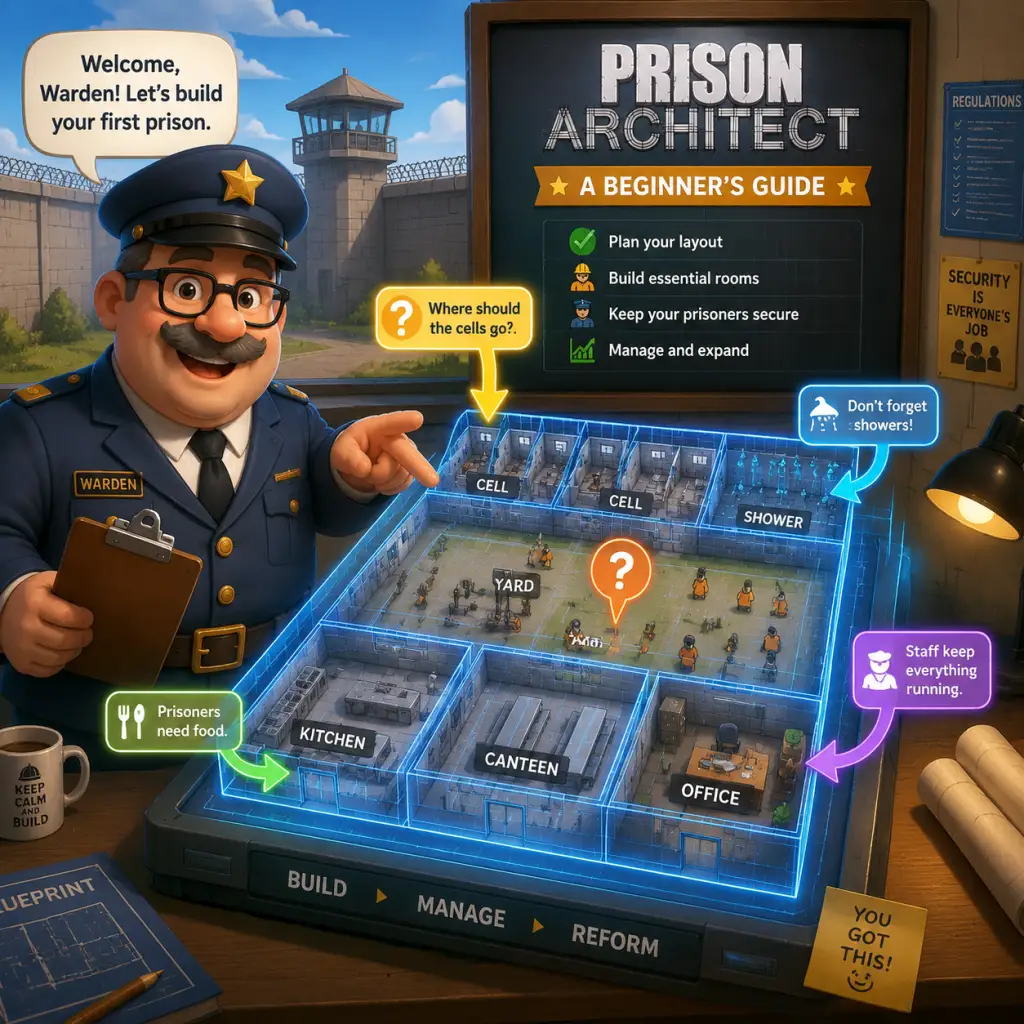
Welcome to Prison Architect, a top-down simulation where you design, build, and manage a maximum-security prison. This guide covers everything a brand-new player needs to survive the first hour, avoid common pitfalls, and set up a functional prison from day one.
No Character Creation
Prison Architect does not feature a character creation system. You control the prison from a god-like perspective, managing staff, prisoners, and facilities. The only "character" is the Warden (you), represented by the player's decisions and the prison's design.
Controls on All Platforms
#### PC (Mouse & Keyboard)
- Left-click: Select, place items, interact.
- Right-click: Cancel / deselect / rotate objects.
- Mouse wheel: Zoom in/out.
- Middle mouse button (click & drag): Pan camera.
- WASD / Arrow Keys: Pan camera.
- Space: Pause/unpause.
- Tab: Toggle speed (1x, 2x, 3x).
- Escape: Open menu / cancel.
- F1-F4: Quick save/load slots.
- Left stick: Move camera.
- Right stick: Rotate/zoom camera (press stick often changes object orientation).
- D-pad: Navigate menus and quick-select building categories.
- A / Cross (X on PlayStation): Confirm / place.
- B / Circle (O): Cancel / back.
- X / Square: Open context menu or toggle building mode.
- Y / Triangle: Open reports or prison overview.
- LB / L1 & RB / R1: Cycle through speed settings.
- Back / Share: Open pause menu.
- Start: Open full build menu.
- Top bar: Money, prisoner count, grants, speed controls, date, and notifications (alerts, events).
- Left sidebar: Main menu icons for Build, Reports, Policy, Intelligence, Finance, and Research.
- Bottom toolbar: Quick actions like materials, rooms, utilities, objects, staff deployment, and zoning tools.
- Right side (small): Tool hints and object health/info when selecting something.
- Center: The prison map, initially empty.
- Escape Menu: Save, load, settings, exit.
- Reports: View prisoner needs, staff, logistics, and incidents.
- Policy: Set regimes, deployment, and prisoner categories.
- Finance: Track income/expenses, grants.
- Research: Unlock new rooms, equipment, and policies (via Bureaucracy).
- Pause the game immediately after starting. Planning before time runs is critical.
- Draw the Delivery Zone (a yellow zone) near the road – it's where trucks drop supplies.
- Build a small Reception Room connected to a Holding Cell. Reception processes new prisoners.
- Build the essentials close together to minimize walking distance.
- Prioritize water pumps and power generators – they are cheap and keep things running.
- Assign guards to patrol corridors.
- Don't build a huge prison right away. Start small (10-20 cells). Expansions are tempting but drain money faster than you earn.
- Don't ignore prisoner needs – hunger, sleep, toilet, and recreation cause riots.
- Don't skip the foundation – all rooms must be enclosed by walls and a foundation.
- Don't place objects before rooms – you must designate a room (e.g., "Canteen") before placing tables and benches.
- Don't forget to connect power and water – pipes and wires must reach the building.
#### PlayStation / Xbox / Switch Controllers
Layout is similar across consoles. Key actions:
Tip: On console, use the radial menu (hold right bumper) to quickly place rooms, utilities, and staff.
UI Overview
When you start a fresh game (Warden Mode -> New Prison), the screen shows:
Key Panels:
Essential Early Objectives (First Hour)
Your first hour should focus on survival and basic function:
1. Accept the starter grant (often "First Grant") – provides initial cash.
2. Build a Holding Cell (room) to house new prisoners.
3. Build a Canteen and Kitchen to feed them.
4. Connect water and electricity to these rooms.
5. Hire Staff: Warden, Chief, Accountant (unlocks grants), Guards, Workmen (for construction).
6. Intake prisoners: Start with a few (minimum 6-8) so you can learn without chaos.
7. Set a basic regime (Eat, Sleep, Free Time, Work) to keep prisoners calm.
8. Add toilets and showers inside the holding cell or a dedicated room.
What to Do First
What to Avoid
Early Resource Priorities
| Resource | Priority | Reason |
|---|---|---|
| Money | High | Used for construction, staff salaries, and materials. Focus on grants for quick cash. |
| Space | Medium | Keep initial footprint small to reduce costs and staff needs. |
| Staff | High | Hire at least 2 guards, 1 warden, 1 cook, 1 workman immediately. |
| Water & Power | High | Every building needs water (toilets/sinks) and power (lights/objects). Install pumps and generators early. |
| Research | Medium | Unlock bureaucracy: start with Warden (enables hierarchy) then Chief (deployment). Grants (via Accountant) bring money. |
| Prisoner Intake | Low | Don't accept more than 6-8 prisoners until basic needs are met. |
Common Beginner Mistakes
1. Building too many cells too early – You pay for empty cells and maintenance. Build as needed.
2. Zoning incorrectly – Rooms must be enclosed by walls and have a door. A "room" is defined by the Room tool, not just objects.
3. Ignoring the regime – Prisoners left idle will find trouble. Use the Policy tab to set a schedule (e.g., 8 hours sleep, 4 hours work, 2 hours yard).
4. Scattering furniture without room designation – Always use the Room tool first, then place objects inside.
5. Forgetting to connect utilities – Water pipes and power cables must hook up to the electrical grid. Capacitors and pumps require distribution.
6. Over-hiring staff – Too many guards drain money. Start with minimal staff and increase as prison size grows.
7. Not saving often – Game is unforgiving. Save every 10-15 minutes.
8. Building in the wrong orientation – Prisons built north of the road require longer walks. Build close to the road for efficiency.
Day-One Checklist
Use this to survive the first in-game day (24 hours):
- [ ] Pause the game.
- [ ] Accept the first grant (Finance -> Grants -> Accept).
- [ ] Buy land if needed (but starter plot is fine).
- [ ] Draw Delivery Zone (Utilities -> Zones -> Delivery Zone) near the road.
- [ ] Draw Garbage Zone next to it.
- [ ] Build a small rectangular foundation (approx. 10x5 tiles) for Holding Cell.
- [ ] Place doors (one entrance from outside).
- [ ] Designate room as "Holding Cell" (Build -> Rooms -> Holding Cell).
- [ ] Place objects inside: Toilets (1 per 4 prisoners), benches, a phone booth, a water pump (if water needed).
- [ ] Connect water to the pump (water pipes from road to pump).
- [ ] Connect electricity (power lines from road generator to building's capacitor).
- [ ] Build a separate 10x5 foundation for Canteen + Kitchen (can be same room, but better separate).
- [ ] Designate Canteen and Kitchen rooms. Place Cookers, fridges, serving tables, tables, and benches.
- [ ] Hire: 1 Warden, 1 Chief, 1 Accountant (unlocks grants), 2 Guards, 1 Cook, 1 Workman.
- [ ] Research Grants (Bureaucracy -> Accountant -> Grants). Accept more grants (e.g., "First Prisoner Grant").
- [ ] Set a basic Regime (Policy -> Regime):
- [ ] Intake 6 prisoners (Policy -> Intake -> Accept prisoners).
- [ ] Unpause the game at normal speed (1x). Observe.
- [ ] Watch for alerts: If prisoners are hungry, build more kitchen capacity. If angry, add recreation (TV, weight bench) or yard.
- [ ] Save your game.
- Use Grants as your primary income early on. They give lump sums for meeting targets.
- Expand gradually. Build a cell block (individual cells) once you have steady income. Cells give more grant money.
- Watch tutorials in-game (the game has built-in tips).
- Read the Prisoner Needs report (Reports > Needs) to see what's causing trouble.
- Keep it simple – a small, functional prison is better than a grand failure.
- 6:00-8:00 Wake Up, 8:00-9:00 Eat, 9:00-12:00 Work, 12:00-13:00 Eat, 13:00-18:00 Free Time, 18:00-19:00 Eat, 19:00-22:00 Free Time, 22:00-6:00 Sleep.
First Hour Walkthrough (Step-by-Step)
1. Start a new sandbox prison (Warden Mode). Choose a default easy prison or start from scratch.
2. Immediately pause (Space).
3. Look at the road at the top of the map. Draw a Delivery Zone (Utilities tab > Zones > Delivery Zone) just inside your boundary near the road.
4. Draw a Garbage Zone next to it.
5. Select the Foundation tool (Build tab > Objects > Foundation). Click and drag a 10x5 rectangle south of the Delivery Zone. This will be your Holding Cell.
6. Right-click to exit foundation. Then click the Room tool (Build tab > Rooms) and select "Holding Cell". Click inside the foundation to designate it.
7. Place a Large Jail Door on one of the walls facing the road.
8. Inside the Holding Cell, place: 4 toilets, 1 sink (for cleaning), 2 benches, 1 phone booth, 1 water pump, 1 capacitor.
9. Route water pipes from the road's water supply to the pump (click water pipe tool, draw a line from the road's water node to the pump).
10. Route power lines similarly (power cables from road generator to capacitor).
11. Build a second foundation next to the holding cell (8x8) for the Canteen/Kitchen. Designate it as "Kitchen" (room). Place 1 cooker, 1 fridge, 1 serving table.
12. Add a Canteen room overlapping the same space or adjacent? Better to make a separate Canteen room nearby or connect via doorway. Simpler: make a combined room using a large foundation, designate half as Kitchen and half as Canteen. Place tables and benches in the Canteen area.
13. Connect water and power to this building.
14. Hire staff: click Staff icon (bottom toolbar) and hire: 1 Warden, 1 Chief, 1 Accountant, 2 Guards, 1 Cook, 1 Workman.
15. Open Reports > Grants and accept the first grant (usually $20,000). Also go to Bureaucracy, research Accountant -> Grants. Accept the "First Prisoner Grant" after it appears.
16. Set Regime (Policy > Regime): click on the regime chart. Create a simple schedule: all prisoners: 8 hours sleep (22:00-06:00), 4 hours work (09:00-13:00), 2 hours yard (13:00-15:00), 1 hour eat (08:00-09:00 and 15:00-16:00), rest free time.
17. Intake prisoners: Policy > Intake, set minimum security prisoners, accept 6.
18. Unpause. Watch your staff build the rooms. Once built and connected, prisoners will arrive after a delay (a bus icon appears).
19. First day will be chaotic – they will need food, showers, toilets. Ensure your cook is hired and kitchen has ingredients (the game auto-starts with some supplies). If prisoners riot, add more guards or improve conditions.
20. Save often.
Final Advice
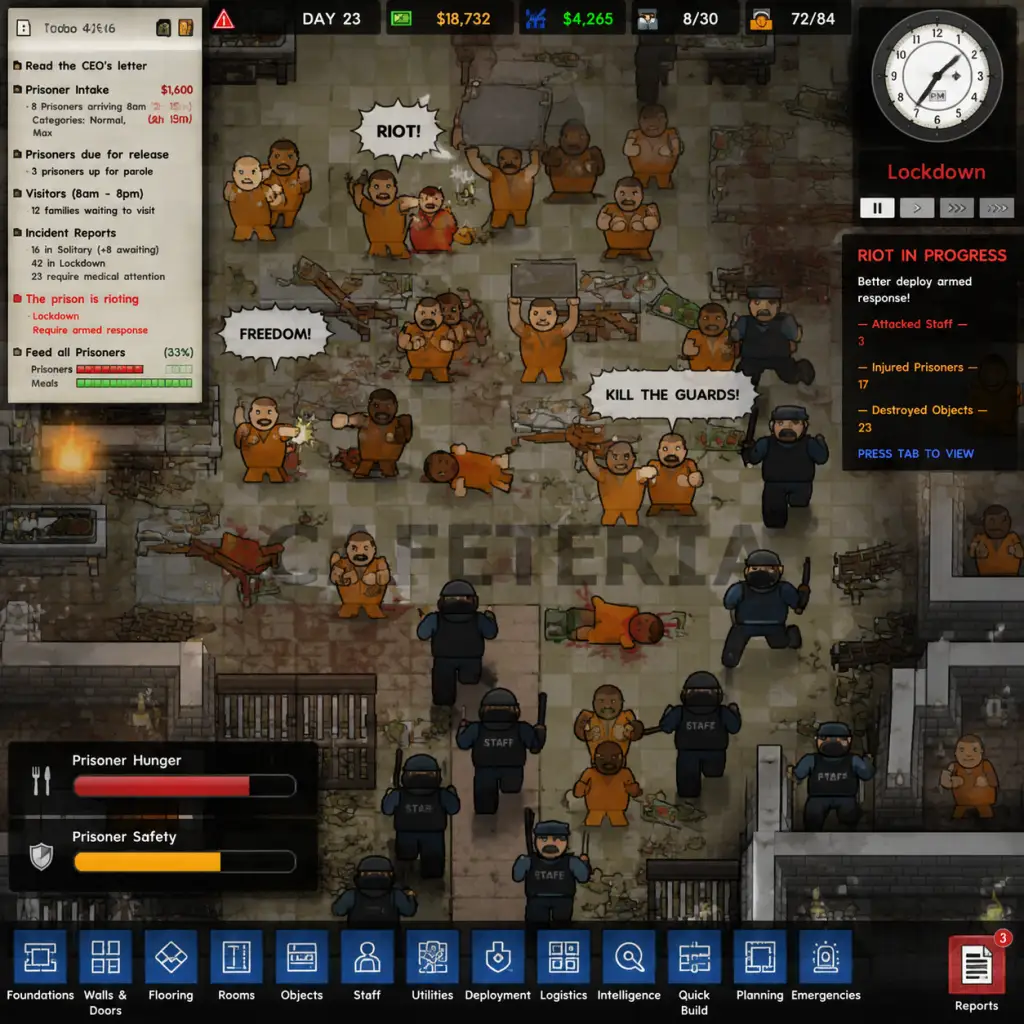
Core Gameplay
Core Gameplay
Prison Architect is a top-down prison management simulation. Your goal is to design, build, and operate a secure, efficient, and (optionally) rehabilitative prison. The game offers a deep, layered experience that evolves through distinct progression tiers. Below we break down the core gameplay systems and how they change as you advance.
Main Gameplay Loop
The fundamental loop is:
1. Intake Prisoners – You accept new inmates from a daily intake or via grants/story missions. Prisoners have varying security ratings (Low, Medium, High, Supermax, Legendary).
2. Provide Facilities – Build cells, canteens, showers, yards, workshops, classrooms, etc. Satisfy prisoner needs (hunger, hygiene, sleep, recreation, family).
3. Maintain Security – Hire guards, deploy CCTV, metal detectors, dog patrols, and manage contraband. Respond to incidents (fights, riots, escapes).
4. Earn Income – Daily government grant per prisoner ($85 for Low, $105 for Medium, $130 for High security as of base game). Sell workshop goods, exports, or use parole programs for bonuses.
5. Expand & Upgrade – Build new wings, improve security, unlock new rooms (e.g., Workshop, Classroom, Chapel) via the Policy and Research tabs (though the game doesn't have a tech tree; it's more about experience through Grants and unlocking specific room types).
6. Manage Staff & Prisoners – Schedule work, recreation, sleep. Meet prisoner needs to reduce reoffending risk and avoid riots.
The loop repeats with increasing complexity and scale.
Progression Tiers
Progression in Prison Architect is not tied to character levels but to prison size, prisoner mix, security level, and financial stability. It is also shaped by the Grants system (missions) and the optional Story Mode campaigns (e.g., "Prison Architect: Island Bound" DLC story). Below is the typical tier breakdown.
---
Early Game
Goal: Stabilize a small, low-security prison with basic facilities and positive cash flow.
What You Have
- Starting funds: ~$10,000 (varies by grant or scenario).
- A small plot of land (often 30x30 or slightly larger).
- A handful of low-security prisoners (first intake usually 6–10).
- Only basic rooms available: Cells, Canteen, Kitchen, Showers, Yard, Staff Room, Offices.
- Limited staff: 1–2 guards, 1 warden, 1 cook, 1 janitor.
- Income primarily from the daily per-prisoner grant. Example: 10 low-security prisoners = $850/day.
- Outgoings: staff salaries ($50–100/day each), food costs, electricity/water bills.
- Grants provide quick cash injections (e.g., "Startup Grant", "Cell Block Grant"). Complete objectives like "Have 10 cells" or "Build a canteen".
- Minimal. Occasional fight between prisoners. Your guards will break it up. No player-controlled combat – you direct staff via right-click.
- Contraband is rare but appears via visitors or thrown over walls. You can search cells manually (click prisoner, search cell) or use metal detectors later.
- Limited to expanding your land (buy adjacent plots if you have cash). No classic exploration.
- Grants serve as tutorials and objectives. Early grants: "Build a Prison", "First Prisoners", "Basic Needs". Complete them to unlock more.
- Story Mode (available in some versions) gives a campaign with specific targets (e.g., escape an island).
- No player character progression. Your prison's Security Rating stays low. Prisoner reoffending risk starts high because of lack of programs.
- Staff don't level up, but you can hire specialists later (e.g., Dog Handlers, Armed Guards).
- Build a 10-cell block (each cell: bed, toilet, door). Build a small canteen with serving tables and benches. Build a kitchen with cookers, fridges, and a sink. Connect utilities (power, water).
- Hire 2 guards, 1 cook, 1 janitor. Set prison policy to "Low Security" for intake.
- Complete the "First Prisoners" grant by accepting 6 low-security inmates. Then do "Basic Needs" grant by ensuring all have food, sleep, and hygiene.
- Watch cash flow; keep don't overspend on luxury items. Your first expansion might be a workshop to generate income.
- A stable prison with 50–100 prisoners, mix of low and medium security.
- Expanded facilities: Workshop, Classroom, Chapel, Parole Rooms, Infirmary, Visitor Booths.
- More staff: 6–10 guards, 2–3 cooks, 2 janitors, a doctor, maybe a few dog handlers.
- Deployment system – You can assign staff to specific sectors (e.g., Armed Guards only in high-security wing).
- Workshops produce license plates or furniture for export profit. Example: 10 work tables + release value ~$200/table if sold. Factory schedule.
- Parole board grants bonus $1,000–$5,000 for successful parolees.
- Income can exceed $5,000/day. You'll have surplus to build high-tech security.
- Riots can occur if prisoner needs aren't met. Medium-security prisoners may start fires or attack guards.
- Tunnels – Prisoners dig; you need dog patrols (sniff) or periodic cell searches.
- Gangs (if DLC enabled) – Prisoners form gangs, which cause more organized fighting and contraband smuggling.
- Expand land significantly. Use the Road Gates to create secure vehicle access.
- Foundation tool – Build foundation walls, multiple floors (add stairs).
- Grants branch into chains: "Rehabilitation" grants, "Security" grants (e.g., "Install 10 Metal Detectors").
- Story mode might involve a high-risk transfer or a prison break scenario.
- Reoffending Risk – Lower by providing education (Classroom), counseling (Chapel), work (Workshop). Track each prisoner's risk level.
- Prisoner Grading – Each prisoner has a grade (A+ to F) based on behavior. High grades reduce risk and increase parole chances.
- Staff – You can unlock new roles via the Policy tab: Warden with traits (e.g., "Old Bill" reduces fights), Chief, Foreman (in DLC).
- Build a workshop with 10 workstations. Assign prisoners to work during their Work regime. Sell license plates on the market (export).
- Add a classroom with 10 chairs and a chalkboard. Run education programs (three levels: Basic, Advanced, Literacy). This lowers reoffending and improves prisoner behavior.
- Install metal detectors at kitchen and workshop entrances. Add CCTV in hallways. Deploy armed guards only near high-traffic areas to avoid accidental shootings.
- Build a perimeter wall (stone) around the prison – prevents contraband throws and tunnel escapes.
- Accept medium-security prisoners. They need more intensive regimes (more free time, separate canteens or yards to reduce conflict).
- Prison capacity over 200. Multiple cell blocks (low, med, high, supermax).
- Full security suite: Snipers on towers, armed guards, dog patrols, perimeter walls, many CCTV stations.
- Special rooms: Solitary, Execution Chamber (if DLC), Psych Ward, Large Kitchen and Canteen.
- Legendary prisoners – Extremely tough, resistant to suppression, often start riots. They require supermax isolation.
- Workshops now produce high-value items (e.g., furniture, electronics) with maxed production lines. Export can bring $10,000+/day.
- Parole rates higher if you have full rehabilitation programs.
- Maintenance costs scale: staff salaries, utilities, building repairs. Need high income to sustain.
- Legendary prisoners – Immune to tasing, very strong; need armed guards and close-quarters patrol.
- Mass riots – Can spread if not suppressed quickly. Use call-to-arms (emergency button) to summon all guards with batons.
- Escape attempts – Prisoners coordinate digging tunnels or break through walls. Use dogs to sniff tunnels, search cells with snipers covering yard.
- Fire – Prisoners can start fires in canteen or workshop; need fire sprinklers (researched via utilities panel) and firemen (emergency services).
- Fully expand your land. Build multiple floors (up to 4+). Use staircases and staff-only elevators.
- Tunnels – late-game prisoners dig deeper; need ground radar (if DLC) or flooding to detect.
- Late-game grants: "Maximum Security", "Supermax Wing", "Police Partnership". May require building execution chamber or solitary wing.
- Story mode final chapters often involve a massive breakout or a transfer of a VIP prisoner.
- Prisoners can reach A+ grade if programs are comprehensive – they become model inmates,eligible for early parole.
- Reoffending risk can be reduced to 0% for some prisoners.
- Staff Traits – Warden with +security or +rehab traits make a big difference. Hire multiple wardens (if DLC).
- Achievements – Unlock various trophies for perfect security, no escapes, etc.
- Build a supermax wing: tiny cells with concrete walls, solitary doors, armed guard station, separate canteen with serving hatch. Keep legendary prisoners here.
- Set up a CCTV control room with 20 monitors – assign officers to watch high-risk areas.
- Create a secure entrance with metal detectors, dog patrols, a holding cell for sweeps.
- Maximize workshop profit: assign 30 prisoners to work in a large workshop with supervised manufacturing.
- Use deployment to flood high-security wings with guards; regularly call shakedown (mass cell search) to find contraband.
- Manage regime schedules carefully: high-security prisoners need more free time in yard (separate from low-security) to reduce fighting.
- A fully built-out prison with all room types, 500+ prisoners, all security levels, complex regimes.
- All grants completed. Economy stable with high profit.
- Staff: dozens of guards, multiple armed guards, dog handlers, cooks, janitors, doctors, and maybe a psychologist.
- Full research (though limited, you can unlock all room types).
- Mainly passive income from large prisoner count (hundreds) plus workshop exports. Example: 500 prisoners at mixed security = $50,000/day income – costs ~$30,000/day, profit $20,000/day.
- No need for grants; you can ignore them or do for fun.
- Very rare – if you manage well, you can go days without a fight. However, legendary prisoners can still cause issues.
- You can trigger emergency events for fun (e.g., unlock all doors, spawn criminals) via the Extreme Event tool (if enabled in settings).
- No new land to explore, but you can demolish and rebuild entire sections for efficiency.
- No new story content unless you start a new scenario. You can replay the Escape Mode (play as a prisoner) or Sandbox unrestricted.
- Maxed: all staff roles, all room types, all grants done. You can fine-tune prisoner rehabilitation to get high parole completion rates.
- Legacy – You can save your prison as a blueprint for new games.
- Build a rehabilitation-focused prison with no solitary, high-quality cells, full programs, and liberal parole – resulting in high ratings and minimal security cost.
- Alternatively, build a maximum security hellhole – supermax only, constant punishment, armed guards everywhere. This tests your crisis management.
- Challenge yourself: no armed guards, no walls (only fences), 100% prison funding efficiency, or achieve 0% reoffending for all prisoners.
- Guards automatically engage: baton hits, taser (if researched), or lethal force (armed guards). You can manually order an attack by clicking the prisoner with a guard selected.
- Staff can be injured. When a guard is knocked out, you need to rescue them or call paramedics (if DLC).
- Incoming contraband: visitors, thrown over walls, deliveries, staff corruption.
- Detection: Metal detectors (search when triggered), dog patrols (sniff), CCTV, periodic shakedowns.
- Each prisoner has a set of needs: Food, Sleep, Hygiene, Toilet, Recreation, Family, Safety, Temperament, etc. Satisfy these via facilities and regime schedule.
- High unmet needs cause bad behavior.
- Create custom schedules per security level (e.g., Low: sleep 0–6, eat 6–7, work 8–12, eat 12–1, etc.). The schedule is essential for controlling prisoner movement and reducing conflict.
- Define staff deployment per sector (e.g., Guard percentage, armed guard patrols, dog patrol routes). Critical for late-game security.
- Set rules: punishment severity (e.g., solitary time, lockdown length), parole conditions, search policy.
- Staff need breaks; place staff rooms to avoid burnout.
Core Systems in Early Game
Economy:
Interaction/Combat:
Exploration:
Quests/Missions:
Character/Build Growth:
Example Early Game Strategy:
---
Mid Game
Goal: Expand to medium security prisoners, increase capacity to 50–100, and start rehabilitation programs. Security threats become more complex.
What You Have
Core Systems in Mid Game
Economy:
Interaction/Combat:
Exploration:
Quests/Missions:
Character/Build Growth:
Example Mid Game Strategy:
---
Late Game
Goal: Manage a large, high-security prison (150–300+ prisoners, including high security and supermax). Maximize profit and security while dealing with legendary prisoners and coordinated escape attempts.
What You Have
Core Systems in Late Game
Economy:
Interaction/Combat:
Exploration:
Quests/Missions:
Character/Build Growth:
Example Late Game Strategy:
---
Endgame
Goal: Achieve a self-sustaining, flawless prison. No escapes, minimal incidents, high happiness, and massive daily profit. This is when you can experiment with creative designs or challenge runs.
What You Have
Core Systems in Endgame
Economy:
Interaction/Combat:
Exploration:
Quests/Missions:
Character/Build Growth:
Strategies:
---
Additional Core Systems Across All Tiers
Combat Resolution:
Contraband Management:
Prisoner Needs:
Regime Scheduler:
Deployment System:
Policy:
Staff Room:
---
This guide covers the core gameplay loop and progression tiers of Prison Architect. Use it as a roadmap to build your perfect correctional facility.
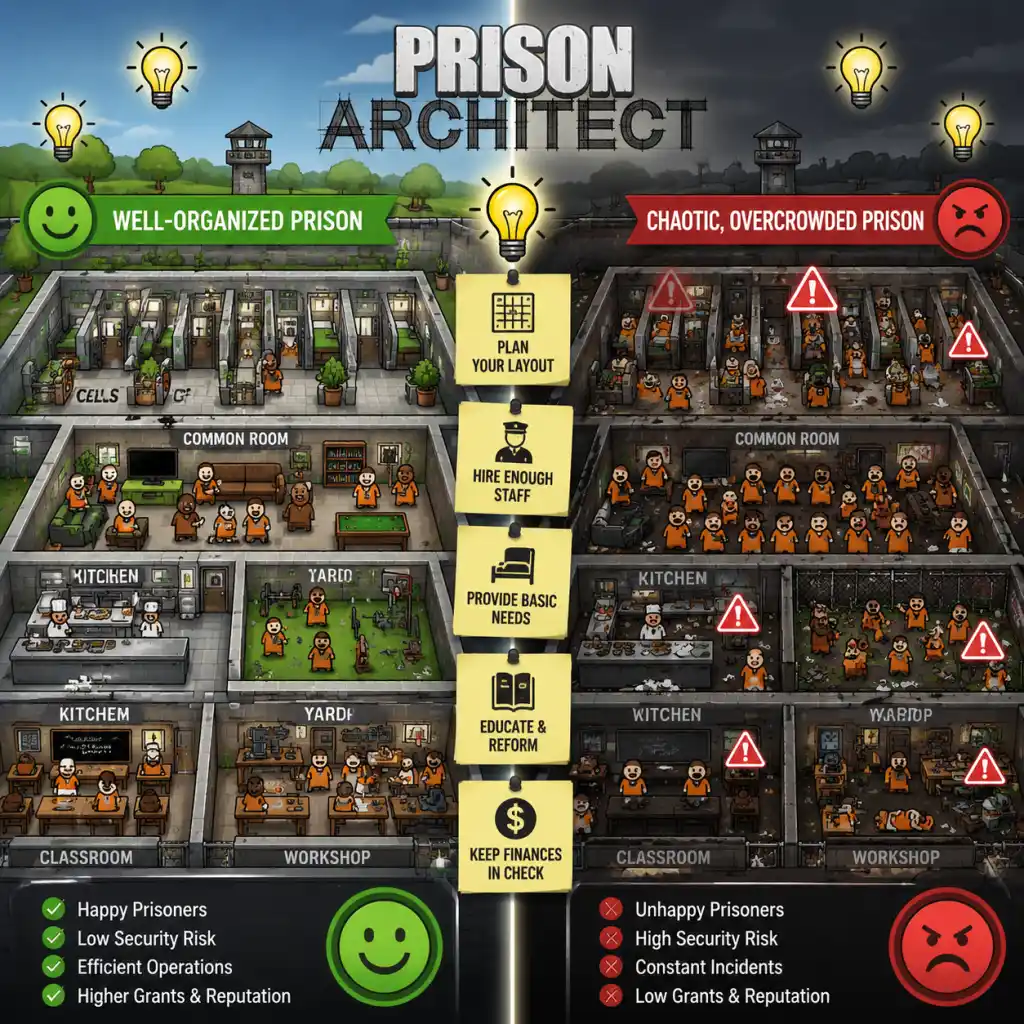
Game Tips
Game Tips
This guide compiles essential tips for mastering Prison Architect, organized by gameplay pillar. Each tip explains the why and when to apply it, with difficulty ratings:
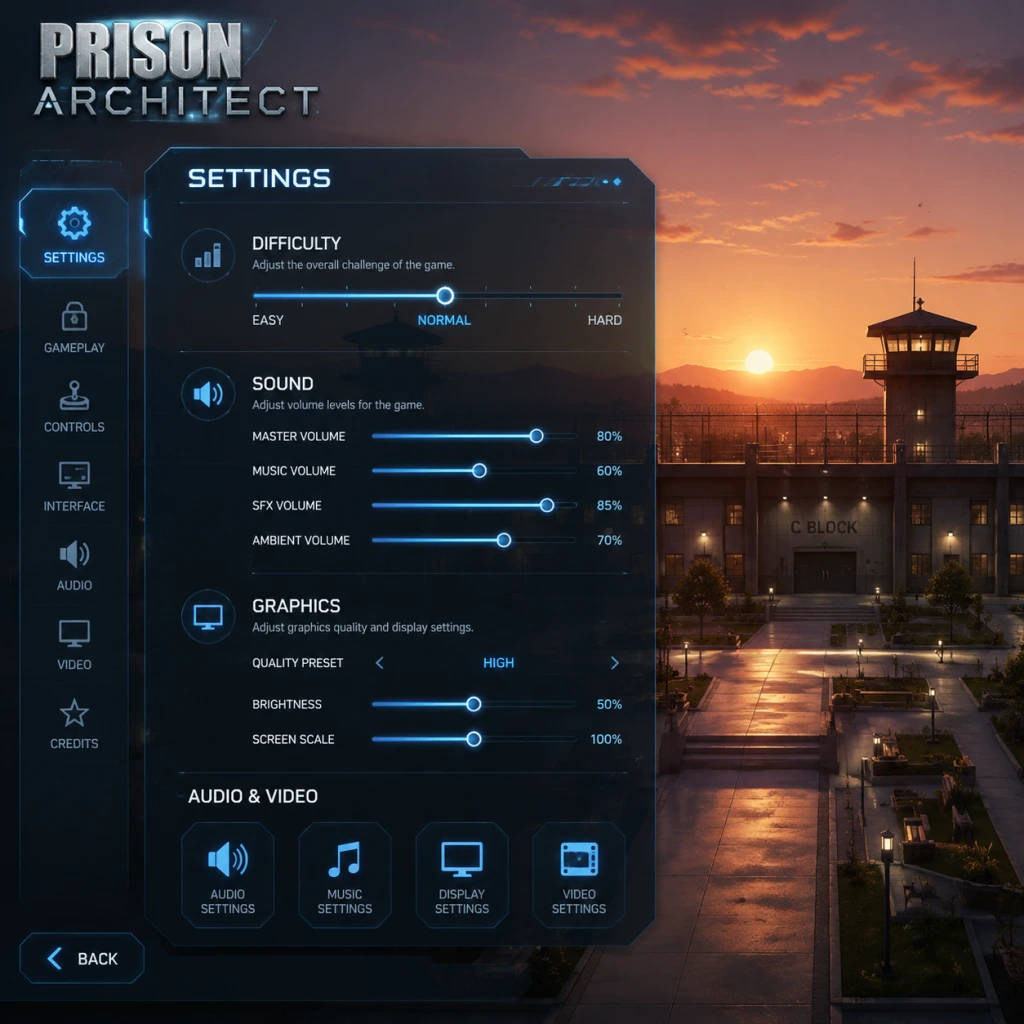
Game Settings
Game Settings
Introduction
Properly configuring your Prison Architect settings ensures a smooth, immersive experience. This guide covers all major settings categories, provides optimal recommendations for different hardware tiers, and highlights common pitfalls that can hinder gameplay or performance.
Graphics Settings
Access: Main Menu → Options → Graphics
- Resolution: Match your monitor's native resolution for best clarity. Lower resolution improves performance but may appear blurry.
- Fullscreen / Windowed: Fullscreen offers slightly better performance; Windowed allows easier multitasking.
- V-Sync: On prevents screen tearing (recommended if you notice tearing), Off can reduce input lag at high FPS.
- Quality Presets: Very Low, Low, Medium, High, Very High, Ultra. Presets adjust multiple options below.
- Advanced:
- Anti-Aliasing (MSAA): Smoothes edges. 2x or 4x recommended; 8x very demanding.
- Texture Quality: Affects visual detail of terrain, buildings, prisoners.
- Reflection Quality: Mirror/water reflections. Off or Low on weak hardware.
- Ambient Occlusion: Adds realistic contact shadows. Significant performance cost.
- Particle Effects: Smoke, fire, etc. Lower on weak GPUs.
- Fog Quality: Overhauls distant haze. Low impact.
#### Recommended Presets by Hardware Tier
| Tier | Hardware Example | Preset / Key Options | Expected Performance |
|---|---|---|---|
| Low-End | Intel HD Graphics 620, 4GB RAM | Very Low preset; Resolution 1366x768; Shadows Low; MSAA Off | 30 FPS, acceptable for manageable prisons (<150 inmates) |
| Mid-Range | NVIDIA GTX 960, 8GB RAM | High preset; 1920x1080; Shadows Medium; MSAA 2x; Reflections Low | 45-60 FPS, handles medium prisons (200-400 inmates) |
| High-End | NVIDIA RTX 3060, 16GB RAM | Ultra preset; 2560x1440 or 1920x1080; Shadows High; MSAA 4x; Ambient Occlusion On | 60+ FPS, large prisons (500+) with minimal slowdown |
Audio Settings
Access: Main Menu → Options → Audio
- Master Volume: Overall game sound.
- Sound Effects Volume: Doors, alarms, footsteps, tools.
- Music Volume: Background tracks.
- Voice Volume: Warden's announcements, prisoner dialogue.
- Mute All / Unmute Toggle: Quick mute button.
- Key Bindings: Customize shortcuts for all actions (e.g., Build, Dezone, Report). Defaults are optimized but you can reassign.
- Mouse Sensitivity: Adjust cursor speed. Default is usually fine.
- Invert Mouse Y-Axis: Toggle for camera tilt.
- Camera Speed: How fast the view scrolls (with keyboard or edge scroll). Increase for big prisons.
- Edge Scrolling: Enable/disable moving camera by moving mouse to screen edge.
- Zoom Speed: Speed of zoom in/out.
- Colorblind Mode: Three options (Protanopia, Deuteranopia, Tritanopia). Adjusts UI colors for readability.
- UI Scale: Increase size of menus, buttons, tooltips. Recommended for high-resolution displays or visual impairments.
- Tooltip Delay: Adjust how quickly info tooltips appear (0.0s to 2.0s).
- Notification Style: Choose between Popup, Ticker, or Both.
- Font Size: Small, Medium, Large (affects tooltips and interface text).
- High Contrast Mode: Makes UI elements more distinct.
- Display Language: Choose from available translations (English, French, German, Spanish, Russian, Chinese, etc.).
- Text Language: Separate from audio? Usually tied together. Some languages may require additional font downloads.
- Port Forwarding: To host a multiplayer session, ensure port 7778 (default) is forwarded in your router firewall. Consult router manual.
- UPnP: Enable automatic port mapping if supported.
- Connection Type: LAN (local) or Internet. Internet requires stable upload speed (≥ 2 Mbps recommended).
- Bandwidth Limit: Adjust data usage per second (Low/Medium/High). Choose appropriate for connection quality.
- Disconnect Detection Timeout: Time before a disconnected player is removed from the session.
- Autosave Interval: Minutes between automatic saves (5, 10, 15, 20, 30, 45, 60). Lower for frequent progress backup.
- Pause on Events: Automatically pause when prison events happen (e.g., Riot, Escape, Death, New Day). Helpful for beginners.
- Notifications: Toggle individual alerts (e.g., Workers done, Prisoner needs, Finance alerts).
- Speed Multiplier: Default (1x, 2x, 3x). Adjusts game speed buttons. Some players prefer slower build speed.
- AI Behavior: Options like "Allow Prisoners to Fight" (on/off) or "Require Guards to Search" – disabled by default for safety.
- Warning Display: Duration warnings stay on screen (Short/Medium/Long).
- Show Tooltips: On/Off. Keep on for new players.
- Enable Tutorial Popups: Even after tutorial, helpful reminders can be turned off.
Note: Keeping audio on enhances immersion (e.g., hearing a riot start), but can be distracting. Adjust SFX and Music to taste.
Controls Settings
Access: Main Menu → Options → Controls
Tip: Prison Architect relies heavily on mouse clicks. Assign 'Build Menu' (B) and 'Deployment Menu' (D) to easily accessible keys.
Accessibility Settings
Access: Main Menu → Options → Accessibility
Language Settings
Access: Main Menu → Options → Language
Attention: Changing language requires restart. Not all languages are fully translated; UI may contain placeholder English.
Network Settings (Multiplayer)
Access: Main Menu → Multiplayer → Host/Join
(Prison Architect supports co-op and competitive multiplayer where multiple players can manage a prison together or separately.)
Troubleshooting: If friends cannot connect, check firewall exceptions and forward port 7778 (TCP/UDP). Test with Direct IP connection.
Gameplay Settings
Access: Main Menu → Options → Gameplay
Special: Turning off "Pause on Events" reduces interruptions but may miss critical moments.
Recommended Configurations Summary
| Category | Low-End | Mid-Range | High-End |
|---|---|---|---|
| Resolution | 1366x768 | 1920x1080 | 2560x1440 or 1920x1080 |
| Quality Preset | Very Low | High | Ultra |
| Shadows | Low | Medium | High |
| MSAA | Off | 2x | 4x |
| Reflections | Off | Low | High |
| V-Sync | Off | On | On |
| Autosave | 10 min | 15 min | 20 min |
| UI Scale | 100% | 100% | 125%+ |
Common Misconfigurations & Attention Points
1. Resolution Overload on Integrated Graphics: Setting 1920x1080 on an Intel HD with Very Low can still cause lag due to pixel count. Downscale to 1366x768.
2. V-Sync Off + High FPS: May cause screen tearing. Enable V-Sync or cap FPS via GPU control panel.
3. Audio Mixing: Turning Master Volume to 0 while SFX on max will produce silence; check all sliders.
4. Colorblind Mode Misuse: If you select the wrong type, UI may become more confusing. Test each.
5. Multiplayer Port Not Forwarded: Host fails silently. Verify port 7778 is open using online port-checking tools.
6. Autosave Too Frequent: Every 5 minutes on a large prison can cause stutter during save; increase interval.
7. UI Scaling Too High: On 1080p, 150% may cut off menus. Stick to 100-125% unless on 4K.
8. Disabling All Notifications: Can miss prison break warnings. Keep essential ones (Riot, Fire, Death) on.
Adjust settings gradually after reaching a prison of 100+ inmates to ensure stability.
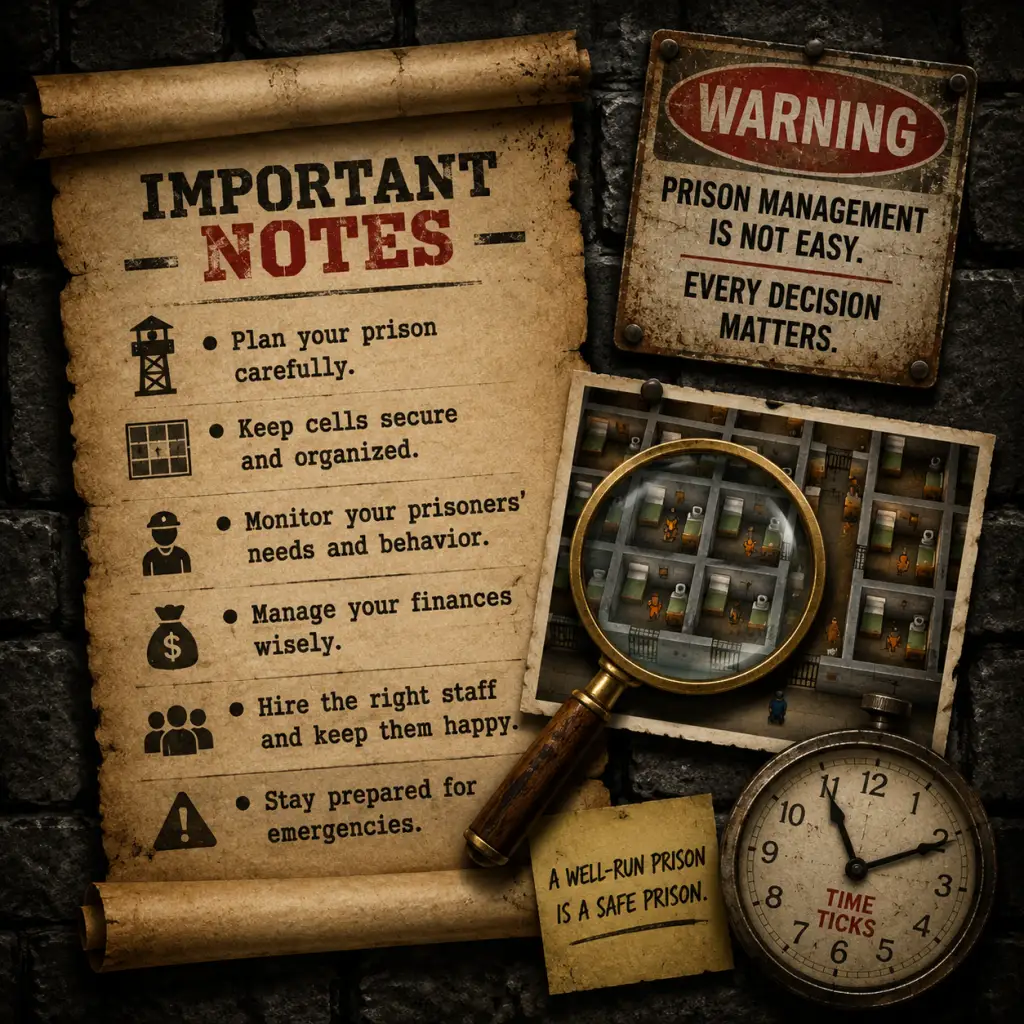
Important Notes
"content": "## Important Notes
Before you dive deep into Prison Architect, there are critical lessons learned by thousands of inmates—er, players. This section covers the most common pitfalls, irreversible mistakes, and practical wisdom that can save you hours of frustration and prevent a prison riot on your hard drive.
---
#### 1. Starting Without a Plan
Introduction
Before you dive deep into Prison Architect, there are critical lessons learned by thousands of inmates—er, players. This section covers the most common pitfalls, irreversible mistakes, and practical wisdom that can save you hours of frustration and prevent a prison riot on your hard drive.
---
Common Pitfalls and Deadly Mistakes
#### 1. Starting Without a Plan
- The Trap: Jumping straight into building cells and hiring staff without zoning or utilities.
- The Fix: Pause immediately on Day 1. Lay out your entire prison zone-by-zone: cell blocks, canteen, kitchen, yard, common room, laundry, solitary, delivery area, and staff only areas. Plan pipe and power routes. Mortar and bricks are cheap; tearing down walls is expensive.
- Why it matters: Unplanned prisons become tangled mazes that cause long travel times, contraband flow, and impossible expansions. You cannot easily move water pumps or power stations later without demolishing rooms.
- The Trap: Building rooms without water pipes or power cables, then wondering why sinks, toilets, and cookers don’t work.
- The Fix: Always lay water pipes under floors before placing room tiles. Connect power cables to generators and then to room power junctions. Use the Utilities overlay (U key) before building.
- Irreversible? Pipes and cables can be dug up and re-routed, but it destroys existing floor tiles and requires re-plastering or flooring materials. This wastes money and time.
- The Trap: Accepting the new prisoner intake grants before building enough cells, canteen space, and toilets.
- The Fix: Turn off “Continuous intake” in the Reports menu – Reports → Intake → uncheck “Continuous intake”. Manually schedule small batches (e.g., 5-10 prisoners) only after you have built at least 1.5x their required capacity. Keep a buffer of empty cells.
- Why: Overcrowding causes instant needs unmet – leading to fights, tunnels, and escape attempts. The game punishes you with riot meter spikes and reputation loss.
- The Trap: Hiring too many or too few staff early on, especially guards.
- The Fix: One guard per ~10 prisoners is a bare minimum. For maximum security, aim for 1 guard per 5 prisoners. Hire cooks first (one per ~15 prisoners), then janitors (one per 20 prisoners). Never hire a psychologist until you have rehabilitative programs running; early freespace benefits are minimal.
- Pitfall: Janitors are cheap but essential – without them, cleaning tasks fall to prisoners, causing anger. Guards are expensive but crucial for suppression.
- The Trap: Choosing a map with limited space or weird terrain.
- Reality: You cannot expand the map boundary after selecting it. The game’s “Land Expansion” DLC adds purchasable land plots, but base game maps are fixed. Once you build, you are stuck with that size.
- Advice: Start with a medium-to-large map (e.g., “Sandbox – Large” in new game). Small maps become unmanageable quickly.
- The Trap: Blocking the main road (the strip where delivery trucks and buses arrive).
- Consequence: If you place an object (wall, fence, etc.) on the road tiles, deliveries and prisoner intake are blocked. The game will not warn you until nothing works. The road is the only entrance – you cannot move it.
- Solution: Leave a 3-4 tile gap between prison walls and the road edge. Build a road gate only when you have the logistics menu unlocked.
- The Trap: Deleting a staff room after assigning a warden, chief, or foreman to it.
- Consequence: That specific staff member is permanently displaced and you cannot reassign them to a new room. You must fire and re-hire them (costs money and reputation).
- Workaround: Never delete a staff room unless you are ready to fire that staff member. Use “Move” tool (M key) to relocate the room instead.
- The Trap: Not unlocking programs in the Bureaucracy tree before prisoners with high recidivism arrive.
- Consequence: Some programs (e.g., Basic Education, Cooking) require a qualified teacher – which you must train via the staff training center. If you delay, prisoners will accumulate negative traits that require long-term sessions.
- Advice: Research “Prisoner Programs” early in Bureaucracy. Unlock “Programs” tab to see all available. Start with “Foundation Education” and “Workplace Safety” – they reduce reoffending quickly.
- The Trap: Installing mods mid-save can corrupt the save file, especially if they add rooms or objects.
- Consequence: Mods that introduce new items (like special doors or furniture) cannot be removed without losing those items from the save.
- Advice: Decide on mods before starting a prison. If you want to try a mod, start a fresh test save. Back up your main save first.
- Why: Prisoners’ needs (food, sleep, freedom, family) start to degrade seriously if you haven’t built at least a canteen, cell, yard, and common room.
- How to survive: Before accepting any prisoners, build a canteen with benches and serving tables, a kitchen with cookers and fridges, a yard with weight benches and phones, and cells with toilet, bed, sink, and a door (not just a wall gap).
- Emergency: If riots break out, deploy all guards manually (right-click the riot icon), order “Lockdown” from the Prison Policy menu, and deploy armed guards (if you have them) to suppress fast.
- Why: Once you upgrade to “Medium Security” prisoners, their needs are higher and compliance lower. They bring in contraband more often.
- How to manage: Install metal detectors at every entrance to canteen and cell block. Build a solitary confinement wing (for punishment). Use the Cell Block schedule to separate Max Sec from others.
- Pitfall: If you accept medium security too early without proper zoning, they will attack guards and start tunnels.
- Why: The physics and AI bog down. Cooks cannot feed everyone, guards cannot patrol all areas, and incidents multiply.
- Optimization: Use “Deployment” to create staff-only corridors. Use “Logistics” to assign specific kitchens to specific canteens. Use “Zone” to restrict low-security prisoners to separate wings. Build multiple smaller cell blocks rather than one giant one.
- Performance: Turn off prisoner needs display (Options → Game → Prisoner Needs) to improve FPS.
- The Trap: Building too many workshop tools (saws, presses) before you have enough prisoners assigned to work programs.
- Consequence: Wasted money and space. Each workshop requires a qualified prisoner to operate – you need a workshop safety program first.
- Advice: Start with one workshop table and one press. Assign only 5-10 prisoners to workshops per table. Expand only when you see a backlog of prisoners waiting for jobs.
- The Trap: Hiring 50 guards for 50 prisoners, all on patrol routes.
- Consequence: Guards waste time walking, and their need for food/sleep is hard to manage. They also cost $200/day each.
- Smart Staffing: Use prisons policy “Patrol route – none” for general areas; only assign patrols to high-risk zones (roads near armory, workshop, solitary). Use “Deployment” to assign guards to specific patrol sectors – they will stand still and watch. Static guards are more effective.
- The Trap: Trying to eliminate all contraband manually by searching every prisoner.
- Consequence: Endless clicking and high tension. Prisoners become more aggressive when searched repeatedly.
- Solution: Use metal detectors + dog patrols. Dogs can sniff out drugs and tunnels. Set a policy: “Shakedown” once per in-game week. Use “Intelligence” tab to see which prisoners are suspicious.
- Steam Workshop: Always read mod descriptions. Some mods are broken after updates. Never subscribe to mods that alter core gameplay if you want to keep achievements.
- Anti-Cheat: No built-in anti-cheat. If you use mods that give unlimited funds, you will not get achievements for that prison.
- Community: Be respectful in forums. Asking “How do I stop riots?” is fine; demanding others build your prison for you is not.
- Save Sharing: If you share saves, ensure the recipient has the same mods and DLC installed.
#### 2. Ignoring Utilities Until Too Late
#### 3. Overcrowding From Day 1
#### 4. Staffing Blindly
---
Irreversible Choices and Missable Content
#### 1. Map Layout Permanency
#### 2. Building on Top of Roads
#### 3. Deletion of Staff Rooms
#### 4. Rehabilitative Program Missables
#### 5. DLC and Mod Content
---
Difficulty Spikes
#### 1. The First Riot (Around Day 10-20)
#### 2. Second Intake Flood (Around Day 30-50)
#### 3. Late-Game Prisoner Count Overwhelm (100+ inmates)
---
Grinding Traps
#### 1. Overbuilding Workshops
#### 2. Too Many Guards Patrolling
#### 3. Grinding Exterminators
---
Online Etiquette (Multiplayer / Workshop)
Note: Prison Architect does not have official multiplayer; however:
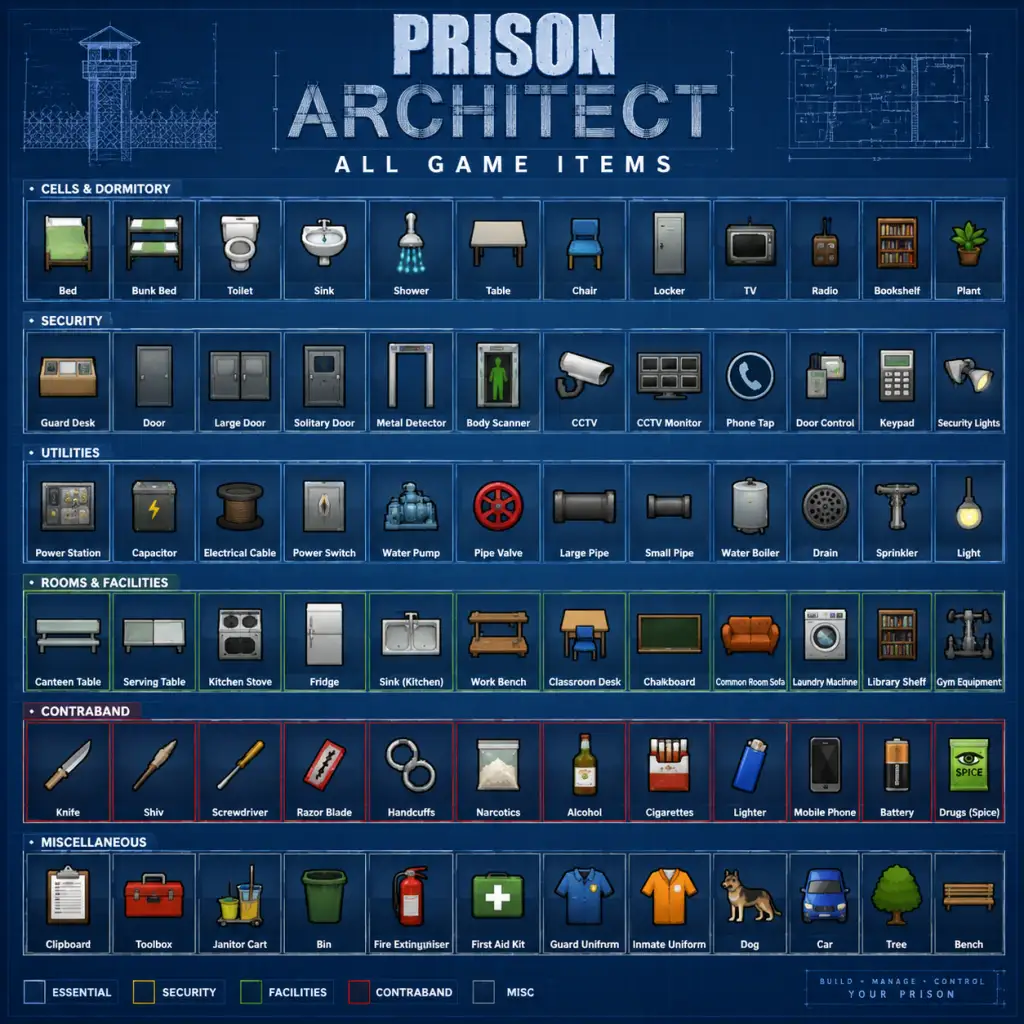
All Game Items
Introduction
In Prison Architect, \"items\" encompass everything you can place, build, purchase, or confiscate within your prison. This guide covers all major categories: currencies and resources, contraband (weapons, tools, drugs), staff equipment, building materials, infrastructure components, office furniture, security devices, rehabilitation tools, and special collectibles. Each item’s function, acquisition method, optimal use case, and important synergies or upgrades are detailed below.
---
Currencies and Resources
| Item | Category | Description | How to Obtain | When Useful | Synergies/Upgrades |
|---|---|---|---|---|---|
| Cash | Currency | The primary currency used to buy all objects, construct buildings, and pay staff wages. | Starting grant, prisoner intake payments, exported goods from workshops, parole hearings, grants. | Always needed for everything. Unlocks new buildings and services. | Use Accounting Office to reduce import/export costs. Combine with Grant Office to unlock larger grants. |
| Grant | Resource | Each grant is a set of objectives; completing them provides a lump sum of cash and often unlocks new items or buildings. | Unlocked via Grant Office, chosen from available grants (e.g., \\(40,000 Prison, Regime Reform). | Early game to fund construction; mid/late game to fund expansions. | Grants often require certain rooms or items (e.g., Workshop, Infirmary) – plan builds accordingly. Completing all grant lines unlocks the Supermax grant for \\),000. |
| Prisoner Intake | Income | Per-prisoner payment: you receive money for each prisoner admitted (varies by security level – max-security pays more). | Automatically when new prisoners arrive via intake system. | Steady, predictable income; essential for budgeting. | Higher security prisoners give more cash but require more expensive security measures. |
| Workshop Export | Income | Money earned from selling products made in the Workshop (e.g., freight, license plates). | Set up a Workshop with a Prisoner Work program and an Exports area. | Significant recurring income once prisoners are trained. | Requires Metal Detector at workshop entrance to prevent tool theft. Combine with Tool Leash (mod) or careful patrols. |
| Parole Hearings | Income | Prisoners who successfully pass a parole hearing grant a cash bonus. | Build a Parole Room and assign a Parole Officer; prisoners with high reform scores will be eligible. | Good for medium/late game when you have rehabilitated prisoners. | Pair with Reform Programs to raise reform score faster. |
| Reputation Tokens | Currency (DLC/Base) | Sometimes used in the Psych Ward DLC or as a premium currency in mobile versions – not a core mechanic in base PC Prison Architect. | Only if playing a version that includes reputation systems. | N/A for most players. | Varies by platform. |
Contraband (Weapons, Tools, Drugs)
Contraband items are illegal objects that prisoners try to obtain or smuggle. They are discovered via searches, metal detectors, dog patrols, or informants. Removing contraband reduces violence and escapes.
| Item | Category | Description | How to Obtain (by prisoners) | When Useful (for you) | Synergies/Upgrades |
|---|
| Hammer | Weapon/Tool | Can be used as a weapon or to damage walls/furniture. | Smuggled from deliveries (e.g., contraband in food deliveries) or stolen from Workshop. | Keep out of prisoners’ hands to prevent escapes (digging through walls). | Shakedown orders will find hidden hammers. Dog Patrols sniff out buried hammers. |
| Knife | Weapon | Similar to shank but more dangerous (higher damage). | Smuggled via visitors, deliveries, or thrown over fence. | Increased lethality – mandatory confiscation. | Visitor Searchers and K9 Units can intercept before knives reach cells. |
| Gun | Weapon | Extremely rare and dangerous; causes fatalities. | Very rarely smuggled in via large contraband items (e.g., crates) or from a rogue guard. | If found, immediate lockdown and armed response. | Armory provides shotguns for guards; use Sniper Towers to prevent fence access. |
| Taser | Weapon | Non-lethal; used by prisoners to disarm guards. | Stolen from guards (if attacked). | Confiscation reduces guard casualties. | Equip all guards with Tasers themselves to counter. |
| Poison | Consumable | Used to kill prisoners or guards. | Hidden in food deliveries or medical supplies. | Rare; search kitchens and infirmaries. | Medical Staff can detect poison symptoms. |
| Drill | Tool | Used for digging tunnels or breaking walls. | Smuggled from delivery trucks or Workshop. | High escape risk. Use Dog Patrols and Perimeter Walls to detect tunnels. | Combine with Tunnel Detection research (requires Security Office). |
| Pickaxe | Tool | More efficient digging tool. | Same as drill. | Even higher escape speed. | Frequent cell searches and Foundations inspections. |
| Alcohol | Drug | Prisoners can become intoxicated, causing behavior issues. | Smuggled via visitors or deliveries. | Confiscate to maintain order. | Drugs Suppression research reduces smuggling. K9 Units sniff out alcohol. |
| Drugs (Generic) | Drug | Includes marijuana, medicine (abused), etc. | Similar to alcohol. | Causes mood swings, violence. | Rehab Program helps treat addiction. Searches are essential. |
| Medicine | Consumable | Legitimate if used properly (e.g., for prisoners in infirmary), but can be overused or abused. | Dispensed by Doctors during treatments. | Manage dosage to prevent abuse. | Pharmacy Room (mod or DLC) can control distribution. |
| Phone | Tool | Prisoners use to communicate outside – can be used to coordinate escapes or smuggle orders. | Smuggled via visitors or deliveries. | Disrupts security; confiscate to prevent escape plans. | Call Blocking mods or Contraband Room to prevent. |
| Lighters | Tool | Used for arson or lighting cigarettes. | Common contraband from anywhere. | Increases fire risk. | Fire Sprinklers in every room mitigate damage. |
| Books | Other | Not dangerous by themselves, but may contain hidden items (e.g., blueprints). | Smuggled. | Confiscate and search thoroughly. | Library can provide legitimate books for reform. |
#### Detection & Confiscation Methods
- Metal Detectors: Catch weapons, tools, and electronics (phones).
- Dog Patrols: Sniff out drugs, alcohol, and buried tunnel tools.
- Informants: Reveal hidden contraband per prisoner.
- Shakedowns: Order all prisoners searched – high efficiency but causes unhappiness.
- Cell Searches: Target specific cells when suspicion arises.
---
Staff Equipment and Uniforms
Staff need specific items to perform duties. Most are placed directly on staff when hired.
| Item | Category | Description | How to Obtain | When Useful | Synergies/Upgrades |
|---|---|---|---|---|---|
| Guard Uniform | Armor/Clothing | Standard gear for guards – includes baton, handcuffs, radio. | Guards are automatically equipped when hired. | Essential for all guards. Upgraded to heavier armor with research. | Patrol Routes and CCTV allow guards to respond faster. |
| Riot Gear | Armor | Heavy armor and shield – reduces damage during riots. | Unlocked via Riot Guard research (needs Security Office and $500). Hire Riot Guards specifically. | Use when a riot breaks out or when entering high-risk areas (max sec). | Combine with Armory to equip guards with shotguns temporarily. |
| Guard Taser | Weapon | Non-lethal electroshock weapon. | Guards automatically carry tasers if the Taser research is completed (needs Security Office and $1,000). | Subdue dangerous prisoners without fatalities. | Taser reduces injury risk but requires Warden Office to research. |
| Sniper Rifle | Weapon | Long-range rifle used in Sniper Towers. | Place a Sniper Tower (costs $3,000). Guards inside are automatically armed. | Deters escapes over fences; can shoot escaping prisoners. | High risk of death – only use for max security perimeter. |
| Shotgun | Weapon | Available in the Armory for guards to pick up. | Build an Armory (costs $5,000) and research Armed Guards (requires Security Office). | During critical events like riots or escapes. | Only equip during emergencies – decreases prison quality when used. |
| Doctor's Scrubs | Clothing | Standard medical attire for doctors. | Doctors are hired with scrubs. | N/A – cosmetic. | Infirmary upgrades allow more efficient treatment. |
| Parole Officer's Briefcase | Tool | Contains forms and files for parole hearings. | Parole Officers are hired with this. | Needed in the Parole Room for hearings. | Parole Room must have a desk and filing cabinet. |
| Warden's Keycard | Tool | Unlocks Warden's Office and certain administrative areas. | The Warden is automatically given a keycard when hired. | Required to access restricted areas. | Keycards can also be used in Keycard Doors for high security rooms. |
| Workman's Toolbelt | Tool | Required for Workmen to construct and maintain objects. | Workmen are hired with toolbelt. | Essential for all construction and repairs. | Multiple Workmen speed up building. |
| Janitor's Broom & Mop | Tool | Used by Janitors to clean facilities. | Janitors are hired with these. | Keep prison clean to reduce disease and improve mood. | Cleaning Rotas improve efficiency. |
| CCTV Operator's Screen | Equipment | Allows guards in Surveillance Room to monitor cameras. | Place a CCTV Console (costs $800). | Essential to watch multiple screens. | Combine with many CCTV Cameras for full coverage. |
| K9 Unit | Equipment / Animal | A dog that sniffs contraband and tracks escaped prisoners. | Purchase a K9 Kennel (costs $1,500) and assign a dog handler (same as guard). | Patrol perimeter and cell blocks for drugs/tunnels. | Dogs are faster than humans and can detect hidden contraband. |
Building Materials and Infrastructure Items
These are placed during construction; many are required for functional rooms.
| Item | Category | Description | How to Obtain | When Useful | Synergies/Upgrades |
|---|---|---|---|---|---|
| Concrete Foundation | Material | The base floor for all buildings. | Build using Foundations tool (costs $X per tile). | Every building must have a foundation. | Combine with Walls and Roofing to enclose rooms. |
| Wall | Building Piece | Standard wall (1 tile). Can be interior or exterior. | Buy from Materials menu ($20 per wall section). | Defines rooms; keeps prisoners contained. | Exterior Walls are stronger and require more health to break. |
| Door | Object | Standard wooden door – allows passage. | Place door in wall gap ($100). | Required for every room entrance. | Jail Door (costs $200) is stronger and can be locked remotely. |
| Window | Object | Provides light and view – can be broken. | Buy ($50) and place in wall. | Useful for staff areas; prisoners may break them. | Barred Windows (cost $75) are stronger. |
| Gate | Object | Large door for vehicles (e.g., delivery). | Buy ($500) and place in exterior wall. | Needed for road access. | Road Gate requires a road connection. |
| Toilet | Object | Essential for prisoner hygiene. | Buy ($100) – place in each cell. | Prevents hygiene need failures. | Pipe connection required; Water Boiler supplies hot water for showers. |
| Shower Head | Object | Allows prisoners to shower. | Buy ($100) – place in shower rooms. | Required by regime for hygiene. | Water Boiler and Drain are recommended to avoid flooding. |
| Bed | Object | Bunk beds for prisoners. | Buy ($150) – one per cell (double beds for two prisoners). | Provides sleep need. | Quality of Life items (TV, phone) improve mood. |
| Chair/Table | Object | Furniture for canteens, common rooms, offices. | Buy – varies by type. | Required in dining and break rooms. | Cafeteria tables increase eating speed. |
| Lamp | Object | Ceiling or wall lamp for lighting. | Buy ($30) – placed on ceilings. | Prevents darkness penalty (decreases mood). | Outside Lights illuminate outdoor areas. |
| Workbench | Object | Used in Workshop for making products. | Buy ($200) each. | Essential for prisoner work. | Upgrades to allow different products (license plates, freight). |
| Cooking Stove | Object | Used in Kitchen to prepare meals. | Buy ($800) – requires Kitchen room. | Feeds prisoners. | Combine with Fridge and Sink for hygiene. |
| Sink | Object | Used in Kitchen and cells (optional). | Buy ($100). | Improves hygiene in cells. | Dishwasher in Kitchen speeds up cleaning. |
| Metal Detector | Security Object | Detects metal weapons/tools on passing prisoners. | Buy ($1,000) – placed in corridors or entrances. | Crucial for contraband detection. | Link with Surveillance Room for alerts. |
| Dog Kennel | Object | Houses K9 Units. | Buy ($1,500) – assign a guard. | Must be placed before using dog patrols. | Dog patrols can be assigned to any route. |
| CCTV Camera | Security Object | Allows surveillance of a small area. | Buy ($300) per camera – requires CCTV Console in Surveillance Room. | Reduces need for guards; catches rule-breaking. | Camera Coverage research increases angle. |
Office Equipment and Furniture
Used in administrative rooms to unlock functions.
| Item | Description | How to Obtain | When Useful | Synergies |
|---|---|---|---|---|
| Desk | Central office furniture – needed for most staff offices (Warden, Chief, Foreman, etc.). | Buy ($200) – place in office room. | Unlocks research and reports. | Warden Office requires a desk. |
| Filing Cabinet | Stores documents, required for certain rooms (e.g., Parole Room). | Buy ($150). | Used in parole hearings, disciplinary offices. | Parole Room needs one. |
| Bookcase | Holds books for the Library or offices. | Buy ($100). | Required for Library room (reform). | Increases reform program effectiveness. |
| TV | Entertainment for common rooms or cells (if allowed). | Buy ($200) – must be placed in common room or cell. | Boosts prisoner mood; reduces needs (recreation). | Needs Power and Cable (via Utility objects). |
| Phone Booth | Allows prisoners to call outside (within controlled parameters). | Buy ($200) – placed in common room or hallway. | Reduces family contact need; can be monitored. | Call Log research allows recording calls. |
| Weight Bench | Recreational object for common rooms. | Buy ($150). | Helps fulfill exercise need. | Combine with other recreation like pool table. |
| Pool Table | Recreation object. | Buy ($200). | Same as weight bench. | Variety improves mood. |
| Bookshelf (Library) | Specific to Library room – holds reform books. | Buy ($100) each. | Allows prisoners to complete educational programs. | Foundations of Education program requires library. |
Rehabilitation Items and Program Objects
Used in reform programs to reduce recidivism.
| Item | Program | Description | How to Obtain | When Useful |
|---|---|---|---|---|
| Workshop Machine | Prisoners work to earn money and skills. | Requires Workshop room and Workbenches. | Research Prisoner Work via Warden Office. Mid to late game. | Generates income and lowers recidivism. |
| Classroom Desk | Foundation Education program. | Buy ($100) – place in Classroom. | Unlock Foundations of Education research. | Allows prisoners to gain literacy. |
| Library Chair | Reading program. | Simple chair – buy for $50. | Place in Library. | Complements education. |
| Parole Room Desk & Chair | Parole hearings. | Standard office furniture. | Build Parole Room and hire Parole Officer. | Reduces sentence of eligible prisoners. |
| Infirmary Bed | Medical treatment + potential rehab. | Buy ($150) – place in Infirmary. | Hire Doctor. | Treats injuries; can support drug rehab programs (DLC). |
| Psychiatry Couch | Psychiatry program (for mentally ill prisoners). | Buy ($200) – place in Psychiatry Room (requires Psych Ward DLC or base). | Unlock via research. | Reduces mental health incidents. |
| Prayer Mat / Religious Symbol | Spiritual programs. | Buy – varies. | Build Chapel room. | Lowers anger and violence. |
Special Items and Collectibles
These are unique objects not essential for gameplay but add fun or achievements.
| Item | Description | How to Obtain | Use |
|---|---|---|---|
| Staff of Life | A golden statue that magically keeps prisoners fed (no kitchen needed). | Unlocked via Grant (\\)40,000 Prison) – requires $200,000 spent. | Removes food logistics – but very expensive. |
| Executive Car | A luxury vehicle for the Warden. | Unlock via Grant (Executive Car grant) – costs $20,000. | Aesthetic only – no gameplay effect. |
| Prisoner Photos | Collectible images of notorious prisoners (Escape Mode). | Found in Escape Mode by exploring. | No effect in Sandbox. |
| Books of Lore | Items left by developers (Easter eggs). | Hidden in certain maps (e.g., the island). | Fun discovery. |
| Achievement Items (e.g., 'Unbreakable' plaque) | Unlockable icons in the game’s main menu. | Complete certain achievements (e.g., \$1,000,000 net worth). | Cosmetic only. |
Summary
Prison Architect’s item system is vast and interconnected. Mastery comes from understanding which items to place and when. Cash is the lifeblood; contraband is the constant threat; infrastructure builds the prison; security items protect it; and rehabilitation items reform it. Use the table above to plan your prison layout and prioritize research grants that unlock critical items like Metal Detectors, Armory, and Workshop tools.
For synergy, always place a Metal Detector at the main entrance to the prison and near the Workshop. Pair CCTV with Dog Patrols for comprehensive contraband control. Invest early in research (via Warden Office) to unlock advanced items like Tasers and Riot Gear. Finally, use the Grant Office to fund your expansions and unlock unique items like the Staff of Life for late-game optimization.
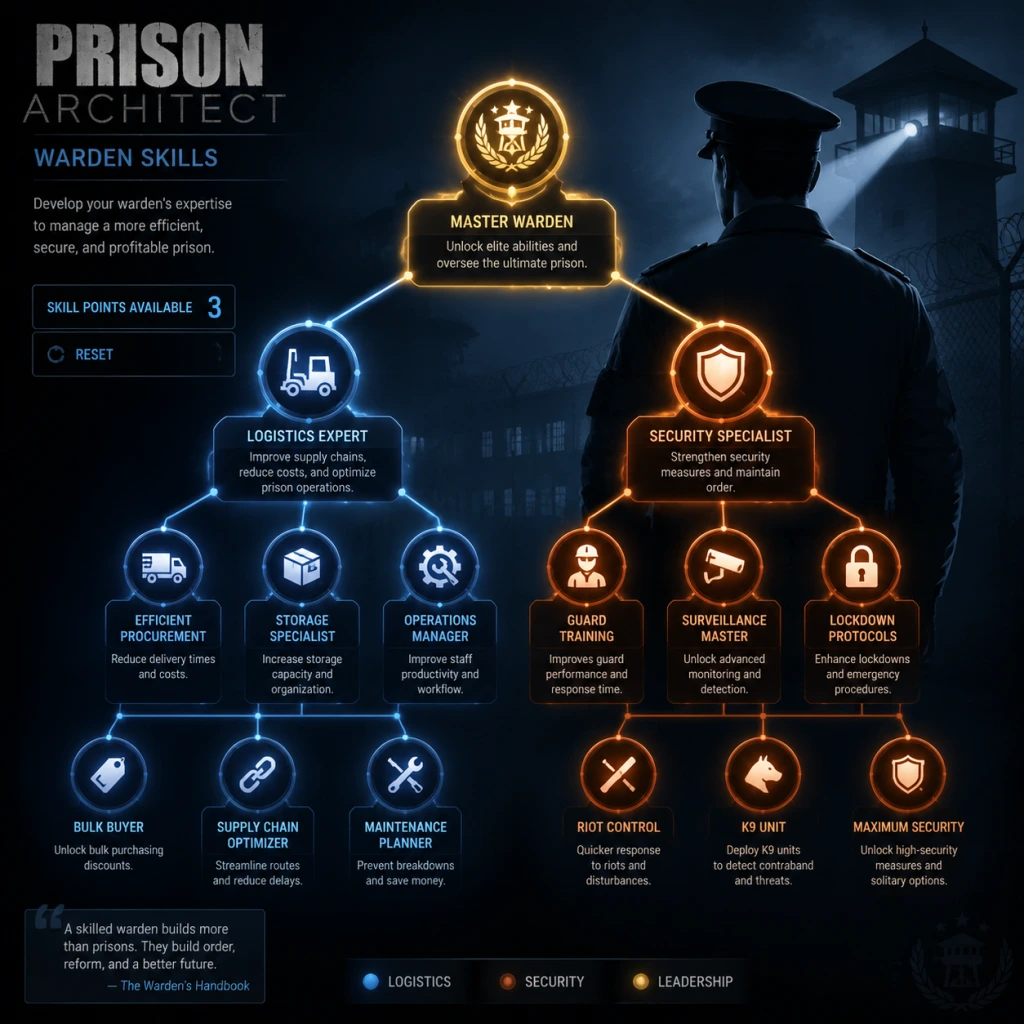
Character Skills
Character Skills Guide
Introduction
Prison Architect is a management simulation where you, the Warden, do not have traditional character skills, spells, or talent trees. Instead, the game revolves around the capabilities of your staff and the prisoners. This guide details every role (playable or controllable) and their unique skills, behaviors, and upgrades. Understanding these skills is crucial for efficient prison management, from security to rehabilitation.
Playable Roles vs. Controllable Entities
You directly control only staff (via assignment and deployment) and indirectly influence prisoners through programs, policies, and layout. There are no player-character levels or skill points—improvements come from building, hiring, and scheduling.
---
1. Staff Roles and Abilities
1.1 Guards
- Skills: Patrolling, Arresting, Searching, Cell Shakedown, Escorting, Suppressing (if armed).
- Cooldowns: None; actions are immediate but take time (searching 10–20 seconds).
- Upgrades: None directly, but hiring guards with higher aggression or speed via mods (base game has traits only for prisoners).
- Combos: Pair with Dog Handlers for contraband detection; use patrols overlapping prisoner needs zones to reduce unrest.
- Recommended Use: Assign patrol routes near high-traffic areas, canteens, and workshops. Use “Search Cell Block” during lockdowns.
- Skills: Taser (non-lethal), Lethal Shot (rifle), Freeze (all prisoners stop moving), Suppression (reduces nearby prisoner aggression).
- Cooldowns: Taser has a 5-second cooldown; lethal shot has a 10-second cooldown.
- Upgrades: None, but having more armed guards increases suppression radius.
- Combos: Use taser on an escaping prisoner, then have a regular guard arrest him. Use lethal shot only when a prisoner attacks others.
- Recommended Use: Station at armory doors, perimeter walls, and during large riots. Do not overuse lethal force—causes reputational damage.
- Skills: Contraband Sniff (detect weapons, drugs, phones in a radius), Attack (on command, bites prisoner), Patrol (moves with dog).
- Cooldowns: Sniff ability lasts 30 seconds, cooldown 10 seconds.
- Upgrades: None, but dogs can be trained via mods.
- Combos: Sniff near cell block entrances after visitation; follow with a guard search.
- Recommended Use: Patrol dog handlers along the main corridor and outside the canteen. Use Attack to subdue fights quickly.
- Skills: Prepare meals in kitchen (set menu size, variety), operate serving tables, clean kitchen (if assigned).
- Cooldowns: Cooking time depends on number of inmates and kitchen size.
- Upgrades: Hire cooks with the “Sanitary” trait (fewer food poisoning events).
- Combos: Ensure balanced meals (variety > 1) for prisoner mood boost.
- Recommended Use: One cook per 20 prisoners. Schedule eat time before work.
- Skills: Clean floor stains, Repair broken objects (if assigned), Empty Trash.
- Cooldowns: Cleaning 5–10 seconds per tile.
- Upgrades: None; hire more janitors as prison grows.
- Combos: Keep cleaning stations near kitchens and toilets to prevent smell complaints.
- Recommended Use: One janitor per 30 prisoners. Set cleaning zones via deployment.
- Skills: Plant and Maintain trees, bushes, flowers, Water plants, Remove dead foliage.
- Cooldowns: Planting instant; maintenance every 12 hours.
- Upgrades: None.
- Combos: Decorative greenery boosts prison beauty and prisoner mood. Place near visitation areas.
- Recommended Use: One gardener per 5 large rooms or 15 small planters.
- Warden: Unlocks grants, reports, and policies. No direct skills but enables programs.
- Accountant: Unlocks Grant Management (faster grant completion) and Finance Report.
- Foreman: Unlocks Workshop (prisoner labor), Construction speed boost.
- Psychologist: Unlocks Rehabilitation Programs (Behavioral Therapy, Alcoholism Treatment, etc.).
- Chief Guard: Unlocks Deployment, Patrols, and Armed Guards.
- Cooldowns: None; they provide passive bonuses and unlock features.
- Upgrades: Hire better-qualified admins via job postings (higher salary = better stats? stats are hidden, but some mods show skill).
- Combos: Hire all five to maximize prison efficiency.
- Recommended Use: Hire Warden first, then Chief Guard for security, Accountant for cash flow.
- Skills: Same as Dog Handler but with extended radius.
- Cooldowns: Same.
- Upgrades: None.
- Combos: Use for perimeter patrols.
- Carpentry: Unlocks Workshop production of beds, tables, chairs. Required for Prisoner Labor.
- Metalworking: Unlocks metal furniture production.
- Electronics: Unlocks phone, TV, computer assembly.
- Cleaning: Unlocks janitorial work.
- Kitchen Safety: Unlocks kitchen work.
- Laundry: Unlocks laundry work.
- Gardening: Unlocks gardening work.
- Teaching: Unlocks education programs (prisoner becomes a teacher).
- Upgrades: Each program takes ~2–4 days (in-game time). Prisoners with higher intelligence learn faster.
- Combos: Combine multiple work skills to reduce prison costs (e.g., laundry and kitchen).
- Recommended Use: Assign workshops early to reduce idle time and earn money.
- Literacy: Unlocks all other education courses.
- Mathematics: Unlocks Bookkeeping (prisoner can manage finances in workshop).
- General Education: Boosts intelligence and reduces re-offending chance.
- Upgrades: None; classes held in Library or classroom.
- Combos: Literacy -> Maths -> General Ed reduces reoffending significantly.
- Recommended Use: Enroll high-security prisoners to lower re-offending.
- Volatile: Prone to violence when stressed.
- Snitch: Likely to inform on other prisoners.
- Ex-Law Enforcement: High suppression and can be targeted.
- Cop Killer: Extremely high security risk.
- Documented Gang Member: Strong loyalty within gang.
- Legendary: Combines multiple negative traits + high skills.
- Effects: Traits influence need levels, learning speed, and contraband creation.
- Combos: Use Informant program to turn snitches into intelligence sources.
- Recommended Use: Segregate volatile prisoners; use protective custody for snitches.
- Hunger: Solved by canteen schedule.
- Bladder: Solved by toilets in cells and common areas.
- Recreation: Solved by yard time.
- Exercise: Solved by weights or yard equipment.
- Family: Solved by visitation.
- Comfort: Solved by quality of cell (bed, TV, radio).
- Upgrades: None; but cell quality items are upgrades.
- Combos: Satisfy needs together to reduce suppression requirement.
- Behavioral Therapy: Reduces aggression over time. Requires psychologist.
- Alcoholism Treatment: Reduces drunken behavior.
- Drug Addiction Treatment: Reduces drug use.
- Anger Management: Reduces fights.
- Cooldowns: Each session lasts 1 hour daily; progress per day.
- Upgrades: None; success depends on psychologist skill (hidden).
- Combos: Pair with work programs to give prisoners purpose and reduce recidivism.
- Recommended Use: Mandatory for high-security prisoners.
- Informant: Prisoner becomes a known snitch; you receive contraband tips.
- Elite Informant: Upgraded informant gives more detailed reports.
- Cooldowns: None; requires high trust.
- Combos: Use dog handlers to verify tips.
- Lockdown: All prisoners go to cells; guards search. No cooldown but requires deployment control.
- Call to Arms: Armed guards rush to a location; temporary suppression boost.
- Freeze (Armed Guard): Stops all prisoner movement within visual range for 3 seconds.
- Taser (Armed Guard): Single-target incapacitate; effective against escaping prisoners.
- Shakedown: Searches all cells in a sector; takes 1 hour.
- Roles: High guard-to-prisoner ratio (1:5), armed guards at every choke point, dog handlers along main corridors.
- Programs: Behavioral Therapy, Anger Management, Informant network.
- Skills Focus: Prisoner work skills in metalworking (legit economy), no education to avoid smart criminals.
- Tips: Use solitary punishment to reduce gang influence.
- Roles: Hire psychologist early, prioritize school and workshop.
- Programs: All education courses, alcohol/drug treatment.
- Skills Focus: Literacy -> General Ed, then carpentry or gardening.
- Tips: Low re-offending rewards grants. Use open-plan cells to reduce bullying.
- Roles: Minimal armed guards, rely on regular guards and snitches.
- Programs: Only informant program.
- Skills Focus: Cleaning and kitchen (self-sufficiency).
- Tips: Use dormitories instead of cells to save money.
1.2 Armed Guards
1.3 Dog Handlers
1.4 Cooks
1.5 Janitors
1.6 Gardeners
1.7 Administrators (Warden Office staff)
1.8 K9 Unit (Unlock via Deployment)
---
2. Prisoner Skills and Traits
Prisoners do not have skill trees but develop work skills and education through programs. These are listed in the Intelligence > Skills tab.
2.1 Work Skills (Learned via Workshops)
2.2 Education Skills (Learned via School)
2.3 Special Traits (Random at Arrest)
Prisoners have innate traits that affect behavior:
2.4 Needs and Their “Skills”
While not skills, prisoners’ needs (hunger, bladder, recreation, etc.) act like timers that must be met. Failure causes misbehavior. Treat each need as a passive ability that requires management.
---
3. Programs and Rehabilitation “Skills”
Programs are like training courses for prisoners. They improve prisoner behavior and unlock skills.
3.1 Foundation Courses
3.2 Security Programs
---
4. Special “Moves” and Abilities (Game Mechanics)
---
5. Recommended Builds (Strategies)
5.1 Maximum Security Build
5.2 Rehabilitation Build
5.3 Low-Cost Minimum Security Build
---
6. When to Use Each Skill/Ability
| Skill/Ability | Best Use Case | Pitfall |
|---|---|---|
| Patrol (Guard) | High-traffic areas | Wasting time if too many guards |
| Sniff (Dog) | After visitation or deliveries | Dog can be attacked by violent prisoners |
| Taser (Armed) | Escaping prisoner or lone fighter | Will incapacitate, not kill |
| Lockdown | During a riot or breach | Causes all needs to skyrocket |
| Shakedown | Weekly contraband sweep | Lowers morale if done too often |
| Work programs | Daily routine to earn money | Prisoners may smuggle tools |
| Informant | Intelligence on contraband | Prisoner marked as snitch – may get killed |
7. Synergies and Combos
- Sniff + Search + Informant: Dog detects contraband, informant reveals location, guard searches. Triple combo for maximum efficiency.
- Workshop + Carpentry + Kitchen: Prisoners produce furniture and food, reducing expenses.
- Armed Guard + Suppression + Behavioral Therapy: Reduce aggression to near zero.
- Yard + Recreation + Exercise: Satisfy multiple needs with one schedule slot.
---
8. Final Advice
Prison Architect has no skill trees for the player, but mastering the abilities of your staff and prisoners is key. Experiment with different ratios of roles, invest in programs for long-term savings, and always have a contingency for riots (armed guards + lockdown). Keep an eye on your prison’s Grading (in Reports) to adjust your skill focus. Remember: a well-trained workforce (prisoner labor) can fund your entire operation.
Now go build that perfect prison—and watch your character skills (and re-offending rates) improve.
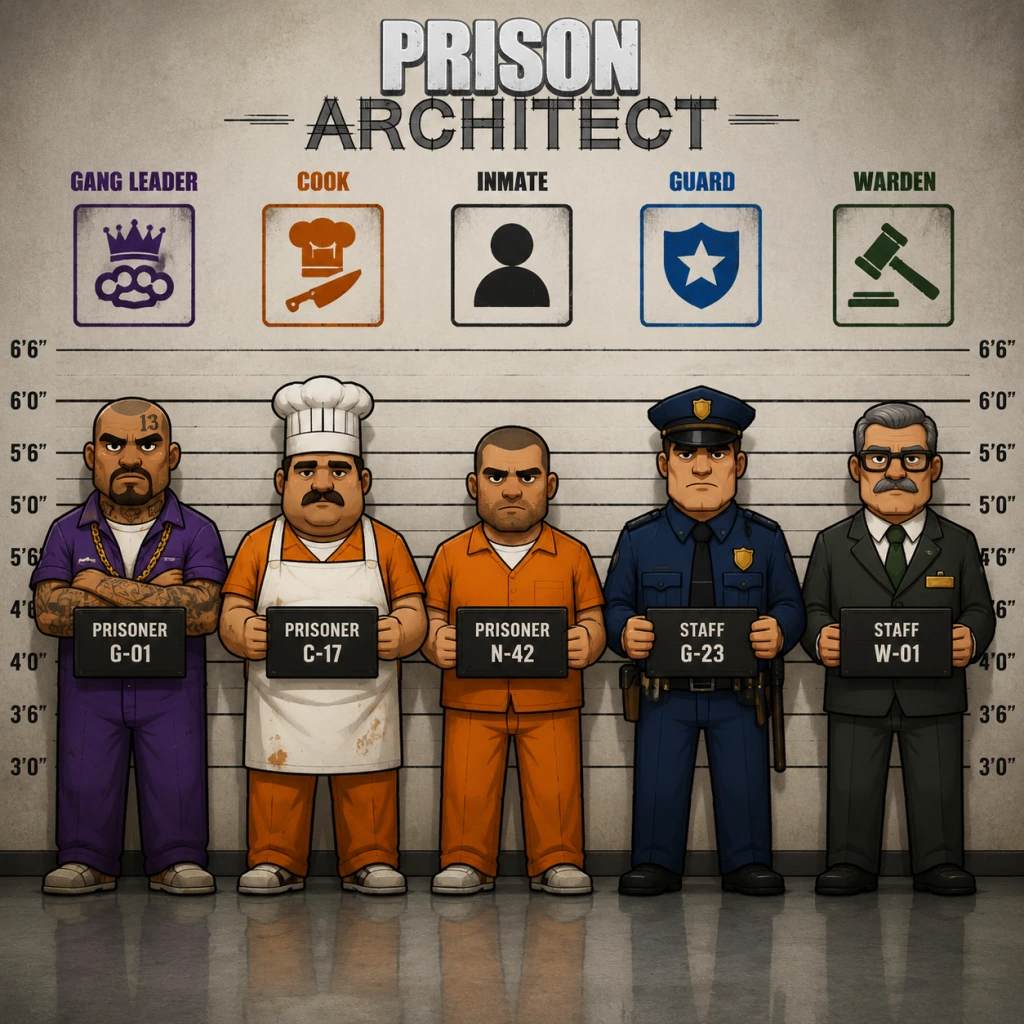
Characters & Roles
Introduction
Prison Architect is a management simulation where your playable "character" is the Warden, who orchestrates the entire prison from a top-down perspective. However, the game features a diverse cast of staff roles and inmate types that function as the core units you manage. This guide covers every major staff member, inmate classification, and special character in the base game and major DLCs (e.g., Total Lockdown, Island Bound). Each entry details their background (where applicable), strengths, weaknesses, recommended playstyle, unlock conditions, equipment or facility needs, and team synergy.
---
Staff Roles
1. Warden (Player Avatar)
- Background: You are the Warden—the ultimate authority. The game treats the Warden as a disembodied manager with no physical presence, but you can assign a name and gender.
- Strengths: Unlimited control over prison policies, construction, and finances. Can override any system.
- Weaknesses: None directly, but you rely entirely on staff for execution.
- Playstyle: Strategic macro-management. Your decisions (regime, reform programs, deployment) shape every aspect.
- Unlock: Always available from the start.
- Recommended Equipment: None; you use the user interface to command.
- Team Synergy: All staff and inmates report to your directives.
- Background: A hardened ex-corrections officer who handles security logistics.
- Strengths: Unlocks deployment screens, allows advanced patrol routing, and provides intelligence on prison security status (e.g., contraband hotspots).
- Weaknesses: Cannot physically intervene; strictly administrative.
- Playstyle: Use the Chief to assign guard patrols, manage Security Rooms, and monitor prison threats through the Security monitor.
- Unlock: Hire from the Staff tab (salary $200/day). Required for Guard Dogs and Armory.
- Recommended Equipment: A Security Room with desks and computers for surveillance.
- Team Synergy: Works hand-in-hand with Guards; the Chief’s deployment assignments dictate guard behavior.
- Background: The backbone of prison order. Guards conduct patrols, search prisoners, and respond to incidents.
- Strengths: Can be deployed to any area, perform cell searches, use tazers, and restrain prisoners.
- Weaknesses: Low morale when overworked; can be overwhelmed by large riots; require breaks.
- Playstyle: Patrol corridors, man staff doors, and respond to alerts. Use deployment screen to assign zones.
- Unlock: Hire from Staff tab ($100/day).
- Recommended Equipment:
- Team Synergy: Guards work with Dogs to sniff contraband; with armed guards (if enabled) during emergencies; with Psychiatrists when escorting volatile inmates.
- Background: Trained Belgian Malinois used for contraband detection and riot control.
- Strengths: Sniffs out hidden contraband (especially drugs, weapons) in cells, common rooms, and during patrols. Effective at intimidating prisoners.
- Weaknesses: Requires a handler (usually a Guard), can become stressed, and needs a Dog Kennel to rest.
- Playstyle: Assign dogs to patrol key areas (delivery, cells, canteens) during search operations.
- Unlock: Research "Guard Dogs" under Security, then build a Dog Kennel. Hire Handler + Dog from Staff tab ($150/day).
- Recommended Equipment: Dog Kennel with food and water bowls.
- Team Synergy: Pair with Guards on contraband patrols; dogs reduce the need for frequent cell searches.
- Background: Elite guards authorized to carry lethal firearms for extreme emergencies.
- Strengths: Instantly suppresses riots—prisoners will surrender when faced with a gun. One armed guard can quell a large fight.
- Weaknesses: High salary, can accidentally shoot unarmed staff or prisoners (lawsuit risk), and their presence increases prisoner suppression (tempers can worsen).
- Playstyle: Keep them in the Armory until needed; deploy only during major riots or to escort high-risk prisoners through dangerous areas.
- Unlock: Research "Armed Guards" (often requires high security), then build an Armory. Hire from Staff tab ($300/day).
- Recommended Equipment: Armory with weapon racks, a secure perimeter.
- Team Synergy: Use with Guards to create a phased response; armed guards should never patrol normally to avoid escalating tension.
- Background: General laborer who builds and maintains prison structures.
- Strengths: Works quickly on construction; can repair damaged objects (doors, generators) instantly.
- Weaknesses: Cannot run from prisoner attacks, easily killed during riots.
- Playstyle: Ensure they are escorted by Guards when working near dangerous prisoners. Keep construction zones secure.
- Unlock: Hire from Staff tab ($80/day).
- Recommended Equipment: Toolbox (storages); provide a Staff Room for rest.
- Team Synergy: Works alongside Foreman for specialized tasks; need Guard protection in high-security areas.
- Background: Oversees construction efficiency; your only builder who can enable “fast track” building (workers move materials faster).
- Strengths: Speeds up construction when assigned to a work zone. Unlocks advanced workshops and digging detection.
- Weaknesses: Higher salary than workmen; still vulnerable in riots.
- Playstyle: Assign to active construction zones. Build a Foreman’s Office to improve speed boost.
- Unlock: Hire from Staff tab ($130/day). Requires a planned office.
- Recommended Equipment: Foreman’s Office with desk and filing cabinet.
- Team Synergy: Directs workmen; also interacts with delivery trucks and exports.
- Background: Maintains cleanliness to prevent disease and prisoner unhappiness.
- Strengths: Cleans up blood, trash, and vomit. Reduces risk of outbreaks (flu, food poisoning).
- Weaknesses: Slow, no combat ability, easily killed.
- Playstyle: Hire one per ~25 prisoners; assign a Janitor’s Closet with mop buckets. Ensure they have clear paths to all areas.
- Unlock: Hire from Staff tab ($60/day).
- Recommended Equipment: Janitor’s Closet with mops, buckets, and a trash bin.
- Team Synergy: Works alongside Cooks to keep kitchen clean; with Doctors to reduce infection.
- Background: Prepares meals for prisoners.
- Strengths: Transforms food ingredients into quality meals. Better meal quality (variety, timing) improves prisoner mood and reduces hunger complaints.
- Weaknesses: Can be attacked by prisoners during meal times; requires a clean kitchen.
- Playstyle: Assign cooks to a Kitchen with cookers, fridges, and serving tables. Set meal times in Regime. Hire more cooks as prison population grows.
- Unlock: Hire from Staff tab ($80/day).
- Recommended Equipment: Kitchen with all necessary appliances. Prisoners can work as cooks (Kitchen Job) to reduce costs.
- Team Synergy: Supply chain: Workmen unload deliveries from trucks; Janitor cleans kitchen; Prisoner workers assist.
- Background: Provides medical care to prisoners and staff.
- Strengths: Heals injured prisoners, treats illnesses, and can revive unconscious individuals (except death). Reduces mortality rate.
- Weaknesses: Cannot treat mental traumas (Psychiatrist needed). Slow when overburdened.
- Playstyle: Build Infirmary with beds, medical cabinets. Hire one Doctor per ~20 prisoners. They auto-treat patients.
- Unlock: Hire from Staff tab ($120/day).
- Recommended Equipment: Infirmary with multiple beds, medicine cabinets. Consider hiring multiple Doctors for large prisons.
- Team Synergy: Works with Psychiatrist for holistic health; Guards need rapid response from Doctors during riots.
- Background: Mental health professional who counsels prisoners.
- Strengths: Reduces suppression and frustration, treats mental conditions (e.g., paranoia, anxiety). Unlocks reform programs like Anger Management.
- Weaknesses: Needs a Psychology Office; requires private sessions (room + chairs). Cannot effect all prisoners (some resist).
- Playstyle: Assign prisoners to therapy sessions via the Reform Programs tab. Build a Psychology Office with comfortable chairs.
- Unlock: Hire from Staff tab ($150/day).
- Recommended Equipment: Psychology Office with desk, chairs, and bookcase.
- Team Synergy: Closely linked with the Reform Programs system; works with Chief to identify at-risk inmates.
- Background: Financial officer who manages grants, exports, and budget reports.
- Strengths: Unlocks the Finance tab showing detailed income/expenditures. Allows you to apply for grants (additional funding).
- Weaknesses: No direct impact on prison operations; just administrative.
- Playstyle: Hire early to maximize grant income. Check Finance regularly for profit/loss.
- Unlock: Hire from Staff tab ($100/day).
- Recommended Equipment: Office with desk and filing cabinet.
- Team Synergy: Works with all staff via budget allocation; essential for money management.
- Background: Defends the prison against lawsuits and handles inmate grievances.
- Strengths: Reduces penalty severity from lawsuits (riots, deaths, escapes). Can expedite prisoner transfers (e.g., to Protective Custody).
- Weaknesses: Requires a Law Office; only effective if you have a dedicated room.
- Playstyle: Hire after you have a few hundred prisoners or when incidents occur. Use Prison Legal feature to assign cases.
- Unlock: Hire from Staff tab ($200/day).
- Recommended Equipment: Law Office with desk, shelves, and poster.
- Team Synergy: Works with Chief to identify legal risks; with Warden to approve new policies.
- Background: A specialist who manages shift changes and overtime.
- Strengths: Improves guard efficiency by reducing overtime fatigue; unlocks patrol scheduling.
- Weaknesses: DLC-restricted; salary cost.
- Playstyle: Assign to administrative wing; use in large prisons with 50+ guards.
- Unlock: Purchase Island Bound DLC; hire from Staff tab.
- Team Synergy: Optimizes guard rotation, reducing burnout.
- Description: Low-risk prisoners with short sentences or non-violent crimes.
- Strengths: Low base suppression; rarely start fights; good candidates for reform.
- Weaknesses: Still can escape if given chance; may become corrupted by higher-security inmates.
- Playstyle: Place in dorms or low-security wings with shared facilities. Focus on work programs (Kitchen, Cleaning). They generate income through Work.
- Unlock: Auto-assigned during Intake (tweak via Policy tab).
- Recommended Facilities: Bunk beds, common room, phone booths. Less need for armed guards.
- Team Synergy: Better suited to reform-focused Psychiatrist sessions; Cooks can train them as cooks.
- Description: Standard inmates; varied crimes and behaviors.
- Strengths: Balanced stats; manageable.
- Weaknesses: Moderate chance of fighting, contraband use. Needs more guard presence.
- Playstyle: Cells with proper amenities. Regime should include work and yard time. Install metal detectors.
- Unlock: Default intake category.
- Recommended Facilities: Workshop for work, protective custody if threatened.
- Team Synergy: Guards patrol regularly; Dogs for contraband sweeps.
- Description: Violent offenders, long sentences, high escape risk.
- Strengths: Can be used in high-intensity work (e.g., Workshop) if managed.
- Weaknesses: Highly volatile; often carry contraband; prone to assault staff and other inmates.
- Playstyle: Separate wing with stronger walls (stone), remote doors, multiple guards. Use strict regime with limited free time. Consider solitary confinement for troublemakers.
- Unlock: Set intake policy to accept Max Sec or they arrive from Secure Transport.
- Recommended Facilities: Cells with heavy doors; Guard towers; Armory nearby.
- Team Synergy: Armed guards on standby; Psychiatrist if they participate in reform (rare).
- Description: The most dangerous prisoners; usually Legendary (see below). Isolated from general population.
- Strengths: N/A – they are a threat.
- Weaknesses: Can start large-scale riots; extremely hard to suppress without armed force. Needs 24/7 guard.
- Playstyle: SuperMax wing with high security: solitary cells with remote doors, no contact with others. Use deployment to assign only Veteran guards.
- Unlock: Policy – set SuperMax status for specific prisoners in the Intelligence tab.
- Recommended Facilities: Single cells with solid walls; no windows; armed guard patrol.
- Team Synergy: Only armed guards should enter; Doctors/Janitors require escort.
- Description: Vulnerable inmates (snitches, child offenders) who need separation.
- Strengths: They stay out of trouble if protected.
- Weaknesses: Extremely low suppression; can be easily bullied; require dedicated wing.
- Playstyle: Build a separate wing with low threat; label as Protective Custody in Deployment. They can mix with Min Sec safely.
- Unlock: Policy – assign prisoners via the Intelligence tab or during intake.
- Recommended Facilities: Same as Min Sec but with enhanced doors; limited interaction with other inmates.
- Team Synergy: Guards must escort them to common areas.
- Description: Special rarity (appears randomly or via high-risk intake). Has exceptional strength, high volatility, and often unique appearance (tattoos, scars).
- Strengths: Extremely dangerous; can kill multiple guards before being subdued.
- Weaknesses: Needs constant isolation; high needs; requires special management.
- Playstyle: Immediately send to SuperMax wing with maximum security. Use tazers and armed guards. Do not assign any reform programs.
- Unlock: Randomly during intake (check their dossier).
- Recommended Facilities: SuperMax cell with solitary restriction; minimal staff interaction.
- Team Synergy: Lone management – no teamwork; use only armed guards for escort.
- Description: Rich or famous criminals with special privileges (e.g., mob boss, corrupt politician).
- Strengths: Can be bought off for reduced sentence? Actually, they demand better conditions.
- Weaknesses: Very demanding (luxury items, TV, pool table). If unsatisfied, they incite others.
- Playstyle: Offer them a High-End Cell with extras; assign them as bookkeeping or workshop workers if possible.
- Unlock: From Special Transport events (DLC).
- Recommended Facilities: Luxury cell with large bed, en-suite, TV, speakers.
- Team Synergy: Guards keep them comfortable; Janitor cleans frequently.
- Background: In Escape Mode, you control a single prisoner trying to break out.
- Strengths: Can sneak, attack guards, pick locks.
- Weaknesses: Must avoid detection; gets tired, injured.
- Playstyle: Stealth – gather information, craft tools, escape through tunnels or walls.
- Unlock: Start a new Escape Mode game (DLC or base game?). Actually, Escape Mode is part of base game.
- Recommended Equipment: Contraband (screwdriver, uniform, keys) found in prison.
- Team Synergy: None; you are alone.
- Background: Prisoner who provides information to guards.
- Strengths: Reveals contraband and escape plans to guards.
- Weaknesses: Other prisoners will attack them if discovered.
- Playstyle: Keep them in Protective Custody; use intelligence to plan searches.
- Unlock: Random trait on inmate.
- Recommended Facilities: Hidden protection (PC wing).
- Team Synergy: Works with Chief to identify threats.
- Not a character but a description.
2. Chief of Security
3. Guard
- Tazers (research required) for non-lethal suppression.
- Body Armor for reduced injury risk.
- Staff Needs (toilets, breaks) to maintain efficiency.
4. Guard Dog (K9 Unit)
5. Armed Guard
6. Workman (Construction Worker)
7. Foreman
8. Janitor
9. Cook
10. Doctor
11. Psychiatrist
12. Accountant
13. Lawyer
14. Guard Supervisor / Chief of Staff? (DLC - Island Bound)
(Other DLC staff include Auctioneer, Fisherman, etc., but these are mostly cosmetic or very niche.)
---
Inmate Types & Security Classifications
1. Minimum Security
2. Medium Security
3. Maximum Security
4. SuperMax
5. Protective Custody
6. Legendary Prisoner
7. High-Profile Prisoner (DLC – Total Lockdown)
(Other inmate types exist due to need profiles (e.g., constant Banging, Vandalism), but these are facets rather than distinct classes.)
---
Special Characters & DLC Additions
1. Escaped Prisoner (Escape Mode)
2. Snitch (Inmate with Informant Status)
3. The Accountant’s “Grant Giver” (Non-entity)
(Island Bound adds Prisoner Dockers, Fishermen, etc., but they function as staff or prisoners with minor distinct roles.)
---
Conclusion
In Prison Architect, your “characters” are the staff you hire and the prisoners you incarcerate. Mastering the strengths and weaknesses of each role is key to running an efficient, secure, and profitable prison. Use this guide to tailor your hiring, facility placement, and deployment strategies for every type of inmate and staff member.
Cheats & Secrets
Cheats & Secrets
Introduction
Prison Architect does not include traditional cheat codes (like invincibility or level skips) found in arcade-style games. However, it features a Developer Console that provides debugging and quality-of-life commands, along with several hidden Easter eggs and references that reward observant players. This guide covers all known legitimate secrets, commands, and hidden content.
---
Developer Console
The console is a built-in tool originally used by developers for testing. It can be used to alter game state, view debug overlays, and unlock features.
#### How to Activate
- Windows/Linux: Press `Ctrl` + `Alt` + `Shift` + `C` simultaneously.
- macOS: Press `Cmd` + `Alt` + `Shift` + `C`.
If the console opens, you will see a text input line at the top of the screen. Type commands and press `Enter` to execute.
#### Useful Commands
| Command | Description | Example / Notes |
|---|---|---|
| `help` | Lists all available commands (often 40+) | Use this first to see everything available in your version. |
| `addmoney [amount]` | Adds instant cash to your available funds. | `addmoney 100000` – gives $100,000. |
| `debug` | Toggles debug overlay (shows pathfinding, needs, and other behind-the-scenes data). | Useful for spotting pathing issues or prisoner needs. |
| `intelligence` | Toggles intelligence overlay (displays each prisoner’s hidden stats like health, needs, etc.). | Great for diagnosing problems with specific inmates. |
| `unlockall` | Unlocks all research items in the current prison (requires the game to be unpaused). | No example needed; simply type and watch the research tree fill. |
| `noise` | Toggles noise overlay (shows sound levels affecting suppression and escape planning). | Handy for controlling suppression and gang activity. |
| `temperature` | Toggles temperature overlay (only if the Psych Ward DLC is installed). | Shows heat/cold values per room. |
| `sway` | Toggles “sway” – makes prisoners more or less likely to attempt escapes. | Use with caution; can break your prison’s balance. |
| `tunneler` | Toggles tunneler detection overlay (highlights prisoners digging tunnels). | Equivalent to the in-game snitch informant, but always active. |
---
Easter Eggs & Hidden Content
#### 1. “The Cake is a Lie” Achievement / Reference
- Details: If you rename any prisoner to “GLaDOS” (case-sensitive), the prisoner will periodically say “The cake is a lie” in the dialogue box. This is a direct reference to Portal.
- Also: Typing `the cake is a lie` (all lowercase) into the console triggers a short pop‑up message: “But it is.” – a nod to Portal’s iconic line.
- Details: When you build a CCTV Monitor in the Security room, there is a small chance that the screen displays a film poster parodying The Shawshank Redemption (with a prisoner crawling through a tunnel). The poster is very low-resolution but visible on zoom.
- Details: If a prisoner dies (or is executed) and their body is taken to the Morgue, there is a rare animation where a Grim Reaper appears, walks over the corpse, and then vanishes. This is purely cosmetic and does not affect gameplay.
- Also: In the Morgue, the drawer icons sometimes show a skeleton with a funny hat or a smiley face.
- Details: On the main menu, click the Introversion logo repeatedly (at least 10 times). A hidden splash screen appears showing a “don’t panic” message and small easter egg text: “You have found the secret button. Good job.”
- Details: In the game’s installation files, inside the `data/` folder, there is a text file named `EasterEgg.txt` containing the sentence: “Prisoners are people, too.” This was a subtle reminder from the developers about rehabilitation.
- Details: If you name a Cell Block “Supermax” (exactly, capital S), the prisoners assigned to that wing will have slightly higher max security requirements and be more resistant to reforms. This is a deliberate developer nod to real‑world supermax prisons, though its effects are minor.
- Details: A persistent player rumor claims there is a secret “Nuclear Option” button that erases your prison. This does not exist. The only way to destroy your prison is via mods or the console (`addmoney` then demolish everything yourself).
- Creative Mode: Accessible from the main menu → New Game → Creative Mode. You start with unlimited money, all research unlocked, and no requirements for prisoner intake. This is the official sandbox mode.
- In‑Game Mod Browser: Many mods on the Steam Workshop or Paradox Mods add cheat-like features, such as infinite money, instant building, or no contraband. These mods are safe and do not trigger any cheat prevention, though they may disable achievements if they alter core game files.
- The Developer Console commands are not considered cheating by the game (you cannot be banned), but some commands may cause instability or corrupt your save if used incorrectly.
- Achievements are disabled in Creative Mode and may be disabled after using console commands in a normal mode save (test per session).
- All Easter eggs listed are harmless and purely cosmetic.
#### 2. Shawshank Redemption Poster
#### 3. Grim Reaper / Morgue Skeleton
#### 4. Introversion Software Logo Clicks
#### 5. “Prisoners are People” – Hidden Message
#### 6. Supermax Wing Reference
#### 7. “Nuclear Option” Myth
---
Mods and Creative Mode (Legitimate Alternatives)
If you want an easier experience without technically “cheating,” the game offers:
---
Important Notes
---
Conclusion
While Prison Architect lacks flashy cheat codes, the Developer Console provides powerful tools for players who want to bypass financial or research constraints. The Easter eggs add charm and show the developers’ love for pop culture references. For a more casual experience, Creative Mode or quality‑of‑life mods are recommended over raw console commands. Use these secrets wisely, Warden!