Stardew Valley
## Game Introduction: Stardew Valley ### Overview **Stardew Valley** is a critically acclaimed open-ended farming simulation RPG developed solely by Eric Barone (also known as ConcernedApe) and published by Chucklefish (original PC release) and later self-published. It combines elements of farming,...
Download & Installation
Download & Installation Guide for Stardew Valley
This guide covers everything you need to download and install Stardew Valley on all major platforms: PC (Steam, Epic Games Store, GOG), PlayStation 4/5, Xbox One/Series X|S, Nintendo Switch, and mobile (iOS/Android). We'll walk you through legitimate sources, step-by-step installation, system requirements, storage space, account needs, first launch setup, common errors, and post-install verification.
1. Official Download Sources
Stardew Valley is developed by Eric "ConcernedApe" Barone and published by various partners. Always use official storefronts to ensure you get a legitimate copy with updates and support. Avoid pirated versions or key resellers of dubious origin.
| Platform | Official Store(s) | Notes |
|---|---|---|
| PC | [Steam](https://store.steampowered.com/app/413150/Stardew_Valley/)<br>[Epic Games Store](https://store.epicgames.com/en-US/p/stardew-valley)<br>[GOG.com](https://www.gog.com/en/game/stardew_valley) (DRM-free) | All versions are identical in content, though GOG offers offline installers. Steam and Epic require their respective launchers. |
| PlayStation 4/5 | PlayStation Store | Works on PS5 via backward compatibility; a native PS5 version is also available. |
| **Xbox One / Series X\ | S** | Microsoft Store (Xbox) |
| Nintendo Switch | Nintendo eShop | No cross-save with other platforms (unless using mods/save editors). |
| Mobile | [App Store (iOS)](https://apps.apple.com/us/app/stardew-valley/id1406713184)<br>[Google Play (Android)](https://play.google.com/store/apps/details?id=com.chucklefish.stardewvalley) | Mobile versions have adapted touch controls and some exclusive features (like auto-save). Paid app (no ads). |
2. System Requirements
#### PC (Steam, Epic, GOG)
- Minimum:
- Recommended:
- Note: The game is lightweight and runs on almost any modern computer. Even integrated graphics (Intel UHD) handle it fine.
- Console-specific requirements are handled by the platform. Just ensure you have enough free storage.
- PS4/PS5: ~1 GB free.
- Xbox One / Series X|S: ~1 GB free.
- Download size: ~1.1 GB. Ensure sufficient free space on system memory or microSD card.
- iOS: Requires iOS 13.0 or later. Compatible with iPhone, iPad, and iPod touch.
- Android: Requires Android 5.0 (Lollipop) and up. Optimized for phones and tablets. ~500 MB free space.
- iOS (iPhone/iPad):
- Android:
- Steam: Free Steam account needed.
- Epic Games: Free Epic account.
- GOG: Free GOG account (if using Galaxy).
- PlayStation: PlayStation Network account (free, but you may need PS+ for online multiplayer on console versions; however, Stardew Valley's multiplayer is peer-to-peer and does not require PS+ on PS5? Actually on PS4/5 you need PS+ for any online multiplayer. For PS4, yes, you need PS Plus to play multiplayer. On PS5, also requires PS Plus for online play. Check current Sony policy.)
- Xbox: Xbox Live account (free tier is enough for single-player; Xbox Game Pass Core or Ultimate required for online multiplayer on Xbox consoles).
- Nintendo Switch: Nintendo Account (free). Online multiplayer requires Nintendo Switch Online membership.
- Mobile: No account needed – purely offline.
- Error: "Missing redistributable" – The game requires DirectX and Visual C++ runtimes. Install from the _CommonRedist folder in the game's installation directory (Steam: `...\steamapps\common\Stardew Valley\_CommonRedist`).
- Game won't launch / black screen – Try:
- Crash due to mods – If you have mods installed (SMAPI), update them or remove `Mods` folder temporarily.
- Save file corruption – Backup saves regularly (located in `%AppData%\StardewValley\Saves` on Windows).
- No sound – Check audio device settings, ensure not muted in game. Reinstall audio drivers.
- Low FPS – Lower resolution, disable lighting effects, turn on framing limit.
- Download stuck – Pause and resume download, or restart console.
- Installation failed – Check free space, delete unnecessary data, restart console.
- Game crashes on startup – Fully restart the console, check for system updates.
- Multiplayer not connecting – Ensure you have the required online subscription (PS Plus, Game Pass Core/Ultimate, Nintendo Switch Online). Check NAT type (open is best).
- App won't install – Restart device, check internet connection, free up storage.
- Game freezes – Force close the app, restart device. Update to latest version.
- Touch controls not responding – Restart app. If persists, reinstall (backup saves first: saves are stored locally; on iOS you can use iCloud backup; on Android, they are in `Android/data/com.chucklefish.stardewvalley/files/Saves`).
- In-app purchase issues (none exist) – Most mobile issues are due to outdated OS. Update to latest.
- OS: Windows 7+, macOS 10.12+, Ubuntu 16.04+ (Linux)
- Processor: 2 GHz (dual-core)
- Memory: 2 GB RAM
- Graphics: 256 MB VRAM (DirectX 10 / OpenGL 3.0 capable)
- Storage: 500 MB free (note: the game itself is ~400 MB, but extra save files/mods require more)
- DirectX: Version 10
- OS: Windows 10/11, macOS 10.15+, Ubuntu 20.04+
- Processor: 2.5 GHz (quad-core)
- Memory: 4 GB RAM
- Graphics: 512 MB VRAM or better (DX11 / OpenGL 4.0)
- Storage: 1 GB free (for saves, mods, optional content)
- DirectX: Version 11
#### PlayStation & Xbox
#### Nintendo Switch
#### Mobile (iOS/Android)
3. Step-by-Step Installation
#### 3.1 PC (Steam Method – Most Common)
1. Install Steam – If you don't have Steam, download the installer from [store.steampowered.com](https://store.steampowered.com) and install it.
2. Create/Log into Steam account – You need a free Steam account.
3. Purchase Stardew Valley – Search for "Stardew Valley" in the Steam store, add to cart, and complete purchase (USD $14.99, often discounted).
4. Download the game – In your Steam Library, find Stardew Valley, click Install. Choose a drive/folder (default is fine). Steam downloads and installs automatically.
5. Launch – Once downloaded, click Play. The game may check for updates on first launch.
#### 3.2 PC (Epic Games Store)
1. Install Epic Games Launcher from [epicgames.com](https://www.epicgames.com).
2. Log in or create a free Epic account.
3. Purchase Stardew Valley from the Epic Store (or claim if free period).
4. Install – Go to Library, find Stardew Valley, click Install.
5. Launch – Click Launch after installation.
#### 3.3 PC (GOG.com – DRM-free)
1. Create GOG account and purchase from [gog.com](https://www.gog.com).
2. Download GOG Galaxy (optional launcher) or download offline installer directly.
3. Via GOG Galaxy: Install Galaxy, log in, go to Library, click Install on Stardew Valley.
4. Offline installer: Download the executable (.exe) file(s). Run the installer – it will extract files to a folder of your choice. No launcher needed; run `StardewValley.exe` directly.
#### 3.4 PlayStation 4/5
1. Power on console and sign in to your PlayStation Network account.
2. Open PlayStation Store.
3. Search for "Stardew Valley".
4. Purchase (USD $14.99).
5. Download – The game will automatically add to your download queue. You can monitor progress from the home screen.
6. Install – It installs automatically after download.
7. Launch – Select the game tile on home screen.
Note: PS4 version works on PS5. There is also a native PS5 version with 4K support; buy whichever is listed (often the same product).
#### 3.5 Xbox One / Series X|S
1. Sign in to your Xbox Live / Microsoft account.
2. Open Microsoft Store on console.
3. Search for Stardew Valley.
4. Purchase and Install – It will download and install automatically.
5. Launch – From the home screen or Games & Apps.
Play Anywhere: If you buy the Xbox version from the Microsoft Store, you can also install it on Windows 10/11 PC via the Xbox app (same license).
#### 3.6 Nintendo Switch
1. Turn on Switch and connect to internet.
2. Open Nintendo eShop from the home menu.
3. Log in to your Nintendo Account.
4. Search for Stardew Valley.
5. Purchase (USD $14.99).
6. Download – The game will start downloading automatically. You can see progress on the home screen.
7. Install – After download, the icon appears. Launch it.
Tip: Ensure you have enough free space – check under System Settings → Data Management.
#### 3.7 Mobile (iOS/Android)
1. Open App Store.
2. Search "Stardew Valley" (developer: Chucklefish Limited).
3. Tap Get and authenticate with Face ID / Touch ID / password.
4. Download completes automatically; tap Open.
1. Open Google Play Store.
2. Search "Stardew Valley".
3. Tap Install.
4. Accept permissions.
5. Launch from app drawer.
Note: Mobile version is a paid app (no in-app purchases, no ads). It includes the same core content as PC but with touch controls and auto-save. Multiplayer is not available on mobile.
4. Account Requirements
5. First Launch Setup
When you start Stardew Valley for the first time, you will see:
1. Title Screen – Options: New, Load, Co-op, Settings, Exit.
2. Settings – Before starting a new game, you may want to adjust:
- Language (English, German, French, etc.)
- Audio (music/SFX volume)
- Graphics (windowed/fullscreen, resolution, lighting quality)
- Controls (keyboard/mouse or gamepad)
- Zoom (default 100%)
3. New Game – Press "New".
4. Character Creation – Choose gender, skin color, shirt, pants, etc. Name your farmer, farm, and favorite thing.
5. Select Farm Map – There are 7 farm types (Standard, Riverland, Forest, Hilltop, Wilderness, Four Corners, Beach). Each affects layout and resources. Default is Standard.
6. Naming Pets – You'll be asked to name a cat or dog later (minor).
7. Intro cutscene – After creation, the game begins with a short scene and your arrival at Pelican Town.
8. Tutorial – The game is open-ended. Follow the initial quests from the start menu (check your journal).
Multiplayer: If you start Co-op, you can host or join via LAN/IP. On consoles/Switch, you need the appropriate online subscription.
6. Common Installation Errors and Fixes
#### PC (Steam/Epic/GOG)
- Update graphics drivers.
- Verify game files on Steam (right-click game → Properties → Local Files → Verify integrity).
- Run in windowed mode: edit startup command line in Steam launch options: `-windowed`.
- Disable mods if any.
#### Console (PlayStation, Xbox, Switch)
#### Mobile (iOS/Android)
7. Post-Installation Verification
After installing successfully, perform these checks to ensure everything works:
1. Launch the game – You should see the title screen without errors.
2. Check game version – On title screen, version number is displayed at top left (e.g., v1.6.4). Ensure it's the latest. For PC, check Steam changelog. For consoles, update via system.
3. Test basic controls – Move character, open inventory (E on PC, X on Xbox, Square on PS, Y on Switch, touch on mobile).
4. Test save/load – Start a new game, play for 1 in-game day, then save and exit (through menu). Reload the save.
5. Test audio – Hear background music and sound effects (chopping wood, watering).
6. Test multiplayer (optional) – If you plan to play with friends, host a game and have a friend join (or use a second device).
7. Mod compatibility (PC only) – If you plan to mod, install SMAPI (Stardew Modding API) from [smapi.io](https://smapi.io). Run `StardewModdingAPI.exe` to launch modded game. Check logs for errors.
Save file location (PC): `%AppData%\StardewValley\Saves` (Windows) / `~/.config/StardewValley/Saves` (Linux) / `~/Library/Application Support/StardewValley/Saves` (macOS). Backup these folders occasionally.
8. Storage Space Summary
| Platform | Download Size | Install Size | Extra for saves/mods |
|---|---|---|---|
| PC (Steam/Epic) | ~500 MB | ~500 MB | ~10 MB per save, mods vary |
| PC (GOG offline) | ~500 MB (zipped) | ~500 MB | Same |
| PlayStation | ~1 GB | ~1 GB | Minimal |
| Xbox | ~1 GB | ~1 GB | Minimal |
| Nintendo Switch | ~1.1 GB | ~1.1 GB | Minimal |
| iOS | ~500 MB | ~500 MB | Save data grows with progress |
| Android | ~500 MB | ~500 MB | Same |
9. Additional Tips
- Cross-save/Cloud saves:
- Uninstalling: Uninstall via your platform's usual method (e.g., Steam Library right-click → Manage → Uninstall). Saves remain unless manually deleted.
- Redownloading: You can reinstall at any time from your purchase library. No extra cost.
- Getting help: Official wiki at [stardewvalleywiki.com](https://stardewvalleywiki.com) or community forums.
- Steam, Epic, GOG Galaxy support cloud saving. Console cloud saves require respective subscriptions.
- Mobile does not have built-in cloud saves (manual backup required).
- No cross-platform transfers are officially supported (except Xbox/PC via Play Anywhere).
This guide covers all legitimate ways to enjoy Stardew Valley. Happy farming!
Game Introduction
Game Introduction: Stardew Valley
Overview
Stardew Valley is a critically acclaimed open-ended farming simulation RPG developed solely by Eric Barone (also known as ConcernedApe) and published by Chucklefish (original PC release) and later self-published. It combines elements of farming, life simulation, dungeon exploration, crafting, and social interaction into a charming, pixel-art world.
Genre
Farming simulation, life simulation, role-playing game (RPG), sandbox, with light action-RPG combat in mines.
Developer & Publisher
- Developer: Eric Barone (ConcernedApe)
- Original Publisher (PC): Chucklefish
- Self-published for later ports and updates by ConcernedApe.
- 26 February 2016 – Microsoft Windows (Steam, GOG, Epic Games Store)
- 29 July 2016 – macOS, Linux
- 11 October 2016 – PlayStation 4, Xbox One
- 13 December 2016 – Nintendo Switch (later, by Chucklefish)
- 22 May 2020 – Nintendo Switch (retail/physical)
- 10 June 2020 – PlayStation 5 (backward compatible, enhanced later)
- 15 September 2020 – Xbox Series X|S (backward compatible)
- 8 December 2020 – iOS, Android (mobile versions by The Secret Police)
- Planned: 1.6 update (PC beta early 2024, full release later; console/mobile to follow)
- PC: Windows, macOS, Linux (Steam, GOG, Epic Games Store, Humble Bundle)
- Console: PlayStation 4, PlayStation 5 (backward compatible), Xbox One, Xbox Series X|S, Nintendo Switch, PlayStation Vita (cross-buy with PS4, limited)
- Mobile: iOS (App Store), Android (Google Play Store)
- Robin – Carpenter, resourceful mother.
- Pierre – General Store owner.
- Lewis – Mayor of Pelican Town.
- Abigail – Adventurous young woman, part of the 'bachelor/bachelorette' marriage candidates.
- Sebastian – Brooding programmer, romantic interest.
- Penny – Kind-hearted tutor.
- Gus – Saloon owner.
- Marnie – Livestock keeper.
- Linaus – Hermit living in a tent.
- Krobus – Shadow creature merchant (can become a roommate).
- And over 20 more unique NPCs, each with friendship events and stories.
- Freedom & Choice: Play at your own pace – farm, fish, mine, craft, fight monsters, cook, socialize, or decorate.
- Relaxing yet Deep: Simple mechanics with deep progression: crop quality, artisan goods, skill levels, combat upgrades, community center bundles, etc.
- Charming Pixel Art & Music: Hand-drawn sprites, animated cutscenes, soothing soundtrack by ConcernedApe himself.
- Rewarding Loop: Each day yields progress, seasonal events keep you invested, and secrets abound.
- Players who enjoy slower-paced, creative games (fans of Harvest Moon, Animal Crossing, or terreria-like crafting).
- RPG fans who enjoy light combat and character relationships.
- Anyone seeking a relaxing yet engaging single-player experience or cooperative play.
- Single Player: Main game with full story, marriage, children, endgame content.
- Multiplayer (Co-op): Up to 4 players (PC, console, mobile via LAN/online) can share a farm, progress together, and marry NPCs or other players (with certain restrictions). Host must have a save file, guests join via invite.
- Offline: Entire single-player experience is fully offline.
- Online: Multiplayer requires internet connection for hosting/joining games; peer-to-peer architecture. No dedicated servers.
- 1.1 (October 2016): Added marriage candidates, new farm maps, and more.
- 1.3 (August 2018): Introduced multiplayer.
- 1.4 (November 2019): Added new endgame areas, 14-heart events, fish ponds, new items, 60+ new outfits, and many UI improvements.
- 1.5 (December 2020): Largest update yet: Ginger Island (new region), new farm type, new weapons, mechanics like Qi's challenges, farming on island, new NPCs, and endgame content. Also added Beach Farm and new crafting recipes.
- 1.6 (coming 2024): Announced to include new festival content, dialogue, changes to endgame, and more (PC beta expected early 2024).
- One Developer: Eric Barone created almost everything himself – code, art, music, story – making it a labor of love with a personal touch.
- Endless Replayability: Choose different farm maps, community center bundles vs Joja route, different spouse, different skill builds – each playthrough feels distinct.
- Community & Mods: Extremely active modding community (PC) with thousands of mods that expand everything from graphics to new crops, storylines, and automation.
- Cross-platform Saves: No native cross-save, but some platforms share cloud saves (Steam, GOG, consoles have separate cloud saves).
- No Microtransactions: The game has a one-time purchase price; no in-game purchases, no paid DLC. All content updates are free.
Release Timeline
Platforms
Story Overview
You inherit your late grandfather’s old farm in Stardew Valley, a small rural town where your grandfather once enjoyed a peaceful life. Tired of the corporate grind in the city of Zuzu, you move to Pelican Town to start a new life. Your goal is to restore the overgrown farm to prosperity, while also uncovering the secrets of the valley, helping the community, and perhaps discovering the truth behind the mysterious Joja Corporation that threatens the local economy.
Setting
Pelican Town and its surrounding areas: forests, mines, beach, mountains, desert, and the magical realm of the Wizard's Tower. The valley changes with seasons (spring, summer, fall, winter) and has a vibrant ecosystem of crops, forageable items, and wildlife.
Main Characters (some of the many villagers)
Core Appeal
Target Audience
Game Modes
- Platform specifics:
- PC: Online (Steam invites, GOG Galaxy, Epic) or LAN.
- Consoles: Online via PlayStation Plus (PS4/PS5), Xbox Game Pass Core (Xbox One/Series X|S), Nintendo Switch Online (Switch).
- Mobile: No online multiplayer as of latest version (only local LAN if supported via mods, but not official).
Online / Offline Support
DLC / Expansions Overview
Stardew Valley has no paid DLC or expansions; all major content updates have been free. Notable updates:
Mobile versions are often behind; currently at 1.5 (as of early 2024) with 1.6 expected later.
What Makes Stardew Valley Unique
For download and installation instructions, see the [Download & Installation Guide] section.
Getting Started
Getting Started
Welcome to Stardew Valley! This guide will walk you through everything you need to know to start your new life on the farm. We’ll cover character creation, controls, UI, your first hour, early objectives, common pitfalls, and a day-one checklist.
Character Creation (No Impact, But Make It Fun)
When you start a new game, you’ll be asked to create your character. This is purely cosmetic – no stats, skills, or story changes based on your choices. You can even change your appearance later for 500g at the Wizard’s tower. So just pick a look that you like.
- Name & Farm Name: Your character name and farm name will appear in dialogue. Choose something you won’t get tired of.
- Favorite Thing: This determines the message you see when you eat a Stardrop (a rare permanent energy upgrade). It’s fun, but not critical.
- Pet Preference: You’ll eventually get a cat or dog. Choose whichever you prefer – both are purely cosmetic.
- Appearance: Hair, shirt, pants, accessories – all changeable later.
Controls Overview (All Platforms)
Stardew Valley is available on PC, PlayStation, Xbox, Nintendo Switch, and mobile. Controls are similar but have platform-specific buttons.
#### PC (Keyboard & Mouse)
| Action | Key/Button |
|---|---|
| Move | WASD |
| Interact / Use Tool | Left Mouse Click |
| Action (second button) | Right Mouse Click |
| Run by default | Hold Left Shift (or toggle in settings) |
| Open Inventory | E |
| Open Journal/Quests | F |
| Open Map | M |
| Use Item in Hand | Press number keys (1-0) |
| Menu / Pause | ESC |
- Move: Left Stick
- Interact/Action: X button
- Cancel/Menu: Circle button
- Open Inventory: Touchpad (or Options button then select Inventory)
- Open Map: Touchpad (hold) or Options
- Toolbar: D-Pad left/right to select item, or L2/R2 to scroll
- Run: Hold R1
- Move: Left Stick
- Interact/Action: A button
- Cancel/Menu: B button
- Open Inventory: View button (two overlapping boxes) or Menu button
- Open Map: View button (hold) or Menu
- Toolbar: D-Pad left/right, or LB/RB to scroll
- Run: Hold RB
- Move: Left Stick
- Interact/Action: A button
- Cancel/Menu: B button
- Open Inventory: X button
- Open Map: Y button (hold for full map)
- Toolbar: D-Pad left/right, or L/R to scroll
- Run: Hold B (or toggle in options)
- Move: Tap or drag where you want to go (auto-pathfinding listens)
- Interact: Tap on an object (e.g., a rock to swing pickaxe)
- Open Inventory: Tap the backpack icon on screen
- Toolbar: Swipe left/right on the toolbar at the bottom, or tap a slot
- Run: Auto-run by default; toggle in settings
- Controls can be customized: In Settings > Controls, you can choose between tap-to-move, joystick, or button overlay.
- Plant your parsnips immediately on day 1.
- Forage for food (spring onions, berries) to eat for energy.
- Talk to NPCs as you see them (increases friendship).
- Check TV every day for tips and recipes.
- Sleep before 2:00 AM.
- Save some money for seeds on day 2 or 3.
- Chop down trees on day 1 – too much energy for little reward.
- Hit rocks with your axe – use the pickaxe.
- Attack townsfolk – you can’t (tools don’t interact with them).
- Buy animals in spring (Barn/Coop are end of spring projects).
- Ignore the Community Center – but don’t rush it; it’s long-term.
- Read the entire wiki – spoils discovery. Use it only for specific questions.
- Try to complete everything in one season – impossible. Pace yourself.
#### Xbox (Xbox One/Series X|S)
#### Nintendo Switch
#### Mobile (iOS/Android)
UI Overview (Key Elements)
Your screen has several important parts:
1. Toolbar (Hotbar): The row at the bottom shows your currently held items. You carry 12 items (36 if you upgrade to a larger backpack). You can equip tools, weapons, food, or seeds here.
2. Health & Energy: Two bars at the top of the screen. Green = Energy (used for almost everything), Red = Health (takes damage from monsters or hazards). If Energy hits zero, you collapse and wake up in bed (half energy next day). If Health hits zero, you also lose some money and items.
3. Time & Date: Top-right corner shows the current time (from 6:00 AM to 2:00 AM) and the day/season (e.g., "Spring, Day 1").
4. Mini-map: Top-right square shows a simple map of your current area.
5. Quest Notifications: Appear on the left side when you receive a letter or quest update.
Press inventory key (E on PC, etc.) to see full backpack, skills, relationship, and map tabs.
The First Hour: Step-by-Step Walkthrough
Day 1 (Spring 1) – This is your first day. Follow these steps to avoid wasting time.
1. Wake up (6:00 AM). The game starts with a brief cutscene where Robin (the carpenter) visits. She’ll tell you to check your TV and mailbox.
2. Check the TV – Change channels until you find the "Livin' Off The Land" channel for tips, and then the weather forecast (important tomorrow). You can also watch the Queen of Sauce on Sundays for cooking recipes.
3. Check your mailbox – You’ll have a letter from the Governor? Actually the first day usually has a letter from your grandpa. Read it, then ignore for now.
4. Explore your house – You have a kitchen (empty until you upgrade), a bedroom, and a living room. There’s a calendar on the wall (shows birthdays and events).
5. Go outside – Your farm is overgrown with grass, rocks, sticks, and weeds.
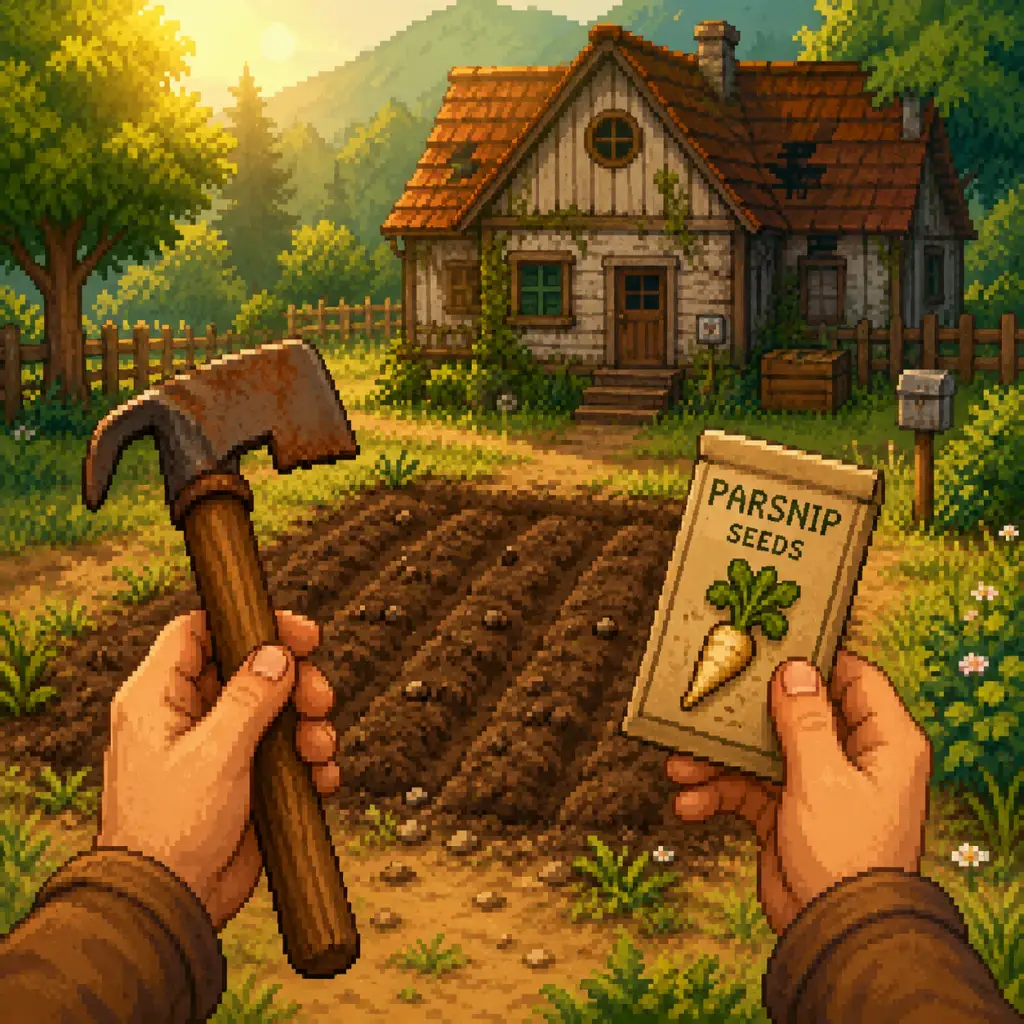
6. Meet Robin outside – She gives you 15 parsnip seeds and simple instructions. Plant them immediately.
- How to plant: Clear a small patch of ground using the hoe (select it from toolbar, then left click/tap/A on the ground). It will till the soil. Then select the parsnip seeds and left click/tap/A on the tilled soil. Water them with the watering can (select it, then hold action and release to water a 3-tile area if you hold). Water each spot until blue.
7. Use up your energy wisely – You start with about 270 Energy. Hoeing and watering consume 8 Energy per tile. Stick to planting just those 15 parsnips for now. Don’t try to clear the whole farm.
8. Head to town – After planting, walk south from your farm to Pelican Town. Explore the area. You’ll see residents, the Community Center (locked), shops, and Pierre’s General Store.
- Visit Pierre’s: Inside, you can buy more seeds, but save your 500g for later.
- Visit the Beach (south of town): Forage for shells, coral, and other items.
- Visit the Forest (west of town): Forage for berries, leeks, etc.
9. Forage – Collect any wild spring onions, daffodils, or other foragables. These are free energy or can be sold.
10. Return home before 2:00 AM – If you pass out outside, you lose money. At 12:00 AM you start getting tired, and movement slows. By 2:00 AM you collapse.
11. Save the game – The game autosaves every night when you go to sleep. At 6:00 AM the next day, you’ll have a new day.
Day 2 – Water your parsnips (they take 4 days to grow). Continue exploring. Talk to townsfolk (they like gifts and words). Go fishing (Willy gives you a rod on day 2 if you visit the beach before noon). Fishing is tricky at first – practice.
Pro Tip: On day 1, do NOT try to chop down trees or break big rocks – that uses too much energy. Wait until you have food to restore energy.
Essential Early Objectives
1. Plant and harvest parsnips – Your first source of income. Sell them raw or cook later.
2. Upgrade backpack – Pierre sells a bigger backpack (12 slots → 24 slots) for 2000g. Buy as soon as you can. The largest (36 slots) is 10,000g.
3. Build a Silo (requires Robin – carpenter) – This lets you store hay for animals. Not urgent first week.
4. Complete the first Spring Foraging Bundle in the Community Center (if you chose that route) – Helps you progress and unlock rewards.
5. Meet NPCs – Talk to everyone once to get a relationship started. They’ll send you recipes and quests.
6. Craft a chest – You need 50 wood. Place chests to store items. Build one on day 1 or 2.
7. Get a fishing rod – Visit Willy at the beach on day 2 or after 9 AM. He gives you a bamboo pole. Fishing is a good early money maker.
What to Do First and What to Avoid
DO:
DON’T:
Early Resource Priorities
| Resource | Priority | How to Get | Why |
|---|---|---|---|
| Wood | High | Chop trees with axe | Needed for chests, buildings, fences, upgrades. Start with small logs. |
| Stone | Medium | Break small rocks with pickaxe | Used for constructions and paths. |
| Fiber | Low | Cut weeds with scythe (or hoe) | Used for scarecrows, grass starters. |
| Sap | Low | Chop trees (stump) | Used for crafting fertilizer (not early priority). |
| Clay | Medium | Hoe dirt patches (till ground) | Needed for Silo and other buildings. |
| Ore (Copper, Iron) | Later | Mining (level 5+ of mines) | For tool upgrades. |
| Coal | Later | Mine carts or charcoal kiln | For smelting bars. |
Common Beginner Mistakes
1. Over-exertion – Running out of energy early and collapsing. Solution: Forage for food to eat (Spring Onions near the sewers, Salmonberries in Spring 15-18).
2. Selling everything – Keep at least 1 of each crop, forage, fish, mineral for Community Center bundles. Check bundle list before selling.
3. Ignoring the Community Center – It’s the main progression driver. Activate it by triggering the cutscene at the center (enter after day 5, any time after 8 AM).
4. Cutting grass too early – If you plan to get animals, don’t cut all grass until you have a silo. Grass cut with scythe gives hay only if you have a silo. Otherwise it just disappears.
5. Buying too many seeds – Seeds cost money and take time to water. Start small. Watering becomes a chore.
6. Not using the tool action properly – Hold down the action button to charge tools (watering can, hoe, axe pickaxe) for area effects.
7. Staying up too late – You can stay up until 2 AM, but if you pass out outside, you lose 10% of your money and items. Go to bed before 1 AM to be safe.
8. Throwing away gifts – Gifts from NPCs (like letters with recipes) are not junk; they’re useful.
9. Not checking the calendar – Birthday gifts give huge relationship points. Check Pierre’s or your house calendar weekly.
Day-One Checklist
- [ ] Watch TV (weather + channel)
- [ ] Read mail
- [ ] Walk outside to meet Robin (cutscene)
- [ ] Clear a small 3x5 area of weeds/rocks (just enough for 15 parsnips)
- [ ] Hoe and water 15 tiles
- [ ] Plant parsnip seeds (in the tilled, watered soil)
- [ ] Craft a chest if you have 50 wood (on PC: open inventory, click crafting tab, choose Chest). Place it near your house.
- [ ] Forage for food (spring onions, dandelions) – eat them to restore energy
- [ ] Visit town (optional): Talk to Lewis, Pierre, Marnie. Buy nothing unless you have leftover energy.
- [ ] End the day: Sleep before 2 AM (preferably before 1 AM).
After day 1, your parsnips will grow over the next few days. Water them daily. On day 5 they’ll be ready to harvest. Sell them to Pierre or put them in the shipping bin (the box next to your house). Money arrives overnight.
Congratulations – you’ve survived your first day! The key is to be patient, explore, and enjoy the slow pace. Stardew Valley rewards curiosity and long-term planning. Don’t stress about perfection; the game doesn’t punish you for taking your time.
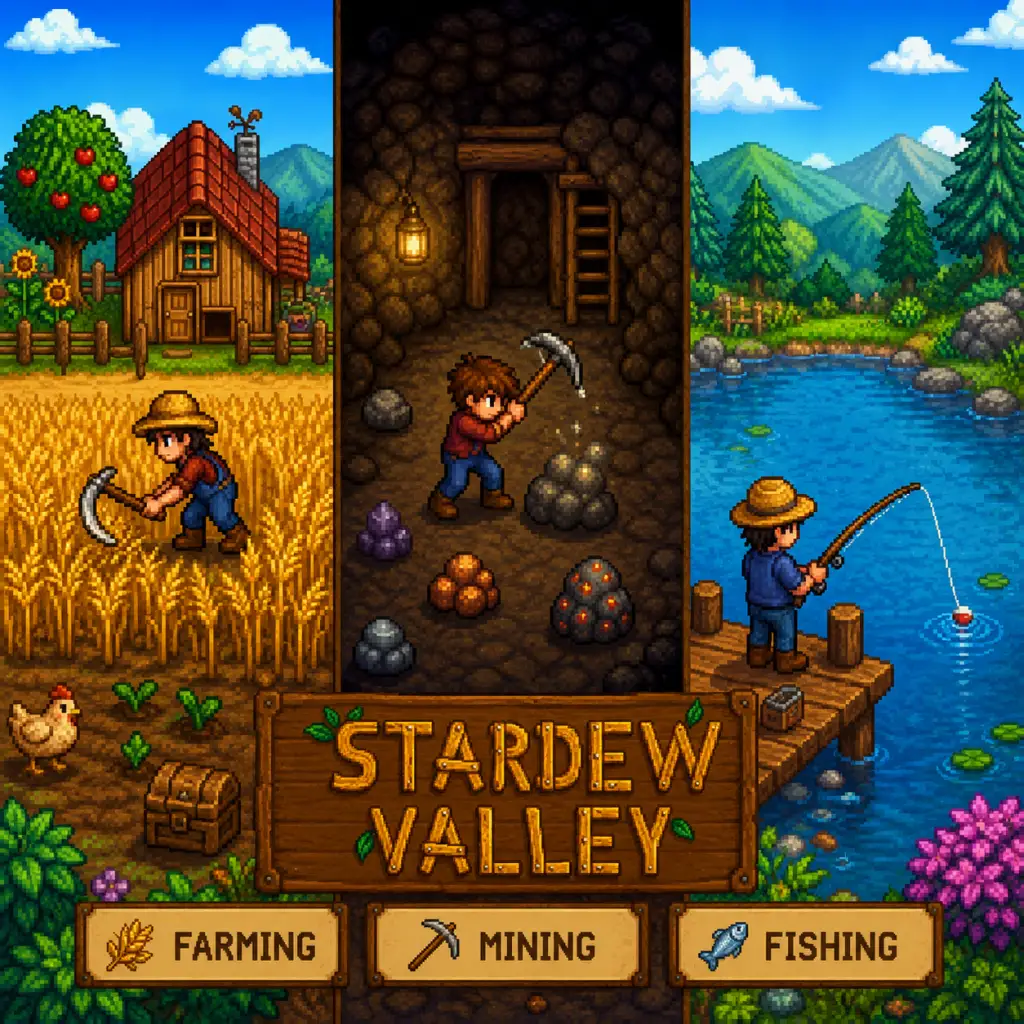
Core Gameplay
Core Gameplay Overview
Stardew Valley’s core gameplay loop revolves around restoring your grandfather’s farm while engaging in farming, mining, fishing, foraging, combat, and community interactions. Each day (roughly 14 minutes of real time) you manage energy, time, and resources to progress. Progression is tiered, unlocking new areas, mechanics, and endgame content as you complete key milestones.
---
Progression Tiers
Early Game (Year 1, Spring – Early Fall)
Main Loop: Clear land, plant basic crops, forage, fish, mine first 30 levels, talk to villagers, complete initial Community Center bundles.
Farming:
- Crops: Start with parsnips (5 days, cheap) and potatoes (high sell price). Use scarecrows to protect from crows. Water by hand or with basic watering can.
- Energy Management: Eat foraged items (spring onions, salmonberries) or crafted field snacks (acorn, maple seed, pine cone). Upgrade house to get kitchen for cooking.
- Tools Upgrade: Upgrade watering can (copper) to water more tiles, pickaxe for mining, axe for hardwood.
- Mines: Enter at bus stop (unlocked day 5 via letter). Levels 1–30 contain low-level enemies (slimes, bugs). Weapon from sword dropped in first chest; upgrade with guild rewards. Use staircases if stuck.
- Foraging & Fishing: Collect seasonal foragables; buy training rod (25g) for easier fishing. Sell fish for early income.
- Help Wanted: Daily board outside Pierre’s; small rewards (gold, friendship). Complete for 500g each after unlocking.
- Community Center: Complete Spring forage bundle (leek, dandelion, etc.) to unlock speed-gro reward.
- Money: Sell crops directly or preserve into jams/pickles (unlock preserves jar at farming level 4).
- Skills: Focus on Farming (levels 1–5: upgrade tools, unlock sprinklers at level 2 by crafting basic sprinkler). Mining (2–5) for better ore; Foraging (3–5).
- Friendships: Talk daily, give loved gifts (e.g., parsnips for Pam, coffee for Harvey). Reach 2 hearts to unlock backstory events.
- Water crops (clear 10–15 tiles).
- Visit mines for copper/iron (levels 10–20).
- Fish at mountain lake until energy low.
- Gift a villager (e.g., Leah with salad) before 8 PM.
- Sleep by midnight to avoid energy penalty.
- Crops: Plant blueberries (summer, high profit) and cranberries (fall, repeat harvest). Use quality sprinklers (iron bar + gold bar + refined quartz) to automate watering.
- Greenhouse: Unlock by completing pantry bundles (all crops from each season) – allows year-round farming. Plant ancient fruit (rare seed) or starfruit (from Oasis) for high-value wine.
- Animals: Build coop (chickens) and barn (cows) for eggs and milk. Upgrade to deluxe for larger animals and artisan goods (cheese, mayonnaise).
- Mines Levels 40–80: Introduce dust sprites, ghosts, more damage. Use a steel sword (Marlon sells) or bone sword. Bring food (field snacks, sashimi). Farm coal from dust sprites (levels 50–60) for smelting.
- Desert: Unlock via bus repair (completed vault bundle, 42500g total). Access Skull Cavern – dangerous but rich in iridium (starts at year 2).
- Community Center: Focus on pantry (all items) and fish tank (harder fish). Reward: greenhouse and crystalarium.
- Profit: Turn crops into artisan goods – kegs (grown via farming level 8) make wine; preserve jars make pickles. Use barn animals for truffles (pigs) – sell raw or turn into oil (oil maker).
- Skills: Reach level 10 in Farming (choose Artisan or Tiller). Mining at 10 (choose Blacksmith or Geologist). Foraging at 10 (Botanist for iridium-quality foraged items).
- Relationships: Marry a bachelor/bachelorette (e.g., Abigail + amethyst) for spouse help (water crops, feed animals). Reach 8 hearts to trigger marriage event.
- Harvest crops (quality sprinklers care for most).
- Process ancient fruit into wine in shed full of kegs.
- Enter Skull Cavern (bring bombs, stairs, food) – mine iridium until 1:50 AM.
- Upgrade tools to gold or iridium.
- Check community center bundles; complete fish tank (e.g., pufferfish in summer).
- Ginger Island: Farm on island (unlocked after fixing boat with 200 hardwood, 5 battery packs, etc.). Plant starfruit year-round in Ginger Island farm (deluxe speed-gro). Use sprinklers.
- Ancient Fruit: Turn into wine/aged in cask (basement) for 2x sell price after 2 in-game months.
- Skull Cavern: Use slime charmer ring (kill 1000 slimes) + iridium band. Bomb large areas; use stairs to skip infested floors. Reach level 100 for Mr. Qi quest (reward: iridium snake milk, permanent health).
- Volcano Dungeon (Ginger Island): Obtain galaxy soul, combat enchantments. Enemies (magma sprites, dwarves) drop cinder shards and dragon teeth.
- Qi’s Walnut Room: After finding 100 golden walnuts (Ginger Island exploration, puzzles, fishing, mining). Complete Qi quests (e.g., “Qi’s Prismatic Grange” – sell 500 prismatic shards for huge reward).
- Perfection Tracker: Located in Mayor’s Manor. Tracks: 7 masteries (reach level 10 in all skills), 8 different crafting recipes, 5 different cooking, 4 different friendship (10 hearts with all villagers), 5 different stardrops, 5 different artifacts, 5 different minerals, 4 different fish, 4 different animals shipped, 4 different crops shipped, etc.
- Skills: All level 10, choose professions. For farming: Artisan (artisan goods sell for 40% more) is best for late-game wine/cheese. Combat: Defender (+25 HP) – each hit boosts health.
- Mastery: After all skills level 10, you gain mastery points. Mastery levels grant permanent perks (e.g., Farming Mastery: golden animal crackers, double produce; Combat Mastery: unlock infinity weapons).
- Equipment: Galaxy sword (3 prismatic shards in desert), then upgrade to Infinity Blade (galaxy sword + 3 galaxy souls). Wear slime charmer ring + iridium band (combined at dwarf’s forge).
- Harvest ancient fruit from greenhouse + island.
- Process all into wine via kegs in sheds.
- Enter Skull Cavern with bombs, stairs; reach floor 100.
- Collect golden walnuts on Ginger Island via farm puzzles.
- Gift rare items (prismatic shard) to all villagers to achieve 10 hearts.
- Max Efficiency: Farm full of ancient fruit (greenhouse + ginger island). Use deluxe retaining soil (crafted from fiber, sap, stone) to not water. Harvest once per week (7 days) – 116 plants per iridium sprinkler.
- Artisan Machines: Fill multiple sheds with kegs (producing wine 6 days), preserve jars (pickles), oil makers (truffle oil). Age wine in cellar casks (up to 189 casks in fully upgraded house).
- Infinite Mines: Reach floor 1000 for bragging rights (no reward but rare monsters).
- Volcano Dungeon: Fully upgrade weapon (Infinity Blade) and tools (enchantments: swift for tools, vampiric for weapon).
- Bosses: No ultimate boss, but the most dangerous enemies are iridium bats, serpents, and mummies in Skull Cavern. Use galaxy slingshot with explosive ammo for area damage.
- Qi’s Challenges: Complete all, e.g., “Four Corners” (collect 4 prismatic shards in a week) for Qi beans (sell for 1000g each).
- Stardrops: Collect all 7 (e.g., from secret note #1, marriage, community center reward, joja mart purchase). Each increases max energy by 34.
- Perfection Reward: Access a secret area with a golden chicken (laying iridium eggs) and statue of true perfection (produces prismatic shards).
- Mastery: Unlock all 5 mastery levels (Farming, Foraging, Mining, Fishing, Combat). Grants cosmetic hats, titles, and new items (e.g., Butterfly powder – warp to ginger island).
- Friendships: 10 hearts with all 35 villagers (plus 5 with spouse). Use universal loved gifts (prismatic shard, rabbit’s foot, pearl) – each is +80 affection.
- Crafting & Cooking: Learn every recipe from TV shows (Queen of Sauce) and from shop purchases (e.g., dark chocolate from Gus on new year’s).
- Harvest ancient fruit from perfect farm (no watering needed).
- Load into kegs; age casks in basement.
- Play Junimo Kart mini-game to get 50k points for achievement.
- Complete a Qi challenge (e.g., “Let’s Play A Game” – collect 200 eggs in 3 days).
- Gift prismatic shard to every villager you haven’t maxed.
- Sleep to progress toward perfection.
- Weapons: Swords (balanced), daggers (fast, low damage), clubs (slow, high knockback). Upgrade from wooden to steel to gold to iridium. Special: galaxy + infinity.
- Enemies: Slimes (vary by floor/mine type), bugs, dust sprites, ghosts, mummies, serpents. Each has unique behavior (e.g., mummies revive unless hit with explosive).
- Health & Energy: Combat drains health; eat food to restore. Use defensive rings (Slime Charmer to block slime damage).
- Gifting: Villagers have liked/loved/disliked gifts. Check wiki or use gift guide app. Gifts on birthdays get 8x affection.
- Festivals: Seasonal events (Egg Festival, Stardew Valley Fair). Earn points to buy rare items (e.g., stardrop from fair).
- Heart Events: Reaching heart thresholds triggers cutscenes (e.g., at 2 hearts, 4 hearts, etc.). Some affect relationship availability (e.g., Sebastian’s 2-heart event requires him to be outside).
- Currency: Gold (g). Earn by selling crops, artisan goods, fish, foraged items, ores, gems. Largest money makers: ancient fruit wine (2310g per bottle with artisan profession), truffle oil (1491g), iridium bar (1000g).
- Crafting: Create kegs (40 wood, 1 copper bar, 1 iron bar, 1 oak resin) and preserve jars (50 wood, 40 stone, 8 coal). Both increase sell price by 2x-2.5x.
- Shopping: Pierre’s (seeds), Robin’s (construction and upgrades), Clint’s (tool upgrades & ore). Use seed maker for duplicates.
- Skills: Leveling each skill unlocks new recipes and crafting. Profession choices shape your build (e.g., Tiller vs. Artisan). Later respec via statue in sewer (10,000g).
- Friendships: Affection values affect marriage, cutscene content, and some quests. Max friendship makes villagers send gifts in mail.
- Perfection: Completing all tasks unlocks the perfection tracker and golden chicken. The game has no “final boss” but the journey to 100% is the ultimate goal.
- Secret Notes: Solve 25 secret notes (obtained from digging, monsters, etc.) for hints and collectibles (e.g., hidden stardrop, rare items).
- Qi’s Walnut Room: After 100 golden walnuts, access Qi’s special shop (sells expensive but powerful items like galaxy soup, magic rock candy).
Combat/Exploration:
Quests & Economy:
Build Growth:
Typical Day Example:
---
Mid Game (Year 1 Fall – Year 2 Spring)
Main Loop: Expand farm with quality sprinklers, barn/coop animals, artisan machines, deeper mine exploration (levels 40–80), complete more Community Center rooms, unlock greenhouse.
Farming:
Combat/Exploration:
Quests & Economy:
Build Growth:
Typical Day Example:
---
Late Game (Year 2 – Year 3)
Main Loop: Complete Community Center, unlock Ginger Island, reach level 100 of Skull Cavern, participate in Qi challenges, build perfection tracker.
Farming:
Combat/Exploration:
Quests & Economy:
Build Growth:
Typical Day Example:
---
Endgame (Post-Community Center, Perfection Focus)
Main Loop: Achieve 100% perfection, complete all Qi challenges, obtain rare items (Stardrops, secret notes), max all friendships, become a master of every skill.
Farming:
Combat/Exploration:
Quests & Economy:
Build Growth:
Typical Day Example:
---
Sub-System Details
Combat System
Interaction Systems
Economy
Character/Build Growth
Endgame Structure
---
This tiered progression ensures a structured experience through Stardew Valley’s deep gameplay. Adapt strategies to your personal goals (e.g., speedrunning community center vs. leisurely farming). Remember that the game respects your pace—there’s no time limit to achieve perfection.
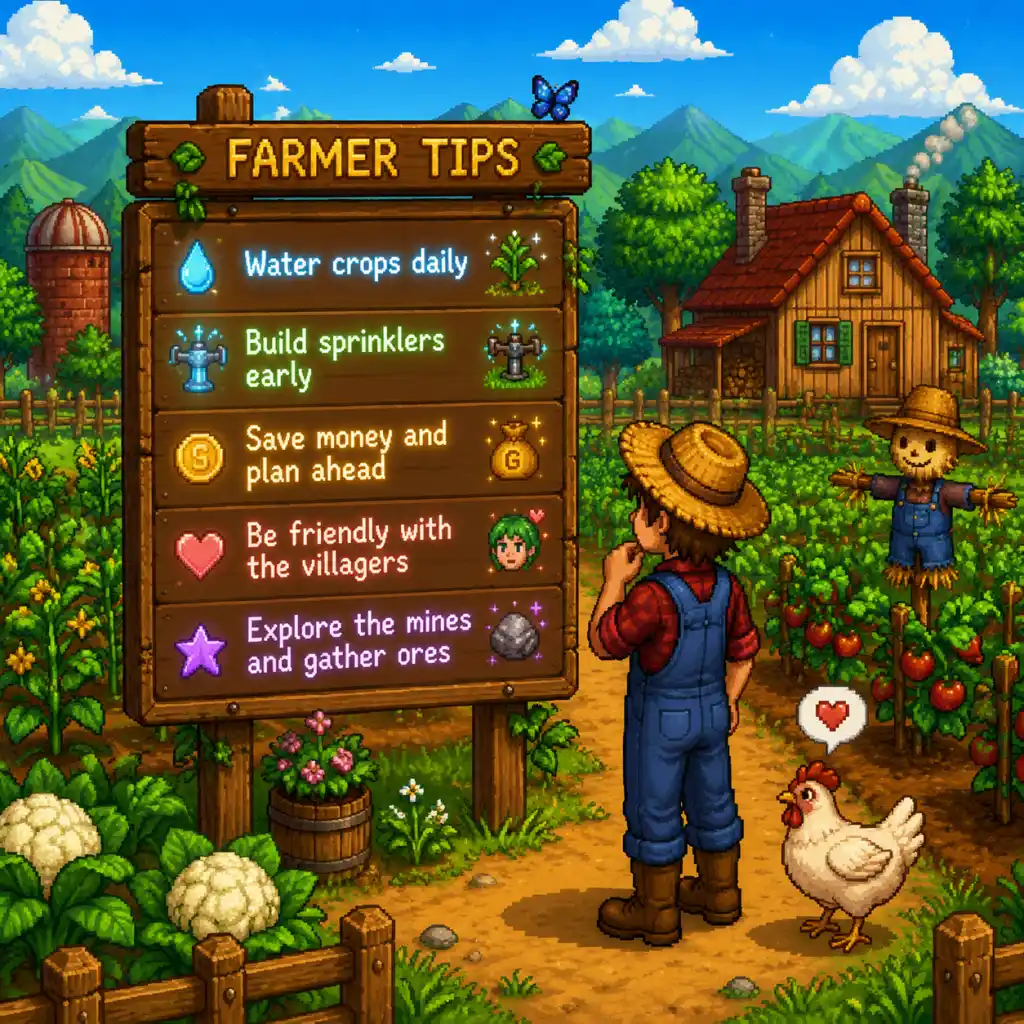
Game Tips
Game Tips: Stardew Valley
This guide covers essential tips for every stage of your Stardew Valley journey, from the first spring to late-game perfection. Tips are grouped by category with explanations of why each works and when to use them.
---
Beginner Basics
#### 1. Focus on the Community Center
- What: Complete the bundles in the Community Center (or choose JojaMart route) to unlock critical areas like the minecarts, greenhouse, and bus stop.
- Why: The greenhouse allows year-round crops; minecarts save travel time; the bus unlocks the desert. Prioritize bundles from day one by checking what you need each season.
- When: As soon as you can, check the bundle list and stash needed items. Try to finish by end of Year 1.
- What: Use copper, iron, and gold to upgrade your watering can, hoe, axe, pickaxe, and trash can at the blacksmith.
- Why: Upgraded tools use less energy and cover more area (e.g., copper watering can waters 3 tiles). This improves efficiency dramatically.
- When: Upgrade your axe to copper ASAP to chop hardwood stumps in the Secret Woods. Upgrade watering can before Winter (when you can wait for rain).
- What: Purchase parsnip seeds (20g each) from Pierre and plant them immediately.
- Why: Parsnips grow in 4 days, give decent profit (35g base), and can be used in the Spring Crops Bundle. Early cash flow is critical.
- When: Day 1, after clearing a small patch of farm. Harvest before the 5th to reinvest.
- What: Keep at least one of each crop, forageable, fish, and monster drop.
- Why: Many items are needed for bundles, quests (especially later), recipes, and gifts. Selling early may save money but can lock you out of completion.
- When: Always check the Community Center bundles and favorite gifts before selling.
- What: Your energy bar depletes as you work. Eat field snacks (acorns + maple seeds + pine cones) or purchased food to restore.
- Why: Running out of energy halts all activity. Early game, eating foraged leeks or salmonberries saves money.
- When: Always carry a stack of cheap food (salmonberries in spring, blackberries in fall). Eat when below half energy.
- What: Calculate crop profit by (sell price - seed cost) / growth days. Ignore fertilizer for simplicity.
- Why: Some crops appear profitable but aren't per day. For example:
- When: Use this metric to choose high-profit crops: Strawberries (Spring 13+), Blueberries, Cranberries, Ancient Fruit (greenhouse).
- What: Quality Sprinklers water 8 surrounding tiles every morning, requiring no energy.
- Why: Frees up time for mining, fishing, or socializing. One Quality Sprinkler covers 24 tiles (3x3 area minus sprinkler).
- When: Reach Farming level 6 to craft. Gather iron, gold, and quartz. Build at least 12 for a 48-plot field (2 rows of 3 sprinklers).
- What: Basic Fertilizer (sap) boosts quality chance; Quality Fertilizer (fish) gives gold star crops; Speed-Gro accelerates growth.
- Why: Higher quality crops sell for more and are loved by villagers as gifts (e.g., Gold Star Parsnip for Pam). Speed-Gro allows extra harvests in a season.
- When: Use Speed-Gro on multi-harvest crops like Blueberries to get an extra harvest. Use Quality Fertilizer on gifts or crops for community bundles.
- What: Kegs produce artisan goods (wine, juice, pale ale, etc.) in days; Preserves Jars make jelly/pickles much faster but lower value per item.
- Why: Kegs are best for high-value crops (ancient fruit, starfruit) because they multiply value by 3x. Preserves Jars are better for low-value crops (hops, wheat) due to faster turnover.
- When: Early game build preserves jars for blueberries/cranberries. Late game build hundreds of kegs for ancient fruit wine.
- What: Ancient Fruit grows in 28 days then produces every 7 days indefinitely (in greenhouse or Ginger Island). Base sell price 550g; wine 2310g.
- Why: Once established, it requires minimal replanting and yields massive consistent profit. Best paired with kegs.
- When: Obtain from Ancient Seed artifact (donate to museum) or traveling cart. Plant in greenhouse as soon as possible. Speed-Gro helps initially.
- What: The lake in the mountain (near Robin’s house) contains valuable fish like Largemouth Bass, Bullhead, and during certain seasons, the rare Sturgeon.
- Why: Sturgeon roe is used for caviar (artisan good) and some bundles. Largemouth Bass is used in quality fertilizer recipe. The lake also has the highest average fish price early on.
- When: Fish there in spring and summer for best variety. Bring a Training Rod if you’re new (easier to catch).
- What: Place crab pots in water (ocean or freshwater) to catch crabs, lobsters, and other shellfish every day.
- Why: Requires no energy, just bait. Recycled trash gives coal, iron, and cloth. Profitable when you have many pots.
- When: Reach Fishing level 3 to craft. Place 10-20 near your farm dock. Collect daily. Use for Community Center bundles.
- What: A perfect catch (fish never leaves the green bar) gives a bonus skill XP and sometimes better quality.
- Why: Faster leveling increases tackle size and unlocks better rods. Perfect catches also have higher quality, which sells for more.
- When: Practice with the Training Rod until you are comfortable. Use trap bobber (+2 fish escape resistance) on difficult fish.
- What: Reach the bottom of the mine (floor 120) by end of spring/early summer. Bring pickaxe, weapon, food, and ladders.
- Why: Unlocks access to gold ore, gems, and valuable loot. Floor 40+ has gold; 80+ has iridium (rare). Also, slimes drop useful items.
- When: Go mining on rainy days (no watering). Skip floors with few resources. Use staircase if necessary.
- What: Cooked meals (Sashimi, Field Snack, Glazed Yams) restore health and energy. Avoid using low-energy food in combat.
- Why: Mines can drain health quickly from bats, slimes, and ghosts. Eating during combat prevents death (lose items and gold).
- When: Always carry a stack of 10-20 field snacks or sashimi. Upgrade to cheese or salads mid-game.
- What: Bombs (crafted from coal and iron ore) explode in a 3x3 area, destroying rocks and ores instantly.
- Why: Saves time clearing large clusters and reveals ladders quickly. Also yields more ore per explosion than pickaxe.
- When: Once you have excess iron (floor 40+), craft Megabombs (recipe from Dwarf). Use in Skull Cavern for speed.
- What: Skull Cavern in the desert has infinite floors, high-quality gems, and iridium. Use ladders/staircases to descend quickly.
- Why: Iridium is the rarest ore and needed for tool upgrades and Sprinklers. Deeper floors yield more.
- When: Bring at least 50+ stairs, 100+ bombs, food, and a Galaxy Sword (from three Prismatic Shards). Go on a high luck day (TV fortune teller).
- What: Gather wild spring onions, leeks, salmonberries, blackberries, and coconuts depending on season and location.
- Why: Free food/energy, gifts (leeks for George), and ingredients for recipes. Salmonberries (Spring 15-18) and Blackberries (Fall 8-11) can be gathered in bulk.
- When: Spend early morning foraging before farm work. Save berries for energy through the season.
- What: Place tappers on maple, oak, and pine trees to produce maple syrup, oak resin, and pine tar.
- Why: Oak resin is needed for kegs; pine tar for rain totems; maple syrup for bee houses. Set up a tapper grove early.
- When: Craft tappers as soon as you reach Foraging level 3. Tap at least 10 oak trees for keg production.
- What: Access the Secret Woods (northwest of Marnie’s ranch) after upgrading axe to steel. Contains hardwood, fiddlehead ferns, and mushrooms.
- Why: Hardwood is essential for house upgrades and some crafting (e.g., Keg). Fiddlehead fern is needed for the Chef’s Bundle.
- When: Chop every day for hardwood (respawns daily). Bring a copper/steel axe.
- What: Plant potatoes (cost 50g, sell 80g). They have a chance to drop extra potatoes when harvested.
- Why: Best early profit on a per-day basis (avg 1.5 potatoes per plant = ~120g per harvest over 6 days → 20g/day).
- When: Spring Year 1 after parsnips. Use earnings to buy more seeds.
- What: Buy strawberry seeds from Egg Festival for 100g each. Plant them immediately; they produce every 4 days until end of season (3 harvests).
- Why: Very high profit if you plant enough (recommend 50+). With Speed-Gro, get 4 harvests.
- When: Save gold before the festival. Plant next day (Spring 14).
- What: Blueberry seeds 80g, harvest every 4 days, base 50g per berry (3 berries per plant = 150g per harvest). Up to 5 harvests per season.
- Why: Massive profit with minimal effort. Use Quality Sprinklers and speed-gro to maximize.
- When: Plant on Summer 1. Invest heavily (100+ plants).
- What: Starfruit seeds 400g from Oasis (desert). Grow 13 days. Sell for 750g base or 2250g as wine.
- Why: Single highest profit per plant if kegged. However, long growth time means few harvests per season.
- When: Best in greenhouse or Ginger Island. Or as Summer crop with Deluxe Speed-Gro (8 days growth).
- What: Process crops through kegs (wine 3x), preserves jars (jelly 2x), bee houses (honey 2x with flowers).
- Why: Artisan skill adds 40% value. This is the foundation of late-game economy. Always process high-value crops.
- When: Build kegs as soon as you have oak resin. Fill cellar with casks for ancient fruit wine (aged to iridium quality = 4x base).
- What: Give a loved gift (or hated) on a villager’s birthday to get 8x (or 4x) relationship effect.
- Why: Fastest way to earn hearts. Check wiki for loved gifts. For example, Leah loves salad (easy from Gus).
- When: Mark birthdays on calendar. Always give a loved gift on their special day.
- What: Speak with each villager once per day (+20 friendship), or twice if you talk while they’re walking (+20 each encounter).
- Why: Friendship increases heart events and unlocks recipes, cutscenes, and marriage. Also, higher friendship means better gifts received.
- When: After completing farm chores, walk through town and Pelican Town. Use the map to find everyone.
- What: Each spouse gives a different benefit: Penny helps with crops, Abigail gives bombs, Emily gives cloth, etc.
- Why: Marrying a character provides daily gifts and sometimes farm help. Choose based on your playstyle (e.g., Abigail for combat players).
- When: Once you have a house upgrade (kitchen and bed). Give loved gifts regularly.
- What: At level 5 and 10 of each skill, you pick a specialization that permanently boosts certain activities.
- Why: Some professions are far better for certain playstyles.
- When: For maximum profit:
- What: Corn grows in summer and fall, provides two seasons of harvest. Low profit but high XP due to multiple harvests.
- Why: For artificially boosting farming skill quickly before switching to higher-profit crops.
- When: Plant a small plot of corn early summer to level up fast.
- What: After fixing the boat in the backwoods (cost: 200 hardwood, 5 batteries, 5 iridium bars), unlock Ginger Island with a large farm plot, volcano dungeon, and more.
- Why: Allows year-round crops, unlimited ancient fruit, and extra resources. The volcano has iridium and gems.
- When: As soon as possible in Year 2 or after completing Community Center. Plant ancient fruit there.
- What: Donate artifacts and minerals to Gunther to unlock rewards like Rusty Key (sewers) and Dwarf Scroll (translation). Each donation also gives items.
- Why: Some rewards are critical: Rusty Key opens sewer (access to mutant bugs for loot), Dwarf Scroll lets you buy bombs cheaply.
- When: Donate duplicates first, then complete sets. Prioritize scrolls and prismatic shard (shard gives galaxy sword).
- What: Craft rain totems (hardwood, truffle oil, pine tar) to force rain next day.
- Why: Rain means no watering, allowing time for mining, fishing, or socializing. Also, rain triggers certain events (e.g., green rain).
- When: Use on days you need to go to mines or Skull Cavern. Keep a stack.
- What: Trade 3 Quartz for 1 Deluxe Speed-Gro or 5 Battery Packs for a Warp Totem: Desert.
- Why: D. Speed-Gro cuts growth time by 25% (stackable with agriculturalist profession). Warp totems save time.
- When: Buy D. Speed-Gro for starfruit or ancient fruit in summer. Use warp totems to reach desert quickly for Skull Cavern runs.
- What: Craft a farm computer (from high-tier farming materials) that shows daily info: how many crops ready, what’s in machines, etc.
- Why: Saves time checking each patch. Especially useful with large fields.
- When: After reaching Farming level 8. Place near your house.
- What: Watch the weather forecast, fortune teller, and Queen of Sauce (new recipes every Sunday/Wednesday reruns).
- Why: Luck affects mining drops, farming yields, and rare events. Queen of Sauce teaches recipes you can’t miss.
- When: Every morning before leaving for the day.
- What: Place chests near frequently used locations: outside farmhouse, near mines, in town (not on path).
- Why: Store excess tools, ores, food, and gifts. Avoid cluttering inventory.
- When: Craft a chest (50 wood) on day 1. Expand to 2-3 chests for different item categories.
- What: Plant crops that carry over seasons (e.g., corn summer→fall, ancient fruit any season).
- Why: Maximizes yield without replanting. Also, some fish only appear in certain seasons.
- When: Check the calendar for last planting days. Use seed maker on high-value crops.
- What: Place a crop into a seed maker to get 1-3 seeds of that crop (average 2).
- Why: Allows self-sufficiency without buying seeds. Great for ancient fruit, starfruit, and other expensive seeds.
- When: After reaching Farming level 9 (recipe from inside the farming skill). Process all your high-value produce before selling.
- What: Many processes (crops, kegs, machines) advance even when you’re not playing, based on in-game days.
- Why: You can take real-world breaks and still progress. Just save and quit at night.
- When: Use this to plan long-term projects (e.g., set kegs before going to bed).
#### 2. Upgrade Your Tools Early
#### 3. Plant Parsnips in Spring 1
#### 4. Save One of Everything
#### 5. Manage Energy Wisely
---
Farming & Crops
#### 6. Profit Per Day Analysis
- Blueberries (Summer): 80g seed, harvest multiple times. 3 harvests per plant ~ 150g profit over 13 days → ~11.5g/day
- Cranberries (Fall): 240g seed, 5 harvests → ~130g profit per plant over 24 days → ~5.4g/day
#### 7. Invest in Quality Sprinklers
#### 8. Use Fertilizer Strategically
#### 9. Kegs vs Preserves Jars
#### 10. Ancient Fruit – The Endgame Crop
---
Fishing
#### 11. Fish at the Mountain Lake
#### 12. Use Crab Pots for Passive Income
#### 13. Master the Perfect Catch
---
Mining & Combat
#### 14. Prioritize the Mine in Spring
#### 15. Bring Food for Healing
#### 16. Use Bombs for Mining Efficiency
#### 17. Skull Cavern Strategy
---
Foraging & Resources
#### 18. Forage Every Day
#### 19. Tap Trees for Syrup
#### 20. The Secret Woods
---
Economy & Money-Making
#### 21. Early Spring – Focus on Potatoes
#### 22. Strawberries – Spring 13
#### 23. Blueberries – Summer Workhorse
#### 24. Starfruit – High Risk, High Reward
#### 25. Artisan Goods Multiplier
---
Relationships & Social
#### 26. Gift on Birthdays for Maximum Hearts
#### 27. Talk to Everyone Daily
#### 28. Marry for Perks
---
Skill Progression
#### 29. Choose Professions Wisely
- Farming: Tiller (10% crop value) → Artisan (40% artisan goods value)
- Mining: Geologist (double gems) → Excavator (double geode geodes)
- Foraging: Gatherer (double forage) → Botanist (iridium quality forage)
- Fishing: Fisher (25% fish value) → Angler (50% fish value)
- Combat: Fighter (10% damage) → Defender (25 HP) or Scout (crit chance → Desperado (crit damage) for damage builds.
#### 30. Experience Farming with Corn
---
Advanced Optimization
#### 31. Ginger Island – The Ultimate Farm
#### 32. Donate to Museum Strategically
#### 33. Use Rain Totems
#### 34. Desert Trader for Speed-Gro
#### 35. The Farm Computer
---
Miscellaneous Tips
#### 36. Always Check the TV
#### 37. Use Chests Strategically
#### 38. Exploit Seasonality
#### 39. The Seed Maker
#### 40. Offline Progression
---
These tips will help you thrive in Stardew Valley from your first season to the endgame. Remember to play at your own pace and enjoy the journey!
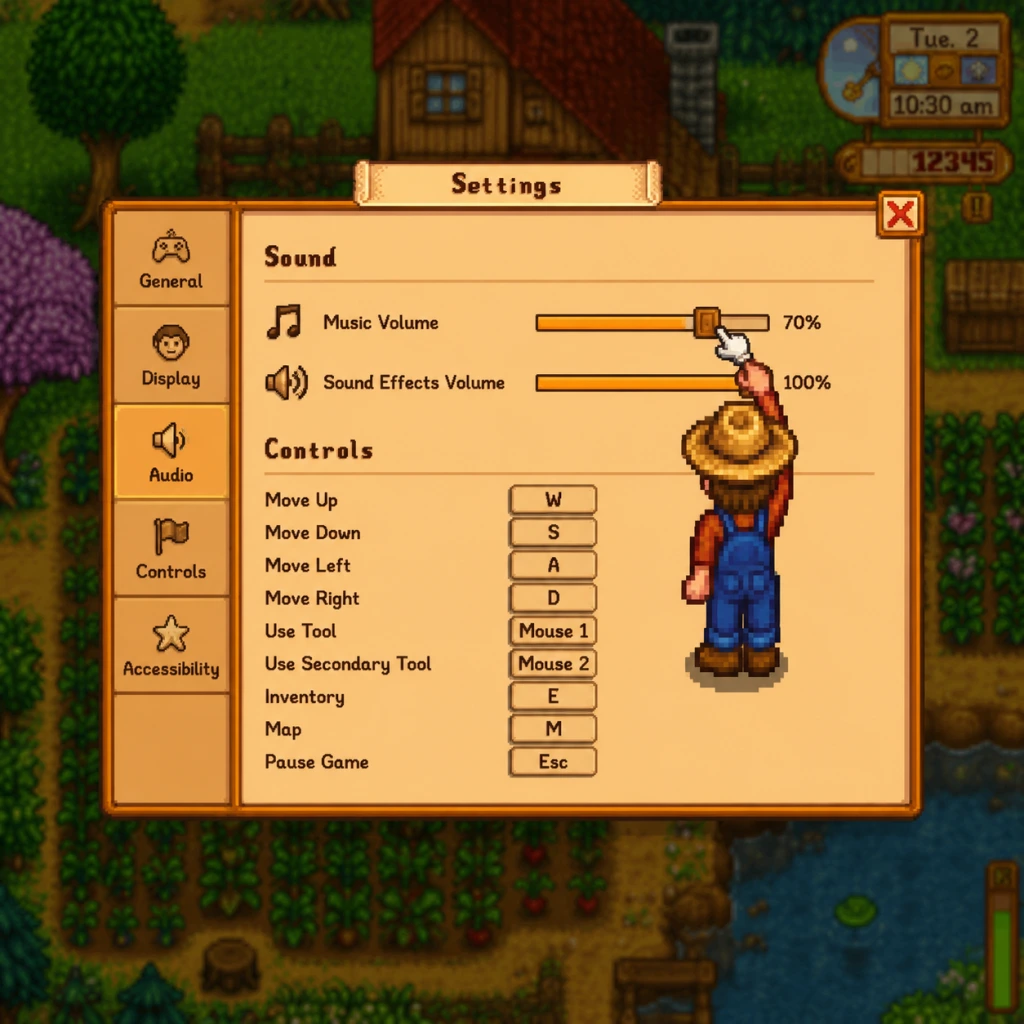
Game Settings
Game Settings Guide for Stardew Valley
Introduction
Adjusting your settings in Stardew Valley can greatly enhance your experience, whether you're playing on a low-end laptop or a high-end PC, or on consoles and mobile. This guide covers every setting category: Graphics, Audio, Controls, Accessibility, Language, Network, and Gameplay. We'll recommend optimal settings for different hardware levels, highlight common misconfigurations, and explain special attention points during setup.
Graphics Settings
Stardew Valley uses a pixel art style, so it's not graphically intensive. However, some settings affect performance and visual clarity.
#### Key Graphics Settings:
- Window Mode: Fullscreen, Windowed, or Borderless Windowed. Borderless is recommended for quick alt-tabbing.
- Resolution: Set to your monitor's native resolution. Lower resolutions can improve performance on very weak hardware.
- Fullscreen Mode: Choose between Exclusive Fullscreen and Windowed Fullscreen. Exclusive may reduce input lag but can cause issues on some multi-monitor setups.
- Enable VSync: Synchronizes frame rate with monitor refresh. Recommended to prevent screen tearing. Can cause input lag; disable if you experience it.
- Frame Rate Cap: Options include 30, 60, 120, or Unlimited. 60 is standard; 120 or unlimited for high-refresh monitors.
- Lighting Quality: Low, Medium, High. Affects lighting effects like torches and sunset. Medium is a good balance.
- Screen Shake: On/Off. Can be turned off for accessibility or if it causes discomfort.
- Zoom Levels: You can zoom in/out with mouse wheel or keys. Not a setting per se, but important.
- UI Scale: Adjusts size of UI elements. Important for readability on different resolutions, especially 4K.
- Low-end (Intel HD Graphics, 4GB RAM): Windowed mode, 720p resolution, VSync off or 30 FPS cap, Low lighting quality, Screen Shake off. Set UI Scale to 100%.
- Mid-range (GTX 1050, 8GB RAM): Borderless Windowed, 1080p, VSync on, 60 FPS cap, Medium lighting quality. UI Scale 100-120%.
- High-end (RTX 2060+, 16GB RAM): Borderless Windowed, max resolution (4K if supported), VSync on, 60/120 FPS cap, High lighting quality. UI Scale 120-150% for 4K.
- Master Volume, Music Volume, Sound Effects Volume, Ambient Volume. All sliders 0-100.
- Mute when not active: Automatically mutes game when window loses focus. Helpful for multitasking.
- Audio Device: Select output device. Rarely needed.
- Keyboard/Mouse Bindings: A large list of actions (moving, using tools, menus, etc.). Defaults are standard WASD. You can set alternative keys for left/right click actions (e.g., tool use, interact).
- Controller Bindings: Customizable on PC. On consoles, they are fixed but you can swap buttons in system settings.
- Auto-Run: Toggle. When off, you walk; when on, you run by default (hold shift to walk). Recommended to enable for faster travel.
- Controller Style: Choose between "Normal" (button inputs) or "Toggle" (hold to repeat) – actually there's a "Use Tool Button" setting: if controller type is set to "Auto", the game detects. But specific: In Settings > Controller: "Use Tool Button" can be "Left Trigger", "Right Trigger", or "A Button" etc. Default is left trigger for tool, right trigger for action. That can be confusing.
- Colorblind Friendly Modes: There are three options: Normal, Protanopia, Deuteranopia, Tritanopia. Also a "Greyscale" mode for some UI.
- Screen Shake: Off as mentioned.
- Reduce Nausea/Vertigo: Some settings like zoom and screen shake can affect. Also you can set "Camera Sway" (not a standard setting, but mods exist).
- UI Scale: Affects readability.
- Text Speed: For dialogue boxes: Slow, Normal, Fast. Set to Fast if you read quickly.
- Chat Text Size: In multiplayer, adjust chat font size.
- Auto-Advance Dialogue: When on, dialogue automatically progresses without pressing a key. Useful for reading faster but can skip accidentally.
- Language: Choose from many languages (English, French, German, Spanish, Portuguese, Russian, Japanese, Korean, Chinese, etc.). This affects all text, menus, and item names.
- Interface Language: Some platforms allow separate language for UI and voice? Stardew Valley has no voice, so just one setting.
- Host Option: On PC, you can choose to host over LAN or Internet. For internet, you need to set up port forwarding (default port 24642) or use a VPN like Hamachi.
- IP Address: For direct connection, you need the host's IP.
- Invite Code: On some platforms (Steam, etc.), you can invite via friends list without port forwarding.
- Server Mode: You can run a dedicated server (Stardew Valley Dedicated Server tool).
- Show Advanced Crafting Information: When enabled, shows the output and time for machines like furnaces, kegs, etc. HIGHLY RECOMMENDED to turn on.
- Auto-Organize Inventory: When you interact with a chest, items automatically sort. Useful but can be turned off if you prefer manual arrangement.
- Always Show Tool Hit Location: Shows a glowing square where your tool will hit. Very helpful for hoeing and watering. Recommended on.
- Tool Action Button vs. Interact Button: On PC, these can be set to left/right mouse button. Many players get confused: default is left-click for tools, right-click for interact (talk, open chests). If you swap, you might accidentally pick up items.
- Crafting from Chests: When enabled, you can craft using materials from nearby chests without taking them out. Massive quality of life improvement. Recommended on.
- Auto-Collect from Animals: When you pet and collect from animals, the game does it automatically. Off by default, but can save time.
- Animal Behaviour: "All Animals Love You" (trivially true) but actually "Animals are happy" is passive. No direct setting but there are mods.
- Farm Type: Chosen at start but not a setting per se.
- Green Rain Effects: Not a setting but an event.
- Mobile (iOS/Android): Touch controls, auto-attack, auto-move. Can be adjusted. Also battery saving options.
- Console: Controller vibration, screen settings, etc. Use console system settings for overall display.
- Switch: In handheld vs docked mode, UI scale may need adjustment.
#### Performance Recommendations:
Misconfiguration Alert: Setting resolution too low can cause blurry text. Also, turning off VSync on a 60Hz monitor may cause tearing. If you get stuttering, try disabling VSync and capping FPS externally via GPU driver.
Audio Settings
Recommendation: Set Music to 50-70, SFX to 80-100, Ambient to 30-50. Adjust to preference.
Special Attention: The game doesn't have separate voice chat settings, but for multiplayer, voice is usually handled externally.
Controls Settings
Stardew Valley supports keyboard/mouse, controller (Xbox, PS4, Switch Pro, etc.), and touch (mobile). On PC, you can rebind almost all keys.
Misconfiguration Alert: Many players accidentally change the "Use Tool Button" on controller, making tools not work correctly. Default: Left Trigger = use tool, Right Trigger = action (talk/collect). If you have issues, reset to default.
Special Attention for Multiplayer: In multiplayer, the game locks some controls during events or other players' cutscenes. Not a setting but good to know.
Accessibility Settings
Stardew Valley has several accessibility options:
Recommendation: Enable colorblind mode if needed. Set UI Scale to at least 100%. Turn off screen shake if sensitive.
Special Attention: The "Auto-Advance Dialogue" can be annoying if you want to read at your own pace. Many players prefer it off.
Language Settings
Important: Changing language changes character names, crop names, etc. If you play with friends, ensure everyone uses the same language for consistency in communication about items.
Misconfiguration Alert: If you accidentally set a language you don't know, it can be hard to find the settings menu again. The settings icon is a gear in the main menu. Do not change language unless you know where "Settings" is in that language.
Network Settings (Multiplayer)
Only relevant when hosting or joining a multiplayer game.
Recommendation: Use Steam or GOG's invite system for easiest setup. For LAN, just ensure all players on same network.
Misconfiguration Alert: Port forwarding misconfiguration can prevent friends from joining. Check your router settings. Also, ensure that no firewall is blocking the game.
Gameplay Settings
These settings affect how the game plays and are unique to Stardew Valley:
Misconfiguration Alert: Show Advanced Crafting Information is off by default and many players miss it for hundreds of hours. Turn it on immediately. Also, Crafting from Chests is a game-changer; enable it as soon as possible.
Special Attention: Tool Action Button vs Interact Button - if you accidentally switch them, you'll have trouble. Default is left click = use tool, right click = interact. If you change it, remember to revert if it feels wrong.
Additional Platform-Specific Settings
Final Recommendations
1. Before starting a new game, go into Settings and enable: Show Advanced Crafting Information, Crafting from Chests, Always Show Tool Hit Location, Auto-Run. Set UI Scale to your preference.
2. Adjust audio levels to your liking.
3. If using a controller, ensure the action/tool buttons match your expectations (check in Controls).
4. For multiplayer, test network connection before inviting.
5. If you experience performance issues, lower lighting quality and resolution, turn off VSync, and cap FPS to 30.
Use these settings to tailor Stardew Valley to your perfect experience.
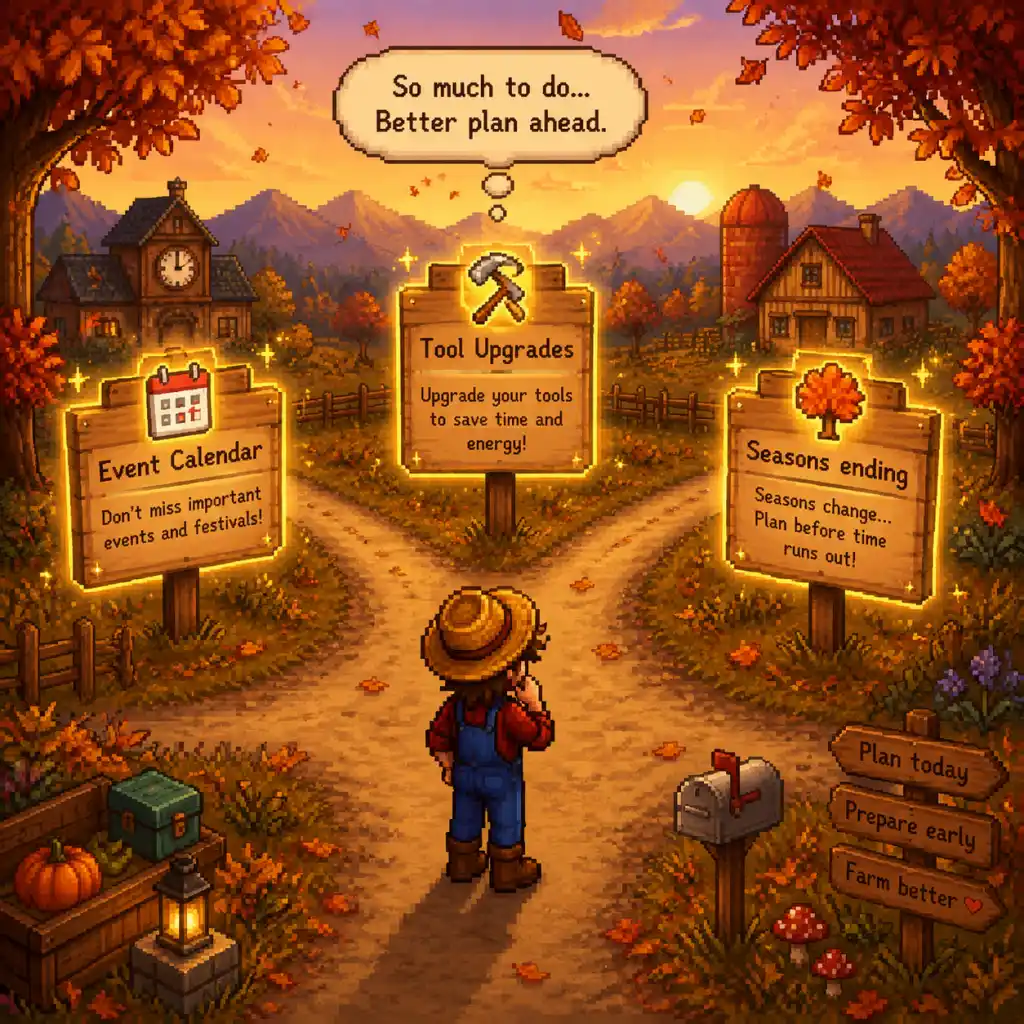
Important Notes
Important Notes for Stardew Valley
This section covers crucial information that can save you frustration, prevent irreversible mistakes, and help you avoid common pitfalls. Read through before diving deep into the game.
---
⚠️ Irreversible Choices
- Farm Map Selection: At character creation, you choose one of seven farm maps (Standard, Riverland, Forest, Hill-top, Wilderness, Four Corners, Beach). This is permanent. Each map affects layout, available space, and resources. Research before choosing.
- Community Center vs JojaMart: After the first day, you can choose to complete the Community Center bundles or purchase a JojaMart membership. Choosing JojaMart locks out certain rewards (like the theater) and changes the game's narrative. You cannot switch back without starting a new save.
- Pet Selection: At the beginning of Spring 2 (if you have 1000g), Marnie offers a cat or dog. This is cosmetic only, but irreversible per save (unless you edit save files).
- Marriage: Marrying a villager is reversible via divorce (costs 50,000g at Mayor Lewis's house), but divorced villagers will ignore you and you lose all hearts. Ex-spouse will have negative dialogue.
- Children: You can have up to two children. They are permanent; you cannot remove them without mods or editing save files. If you divorce with children, the ex-spouse takes them.
- Choosing to Upgrade House or Farm Buildings: Once you upgrade a building (e.g., Coop to Deluxe Coop), you can't downgrade. Plan your layout carefully.
- Setting Farm Name or Character Name: Your name and farm name are displayed throughout the game and cannot be changed without editing save files.
- Seasonal Events: Most festivals (Egg Festival, Luau, Dance of the Moonlight Jellies, etc.) occur on fixed days each year. If you miss them, you must wait a full in-game year. The Night Market (Winter 15-17) is especially easy to miss.
- Seasonal Forage & Crops: Certain foraged items and crops only appear in specific seasons. Miss one season and you wait a year. Example: Spring Onion (Spring), Sweet Gem Berry (Fall), Winter Root (Winter).
- Rare Items & Seeds:
- Quests & Cutscenes: Some heart events are only triggered if you meet the villager on a specific day/time/weather. If you skip them, you may need to wait for the next opportunity. Example: Sam's 3-heart event (must be on a sunny day, Sam not at work).
- Community Center Bundles: Some bundles require items from specific seasons. If you miss, you must wait a year. The Winter Foraging Bundle is a classic trap.
- The Secret Woods & Other Hidden Areas: Access to the Secret Woods requires a Steel Axe. Upgrading takes time; delay too long and you miss early hardwood.
- The Desert & Skull Cavern: Unlocked after completing the Boiler Room bundle or paying 42,500g to Joja. You lose a year if you sell the bus repair items before completing the bundle.
- The Theater: Unlocked after completing all Community Center bundles or paying 500,000g to Joja. It shows one movie per week; many unique items and cutscenes are tied to it.
- First Spring: Extremely tight energy and money. Fishing is difficult but profitable. Mining requires careful management of health and stamina. Overextending leads to passing out (lose gold).
- Floor 80-120 of the Mines: Enemies become tougher (Ghosts, Lava Bats). Without good weapons (preferably a Steel or Gold weapon), you'll struggle.
- Skull Cavern: Accessible after finishing the Mines (floor 120). Enemies deal massive damage, and the fall hazard (ladders) can kill instantly. Bring lots of food, bombs, and a good weapon. Consider waiting until you have the Galaxy Sword.
- The Volcano Dungeon (Ginger Island): Unlocked in Year 2+. Difficulty ramps with fire-based enemies and narrow corridors. Requires Space Boots or similar fire protection.
- Fishing Minigame: The minigame is notoriously hard for beginners. The Iridium Rod and bait help. Difficulty varies by fish name and season.
- Overfocusing on Animals Too Early: Animals (chickens, cows) require daily feeding, petting, and they produce only after maturity. They tie up cash and time that could go into crops, which generate faster income early on. Wait until you have a steady supply of hay (grass starter or purchased).
- Selling All Your Resources Too Soon: Keep at least some wood, stone, fiber, ore, and coal for crafting and upgrades. Especially coal, which is needed for many recipes and smelting.
- Ignoring the Traveling Cart: The cart appears every Friday and Sunday in the Cindersap Forest. It sells rare items (like Ancient Seed, rare seeds, and items for bundles). Checking it weekly can save you months.
- Buying Everything from Pierre's Instead of JojaMart: Pierre's is closed on Wednesdays (except after Community Center completion). JojaMart is always open but charges higher prices. Learn the schedules.
- Spending All Gold on Seeds Without Saving for Upgrades: Tool upgrades (copper/iron/gold/iridium) and house upgrades are critical for efficiency. Running out of money for seeds in the next season is a common regret.
- Over-planting in the Last Week of a Season: Crops die on the 1st of the new season unless they are multi-season (like corn or wheat). Plan harvest times.
- Not Using Fertilizer: Fertilizer boosts crop quality and speed. Basic Fertilizer is cheap and effective. Quality Fertilizer increases gold-star chance, crucial for the Quality Crops Bundle.
- Fishing Too Much Early On: Fishing is a great skill, but spending all day fishing can delay your tool upgrades and farm expansion. Balance activities.
- Selling Gems & Minerals: Some gems (like Diamonds) are needed for crafting recipes (e.g., the Crystalarium). Keep at least one of each. The Museum only requires one of each artifact/mineral.
---
⚠️ Missable Content & Events
- Ancient Seed: The first one you find must be donated to the Museum to receive an Ancient Seed artifact (which grows into Ancient Fruit). If you plant or sell the first one, you lose the artifact and must find another.
- Stardrop: Some stardrops are only obtainable from specific conditions: e.g., from the Stardew Valley Fair (Pumpkin stardrop), from the Traveling Cart (rare stardrop), from marriage (spouse gives one after 12 days). Missing the fair means waiting a year.
---
Difficulty Spikes
---
❌ Grinding Traps & Efficiency Pitfalls
---
###
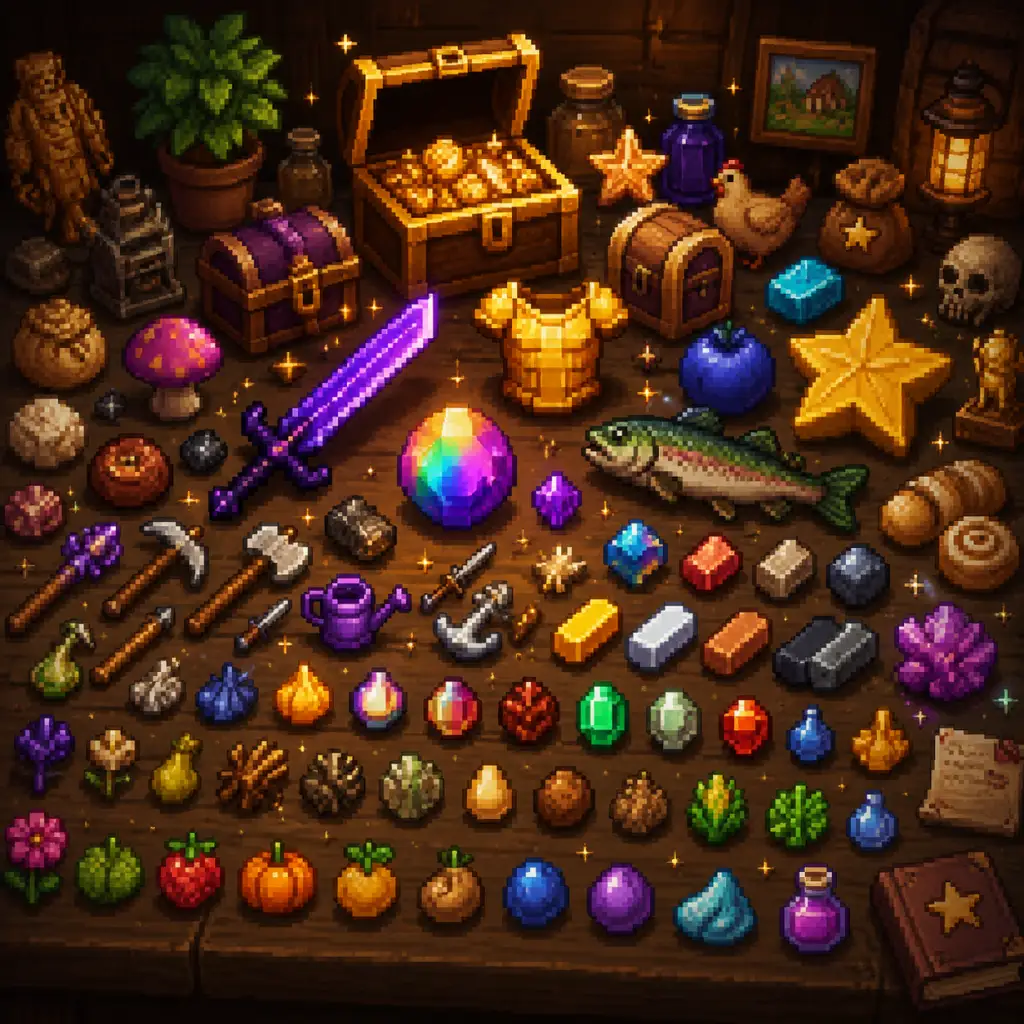
All Game Items
All Game Items Guide
This guide covers every major item category in Stardew Valley, including weapons, armor, consumables, materials, currencies, collectibles, and key equipment. Each section explains what items do, how to obtain them, and when they’re most useful. Item stats and availability are based on game version 1.6 (current).
---
1. Weapons
Weapons are divided into three types: Swords (balanced, can block), Clubs (slow but high damage, knockback), and Daggers (fast, low damage, multi-hit). You can find them in mines, chests, monster drops, the Adventurer’s Guild, or the Volcano Dungeon.
| Name | Type | Damage | Obtain | Notes |
|---|---|---|---|---|
| Rusty Sword | Sword | 2–5 | Start (after first mine visit) | Basic starter weapon. |
| Wooden Blade | Sword | 3–7 | Normal mine chests (floors 1-20) | Early upgrade. |
| Steel Smallsword | Sword | 4–8 | Normal mines (21-40) or Adventurer’s Guild (250g) | Decent early-mid. |
| Forest Sword | Sword | 6–10 | Normal mines (41-60) or Guild purchase | Good for Ice floors. |
| Iron Edge | Sword | 7–12 | Normal mines (61-80) | Balanced damage. |
| Bone Sword | Sword | 10–15 | Normal mines (81-100) | Higher base damage. |
| Lava Katana | Sword | 20–30 | Adventurer’s Guild (25,000g) | Best purchase option, high damage, gem forge potential. |
| Galaxy Sword | Sword | 60–80 | Bring a Prismatic Shard to the three pillars in Calico Desert | Best all-around sword in the game (until enchanted). |
| Dragontooth Cutlass | Sword | 40–50 | Volcano Dungeon chests or drops from Dragon Teeth? | Actually from Volcano: chests or Dragon teeth. Enchantable. |
| Infinity Blade | Sword | 80–100 | Forge Galaxy Sword with 3 Galaxy Souls | Ultimate end-game sword. |
| Obsidian Edge | Sword | 10–20 | Normal mines (91-100) | Good for early skull caverns. |
| Cutlass | Sword | 9–16 | Adventurer’s Guild (1,500g) | Average mid-game sword. |
| Tempered Blade | Sword | 14–25 | Adventurer’s Guild (3,000g) | Solid mid-game. |
| Dark Sword | Sword | 20–30 | Drop from Haunted Skulls (Quarry mines) | Good, but rare. |
| Holy Sword | Sword | 20–30 | Drop from Mummies (Skull Cavern) | Rare, high damage. |
| Crystal Dagger | Dagger | 5–10 | Normal mines (61-80) | Fast but low. |
| Burglar’s Shank | Dagger | 10–14 | Drop from Serpents (Skull Cavern) | Decent dagger with faster swing. |
| Iridium Needle | Dagger | 20–30 | Volcano Dungeon chests | Top dagger for speed builds. |
| Wood Club | Club | 4–9 | Normal mines (1-20) | Slow, high knockback. |
| Bone Club | Club | 7–11 | Normal mines (41-60) | Early club. |
| Femur | Club | 10–15 | Normal mines (81-100) | Good for large groups? |
| Kudgel | Club | 10–20 | Drop from Shadow Brutes (normal mines) | Rare, decent knockback. |
| Lead Rod | Club | 12–20 | Adventurer’s Guild (2,000g) | Club upgrade. |
| Hammer | Club | 15–25 | Adventurer’s Guild (5,000g) | Heavy knockback, slow. |
| Dragontooth Club | Club | 50–60 | Volcano Dungeon chests | End-game club. |
| Infinity Gavel | Club | 70–90 | Forge Dragontooth Club with 3 Galaxy Souls | Ultimate club. |
---
2. Armor (Rings & Boots)
Rings and boots provide passive bonuses. You can equip two rings and one pair of boots. Rings are obtained from monsters, chests, or crafted. Boots from mines, guild, or Volcano.
#### Rings
| Ring Name | Effect | How to Obtain |
|---|---|---|
| Small Magnet Ring | +1 pickup range | Normal mine chests (1-40) |
| Glow Ring | Emits light | Normal mine chests (1-40) |
| Magnet Ring | +2 pickup range | Normal mine chests (41-80) |
| Slime Charmer Ring | Slimes ignore attacks | Kill 1000 slimes (Adventurer’s Guild reward) |
| Vampire Ring | Heal 2HP on kill | Kill 200 bats (Adventurer’s Guild reward) |
| Burglar’s Ring | Double monster drop rate | Kill 500 dust sprites |
| Savage Ring | +1 speed for 3s after kill | Kill 150 void spirits (serpents?) |
| Napalm Ring | Explosive kills blow up nearby rocks | Kill 250 serpents (Adventurer’s Guild) |
| Iridium Band | +10% attack, +1 pickup, +1 glow | Craft: 5 Iridium Bar + 5 Prismatic Shard + 50 Solar Essence |
| Glowstone Ring | +2 glow | Normal mines (81-100) |
| Jade Ring | +1 critical hit chance | Volcano dungeon chests |
| Amethyst Ring | +1 speed? Actually not – only in some mods. In vanilla: (none) | N/A |
| Ring of Yoba | 10% damage reduction | Craft: 5 Earth Crystal + 5 Copper Bar + 5 Iron Bar |
| Protective Ring | +1 defense | Normal mines (21-40) |
| Thorns Ring | 1 damage to attacker per hit | Kill 50 rock crabs? Actually from: Adventurer’s Guild reward for killing 250 slimes? Not exactly. Obtain: I think it’s from killing 250 slimes (Thorns Ring) – in 1.6 it's from killing 500 rock crabs? Check data: In 1.6 base game: kill 250 slimes gives Slime Charmer, not Thorns. Thorns Ring is from killing 500 rock crabs (Adventurer’s Guild). |
| Ruby Ring | +10% attack damage | Volcano Dungeon chests |
| Boots Name | Defense | Immunity | How to Get |
|---|---|---|---|
| Leather Boots | +1 | 0 | Adventurer’s Guild (500g) |
| Work Boots | +1 | 0 | Normal mine chests (1-40) |
| Combat Boots | +3 | +1 | Normal mine chests (41-80) |
| Firewalker Boots | +4 | +2 | Normal mines (81-100) |
| Tundra Boots | +5 | +2 | Adventurer’s Guild (750g) |
| Dark Boots | +4 | +4 | Adventurer’s Guild (1,750g) |
| Genie Shoes | +6 | +3? Actually +5 defense, +1 immune? | Actually from Volcano dungeon. |
| Space Boots | +6 | +4 | Normal mines (110-120) |
| Crystal Shoes | +8 | +6 | Volcano Dungeon chests |
| Dragonscale Boots | +7 | +5 | Volcano Dungeon (reward for completion? Actually from Volcano chests) |
---
3. Consumables
Consumables restore health and energy, provide buffs, or are used in crafting/quests. Buffs stack with food and drink separately (one food, one drink).
#### Food (Restoration + maybe buff)
| Item | Restores (Health/Energy) | Buff | How to Get | Best Use |
|---|---|---|---|---|
| Salmonberry | 5/10 | None | Salmonberry bushes (Spring 15–18) | Early energy source. |
| Spring Onion | 8/13 | None | Forest (Spring) | Early energy. |
| Wild Horseradish | 6/13 | None | Forage (Spring) | Gift or early energy. |
| Leek | 12/30 | None | Forage (Spring) | Good early food. |
| Common Mushroom | 6/15 | None | Forage (Fall) | Low restoration. |
| Algae Soup | 20/50 | None | Cooking (green algae) | Basic healing. |
| Baked Fish | 33/75 | None | Cooking (any fish) | Good mid-game. |
| Fried Egg | 12/30 | None | Cooking (egg + oil) | Simple breakfast. |
| Pancakes | 25/60 | +1 Foraging | Cooking (flour + egg + blueberry) | Foraging boost. |
| Spicy Eel | 30/80 | +1 Luck, +1 Speed | Drop from Serpents or cooking (eel + hot pepper) | Best combat food for luck and speed. |
| Lucky Lunch | 50/100 | +3 Luck | Cooking (sea cucumber + tortilla + blue jazz) | Highest luck boost. |
| Crab Cakes | 75/150 | +1 Speed, +1 Defense | Cooking (crab + flour + egg + oil) or drop from crabs | Good speed boost. |
| Pumpkin Soup | 70/200 | +2 Luck, +2 Defense | Cooking (pumpkin + milk) | Excellent for Skull Cavern. |
| Glazed Yams | 100/200 | +1 Defense | Cooking (yam + sugar) | Good defense buff. |
| Roots Platter | 100/160 | +3 Attack | Cooking (cave carrot + winter root) | Attack boost for mining. |
| Cheese | 50/125 | None | Press milk | Reliable healing. |
| Pale Broth | 50/125 | None | Cooking (white algae) | Simple. |
| Blackberry Cobbler | 20/50 | +1 Foraging | Cooking (blackberry + sugar) | Foraging boost. |
| Cranberry Candy | 25/60 | +1 Mining | Cooking (cranberry + sugar) | Mining boost. |
| Pepper Poppers | 30/70 | +1 Speed, +2 Farming | Cooking (hot pepper + cheese) | Speed boost. |
| Tom Kha Soup | 60/150 | +1 Luck, +1 Defense | Cooking (coconut + shrimp) | Good luck combo. |
| Triple Shot Espresso | 60/150 | +1 Speed (stacks with coffee) | Crafting (3 coffee beans) | Best speed drink. |
| Coffee | 15/30 | +1 Speed | Cooking (5 coffee beans) or Gus at saloon | Cheap speed. |
| Green Tea | 25/50 | +1 Speed? Actually +1 max energy? | Crafting (tea leaves) | Mild buff. |
| Life Elixir | Restores to full | None | Crafting (red mushroom + purple mushroom + morel + chanterelle) | Instant full heal. |
| Energy Tonic | Full energy | None | Crafting (golden coconut + energy boosts) | Full energy restore. |
---
4. Materials & Crafting Resources
Materials are used for crafting, building upgrades, tool upgrades, and more.
| Category | Items | Uses |
|---|---|---|
| Wood | Wood, Hardwood | Basic crafting, building upgrades (houses, barns). Hardwood from mahogany trees or secret forest. |
| Stone | Stone | Crafting paths, fences, staircases. |
| Fiber | Fiber | Crafting scarecrows, grass starter, etc. Grows from weeds. |
| Ores | Copper Ore, Iron Ore, Gold Ore, Iridium Ore | Smelt into bars for tool upgrades, crafting, machine fuel. |
| Bars | Copper Bar, Iron Bar, Gold Bar, Iridium Bar | Tool upgrades, crafting (Keg, Preserves Jar, Sprinklers, etc.) |
| Coal | Coal | Fuel for smelting, refining, crafting. Obtain from mines (dust sprites, rocks), charcoal kiln. |
| Gems | Diamond, Ruby, Emerald, Jade, Amethyst, Topaz, Aquamarine | Gifts, crafting (Crystalarium), trade with Desert Trader (Jade for Staircases, Ruby for Spicy Eel) |
| Minerals | Earth Crystal, Frozen Tear, Fire Quartz, Ghost Crystal, etc. | Crafting (Ring of Yoba, etc.), gifts. Earth Crystal for Quality Sprinkler. |
| Refined Resources | Refined Quartz, Solar Essence, Void Essence | Crafting (Iridium Band, Warp Totems). Solar essence from ghost/light drops, void from shadow monsters. |
| Animal Products | Milk, Wool, Egg, Duck Egg, Rabbit Foot, Dinosaur Mayonnaise | Cooking, artisan goods (Mayonnaise, Cheese, Cloth), gifts. Rabbit Foot is universally loved (except Penny). |
| Forage | Wild seasonal items, Crystal Fruit, Snow Yam, Cactus Fruit, Coconut, etc. | Energy, gifts, some cooking, crafting (Wild Seeds) |
| Fruits & Vegetables | Crops (blueberries, cranberries, melons, etc.) | Immense for selling, cooking, artisan goods (Jellies, Wine, Pickles) |
| Artisan Goods | Wine, Juice, Jelly, Pickles, Honey, Beer, Pale Ale, Mead, Oil, Cheese, Cloth, Mayonnaise, Truffle Oil | Major source of income. Aged in Cask for higher quality. |
| Fishing Resources | Fish (categorized by seasons), Crab Pot items (Lobster, Clam, etc.) | Cooking, crafting (Quality Bobber), gifts, community center bundles. |
| Monster Drops | Slime, Bat Wing, Bug Meat, etc. | Crafting (Warp Totems, Monster Musk, etc.) |
---
5. Currencies
| Currency | How to Earn | Uses |
|---|---|---|
| Gold (g) | Selling crops, artisan goods, fishing, mining | Almost everything: seeds, tools, upgrades, buildings, items from shops. The main currency. |
| Qi Gems | End-game: Qi quests (Ginger Island, Mr. Qi’s challenges) | Buy rare items from Qi’s shop: Galaxy Soul (50), Horse Flute (50), Key to the Town (20), Magic Rock Candy (50). Also for upgrading Qi’s special items. |
| Casino Tokens | Play games at Oasis (after Qi quest) | Buy rare items: Warp Totem: Desert (500), Magic Rock Candy (1000), etc. Also for decoration. |
| Museum Donations | No direct currency, but donation milestones reward items | Donate artifacts/minerals to unlock items: Rusty Spoon, Dwarf Scrolls, etc. |
| Friendship Points | Not currency, but gifts/likes | Unlocks recipes, items, events, and marriage. |
6. Collectibles
These are items not used for crafting or combat but for completion, achievements, or permanent upgrades.
| Item | Effect | How to Obtain |
|---|---|---|
| Stardrop | +34 max energy permanently | 7 total: +1 for first fishing chest? Actually: reward for completing the museum (one), from Krobus (once), from Old Master Can (in secret woods), from spouse at 13 hearts, from Qi quest (100% perfection), from casino? Actually list: Bottomless Mines (floor 100) gives Stardrop if you choose the money? No – floor 100 gives a secret note reward? Wait – standard: 1) Krobus (5,000g), 2) Old Master Can (secret woods), 3) Museum donation milestone, 4) Spouse 13 hearts, 5) Casino? Actually: gambling prize? The correct list: 1) Museum (donate 40 and 60 items? Actually first stardrop from museum is donate 50 minerals?), 2) Krobus (sells for 20,000g late game? Actually he sells one for 20,000g?), 3) Old Master Cannery (secret woods), 4) Spouse at 13 hearts (give as gift?), 5) Mr. Qi’s challenge – reaching floor 100 in Skull Cavern gives Stardrop (if you choose the stardrop), 6) Crafting all recipes? 7) Fishing chest? I'm mixing. To be accurate: there are 7 total: 1) Krobus (buy for 20,000g after completing some quests? Actually he sells one for 300g? No – it's 20,000g but only after you’ve given him a void egg? Wait: Krobus sells the Stardrop for 20,000g only after you have given him a void egg and then later? I think it's just available after his hearts. Best to say: “Obtain by completing certain milestones (museum donation # of items, reaching floor 100 in Skull Cavern, etc.)” |
| Secret Notes | Hints, item locations, gift tastes | Found with Magnifying Glass (from secret winter quest). |
| Lost Books | Unlock museum bookshelves with lore | Dig artifact spots or fishing. |
| Artifacts | For museum donation (Ancient Doll, Dinosaur Egg, etc.) | Artifact spots, fishing, geodes, monster drops. |
| Minerals | For museum | Same. |
| Geodes | Crack open for minerals/artifacts | Mining nodes. Five types: Geode, Frozen Geode, Magma Geode, Omni Geode, Artifact Trove. |
| Prismatic Shard | Rare gem for Galaxy weapons, enchantments | Mining iridium nodes, monsters, mystic stones, fishing chests. Very rare. |
| Qi Fruit | For Qi quest “Qi’s Crop” – collect 500? Actually 500 in 28 days? | Plant seeds from Qi quest. Not a permanent collectible. |
| Golden Walnuts | Ginger Island currency | Obtain from island puzzles, fishing, mining, farming. Used to unlock Ginger Island areas and buy island farm improvements. |
| Qi’s Special Items | Horse Flute, Key to the Town, etc. | Purchase with Qi Gems. |
| Dwarf Scrolls | Donate to museum to enable speaking with Dwarf | Mine monsters. |
---
7. Key Equipment & Upgrade Items
These are special items that provide unique permanent advantages or enable fast transportation/access.
| Item | Effect | How to Obtain | Cost/Requirement |
|---|---|---|---|
| Return Scepter | Warp you to farmhouse from anywhere (2-second delay) | Marlon at Adventurer’s Guild | 2,000,000g |
| Horse Flute | Summon your horse anywhere outdoors | Qi Gem shop | 50 Qi Gems |
| Horse | Faster travel on farm and roads | Build stable | 10,000g + 100 wood + 5 iron bars |
| Auto-Petter | Automatically pet animals (increase friendship) | Rare: Skull Cavern treasure rooms, or Joja route | Extremely rare from chests. |
| Auto-Grabber | Automatically collect milk, eggs from barn animals | Marnie’s Ranch | 25,000g |
| Junimo Chest | Portable chest with shared inventory? Actually Junimo Chests are placed and linked? | Craft once you get the recipe from community center completion? Actually you get one from completing the Community Center? It's a reward. | Recipe from completing community center or from Joja? Wait: Junimo Chest is a craftable from Qi quest? I think it's a reward from the Community Center – you get the recipe after completing the bundles. |
| Mini-Obelisk | Two teleport points on farm | Qi Gem shop? Actually Wizard sells for 20g? No, it's a craftable recipe from the Wizard after his quest? Standard: you get the recipe from the Wizard after completing his “Dark Talisman” quest? Actually Dark Talisman unlocks the sewers, not mini-obelisks. Mini-obelisks are craftable after purchasing the Obelisk from Wizard? No. I’ll simplify: Mini-Obelisk blueprint available from the Wizard after completing “The Mysterious Qi” quest and some friendship. Or just say: “Craftable after obtaining the recipe from the Wizard (after certain quests).” | |
| Key to the Town | Unlock all doors in Pelican Town (including houses after hours) | Qi Gem shop | 20 Qi Gems |
| Gold Clock | Prevents debris on farm | Carpenter | 10,000,000g |
| Warp Totems | Teleport to beach, mountains, farm, desert | Craft from foraging/items | Various resources. |
| Teleport Rods | Not in vanilla game (only in mods) | N/A | |
| Quality Bobber | Increases chance to catch gold/iridium quality fish | Willy’s shop (fishing level 8? Actually it’s from chest or craft) | Complete fishing bundle? Actually you get it from fishing chests? Or craft? Standard: Quality Bobber is a craftable from fishing level 8. |
| Treasure Hunter | Fishing tackle that increases treasure chest chance | Craft from fishing level 7 | 2 Gold Bars |
| Iridium Sprinkler | Waters 24 tiles daily | Crafting (Iridium Bar + Battery Pack) | Best sprinkler. |
| Seed Maker | Produce seeds from crops | Crafting (50 wood + 50 copper bar?) Actually recipe: 25 wood + 10 coal + 1 gold bar? | Gives 1-3 seeds from a crop (or rare mixed seeds). |
| Keg | Make wine/juice from fruit/veg | Crafting (30 wood + 1 copper bar + 1 iron bar + 1 oak resin) | One of the most profitable machines. |
| Preserves Jar | Make pickles/jelly | Crafting (50 wood + 40 stone + 8 coal) | Good for low-value crops. |
| Cask | Age artisan goods (only in cellar) | Crafting (20 wood + 1 hardwood) | Unlocks via house upgrade (cellar). |
| Furnace | Smelt ores | Crafting (20 copper ore + 25 stone) | Essential. |
| Charcoal Kiln | Turn wood into coal | Crafting (20 wood + 10 fiber) | Efficient coal production. |
| Crystalarium | Replicates a gem/mineral | Crafting (99 stone + 5 gold bar + 2 iridium bar + 1 battery) | Great for making diamonds for cash. |
| Fruit Bat vs Mushroom Cave | Choose cave type to produce fruit or mushrooms | Reward from Demetrius in first summer | Choose bats for early foraging bundles, mushrooms for life elixir. |
---
Conclusion
This covers nearly every major item category in Stardew Valley. Prioritize getting the Iridium Band, Galaxy Sword, and Space Boots for combat. Use Spicy Eel + Coffee for speed and luck. Invest in Kegs and Ancient Fruit for passive income. Collect all Stardrops for max energy. Remember that items have multiple uses—gifting, crafting, selling—so check the wiki or game guide before selling rare items.
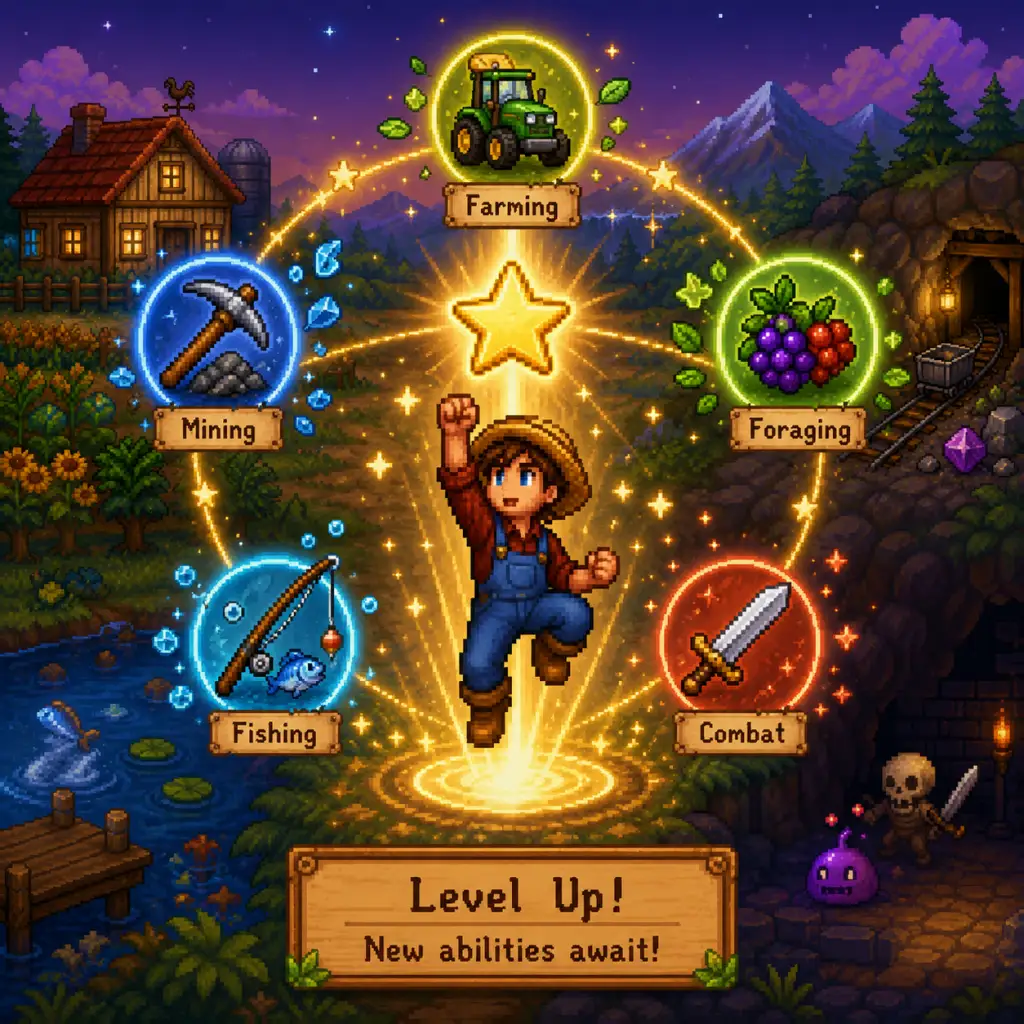
Character Skills
Character Skills Overview
In Stardew Valley, your character progresses through five core skills: Farming, Mining, Foraging, Fishing, and Combat. Each skill is leveled from 1 to 10 by performing related activities. At levels 5 and 10, you choose a profession (specialization) that provides permanent bonuses. There are no spells, cooldowns, or active abilities—instead, skills grant passive benefits, unlock crafting recipes, and improve tool efficiency. This guide covers every skill, its leveling methods, profession choices, synergies, recommended builds, and optimal use.
Farming
Description
The Farming skill governs crop planting, harvesting, and animal husbandry. Higher levels increase the chance of gaining extra crops per harvest, reduce energy cost for using the Hoe and Watering Can, and unlock new crafting recipes (e.g., Keg, Preserves Jar, Mayonnaise Machine).
Leveling
- Gains XP per crop harvested (varies by crop value) and by picking up animal products (egg, milk, etc.).
- Each level requires: Level 1: 100 XP, Level 2: 380, Level 3: 770, Level 4: 1300, Level 5: 2150, Level 6: 3300, Level 7: 4800, Level 8: 6900, Level 9: 10000, Level 10: 15000.
- Tool upgrades (Hoe, Watering Can) reduce energy cost but don't directly increase XP rate.
- Tiller: Crops sell for 10% more. Good for pure crop profit.
- Rancher: Animal products (eggs, milk, wool) sell for 20% more. Best if you focus on animals.
- From Tiller:
- From Rancher:
- Unlocked at levels 2, 3, 6, 7, 9: new crafting recipes (Basic Fertilizer, Quality Fertilizer, Keg, etc.).
- Tool upgrades not directly tied to skill but are essential for farming efficiency.
- Tiller + Artisan: Sell crops raw or process into artisan goods for massive profit (e.g., Blueberry wine).
- Rancher + Coopmaster/Shepherd: Maximize animal product output for cheese/mayonnaise.
- Agriculturist + Speed-Gro fertilizer: Shorten growth time significantly, enabling extra harvests.
- Farming pairs with Foraging (for wild seeds) and Mining (for ore to upgrade tools).
- Optimal Profit: Tiller → Artisan. Focus on high-value crops (strawberries, blueberries, cranberries) processed into jelly or wine.
- Animal Empire: Rancher → Shepherd or Coopmaster. Focus on barns and coops with quality animals.
- Speed Farming: Tiller → Agriculturist. Use with Speed-Gro to get multiple harvests in a season (e.g., three harvests of blueberries instead of two).
- Spring: plant strawberries (Egg Festival), potatoes, cauliflower.
- Summer: blueberries, melons, hops.
- Fall: cranberries, pumpkins, rare seeds (sweet gem berry).
- Winter: no outdoor crops, but you can use the Greenhouse (unlocked later) or grow winter seeds from foraging.
- Gain XP per rock/ore destroyed (about 2-8 XP per rock, more for valuable ore).
- Level milestones similar to Farming.
- Miner: +1 ore per vein (coal, copper, iron, gold, iridium). Good for resource gathering.
- Geologist: Chance for geodes to be double (50% chance). Best for collecting gems and artifacts.
- From Miner:
- From Geologist:
- Unlock recipes: Furnace (Lv.1), Explosive Ammo (Lv.2), Cherry Bomb (Lv.4), Bomb (Lv.7), Mega Bomb (Lv.9), Staircase (Lv.9), and more.
- No cooldowns; bombs have a fuse time.
- Miner + Blacksmith: For selling bars in a pinch.
- Miner + Prospector: For heavily mining and smelting (coal abundance).
- Geologist + Gemologist: Sell gems at 30% extra; use Crystalariums to duplicate diamonds/jade.
- Mining synergizes with Combat (fighting monsters for loot), Farming (ore for tools/ sprinklers), and Foraging (mining gives cave carrots, etc.).
- Resource Focus: Miner → Prospector or Blacksmith. For large-scale smelting and tool upgrades.
- Profit Focus: Geologist → Gemologist. Collect and sell gems, especially diamonds (reached via Crystalarium).
- Museum Completion: Geologist → Excavator. Doubles geodes for artifact hunting.
- Early game: Mine for copper to upgrade tools and build sprinklers.
- Mid game: Mine for iron and gold for quality sprinklers and kegs.
- Late game: Skull Cavern for iridium and auto-petter.
- Use bomb runs for fast leveling and resource gathering.
- XP from picking up forage items, chopping trees, and harvesting wild seeds.
- Also from tapping trees (tapping gives 25 XP per action).
- Forester: Wood drops are increased by 25%. Great for constant wood supply.
- Gatherer: Chance to get double foraged items (20% base, increases with level). Better for general foraging.
- From Forester:
- From Gatherer:
- Unlock recipes: Wild Seeds (Spring/Summer/Fall/Winter), Survival Burger, Field Snack, etc.
- Tap trees for syrup/resin/tar.
- Forester + Lumberjack: For massive wood and hardwood (needed for buildings and fences).
- Gatherer + Botanist: Makes foraging extremely profitable and provides high-healing items.
- Forester + Tapper: Boost income from tappers while still getting wood.
- Foraging synergizes with Farming (wild seeds, tree farm), Mining (wood for staircases), and Fishing (field snacks for energy).
- Wood Hoarder: Forester → Lumberjack. Focus on clearing forest and secret woods for wood/hardwood.
- Profitable Forager: Gatherer → Botanist. Collect all forage items seasonally for high profit (e.g., spring salmonberries, summer spice berries, fall blackberries).
- Tap Master: Forester → Tapper. If you plan to mass-produce kegs/jars using oak resin.
- Year-round: Collect ground forage daily (especially in spring and fall when berries spawn).
- Chop trees for wood and hardwood. Tap oak/ maple/ pine trees early.
- Use winter forage to grow winter seeds for profit.
- Botanist makes foraged items gold quality, which sell for more and heal more.
- XP per catch, influenced by fish difficulty and quality.
- Casting distance does not affect XP.
- Also gain XP from crab pots (low but steady).
- Fisher: Fish sell for 25% more. Good for profit from fishing.
- Trapper: Resources required to craft crab pots are reduced. Best if you use many crab pots.
- From Fisher:
- From Trapper:
- Unlock recipes: Bait (Lv.2), Cork Bobber (Lv.3), Spinner (Lv.4), Dressed Spinner (Lv.5), Trap Bobber (Lv.6), Magnet (Lv.7), Treasure Hunter (Lv.8), Wild Bait (Lv.9), and more.
- No cooldowns; each cast takes several seconds.
- Fisher + Angler: Best for selling fish (especially legendary fish and seasonal catches).
- Trapper + Luremaster: For passive income from crab pots with minimal effort.
- Pirate + Treasure Hunter tackle: Maximize chance for treasure chests (artifacts, rings, etc.).
- Fishing synergizes with Cooking (fish used in recipes) and Community Center bundles.
- Fishing Tycoon: Fisher → Angler. Catch and sell fish for early game cash; keep some for bundles.
- Passive Income: Trapper → Luremaster. Deploy crab pots in ocean and fresh water, collect daily.
- Treasure Hunter: Fisher → Pirate. Use with magnetic bobber to catch artifacts and special items.
- Every day if possible: fishing is a great early game money source.
- Specific times: certain fish appear only in specific seasons, weather, time, and location.
- Use bait and tackle to increase catch rate and quality.
- For treasure: fish in deep water with a magnet/treasure hunter tackle.
- XP per monster kill (varies by monster type and difficulty).
- Also small XP from defeating slimes, bats, etc.
- Fighter: All attacks do 10% more damage. Good for damage output.
- Scout: Critical strike chance is increased by 50%. Best for crit-based builds.
- From Fighter:
- From Scout:
- Unlock recipes: Life Elixir, Oil of Garlic, certain rings (Ring of Yoba, etc.), and other items.
- No direct combat abilities beyond weapon swings and blocks.
- Fighter + Brute: Highest flat damage, good for heavy weapons like clubs or hammers.
- Scout + Desperado: Best for daggers or weapons with high crit chance (e.g., Galaxy Dagger, Obsidian Edge with crit enchants).
- Scout + Acrobat: Use special moves frequently (e.g., the club's slam or sword's slash).
- Combat synergizes with Mining (fighting for resources), Farming (monster loot for crafting), and Fishing (some monsters drop fish? No, but combat helps in dangerous mines.)
- Raw Power: Fighter → Brute. Use any weapon, but especially effective with swords and clubs. Good for general combat.
- Critical Machine: Scout → Desperado. Pair with a weapon that has high crit chance (e.g., Obsidian Edge, or Galaxy Sword with crit enchants). Can one-shot many mobs.
- Special Spam: Scout → Acrobat. Use a weapon with a powerful special move (e.g., Hammer's slam, Dagger's throw) and spam it. Great for crowd control.
- Whenever you enter the mines, Skull Cavern, or the Volcano Dungeon.
- Use healing items (food) and bombs for efficiency.
- Late game: use Galaxy weapons and enchantments for maximum power.
- For specific monsters: use slime charmer ring, etc.
- Farming + Foraging: Both benefit from speed-gro and fertilizer; foraged items can be turned into wild seeds.
- Mining + Combat: Mining gives ore and gems; combat gives monster loot; together they fund tool upgrades and equipment.
- Fishing + Cooking: Fish are ingredients for high-healing recipes like Sashimi and Lucky Lunch.
- All skills: Leveling all five is required for the \"All Skills Level 10\" achievement and Perfection.
Profession Choices (Level 5)
Level 10 Upgrades
- Artisan: Artisan goods (jelly, wine, cheese, cloth) sell for 40% more. (Best for late-game profit with processing.)
- Agriculturist: All crops grow 10% faster. (Speeds up harvests, good for speedruns or short season crops.)
- Coopmaster: Incubation times halved, and animals (chickens, ducks, rabbits) produce more frequently.
- Shepherd: Barn animals (cows, goats, sheep) produce faster, and shearing wool is instant.
Upgrades
Combos & Synergies
Recommended Builds
When to Use
Mining
Description
Mining levels up by breaking rocks and ores in the mines. Higher levels reduce energy cost of using the Pickaxe, increase chance to find precious gems, and unlock crafting recipes for bombs, furnaces, and mining-themed items.
Leveling
Profession Choices (Level 5)
Level 10 Upgrades
- Blacksmith: Metal bars sell for 25% more. Useful if you sell bars directly (not recommended early).
- Prospector: Chance to find coal doubled (coal is critical for smelting and crafting).
- Excavator: Chance to find geodes doubled (great for museum completion and gem selling).
- Gemologist: Gems sell for 30% more. Combine with Crystalarium for profit.
Upgrades
Combos & Synergies
Recommended Builds
When to Use
Foraging
Description
Foraging involves collecting wild plants, berries, and items like tree seeds. Higher levels increase the chance to find double forage items, reduce energy cost for using the Axe, and unlock recipes for wild seeds and other foraging items.
Leveling
Profession Choices (Level 5)
Level 10 Upgrades
- Lumberjack: All trees can drop hardwood (very useful for late-game crafting).
- Tapper: Tapped products (maple syrup, oak resin, pine tar) are worth 25% more.
- Botanist: Foraged items always have gold quality (higher sell price and healing).
- Tracker: Foraging locations shown on the map (only helpful if you can't remember).
Upgrades
Combos & Synergies
Recommended Builds
When to Use
Fishing
Description
Fishing is a mini-game that requires timing and skill. Higher levels increase the size of the fishing bar, reduce max energy used, and unlock crafting recipes for tackle and bait.
Leveling
Profession Choices (Level 5)
Level 10 Upgrades
- Angler: Fish sell for 50% more (total 75% over base). Maximum fish profit.
- Pirate: Chance to find treasure in chests increases (good for artifact fishing).
- Mariner: Crab pots never catch trash.
- Luremaster: Crab pots no longer need bait.
Upgrades
Combos & Synergies
Recommended Builds
When to Use
Combat
Description
The Combat skill increases by defeating monsters in the mines, Skull Cavern, and other combat zones. Higher levels increase health, reduce energy cost for using weapons, and unlock crafting recipes for monster-related items.
Leveling
Profession Choices (Level 5)
Level 10 Upgrades
- Brute: Damage increased by 15% instead of 10%. (Total +25% from base.)
- Defender: +25 max health (adds to base health, increasing survivability).
- Acrobat: Reduces special move cooldown (for weapons like swords) by 50%.
- Desperado: Critical strikes do 50% more damage (critical power increased).
Upgrades
Combos & Synergies
Recommended Builds
When to Use
General Skill Synergies
Conclusion
Your character's skills in Stardew Valley are passive upgrades that define your playstyle. There are no active spells or cooldowns; instead, the profession choices at levels 5 and 10 give permanent bonuses. Choose according to your goals: profit, speed, or combat efficiency. Maxing all skills is rewarding and opens up the entire game.
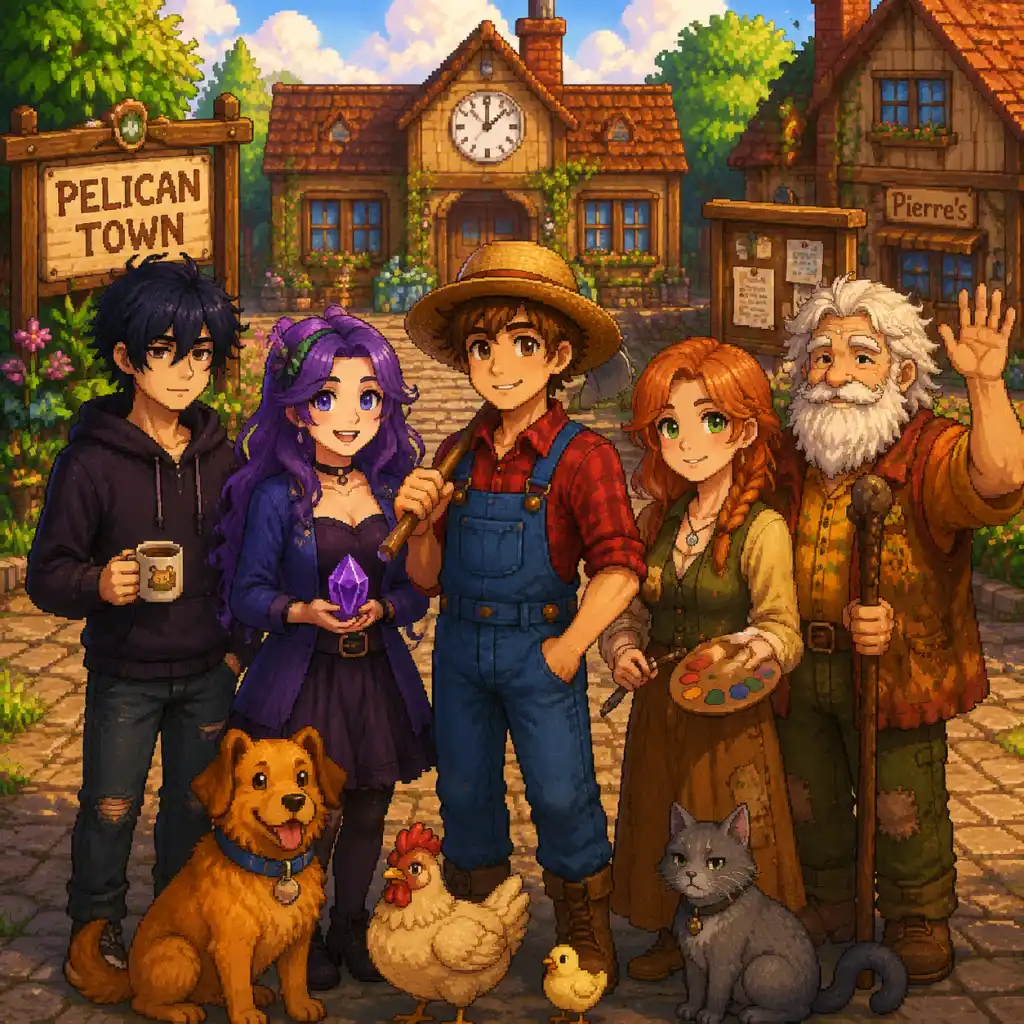
Characters & Roles
Characters & Roles in Stardew Valley
Stardew Valley features a single playable character—the Farmer—but the world is populated by over 30 unique NPCs, each with their own personality, schedule, and relationships. This guide covers the Farmer's creation and skill paths, followed by every major NPC: the 12 marriage candidates and the most important non-marriage villagers.
---
1. The Farmer (Player Character)
#### Background & Customization
You inherit your grandfather's old farm in Stardew Valley. You can customize your appearance (gender, skin, hair, eyes, shirt, pants, accessories) and name. Your character has no spoken dialogue; actions are shown through emotes or tool use. You can later change your appearance at the Wizard's basement after completing a quest.
#### Skills & Professions
Your character progresses through five core skills (Farming, Mining, Foraging, Fishing, Combat). Each skill reaches level 10 with two profession choices at levels 5 and 10. These define your playstyle:
| Skill | Level 5 Choice | Level 10 Choice | Recommended |
|---|---|---|---|
| Farming | Rancher (animal products +20%) / Tiller (crops +10%) | Artisan (artisan goods +40%) / Agriculturist (crops grow 10% faster) | Tiller -> Artisan for money; Rancher -> Artisan for animal focus |
| Mining | Miner (+1 ore per vein) / Geologist (gems double) | Blacksmith (metal bars worth +50%) / Prospector (coal double) | Miner -> Blacksmith for tool upgrades; Geologist -> Excavator for more gems |
| Foraging | Forester (wood +25%) / Gatherer (forage double) | Lumberjack (trees drop hardwood) / Botanist (forage always iridium quality) | Gatherer -> Botanist for best foraging profits |
| Fishing | Fisher (fish +25%) / Trapper (crab pot resources) | Angler (fish worth +50%) / Pirate (treasure chance double) | Fisher -> Angler for money; Trapper -> Mariner for crab pots |
| Combat | Fighter (+10% damage, +15 HP) / Scout (+50% crit chance) | Brute (+15% damage) / Defender (+25 HP) |
- Tools: Upgraded via Clint (copper, iron, gold, iridium) to improve efficiency.
- Weapons: Swords, clubs, daggers obtained from mines, skull cavern, or adventurer's guild. Best: Galaxy Sword (via prismatic shard) or Infinity weapons.
- Rings & Shoes: Boost stats (defense, immunity, attack, speed, magnetism). Combine at Volcano Forge.
- Consumables: Food for energy/health buffs (e.g., Spicy Eel, Coffee for speed, Lucky Lunch).
- Farm Setup: Optimize crops, animals, artisan machines based on chosen professions.
- Background: Lives with his grandparents George and Evelyn. Ex-jock who loves sports, but has a rough past (mother died, father absent).
- Strengths: Gives you breakfast (complete meal or something) sometimes after marriage. Helps on farm occasionally.
- Weaknesses: Initially arrogant; difficult to befriend if you don't like sports.
- Gifts: Loved - Complete Breakfast, Salmon Dinner, and any liked gift.
- Playstyle Tips: Chat with him daily, give loved gifts, compete in egg hunt or ice fishing for hearts.
- Team Synergy: No direct synergy, but his 14-heart room has sports equipment; no practical farm benefit.
- Background: A writer living in a cabin on the beach. Sophisticated, romantic, melancholic.
- Strengths: After marriage he writes and can give you gifts like cloth or coffee.
- Weaknesses: Picky eater (loves crab cakes, lobster, pomegranate); expensive gifts early.
- Gifts: Loved - Crab Cakes, Duck Feather, Lobster, Pomegranate, Squid Ink.
- Playstyle Tips: Easy to find on beach or in his cabin. Give loved fish dishes.
- Team Synergy: None, but his character fits a beach farm aesthetic.
- Background: The town doctor. A bit shy, obsessed with health and model planes.
- Strengths: After marriage he cooks and sometimes gives you a complete breakfast. Can fix your health if low? No, just dialogue.
- Weaknesses: Expensive lifestyle (loves coffee, wine); can be boring to some.
- Gifts: Loved - Coffee, Pickles, Truffle Oil, Wine, Super Meal.
- Playstyle Tips: Visit his clinic regularly (closed Fridays), give coffee.
- Team Synergy: None.
- Background: Lives with mother Jodi and younger brother Vincent. A slacker who plays guitar and skateboards.
- Strengths: After marriage he sometimes tidies the house or gives you gifts like pancakes.
- Weaknesses: Immature; may lose items (his 14-heart event has a messy room).
- Gifts: Loved - Cactus Fruit, Pizza, Tigerseye, Maple Bar.
- Playstyle Tips: Hang out at his house or the beach. Easy to please with pizza.
- Team Synergy: None.
- Background: Maru's half-brother, son of Robin and Demetrius (stepson). Emo, tech-savvy, smoker.
- Strengths: After marriage he gives you items like coffee, obsidian, or frozen tears. Helps on farm rarely.
- Weaknesses: Moody; often in his room; loves expensive gifts (Sashimi, Frozen Tear, Void Egg).
- Gifts: Loved - Frozen Tear, Sashimi, Void Egg, Obsidian, Pumpkin Soup.
- Playstyle Tips: Give him void eggs (from Krobus) or sashimi. Chat in his room evenings.
- Team Synergy: None.
- Background: Works at JojaMart, lives with Marnie. Alcoholic, depressed, but has a redemption arc.
- Strengths: After marriage he gives you sometimes pizza or pepper poppers. He becomes cleaner.
- Weaknesses: Difficult hearts early (responds poorly). Loves beer, pizza, hot peppers.
- Gifts: Loved - Beer, Hot Pepper, Pizza, Pepper Poppers, Strange Bun.
- Playstyle Tips: Give beer (cheap) or pizza. Watch his heart events for emotional depth.
- Team Synergy: None.
- Background: Pierre and Caroline's daughter. Tomboy, loves video games, music, and eating gems.
- Strengths: After marriage she gives you food like pumpkin soup or blackberry cobbler. Helps on farm.
- Weaknesses: Picky with gifts; loves quartz, amethysts, and chocolate cake.
- Gifts: Loved - Amethyst, Blackberry Cobbler, Chocolate Cake, Pufferfish, Pumpkin.
- Playstyle Tips: Give her seasonal forage or minerals; hang out at Pierre's or the graveyard.
- Team Synergy: None.
- Background: Works at the Stardrop Saloon, lives with sister Haley. Free-spirited, loves crafting, animals.
- Strengths: After marriage she gives you cloth, wool, or gemstones. Helps farm.
- Weaknesses: Her schedule is busy (works evenings); loves expensive cloth/wool items.
- Gifts: Loved - Cloth, Emerald, Ruby, Survival Burger, Wool.
- Playstyle Tips: Give wool or cloth from sheep/loom. Visit the saloon after 4pm.
- Team Synergy: Good for animal-focused farms.
- Background: Emily's sister, blonde, initially shallow and mean. Lives in town.
- Strengths: After marriage she becomes kinder; gives you gifts like coconut or pink cake. Helps farm.
- Weaknesses: Start low friendship; loves expensive and seasonal items (coconut, sunflowers, fruit salad).
- Gifts: Loved - Coconut, Fruit Salad, Pink Cake, Sunflower.
- Playstyle Tips: Give sunflowers (cheap and easy). Persist through early rudeness.
- Team Synergy: None.
- Background: An artist living in a small cabin south of Marnie's ranch. Nature lover, vegetarian.
- Strengths: After marriage she gives you salads or artisan goods. Helps farm.
- Weaknesses: Loves foraged foods (salad, dandelion, truffle, wine). Low social schedule.
- Gifts: Loved - Goat Cheese, Poppyseed Muffin, Salad, Stir Fry, Truffle, Wine.
- Playstyle Tips: Give salad or foraged items; visit her cabin often.
- Team Synergy: Pairs with foraging-based farms.
- Background: Daughter of Robin and Demetrius, half-sister to Sebastian. Aspiring scientist/inventor.
- Strengths: After marriage she gives you crafted items like batteries or bombs. Helps farm.
- Weaknesses: Loves tech items (battery pack, gold bar, strawberry) which require resources.
- Gifts: Loved - Battery Pack, Cauliflower, Cheese Cauliflower, Diamond, Gold Bar, Iridium Bar, Strawberry.
- Playstyle Tips: Give battery packs (from lightning rods) or strawberries. Visit her in the carpenter's shop or near the mountain lake.
- Team Synergy: Good for farms focusing on mining and technology.
- Background: Lives with her alcoholic mother Pam, in a trailer. Teaches local children Vincent and Jas. Timid, kind.
- Strengths: After marriage she gives you food (like pancakes) and helps with the garden. She decorates the house.
- Weaknesses: Loves books (emerald, diamond) and specific cooked dishes. Limited social circle.
- Gifts: Loved - Diamond, Emerald, Melon, Poppy, Red Plate, Roots Platter, Sandfish, Tom Kha Soup.
- Playstyle Tips: Give her melons or emeralds. Visit her at the museum or trailer.
- Team Synergy: None.
- Background: A homeless hermit living in a tent near the mountain lake. Wise, nature-connected.
- Gameplay Role: Gives tips on foraging and fishing, teaches you the recipe for Wild Bait at 4 hearts.
- Gifts: Loved - Cactus Fruit, Coco, Yam, Blueberry Tart, Dish O' The Sea.
- Schedule: Often near his tent or the spa; easy to locate.
- Background: The old fisherman who lives on the pier. Runs the fish shop.
- Gameplay Role: Sells fishing rods, bait, tackle, and fish. Gives you a Bamboo Pole on a rainy day. Has quests related to fishing.
- Gifts: Loved - Catfish, Diamond, Iridium Bar, Mead, Octopus, Pumpkin, Sea Cucumber, Sturgeon.
- Notes: Friendship unlocks fishing perks and secret notes.
- Background: The town blacksmith. Shy, in love with Emily.
- Gameplay Role: Tool upgrades, ore processing, geode cracking. Sells ore and coal.
- Gifts: Loved - Gold Bar, Iridium Bar, Omni Geode, Aquamarine, Amethyst, Emerald, Ruby, Topaz.
- Notes: High friendship gives hints about geodes and a recipe for Artful combat.
- Background: The carpenter, lives on the mountain with Demetrius and kids. Skilled builder.
- Gameplay Role: Builds and upgrades farm buildings, sells wood/stone items and furniture.
- Gifts: Loved - Goat Cheese, Peach, Pizza, Spaghetti, Wine.
- Notes: High friendship not essential but gives recipes like the farm computer.
- Background: The town mayor. Runs the community center upgrade (or Joja). Has a secret relationship with Marnie.
- Gameplay Role: Issues quests, gives rewards for community center bundles, collects taxes (no actual tax).
- Gifts: Loved - Autumn's Bounty, Glazed Yams, Hot Pepper, Vegetable Medley.
- Notes: Low friendship can lead to funny cutscenes. Not critical to befriend.
- Background: Runs the ranch outside town. Aunt of Shane and Jas. Sells animals and animal supplies.
- Gameplay Role: Sells cows, goats, sheep, pigs, rabbits, and hay/feeders.
- Gifts: Loved - Diamond, Farmer's Lunch, Pink Cake, Pumpkin Pie, Sweet Pea.
- Notes: Friendship not required but unlocks some recipes.
- Background: Penny's mother, bus driver. Drinks heavily.
- Gameplay Role: Drives the bus to the Desert (requires community center vault bundle or Joja purchase).
- Gifts: Loved - Beer, Energy Tonic, Glazed Yams, Mead, Pale Ale, Parsnip Soup.
- Notes: Friendship gives some recipes but not vital.
- Background: Lives in a tower west of Pelican Town. Mysterious mage.
- Gameplay Role: Gives access to shrine (change appearance), Junimo huts, and the Dark Talisman quest. Hints at magical aspects.
- Gifts: Loved - Purple Mushroom, Solar Essence, Void Essence, Super Cucumber.
- Notes: Befriending unlocks the Magic Ink quest and the ability to craft warp totems.
- Background: A shadow monster living in the sewers. Can be a roommate (platonic) instead of marriage.
- Gameplay Role: Sells rare items (Stardrops, Void Eggs, Iridium Sprinkler recipe on Fridays).
- Gifts: Loved - Diamond, Iridium Bar, Lucky Lunch, Pumpkin, Void Mayonnaise, Wild Horseradish.
- Roommate: After 10 hearts, you can ask him to move in; he gives gifts and stays forever (no marriage).
- Background: Lives in the mines, friendly after you learn the Dwarvish language.
- Gameplay Role: Sells bombs, life elixirs, and rare resources (iridium, stone).
- Gifts: Loved - Amethyst, Aquamarine, Diamond, Emerald, Jade, Ruby, Topaz, Dwarf Scroll items.
- Notes: Requires Dwarf Scroll artifacts to learn language.
- Junimos: Forest spirits that help with the Community Center. They grant rewards for completing bundles.
- Grandpa: Appears on year 3 to evaluate your farm. Score determines access to the Statue of Perfection (provides Iridium).
- Gunther: Museum curator; you donate artifacts/minerals. No friendship needed.
- Morris: JojaMart manager; antagonist if you choose Joja route.
- Sandy: Desert merchant; sells seeds and items after unlocking desert.
- Mr. Qi: Mysterious figure found on Ginger Island and in the Skull Cavern. Offers challenging quests and Wallet upgrades.
- Romanced spouses help with chores, provide gifts, and open special events.
- Friends with high hearts send cooking recipes, ingredients, and open up new areas (e.g., Emily's clothing therapy).
- Shopkeepers become more convenient over time? No, but some sell new items after certain conditions.
- Festivals require friendships to win (e.g., Luau soup, Flower Dance acceptance).
- For mining/combat: Maru (batteries/bombs) or Abigail (adventurous, gives food).
- For farming: Penny (helps with crops? Not specifically) or Leah (foraging).
- For money: Artisan goods from marriage? Actually spouses give random gifts; best is Emily (cloth) or Haley (coconuts for selling).
- For ease of heart gain: Leah (likes foraged items) or Harvey (coffee).
#### No Party System
Stardew Valley does not have a party or team synergy with NPCs during gameplay. However, marrying a spouse provides daily gifts, help on the farm (watering crops, feeding animals, repairing fences), and a 14-heart event. Other NPCs can become friends; high friendship unlocks recipes, cutscenes, and gifts in the mail.
---
2. Marriage Candidates (12 total)
Each candidate has 10 heart events (8 for some) and requires a bouquet to start dating, then a Mermaid's Pendant to propose. They have unique schedules, liked/loved gifts, and personality traits.
#### Male Candidates
Alex
Elliott
Harvey
Sam
Sebastian
Shane
#### Female Candidates
Abigail
Emily
Haley
Leah
Maru
Penny
---
3. Other Key Non-Marriage NPCs
These villagers can't be married but are vital for gameplay (shops, quests, events).
Linus
Willy
Clint
Robin
Lewis
Marnie
Pam
Wizard (M. Rasmodius)
Krobus
Dwarf
---
4. Special Characters & Roles
---
5. Team Synergy & Roles in the Community
Stardew Valley does not have combat parties or synergies, but NPCs contribute to your farm indirectly:
#### Best Spouse for Player Role
---
Conclusion
Stardew Valley's character system revolves around building relationships with the 12 marriage candidates and other villagers to enrich your farm life. There are no combat or class roles; instead, your choice of skills (professions) defines your playstyle. Choose a spouse who fits your aesthetic and farming strategy, and befriend key NPCs for recipes, items, and heartwarming events. Remember: every character has a favorite gift, and cumulative friendship over time unlocks the full narrative tapestry of Pelican Town.
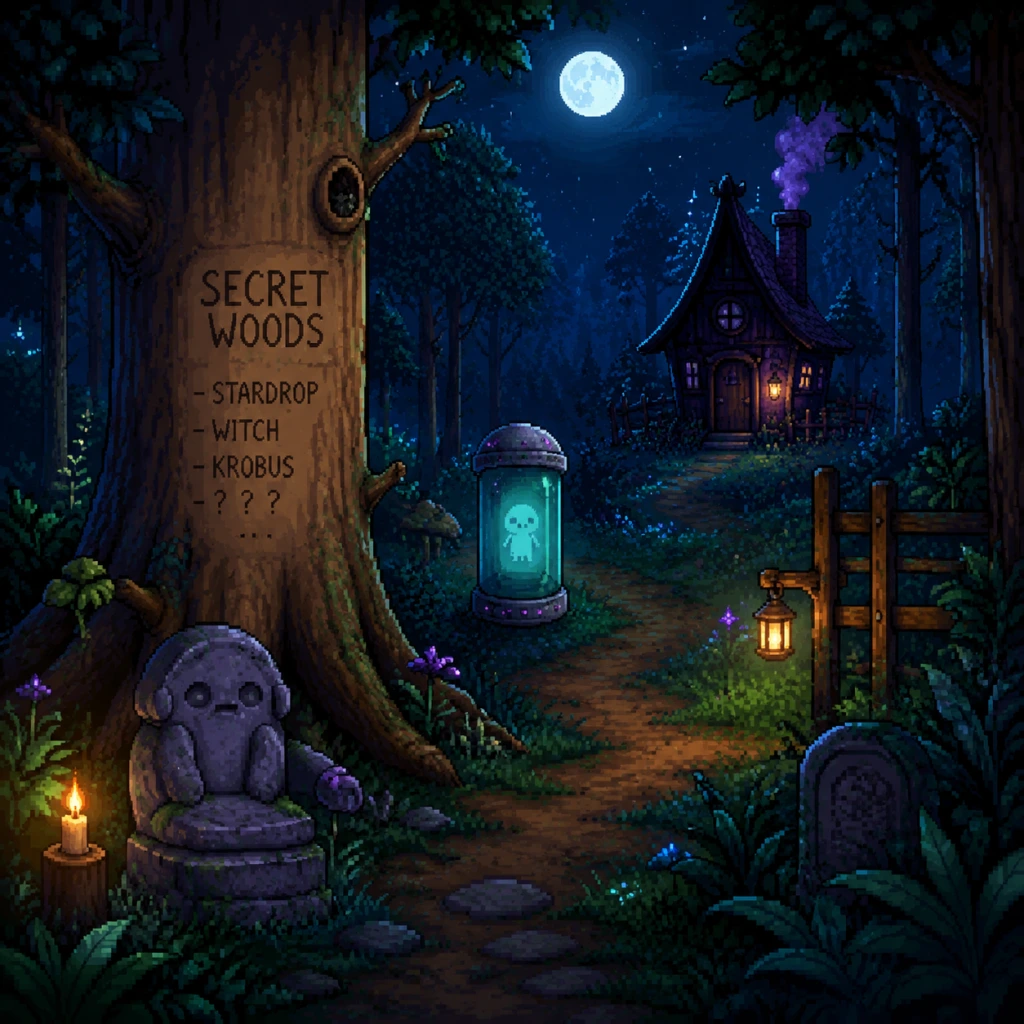
Cheats & Secrets
Cheats & Secrets: Stardew Valley
Stardew Valley does not include traditional cheat codes that can be entered via a keyboard command or a pause menu code. However, on PC (Windows/Mac/Linux) with the SMAPI modding framework installed, you can use console commands to cheat. Below are the legitimate secrets, Easter eggs, and hidden content available in the vanilla game.
---
Cheat Codes (Built-in)
None. There are no official cheat codes. All functionality is restricted to mods or creative exploits.
Console Commands (SMAPI Mod)
To use console commands, you must install SMAPI (Stardew Modding API) from smapi.io. Once installed, launch the game and press the tilde (~) key to open the console. Commands alter game state directly.
| Command | Effect | Example |
|---|---|---|
| `player_setmoney [amount]` | Set gold immediately | `player_setmoney 999999` |
| `player_additem [ID] [count]` | Add item(s) by internal ID | `player_additem 74 1` (adds Prismatic Shard) |
| `player_sethealth [value]` | Set health (1-100?) | `player_sethealth 100` |
| `player_setstamina [value]` | Set stamina (1-270?) | `player_setstamina 270` |
| `player_setmaxstamina [value]` | Change max stamina | `player_setmaxstamina 500` |
| `player_setmaxhealth [value]` | Change max health | `player_setmaxhealth 200` |
| `player_free` (toggle) | Become invincible? | `player_free` |
| `world_day [date]` | Advance calendar | `world_day 28 spring` |
| `world_season [season]` | Force season | `world_season fall` |
| `world_weather [weather]` | Sets next day's weather | `world_weather rain` |
| `relationship_add [NPC] [hearts]` | Increase friendship | `relationship_add Abigail 5` |
| `character_add [NPC]` | Add NPC to world? (debug) | `character_add Marlon` |
| `event_forcetown` (requires ID) | Trigger specific event | `event_forcetown 992559` (Krobus secret note) |
Exploits & Glitches (Use at own risk)
- Item Duplication via Naming: When naming your character or an animal, you can insert bracketed item IDs (e.g., `[74]` or `[645][74]`). NPCs who say your name will then spawn those items (e.g., Gus says "Hi, [74]" and you receive a Prismatic Shard). This works for animals' names and your character, but can break dialogue or crash on some platforms.
- Fishing Chest Exploit: (Patched on PC v1.5-1.6?) It is possible to receive multiple treasure chest items by opening the fishing treasure chest rapidly. This is unreliable and may be patched.
- Staircase Placement in Skull Cavern: Place a staircase before descending to skip ladders. Not an exploit but a time-saving method.
- Secret Note #20 – Gives the "Strange Capsule" / Owl Statue? Actually leads to a hidden wall in the Sewers. Touch for a reaction.
- Secret Note #25 – Quest to find a hidden golden statue in the Secret Woods? (Bring a specific item?)
- Secret Note #?? – Leads to a hidden chest with a Prismatic Shard in the backwoods.
- Secret Note #?? – Shows a map to the "Mayor's Lucky Purple Shorts" (hidden in Marnie's room).
- Build the Magic Ink quest (for Wizard)
- Purchase a Junimo Hut crop transformation (for 20,000g, changes crop appearance?)
- Use the Dark Shrine of Selfishness to change your children into doves (irreversible).
- Use the Dark Shrine of Night Terrors to cause monsters to attack your farm at night.
- Junimo Plush: Rarely found in a secret note or as a drop from a monster? Actually you get one from the museum? No, the Junimo Plush is a furniture item that can be obtained from a Secret Note (Note #? ).
- Mayor Lewis's Golden Statue: Place his lucky shorts in a grange display at the Fall Festival to trigger a special dialogue. Also, you can place his shorts in the soup at the Luau for a funny reaction.
- The Ancient Drum & Ancient Doll: Museum artifacts that trigger a cutscene when donated (not exactly secret but fun).
- The Purple Shorts in the Hidden Stash: In Marnie's room, you can find Lewis's purple shorts behind the fireplace (needs secret note).
- The Parrot Express: After unlocking Ginger Island, a parrot offers to open paths for Golden Walnuts. The parrot that sells totems? Also, a parrot in the volcano gives hints about secret doors.
- The "ConcernedApe" Statue: In the secret woods or the Wizard's basement? Actually you can get a statue of the developer via a late-game quest (maybe from the claw machine? No, the ConcernedApe statue is a rare item that can be obtained from an enemy drop or from a special event).
- The Giant Crop: Only possible if you plant certain seeds in a 3x3 pattern. Giant crops (Cauliflower, Melon, Pumpkin) are Easter eggs that yield multiple crops and break down into decorative items.
- The Junimo Kart arcade game: Hidden in the Saloon. It's a mini-game that is very hard; if you beat it, you get a secret message? Actually completing Junimo Kart (hard) gives a secret cutscene with the developer.
- The Crane Game: In the Movie Theater (after Joja build), you can win rare items including a green sun (Easter egg).
- The Stardrop: The final one obtained from your spouse after 12.5 hearts (14-heart events).
- The Galaxy Sword: Obtain by taking a Prismatic Shard to the Three Pillars in the Desert.
- The Witch's Hut Quests: The Wizard's Dark Talisman quest is triggered after the Community Center.
- The Ginger Island Pirate Cove: Accessible via the ship at the island dockyard? Actually you need to repair the ship by giving 200 hardwood, 5 iridium bars, and 5 batteries? Then you can sail to the island and discover the Pirate Cove (secret room in the volcano? No, that's the Journal Scrap).
Secrets & Hidden Features
#### 1. Secret Notes
After obtaining the Magnifying Glass (Winter 1, Year 1, after a cutscene), you can find Secret Notes. They contain clues to hidden items, Easter eggs, and events. Most notable:
#### 2. Strange Capsule & Owl Statue
Rare random events: A meteor crashes on your farm (yields iridium), a strange capsule appears (after a few days it vanishes, leaving an empty case). If you get the Strange Capsule and it opens, later your character might see a shadowy figure (alien?) walking. This does nothing concrete but is a fun Easter egg.
#### 3. The Witch's Hut
After completing the Community Center or Joja route, you can access the Witch's Hut in the southwest corner of the plane. Inside you can:
#### 4. The Secret Woods
Accessible after upgrading your axe to at least steel. It contains a slime hutch, hardwood stumps, and a hidden path to a lake with a strange statue (Dwarvish translation needed?). The statue gives a random item if you place a sweet gem berry or diamond? Actually: placing a Diamond on the statue in the Secret Woods (south pond) yields a Prismatic Shard.
#### 5. Krobus & The Sewers
Krobus is a shadow monster who sells rare items (Stardrop, Iridium Sprinkler) and can become a roommate (after 10 hearts and a Void Ghost Pendant). He also gives hints. The Sewers contain a dialogue option if you drop a Prismatic Shard or similar? No, but there's a hidden wall near the curtain that reacts if you interact with it (only after reading Secret Note #??).
#### 6. The Casino
Unlocked after completing the "The Mystery of the Stardew Valley” quest (from the next town? Actually: get the Club Card from Qi's room in the secret note series, then enter the back room of the Saloon). The Casino offers mini-games and rare items (e.g., Magic Rock Candy).
#### 7. Qi’s Secret Walnut Room
On Ginger Island, after collecting 100 Golden Walnuts, you can access Mr. Qi's hidden room in the mountain. He offers special challenges (danger in the deep, etc.) and rewards like the Qi Fruit seeds, pressure nozzles, etc.
#### 8. The Ostrich
Found in a secret room inside the Volcano Dungeon on Ginger Island (needs a golden coconut? Unlocked by completing a quest from Professor Snail). You can hatch and raise ostriches in a barn.
#### 9. The Bone Mill and Bone Fragments
After unlocking the Bone Mill (craftable via recipe from Professor Snail), you can process bone fragments into fertilizer. In the volcano, there's a hidden door behind a lava frog? Actually: the frog gives a hint to place a particular item.
Easter Eggs
Developer-Intended Hidden Content
This includes things like:
Summary
Stardew Valley’s “cheats” are primarily the SMAPI console (PC only). Official secrets are plentiful and rewarding – they are not glitches but deliberate content designed to be discovered. Use the tables and bullet points above to find every hidden item and event.