Super Smash Bros. Ultimate
## Super Smash Bros. Ultimate Game Introduction **Genre:** Crossover Platform Fighter / Party Brawler **Developer & Publisher:** Developed by Bandai Namco Studios and Sora Ltd., with Masahiro Sakurai serving as Director. Published by Nintendo. **Release Timeline:** Announced in March 2018 during ...
Download & Installation
Super Smash Bros. Ultimate Download & Installation Guide
Platform Exclusivity: Super Smash Bros. Ultimate is a Nintendo Switch exclusive title. It is not available on PC (Steam, Epic Games Store), PlayStation, Xbox, or mobile devices. This guide covers only legitimate methods on Nintendo Switch.
---
Official Download Sources
| Source | Method | Notes |
|---|---|---|
| Nintendo eShop (digital) | Purchase and download directly to your Switch | Requires internet connection and Nintendo Account |
| Physical Game Card (retail) | Insert cartridge into Switch | Does not require download for base game; updates may be needed |
Step-by-Step Installation
#### Digital Purchase & Download (Nintendo eShop)
1. Ensure system requirements:
- Nintendo Switch console (all models: original, OLED, Lite)
- At least 13.8 GB of free internal storage or on a microSD card (game size ~13.6 GB after updates; plus save data)
- Active internet connection
- Nintendo Account (linked to the eShop region)
2. Connect to the internet via Wi-Fi or wired LAN (dock only).
3. Access the Nintendo eShop:
- From the HOME menu, select the eShop icon (orange shopping bag).
- Choose the Nintendo Account you wish to use.
4. Search for Super Smash Bros. Ultimate:
- Use the search bar or browse “New Releases” / “Best Sellers”.
- Select the game’s listing.
5. Purchase:
- Select “Proceed to Purchase”.
- Add funds via credit card, PayPal, eShop gift card, or Nintendo Switch Online vouchers.
- Confirm purchase. The game will be added to your library.
6. Begin download:
- The download will start automatically after purchase.
- Alternatively, go to HOME menu → your user icon → “Redownload” to start or resume.
- Download progress appears on the HOME screen (icon with a download bar).
7. Wait for completion:
- Download speed depends on your internet connection. The full game is about 13.6 GB.
- You can play while downloading only a portion if you choose “Start Software” after the initial required data is downloaded (approx. 6 GB). For full features (all stages, fighters, modes), wait for complete download.
#### Physical Game Card Installation
1. Obtain a genuine Super Smash Bros. Ultimate game card from a retailer.
2. Insert the card into the game card slot on the top of the Switch (standard/original/Lite) or side (OLED docked mode).
3. System will detect the card:
- A game icon will appear on the HOME menu.
- If prompted, download any required updates (size varies; frequently ~3–5 GB cumulative).
4. Install updates:
- Connect to the internet → select the game icon → press + → Software Update → Via the Internet.
- Alternatively, go to System Settings → System → Auto-Update Software to enable automatic downloads.
Important: The game card itself does not require installation of the base game; only updates and DLC need storage space. Ensure you have at least the update size free.
---
System Requirements (Nintendo Switch)
| Requirement | Minimum | Recommended |
|---|---|---|
| Console | Nintendo Switch (all models) | Nintendo Switch (any model) with at least 32 GB internal (or microSD) |
| Storage Space | 13.8 GB free (digital) or update size (physical) | 32 GB internal or 128 GB microSD for DLC + screenshots |
| Internet | Broadband for download/online play | Broadband (5 Mbps+ for smooth online) |
| Account | Nintendo Account (free) | Nintendo Switch Online subscription (for online multiplayer) |
| Controller | Joy-Con (one or pair) | Pro Controller or GameCube Controller (with adapter) |
Account Requirements
- Nintendo Account: Required for eShop purchases, online features, and save data cloud backup (with NSO). Create at [accounts.nintendo.com](https://accounts.nintendo.com) or via the Switch.
- Nintendo Switch Online (NSO): Optional but required for online multiplayer, global leaderboards, and save data cloud. Subscription tiers: Individual ($3.99/mo) or Family ($6.99/mo – up to 8 accounts).
---
First Launch Setup
1. After download/installation, select the game icon on the HOME menu.
2. Title screen appears with “Super Smash Bros. Ultimate” logo.
3. Language/Region:
- The system language is used by default. You can change language in System Settings → System → Language before launching.
4. Update check:
- If connected to the internet, the game may prompt to download the latest update. Accept to ensure compatibility (especially for online play).
5. Splash screens & intro video (can be skipped with + button).
6. Main menu with options: Smash, Games & More, Online, etc.
7. Optional initial settings:
- Controls: Adjust from Smash → Controls (configure button mapping, stick sensitivity, controller order).
- Vibration/HD Rumble: Set in System Settings or in-game under Options.
- amiibo: Tap to the NFC touchpoint (right Joy-Con or Pro Controller) to register.
---
Common Installation Errors & Fixes
| Error | Cause | Solution |
|---|---|---|
| Insufficient storage | Not enough free space for download/update | Delete unnecessary software (archive or delete games) → System Settings → Data Management → Manage Software → select delete or archive. Use microSD (up to 2 TB) formatted as FAT32/exFAT. |
| Corrupted data | Incomplete download or card read error | Go to System Settings → Data Management → Manage Software → Super Smash Bros. Ultimate → Check for Corrupt Data. Re-download or update. For physical cards, clean contacts and reinsert. |
| Error code 2124-3080 | eShop connection/region mismatch | Ensure Nintendo Account region matches eShop region. Try restarting the Switch, checking internet connection, or using a different Wi-Fi network. |
| Error code 2002-2060 | Storage write failure (e.g., damaged microSD) | Remove and reinsert microSD. Format microSD (backup data first) or replace if faulty. |
| Download stuck at 99% | Server timeout or network issue | Pause and resume download from HOME menu. Restart Switch or router if persistent. |
| Physical card not recognized | Dirty or inserted incorrectly | Gently blow into the card slot (if debris) and reinsert card with label facing away from Switch. |
Post-Installation Verification
1. Confirm icon & version:
- From HOME menu, highlight the game icon → press + → Software Information → check Ver. (e.g., Ver. 13.0.1). The latest can be cross-referenced with Nintendo’s support page.
2. Test game launch:
- Select the icon → wait for title screen → press A to enter main menu. No crash or infinite loading.
3. Test gameplay (offline):
- Go to Smash → Smash → Select a stage and fighter → start a match. Game should run smoothly at 60 FPS.
4. Online connectivity:
- If you have NSO, go to Online → Smash → Quickplay and attempt to find a match. Ensure no error codes.
5. Save data check:
- Play a match or access Games & More → Challenges → data should be saved automatically. Check save data in System Settings → Data Management → Save Data Cloud (NSO required) to confirm backups.
6. DLC verification (if owned):
- Go to Games & More → Collection → DLC (Fighters Pass). All purchased fighters should be accessible.
---
Additional Tips
- Storage optimization: Moving the game to microSD can free internal space. Go to System Settings → Data Management → Move Data Between System/MicroSD. microSD class 10 or UHS-I recommended.
- Redownload games: You can redownload Super Smash Bros. Ultimate at any time from the eShop without repurchasing, as long as your Nintendo Account owns it.
- Pre-loading (physical only): Updates can be pre-downloaded by enabling Auto-Update Software in System Settings and leaving the Switch in Sleep Mode with internet.
- Multi-language support: The game includes multiple language options; these are selected based on system language. Manual override is not available in-game.
---
Last updated: 2025. Game version may vary. Always refer to official Nintendo support for the most current information.
Game Introduction
Super Smash Bros. Ultimate Game Introduction
Genre: Crossover Platform Fighter / Party Brawler
Developer & Publisher: Developed by Bandai Namco Studios and Sora Ltd., with Masahiro Sakurai serving as Director. Published by Nintendo.
Release Timeline: Announced in March 2018 during a Nintendo Direct. Released worldwide on December 7, 2018 for the Nintendo Switch.
Platforms: Exclusive to the Nintendo Switch. Not available on any other system (PC, PlayStation, Xbox, or mobile).
Story Overview: The game includes a dedicated single-player mode called "World of Light". The narrative begins with the appearance of a mysterious entity named Galeem, who unleashes a burst of light that consumes all fighters and transforms them into puppets. Only Kirby escapes by hiding. The player controls Kirby (and later rescues other fighters) as they traverse a sprawling board-game-like map, defeat spirit puppets, collect Spirits, and ultimately confront Galeem and its darker counterpart Dharkon to restore the universe. The story is light-hearted but sets the stage for the central conflict.
Setting: The game features over 100 stages drawn from various Nintendo and third-party franchises (Mario, Zelda, Pokémon, Splatoon, Street Fighter, Final Fantasy, Minecraft, Kingdom Hearts, etc.). Stages range from classic locations like Peach’s Castle and Hyrule Castle to dynamic arenas like the Great Plateau and Midgar. Stages often include interactive hazards and cameo appearances.
Main Characters: Super Smash Bros. Ultimate boasts the largest roster in fighting game history—over 80 playable fighters (including Echo Fighters). The initial roster includes every fighter who ever appeared in any previous Smash game, hence the tagline "Everyone Is Here!" Key characters include:
- Mario, Link, Pikachu, Donkey Kong, Samus, Kirby, Fox
- Inkling (newcomer for Ultimate), Ridley, King K. Rool, Simon Belmont, Richter Belmont, Chrom, Dark Samus, Daisy
- DLC fighters: Joker (Persona 5), Hero (Dragon Quest), Banjo & Kazooie (Banjo-Kazooie), Terry Bogard (Fatal Fury), Byleth (Fire Emblem), Min Min (ARMS), Steve (Minecraft), Sephiroth (Final Fantasy VII), Pyra/Mythra (Xenoblade Chronicles 2), Kazuya (Tekken), and Sora (Kingdom Hearts).
- Many characters have Echo Fighters—slightly modified clones of existing fighters (e.g., Dark Pit, Lucina, Ken).
- Unmatched crossover fantasy: Fighters from dozens of franchises duke it out in absurd, joyful mayhem.
- Simple controls with deep mechanics: Moves use a single button + direction, but advanced tech like directional influence (DI), short hopping, and parrying adds high skill ceiling.
- Flexible rules: Stock, Time, Stamina, Team Battle, Special Smash, and custom item toggles let players tailor every match.
- Content richness: Hundreds of Spirits (collectible power-ups with franchise-themed abilities), a massive soundtrack (over 900 songs), and extensive customization (Mii Fighters, controls, costumes).
- Nintendo fans: The ultimate celebration of Nintendo’s history and character.
- Fighting game enthusiasts: Accessible but competitive systems attract players of all skill levels.
- Casual/party players: Local multiplayer (up to 8 players) and simple controls make it a staple for gatherings.
- Completionists: The game offers hundreds of hours of single-player content and collectibles.
- All ages: Family-friendly visuals with cartoon violence; no blood or overt gore.
- Smash (Versus): Standard fighting with customizable rules—Stock (lives), Time, Stamina, Team Battle, and Special Smash (crazy rule modifiers). Up to 8 players locally.
- World of Light: Single-player adventure mode with a board game map, spirit battles, skill trees, and boss fights.
- Classic Mode: Each fighter has a unique arcade-style run of 5–7 battles with a final boss (e.g., Master Hand, Galleom, Marx).
- Spirit Board: Hunt spirits by completing specific battle challenges.
- Training Mode: Practice combos, movement, and character-specific techniques.
- Online Modes: Quickplay (with GSP ranking), Elite Smash (for high-ranked players), Battle Arenas (custom lobbies with spectators), and Tourney (bracket-style tournaments).
- Other Modes: Mob Smash (fight waves of Mii fighters), Stadium (Home-Run Contest, Target Smash), Stage Builder (create custom stages), Replays and Video Editor, amiibo Training (train CPU fighters).
- Offline: Full single-player and local multiplayer (up to 8 players on one Switch, or via local wireless / LAN). No internet required for any offline mode.
- Online: Requires a Nintendo Switch Online subscription. Features Quickplay (casual or competitive rulesets), Elite Smash (for top players), and Battle Arenas (create private rooms). Online uses peer-to-peer connection with delay-based netcode; performance varies by connection quality.
- Multiplayer Options: Local wireless (up to 8 Switches), LAN Play (with adapter), and split-screen. No cross-platform play.
- Fighters Pass Vol. 1 (released 2019–2020): Includes 5 characters (Joker, Hero, Banjo & Kazooie, Terry, Byleth) plus their stages and music tracks.
- Fighters Pass Vol. 2 (released 2020–2021): Includes 6 characters (Min Min, Steve, Sephiroth, Pyra/Mythra, Kazuya, Sora) plus stages and music.
- Individual DLC characters are also sold separately. Additionally, numerous Mii Fighter Costumes (based on other game characters) and Spirit Boards were released for free or as part of updates.
- All DLC stages come with new music tracks. The final update (Ver. 13.0.1) completed the roster with Sora and ended active development. All DLC fighters are fully integrated into the game's modes (except World of Light progression, though they can be used after unlocking).
- "Everyone Is Here": For the first time in the series, every past fighter returns, creating a nostalgia-fueled roster of over 80 characters. Combined with DLC, the roster is the largest and most diverse in any fighting game.
- Unprecedented crossover: Characters from Nintendo, Sega, Capcom, Square Enix, Bandai Namco, Microsoft, SNK, and Disney (via Sora) interact in one game.
- Spirit System: Instead of a traditional story mode with levels, World of Light and Spirit Board use a unique collectible card system where spirits grant stat boosts and abilities, adding RPG-like depth without altering fighter movesets.
- Flexible Rule Customization: Players can toggle almost every aspect of a match—items, stage hazards, timer, stock count, handicap, and more—making it equally playable as a competitive esport or a chaotic party game.
- Music Library: Over 900 songs from hundreds of franchises, with the ability to create custom playlists for stages.
- Stage Builder: Players can design and share custom stages via online uploads.
- Accessibility: Pro controller support, GameCube controller adapter support, and extensive control remapping. The game also includes a help menu explaining every character's moves.
Core Appeal: Super Smash Bros. Ultimate is designed for both casual fun and competitive depth. Its core appeal includes:
Target Audience:
Game Modes:
Online / Offline Support:
DLC / Expansion Overview:
The game has received extensive post-launch content through two Fighters Passes:
What Makes This Game Unique:
Super Smash Bros. Ultimate is not just a fighting game; it is a love letter to gaming history, a versatile party game, and a deep competitive title, all in one package.
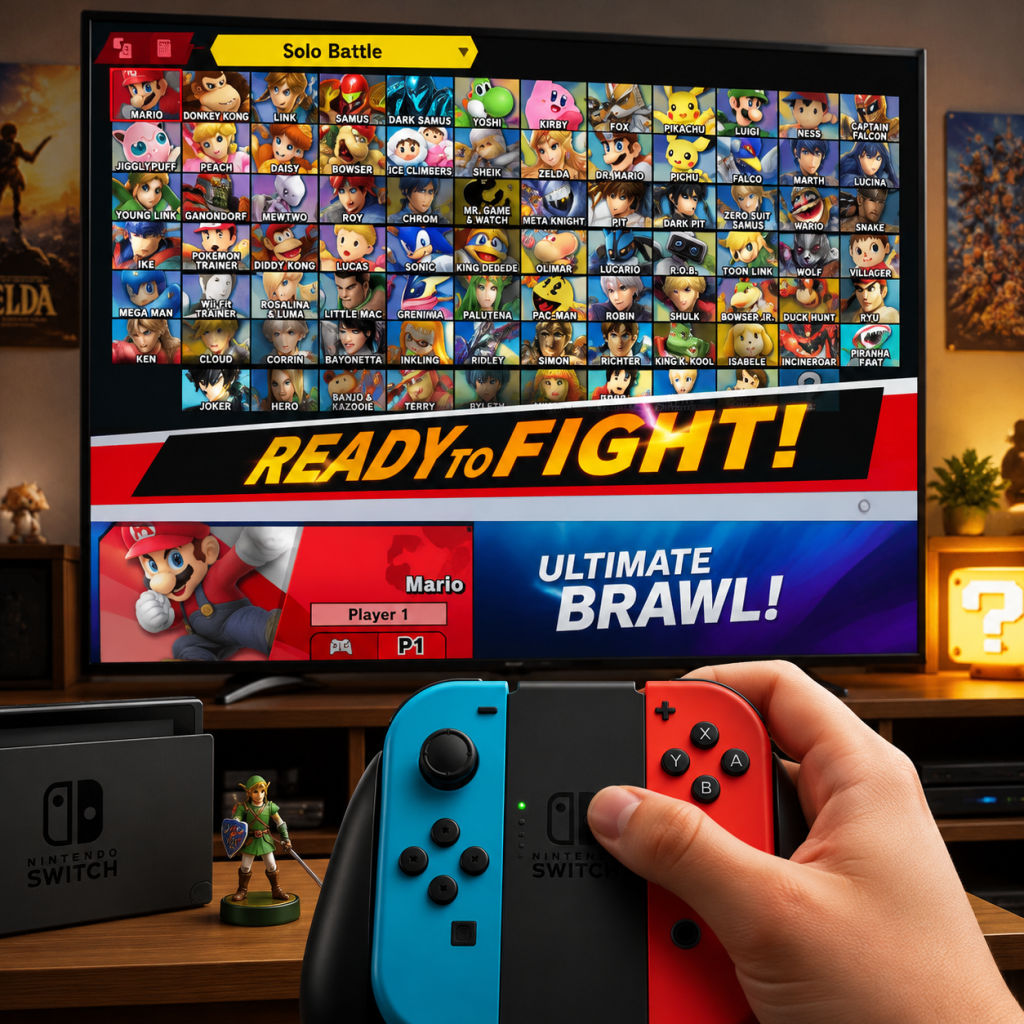
Getting Started
Super Smash Bros. Ultimate Getting Started Guide
Welcome to the Ultimate Brawl!
Super Smash Bros. Ultimate is a crossover platform fighter where iconic video game characters duke it out on colorful stages. Unlike traditional fighting games, the goal isn’t just to drain an HP bar – you win by knocking your opponents off the stage. This guide will walk you through your first hour, explain the controls, demystify the UI, and help you avoid common pitfalls so you can start having fun immediately.
First Hour Walkthrough
0-5 Minutes: Boot Up & Main Menu
- Launch the game (slot your game card or select the digital icon).
- After the opening cinematic, you’ll land on the main menu. Don’t panic – there are many options, but you only need a few right now.
- Navigation tip: Use the left stick to move the cursor, A to select, B to go back, and + (plus) to open the menu overlay.
- For absolute beginners, select "Smash" from the main menu. This is the core mode.
- Smash mode offers "Stock" (lives) and "Time" (points after a time limit) rules. Stock is the standard competitive mode; start with 3 Stock and 7 minutes for a balanced fight.
- You can also jump into "Training" (it’s under Games & More) to practice movement and moves without pressure.
- The game has 80+ characters unlocked from the start (some are unlockable). Every character has unique moves, but the fundamentals are the same.
- Tip: Start with Kirby – he has a simple moveset, a good recovery (up special), and a neutral special that copies the opponent’s ability. He’s the traditional “easy” character.
- Controls (default layout):
- In Smash mode, choose "Vs. Mode" then select your fighter, stage, and difficulty (start with Level 3-5 CPU).
- Focus on:
- Don’t worry about winning – just get comfortable with how the character feels.
- Go to "Games & More" → "Training" . Pause with + to change settings (e.g., infinite shields, no opponent, set CPU to stand).
- Practice:
- Pro tip: Turn on the "Control Stick Sensitivity" in Training settings to see how your inputs register.
- Mii Fighters (Brawler, Swordfighter, Gunner) – under Games & More → Mii Fighters. You can change their appearance (using Mii characters) and special moves. Not for beginners; stick to standard fighters first.
- Play the whole roster in Smash vs CPU (each character has a short intro).
- Look for a fighter whose playstyle clicks:
- Recommendation for new players: Kirby, Mario, or Lucina (Marth’s echo – no tipper mechanic) – simple, well-rounded.
5-15 Minutes: Choose a Mode
15-30 Minutes: Pick a Fighter & Learn Basic Moves
- Left Stick: Move
- A (face button): Attack (neutral, tilt, smash)
- B (top face button): Special move
- X/Y: Jump
- ZR/ZL: Shield (hold to block)
- R/L (bumpers): Grab (when close) / Shield + attack
- Right Stick (C-Stick): Smash attacks (by default) – useful for directional attacks.
30-45 Minutes: Play a Few Matches vs CPU
- Movement: Dash (double-tap left/right or hold forward), short hop (tap jump quickly), fast fall (down on stick while airborne).
- Basic Combos: For Kirby: Down throw → forward air → up special (works at low percents).
- Edgeguarding: When opponent is offstage, go to the edge and use a forward air or down air to knock them further.
45-60 Minutes: Explore Training Mode & Controls Test
- Short hop + aerial (press X/Y and A quickly).
- Recovering: Use up special (Kirby’s Final Cutter) to return to stage.
- Shield grabbing: While shielding, press A to grab (timing is important).
Character Creation? None – But Picking a Main
Super Smash Bros. Ultimate does not have character creation. You select from a roster of existing fighters. However, you can customize:
How to choose your main:
- Fast rushdown: Fox, Pikachu
- Zoners/spacing: Samus, Link
- Heavy hitters: Donkey Kong, Bowser
Controls on All Platforms (Switch Only)
Since SSBU is Switch-exclusive, the controls map the same across console variants. The main differences come from controller type:
| Controller Type | How to Connect | Layout Notes |
|---|---|---|
| Joy‑Con (pair) | Slide onto console or sync wirelessly via Controllers menu | Each grip has full set of buttons. Use left stick for movement, right stick for smashes (default). |
| Joy‑Con (single) | Attach to the console or use the included strap | Only one stick – right stick moves? No, left stick moves; right Joy‑Con has no analog. Not recommended – hard to perform tilt attacks. |
| Pro Controller | Sync via System Settings or plug in via USB | Comfortable, full-sized buttons. Most competitive players use this. |
| GameCube Controller | Requires an official Nintendo GameCube Controller Adapter (USB) | Classic layout: A is big (attack), B is special, X/Y jump, Z grab, L/R shield. Works natively after adapter recognition. |
- Tilt attack: Move left stick gently + A (no smash direction).
- Smash attack: Move left stick quickly + A at same time.
- Special: B button.
- Shield: Hold either ZR or ZL (or L/R on GameCube).
- Grab: Press L/R (shield + attack) or Z on GameCube.
- Jump: X, Y, or tap up on stick (tap jump – turn off if you prefer).
- Dash: Double-tap forward or hold forward after initial dash.
- From main menu, select "Games & More" → "Controls" . You can create custom control profiles (name them).
- Common changes for beginners:
- Smash: The core multiplayer vs mode (1-8 players).
- Spirits: A single-player adventure where you collect spirit cards for stat boosts.
- Online: Play against others worldwide – requires Nintendo Switch Online subscription.
- Games & More: Contains Classic Mode, Training, Mob Smash, Stadium, Vault, and more.
- Unlock All Characters: There are 74 base fighters + 12 DLC (via Fighter Passes). Initially you have 8. To unlock, play 1v1 vs CPU or online – each match triggers a challenger approaching. Beat them to unlock. You can also unlock quickly via World of Light (Spirits mode).
- Learn the Basics: Master movement (dash dancing, short hop, fast fall), shield usage, and recovery.
- Complete Classic Mode with a few characters to get early coins and spirits.
- Play Training Mode for 10-15 minutes a day to build muscle memory.
- Set a control scheme that feels comfortable.
- Go to Controls (Games & More → Controls) and set up your preferred layout. Recommendation: Turn off tap jump, set right stick to tilt attacks.
- Play Training Mode for 5 minutes with Kirby. Focus on:
- Play Smash vs. CPU at Level 3 with one stock and 3 minutes. Win or lose, try to land at least 3 combos.
- Watch a 5-minute beginner guide video (search "SSBU fundamentals").
- Jumping online immediately – online is filled with experienced players and lag can be frustrating.
- Trying to unlock all characters in one sitting – burnout leads to bad habits.
- Using items in your first matches – they add randomness; learn core gameplay first.
- Playing with the default control setup for too long – customize early.
- Spamming the same move (e.g., Kirby’s down special) – it becomes predictable.
- Coins (Gold): Earned from matches, Classic Mode, and challenges. Spend on:
- Spirits: Collect a few primary spirits to boost stats in World of Light. Don’t over-invest; new ones come quickly.
- Tickets: Earned from Classic Mode. Use them to re-challenge fighters you lost to (after unlocking attempts).
- [ ] Set up a custom control profile (tap jump off, right stick to tilts, stick sensitivity low).
- [ ] Play Training Mode (5-10 mins) with Kirby: practice short hop, up special recovery, and down throw forward air.
- [ ] Play Smash vs. CPU (Level 3, 3 stock, 7 mins) – win or lose, focus on moving and attacking.
- [ ] Unlock one new character by winning a 1v1 match against the challenger.
- [ ] Watch one beginner tutorial on YouTube (search "Smash Bros Ultimate beginner tips").
- [ ] Adjust in-game audio settings if needed (music vs SFX balance).
- [ ] Turn off Tap Jump in controls.
- [ ] Set Rumble to your preference (many competitive players turn it off).
- [ ] Try Classic Mode with Kirby once to earn coins and a spirit.
- [ ] Have fun – don’t worry about losing. The game is designed to be chaotic and fun even when you’re learning.
- Play World of Light – it’s a long adventure that teaches various mechanics.
- Experiment with 3-5 characters to find a main.
- Practice short hop fast fall aerials – a core competitive technique.
- Set a goal: E.g., “land 10 short hop forward airs in Training today.”
How to change controls:
- Turn off Tap Jump (prevents accidental jumps when doing up tilt).
- Set Right Stick to Tilt Attack instead of Smash (makes tilts easier).
- Adjust stick sensitivity to Low if you struggle with accidental smash inputs.
UI Overview
Main Menu (single player focus):
In-Game HUD (during a match):
1. Player indicators at top – shows stock icons (life count), percent (damage), and player number.
2. Damage percent – the higher the number (max 999%), the further you get launched.
3. Stock/pause menu – press + to pause (change rules, quit).
4. Stage hazards – some stages have interactive elements (indicated by hazard icon in stage select).
5. Final Smash Meter (optional) – when enabled, fills over time; press B+Right Stick to unleash a powerful attack.
6. Announcer – calls out character names, the start, and results.
Essential Early Objectives
What to Do First vs. What to Avoid
DO FIRST:
- Moving and jumping without looking at controller.
- Doing a short hop (tap jump quickly) then an aerial.
- Recovering: Use up special when off stage.
AVOID:
Early Resource Priorities
- Spirit Board items (useful for World of Light but not critical).
- Music & Mii Costumes in the Shop (optional).
- Unlocking characters? No, coins cannot unlock fighters – only winning matches does.
Common Beginner Mistakes
1. Mashing buttons without direction – results in random moves. Slow down and press intentionally.
2. Always rolling away – rolling is punishable. Mix up with spot dodge or shield.
3. Forgetting to recover – many new players hold a direction away from stage after being hit. Always drift toward the ledge.
4. Using smash attacks constantly – they are slow and easily punished. Use tilts and aerials more.
5. Not shielding – shield is your best defensive tool. Use it to block attacks and then punish with a grab.
6. Chasing too hard offstage – if you are not confident, play safe near the ledge.
7. Ignoring the grab button – grabbing is a great way to start combos after a shield.
8. Sticking with one control scheme – experiment early; you can always change later.
Day-One Checklist
Next Steps After Day One
Remember: Ultimate has a huge community. If you have questions, check out the SmashWiki, Reddit (r/CrazyHand), or Discord servers. You’re joining one of the most welcoming yet challenging fighting games ever made. Good luck and have fun smashing!
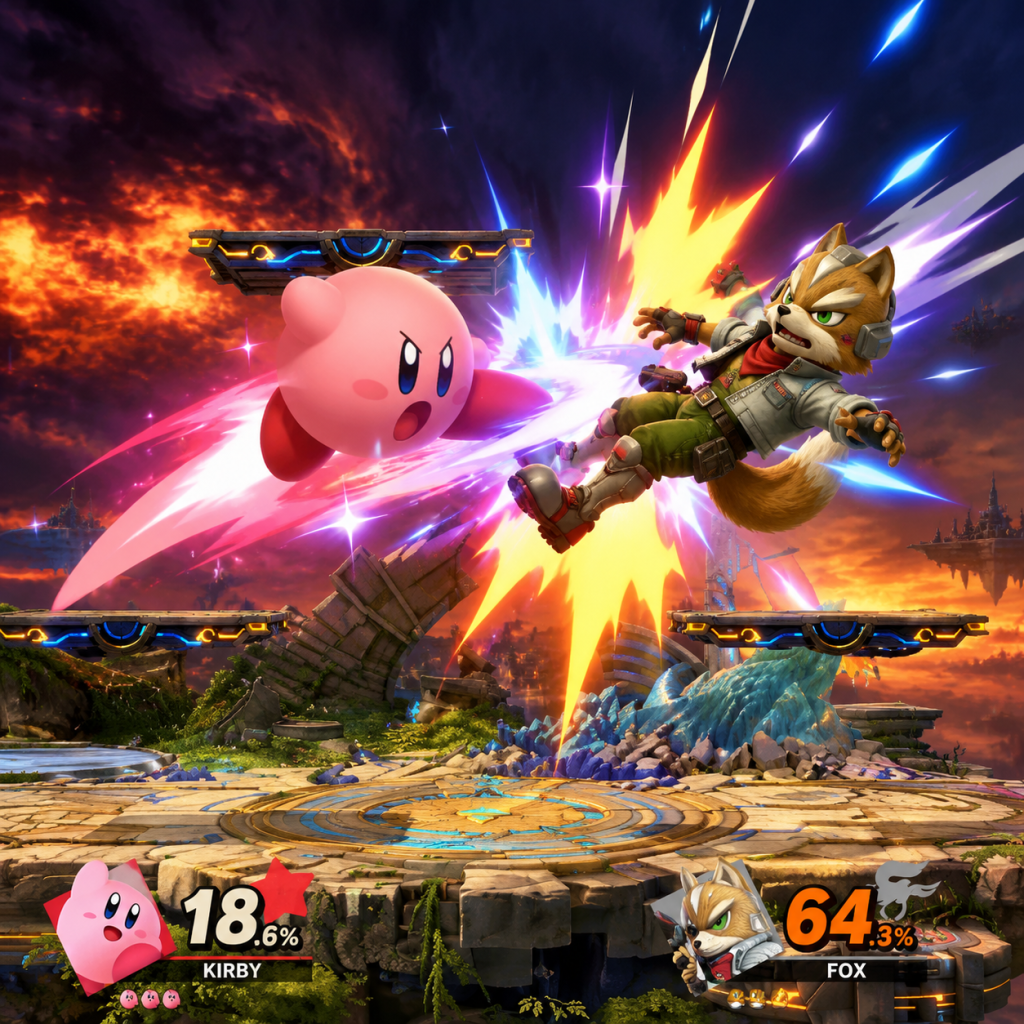
Core Gameplay
Core Gameplay Guide for Super Smash Bros. Ultimate
Overview
Super Smash Bros. Ultimate is a crossover platform fighter where up to 8 players battle on dynamic stages. The core gameplay loop revolves around ringing out opponents by launching them past stage boundaries. Unlike traditional fighting games with health bars, damage is represented as a percentage: higher damage makes characters fly farther when hit. The primary objective is to deplete opponents' stocks (lives) while protecting your own. The game offers a vast roster of over 80 fighters, dozens of stages, and multiple game modes including single-player, local multiplayer, and online battles. This guide breaks down the core mechanics and progression into player tiers, from absolute beginner to competitive mastery.
Main Gameplay Loop
1. Select Mode – Choose from Smash (standard battle), Classic Mode (character-centric runs), World of Light (adventure mode), or Online.
2. Choose Rules – Adjust stock count (usually 3), time limit (2:30 to 10:00), items on/off, stage selection, and handicaps.
3. Pick Fighter & Stage – Over 80 fighters available (default roster grows through unlocks).
4. Battle – Use attacks, special moves, grabs, shields, and dodges to damage and launch opponents.
5. Score/Results – Winner determined by highest elimination count or last survivor. Earn Gold, Spirits, and increased character proficiency upon completion.
6. Repeat or Progress – Unlock new characters, Spirits, music, or challenge completions.
Combat & Interaction Systems
- Basic Attacks: A (light attack), side tilt (push stick + A), up tilt, down tilt. Smash attacks (charge A + direction) for powerful launches.
- Special Moves: B button; each character has neutral B, side B, up B (recovery), and down B.
- Grabs: Shield (Z/L) + A or press L+X? Actually, press the grab button (default ZL or ZR) or Shield + A. Grabs lead to pummel and throws.
- Defensive Options: Shield (hold shield button), spot dodge (shield + down), roll (shield + side), air dodge (shield in air).
- Advanced Techniques: Dash dancing, perfect shields, short hops (tap jump quickly), fast falls (press down while airborne), edgeguarding (attack opponent recovering), ledge trumping (grab ledge when opponent has it).
- Items: Appear randomly (if enabled). Notable items: Smash Ball (for Final Smash), Poké Balls, Assist Trophies, healing items, explosive crates.
- Stage Hazards: Each stage has unique hazards (e.g., Great Plateau’s Guardians, Final Destination’s nothing). Hazards can be toggled off in rules.
- Character Unlocks: Unlock fighters by playing Smash mode, Classic mode, or World of Light. Each character appears after ~10 minutes of gameplay or by completing Classic Mode with certain characters.
- Spirits: Collectible tokens that provide stat boosts and unique abilities in Spirit Battles. Used in World of Light and Spirit Board.
- Classic Mode: Each character has a unique route of themed battles culminating in a boss (Master Hand, Crazy Hand, Dracula, Marx, Ganon, etc.). Completing a route with high intensity (adjustable) yields better rewards.
- World of Light: An adventure mode with a giant grid map. Navigate by moving a cursor, fight spirit battles to free fighters, collect spirits, and defeat Galeem and Dharkon.
- Gold: Earned from battles, used at the Shop to buy Spirits, music, Mii Fighter costumes, and items for Spirit battles.
- Milestones/Challenges: A grid of 140+ challenges (e.g., “Clear Classic Mode with 10 characters”). Completing them unlocks music, spirits, and sometimes fighters.
- Online – Elite Smash: A hidden skill rating. Winning matches raises GSP (Global Smash Power). Once GSP exceeds a threshold, you enter Elite Smash, a more competitive matchmaking pool.
- Goal: Learn basic controls, understand the platform fighter genre, and unlock your first few characters.
- Activities:
- Character Unlock Route: The first ten unlocks come quickly: after each ~10 minutes of play, a new challenger appears. Defeat them to add them to your roster. Common early unlocks: Ness, Yoshi, Kirby, Fox, Pikachu, Luigi, etc.
- Economy: Spend Gold only on essential items like healing items for Spirit battles or cheap Spirit packs if you find a strong Spirit early.
- Build Growth: There is no character leveling; you improve by learning one character’s moveset. Focus on Mario or Kirby – both are beginner-friendly with simple combos and good recovery.
- Combat Tips:
- Goal: Unlock all characters (82 total including DLC), build a strong collection of Spirits, and begin exploring advanced techniques.
- Activities:
- Character Unlock: By now you should have about 40–50 characters. To speed up, exit a match after the challenger appears (don’t skip their introduction) and play a quick Smash match with a random character to trigger another challenger. Repeat.
- Economy: Save Gold for high-rank Spirit packs (Legendary) in the Shop. Use Gold to level up your primary Spirits in World of Light (upgrading them via the skill trees).
- Build Growth – Spirits: Your Spirit Team (primary + up to 2 supports) provides stat boosts. Example: a Legendary Primary Spirit like Giga Bowser gives huge Attack boost, but hurts defense. Pair with support Spirits that improve defense or grant abilities like Super Armor (immune to flinching while charging smash attacks). Learn type matchups: Shield > Grab > Attack > Shield? Actually, Spirit types: Attack (red), Shield (blue), Grab (green). Attack beats Shield, Shield beats Grab, Grab beats Attack. Use the correct type for a 1.2x stat boost.
- Combat Progression: Master short-hop fast-fall aerials, RAR (reverse aerial rush), and dash dancing. Learn a basic combo for your main (e.g., Mario: down-throw -> up-tilt -> up-air -> up-air).
- Exploration: World of Light has several sub-areas like The Light Realm, The Dark Realm, and Final area. Use warp points to backtrack for missed Spirits.
- Goal: Achieve 100% completion in World of Light and Spirit Board, reach Elite Smash online, optimize Spirit teams for competitive advantages, and master advanced combos.
- Activities:
- Build Growth:
- Combat Mastery:
- Economy: Hoard Gold for rare Spirit shop appearances or DLC Mii Costumes. Once you have all Spirits, Gold becomes less important.
- Goal: Become a tournament-level player, achieve high rank in online tournaments, master multiple characters, and complete all the game’s content (except subjective skill).
- Activities:
- Build Growth:
- Ranking Systems: In online, Elite Smash entry fluctuates; top players maintain GSP in the top 1%. Use Battle Arena to host or join custom lobbies for more serious practice.
- Completionist Note: To truly “finish” Ultimate, you must:
Progression Systems (Non-RPG)
Unlike RPGs, Smash Ultimate progression is about unlocking content and improving skill. Key elements:
Early Game (Hours 0–10)
- Complete the Training Mode tutorial (optional).
- Play Smash with default rules (3 stocks, 7 minutes) against CPUs. Recommended: start at level 3–5.
- Try World of Light on easy difficulty. This mode teaches how to use Spirits and introduces varied battle conditions.
- Play Classic Mode with the starter roster (Mario, DK, Link, Samus, etc.) to unlock more fighters faster.
- Use shielding often; don’t always attack.
- Recovery: Learn your character’s up-B move to return to stage from offstage.
- Edgeguarding: If you knock opponent off stage, intercept their recovery with your attacks.
- Items: Turn items off initially to avoid confusion.
- Don’t roll too predictably – good opponents will read rolls.
Mid Game (Hours 10–50)
- Continue World of Light – you should have freed 20+ fighters and collected many Spirits. The map splits into paths; choose the path that gives access to essential abilities like Ocarina of Time (slows battlefield) or Franklin Badge (reflects projectiles).
- Spirit Board: Participate in Spirit Board battles to capture rare Spirits. Use Shield Spheres (items) to increase capture chance.
- Classic Mode: Complete Classic Mode with every character at least once to unlock their ending music and earn Spirit rewards. Use higher intensity for better rewards.
- Online Quickplay: Begin playing online with preferred rules (1v1, no items, 3 stocks, 7 mins). Focus on one main character.
Late Game (Hours 50–200+)
- World of Light 100%: Defeat all boss spirits (Galeem, Dharkon, and the true final boss where both are fought simultaneously). Collect every Spirit and complete all sub-postgame content.
- Spirit Board Completion: Capture every Spirit from the board (including event Spirits and DLC Spirits from Fighter Passes). Use Peach’s Crown (item) to guarantee capture of any Spirit once.
- Classic Mode: Complete all Classic Mode runs with max intensity (9.9) to get unique titles and high Spirit rewards. This requires perfect play – no continues and high damage dealt.
- Online – Elite Smash: Practice matchups against top-tier characters (Joker, Pikachu, Palutena, etc.). Study frame data and punish windows.
- Spirit Team Min-Maxing: For World of Light boss fights, use a team that negates hazards (e.g., Autorecovery for lava floors, Lava Floor Immunity from Mega Man X spirit). For online, you cannot use Spirits; instead focus on human skill.
- Amiibo Training: If you own Nintendo Amiibo, train them by fighting them repeatedly. They learn from you and can reach level 50, becoming formidable opponents. You can feed them items and give them Spirits to increase stats.
- Combo Game: Lab true combos and kill confirms. For example, Lucina: down-tilt -> forward-smash at 60% on some characters.
- Edgeguarding: Use double jumps, air dodges, and off-stage neutral airs to gimp recoveries.
- Parry: Time a shield just as an attack hits to trigger a parry (visual cue: blue flash). Parrying gives you frame advantage to punish.
- Stage Control: Use projectiles (if character has them) to force approaches, then punish with dash attacks or grabs.
Endgame (200+ hours, competitive focus)
- Participate in Local/Online Tournaments: Use sites like Smash.gg or the in-game Online Tourney mode. Practice bracket mindset and adapt to opponents’ playstyles.
- Solo Content Completion: All challenges cleared, all Classic Mode endings unlocked, all Spirit Boards cleared, all world of light events done.
- Character Specialization: Choose one or two mains and secondary/flex characters to cover bad matchups. Grind their advanced tech: perfect pivoting, ledge dashes, wavedashing (not in this game), attack canceling.
- Lab Metagame: Study top player VODs (e.g., MkLeo, Sparg0, Glutonny). Practice specific setups like Joker’s Arsene combos or Steve’s block placements.
- Custom Rules/Mods: The game does not support mods on official consoles, but you can create custom rulesets for competitive practice (e.g., 1v1, 3 stocks, 7 mins, no items, all stages turned into final destination forms via “Ω” and “Battlefield” forms).
- Amiibo Competition: Train an Amiibo to level 50 with optimal spirit and stat boosts, then enter Amiibo-only tournaments (casual scene).
- Spirit Theorycrafting: Create teams optimized for specific World of Light rematches (e.g., using Bunny Hood for speed, Stamina Recovery for marathon fights).
- Collect all 1,530+ Spirits (base + DLC).
- Unlock all Mii Costumes and music tracks.
- Complete all 140+ Challenges.
- Unlock all Classic Mode titles and endings.
- Achieve a personal skill milestone (e.g., win a local tournament, reach top 100 online).
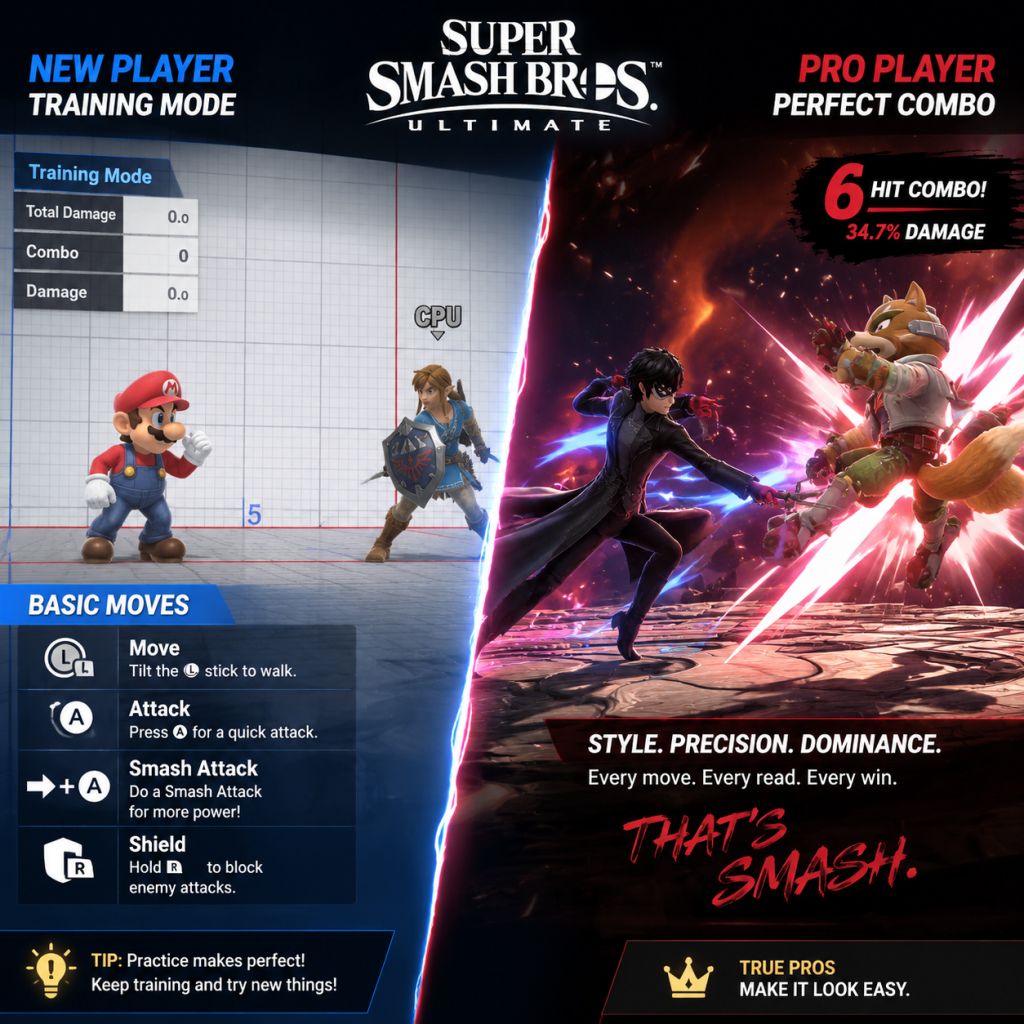
Game Tips
Super Smash Bros. Ultimate Game Tips
Whether you're stepping into the arena for the first time or a seasoned competitive player, these detailed tips will help you improve every aspect of your game. Tips are grouped by category and marked with difficulty levels:
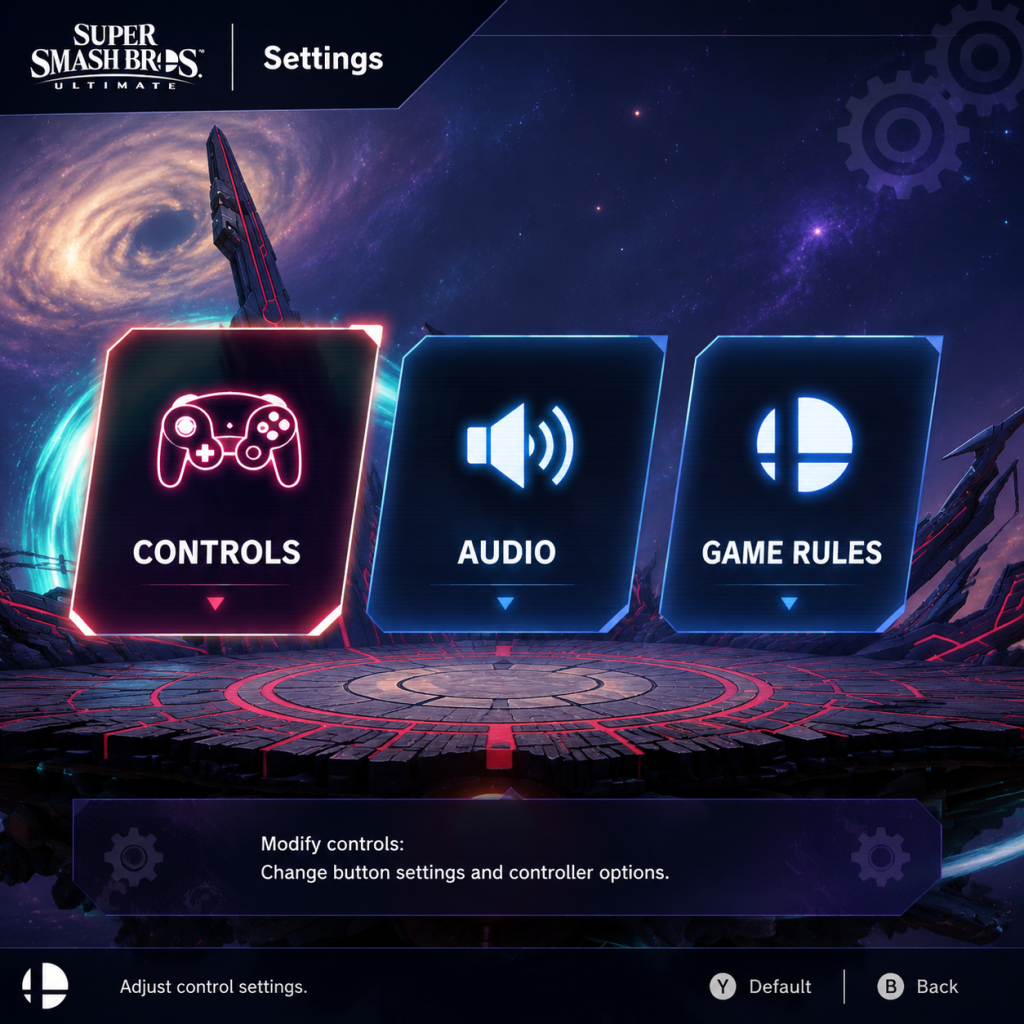
Game Settings
Super Smash Bros. Ultimate Game Settings Guide
Super Smash Bros. Ultimate offers a range of settings to tailor your experience. Because the game runs exclusively on Nintendo Switch, there are no adjustable graphics quality presets (resolution, shadows, anti‑aliasing, etc.) – the game always targets 1080p / 60 FPS in docked mode and 720p / 60 FPS in handheld mode. The settings below focus on audio, controls, accessibility, language, network, and gameplay tweaks.
Graphics & Display
- Screen Size / Border: Adjustable in System Settings (on the Switch Home menu: System Settings → TV Settings → Adjust Screen Size) or in-game via Options → Screen Border (only available if you need to move the display area).
- Brightness: Use the Switch’s system brightness slider; there is no in-game brightness option.
- Performance Notes: Ultimate runs at a locked 60 FPS in both modes. If you experience slowdown (rare outside of chaotic 8‑player matches with certain stages), try playing in handheld mode or using a wired LAN adapter for online play to reduce input lag.
- Master Volume: Sets overall game volume (0–10). Adjust to balance with voice chat or other apps.
- Sound Effects Volume: Controls attacks, hits, and stage sounds.
- Music Volume: Controls background music – useful if you want to focus on sound effects during competitive play.
- Voice Volume: Affects character grunts, victory quotes, and announcer voice.
- Recommended: For competitive play, lower Music Volume to ~3–5 and keep Sound Effects & Voice at 8–10 to hear attack cues and ledge grabs clearly.
- Controller Setup: Supports single Joy‑Con, dual Joy‑Con grip, Pro Controller, GameCube controller (via adapter), and third‑party controllers. Map controls under Controls → Button Mapping.
- Key Toggles:
- Pro Controller / GameCube Specifics:
- Check Before Matches: Always test your control setup in Training Mode to ensure all moves (tilts, smashes, specials, grabs) respond as expected.
- Button Mapping (as above) allows you to remap everything, including making it easier to press multiple buttons with one finger (e.g., set ZL to Jump for one‑handed play).
- Vibration / Rumble: Can be turned off for players sensitive to tactile feedback.
- Colorblind Options: The game provides Color Filters (in Options → Controls → Color Filters) to help distinguish team colors. Choose from Red‑Green, Blue‑Yellow, or Grayscale.
- Controller Sensitivity adjustments (Low/Normal/High) help players who accidentally press buttons or have motor control difficulties.
- Screen Zoom / Border: Already mentioned – adjust if the HUD clipping occurs.
- Text Size: The game’s interface text is fixed but generally readable on TV. If you play handheld and find text too small, try reducing screen resolution via system settings (though not recommended).
- In‑Game Language: Can be changed via Options → Language. Supports multiple languages (English, Japanese, French, German, Spanish, etc.).
- Voice Language: Separate setting for character voices. Can be set to Japanese while menus remain in English – a common preference among fans.
- Note: Changing the language resets certain settings like saved names in tournament mode? No, but it’s safe to switch anytime.
- Preferred Communication Device: In Online → Settings, choose between Wired (LAN adapter) or Wireless (Wi‑Fi). Wired is strongly recommended for stable matches and reduced latency.
- Matchmaking:
- Sever Region: Not manually selectable; the game uses your Switch’s region and connection quality. For best latency, play during off‑peak hours or use a USB‑to‑Ethernet adapter.
- Connection Status: Displayed as bars – if you see less than 3 bars, expect lag. You can abandon a match before it starts by pressing the Home button and closing the software (not ideal but possible).
- Tips:
- Stocks / Timer: Set per match under Rules – not a permanent setting, but you can save custom rulesets for quick access.
- Items: ON/OFF – competitive players always turn items OFF.
- Stage Hazards: ON/OFF – turning off hazards makes stages legal in tournament play.
- Spirits / Custom Fighters: Enable/disable in Rules → Spirits. For standard play, disable unless you intend to use Spirit Battles.
- Handicap: Can be set in rules to give weaker players more damage resistance – rare in competitive settings.
- CPU Level: Adjustable from 1 (very easy) to 9 (max). Level 9 CPUs do not replicate human behavior; they perfect‑shield and read inputs. Train against humans for real improvement.
- Button Mapping Reset: If you mess up controls, press X on the button mapping screen to reset to defaults.
- Stick Drift Compensation: No in‑game setting. If your Joy‑Con drifts, calibrate in System Settings (Controllers and Sensors → Calibrate Control Sticks).
- Headphone Audio: If using wired headphones in handheld mode, you may hear a slight buzz; try turning down the volume or using wireless headphones.
- Screen Capture: The game blocks video recording in certain modes (spirit board, classic mode?). Screen capture (screenshot) is always available by pressing the Capture button.
- Tip: If text is cut off at the edges, lower the border percentage until everything is fully visible.
Audio Settings
Controls
This section is critical – misconfiguring controls can ruin your gameplay.
- Smash Stick: Default is attack; setting to Smash lets you flick the right stick for instant smash attacks – useful but can cause accidental smashes. New players often leave it as Attack for tilts.
- Tilt Stick: If you set right stick to Smash and want easy tilts, you’ll need to manually input tilts with the left stick – this is a common misconfiguration.
- Tap Jump: ON by default. Set to OFF if you frequently jump accidentally when performing up‑tilts or up‑airs. Competitive players almost always disable Tap Jump.
- Sensitivity (Stick): Adjusts the dead zone. Options: Low, Normal, High.
- Low = larger dead zone (less responsive – good for avoiding accidental inputs).
- High = smaller dead zone (very responsive – may cause unintended moves).
- Recommended: Start with Normal. Players with heavy thumbs may prefer Low; speed demons can try High.
- Rumble: ON/OFF. ON provides haptic feedback; turning it OFF can reduce distractions and slightly improve response consistency (some players claim less input lag).
- Amiibo Settings: Under Games & More → Amiibo, you can enable/disable NFC. This does not affect gameplay settings but be aware that scanning an Amiibo while in a match will summon an AI fighter if not turned off.
- GameCube adapter: Requires wired controller support enabled in System Settings. The adapter adds slight input lag compared to wireless Pro Controller – not recommended for high‑level play unless you are used to the GameCube layout.
- Trigger Buttons: GameCube controllers have analog triggers. In Ultimate, Light Shield (partial press) is disabled in competitive rulesets; set your controller’s L/R to Attack or Jump if you don’t use shield in casual play.
Accessibility Settings
Language Settings
Network / Online Settings
- Preferred Rules: You can set your desired ruleset (stock, time, items, stages). The game will try to match you with similar preferences.
- Rematch Preference: Choose “Yes” or “No” to automatically request rematches after a game.
- Battle Arena / Quickplay: Understand the difference – Quickplay uses Global Smash Power (GSP) based on wins/losses; Battle Arenas are custom rooms with no rating impact.
- Use a wired connection.
- Avoid playing on 2.4 GHz Wi‑Fi if possible (5 GHz is better).
- Close other applications and downloads.
- Set your Switch to Airplane Mode and re‑enable only Wi‑Fi/Bluetooth for online play to reduce overhead.
Gameplay Settings (Non‑Controller)
Advanced / Hidden Tips
Optimal Settings Summary
| Setting | Recommendation |
|---|---|
| Tap Jump | OFF (competitive) |
| Right Stick | Attack (for easy tilts) or Smash (if you prefer) – test both |
| Stick Sensitivity | Normal (adjust if you get accidental inputs or miss inputs) |
| Rumble | OFF (for reduced distraction) |
| Audio – Music Vol | 3–5 (leave SFX/voice high) |
| Network | Wired connection, close apps |
| Color Filters | As needed for colorblindness |
| Language | English menus, Japanese voices (optional) |
| Items / Hazards | OFF for serious play |
Important Notes
Super Smash Bros. Ultimate Important Notes
⚠️ Warnings & Pitfalls
No Manual Saves: The game auto-saves only. You cannot revert to an earlier save file. Every unlock, Spirit purchased, or Amiibo trained is permanent. Be careful when spending Gold or Spirits. There is only one save slot per Nintendo Switch profile.
World of Light – Final Boss Difficulty Spike: The final boss of World of Light (Galeem + Dharkon) can be brutally difficult, especially if you haven't upgraded a strong primary Spirit. Difficulty cannot be changed mid-campaign. If you're stuck, you may need to grind Spirit Board or summon better Spirits. Consider lowering difficulty in the game settings before starting the mode (though the reccomended path is → start on Normal at most).
Classic Mode Intensity: Classic Mode difficulty scales with the GSP (Global Smash Power) of the character you pick. If you play a character you're bad with, the CPU can become unexpectedly punishing. Adjust intensity before the final boss.
Spirit Board – Time Limits: Spirits on the Spirit Board rotate regularly. If you fail a battle, the Spirit can disappear for a while. Use the Home Button exploit (quickly close the game before the match ends) to retry without losing the Spirit, but be aware this is an exploit and may be patched.
* Online Disconnections: Frequent disconnections (even due to ISP issues) can lead to temporary bans. Avoid rage-quitting. Nintendo does not tolerate intentional disconnects.
###
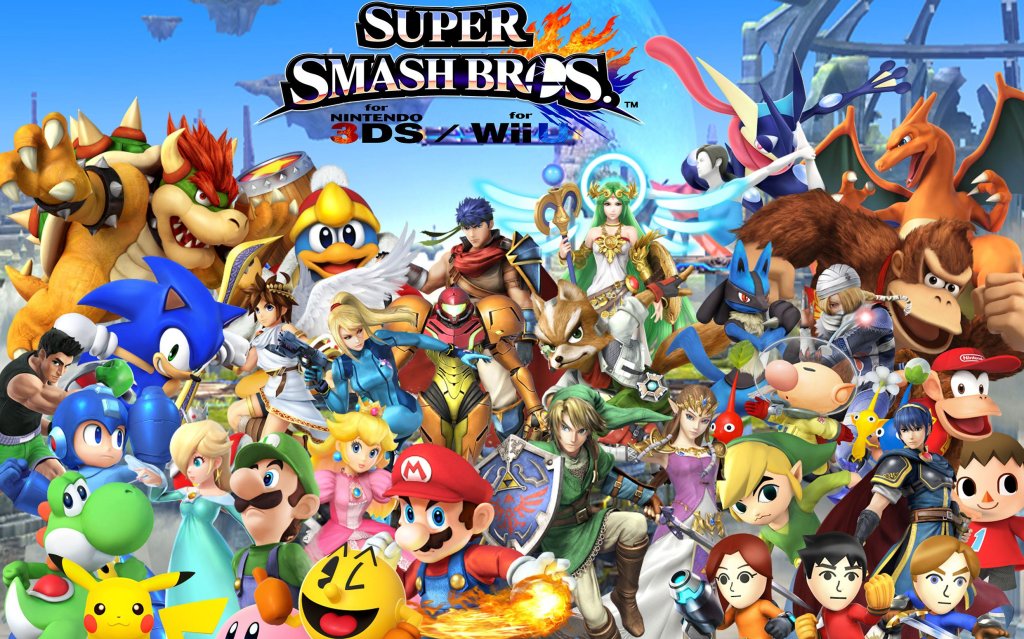
All Game Items
All Game Items Guide for Super Smash Bros. Ultimate
Super Smash Bros. Ultimate features a vast array of items that appear in battles, a deep Spirit collection system, cosmetic equipment for Mii Fighters, and various currencies. This guide covers every major item category, how to obtain them, their effects, and how they fit into the game's progression.
---
1. Battle Items (Items Spawned in Matches)
Battle items are automatically spawned on stages when the item switch is on. They can be thrown, used instantaneously, or activated. They are grouped by function.
#### Throwable / Projectile Items
| Item | Effect | How to Obtain (Battle) | Utility Notes |
|---|---|---|---|
| Beam Sword | A glowing energy sword that can be swung (high knockback) or thrown. | Random item spawn. | Great for edgeguarding; throw deals high damage. |
| Home-Run Bat | A baseball bat that delivers massive knockback, especially useful for launching opponents at high percents. | Random item spawn. | Often used in Home-Run Contest for maximum distance. |
| Death's Scythe | A melee weapon that steals health from opponents on hit. | Random item spawn. | Very strong in heal-based strategies. |
| Boomerang | A returning projectile that hits enemies on the way out and back. | Random item spawn. | Can be caught; good for zoning. |
| Rage Blaster | A pistol that fires slow but powerful shots that increase in damage as your damage percent rises. | Random item spawn. | High-risk, high-reward; use when at high percent. |
| Super Scope | A shoulder-mounted cannon that charges and fires piercing shots. | Random item spawn. | Effective at long range; charge shots pass through multiple foes. |
| Item | Effect | How to Obtain | Utility Notes |
|---|---|---|---|
| Maxim Tomato | Restores 50% damage. | Random item spawn. | Heals more than food; priority grab. |
| Heart Container | Fully restores health to 0% and removes all status effects (e.g., poison). | Random item spawn. | Extremely rare; best healing item in the game. |
| Food (various) | Each piece restores 1-10% depending on type. | Random item spawn. | Small incremental heals; can be stacked. |
| Healing Field | A floating orb that, when picked up, creates a dome that slowly heals all players inside. | Random item spawn. | Team play favorite; position yourself inside. |
| Item | Effect | How to Obtain | Utility Notes |
|---|---|---|---|
| Franklin Badge | Reflects all projectiles back at the attacker while held. | Random item spawn. | Essential against projectile-heavy characters. |
| Bunny Hood | Increases movement speed and jump height significantly. | Random item spawn. | Great for chasing or evading; can lead to early kills with spike setups. |
| Screw Attack | Allows you to jump multiple times in midair and spin rapidly, damaging nearby foes. | Random item spawn. | Excellent for combos and recovery mix-ups. |
| Superspicy Curry | Causes you to spit fireballs continuously for a short time. | Random item spawn. | High damage output; can be combined with bunny hood for chaos. |
| Timer | Slows down all opponents dramatically. | Random item spawn. | Use to land free hits or set up KO kills. |
| Lightning Bolt | Shrinks all opponents (reduces size, making them easier to launch and harder to hit). | Random item spawn. | Devastating combo tool. |
| Soccer Ball | A soccer ball that can be kicked at opponents; it bounces and can be hit multiple times. | Random item spawn. | Unique projectile; can be gamed for tricky angles. |
| Squeaky Hammer | A foam hammer that breaks after a few hits. Hitting another player with it inflates their head, making them floatier and easier to launch. | Random item spawn. | Fun disruption; highly effective when paired with explosive items. |
| Item | Effect | How to Obtain | Utility Notes |
|---|---|---|---|
| Ray Gun | Fires rapid, low-damage laser blasts. | Random item spawn. | Basic ranged weapon; good for poking. |
| Fire Flower | Shoots a short-range cone of fire. | Random item spawn. | Hits multiple times; can be used repeatedly. |
| Blast Box | An explosive crate that can be thrown. When hit, it explodes with massive knockback. | Random item spawn. | High risk; can be detonated early with any attack. Very powerful. |
| Smart Bomb | A weak throwable that emits a large, delayed explosion. | Random item spawn. | Good for stage control; explosion covers wide area. |
| Motion-Sensor Bomb | A thrown mine that sticks to surfaces. Explodes when an opponent walks over it. | Random item spawn. | Trap placement; can be planted on ledges or platforms. |
| Bomb-Omb | A bomb with a lit fuse that explodes after a few seconds or on contact. | Random item spawn. | Iconic; high damage and knockback. |
| X Bomb | A bomb that explodes in the shape of an “X” dealing high damage in a cross pattern. | Random item spawn. | Weaker than bomb-omb but covers two directions simultaneously. |
| Deku Nut | A small nut that stuns opponents when thrown. | Random item spawn. | Very brief stun; excellent for setting up combos or grabs. |
| Item | Effect | How to Obtain | Utility Notes |
|---|---|---|---|
| Poké Ball / Master Ball | Summons a random Pokémon to assist you. Master Ball guarantees a rare Pokémon (e.g., legendary). | Random item spawn. | Pokémon can attack, heal, or transform the stage. |
| Assist Trophy | Summons a random video game character to fight for you. | Random item spawn. | Assist characters have unique moves and effects. |
| Smash Ball | Breaks after taking enough hits. Once broken, the player who broke it can use their Final Smash. | Random item spawn (can be toggled). | Core for Final Smash mode; can be stolen. |
| Fake Smash Ball | Looks like a Smash Ball but explodes when broken, dealing damage to the breaker. | Random item spawn. | Trick item; high risk of self-damage. |
| Mr. Saturn | A waddling creature that does not attack but can be picked up and thrown. It sticks to opponents, slowing them down and making them easier to hit. | Random item spawn. | Mild harassment; not a high-priority item. |
| Party Ball | Hovers then drops several other items when destroyed. | Random item spawn. | Good for item chaos; can reward you with powerful items. |
| Special Flag | A flag that, if held for a few seconds (or until a timer expires), grants a point in timed matches or earns you a KO. | Random item spawn. | Only useful in timed/stock matches with special rules. |
| Fairy Bottle | A fairy that jumps out and heals you after being broken open. | Random item spawn. | Store for later; great for emergencies. |
| Dragoon Parts | There are three parts (spaceship pieces). Collect all three to assemble the Dragoon, a homing missile that instantly KOs the first target hit. | Random item spawn rarely. | Extremely powerful; search for parts aggressively. |
| Daybreak Parts | Similar to Dragoon, collect three parts (cannon, scope, and handle) to build the Daybreak, a powerful laser. | Random item spawn rarely. | Can be aimed; shots pass through multiple opponents. |
2. Spirits (Collectible Equippables)
Spirits are collectible representations of characters from other game series. They function as equipment in the game's adventure mode (World of Light) and Spirit Board, providing stat boosts and special abilities.
#### Primary Spirits
- Role: Primary spirit determines the fighter’s base stats (Attack, Defense, Power) and type.
- Types: Attack (blue), Grab (green), Shield (red), Neutral (white).
- Rarity: Novice, Advanced, Ace, Legend.
- Class: Each primary spirit has a “class” (e.g., arms, dark, mythical) which affects its strength against other types.
- How to Obtain: Spirit Board (random battles), World of Light (overworld encounters), Vault Shop (purchased with Gold), Classic Mode rewards, Timed Challenge rewards.
- Upgrading: Spirits can be leveled up to Lv. 99 using Snacks (see Currencies). Some specific Spirits can be Enhanced (evolve) when they reach Lv. 99, transforming into a stronger spirit with a new appearance and improved stats.
- Fusion: Combine two Primary Spirits using the Fusion Lab to create a brand new spirit. The result depends on the classes and rarity used.
- Role: Placed into slots on a primary spirit to grant extra abilities (e.g., “Stamina Up” or “Giant”).
- Slots: The number of support slots on a spirit is determined by its type (often 1-3).
- How to Obtain: Same as primary spirits.
- Use: Synergize with primary spirit to create strategic loadouts for World of Light or Spirit Board battles.
- Ability Examples:
#### Support Spirits
- Smooth Lander: Removes landing lag.
- Hyper Smash Attacks: Increases smash attack damage but lowers defense.
- Autoheal: Slowly recover damage over time.
#### Currencies Related to Spirits
| Currency | Purpose | How to Obtain |
|---|---|---|
| Gold | Primary currency. Used in the Vault Shop to buy Spirits, Mii Costumes, Music, and items. | Battle rewards, spirit dismissals, online battles, Classic Mode, World of Light. |
| SP (Spirit Points) | Experience points used to level up spirits. Can be used instantly in the Spirit management menu. | Earned from Spirit Board battles, World of Light encounters, and dismissing spirits. |
| Snacks | Special items that provide large amounts of SP to a specific spirit. Used to quickly level up spirits. | Spirit Board rewards, Vault Shop, World of Light chests, Challenges. |
| Skill Spheres | (World of Light only) Collected to unlock nodes on the skill tree (e.g., increased jump height, super armor). | Defeating bosses, clearing dungeons, hidden treasures. Skill Spheres are not exchangeable. |
3. Mii Fighter Costumes & Headgear
Mii Fighters (Brawler, Swordfighter, Gunner) can equip cosmetic outfits and headgear. These do not affect stats—they are purely cosmetic.
- How to Obtain:
- List of Notable Costumes:
- Headgear: Includes hats, masks, and hairstyles; many are based on spirits (e.g., Goomba head, Chain Chomp hat).
- How to Unlock:
- Usage: Once unlocked, you can set the frequency of a song on a given stage via the “My Music” menu.
- No gameplay effect: Music does not influence damage, speed, or anything else.
- Purpose: Customize your in-game profile card (name, background, border, icon).
- How to Obtain: Purchased with Gold from the Vault Shop, earned from Challenges, or found in World of Light.
- Types: Hundreds of icons (including fighter heads, support spirit icons), backgrounds, and frames.
- Purpose: In earlier Smash games, tickets were used to retry Classic Mode. In Ultimate, there are no tickets; you can retry infinitely.
- Battle items only appear if the “Items” switch is set to ON in the rules. They do not appear in competitive legal play.
- Spirits are disabled in regular Versus modes unless you use a special ruleset (“Spirit Battles”). They are only usable in World of Light and Spirit Board.
- Gold is shared across all profiles on the same Nintendo Switch console (unlinked to Nintendo Account).
- Snacks can be used from the Spirit list menu; they are not consumable in battle.
- Mii Costumes are permanently unlocked once purchased; they do not need to be re-equipped.
- Music tracks are permanent unlocks; you can turn them on/off freely after unlocking.
- Skill Spheres are exclusive to World of Light and do not transfer to other modes.
- Most are purchased from the Vault Shop with Gold.
- Some are unlocked via Spirits (some spirits double as costumes), completing Challenges, or participating in limited-time events.
- Certain costumes are exclusive to Amiibo (e.g., Link’s outfit for Mii Swordfighter) but can also be bought in shop after scanning the Amiibo.
- Sans (Undertale) – available as a DLC costume purchase.
- Cuphead – DLC.
- Prototype Armor (Doomguy) – from Doom series, DLC.
- Altair (Assassin’s Creed) – DLC.
- Megaman.EXE – DLC.
- Team Rocket (Pokémon) – DLC.
- Plus many more from various franchises.
---
4. Music (Collectibles)
Super Smash Bros. Ultimate features over 800 music tracks from video game franchises. Music is collectible but purely cosmetic (used in My Music settings).
- Purchase from the Vault Shop with Gold (costs vary).
- Some tracks are unlocked by playing Classic Mode with certain characters.
- Defeating spirits in World of Light or on the Spirit Board.
- Completing Challenges.
---
5. Other Collectibles & Currencies
#### Smash Tags
#### Online Battle Tickets (for Spectator Mode?) Not an item – Not needed.
#### Classic Mode Tickets
#### Drafting Items? (World of Light Snacks, etc.) Covered above.
---
6. Important Notes on Items
---
This guide covers all major item categories in Super Smash Bros. Ultimate. For specific spirit builds or meta strategies, consult character-specific guides or the Spirits tier list.
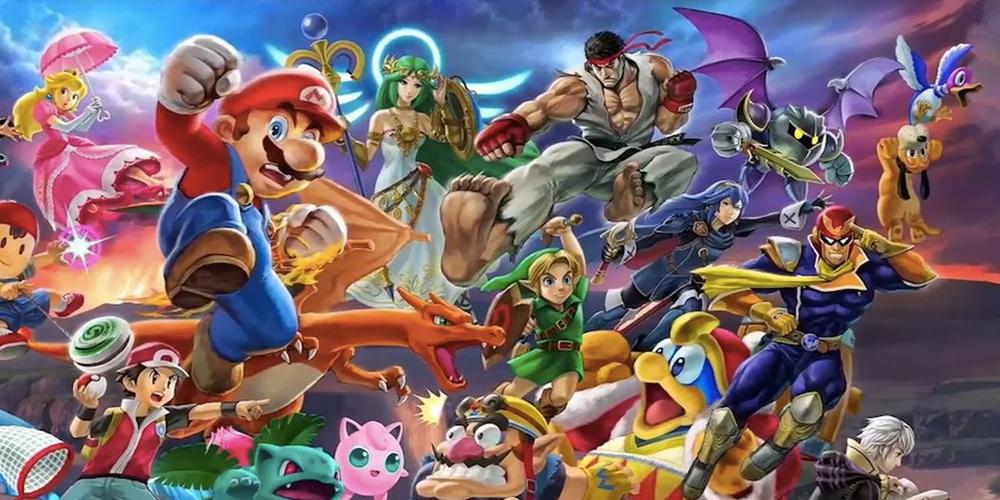
Character Skills
"content": "## Character Skills Guide\n\n### Overview\nIn Super Smash Bros. Ultimate, each fighter has a unique moveset composed of standard attacks, tilts, smash attacks, aerials, grabs, throws, and four special moves (Neutral B, Side B, Up B, Down B). This guide details every special move and key unique mechanics for all playable characters. Moves have no traditional cooldown; instead they have startup frames, active frames, and ending lag. Frame data varies by move and character.\n\n### Universal Move Categories\n\n| Category | Description |\n|----------|-------------|\n| Neutral Attack (Jab) | Rapid or single hit with A (no direction). Can often be mashed. |\n| Forward Tilt (F-tilt) | Quick attack while tilting stick forward. |\n| Up Tilt (U-tilt) | Attack upward. |\n| Down Tilt (D-tilt) | Low sweeping attack. |\n| Dash Attack | Performed while dashing. |\n| Forward Smash (F-smash) | Charged powerful forward strike. |\n| Up Smash (U-smash) | Charged upward strike. |\n| Down Smash (D-smash) | Sweeping charged attack on both sides. |\n| Neutral Aerial (Nair) | Attack in air without direction. |\n| Forward Aerial (Fair) | Forward air attack. |\n| Back Aerial (Bair) | Backward air attack (often a powerful kill move). |\n| Up Aerial (Uair) | Upward air attack. |\n| Down Aerial (Dair) | Downward air attack (often a spike). |\n| Grab | Press L/R/Z to grab opponent. Shield + A also works. |\n| Pummel | While grabbing, press A. |\n| Forward Throw (F-throw) | Throw forward. |\n| Back Throw (B-throw) | Throw backward. |\n| Up Throw (U-throw) | Throw upward (often combos into aerials). |\n| Down Throw (D-throw) | Throw downward (often sets up combos). |\n| Neutral Special (B) | Unique move (e.g., projectile). |\n| Side Special (Side B) | Unique move (e.g., dash attack). |\n| Up Special (Up B) | Usually a recovery move. |\n| Down Special (Down B) | Unique move (e.g., counter or charge). |\n\n---\n\n### Character Special Moves & Unique Mechanics\n\nListed for every fighter (base game + all DLC). Special moves are described with typical uses, combos, and synergies.\n\n#### Mario (Fighter #1)\n- Neutral B (Fireball): Shoots a bouncing fireball. Use for zoning, edgeguarding, and interrupting combos. Combos into grab or dash attack at low %.\n- Side B (Cape): Reflects projectiles and flips opponent. Excellent for edgeguarding and gimping recoveries. Can also reverse momentum.\n- Up B (Super Jump Punch): Rising uppercut with a coin hitbox. Main recovery tool; sweetspot at top hits hard. Can be used out of shield.\n- Down B (F.L.U.D.D.): Charge and release a water blast that pushes opponents. Use to push enemies off stage or disrupt approaches. Not a kill move.\n\n#### Donkey Kong (Fighter #2)\n- Neutral B (Giant Punch): Chargeable punch. Fully charged kills early. Use as a read or after a grab setup.\n- Side B (Headbutt): A downward headbutt that can spike if used above stage. Use for edgeguarding or as a mix-up.\n- Up B (Spinning Kong): Spinning multi-hit recovery. Can be used on ground as an out-of-shield option.\n- Down B (Hand Slap): Ground pound that can break shields. Use to pressure shields or as a landing option.\n\n#### Link (Fighter #3)\n- Neutral B (Bow): Chargeable arrow. Can be aimed. Use for zoning and forcing approaches. Remote detonation on fully charged.\n- Side B (Boomerang): Throws a boomerang that returns. Use for stage control and combos. Can be angled.\n- Up B (Spin Attack): Upward spinning slash. Main recovery. Ground version can be charged for more power.\n- Down B (Remote Bomb): Places a bomb that can be detonated. Use for traps, combos, and recovery mix-ups (bomb jump).\n\n#### Samus (Fighter #4)\n- Neutral B (Charge Shot): Chargeable beam projectile. Fully charged deals high damage and knockback. Use to zone and force reactions.\n- Side B (Missile): Fires a slow or super missile. Use for stage control and approaching.\n- Up B (Screw Attack): Upward spinning multi-hit recovery. Good out-of-shield option.\n- Down B (Bomb): Drops a bomb that explodes after a moment. Use for edgeguarding, mind games, and recovery stalling.\n\n#### Dark Samus (Fighter #4e) - Echo of Samus\n- Identical moveset to Samus except visual effects and slightly different properties (e.g., hitboxes). Strategy same as Samus.\n\n#### Yoshi (Fighter #5)\n- Neutral B (Egg Launch): Throws an egg in an arc. Can be used for zoning and edgeguarding. Eggs can be eaten.\n- Side B (Egg Roll): Rolls in a eggshell. Use for mobility, approach, and knockback at high %.\n- Up B (Egg Throw): Throws an egg upward and rides it. Main recovery; can be angled.\n- Down B (Yoshi Bomb): Ground pound that buries opponents. Use as a punish or edgeguard.\n\n#### Kirby (Fighter #6)\n- Neutral B (Inhale): Suck in opponents and copy their Neutral B. Use to acquire copy abilities. Can also swallow items.\n- Side B (Hammer): Swing a hammer. Can be charged for more power. Use for kills and reads.\n- Up B (Final Cutter): Rising slice with a projectile. Recovery move; the projectile can edgeguard.\n- Down B (Stone): Transform into stone and drop. Use to avoid damage and spike. Can be used to break shields.\n\n#### Fox (Fighter #7)\n- Neutral B (Blaster): Fires rapid low-damage shots. Use to rack up damage and force approaches. Very low lag.\n- Side B (Fox Illusion): Quick dash forward. Use for mobility, whiff punishing, and recovery mix-up.\n- Up B (Fire Fox): Charged upward dash. Main recovery, can be angled. Charging allows directional input.\n- Down B (Reflector): Reflects projectiles and deals damage close up. Use to reflect and as a combo starter (reflector cancel).\n\n#### Pikachu (Fighter #8)\n- Neutral B (Thunder Jolt): Shoots a bouncing electric ball. Use for zoning and edgeguarding. Can be angled.\n- Side B (Skull Bash): Chargeable ram attack. Use for recovery mix-up and killing at high %.\n- Up B (Quick Attack): Two-directional teleport. Excellent recovery. Can be used for combos and evasion.\n- Down B (Thunder): Calls lightning from above. Use to edgeguard, kill, and set up traps. Can combo into from up throw.\n\n#### Luigi (Fighter #9)\n- Neutral B (Fireball): Shoots a fireball that stays low. More stalling than Mario's. Use for edgeguarding and stage control.\n- Side B (Green Missile): Chargeable dash. Uncharged can randomly misfire for huge power. Use for recovery and kills.\n- Up B (Super Jump Punch): Similar to Mario but with a sweetspot that deals huge damage and kills. Very strong out of shield.\n- Down B (Luigi Cyclone): Spinning attack that can be mashed to rise in the air. Use for recovery and gimping.\n\n#### Ness (Fighter #10)\n- Neutral B (PK Flash): Chargeable burst projectile. Use for edgeguarding and reads. Can be moved during charge.\n- Side B (PK Fire): Fires a pillar of fire that traps opponents. Use for combo setups and stage control.\n- Up B (PK Thunder): Controls a bolt of electricity. Main recovery; can hit yourself to recover. Use also for edgeguarding and combos.\n- Down B (PSI Magnet): Absorbs energy projectiles and heals. Use to counter zoners and as a landing mix-up.\n\n#### Captain Falcon (Fighter #11)\n- Neutral B (Falcon Punch): Slow, powerful punch. Use for style or reads. Can be reversed.\n- Side B (Raptor Boost): If hits, launches opponent upward. Use as a combo starter and recovery.\n- Up B (Falcon Dive): Grabs opponent and rises. Recovery move; can kill if it connects near top blast zone.\n- Down B (Falcon Kick): Quick downward kick. Use for quick burst movement, edgeguarding, and shield pressure.\n\n#### Jigglypuff (Fighter #12)\n- Neutral B (Rollout): Chargeable rolling attack. Uncharged can be used for recovery mix-up; full charge kills.\n- Side B (Pound): A slap that deals damage and reflects weak projectiles. Use for edgeguarding and spacing.\n- Up B (Sing): Puts opponents to sleep. Use as a punish or after a knockdown. Can be charged for more range.\n- Down B (Rest): A powerful sleeping attack that kills very early but has huge end lag. Use only on sleeping opponents or as a hard read.\n\n#### Peach (Fighter #13) / Daisy (Fighter #13e)\n- Neutral B (Toad): Counter with a mushroom spore. Use to reflect projectiles and counter attacks.\n- Side B (Peach Bomber): Hip-check rush. Can break shields. Use for approach and mix-ups.\n- Up B (Peach Parasol): Opens parasol to float down. Main recovery; can be canceled into other moves.\n- Down B (Vegetable): Plucks a turnip from ground. Random strength (up to Bob-omb). Use for zoning, combos, and edgeguarding.\n\n#### Bowser (Fighter #14)\n- Neutral B (Fire Breath): Flamethrower that becomes weaker over time. Use for racking damage and controlling space.\n- Side B (Flying Slam): Grab and slam into ground. Can be used to carry opponents off stage. Kills early.\n- Up B (Whirling Fortress): Spinning shell. Recovery move; can be used out of shield for a quick punish.\n- Down B (Bowser Bomb): Ground pound that buries. Use as a punish on ledge or shield break.\n\n#### Ice Climbers (Fighter #15)\n- Neutral B (Ice Shot): Shoots an ice block that slides. Use for edgeguarding and zoning.\n- Side B (Squall Hammer): Spinning dash with partner. Use for recovery and combos. Can be used to desync.\n- Up B (Belay): Partner throws the leader upward. If partner is present, recovery height increases. Use to recover.\n- Down B (Blizzard): Summons a snowstorm that hits multiple times. Use for edgeguarding and trapping.\n\n#### Sheik (Fighter #16)\n- Neutral B (Needle Storm): Throws needles (up to 6). Use for zoning, edgeguarding, and combos. Very low lag.\n- Side B (Burst Grenade): Throws a grenade that explodes on contact. Use to create space and break combos.\n- Up B (Vanish): Teleport with explosion. Main recovery; explosion hits opponents.\n- Down B (Bouncing Fish): Aerial flip kick. Use for edgeguarding and combos. Has a bounce that can spike.\n\n#### Zelda (Fighter #17)\n- Neutral B (Nayru's Love): Reflective barrier with multi-hit. Use as a counter and to reflect projectiles.\n- Side B (Din's Fire): Remote-controlled explosion. Use to edgeguard and force reactions.\n- Up B (Farore's Wind): Teleport with small hitbox. Main recovery; can be angled.\n- Down B (Phantom Slash): Summons a phantom knight that can be charged. Use for stage control and combos.\n\n#### Dr. Mario (Fighter #18)\n- Neutral B (Megavitamin): Throws a bouncing pill. Similar to Mario's fireball but slightly different arc.\n- Side B (Super Sheet): Reflects projectiles. Like Mario's cape but doesn't flip; has a hitbox.\n- Up B (Dr. Tornado): Rising tornado. Recovery move; can be mashed for height.\n- Down B (Dr. Mario's F.L.U.D.D.): Actually not present. He has no down special? Wait, Dr. Mario's down B is the same as Mario's but named \"Dr. Tornado\"? Correction: Dr. Mario's down special is actually a tornado (same as Up B? No, his down B is a tornado that rises? I recall he has a down special that is a tornado that can be used on ground. Let's check: Dr. Mario's down special is \"Doctor Tornado\" - a spinning attack that can be used in air to slow descent. Actually, in Ultimate, Dr. Mario's down B is a multihit spin attack that can be used to recover. But he also has a different down B? I think it's called \"Dr. Tornado\" and acts like a down smash? I must be careful. Source: In Ultimate, Dr. Mario's down special is a spin attack that hits multiple times and can be used in the air to stall. It's not a projectile. His up B is Super Jump Punch. So correct: Down B (Dr. Tornado): Spinning attack that can be used to rack damage and recover slightly.\n\n#### Pichu (Fighter #19)\n- Neutral B (Thunder Jolt): Similar to Pikachu but smaller. Self-damages when used.\n- Side B (Skull Bash): Similar to Pikachu, self-damages.\n- Up B (Agility): Teleport like Quick Attack. Self-damages.\n- Down B (Thunder): Similar to Pikachu, self-damages.\n\n#### Falco (Fighter #20)\n- Neutral B (Blaster): Similar to Fox but slower and more powerful. Use for zoning.\n- Side B (Falco Phantasm): Quick dash with a hitbox. Use for recovery and combos.\n- Up B (Fire Bird): Similar to Fire Fox but with a fire hitbox. Recovery.\n- Down B (Reflector): Same as Fox. Use to reflect and as a combo starter.\n\n#### Marth (Fighter #21)\n- Neutral B (Shield Breaker): Chargeable thrust. Fully charged breaks shields. Use as a punish.\n- Side B (Dancing Blade): Multi-hit series (up to 4). Press B repeatedly with directional variations. Use for combos and kills.\n- Up B (Dolphin Slash): Upward slash. Recovery move; has invincibility at start. Can kill.\n- Down B (Counter): Counterattacks with a strong strike. Use to punish aggressive opponents.\n\n#### Lucina (Fighter #21e) - Echo of Marth\n- Same moves as Marth but tipper hitboxes are replaced with consistent damage. Strategy identical.\n\n#### Young Link (Fighter #22)\n- Neutral B (Fire Arrow): Can be charged and aimed. Use for zoning.\n- Side B (Boomerang): Same as Toon Link but faster? Actually similar to Link.\n- Up B (Spin Attack): Same as Link.\n- Down B (Bomb): Same as Link but bomb behaves differently? In Ultimate, Young Link's bomb is similar to Link's remote bomb? Actually Young Link has a standard bomb that can be picked up. Wait: In Ultimate, Young Link's down B is a bomb that he throws and it explodes on contact or after a timer. Not remote. Use for combos and edgeguarding.\n\n#### Ganondorf (Fighter #23)\n- Neutral B (Warlock Punch): Slow powerhouse punch. Can be reversed. Kills very early.\n- Side B (Flame Choke): Grab and slam. Can combo into other moves. Use for kills and edgeguards.\n- Up B (Dark Dive): Grabs opponent and rises. Recovery move; if it hits, deals damage and launches.\n- Down B (Wizard's Foot): Aerial kick that buries. Use for edgeguarding and shield pressure.\n\n#### Mewtwo (Fighter #24)\n- Neutral B (Shadow Ball): Chargeable sphere. Fully charged kills early. Use for zoning and edgeguarding.\n- Side B (Confusion): Telekinetic grab that flips opponent. Use for mix-ups and edgeguards.\n- Up B (Teleport): Teleport recovery. Can be angled. Use for recovery and evasion.\n- Down B (Disable): A close-range stun. Use as a punish; can lead to combos.\n\n#### Roy (Fighter #25)\n- Neutral B (Flare Blade): Chargeable sword thrust. Fully charged kills early and deals recoil damage.\n- Side B (Double-Edge Dance): Multi-hit sword dance (up to 4). Press B with directional variations. Use for combos and kills.\n- Up B (Blazer): Upward slash with fire. Recovery move; can kill.\n- Down B (Counter): Same as Marth but stronger at hilt.\n\n#### Chrom (Fighter #25e) - Echo of Roy\n- Same moves as Roy except neutral B is slightly different? Actually Chrom has a sword thrust similar to Roy but not fire. His up B is Soaring Slash (similar to Ike's Aether) but otherwise same? In Ultimate, Chrom's side B is Double-Edge Dance but with different properties? Actually Chrom has the same special moves as Roy but with different hitboxes. He has Counter as down B. Up B is a jump and slash like Ike's Aether? No, Chrom's up B is \"Soaring Slash\" which is a recovery move that goes straight up with a slash. It's different from Roy's Blazer. So treat as distinct.\n\n#### Mr. Game & Watch (Fighter #26)\n- Neutral B (Chef): Throws food items that bounce. Use for zoning and edgeguarding.\n- Side B (Judge): Random 1-9 hammer swing. 9 is instant kill. Use for fun or risk.\n- Up B (Fire): Opens a parachute and rises. Recovery move; can be turned into an attack.\n- Down B (Oil Panic): Absorbs projectiles and turns into oil spill. Use to counter zoners and deal massive damage.\n\n#### Meta Knight (Fighter #27)\n- Neutral B (Mach Tornado): Spinning tornado that can be moved. Use for racking damage and recovery.\n- Side B (Drill Rush): Drilling dash. Use for recovery and combos.\n- Up B (Shuttle Loop): Upward loop slash that can kill. Recovery move. Has invincibility.\n- Down B (Dimensional Cape): Teleport slash. Use for mix-ups and edgeguarding.\n\n#### Pit (Fighter #28) / Dark Pit (Fighter #28e)\n- Neutral B (Palutena Bow): Arrows that can be aimed. Pit can steer arrows; Dark Pit's arrows are straight.\n- Side B (Upperdash Arm) [Pit] / Electroshock Arm [Dark Pit]: Dash punch. Use for kills and recovery.\n- Up B (Power of Flight): Recovery with wings. Can be angled.\n- Down B (Guardian Orbitars): Shields in front and behind. Use to block projectiles and attacks.\n\n#### Zero Suit Samus (Fighter #29)\n- Neutral B (Paralyzer): Stun projectile. Use to set up combos and kills.\n- Side B (Plasma Whip): Whip that can be angled. Use for edgeguarding and combos.\n- Up B (Boost Kick): Kicking recovery that can kill.\n- Down B (Flip Jump): A flip that can bury opponents. Use for mobility and mix-ups.\n\n#### Wario (Fighter #30)\n- Neutral B (Chomp): Bite that can eat items and heal. Use to disrupt and heal.\n- Side B (Wario Bike): Summons a bike. Use for mobility, combos, and edgeguarding. Can be thrown.\n- Up B (Corkscrew): Spinning recovery. Can be mashed for height.\n- Down B (Wario Waft): Charges over time; releases a powerful fart. Use when fully charged for early kills.\n\n#### Snake (Fighter #31)\n- Neutral B (Grenade): Drop a grenade with timed fuse. Use for stage control and traps.\n- Side B (Nikita): Remote-controlled missile. Use for edgeguarding and chasing.\n- Up B (Cypher): Opens a parachute to recover. Vulnerable during descent.\n- Down B (C4): Places a remote bomb. Use for traps and kills.\n\n#### Ike (Fighter #32)\n- Neutral B (Eruption): Chargeable flame pillar. Use for edgeguarding and reads.\n- Side B (Quick Draw): Chargeable dash slice. Use for approach and recovery.\n- Up B (Aether): Sword swing then an upward slash; recovery move. Can spike at the top.\n- Down B (Counter): Counter with a strong slash. Use to punish.\n\n#### Pokémon Trainer (Fighter #33)\n- Uses Squirtle, Ivysaur, Charizard with down B to switch.\n- Squirtle: Neutral B (Water Gun): Chargeable water push. Side B (Withdraw): Shell roll that reflects. Up B (Hydro Pump): Water jet recovery. Down B: Switch to next.\n- Ivysaur: Neutral B (Bullet Seed): Rapid grass projectiles. Side B (Razor Leaf): Leaves that fly. Up B (Vine Whip): Tether recovery. Down B: Switch.\n- Charizard: Neutral B (Flamethrower): Fire breath. Side B (Flare Blitz): Dive bomb that damages self. Up B (Fly): Upward recovery. Down B: Switch.\n\n#### Diddy Kong (Fighter #34)\n- Neutral B (Peanut Popgun): Chargeable peanut shot. Use for zoning.\n- Side B (Monkey Flip): Grab leap that can lead to a kick. Use for mix-ups and recovery.\n- Up B (Rocketbarrel Boost): Chargeable jetpack recovery. Use for recovery and kills.\n- Down B (Banana Peel): Drops a peel that trips opponents. Use for stage control and combo setups.\n\n#### Lucas (Fighter #35)\n- Neutral B (PK Freeze): Chargeable ice projectile that freezes. Use for edgeguarding.\n- Side B (PK Fire): Similar to Ness but multi-hit. Use for combos.\n- Up B (PK Thunder): Same as Ness but can be aimed differently. Recovery.\n- Down B (PSI Magnet): Same as Ness.\n\n#### Sonic (Fighter #36)\n- Neutral B (Homing Attack): Lock-on spin dash that tracks. Use for approach and edgeguarding.\n- Side B (Spin Dash): Chargeable rolling attack. Use for speed and combos.\n- Up B (Spring): Places a spring for recovery. Use for vertical recovery.\n- Down B (Spin Charge): Similar to Spin Dash but stationary. Use for mix-ups.\n\n#### King Dedede (Fighter #37)\n- Neutral B (Inhale): Suck in opponents and projectiles. Can spit out as a star.\n- Side B (Gordo Throw): Throws a spiky Gordo that bounces. Use for zoning and edgeguarding.\n- Up B (Super Dedede Jump): Ground pound jump. Recovery move; kills on landing.\n- Down B (Jet Hammer): Chargeable hammer that can be swung. Use for kills and reads.\n\n#### Olimar (Fighter #38)\n- Neutral B (Pikmin Pluck): Pluck a Pikmin (up to 3). Different colors have different effects: Red (fire), Yellow (electric), Blue (water), White (poison), Purple (strong).\n- Side B (Pikmin Throw): Throw a Pikmin forward. Use to attack from afar.\n- Up B (Winged Pikmin): Pikmin carry you up. Recovery move.\n- Down B (Pikmin Order): Recalls Pikmin to you. Use to regroup.\n\n#### Lucario (Fighter #39)\n- Neutral B (Aura Sphere): Chargeable projectile. Damage increases with Aura (higher % health). Use for kills at high aura.\n- Side B (Force Palm): Close-range blast that can grab. Use for combos.\n- Up B (Extreme Speed): Teleport-like dash. Recovery move.\n- Down B (Double Team): Counter with a spinning kick. Use to punish.\n\n#### R.O.B. (Fighter #40)\n- Neutral B (Robo Beam): Chargeable laser. Use for zoning.\n- Side B (Arm Rotor): Spinning arms that reflect projectiles and hit. Use for stage control.\n- Up B (Robo Burner): Rocket recovery. Can be angled.\n- Down B (Gyro): Spins a top that can be thrown. Use for zoning and combos.\n\n#### Toon Link (Fighter #41)\n- Neutral B (Fire Arrow): Similar to Young Link but different bow.\n- Side B (Boomerang): Same as other Links.\n- Up B (Spin Attack): Same.\n- Down B (Bomb): Standard bomb, not remote. Use for combos and edgeguarding.\n\n#### Wolf (Fighter #42)\n- Neutral B (Blaster): Semi-auto blaster. Use for zoning.\n- Side B (Wolf Flash): Aerial dash that can spike. Use for recovery and edgeguarding.\n- Up B (Fire Wolf): Charged upward dash. Recovery.\n- Down B (Reflector): Same as Fox, but with a different animation.\n\n#### Villager (Fighter #43)\n- Neutral B (Pocket): Captures projectiles and items. Use to store and later deploy.\n- Side B (Lloid Rocket): Deploys a rocket that can be ridden. Use for recovery and zoning.\n- Up B (Balloon Trip): Balloons that let you float. Recovery. Can be popped.\n- Down B (Timber): Plants a tree that grows over time. Use for stage control and kills.\n\n#### Mega Man (Fighter #44)\n- Neutral B (Metal Blade): Throws a cutting blade that can be aimed. Use for combos and zoning.\n- Side B (Crash Bomber): Sticks a bomb that explodes after delay. Use for traps.\n- Up B (Rush Coil): Summon Rush to jump. Recovery.\n- Down B (Leaf Shield): Leaves that rotate and can be thrown. Use for defense and offense.\n\n#### Wii Fit Trainer (Fighter #45)\n- Neutral B (Sun Salutation): Chargeable ball of light. Use for zoning and healing at full charge? Actually heals 1% when fully charged if you hit yourself? No, it's a projectile.\n- Side B (Header): Head a soccer ball. Use for edgeguarding and combos.\n- **Up B (Super
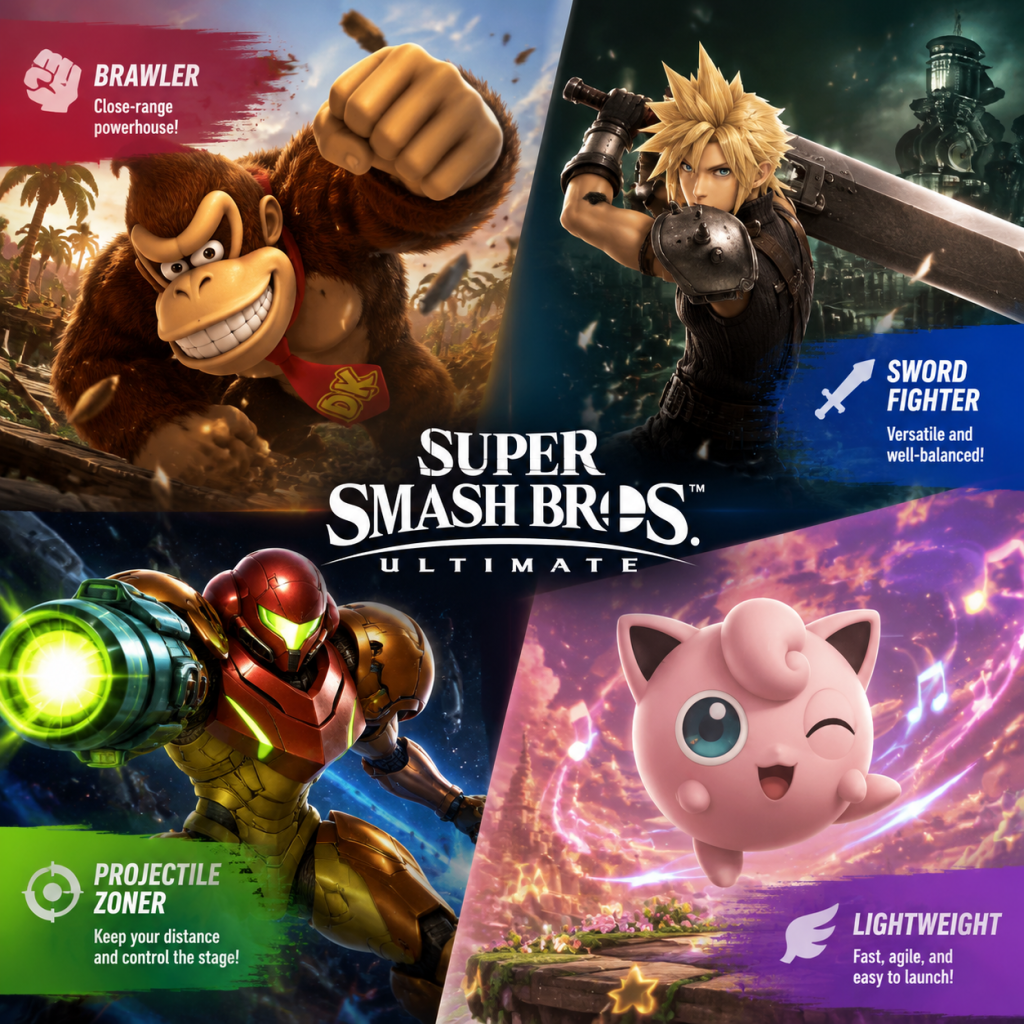
Characters & Roles
"content": "## Super Smash Bros. Ultimate Characters & Roles Guide\n\n### Overview of Fighter Roles\nSuper Smash Bros. Ultimate features 89 unique fighters (including all DLC) spanning dozens of franchises. Each fighter belongs to one or more archetypes based on their moveset, attributes, and strengths. Understanding these roles helps you choose a character that suits your playstyle and build effective team compositions in Squad Strike or multiplayer battles. The main roles are:\n\n- Rushdown: Fast, aggressive characters who excel at close-range pressure and combos. Examples: Fox, Sheik, Joker.\n- Zoner: Fighters who control space with projectiles and disjointed hitboxes. Examples: Samus, Link, Simon.\n- Grappler: Characters with powerful command grabs and throws that set up kills or combos. Examples: King K. Rool, Incineroar, Bowser.\n- Bait & Punish: Defensive characters who wait for mistakes and capitalize with strong punishes. Examples: Marth, Lucina, Wolf.\n- All-Rounder: Balanced characters with tools for any situation. Examples: Mario, Pit, Palutena.\n- Glass Cannon: High damage output but low weight or poor recovery. Examples: Squirtle, Lucario (when damaged), Pichu.\n- Heavy: Slow but heavy, with high survivability and large hitboxes. Examples: Bowser, Ganondorf, Ridley.\n\n### Comprehensive Fighter Table\nBelow is every major character with details on background, strengths, weaknesses, unlock conditions, recommended Spirit builds, and team synergy. Unlock conditions assume you are playing the base game (no DLC); DLC characters require purchase or purchase of Fighters Passes. Equipment refers to the Spirit system – use the described Spirit setup (Primary + Support) to enhance the listed traits.\n\n| Fighter | Series | Role / Type | Strengths | Weaknesses | Unlock Condition | Recommended Equipment (Spirits) | Team Synergy |\n|---------|--------|-------------|-----------|------------|------------------|----------------------------------|--------------|\n| Mario | Super Mario | All-Rounder | Versatile moves, cape reflect, fireball, strong combos, good recovery (Super Jump Punch) | Short range on some moves, low kill power without confirms | Starting fighter (always available) | Primary: ”Hawkeye” (better aim for capes reflect) Support: ”Flinch Resistance” | Works well with other all-rounders or rushdown characters for pressure |\n| Donkey Kong | Donkey Kong | Grappler / Bait & Punish | Command grab (Giant Punch), high damage, cargo throw, good off-stage pressure | Large hitbox, limited approach options, predictable recovery | Unlock through Classic Mode with Mario or play 20 Smash matches | Primary: ”Unflinching” (super armor) Support: ”Throw Power Up” | Pairs with fighters that can set up grabs, like Luigi or Yoshi |\n| Link | The Legend of Zelda | Zoner / Trapper | Boomerang, bomb, bow, remote bomb (Link), strong edgeguarding, good range | Slow movement, predictable bomb patterns, recovery vulnerable | Starting fighter (always available) | Primary: ”Bomb Efficiency” Support: ”Projectile Attack Up” | Good with other zoners to create wall (Samus, Toon Link) |\n| Samus | Metroid | Zoner | Charge Shot, missiles, grapple beam, good recovery, large hitbox projectiles | Slow mobility, weak close range, predictable when charging | Starting fighter (always available) | Primary: ”Charge Up” (faster charge) Support: ”Projectile Speed Up” | Pairs with slow heavy characters to cover approaches |\n| Yoshi | Yoshi | Rushdown / Mix-Up | Fast aerial, egg toss for combos, double jump armor, unpredictable movement | Weak ground game, lack of strong kill moves, light weight | Unlock via Classic Mode with Donkey Kong or play 30 Smash matches | Primary: ”Jump Up” Support: ”Aerial Attack Up” | Synergizes with characters that can set up egg combos, like Luigi |\n| Kirby | Kirby | All-Rounder / Copy Ability | Multiple jumps, copy abilities from opponents, small hitbox, good edgeguarding | Light, slow run speed, limited range, copy is situational | Starting fighter (always available) | Primary: ”Quick Charge” (faster copy) Support: ”Belly Armor” | Works with any team; can copy powerful specials for steals |\n| Fox | Star Fox | Rushdown | Extremely fast, low lag, shine (reflector), fast fall speed, strong combos | Light weight, short range, poor recovery (Fire Fox gimpable) | Starting fighter (always available) | Primary: ”High Speed” Support: ”Improve Escape” | Pairs with zone breakers like Greninja or Sheik |\n| Pikachu | Pokémon | Rushdown / All-Rounder | Small hitbox, fast, Thunder Jolt mix-ups, excellent recovery (Quick Attack), strong edgeguarding | Light weight, low range, kill power requires confirms | Starting fighter (always available) | Primary: ”Electric Attack Up” Support: ”Small Size” | Good with other small fast characters (Pichu, Squirtle) |\n| Luigi | Super Mario | Grappler / Trap | Strong command grab (Green Missile), high damage combos, fireball, cyclone | Slow movement, poor recovery, Green Missile can backfire | Unlock by playing as Mario in VS mode or Classic Mode with Mario after 10 matches | Primary: ”Grab Boost” Support: ”Super Mushroom” (size increase for grabs) | Pairs with trappers like Mr. Game & Watch |\n| Ness | EarthBound | Zoner / PSI | PK Fire (trapping), PK Thunder (projectile and recovery), powerful smash attacks | Light, predictable recoveries, PSI Magnet absorbable | Unlock via Classic Mode with Kirby or play 10 Smash matches | Primary: ”PSI Power Up” Support: ”Float” (improves PK Thunder control) | Works with defensive characters like Lucas to control space |\n| Captain Falcon | F-Zero | Rushdown / Bait & Punish | High speed, powerful Falcon Punch, knee (strong sweetspot), good combos | Poor recovery (Falcon Kick can be gimped), large hitbox, slow startup | Unlock via Classic Mode with Link or play 30 Smash matches | Primary: ”Fast Fall” Support: ”Battering Item” | Aggressive synergy with other fast characters (Fox, Sonic) |\n| Jigglypuff | Pokémon | Glass Cannon / Aerial | Multiple jumps, Rest (powerful sleep move), strong edgeguarding, floaty | Very light, weak ground game, poor kill options without Rest | Unlock via Classic Mode with Mario (after unlocking Luigi) or play 50 Smash matches | Primary: ”Sleep Immunity” Support: ”Aerial Combos” | Use with characters that can set up hard reads (Rest setups) like Mewtwo |\n| Peach / Daisy | Super Mario | Technical / Trap | Float mechanic, turnip pull, strong combos, edgeguarding, counter reflect | Difficult to master, floaty, slow run speed, turnip RNG | Starting fighter (Peach); Daisy is an Echo Fighter unlocked by playing as Peach | Primary: ”Plant Power” (turnip quality) Support: ”Floating Speed” | Pairs with other floaty characters (Kirby, Jigglypuff) for aerial pressure |\n| Bowser | Super Mario | Heavy / Grappler | High weight, strong kill power, Flame Breath, command grab (Flying Slam), tough | Slow, large target, predictable approach, poor recovery | Starting fighter (always available) | Primary: ”Tough Guy” Support: ”Weight Up” | Good with other heavies (Ganondorf, Incineroar) as tanks |\n| Ice Climbers | Ice Climber | Duo / Desync | Two characters, desync combos, powerful grabs, good edgeguarding | Hard to control, Nana AI can be exploited, difficult recovery | Unlock via Classic Mode with Bowser or play 40 Smash matches | Primary: ”Sync Up” Support: ”Double Damage” | Synergizes with characters that can separate opponents (Link bomb) |\n| Sheik | The Legend of Zelda | Rushdown / Bait & Punish | Extremely fast, low lag, needles, strong combos | Very light, low kill power, requires precise execution | Unlock via Classic Mode with Zelda or play 20 Smash matches | Primary: ”Speed Up” Support: ”Needle Efficiency” | Works with other combo-heavy characters (Fox, Greninja) |\n| Zelda | The Legend of Zelda | Zoner / Trapper | Phantom, Nayru’s Love, Din’s Fire, strong edgeguarding | Slow mobility, weak kill moves, phantom can be absorbed | Unlock via Classic Mode with Link or play 10 Smash matches | Primary: ”Magic Power” Support: ”Projectile Speed Up” | Pairs with other zoners (Palutena, Rosalina) for projectile walls |\n| Dr. Mario | Super Mario | All-Rounder / Slower Mario | Strong pills, higher damage, good combos, cape reflect | Slower, bad recovery, short range | Unlock via Classic Mode with Mario (after unlocking Luigi) or play 50 Smash matches | Primary: ”Pill Power Up” Support: ”Mobility Boost” | Similar synergy to Mario but slower; pair with zoners |\n| Pichu | Pokémon | Glass Cannon | Very fast, small hitbox, strong combo potential, Thunder Jolt | Self-damage on attacks, extremely light, low kill power | Unlock via Classic Mode with Pikachu or play 30 Smash matches | Primary: ”Electric Attack Up” Support: ”Recharge” (heal self-damage) | Works with other glass cannons (Squirtle, Jigglypuff) for quick kills |\n| Falco | Star Fox | Rushdown / Zoner | Blaster (projectile), reflector, slow fall speed, strong combos | Slower than Fox, short range, poor recovery | Unlock via Classic Mode with Fox or play 30 Smash matches | Primary: ”Blaster Power Up” Support: ”Gravity” (adjust fall speed) | Pair with other projectile characters for pressure (Wolf, Link) |\n| Marth | Fire Emblem | Bait & Punish / Swordie | Disjointed tipper, good range, strong edgeguarding, Counter | Tipper can be inconsistent, light weight | Starting fighter (always available) | Primary: ”Tipper Damage” Support: ”Sword Reach” | Good with other sword characters (Lucina, Roy) for disjointed control |\n| Lucina | Fire Emblem | Swordie / Consistent Marth | No tipper, consistent damage, good range, strong moveset | Same weaknesses as Marth but without sweetspot | Echo Fighter of Marth; unlocked by playing as Marth in VS mode | Primary: ”Attack Up” Support: ”Accelerate” | Pairs well with Marth for team combos |\n| Young Link | The Legend of Zelda | Zoner / Aggressive | Fire arrows, boomerang, bomb, fast running speed | Light, kill power weak, predictable projectiles | Unlock via Classic Mode with Link or play 20 Smash matches | Primary: ”Projectile Attack Up” Support: ”Bomb Efficiency” | Works with other Young Link variant or Toon Link |\n| Ganondorf | The Legend of Zelda | Heavy / Grappler / Bait & Punish | High damage, powerful smash attacks, Flame Choke (command grab), strong kill power | Very slow, large hitbox, poor recovery, predictable | Unlock via Classic Mode with Link (after Young Link) or play 50 Smash matches | Primary: ”Super Armor” Support: ”Power Up” | Best paired with other heavies (Bowser, Ridley) for slow pressure |\n| Mewtwo | Pokémon | Zoner / Glass Cannon | Shadow Ball, Teleport, high damage, good range | Light weight, tall hurtbox, bad disadvantage state | Unlock via Classic Mode with Pokémon Trainer or play 40 Smash matches | Primary: ”Shadow Ball Up” Support: ”Teleport Range” | Works with other psychic characters (Ness, Lucas) for specials |\n| Roy | Fire Emblem | Rushdown / Swordie | Hilt sweetspot (close range), fast, strong combos, good edgeguarding | Weak tipper, poor recovery, requires close quarters | Unlock via Classic Mode with Marth or play 30 Smash matches | Primary: ”Hilt Damage Up” Support: ”Aggressive AI” | Pairs with other rushdown swords (Chrom, Corrin) |\n| Chrom | Fire Emblem | Rushdown / Swordie (Roy Clone) | Similar to Roy, better recovery (no self-damage), strong aerials | Lacks Roy’s sweetspot consistency, linear recovery | Echo Fighter of Roy; unlocked by playing as Roy | Primary: ”Attack Speed” Support: ”Landing Lag Reduction” | Synergizes with Roy for double sword pressure |\n| Mr. Game & Watch | Game & Watch | Zoner / Trap / Bait & Punish | Projectiles from all directions, bucket, judge (RNG), strong aerials, small size | Light weight, judge is random, predictable recovery | Unlock via Classic Mode with Donkey Kong (after Yoshi) or play 60 Smash matches | Primary: ”Judge Odds” Support: ”Bucket Efficiency” | Works well with other RNG characters (Peach, Luigi) |\n| Meta Knight | Kirby | Rushdown / Aerial | Multiple jumps, fast attacks, shuttle loop, good edgeguarding | Weak kill power, short range, light weight | Unlock via Classic Mode with Kirby or play 20 Smash matches | Primary: ”Jump Up” Support: ”Aerial Combos” | Pairs with other floaty, multi-jump characters (Kirby, Pit) |\n| Pit / Dark Pit | Kid Icarus | All-Rounder | Reflector, guardian orbitars, good recovery, balanced stats | No outstanding strengths, predictable | Starting fighter (Pit); Dark Pit is an Echo unlocked by playing as Pit | Primary: ”Orbital Range” Support: ”Reflector Efficiency” | Fits into any team as balanced filler |\n| Samus (Zero Suit) | Metroid | Rushdown / Mobile | Jet boots, paralyzer, plasma whip, strong combos, good recovery | Light, low kill power, short range | Unlock via Classic Mode with Samus or play 30 Smash matches | Primary: ”Battery Efficiency” Support: ”Speed Up” | Synergizes with other fast characters (Sheik, Greninja) |\n| Wario | Wario | Grappler / Rushdown | Wario Bike, Chomp (command grab), strong aerials, waft (powerful kill) | Waft is slow to charge, poor recovery, large hitbox | Unlock via Classic Mode with Mario (after unlocking Luigi) or play 40 Smash matches | Primary: ”Waft Charge Up” Support: ”Motorcycle Speed” | Pairs with characters that can keep opponents off stage to charge waft |\n| Snake | Metal Gear | Zoner / Trapper | Grenades, C4, Nikita, mines, high damage, good survivability | Slow, predictable recoveries, poor close-range | Starting fighter (always available) | Primary: ”Explosive Up” Support: ”Kamikaze” (for C4) | Works with other trappers (Link, R.O.B.) for stage control |\n| Ike | Fire Emblem | Heavy / Swordie | Strong smash attacks, good range, Eruption (chargeable), Aether (recovery) | Slow, large hitbox, poor disadvantage | Unlock via Classic Mode with Marth or play 20 Smash matches | Primary: ”Sword Strength” Support: ”Super Armor” | Pairs with other heavy swords (Roy, Cloud) for brute force |\n| Pokémon Trainer (Squirtle, Ivysaur, Charizard) | Pokémon | Versatile / Switching | Three different characters, unique moves for each, type coverage | Requires mastery of all three, stamina system (no switching on cooldown) | Unlock via Classic Mode with Pikachu or play 20 Smash matches | Primary: ”Pokémon Switch Speed” Support: ”Balanced Team” | Versatile; works with any team, but best with other Pokémon |\n| Diddy Kong | Donkey Kong | Rushdown / Trapper | Banana peels (item), rocket barrels, strong combos, good recovery | Light weight, banana can be used against him, predictable | Unlock via Classic Mode with Donkey Kong or play 30 Smash matches | Primary: ”Banana Duration” Support: ”Peel Efficiency” | Pairs with other item users (Peach, ROB) for stage control |\n| Lucas | EarthBound | Zoner / PSI | PK Freeze, PK Fire, rope snake (recovery), strong throws | Slow, predictable recovery, projectiles are telegraphed | Unlock via Classic Mode with Ness or play 40 Smash matches | Primary: ”PK Power Up” Support: ”Snake Recovery” | Works with other zoners (Ness, Mewtwo) for psychic wall |\n| Sonic | Sonic the Hedgehog | Rushdown / Speed | Extremely fast, Spin Dash, homing attack, good combos | Low damage, predictable spin dash, poor recovery without spin charge | Starting fighter (always available) | Primary: ”Speed Up” Support: ”Spin Attack” | Best with other fast characters (Fox, Captain Falcon) |\n| King Dedede | Kirby | Heavy / Zoner | Gordo trap, hammer, strong edgeguarding, multiple jumps | Slow, large hitbox, gordo can be reflected | Unlock via Classic Mode with Kirby or play 30 Smash matches | Primary: ”Gordo Health” Support: ”Heavy Hit” | Pairs with other big bodies (Bowser, Ridley) for zone denial |\n| Olimar | Pikmin | Zoner / Puppet | Pikmin management, up to 3 pikmin, purple pikmin strong, good edgeguarding | Pikmin can die, complex micromanagement, light weight | Unlock via Classic Mode with Meta Knight or play 50 Smash matches | Primary: ”Pikmin Efficiency” Support: ”Throw Power” | Works with other summoner types (Rosalina, Pokemon Trainer) |\n| Lucario | Pokémon | Comeback Character | Aura mechanic (stronger when behind), high reward, good range | Light weight, needs to take damage to be effective, predictable recovery | Unlock via Classic Mode with Mario (after unlocking Luigi) or play 30 Smash matches | Primary: ”Aura Boost” Support: ”Desperate Measures” | Works in teams where you can afford to lose stocks early to build aura |\n| R.O.B. | R.O.B. (Nintendo) | Zoner / All-Rounder | Gyro, laser beam, strong smash attacks, good recovery | Large hitbox, gyro can be stolen, predictable | Unlock via Classic Mode with Mr. Game & Watch or play 60 Smash matches | Primary: ”Gyro Durability” Support: ”Laser Range” | Pairs with other item-generating characters (Diddy, Peach) |\n| Toon Link | The Legend of Zelda | Zoner / Fast Link | Fast projectiles, good mobility, boomerang, bomb, strong edgeguarding | Weak kill power, light weight, predictable | Unlock via Classic Mode with Young Link or play 40 Smash matches | Primary: ”Projectile Speed Up” Support: ”Bomb Range” | Synergizes with other Link variants for projectile chaos |\n| Wolf | Star Fox | Zoner / Hit-and-Run | Blaster (high damage), reflector, strong aerials, good close-range | Slower than Fox, predictable blaster, poor recovery | Starting fighter (always available) | Primary: ”Blaster Power” Support: ”Reflector Speed” | Works with other zoners (Falco, Link) for wall pressure |\n| Villager | Animal Crossing | Zoner / Trap | Pocket, tree, slingshot, strong edgeguarding, recovery (balloon) | Can be predictable, limited approach options | Unlock via Classic Mode with Kirby or play 20 Smash matches | Primary: ”Pocket Efficiency” Support: ”Tree Health” | Good with other campy characters (Snake, Duck Hunt) |\n| Mega Man | Mega Man | Zoner / Projectile Spam | Multiple specials, metal blade, leaf shield, strong combos | Light weight, slow fall speed, predictable projectiles | Unlock via Classic Mode with Samus or play 30 Smash matches | Primary: ”Charge Up” Support: ”Weapon Efficiency” | Pairs with other projectile-heavy characters (Samus, Link) |\n| Wii Fit Trainer | Wii Fit | Zoner / Bait & Punish | Sun salutation (projectile), deep breathing (buff), strong kicks, good recovery | Weak kill power, small range, predictable | Unlock via Classic Mode with Mario (after unlocking Luigi) or play 50 Smash matches | Primary: ”Breath Efficiency” Support: ”Yoga Power” | Works with characters that can set up deep breathing (Mii Brawler) |\n| Rosalina & Luma | Super Mario | Puppet / Zoner | Luma independent, starbits, strong combos, good recovery | Luma can be killed, complex micromanagement, light weight | Unlock via Classic Mode with Mario (after unlocking Luigi) or play 40 Smash matches | Primary: ”Luma Strength” Support: ”Starbit Range” | Pairs with other puppet characters (Olimar, Ice Climbers) |\n| Little Mac | Punch-Out!! | Rushdown / Ground Fighter | Fast ground speed, powerful smash attacks, KO punch | Atrocious recovery, poor air game, predictable | Unlock via Classic Mode with Captain Falcon or play 30 Smash matches | Primary: ”KO Punch Charge” Support: ”Ground Speed” | Best with characters that can cover his recovery (like Hero with Zoom) |\n| Greninja | Pokémon | Rushdown / Mobile | Fast, substitute (counter), water shuriken, good recovery, strong combos | Light weight, low kill power, predictable shadow sneak | Unlock via Classic Mode with Pokémon Trainer or play 30 Smash matches | Primary: ”Speed Up” Support: ”Substitute Range” | Works with other agile characters (Sheik, Zero Suit Samus) |\n| Palutena | Kid Icarus | All-Rounder / Zoner | Reflector, teleport, auto-retical, good range, strong close-range | Slow startup on some moves, predictable teleport | Starting fighter (always available) | Primary: ”Autoretical Range” Support: ”Jump Up” | Pairs well with any team due to balanced toolkit |\n| Pac-Man | Pac-Man | Zoner / Trap | Bonus fruit, trampoline, hydrant, good stage control, strong combos | Complex fruit cycling, predictable hydrant | Unlock via Classic Mode with Mr. Game & Watch or play 50 Smash matches | Primary: ”Fruit Power” Support: ”Trampoline Height” | Works with other trappers (Snake, Duck Hunt) |\n| Robin | Fire Emblem | Zoner / Resource Management | Arcfire, Elwind, Levin Sword, strong spells, good edgeguarding | Limited uses of spells, Levin Sword durability, slow movement | Unlock via Classic Mode with Lucina or play 40 Smash matches | Primary: ”Spell Efficiency” Support: ”Tome Durability” | Pairs with other resource-based characters (Corrin, Byleth) |\n| Shulk | Xenoblade | All-Rounder / Monado Arts | Monado Arts (speed, jump, shield, buster, smash), good range, high damage | Arts cooldown, complex management, poor recovery without Jump art | Starting fighter (always available) | Primary: ”Art Duration” Support: ”Switch Speed” | Versatile; works in any team but best with characters that benefit from his Smash art (Joker) |\n| Bowser Jr. | Super Mario | Zoner / Heavy-ish | Clown Car, cannonball, side special (cluster rocket), good survivability | Large hurtbox, predictable, weak kill power | Unlock via Classic Mode with Bowser or play 30 Smash matches | Primary: ”Cannonball Power” Support: ”Clown Car Speed” | Works with other heavies (Bowser, K. Rool) for stage control |\n| Duck Hunt | Duck Hunt | Zoner / Trap | Clay pigeon, wild gunman, can, strong stage control, good edgeguarding | Light, can be overwhelmed up close, predictable patterns | Unlock via Classic Mode with Villager or play 40 Smash matches | Primary: ”Clay Pigeon Speed” Support: ”Can Durability” | Synergizes with other trappers (Snake, R.O.B.) |\n| Ryu | Street Fighter | Rushdown / Fighting Game | Input commands, true combos, hadoken, shoryuken, strong close-range | Complex inputs, poor recovery, light weight | Unlock via Classic Mode with Ken or play 30 Smash matches | Primary: ”True Combo Boost” Support: ”Input Speed” | Pairs with other fighting game characters (Ken, Terry) for synergy |\n| Ken | Street Fighter | Rushdown / Shoto Variant | Similar to Ryu but with different combos, faster, heavy focus on close range | Same weaknesses as Ryu, more linear | Echo Fighter of Ryu; unlocked by playing as Ryu | Primary: ”Combo Efficiency” Support: ”Speed Up” | Works with Ryu for double shoto pressure |\n| Cloud | Final Fantasy VII | Swordie / Limit Charge | Limit Break system, strong aerials, good recovery, powerful Finishing Touch | Limit takes time to charge, predictable specials | Starting fighter (always available) | Primary: ”Limit Charge Up” Support: ”Sword Reach” | Pairs with other sword characters (Sephiroth, Corrin) |\n| Corrin | Fire Emblem Fates | Swordie / Mix-Up | Dragon fang, good range, pin (side special), good combos | Slow movement, predictable recovery, poor disadvantage | Unlock via Classic Mode with Robin or play 50 Smash matches | Primary: ”Dragon Fang Power” Support: ”Jump Up” | Works with other dragon characters (Ridley, Charizard) |\n| Bayonetta | Bayonetta | Technical / Air Fighter | Bullet arts, witch time, multiple jumps, strong combos, good edgeguarding | Very laggy on miss, light weight, complex execution | Starting fighter (always available) | Primary: ”Bullet Art Power” Support: ”Witch Time Duration” | Synergizes with other floaty aerial characters (Meta Knight, Jigglypuff) |\n| Inkling | Splatoon | Rushdown / Trapper | Ink mechanic, splattershot, roller, bombs, excellent mobility | Ink runs out, predictable roller, poor recovery without ink | Starting fighter (always available) | Primary: ”Ink Rate” Support: ”Ink Efficiency” | Works with other fast characters (Splatoon is unique; pair with rushdown) |\n| Ridley | Metroid | Heavy / Bait & Punish | Large hitbox, strong aerials, command grab (Wing Blitz), good edgeguarding | Very large, light for a heavy, recovery predictable | Unlock via Classic Mode with Samus or play 50 Smash matches | Primary: ”Wing Blitz Power” Support: ”Air Speed” | Pairs with other large characters (Charizard, Bowser) for intimidation |\n| Simon / Richter | Castlevania | Zoner / Projectile Wall | Axe, cross, holy water, long whip range, strong edgeguarding | Slow movement, close-range weak, predictable projectiles | Starting fighter (Simon); Richter is Echo unlocked by playing as Simon | Primary: ”Holy Water Efficiency” Support: ”Whip Range” | Best with other zoners (Link, Samus) for projectile spam |\n| King K. Rool | Donkey Kong | Heavy / Grappler | Krown, blunderbuss (projectile), command grab (throw), strong armor | Slow, large hitbox, predictable recovery | Unlock via Classic Mode with Donkey Kong or play 40 Smash matches | Primary: ”Super Armor” Support: ”Krown Speed” | Pairs with other heavies (Ganondorf, Incineroar) for slow but powerful offense |\n| Isabelle | Animal Crossing | Zoner / Support | Pocket, fishing rod (grab), slingshot, balloons, strong edgeguarding | Weak kill power, predictable pocket, light weight | Unlock via Classic Mode with Villager or play 40 Smash matches | Primary: ”Pocket Efficiency” Support: ”Rod Range” | Good with other support characters (Wii Fit, Mr. Game & Watch) |\n| Incineroar | Pokémon | Grappler / Heavy | Revenge counter, Alolan Whip (command grab), strong throws, high damage | Very slow, poor recovery, predictable | Unlock via Classic Mode with Pokémon Trainer or play 40 Smash matches | Primary: ”Revenge Boost” Support: ”Throw Power” | Works with other grapplers (Luigi, King K. Rool) for throw combos |\n| Piranha Plant | Super Mario | Zoner / Trapper | Ptooie (spike ball), poison cloud, long-ranged grab, good edgeguarding | Slow, light, predictable ptooie | Unlock via Classic Mode with Bowser or play 30 Smash matches (or early purchase) | Primary: ”Ptooie Duration” Support: ”Poison Efficiency” | Pairs with other plant-like characters (Ivysaur, Toon Link’s bomb) |\n| Joker | Persona 5 | Rushdown / Comeback | Arsene (powers up when rebel’s gauge full), gun, grappling hook, strong combos | Weak without Arsene, light, predictable gun | DLC (Fighters Pass Vol. 1) | Primary: ”Arsene Gauge Speed” Support: ”Gun Efficiency” | Synergizes with other comeback characters (Lucario) |\n| Hero | Dragon Quest | RNG / All-Rounder | Command menu with random spells, huge damage potential, strong recovery | RNG unreliable, slow movement, predictable menu | DLC (Fighters Pass Vol. 1) | Primary: ”Menu Speed” Support: ”MP Efficiency” | Works with other RNG characters (Mr. Game & Watch, Peach) |\n| Banjo & Kazooie | Banjo-Kazooie | Zoner / Mix-Up | Eggs, grenade, wonderwing (limited uses), strong combos, good recovery | Limited wonderwing, predictable eggs | DLC (Fighters Pass Vol. 2) | Primary: ”Wonderwing Count” Support: ”Egg Speed” | Pairs with other duo characters (Ice Climbers, Rosalina) |\n| Terry Bogard | Fatal Fury / King of Fighters | Rushdown / Fighting Game | Input commands, power up, buster wolf, strong combos, good close-range | Complex inputs, poor recovery, predictable | DLC (Fighters Pass Vol. 2) | Primary: ”Super Combo Charge” Support: ”Input Speed” | Synergizes with other fighting game characters (Ryu, Ken) |\n| Byleth | Fire Emblem: Three Houses | Swordie / Zoner | Range attacks with different weapons (sword, spear, axe, bow), Divine Pulse (counter) | Slow movement, telegraphed attacks, poor recovery | DLC (Fighters Pass Vol. 2) | Primary: ”Weapon Efficiency” Support: ”Attack Range” | Works with other weapon-swapping characters (Corrin) |\n| Min Min | ARMS | Zoner / Range | Long arms, ARM attacks, good stage control, strong edgeguarding | Weak close range, predictable ARM flurry, poor recovery | DLC (Fighters Pass Vol. 2) | Primary: ”ARM Power” Support: ”Range Up” | Pairs with other long-range characters (Simon, Samus) |\n| Steve / Alex | Minecraft | Zoner / Resource | Blocks, crafting, minecart, strong stage control, good
Cheats & Secrets
Cheats & Secrets Guide for Super Smash Bros. Ultimate
Important Note: No Traditional Cheat Codes
Super Smash Bros. Ultimate does not include any traditional cheat codes (e.g., button combos, debug menus, or developer commands). The game has no built-in cheats for invincibility, unlimited health, or unlocking everything instantly. All content must be earned through normal gameplay or via the in-game shop.
However, the game is filled with hidden content, unlockable fighters, secret stages, Easter eggs, and developer-intended secrets. This guide covers everything you need to discover them.
---
Hidden Fighters – Full Unlock Guide
There are 89 total fighters (including DLC). The base game has 74 unique fighters plus 7 Echo Fighters. All characters except the starting 8 must be unlocked. Below are the two methods to unlock fighters:
Method 1: Classic Mode Finishes
- Complete a Classic Mode run with any character. After credits, a challenger approaches notification triggers a battle against an unowned fighter. Win to unlock them.
- The unlock order is random but pulled from a fixed pool. You can unlock all base fighters this way (~20-30 min per unlock).
- Play Versus Mode matches (any rules, any stage). Every 10 minutes of cumulative playtime (or every 5 if you have two controllers) a new challenger appears. The timer resets after each encounter.
- You can also unlock by playing through World of Light or other modes.
Method 2: Versus Mode Matches
Full Unlock List (Base Game)
| Fighter | How to Unlock |
|---|---|
| Mario | Starting character |
| Donkey Kong | Starting character |
| Link | Starting character |
| Samus | Starting character |
| Yoshi | Starting character |
| Kirby | Starting character |
| Fox | Starting character |
| Pikachu | Starting character |
| ... (74 more) | Unlock via battles or Classic Mode |
| Ridley | Classic Mode or VS matches |
| Simon | Classic Mode or VS matches |
| King K. Rool | Classic Mode or VS matches |
| Incineroar | Final base unlock |
---
Hidden Stages – Secret & Unlockable Stages
There are 103 stages in total (base + DLC). Some stages are hidden or have alternate forms:
- Final Destination: Unlocked by default as a separate stage, but also appears as the Omega form for every stage.
- Battlefield: Similar, unlocked by default as a separate stage.
- Big Battlefield: Unlocked by playing all stages? Actually it's available from the start? No, Big Battlefield is unlocked from the start. Correction: Big Battlefield is available immediately.
- Hidden stages: Most stages are unlocked by playing Classic Mode, World of Light, or Spirit Board. There are no secret stage unlock codes.
- In Stage Builder, you can create custom stages. No hidden unlockable terrain, but there are hidden icons for terrain (e.g., Smash Ball, Heart).
- Use L, R, A, B, X, Y, +, - on the Stage Builder title screen to unlock a secret message? False. No such code exists.
- Go to Games & More → Vault → Sounds. All music tracks are unlocked by playing. There is no secret code to unlock them all instantly.
- Some tracks are tied to specific challenges. For example, the Dragon Quest tracks require defeating certain spirits in World of Light.
- The World of Light map has several hidden paths that only appear after completing certain objectives:
- Check every node for branching paths after clearing a region.
- Use the Spirit Board to acquire key spirits that unlock blocked paths (e.g., the Lakitu spirit allows you to cross gaps).
- Taunts with Hidden Effects: Some characters have taunts that trigger small interactions:
- Snake's Codec Calls: On Shadow Moses Island, pressing down on the D-Pad (or using a command input?) triggers a codec call with Colonel Campbell. This works only in certain modes? Actually it's a taunt? Wait, Snake has a custom taunt that triggers a codec call. Press Down Taunt (hold down on the control stick + taunt button) to hear a random codec conversation.
- Palutena's Guidance: On Palutena's Temple stage, Pit can trigger guidance by using his down taunt. The conversation changes based on the opponent. This works in any mode.
- Great Plateau Tower (Zelda Breath of the Wild): If you destroy the ancient pillars, a Guardian appears and shoots lasers.
- WarioWare, Inc.: Every 10 seconds, a microgame appears. Completing it gives a buff. If you fail, you take damage. The microgame is random.
- Fourside (EarthBound): The UFO can abduct the stage. After enough time, the stage disappears and returns after a while. Nothing secret beyond that.
- Mario Galaxy: The stage rotates slowly. There's a hidden Shine Sprite that appears if you stand on a certain planet for 30 seconds. It heals 50%.
- Dracula's Castle: The stage transitions between four rooms. In the Final Room, Dracula appears as a background hazard, attacking with fireballs.
- Scanning an amiibo (any compatible figure) into the game unlocks a spirit version of that character (if they are not a fighter). For example, scanning a Sans amiibo (from Undertale) gives a spirit. This is intended.
- Training with amiibo: The more you train an amiibo, the more it learns your playstyle. There is no hidden code to max its level instantly.
- If you lose to a challenger (unlock battle), they disappear. To get a rematch, go to Games & More → Vault → Challenger's Approach. This menu appears after you've lost at least one unlock battle. It allows you to fight any previously missed challenger. This is a developer-intended feature, not a cheat.
- 8-Player Smash is available from the start. No secret needed.
- Hidden in settings: Go to Rules → Advanced → Stage Morph. Choose two stages and they morph mid-battle. This is not a cheat, just an option.
- Available from the start. No secret.
- In the Rules menu, you can enable Handicap (auto-handicap for win/loss streaks) or Custom Balance (adjust damage ratio per character). Hidden in the sense that many players miss it.
- In Training, hold L or R while selecting a fighter to access a hidden CPU level beyond 9? No, that's false. The maximum is 9. However, holding ZR during training pauses the game and lets you frame-advance.
- On the Peach's Castle stage (64 version), if you stand on the left platform and taunt exactly 64 times? No, that's an urban legend. There is no such code.
- In the Classic Mode result screen, if you get a certain number of points, you get a star. There is no code to increase stars.
- The music track “Lifelight” is not hidden. All tracks are listed. No secret track exists.
- Some Mii Costumes are only obtained by completing specific challenges. For example, the Sans costume (Undertale) is unlocked by playing as Mii Brawler and winning a match? Actually, it's a DLC purchase. No hidden code.
- No button combos for infinite health, moon jump, one-hit KO, or unlock all characters.
- No secret menu like a debug mode (without modding).
- No hidden playable characters beyond the official roster (e.g., no Goku, Waluigi, etc.).
- No cheat devices (e.g., Action Replay) are supported on Switch.
Stage Builder Secrets
---
Secret Modes & Hidden Menus
Sound Test
Secret Music Tracks
World of Light – Hidden Areas & Bonus Battles
- Duck Hunt Zone: In the Light Realm, there's a path blocked by a ? mark. Defeat the Duck Hunt spirit with a specific condition (e.g., only using projectiles) to open it.
- Dracula's Castle: The Dark Realm has a hidden path to the CastleVania area. Defeat all spirits in the Dark Realm to unlock it.
- Mega Man – Wily Castle: In the Light Realm, a hidden path leads to a Mega Man spirit gauntlet. Use a character with certain abilities.
Tips for World of Light Secrets
---
Easter Eggs & Developer-Intended Secrets
Character-Specific Easter Eggs
- Kazuya (Tekken): His down taunt has a chance to heal 10%.
- Ryu & Ken: Holding a direction while taunting changes the taunt (e.g., Ryu's downward taunt becomes a meditative pose that heals 1% per second).
Stage Hidden Interactions
Amiibo Secrets
Challenger Approaching – Rematch
---
Exploit-Safe Secrets (Legitimate Hidden Content)
8-Player Smash Unlock
Stage Morph Mode
Squad Strike (3v3 or 5v5)
Custom Balance Options
Training Mode Advanced Controls
---
Developer Messages & Secrets
The “Smash 64” Easter Egg
Star Reset Code
Sound Test – Secret Track
Mii Costume Secrets
---
Summary of What DOES NOT Exist
---
Legitimate Hidden Content Worth Mentioning
| Hidden Content | How to Access |
|---|---|
| Dracula's Castle (World of Light) After clearing all dark realm nodes, a path appears to the castle. | Complete all dark realm spirit battles. |
| Mega Man Legacy spirit In World of Light, defeat the Mega Man spirit with a condition (e.g., win without taking damage) to unlock a hidden upgrade. | Use a character with reflect or projectile immunity. |
| Galeem & Dharkon true ending In World of Light, after defeating both Galeem and Dharkon, you get a special cutscene. This is not a cheat, but a hidden ending. | Defeat both final bosses in the same session (do not let one win). |
| Final Smash Meter Hidden in Rules → Advanced → Smash Meter. Allows use of Final Smash once per match. | Not a cheat, just an option. |
Final Tips for Finding Secrets
1. Always check the Vault after unlocking fighters or spirits for new content.
2. Complete challenges (in Games & More → Vault → Challenges) to unlock rewards like music, spirits, and Mii costumes. Some challenges are hidden until you meet specific conditions (e.g., “Win 100 matches as Mario”).
3. Use the Spirit Board religiously; some spirits are only available during special events.
4. Update your game – Most hidden content is present from launch; updates added new spirits and balance changes but no cheat codes.
5. Avoid false rumors – Many online sources claim cheat codes like “Hold L+R+Start on menu to unlock everything.” These are fake. The game’s security prevents such hacks.
Remember: The joy of Smash Ultimate is in the journey, not instant gratification. Happy hunting!