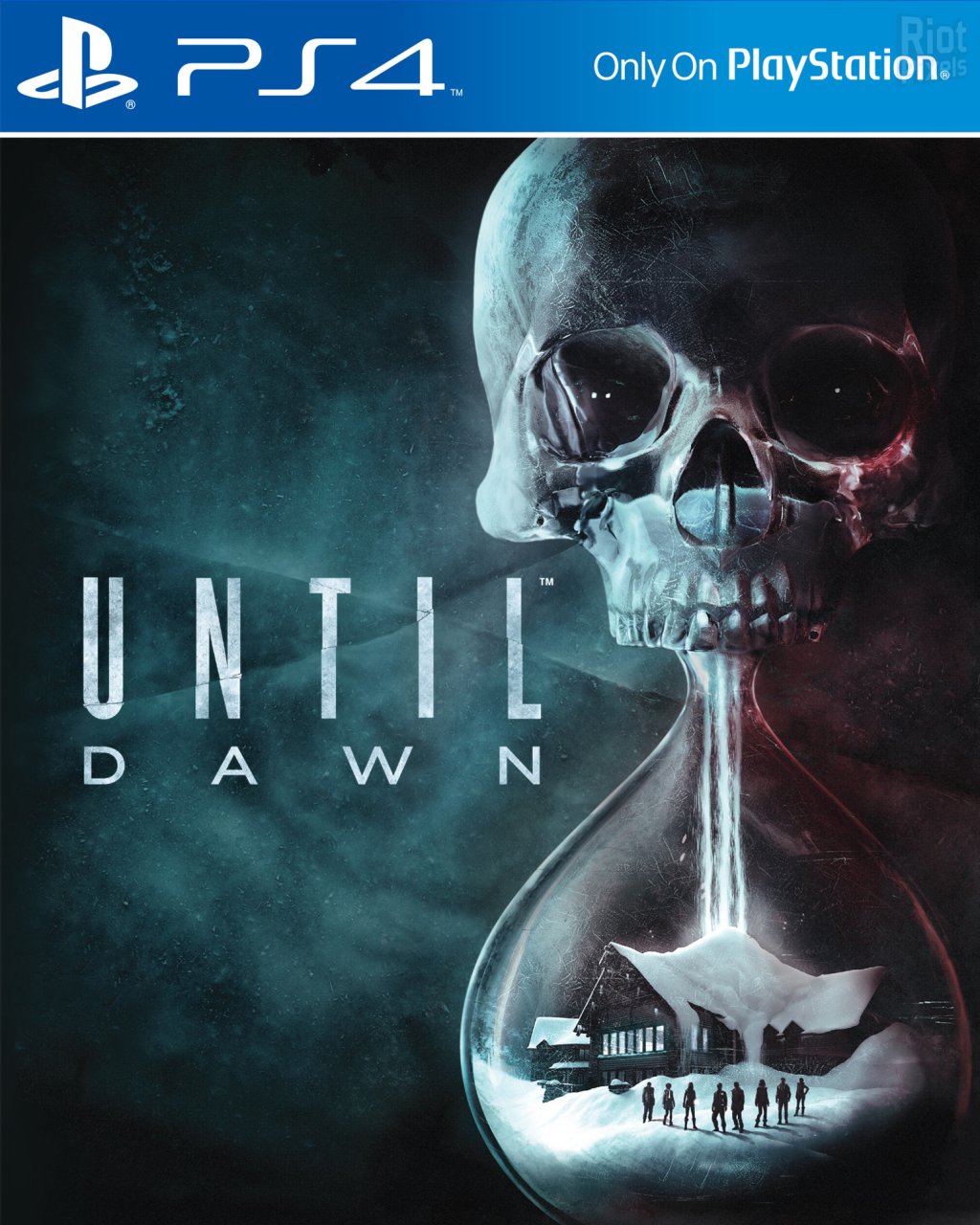
Until Dawn
## Game Introduction: *Until Dawn* ### Overview *Until Dawn* is an interactive drama survival horror game that masterfully blends cinematic storytelling with player-driven choices. Developed by **Supermassive Games** and published by **Sony Computer Entertainment**, the game originally launched as ...
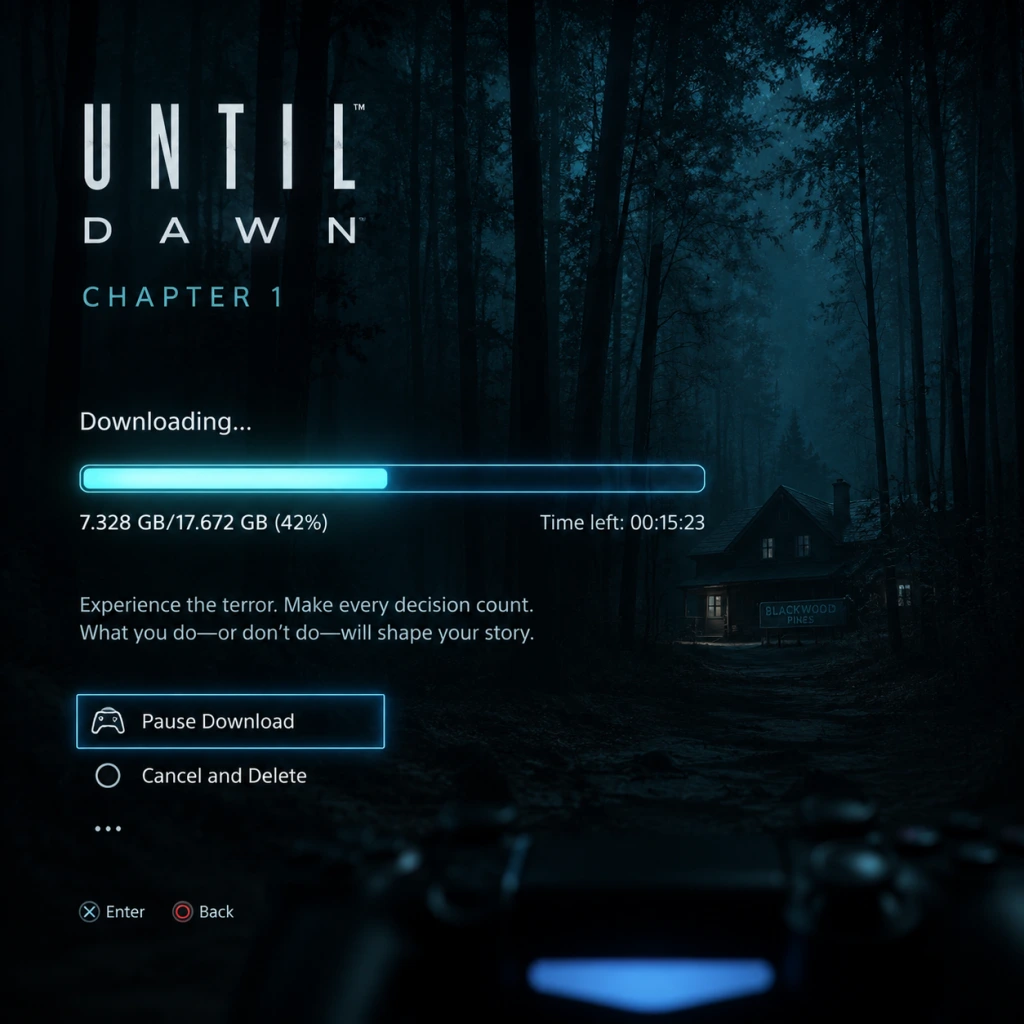
Download & Installation
Download & Installation Guide for Until Dawn
This guide covers all major platforms on which Until Dawn is available: PlayStation 4 (original release), PlayStation 5 (backward compatibility or via the 2024 remake), and PC (Steam and Epic Games Store). The game is not available on Xbox, Nintendo Switch, or mobile devices. Only legitimate, official sources are described. Follow the steps for your platform.
---
Platform Overview
| Platform | Version(s) | Official Source(s) |
|---|---|---|
| PlayStation 4 | Original release | PlayStation Store (digital) or retail disc |
| PlayStation 5 | Backward compatible with PS4 version; dedicated PS5 remake (2024) | PlayStation Store |
| PC (Windows) | 2024 remake | Steam, Epic Games Store |
System Requirements (PC – 2024 Remake)
These are the official minimum and recommended specifications for the PC version. Requirements may change with updates.
#### Minimum Requirements
- OS: Windows 10 64-bit (version 20H2 or newer)
- CPU: Intel Core i5-8600 / AMD Ryzen 5 3600
- RAM: 12 GB
- GPU: NVIDIA GeForce GTX 1080 (8GB) / AMD Radeon RX 5700 (8GB)
- Storage: 70 GB available space (SSD recommended)
- DirectX: Version 12
- Additional: Internet connection required for initial activation and updates
- OS: Windows 11 64-bit
- CPU: Intel Core i7-10700K / AMD Ryzen 7 5700X
- RAM: 16 GB
- GPU: NVIDIA GeForce RTX 2080 (8GB) / AMD Radeon RX 6800 XT (16GB)
- Storage: 70 GB SSD
- DirectX: Version 12
- Additional: High-speed internet for download and online features (e.g., photo sharing)
- PlayStation (PS4/PS5): A PlayStation Network (PSN) account is required to purchase, download, and play the game from the PlayStation Store. The game is tied to your PSN account.
- PC (Steam): A Steam account is needed.
- PC (Epic Games Store): An Epic Games account is required.
- Language Selection: On first run, you may be prompted to choose text and audio languages. These can often be changed later from the in-game settings menu.
- Graphics Settings (PC only): The game will detect your hardware and may recommend a preset (e.g., Low, Medium, High, Ultra). You can adjust resolution, frame rate cap, V-Sync, ray tracing (if supported), and more.
- License Agreements: Accept any EULA or terms of service if presented.
- Cloud Saves (PC): Steam and Epic Cloud Saves are automatically enabled. You may be asked to sync saved data.
- Controller Configuration: The game natively supports DualSense, DualShock 4, Xbox controllers, and keyboard/mouse. You can remap controls in settings.
- Online Features: Some features (like photo sharing or leaderboards) may require internet connection.
- Shader Compilation: On PC, the first launch may compile shaders, which can take several minutes. Do not interrupt this process.
#### Recommended Requirements
---
Account Requirements
---
Step-by-Step Installation
PlayStation 4 (Original)
#### Digital Purchase & Download
1. Turn on your PS4 and ensure it is connected to the internet.
2. Sign in to your PSN account.
3. Go to the PlayStation Store from the home screen.
4. Search for “Until Dawn” (not “Rush of Blood” or “The Inpatient”).
5. Select the game and choose “Add to Cart” (or “Download” if you already own it).
6. Complete purchase using your PSN wallet or a payment method.
7. The download will begin automatically. You can check progress from the Notifications menu > Downloads.
8. Once downloaded, the game will appear on your home screen. Insert a retail disc if you have the physical version – the game will install automatically.
#### Installing from Disc
1. Insert the Until Dawn disc into the PS4.
2. An installation prompt will appear; select “Install”.
3. Wait for the installation to complete (progress bar on screen).
4. Keep the disc in the drive to play.
---
PlayStation 5 (Backward Compatibility or Remake)
#### Playing the PS4 Version on PS5
1. Insert your PS4 disc (or use digital license if previously purchased on PSN).
2. The PS5 will automatically download the PS4 version via backward compatibility.
3. If digital, go to your Game Library, find Until Dawn (PS4 version), and start the download.
4. Installation is automatic; the game will appear with a PS4 badge.
5. Launch directly from the PS5 home screen.
#### Downloading the PS5 Remake (2024)
1. On your PS5, navigate to the PlayStation Store.
2. Search for “Until Dawn” – the PS5 version will be listed separately from the PS4 one.
3. Select the PS5 remake and purchase/download.
4. The game will install automatically. You can monitor progress from Control Center > Downloads/Uploads.
5. Once installed, start the game. It will run natively on PS5 with enhanced graphics and DualSense features.
---
PC (Steam)
#### Installation via Steam
1. Install Steam Client from [store.steampowered.com](https://store.steampowered.com) if not already installed.
2. Launch Steam and log in to your account.
3. Go to the Store tab and search for “Until Dawn”.
4. Add the game to your library (purchase if needed).
5. Go to your Library and find Until Dawn in the list.
6. Click “Install” and choose installation location (ensure at least 70 GB free).
7. Select desired options (e.g., create desktop shortcut).
8. Download will begin. You can pause/resume as needed.
9. After download completes, the “Play” button becomes active.
10. First launch may prompt for additional setup (see below).
#### Installation via Epic Games Store
1. Download and install Epic Games Launcher from [epicgames.com](https://www.epicgames.com).
2. Log in to your Epic Games account.
3. Go to the Store and find “Until Dawn”.
4. Purchase or claim (if free) the game.
5. Go to your Library and click “Install”.
6. Select installation directory and confirm.
7. Download and installation proceed automatically.
8. Launch from the library after installation.
---
First Launch Setup
---
Common Installation Errors and Fixes
| Error | Cause | Solution |
|---|---|---|
| Insufficient disk space | Not enough free storage | Free up space by deleting unnecessary files. The game needs ~70 GB. Ensure you have at least 75 GB free before installing. |
| Download stuck or slow | Network issues, server load | Pause and resume the download. Restart your router. On Steam, change download region in Settings > Downloads. On Epic, restart launcher. |
- Steam: Right-click game in Library > Properties > Installed Files > Verify integrity of game files.
- Epic: Go to Library, click three dots on the game > Manage > Verify Files. |
- PS4 version (digital): approximately 50 GB.
- PS5 Remake (2024): approximately 70 GB.
- PC version: 70 GB (SSD strongly recommended).
- PlayStation Store: For PS4 and PS5 versions (digital).
- Retail Discs: Available for PS4 (and playable on PS5 via backward compatibility). No disc version exists for PC.
- Steam and Epic Games Store: For PC version.
- Third-party key resellers: Use at your own risk; only purchase from authorized resellers listed on the official sites (e.g., Humble Bundle, Green Man Gaming). Avoid pirate or unverified sources.
- Pre-loading: On PC and PlayStation, you may be able to pre-load the game before release day if you pre-ordered. This allows you to play immediately at launch.
- Cross-save: Until Dawn does not support cross-save between PS4/PS5 and PC. Saves are platform-specific.
- Network requirements: The game does not require constant online connection for single-player, but an internet connection is required for initial download and patch updates.
- Accessibility: The game features subtitle options, contrast adjustments, and audio cues. Access these from the settings menu.
- [PlayStation Support](https://www.playstation.com/en-us/support/)
- [Steam Support](https://help.steampowered.com/)
- [Epic Games Support](https://www.epicgames.com/help/)
| Installation hangs at 99% | Antivirus interfering | Temporarily disable real-time protection during installation, or add the game folder to antivirus exclusions. |
| Black screen on launch | Outdated graphics drivers, incompatible settings | Update GPU drivers (NVIDIA/AMD). Launch game with -windowed or -fullscreen command (right-click game in Steam > Properties > Launch Options). |
| Missing DLL errors | Corrupted redistributables | Install or repair Visual C++ Redistributables (available from Microsoft). The game may also require DirectX. Run `dxdiag` to check. |
| License not recognized (PSN) | Account region mismatch | Ensure you are logged in with the account that purchased the game. For disc, check region compatibility (PS4 discs are region-free). |
| PS5 crash on startup | System software issue | Update PS5 to latest firmware. Rebuild database (Safe Mode > Rebuild Database). |
---
Post-Installation Verification
After installation, perform these checks to ensure everything is working correctly:
1. Launch the game and confirm it reaches the main menu without errors.
2. Check for updates – On PS4/PS5, the game will prompt if a patch is available. On PC, Steam/Epic automatically download updates. Make sure you are on the latest version.
3. Test basic functionality – Start a new game or load a save. Verify that audio, video, and controls respond as expected.
4. Adjust settings – If performance is poor, lower graphics settings. Enable DLSS/FSR if available.
5. Back up saves – On PC, you can manually back up your save files (usually located in `%USERPROFILE%\Documents\My Games\Until Dawn` or similar). On PlayStation, save data is backed up to the cloud with PS+ or via USB.
6. Check DLC – If you purchased any DLC (e.g., bonus content), confirm it appears in-game (usually in the main menu or extras section).
---
Storage Space Details
For optimal performance on PC, install on an SSD. On PS5, the game is automatically installed on internal SSD. On PS4, an external HDD is fine but may cause longer load times.
---
Legal and Official Sources Only
---
Additional Tips
By following this guide, you should be able to download and install Until Dawn smoothly on your chosen platform. If you encounter any issues not listed, consult the official support pages:
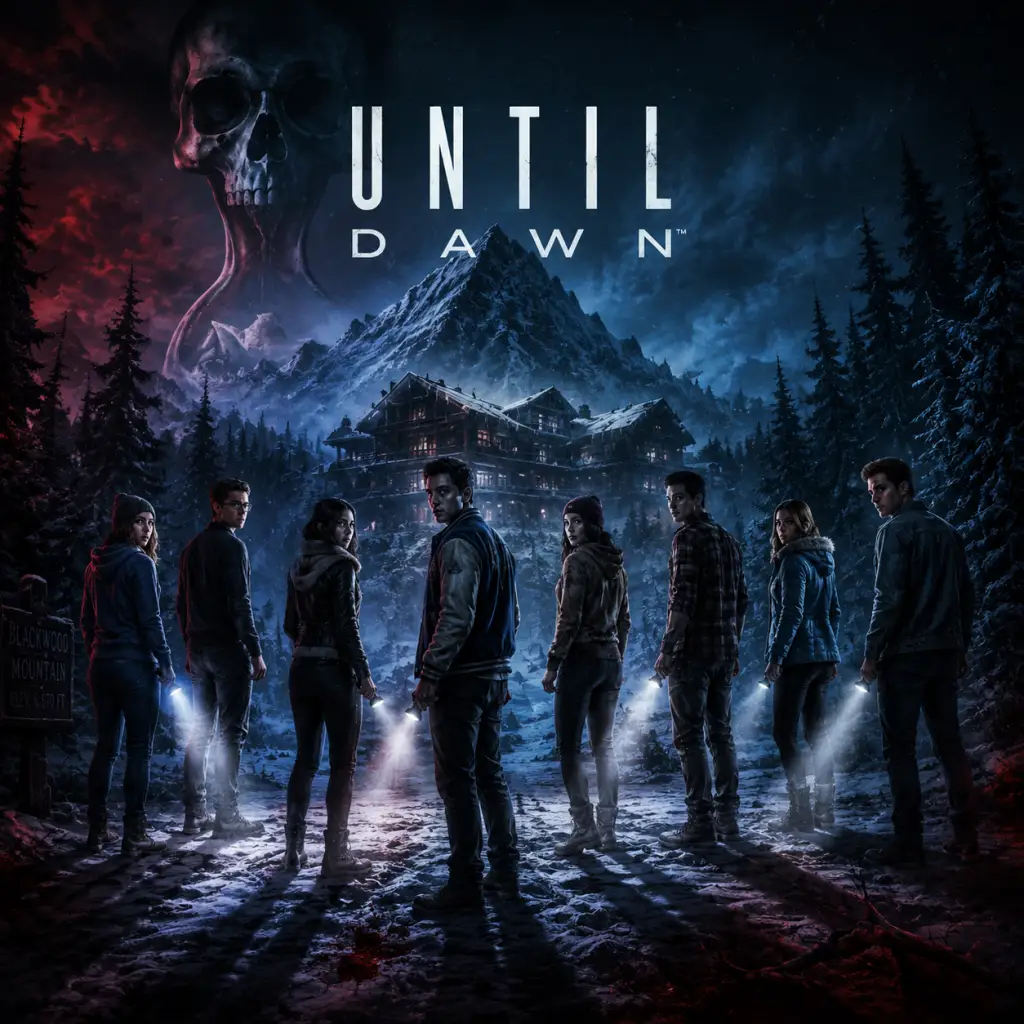
Game Introduction
Game Introduction: Until Dawn
Overview
Until Dawn is an interactive drama survival horror game that masterfully blends cinematic storytelling with player-driven choices. Developed by Supermassive Games and published by Sony Computer Entertainment, the game originally launched as a PlayStation 4 exclusive on August 25, 2015 (North America) and August 28, 2015 (Europe). A remastered version, Until Dawn (2024), was released for PlayStation 5 and PC (Steam and Epic Games Store) on October 4, 2024, featuring enhanced visuals, improved performance, and new accessibility options. The game is primarily a single-player experience with no competitive multiplayer or online modes, though it supports offline play entirely.
Genre & Core Appeal
Until Dawn is a choice-driven survival horror game where every decision matters and can mean the difference between life and death for its eight protagonists. It falls under the umbrella of interactive drama, akin to a playable horror movie. The core appeal lies in the Butterfly Effect system— seemingly minor choices early on can cascade into major consequences hours later. The tension is amplified by quick-time events (QTEs) and the ever-present threat of permanent character death. Players are drawn to the game’s high replayability, branching narrative, and the thrill of trying to keep everyone alive (or deliberately engineering their demise).
Story Overview
Set over one terrifying night on Blackwood Mountain, the story follows a group of eight friends who reunite at a remote ski lodge one year after a tragic prank led to the deaths of two of their friends, Hannah and Beth Washington. As the group gathers for a memorial, they soon realize they are not alone. Hunted by a mysterious psycho and a nightmarish creature lurking in the mountain’s mines, the friends must survive until dawn. The narrative masterfully twists between slasher horror and supernatural elements, culminating in revelations about the Wendigo—a malevolent spirit that possesses anyone who resorts to cannibalism. The player’s choices determine who lives, who dies, and how the story concludes.
Setting
* The Blackwood Mountain lodge and surrounding wilderness in Alberta, Canada. The environment is snowbound and isolated, cut off from civilization. Locations include the lodge interior, cable cars, the sanatorium (an abandoned mental hospital), the mines, and the mountain summit. The atmospheric lighting, blizzard conditions, and eerie silence are key to the horror.
Main Characters
| Character | Actor | Role/Description |
|---|---|---|
| Sam | Hayden Panettiere | The protective, athletic friend; often the groups moral compass. |
| Mike | Brett Dalton | The brave but reckless leader; heavily involved in action sequences. |
| Jessica | Meaghan Rath | Mikes girlfriend; confident and loyal, but often in danger. |
| Josh | Rami Malek | The troubled brother of Hannah and Beth; hosts the weekend getaway. |
| Matthew | Jordan Fisher | Sensitive and resourceful; Chris’s friend. |
| Emily | Nichole Bloom | Sharp-witted and pragmatic; Matts girlfriend. |
| Chris | Noah Fleiss | The comic relief with a crush on Ashley. |
| Ashley | Galadriel Stineman | Intelligent and cautious; often perceptive to dangers. |
Target Audience
- Fans of horror movies, especially slasher and supernatural genres.
- Players who enjoy narrative-driven games with branching stories (e.g., Life is Strange, The Walking Dead).
- Those seeking a tense, cinematic experience with high replay value.
- Adult audiences due to gore, intense violence, and mature themes.
- Single-player only: No multiplayer or co-op modes.
- Offline: Fully playable offline; no internet required after installation.
- No DLC or expansions: The original game shipped as a complete package. The 2024 version is a remaster, not an expansion, and includes all content from the original plus technical improvements. No additional story content has been released.
Game Modes & Support
What Makes Until Dawn Unique?
1. Butterfly Effect System: Truly dynamic choices—even seemingly insignificant ones (like choosing which path to take) can lead to entirely different character fates or alter the final montage.
2. Multiple Endings: Over 100 possible variations, with thousands of branch points. No two playthroughs are identical.
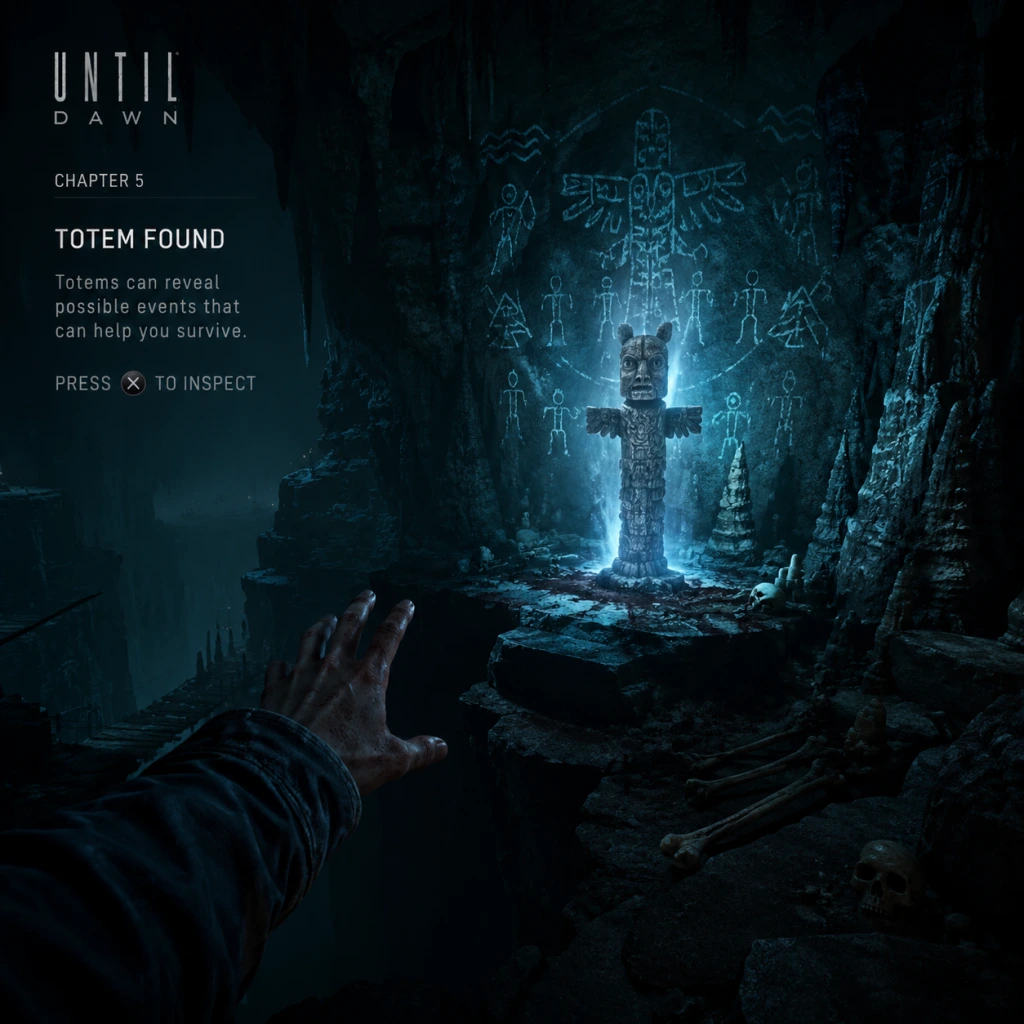
3. Totem Visions: Collectible totems scattered around the environment grant cryptic glimpses of possible future events, helping (or misleading) players.
4. Character Permadeath: Any of the eight friends can die permanently based on player choices or failed QTEs. The story adapts and continues without them.
5. Cinematic Presentation: Motion capture and performances from well-known actors (Hayden Panettiere, Rami Malek, Brett Dalton) elevate the realism.
6. Psychological Horror: The game mixes classic jump scares with psychological dread, exploring guilt, paranoia, and the consequences of past actions.
7. New Game+ (2024 Remake): In the updated version, players can start a new playthrough while retaining collected totems and certain choices, encouraging experimentation.
Until Dawn remains a landmark title in the interactive drama genre, praised for its narrative depth, tense gameplay, and atmosphere. Whether playing the original PS4 classic or the remastered version, it delivers a uniquely harrowing and replayable horror experience.
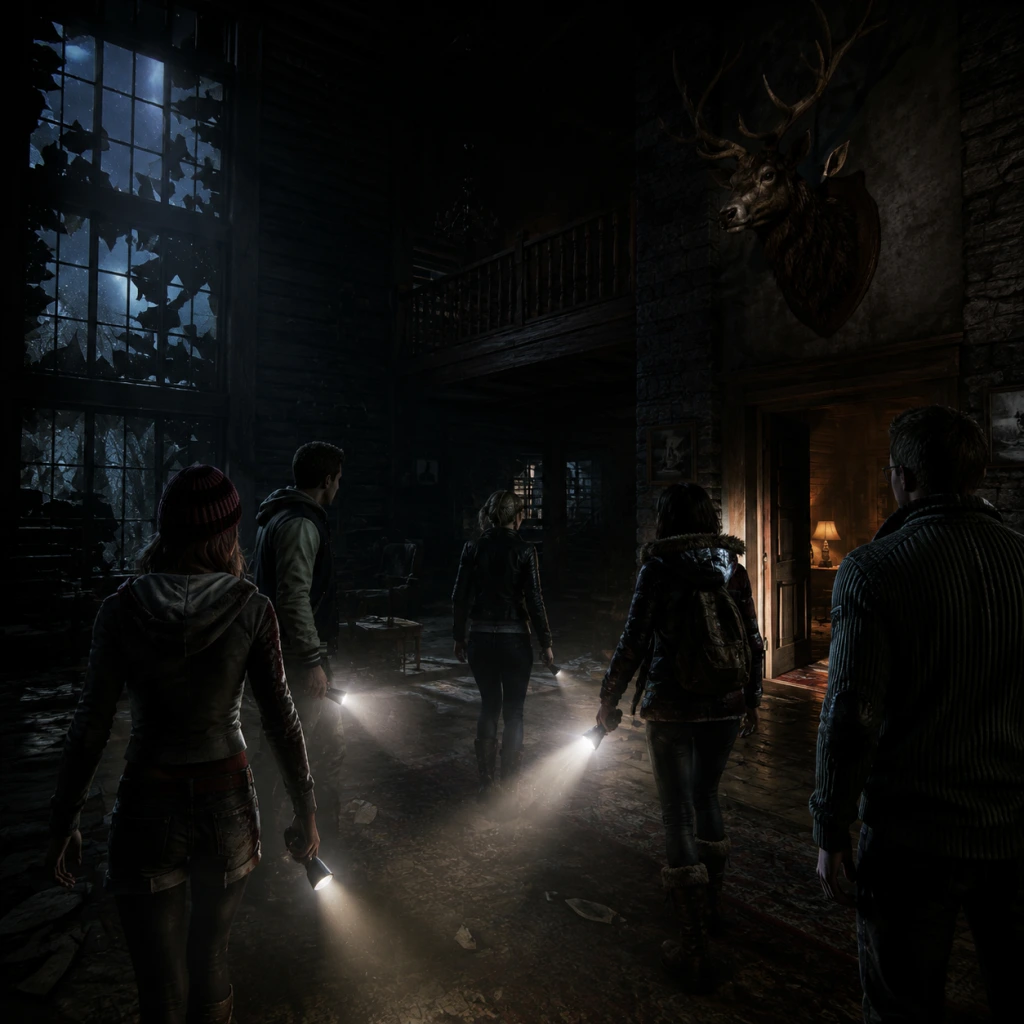
Getting Started
Getting Started Guide for Until Dawn
First Hour Walkthrough (Chapters 1–2)
The game opens with a prologue set on Blackwood Mountain one year before the main story. You play as two unnamed characters (the twin sisters Hannah and Beth) fleeing from an unknown threat. This section establishes the tone and introduces movement and interaction controls (walk, run, examine objects). Important: Follow the linear path – there are no choices here. The prologue ends with a scripted event that triggers the main plot.
After the prologue, the story jumps to the present day. You control Matt first (Chapter 1), then Mike and Jess (Chapter 2). During this first hour you will:
- Chapter 1: Explore the lodge as Matt and Emily. Focus on picking up clues (glowing items) and totems (see next section). Key area: the main hall, kitchen, and upstairs bedrooms. A mandatory quick-time event (QTE) occurs when you try to open a stuck door – tap the button rapidly.
- Chapter 2: Play as Mike and Jessica walking along a snowy trail. This introduces stealth sections (avoiding being seen by a figure in the forest). You must stay quiet: move slowly by tilting the left stick gently, and don’t let Jess trigger loud actions. At the cabin, a series of QTEs determine immediate safety – failures can lead to early character death.
Character Creation
There is no character creation in Until Dawn. The eight playable characters (Sam, Mike, Chris, Ashley, Emily, Matt, Jess, Josh) are fully predefined with fixed appearances, personalities, and backgrounds. Your choices shape their relationships and survival, but you cannot change their looks or stats. This is a story-driven experience, not a role-playing game with stat building.
Controls on All Platforms
#### PlayStation 4 / PlayStation 5
| Action | Button |
|---|---|
| Move character | Left stick |
| Camera control | Right stick |
| Interact / Examine | Triangle |
| Run (hold) | L2 |
| Hide / Stay still | R2 (press/hold) |
| QTE prompts | On-screen button (e.g., Circle, Square) |
| Motion control (torch, balance) | Tilt controller – keep it steady to avoid swaying |
| Pause menu | Options button |
#### PC (Keyboard & Mouse)
| Action | Key |
|---|---|
| Move | W/A/S/D |
| Look around | Mouse movement |
| Interact | E |
| Run | Shift (hold) |
| Hide / Stay still | Ctrl (hold) |
| QTE | Prompted letter/number (e.g., press F, then E quickly) |
| Pause | Escape |
UI Overview
- Health / Status indicators: Each character has a head icon at the top of the screen. When they’re healthy it’s white; after an injury it turns yellow or red. A skull icon means death (permanent).
- Totem visions: When you find a totem, you can view a brief premonition from the pause menu (Touchpad on PS, Tab on PC). These visions hint at future events.
- Butterfly Effect: After major choices, a butterfly icon appears with text like “____ will remember that.” These choices affect dialogue and outcomes later.
- Clue tracker: In the pause menu, under “Evidence,” you can see which clues you’ve collected per chapter. Aim for 100% to unlock extra endings.
- QTE timer: When a QTE appears, a circular timer or shrinking bar shows the time limit. Failure can harm or kill the character immediately.
- Don’t rush through exploration. Skipping dialogue or running past interactable objects means missing clues that explain the plot and affect later events.
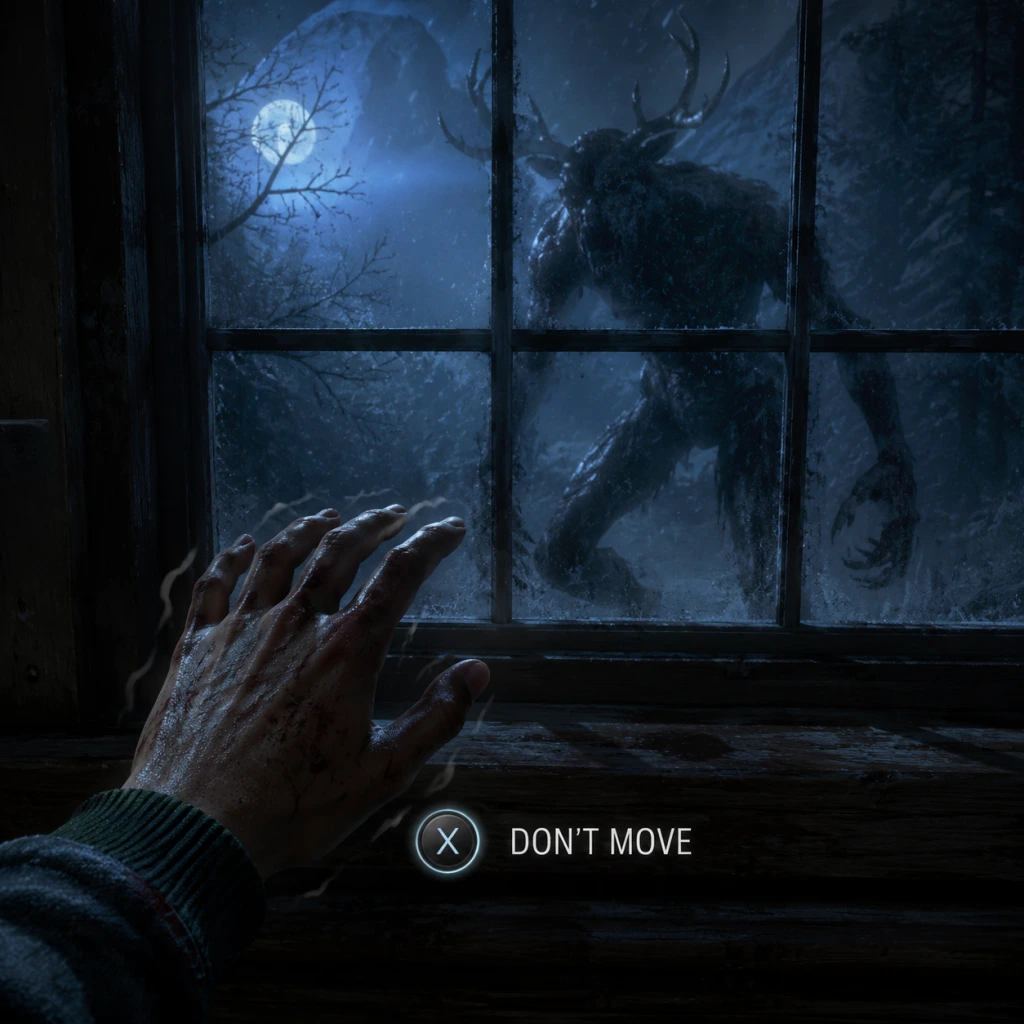
- Never shake the controller during “Don’t Move” segments. Even a slight tremor counts as movement. Rest the controller on a flat surface or your lap to stay perfectly still.
- Avoid choosing obviously reckless dialogue options early on (e.g., making cruel comments to other characters). These affect relationships and can lead to characters refusing to help you later.
- Do not ignore the totems. While optional, they are the only source of future hints. Without them, you walk in blind.
- Clues: Collect as many as possible. They unlock chapter summary information and affect ending scenes.
- Totems: Prioritize picking up all totems. They directly impact your ability to make informed decisions.
- Character relationships: Treat every character decently. Being kind (or at least neutral) builds trust. Don’t antagonize anyone unless you have a good reason.
- [ ] Play through the prologue fully (no missable content).
- [ ] In Chapter 1, explore every room in the lodge – collect all 3 clues (two in the main hall, one in the kitchen) and 2 totems (one in the main hall, one in the upstairs bedroom).
- [ ] Learn the totem colors by viewing them in the pause menu.
- [ ] Practice “Don’t Move” during the prologue’s first hiding section. Rest the controller on a table.
- [ ] Complete Chapter 1’s ending QTE (the stuck door) successfully.
- [ ] In Chapter 2, move slowly on the trail – never run until you are chased. Hide behind rocks when prompted.
- [ ] Pass all QTEs during the cabin sequence to ensure Jessica remains unharmed.
- [ ] After Chapter 2, save the game (autosave occurs) and either continue or take a break.
- [ ] Optional but recommended: Write down the totem visions you see – they come in handy later.
Essential Early Objectives (What to Do First)
1. Find all collectibles in the prologue and Chapter 1. There are 3 clues and 2 totems to find before the lodge scene. Clues help with story comprehension; totems give life-saving hints.
2. Learn the totem colors:
- Black totem: Shows a death (bad outcome to avoid).
- White totem: Shows a survival outcome (good path).
- Yellow totem: Shows a danger warning.
- Red totem: Shows a fate that someone will remember.
- Collecting and interpreting totems early gives you strategic information.
3. Practice QTEs. The first two chapters have several “Don’t Move” segments (hold the controller very still) and button-mashing sections. Train yourself to stay calm – a sudden flinch can fail the “Don’t Move” prompt.
4. Save the first characters. During the opening of Chapter 2 (Mike & Jess), if you fail any QTE on the trail, Jessica may get injured or die. Always run when chased, hide when required, and never make loud noises.
What to Avoid
Early Resource Priorities
There are no traditional resources (health, ammo, money) in Until Dawn. The only “resources” are:
Common Beginner Mistakes
1. Moving during “Don’t Move” prompts. This is the #1 cause of early death. Many beginners instinctively react to a jump scare by flinching. Solution: set the controller down or hold it as still as a statue.
2. Mashing buttons too early. Some QTEs require you to wait for a specific cue before pressing (e.g., hold still then press a button). Rushing leads to failure.
3. Thinking choices don’t matter. Every dialogue choice and action has consequences – sometimes hours later. Treat each decision seriously.
4. Forgetting to look around. The camera auto-follows, but you can control it. Use the right stick to scan corners, behind furniture, and ceilings for clues and totems.
5. Not saving often enough. The game autosaves frequently, but if you quit mid-chapter you’ll lose progress. Wait for the autosave icon (a spinning disk) before closing the game.
Day-One Checklist
This first hour sets the foundation for the entire game. Master these basics, and you’ll be well-prepared for the horrors ahead.
Core Gameplay
Core Gameplay Guide for Until Dawn
Until Dawn is an interactive drama survival horror game where your choices and quick reflexes determine the fate of eight teenagers trapped on Blackwood Mountain. Unlike traditional action games, there is no experience points, skill trees, or inventory management. Instead, the core gameplay loop revolves around exploration, decision-making, quick-time events (QTEs), and the "Don't Move" mechanic. The narrative is divided into 10 chapters, with each chapter representing a shift in the story and the intensity of threats. Below, the core systems are explained and then organized by player progression tiers.
---
Core Gameplay Systems
#### 1. The Gameplay Loop
1. Explore a fixed environment (e.g., lodge rooms, mines, forest paths) from a third-person perspective. The camera is often fixed but occasionally follows over-the-shoulder.
2. Interact with objects (books, drawers, doors, machinery) to find clues, tools, or trigger events.
3. Make choices via dialogue wheels or action prompts (e.g., "Slap" vs. "Kiss" Josh). These affect relationships and the butterfly effect.
4. React to QTEs during chase sequences, climbing, or fights (e.g., mash X to pull a lever; press A repeatedly to run).
5. Use the "Don't Move" mechanic – hold the controller absolutely still when prompted (or use gyro on PS5/PC). Any movement can alert enemies or cause instant death.
6. View consequences – after major choices, the game shows a “Butterfly Effect” icon, and totem visions may hint at future outcomes.
#### 2. Combat / Interaction Systems
- No traditional combat. You cannot attack enemies with weapons; you must outrun, hide, or use environmental traps (e.g., shooting a barrel in the sawmill).
- Interactions include pushing, pulling, pressing buttons, and shooting (e.g., Mike aiming a gun in the sanatorium – controlled by aiming reticle and pressing R2).
- Dialogue choices use a wheel with two to four options, often with a time limit (e.g., "Be Nice" / "Be Mean" / "Stay Silent").
- QTEs vary: button mashing (circle), single presses (X, square), stick wiggling, and timed holds.
- The story progresses linearly through chapters. You cannot return to previous areas after leaving them (except via chapter select after completion).
- Butterfly Effect means your choices cause branches: characters can die at various points, altering later scenes and dialogue.
- The game tracks your decisions in a menu, but there is no level or skill progression.
- Clues: 60 collectible items scattered across environments. Finding them adds to the mystery (e.g., Hannah’s diary, newspaper clippings).
- Totems: 30 carved wooden totems that show premonitions of possible future events – helpful for making informed choices.
- Some areas are only accessible when playing as a specific character (e.g., Chris can use the service elevator).
- Each chapter has an implicit objective (e.g., “Find the key to the secret room” or “Survive the psycho’s trap”).
- There are no side quests; every action advances the main story.
- No currency or shops. The only collectibles are clues and totems, which unlock trophies/achievements and affect the ending (e.g., collecting all clues reveals the full truth).
- Relationships: Your choices influence how much characters trust each other. For example, Mike and Jess’s relationship can be strong or strained. High trust can unlock cooperative actions (e.g., Mike saves Jess more easily).
- Character Traits: Some dialogue options are locked behind traits gained during play (e.g., being “brave” or “cautious”). For example, if Chris chooses to shoot himself during the saw trap, he gains a “Heroic” trait that unlocks a different response later.
- Totems as "build": Collecting specific totems (e.g., Danger, Guidance) gives you hints that act as a limited form of meta-progression, but they are optional.
- The final chapter (Chapter 10) features a massive chase sequence where surviving characters try to escape the burning lodge. Multiple death opportunities occur.
- After the credits, a brief epilogue (1–2 minutes) shows the surviving characters and a police investigation. The ending depends on who survives and whether the wendigo curse is understood (based on clues found).
- No post-game content other than chapter select to replay and change outcomes.
- Focus: Introduction of characters, exploration of the lodge and grounds, first deaths possible.
- Length: Approximately 2–3 hours.
- Tone: Light horror with pranks and mild suspense; the “psycho” (Josh) is the main threat.
- Exploration of the lodge (main hall, bedrooms, basement).
- Simple QTEs (pressing buttons to catch falling objects, open doors).
- First “Don’t Move” sequence (during Beth’s dream at the start of Chapter 2).
- Dialogue choices affecting relationships (e.g., Mike and Jess argue over the phone message).
- Finding clues: Hannah’s makeup room, the owl totem, initial newspaper clippings.
- First Totem (premonition) in Chapter 2 – shows a character falling.
- Chapter 2: As Sam, choose to slap or kiss Josh. Slapping him makes him suspicious, and later he may act more hostile. Kissing creates trust but may lead to a trap.
- Chapter 4: Playing as Mike in the basement during the “light switch” puzzle. QTEs for avoiding the psycho’s trap – if you fail, Ashley might be startled later.
- First Death: Jess can die in Chapter 4 if you fail the chase QTEs and Don’t Move while hiding. This is the earliest permanent death.
- Explore thoroughly – clues in early chapters affect the ending (e.g., the “Stranger’s” identity).
- Prioritize building relationships between characters who will later be paired (e.g., Mike & Jess, Chris & Ashley).
- Practice holding the controller perfectly still during Don’t Move – the slightest vibration counts as movement on PS5/PC (use a level surface if needed).
- Focus: Exploration expands to the sanatorium, mines, and sawmill. The wendigo is revealed as the real threat.
- Length: Approximately 3–4 hours.
- Tone: Darker, with more gore and jump scares. The “psycho” trick is exposed.
- Stealth sections: Sneaking past the psycho (Josh) or wendigos (e.g., Sam in the tunnels).
- Aiming mechanic: Mike uses a gun in the sanatorium – you must aim with the right stick and press R2 to shoot. Ammo is limited (only certain encounters).
- Character switching: You control multiple characters in the same chapter (e.g., Chapter 6 switches between Mike in sanatorium and Ashley in the lodge).
- Environmental traps: Triggering a winch or dropping a chandelier to kill the psycho – requires precise QTEs.
- Relationship consequences: If Chris trusts Josh too much, he may die in the saw trap because Ashley doesn’t let him in.
- Chapter 5: As Mike in the sanatorium, you must shoot attacking wendigos (QTEs with aiming). Missing shots can lead to injury or death.
- Chapter 6: As Ashley, you hear a noise outside the library – you can choose to investigate or ignore. Investigating leads to a QTE chase and possible death.
- Chapter 7: The stranger (Floss) explains the wendigo in detail, but only if you found his journal earlier. If you didn’t, the explanation is vague.
- Chris’s trap: In the sawmill, you must choose to shoot Josh or yourself. Shooting yourself shows selflessness, which makes Ashley more likely to save you later.
- Hiding from the psycho: As Sam, staying completely still when Josh appears determines if he finds you.
- In shooting sections, keep the crosshair still – movement alerts enemies. Aim for center mass.
- Use headphones to detect ambient sounds (e.g., wendigo growls) for better timing in Don’t Move segments.
- Collect all totems – the Guidance totem is especially helpful (shows where to hide).
- Focus: The final confrontation with the wendigo, escape from the lodge, and resolving all character fates.
- Length: Approximately 3–4 hours (including final chase).
- Tone: Intense, high stakes, constant threat. Many characters can die in quick succession.
- Multiple NPC deaths: In Chapter 9, Matt and Emily can die in the mine based on prior actions (e.g., if Matt didn’t find the flare gun, Emily can’t signal for help).
- Final Don’t Move gauntlet: As Sam in Chapter 10, you must remain completely still while the lodge burns. Any movement triggers a wendigo attack.
- Relationship payoff: High trust can unlock dialogue options that save characters (e.g., Ashley can convince Chris to flee instead of fighting).
- Clue-based endings: If you found all clues and totems, you can prevent certain deaths (e.g., Mike can know that fire hurts wendigos).
- Chapter 8: When Mike searches the lodge basement for Sam, you must solve a puzzle (match wires) under time pressure. Failure electrocutes him.
- Chapter 9: The encounter with the wendigo in the mine – Matt must choose to save Emily or jump to safety. If he tries to save her, both may survive if you pass QTEs.
- Chapter 10: The final scene – you control Sam as she navigates the burning lodge. The “Don’t Move” sections are extremely long (up to 30 seconds). Moving even slightly kills Sam instantly.
- The flamethrower: In Chapter 8, Mike can pick up the flamethrower. This allows him to burn wendigos, saving characters like Sam later.
- Open the door: As Sam, deciding to open the lodge door lets the wendigo in but gives others an escape route. Depends on whether you want to save everyone.
- Before Chapter 9, review your totem visions – they often hint at the final chase route.
- During the final Don’t Move sequence, place the controller on a flat surface and do not breathe heavily. On PC, disable the controller’s rumble if possible.
- Use chapter select after the ending to redo earlier choices that led to deaths; the game saves your choices globally.
- After the final credits, you see a police investigation scene where the survivors recount the events. The ending is based on how many characters survived (0–8) and whether the truth about the wendigo curse is uncovered.
- There is no new game+, but you can replay any chapter via the main menu (changes overwrite previous choices for that playthrough).
- Epilogue: A 2-minute cutscene showing survivors’ fates (e.g., the police arrest Josh or he becomes a wendigo).
- Trophy/Achievement cleanup: You can reload chapter select to find missed clues or totems. A list in the menu shows how many you have per chapter.
- Multiple endings: The “best” ending (all 8 survive) requires very specific choices from Chapter 2 onward. No post-game activities beyond replaying.
- Everyone survives: Requires choosing the “right” options (e.g., Sam hiding, Mike saving Jess, Chris not shooting himself, etc.). The lodge burns, and all friends are rescued.
- No one survives: If you fail every QTE and make poor choices, all eight die. The epilogue shows the police finding no survivors, and the wendigo curse continues.
- Josh becomes a wendigo: If you collect the “Hannah’s Diary” clues and Josh survives, he becomes a wendigo in the mines after being captured.
- Use a guide for the exact combination of choices needed for the “all alive” ending – one wrong move in Chapter 2 can cascade.
- The “Butterfly Effect” menu shows all your decisions; reload chapters to tweak them without restarting the whole game.
- To see all endings quickly, use chapter select focusing on the final two chapters (9 and 10) after choosing different lead-ups.
#### 3. Progression
#### 4. Exploration
#### 5. Quests / Missions
#### 6. Economy
#### 7. Character / Build Growth
#### 8. Endgame Structure
---
Player Progression Tiers
The experience is divided into four tiers based on chapter progression, new gameplay elements introduced, and increasing difficulty of QTEs and stealth sections.
---
Early Game: Chapters 1–4
#### Overview
#### Key Systems Active
#### Examples
#### Tips for Early Game
---
Mid Game: Chapters 5–7
#### Overview
#### Key Systems Introduced
#### Examples
#### Critical Choices
#### Tips for Mid Game
---
Late Game: Chapters 8–10
#### Overview
#### Key Systems Exacerbated
#### Examples
#### Critical Choices
#### Tips for Late Game
---
Endgame (Post-Chapter 10)
#### Overview
#### Endgame Content
#### Example Endings
#### Tips for Endgame Mastery
---
Summary Table: Progression Tiers
| Tier | Chapters | Key Mechanic Introduced | Main Threat | Estimated Playtime |
|---|---|---|---|---|
| Early Game | 1–4 | Exploration, QTEs, Don’t Move, Dialogue choices | The “psycho” (Josh) | 2–3 hours |
| Mid Game | 5–7 | Stealth, aiming, environmental traps, co-op puzzles | Wendigo (revealed) + Psycho | 3–4 hours |
| Late Game | 8–10 | High-stakes chase, final Don’t Move gauntlet, relationship payoff | Wendigo horde | 3–4 hours |
| Endgame | Post-Chapter 10 | Epilogue, chapter select, trophy hunting | None | Variable (for collectibles) |
Final Advice
Until Dawn is a game where your choices and reactions matter more than any grind or build. The best way to enjoy it is to play blind first, then use chapter select to perfect your outcome. Memorize the location of totems (they save lives) and always keep your controller still during Don’t Move. Treat every QTE as life-or-death, because in this game, they literally are.
Game Tips
Game Tips: Until Dawn
This guide offers practical tips for surviving Blackwood Mountain and uncovering the game’s deepest secrets. Tips are categorized and graded by expertise level: Beginner (first playthrough), Intermediate (after understanding mechanics), and Advanced (for completionists and those aiming for specific endings).
---
General Tips – Foundation for Any Playthrough
- Save Often (Manual Save Feature): Until Dawn auto-saves at chapter breaks, but you can manually create additional save slots from the pause menu. Use this before major decisions or collectible-heavy areas to revert easily if you miss something or want to see another outcome.
- Listen to the Characters: Each character has unique personality traits that influence their behavior and dialogue. Pay attention to their fears, likes, and dislikes—this affects relationship scores and survival chances (e.g., Mike is brave but impulsive, Sam is cautious and observant).
- Understand the Don’t Move Mechanic: During tense segments, the game prompts you to hold the controller perfectly still. Even slight movements (e.g., breathing heavily, adjusting grip) can cause failure. Place the controller on a flat surface or your lap to minimize tremors. On PS5 DualSense, gyro sensitivity is higher; consider turning the controller upside down if you have shaky hands.
- Keep a Steady Frame of Mind: Until Dawn rewards patience. Rushing into choices can lead to unintended deaths. Take your time reading dialogue options and consider the long-term consequences.
- Every Choice Matters: The “Butterfly Effect” system ensures that even seemingly minor decisions (like whether to investigate a noise) can have cascading effects hours later. Always think ahead.
- Character Relationships: Treating characters kindly or rudely affects their willingness to cooperate later. For example, being supportive toward Ashley early on may influence her actions in Chapter 8.
- Save Everyone If Possible: The trophy/achievement “They All Live” requires every main character to survive until dawn. To achieve this, you must make near-perfect choices and pass every QTE. Use a guide on subsequent playthroughs.
- Weapon Usage: Picking up a gun or an item early can change outcomes. For instance, Mike finding the flare gun in Chapter 5 allows him to defend against a threat later. Always search thoroughly in areas where a character is alone.
- The Dog vs. the Deer: In Chapter 2, Chris can either shoot the barrel near the deer or spare it. Shooting scares away the deer but also alerts the Wendigo to your presence. Sparing is safer for immediate survival but may affect Chris’s relationship with Ashley.
- Hiding vs. Running: When confronted by a Wendigo, your options are usually to hide, run, or fight. Fighting is risky unless you have a weapon. Hiding is the safest if the “Don’t Move” segment succeeds. Running can lead to tripping if you fail QTEs.
- Manipulating Character Survival: For a perfect ending, ensure that no character is left alone for too long. Keep the group together as much as possible; splitting up often leads to isolation and death. However, some solo sequences are unavoidable—practice those QTEs.
- The Stranger’s Advice: The mysterious “Stranger” (the old man in the mine) gives crucial information about Wendigos: they are blind but track by sound. Do not run or make noise when they are near. He also warns against the wendigo’s weakness to fire. Use this knowledge in later chapters (e.g., Chapter 9).
- Totems and Pre-Vision: Collecting totems reveals short flash-forwards of possible futures. Use these to inform your choices. For example, a “Danger” totem showing a character dying in a specific location tells you to avoid that area or take extra precautions.
- Stay Relaxed: QTEs are often fast, but panic causes mistakes. Keep your thumbs relaxed over the buttons. The game usually gives a brief pause before a QTE appears—use that to anticipate.
- Know the Pattern: Left/right stick flicks are common for dodges. Button presses (Square, Circle, etc.) appear for actions like grabbing ledges or punching. Repeated button mashing (e.g., running sequences) requires an even rhythm; don’t flail rapidly as it wastes energy.
- Practice on Easy: The game’s “Easy” mode reduces QTE speed and leniency. Use this on your first playthrough to learn the rhythm without frustration.
- Save Your Strength: In long, multi-phase QTEs (e.g., Mike’s chase in Chapter 5), pace yourself. The game will not let you fail early—only later phases matter. Conserve your energy for the final button sequences.
- Memorize Key Sequences: Some QTEs are nearly identical across playthroughs. For example, the sequence where Mike runs through the sanatorium always has the same patterns. After your first playthrough, you can predict most inputs.
- Use the Pause Trick: If you need a breather during a series of QTEs, pause the game immediately after a successful input. The game pauses for a few seconds before the next prompt, giving you time to reset.
- No Mistakes Speed Run: For trophies like “The Quickest of Hands” (perfect QTE completion in a single playthrough), you must get every QTE right. On subsequent runs, disable vibration in settings – it can distract. Also, sit in a quiet room to minimize external noise.
- Gyroscope Calibration: For “Don’t Move” sections, calibrate the DualSense gyro by holding the controller in your natural resting position before the prompt appears. If the controller is tilted, the game may think you moved.
- Backup Save Method: If you fail a QTE and want to redo it, close the game immediately after failure (before the game autosaves the death). Restart from the last save point. This works only if you haven’t triggered an autosave after the death.
- Search Every Room: The game is linear but has many side areas with clues, totems, and documents. Rotate the camera fully to spot items on shelves, behind furniture, or in corners. Use the flashlight (on characters like Sam) to illuminate dark areas.
- Totems Are Key: There are 30 totems hidden throughout the game. Each gives a brief vision of a future event—either helpful (Guidance totems) or warning (Danger, Death). Collect as many as possible to prepare for upcoming threats.
- Clues Build the Story: Over 100 clues explain the mystery of Hannah, Beth, and the Wendigo. Read every one in the menu to fully understand the lore and unlock the “Truth” ending.
- Missable Collectibles: Many totems and clues are available only during specific chapters or if certain characters are alive. For example, the “Hannah’s Diary” entry in Chapter 6 is only reachable if Mike survives a certain door. Prioritize keeping characters alive to get full collectible sets.
- Use the Map Wisely: When exploring large areas like the mine, look for branching paths. A dead end often hides a collectible. Listen for audio cues (e.g., the sound of a totem) to know you’re near.
- Chapter Select after Completion: After finishing the game, you can replay any chapter to grab missed items without starting over. However, decisions made in earlier chapters may affect availability. A second full playthrough is often needed for 100% completion.
- Complete the Truth Ending: To unlock the “Truth” ending (where the police investigate and learn the Wendigo truth), you must collect all 12 mysterious totems hidden in the final chapter. These totems require specific characters to be alive. Plan your playthrough to ensure the right characters survive.
- Time-Sensitive Collectibles: In Chapter 4, while playing as Ashley, there is a brief window to find a clue about the “Wendigo Camp.” If you dawdle, the sequence ends and the clue is lost. Be efficient.
- Using Collectibles for Trophy Progress: The “Rookie” trophy (all clues) and “Mystery” trophy (all totems) are easier with a checklist. Print a written guide or use the in-game menu’s percentage tracker to avoid missing anything.
- Don’t Split Up: The classic horror trope “Don’t split up” is literally the best advice. When given the option to stay together or separate, always choose to stick as a group. The Wendigo attacks isolated individuals more often.
- Protect Sam: Sam is the most versatile survivor. She can run fast, hold her breath, and is present in critical late-game segments. Keeping her alive is essential for the best ending. Never make her act recklessly.
- Avoid the Flamethrower Guy’s Death: In Chapter 6, Mike encounters the Stranger in the sanatorium. If you fail the QTE to shoot the Wendigo, the Stranger dies, and you lose critical advice later. Practice that QTE.
- Jessica’s Survival: Jessica is in the most danger early. In Chapter 2, Mike can choose to run to the lodge or take a shortcut. Taking the shortcut (and failing the QTE) results in Jessica being dragged. To save her, run directly to the lodge and succeed in the chase QTEs. Also, later in the mine, she can be saved again if Mike finds her quickly.
- Josh’s Fate: Josh is not a playable character after Chapter 6, but his fate is determined by earlier choices. If you explore Josh’s room and find the “Psycho” mask, you can trigger his “Saw” sequence differently. For the best outcome, avoid being too aggressive with him, but don’t be completely passive either.
- Mike’s Sacrifice: In the final chapter, Mike can sacrifice himself to save Sam. To avoid this, make sure Sam is safe and has a clear path to the exit. Mike’s death is optional – only happens if you fail the final “Don’t Move” segment while controlling Sam.
- Perfect Run Route: To keep all eight characters alive, follow this golden path:
- Emergency Exit: If a character dies, you can still continue the story. Do not restart unless you want a perfect run. Deaths affect collectibles and endings.
- Collect Every Type: There are five totem colors: Black (Death – shows a character dying), White (Guidance – shows correct action), Gold (Fortune – shows a beneficial outcome), Cyan (Danger – warns of threat), and Red (The Stranger – shows his fate). Each gives a short clip. Use these to know what not to do (e.g., if you see Mike falling from a ledge in a Black totem, avoid that path).
- Totems Are Replayable: Once collected, you can view their visions in the menu at any time. Replay them before making a major decision to refresh your memory.
- Matching Visions to Choices: For instance, a Guidance totem showing Sam pressing a switch in the lodge means you should later press the switch instead of hiding. If you see a Danger totem of Mike being impaled, avoid the mine elevator in Chapter 8.
- Hidden Totems in “Strange” Positions: Some totems are only visible if you change the camera angle or backtrack. Example: In Chapter 4, after climbing the ladder to the fire tower, look behind it – there’s a Moth totem (white).
- Totems for Trophy “Totemist”: Collect all 30 totems to unlock a special secret (a note from the developers) and the related trophy. Use a comprehensive guide to find each location. Organize your collectible hunt by chapter.
- Exploiting Totem Knowledge: Because you can predict future events, you can intentionally make bad choices to see different totem outcomes, then reload. This is useful for seeing all possible visions.
- Weapons Are Limited: The game only gives you a few weapons: the flare gun, a shotgun, a machete, and a knife. Always pick up any weapon you see, even if you don’t plan to use it immediately. Later, it may be your only defense.
- Ammo Conservation: The flare gun has one shot. Use it only when absolutely necessary (e.g., to kill a Wendigo attacking a friend). The shotgun has two shells; save them for the final confrontation.
- Flashlight Management: In dark sections, the flashlight battery is infinite, but you can toggle it on/off. Turning it off makes you harder to detect by Wendigos, but you may miss clues. Use short bursts when searching.
- The Psychology of “Items”: Some items are not physical but are “information” (e.g., a note about the Wendigo’s weakness to fire). These are just as valuable as weapons. Read every document to gain tactical knowledge.
- Weapon-Specific Survival: The machete found in the Hunter’s Lodge can be used to cut ropes or break locks. Keep it equipped on characters who are likely to face physical obstacles (e.g., Mike).
- Flare Gun Strategy: The flare gun can be used to distract a Wendigo by firing it into the air. This can buy time while another character escapes. Use it wisely – you only have one.
- No Resource Grind: Until Dawn has no inventory system like RPGs. You can only hold one weapon per scene. If you have a weapon, you cannot drop it for another unless the game forces a swap. Plan ahead which character carries what.
- Hidden Items: In the mine, there is a hidden crossbow that can kill a Wendigo instantly. It’s only accessible if you solved a puzzle earlier (the hanging lanterns). Seek it out for an easier final battle.
- The Stranger’s Items: In Chapter 6, the Stranger gives Mike a protective talisman. This talisman can save Mike from a death later if he wears it. Do not refuse it – always accept.
- The Psycho Mask: In Josh’s room, you can find a mask and various tools that reveal his identity earlier. This changes some dialogue.
- The Bat: A large bat creature appears as an Easter egg if you catch it in the camera during certain mine scenes. It is a reference to another game.
- Mine Map Secret: Underneath the mine’s map table, there is a hidden note from the developers. To see it, you must lower the camera and look under the table.
- The Wendigo’s True Form: If you thoroughly explore Chapter 8, you can find a hidden Wendigo corpse that is not an enemy – a jumpscare intended to unnerve you.
- The “Original” Ending: There is an early concept ending accessible via a glitch. Stand in a specific spot in Chapter 10 while holding a particular item to trigger a cut scene not meant to be seen. (This requires precise timing and a PS4 original version; patched in later releases.)
- Developer Commentary: After 100% completion, a special developer commentary mode unlocks. Listen to it for behind-the-scenes insights.
- Pass & Play Tips: Assign characters to players based on personality: give brave players Mike or Sam, cautious players Ashley, etc. This makes the story more immersive.
- Online Leaderboards: Not available in remake versions, but the original PS4 version had leaderboards for QTE performance. They are no longer active.
- Replayability Is High: The game is short (8–10 hours) but has hundreds of branching paths. Play through at least three times: once blind, once for perfect survival, once for all collectibles.
- Use Chapter Select for Alternate Paths: After your first completion, you can replay chapters to see what would have happened if you made different choices. This is a great way to see all deaths without full replay.
- Play with Friends: If you want a chaotic and fun experience, play Pass & Play with friends who have different playstyles. It can lead to surprising outcomes.
- Don’t Trust the Dogs: The dog that appears in the sanatorium can be saved, but it doesn’t affect the main plot – it’s purely a moral choice. Saving it gives a warm moment but no gameplay advantage.
- Stay Calm in the Face of Death: Deaths in Until Dawn are permanent and often brutal. Accept that your first playthrough will likely have casualties. Embrace the horror and learn from mistakes.
---
Choices & The Butterfly Effect
#### Beginner Tips
#### Intermediate Strategies
#### Advanced Optimizations
---
Quick Time Events (QTEs)
#### Beginner
#### Intermediate
#### Advanced
---
Exploration & Collectibles
#### Beginner
#### Intermediate
#### Advanced
---
Character Survival – Keeping Everyone Alive
#### Beginner
#### Intermediate
#### Advanced
- Chapter 1: Take all dialogue options that build trust.
- Chapter 2: Save Jessica via the lodge path.
- Chapter 3: As Chris, aim the gun away from Ashley.
- Chapter 4: As Ashley, explore until the basement but do not open the trapdoor.
- Chapter 5: As Mike, succeed at all sanatorium QTEs, and save the dog.
- Chapter 6: Save the Stranger.
- Chapter 7: As Sam, hide successfully in the lodge.
- Chapter 8: As Mike, don’t shoot Emily (even if she’s bitten).
- Chapter 9: As Matt, choose to save Emily, and as Emily, jump through the window.
- Chapter 10: Final lodge – Sam must succeed at both “Don’t Move” segments and turn on the switch.
---
Totems – Reading the Future
#### Beginner
#### Intermediate
#### Advanced
---
Resources – Items & Equipment
#### Beginner
#### Intermediate
#### Advanced
---
Economy – Not Applicable
Until Dawn has no currency or shop system. However, the “economy” here refers to how you spend your attention. Time is the only resource: you have limited opportunities to explore, converse, and act. Prioritize exploration over combat if you want collectibles; prioritize relationship points if you want everyone to trust each other. Balanced priorities yield the best story.
---
Hidden Secrets & Easter Eggs
#### Beginner
#### Intermediate
#### Advanced
---
Multiplayer / Social Features
Until Dawn is primarily a single-player game. However, it includes Pass & Play mode (also known as Party Mode). In this mode, up to 8 players can each control a different character, passing the controller during character swaps. This is excellent for group play.
---
Final Tips – Mastering Blackwood Mountain
---
Good luck, and may you survive until dawn.
Game Settings
Game Settings Guide for Until Dawn
This guide covers all configurable settings in Until Dawn across PlayStation 4, PlayStation 5, and PC. Properly tuning these options will enhance your experience, improve performance, and ensure you don't miss critical visual or audio cues in this narrative-driven horror game.
Overview of Settings Categories
Until Dawn offers the following settings menus:
- Graphics (PC only; console versions use presets and hardware defaults)
- Audio
- Controls
- Accessibility
- Language
- Network (limited to online features)
- Gameplay (very minimal)
- Low – For minimum spec systems (e.g., GTX 960, 8GB RAM)
- Medium – Balanced for 30–60 FPS on mid-range hardware (e.g., GTX 1060, 16GB RAM)
- High – Targets 60 FPS on high-end hardware (e.g., RTX 2060, 16GB RAM)
- Ultra – For 4K/60 FPS or high-refresh-rate monitors (e.g., RTX 3080+, 32GB RAM)
- Custom – Manual tuning of individual options
---
Graphics Settings (PC)
Until Dawn on PC provides a range of graphical options to balance visual fidelity and performance. The game uses Unreal Engine 4, and these settings are identical in both the Steam and Epic Games Store versions.
Graphics Presets
Detailed Graphics Options
| Setting | Low | Medium | High | Ultra | Description & Recommendation |
|---|
| Display Mode | Fullscreen, Windowed Borderless, Windowed | – | – | – | Fullscreen gives best performance; Borderless recommended for multi-monitor.
| VSync | On/Off | – | – | – | Turn OFF for lower input lag if you have G-Sync/FreeSync; otherwise ON to prevent screen tearing.
| Frame Rate Limit | 30, 60, 120, Unlimited | – | – | – | Set to your target (60 for most, 120+ for high refresh). Unlimited may cause GPU overheating.
| Field of View (FOV) | 70–100 (slider) | – | – | – | Default 80 is fine. Increase to 90+ if you feel motion sick during tight corridors.
| Anti-Aliasing | Off, FXAA, TAA, MSAA x2/x4 | – | – | – | TAA provides best quality with minimal performance hit. FXAA is lighter but blurs. MSAA is heavy; avoid on mid-range.
| Texture Quality | Low, Medium, High, Ultra | – | – | – | Impacts VRAM. Low/Medium for 4GB VRAM, High for 6GB+, Ultra for 8GB+.
| Shadow Quality | Low, Medium, High, Ultra | – | – | – | Medium is a good middle ground. Shadows become sharper at High/Ultra but cost FPS.
| Post-Processing | Low, Medium, High, Ultra | – | – | – | Controls bloom, depth of field, lens flares. High enhances atmosphere; drop to Low for extra FPS.
| Motion Blur | On/Off | – | – | – | Easy to misconfigure: Turn OFF for clearer vision during quick-time events. Motion blur can obscure on-screen prompts.
| Film Grain | Off, On | – | – | – | Personal preference. On adds a horror-movie feel; Off gives a cleaner image.
| Ambient Occlusion | Off, Low, Medium, High, Ultra | – | – | – | Adds depth to shadows. Medium is recommended for balance.
| Reflections | Off, Low, Medium, High, Ultra | – | – | – | Screen-space reflections (SSR). High/Ultra may cause shimmering; Medium is safe.
| Volumetric Lighting | Off, Low, Medium, High, Ultra | – | – | – | Used for fog and light rays. High can be demanding; set to Low on mid-range cards.
| Tessellation | Off, On | – | – | – | Adds detail to snow and terrain. On looks better but costs ~5 FPS.
| Effect Quality | Low, Medium, High, Ultra | – | – | – | Controls particles, fire, smoke. Medium recommended.
Optimal PC Graphics Settings by Hardware Tier
- Low-End (e.g., GTX 960 / RX 470, 8GB RAM, 1080p):
- Mid-Range (e.g., GTX 1060 / RX 580, 16GB RAM, 1080p/1440p):
- High-End (e.g., RTX 2060 / RX 5700, 16GB RAM, 1440p):
- Ultra (e.g., RTX 3080 / RX 6800 XT, 32GB RAM, 4K):
- Master Volume – Controls overall loudness; set to 80–90% to avoid clipping.
- Music Volume – Reduces background music; default 100%. Lower if you want to hear environmental sounds more clearly.
- SFX Volume – Sound effects, footsteps, doors. Keep at 100% to catch audio cues.
- Dialogue Volume – Character speech. Set to 100%—critical for understanding story.
- Voice Language – Choose between English, French, German, Spanish, Italian, Japanese, etc. (varies by region).
- Audio Output – Stereo, 5.1, 7.1, or Headphones. Easy to misconfigure: If you set to 5.1/7.1 but use stereo headphones, dialogue may sound distant. Choose 'Headphones' for best directional audio with a headset.
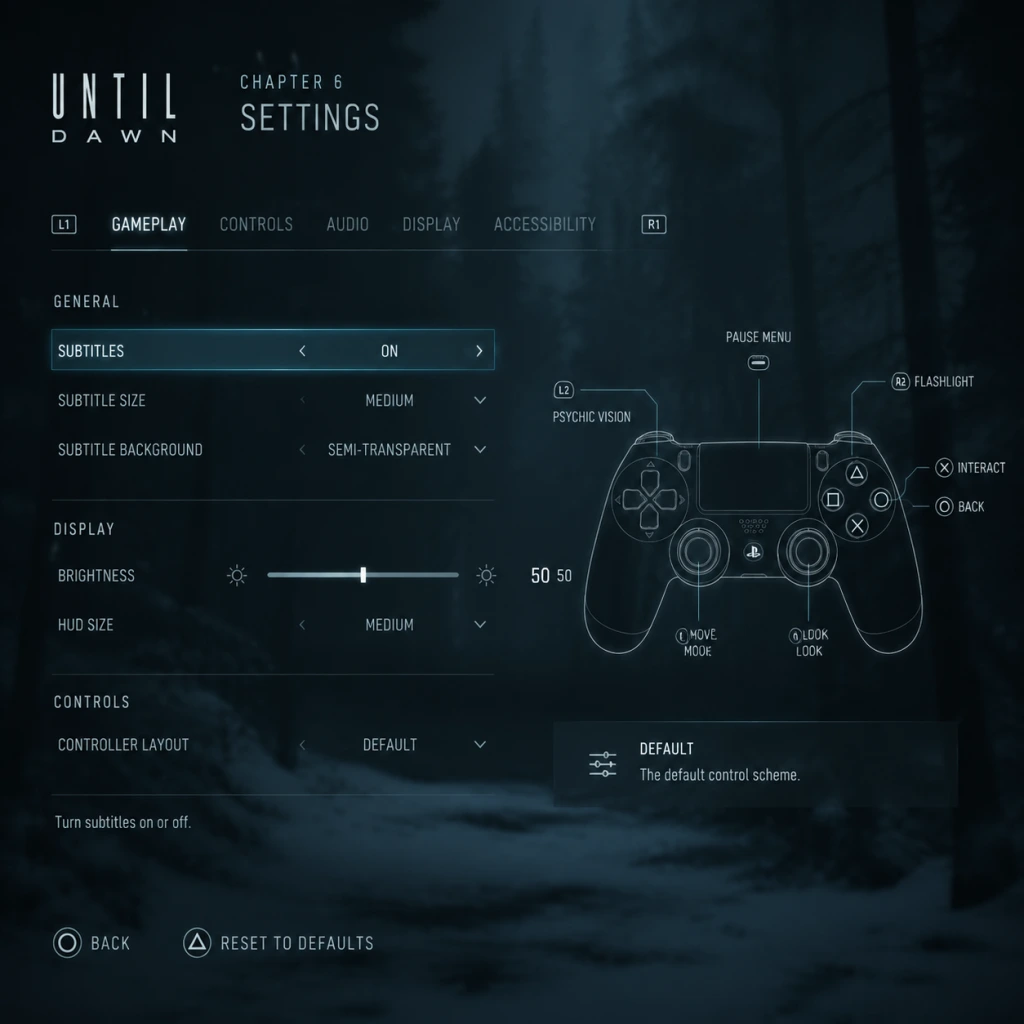
- Subtitles – On/Off. Recommend ON for non-native speakers or low volume play.
- Invert Look – On/Off. Default Off.
- Controller Vibration – Intensity: Off, Low, High. Keep at High for immersion; feedback from heartbeats and tremors is useful.
- Controller Speaker – On/Off (PS4 only). On gives audio from the controller (e.g., phone calls). Can be distracting; Off recommended for clarity.
- Key Bindings – Fully rebindable. Default follows standard WASD, mouse look, E for interact, Space for run, Shift for sprint (walk toggle).
- Mouse Sensitivity – Slider. Default 5/10. Adjust to your comfort; lower for precision during totems and QTEs.
- Invert Mouse Y – Off by default.
- Controller Support – Full support for Xbox, PlayStation, and generic controllers. Recommended for the cinematic feel, as the game was designed for controller.
- Subtitle Size – Small, Medium, Large. Set to Large for better readability on TV or small screens.
- Subtitle Background – None, Light, Dark. Use Dark for high contrast.
- Colorblind Modes – Protanopia, Deuteranopia, Tritanopia. Affects button prompts and totem colors. Activate if needed.
- QTE Timing Mode – Normal, Generous. Crucial setting for QTE difficulty. Generous doubles the timer. Recommended for players with slower reaction times or first playthrough.
- Hold vs Tap – For interactions, you can set to Hold (hold button) or Tap (press once). Hold reduces accidental actions.
- Screen Shake – On/Off. Off reduces motion sickness during explosions or falls.
- Auto-Ready Weapon – On/Off. Controls whether the aiming reticle appears automatically when danger is near.
- In-Game Text – Choose interface language separately from audio.
- Audio Language – As mentioned in Audio section.
- Subtitles – Match audio language or display a different language for subtitles (e.g., English audio with French subtitles).
- Online Features – Enable/disable. Allows sharing of "Butterfly Effect" choices to load community stats (optional). Disable if you have strict privacy concerns.
- Leaderboards – For some minigames (e.g., collectible races) – can be disabled.
- Auto-Sync Cloud Saves – PS5 and PC via cloud service. Keep enabled to avoid losing progress.
- QTE Timing Mode (described in Accessibility) – This effectively serves as difficulty adjustment.
- Tutorial Hints – On/Off. Off removes on-screen hints after the first few chapters.
- Totem Vision – On/Off. Totems are collectibles that show future events. Off disables their glow, making them harder to find but more immersive.
- Preset: Low, then manually set Textures to Medium (if VRAM allows) and Post-Processing to Low.
- Disable Motion Blur and Film Grain for clarity.
- Target 30 FPS stable.
- Preset: Medium, adjust Textures to High, Shadows to Medium, and Volumetric Lighting to Medium.
- Enable TAA anti-aliasing.
- Motion Blur OFF for QTE readability.
- Target 60 FPS at 1080p; 30–40 FPS at 1440p.
- Preset: High, then set Textures to Ultra, Shadows to High, Reflections to High.
- Keep Motion Blur OFF.
- Enable VSync (or G-Sync).
- Target 60 FPS stable.
- Preset: Ultra, enable all options at max.
- You can safely turn Motion Blur ON for cinematic feel, but be aware of QTE risks.
- Use DLSS (if available) or TAA for upscaling.
- Target 60 FPS at 4K.
> Special Attention: Motion Blur and V-Sync are two settings that can accidentally degrade gameplay. Always turn Motion Blur off until you are confident in your QTE timing. VSync should be off if using adaptive sync monitors.
---
Audio Settings
All platforms offer similar audio options.
---
Controls Settings
Control options differ between console and PC.
PlayStation (PS4/PS5) – Default Controls
PC – Keyboard & Mouse
> Special Attention: Quick-Time Events (QTEs) require fast button presses. If using keyboard, consider rebinding QTE actions (e.g., F or Space for mash prompts) to a comfortable key. Many players prefer a controller to avoid keyboard mash fatigue.
---
Accessibility Settings
Until Dawn offers several accessibility features.
---
Language Settings
---
Network Settings
Until Dawn has no traditional multiplayer. Network options are limited:
---
Gameplay Settings
Unlike many modern games, Until Dawn has no difficulty slider. The only gameplay-altering setting is:
---
Special Attention Points During Setup
1. Motion Blur – Turn it OFF. It reduces visual clarity during QTE prompts, causing missed inputs. The game's filmic look is preserved anyway through cinematic camera cuts.
2. QTE Timing Mode – Set to Generous if you are not confident in quick reactions. The game does not warn you about this setting; many players miss it and struggle unnecessarily.
3. Audio Output – If using a TV's built-in speakers, set to Stereo. Headphone users should select 'Headphones' for spatial audio. Incorrect setting can make whispers in the distance sound flat.
4. Controller vs Keyboard – The game was designed for a controller. QTEs use face buttons (X, Square, Circle, Triangle) and analog stick waggles. On keyboard, rebind button prompts to intuitive keys (e.g., J, K, L, ;) to avoid fumbling.
5. FOV on PC – Stick to default 80. Higher FOV can cause fisheye distortion due to the fixed camera angles in the game; the game already handles perspective via cinematography.
6. Cloud Saves – Ensure cloud sync is ON, especially on PC. The game has multiple branching paths; losing a save can mean replaying hours.
7. HDR (PS5 and PC) – If your display supports HDR, enable it in the system settings (not in-game; the game respects Windows HDR toggle). HDR enhances the dark snowy scenes and torch-light, but requires proper calibration to avoid crushed blacks.
---
Conclusion
By adjusting these settings to your platform and hardware, you can enjoy Until Dawn with optimal performance, clear audio, and responsive controls. Remember that the game's atmosphere relies heavily on sound and visual cues—never compromise dialogue volume or disable subtitles if you want to follow the story fully. Start with the recommended presets, then tweak based on your system's capability and personal comfort.
Important Notes
Important Notes for Until Dawn
⚠️ Warnings and Pitfalls
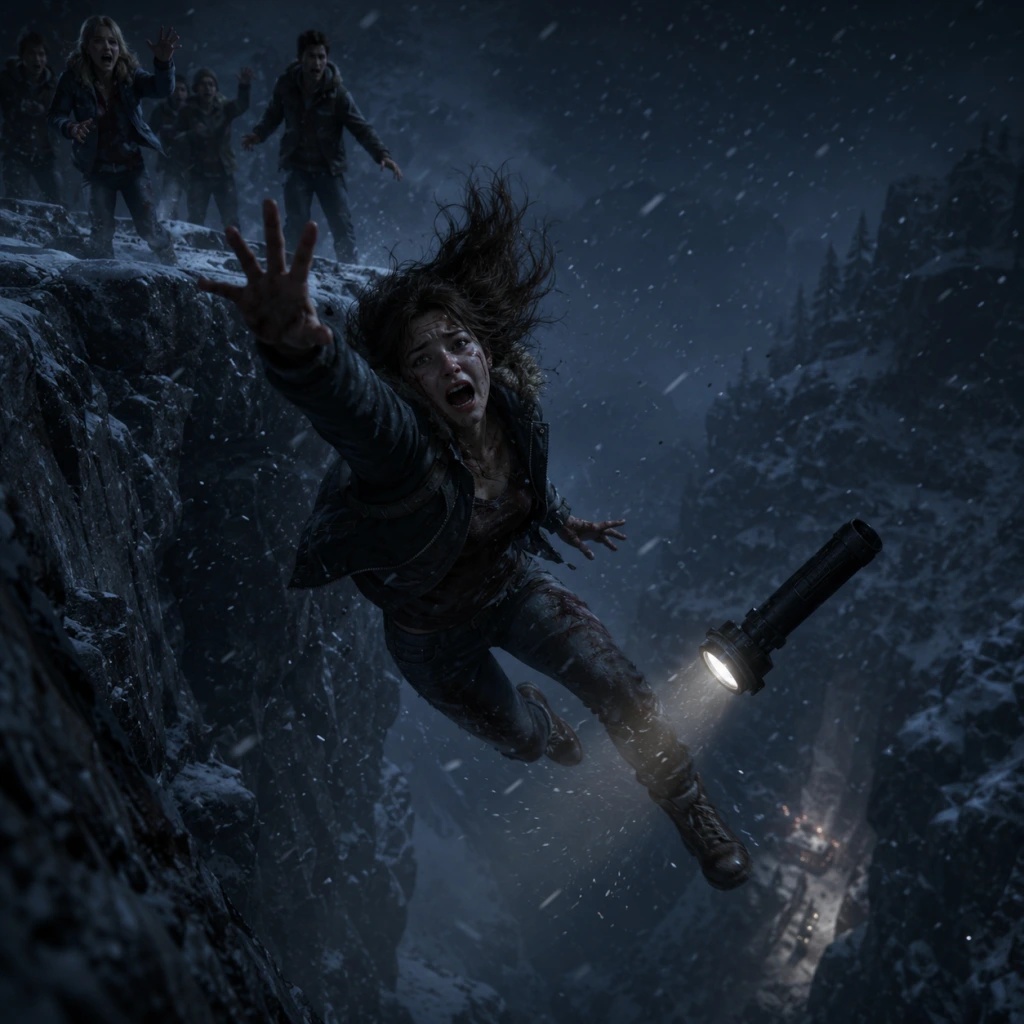
- Permanent Character Deaths: Any character can die permanently based on your choices and quick-time event (QTE) performance. Once a character dies, they are gone for the rest of the playthrough. There is no resurrection or save-scumming (unless you manually reload a save in the 2024 remake).
- No Manual Saves in Original (PS4): The 2015 original Until Dawn uses a single auto-save slot. You cannot create manual saves, and leaving the game mid-chapter will restart you at the last checkpoint. The 2024 remake (PS5/PC) adds multiple manual save slots—use them strategically before critical decisions.
- QTEs Can Be Brutal: Quick-time events require precise timing. Miss a prompt (or hit the wrong button) and a character may die or suffer a permanent injury that affects later scenes. Keep your controller (or keyboard/mouse) ready at all times.
- Don’t Rush to Save Everyone First Playthrough: The game is designed for multiple playthroughs. Trying to save everyone on your first run is extremely difficult because many choices have hidden consequences. Enjoy the story and accept that some characters may die.
- Motion Controls (PS4/PS5): In the original PS4 version, some QTEs require holding the controller still (DualShock 4 gyro). If you have motion controls enabled, sudden movement can fail the prompt. Disable motion controls in settings (if available) or place the controller on a flat surface when not moving.
- Psychological Horror Elements: The game contains intense jump scares, graphic violence, and disturbing themes (suicide, gore, mental illness). If you are sensitive to such content, consider lowering the volume or playing with a friend.
###
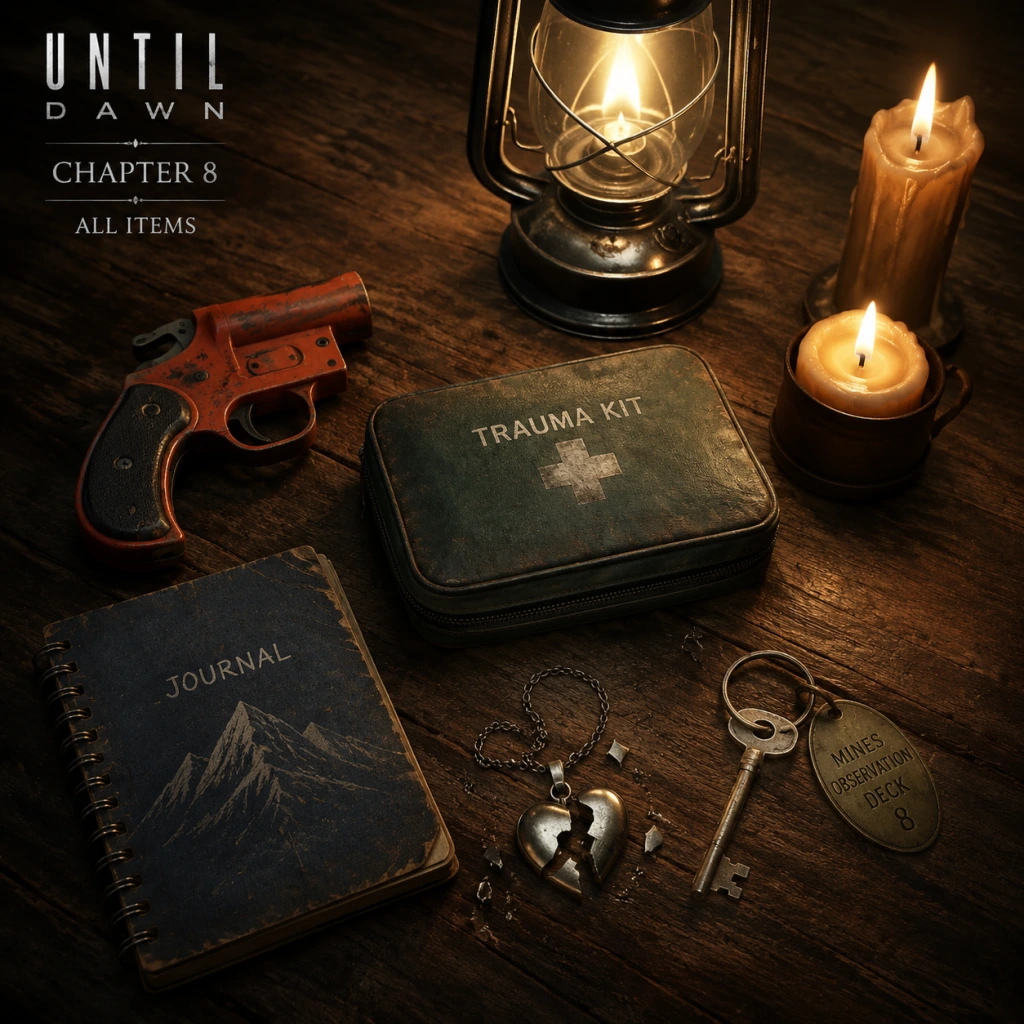
All Game Items
Comprehensive All Game Items Guide for Until Dawn
Until Dawn is a narrative-driven horror game where your choices and quick-time events determine the fate of eight teenagers. While the game lacks a traditional loot system, it features a variety of key items, weapons, consumables, and collectibles that influence the story, unlock clues, and affect survival. This guide lists every major item, explains its purpose, how to obtain it, and when it becomes useful.
---
1. Weapons and Tools
These items allow characters to defend themselves or interact with the environment. Most are found during exploration or given through story events.
| Item | Character(s) | How to Obtain | Use / Effect | Important Notes |
|---|---|---|---|---|
| Hunting Knife | Mike (Chapter 6) | Found in the Wolf's den near the sanatorium. | Used by Mike in a QTE to kill a Wendigo attacking the wolf. | If missed, the wolf may not survive to help later. |
| Shotgun | Emily (Chapter 4), Mike (Chapter 6) | Emily finds it in the cable car station. Mike can pick it up later from the same spot. | Can be fired to kill a Wendigo (in Mike's case) or used to threaten others. | Ammo is limited; using it unwisely can lead to death. One shot available. |
| Flare Gun | Matt | Found in the fire tower (Chapter 6) if Matt explores the right area. | Can be fired to signal for help or scare off an attacker. Saves Matt from falling if used correctly. | If not found, Matt will have fewer survival options. |
| Baseball Bat | Ash / Chris (Chapter 5) | Found in the lodge basement by Ashley. | Used to break a locked door in the basement to rescue Josh (fake). | A simple tool with no combat use; story progression. |
| Scissors | Jessica | Found in the bedroom of the cabin (Chapter 2) if Jess looks carefully. | Can be used to cut the rope when escaping the cabin if the player chooses that QTE. | Only useful for a single escape sequence. |
| Syringe / Drugs | Emily / Mike | Found in the infirmary (Chapter 4) by Emily or later by Mike. | Contains a sedative; used by Mike to incapacitate the wendigo-like creature (actually Josh) in the shed. | Key to revealing the identity of the "psychopath." |
| Pipe | Mike | Found in the sanatorium (Chapter 6) as a wrench or pipe piece. | Used to turn off the fire sprinklers or to pry open a door. | Not a weapon, but a tool for solving environment puzzles. |
| Gas Can | Mike (Chapter 7) | Found in the garage after the wendigo chase. | Used to explode the building (optional) to kill wendigos. | The can must be thrown and shot with the shotgun to create an explosion. |
| Flashlight | Various | Automatically equipped when entering dark areas. | Illuminates paths; can attract wendigos if used carelessly. | Essential for navigation; wendigos are drawn to light. |
2. Key Items (Plot Progression)
Items that must be collected to advance the story or unlock specific scenes.
| Item | Description | Location | Importance |
|---|---|---|---|
| Josh's Phone | A smartphone found in the basement. | Chapter 8, after the reveal. | Used to call for help and escape the mines via the grate. |
| Gold Hairpin | Beth's hairpin found by the cliff. | Prologue (Hannah/Beth) or Chapter 1 (if revisited). | Used to unlock the desk drawer in the old lodge, revealing a secret diary. |
| Rope | A coil of rope in the cabin. | Chapter 2 (cabin) or later in the mines. | Required to descend into the depths or climb down cliffs. |
| Explosives | Dynamite sticks stored in the mine. | Chapter 9 (mines). | Used to blow up the entrance to the wendigo lair, preventing escape. |
| The Book / Journal | A document detailing the wendigo curse. | Found in the stranger's hut (Chapter 6). | Provides backstory and clues about how to stop the wendigos. No direct gameplay effect. |
| Keys | Various keys (e.g., to the car, to the shed). | Scattered through chapters. | Open locked doors or containers, leading to items or safety. |
3. Consumables and Healing Items
Until Dawn does not have health bars; instead, damage leads to character death based on choices. However, there are a few temporary-use consumables.
| Item | Effect | Found | Notes |
|---|---|---|---|
| Pill Bottle (Painkillers) | Emily can take pills to calm her heart rate after being chased. | Infirmary cabinet. | Not required; a narrative choice affecting panic level. |
| Cherry Bomb | A distraction device. Can be thrown to divert a wendigo. | Found in a drawer in the lodge (Chapter 3). | Only useful in a single QTE sequence with Chris and Ash. |
| Snack Bar | Provides a temporary morale boost? No real effect. | Various drawers. | Purely flavor item. |
4. Currencies and Materials
There is no traditional currency in Until Dawn. Items are found and used at specific moments. No crafting system. The closest to "materials" are metal parts used to create traps (only in one branching path).
| Item | Use | Location |
|---|---|---|
| Metal Scrap | Can be used to repair the elevator cable or build a trap to catch a wendigo. | Found in the garage and near the mine entrance (Chapter 7–8). |
5. Collectibles (Totems and Clues)
These do not have direct gameplay effects but influence the story and forewarn the player about future events. They are divided into Totems and Clues.
#### 5.1 Totems
Totems are carved wooden tokens that show a brief vision of a possible future. They are color-coded by type. Finding all totems in a group unlocks the "All Totems" trophy/achievement.
| Color | Meaning | Example Vision |
|---|---|---|
| White (Death) | Shows a character's potential death. | A picture of a character impaled on antlers. |
| Black (Loss) | Shows a character losing something important (e.g., a weapon or a friend). | A figure dropping a gun. |
| Yellow (Fortune) | Shows a favorable outcome if the correct choice is made. | A character smiling after a decision. |
| Red (Danger) | Warns of immediate peril (e.g., QTE failure). | A hand reaching out to grab someone. |
| Blue (Guidance) | Gives a hint for solving a puzzle or escaping. | A character looking at a map. |
#### 5.2 Clues
Clues are documents, photos, or objects that reveal backstory and foreshadowing. There are over 100 in total. Key examples:
| Clue | Type | Relevance |
|---|---|---|
| Hannah's Diary | Journal entry (found in the drawer unlocked with the hairpin). | Reveals that Hannah was in love with Mike and was pranked. |
| The Wendigo Drawing | Sketch (found in the mines). | Shows the transformation process; hints at the monster's weakness. |
| Stranger's Notes | Handwritten notes (found in the hut). | Explain the history of the wendigo curse and how to kill them (fire). |
| Photo of the Twins | Photo (found in the lodge). | Shows Beth and Hannah; triggers memories. |
| Severed Head | Human remains (found in the mines). | Confirms that wendigos eat human flesh and can be killed by decapitation. |
| The Prank Video | Recording of the prank on Hannah (found in the cable car station). | A major clue that explains why Hannah and Beth ran into the forest. |
| Police Report | Official document (found in the station). | Mentions the missing girls and the suspicious deaths on the mountain. |
---
6. Special Items (Butterfly Effect Triggers)
Certain items directly affect the branching story paths (the "Butterfly Effect").
| Item | Character | Action | Consequence |
|---|---|---|---|
| The Coin | Matt / Emily | Found on the floor of the cable car station. | Can be used to distract the deer or thrown to make noise; can save or doom characters. |
| The Fire Poker | Ash | Found near the fireplace in the lodge. | Used to defend against an attacker; if used at the wrong time, can cause a death. |
| The Space Keychain | Found by Mike in the laundry room. | Triggers a memory of Hannah; no gameplay effect but ties to the story. | |
| The Santa Hat | Found in the attic. | A joke item; can be put on as a disguise (optional) leading to a comedic scene. |
7. Environmental Interactions (Quasi-Items)
These are not inventory items but objects in the world that the player can use for specific actions.
| Object | Use |
|---|---|
| Windows | Can be smashed to escape a room or create an opening. |
| Doors | Can be locked or unlocked; essential for defense. |
| Light Switches | Can be flipped to turn on lights, which may attract or repel enemies. |
| Generators | Can be turned on to restore power to areas. |
| Heating Vents | Can be closed to prevent wendigos from using them as passages (strategic). |
8. Important Synergies and Upgrades
Since the game does not have upgrades, synergies come from combining items with choices:
Shotgun + Gas Can = Explosion: If Mike carries both, he can blow up the sanatorium, killing many wendigos.
Flare Gun + Matt: The flare gun can save Matt from being pulled off a cliff if fired at the right moment.
Scissors + Jessica: If Jess has the scissors, she can cut the rope to escape; without them, she must wait for Mike.
Hairpin + Desk Drawer: Unlocks the diary clue.
Metal Scrap + Trap: Setting a trap for a wendigo requires the scrap and a correct repair sequence.
---
9. Missable Items and Tips
Because Until Dawn is linear, items can be permanently missed if not picked up in their chapter.
Flare Gun: Only available in Chapter 6 if Matt explores the fire tower.
Hairpin: Collect during the prologue or return in Chapter 1; if missed, the diary cannot be opened.
Syringe: Must be taken from the infirmary in Chapter 4 to later drug Josh.
Scissors: Easily missed in the bedroom; check the drawer.
Cherry Bomb: Only appears if you investigate the lodge desk in Chapter 3.
Pro Tip: Use a collectible guide to avoid missing clues and totems, especially for trophy hunters.
---
10. Summary Table: Items by Category
| Category | Examples | Purpose |
|---|---|---|
| Weapons | Hunting Knife, Shotgun, Flare Gun | Combat and defense |
| Tools | Rope, Pipe, Gas Can | Environment interaction and puzzle solving |
| Key Items | Phone, Hairpin, Explosives | Story progression |
| Consumables | Pills, Cherry Bomb | Temporary effect (rare) |
| Collectibles | Totems, Clues | Lore and achievements |
| Butterfly Items | Coin, Fire Poker | Branching consequences |
This guide covers all major items in Until Dawn. Remember that the game prioritizes story over inventory, so most items serve narrative or quick-time purposes. Use them wisely to keep your characters alive.
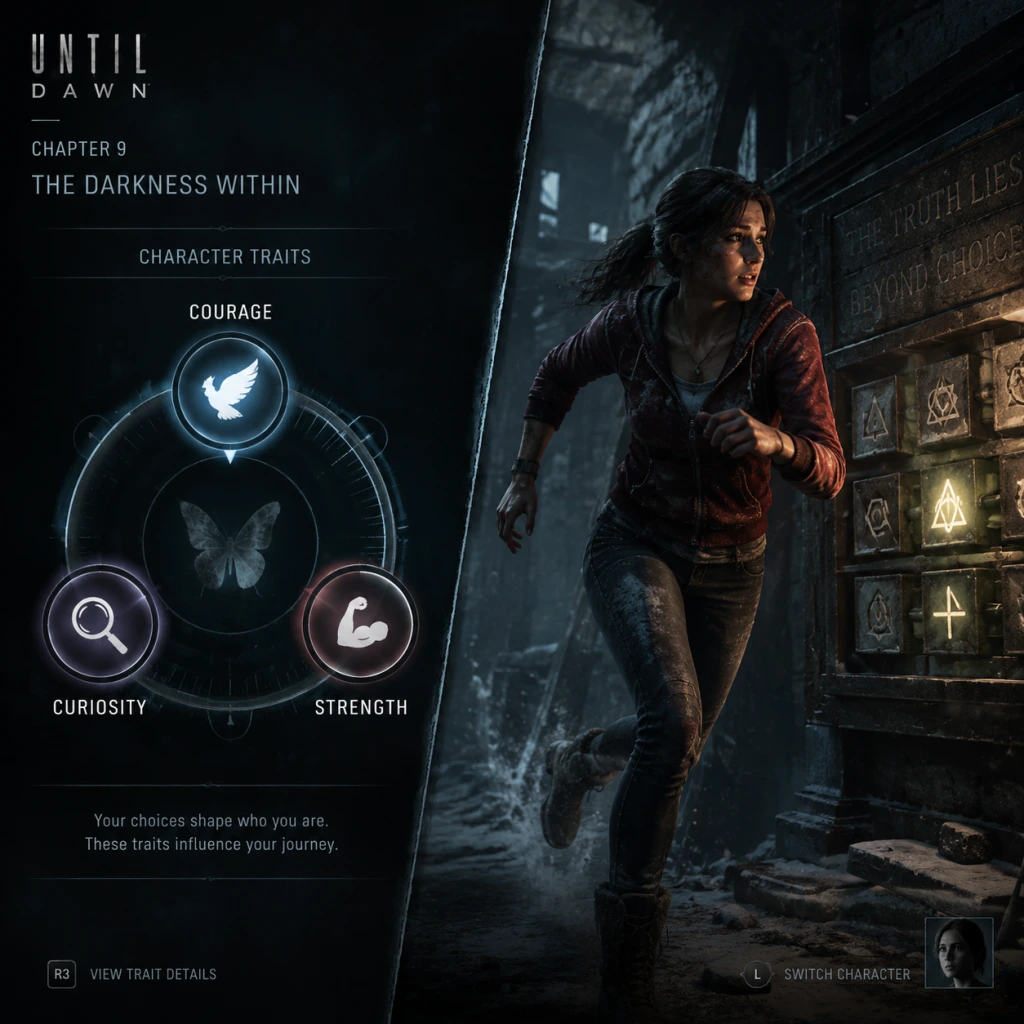
Character Skills
Character Skills Guide for Until Dawn
Until Dawn is primarily a narrative-driven interactive drama, not a traditional RPG with skill trees or cooldowns. However, each of the eight playable characters possesses unique innate traits that influence their effectiveness in certain gameplay situations—quick‑time events (QTEs), stealth sections, chase sequences, and dialogue choices. Understanding these implicit ‘skills’ helps you make optimal decisions and keep characters alive.
This guide covers all playable protagonists: Sam, Mike, Ashley, Chris, Emily, Jessica, Matt, and Josh (though Josh’s role is mostly non‑interactive). Each entry lists:
- Character Role – Their archetype in the group.
- Innate Traits – Passive strengths/weaknesses (movement speed, stealth, strength, intelligence, etc.).
- Special Abilities – Unique actions or reactivity (e.g., Sam’s stealth, Mike’s gun proficiency).
- Situational Skills – How to leverage these traits during key scenes (chases, hiding, confrontations).
- Synergy Notes – How their skills interact with totems, butterfly effects, or other characters.
- Role: The Protagonist / Last Girl
- Innate Traits: Highest stealth (moves silently), moderate speed, excellent endurance (can hold breath longer), low strength.
- Special Ability: Hold Breath – Sam can remain completely still without making a sound. Use this when the wendigo or the psycho is searching nearby. The game tracks how long you can hold it; Sam lasts longer than any other character.
- Situational Skills:
- When to Use:
- Synergy: Collecting The Stranger’s Journal and Bird Totems gives Sam premonitions that directly help her survival (e.g., knowing where to run).
- Role: The Action Hero / Leader
- Innate Traits: High strength, moderate speed, good with firearms, poor stealth (heavy footsteps).
- Special Ability: Firearm Proficiency – Mike is the only character who can wield the flare gun and later the hunting rifle effectively. He has a smaller aim reticle and faster bullet travel time.
- Situational Skills:
- When to Use:
- Synergy: Pair Mike’s loud, aggressive style with Sam’s stealth in the final lodge; Mike can draw the wendigo’s attention while Sam flanks.
- Role: The Scholar / Researcher
- Innate Traits: High perception (notices hidden clues, totems, and environmental details), low physical stamina, slow speed, poor combat.
- Special Ability: Sharp Eye – When exploring, Ashley automatically highlights interactive objects (books, photographs, lore items) with a faint glow. This does not appear for other characters.
- Situational Skills:
- When to Use:
- Synergy: Combine Ashley’s perception with Emily’s survival knowledge; if both are alive, they unlock optional dialogue about the wendigo’s weakness.
- Role: The Comic Relief / Smart Aleck
- Innate Traits: Moderate speed, low strength, decent agility (climbing, vaulting), but clumsy (more QTE failures if rushed).
- Special Ability: Quick Wit – Chris can use sarcasm or humor to defuse tense social situations, occasionally opening unique dialogue options that improve relationship scores.
- Situational Skills:
- When to Use:
- Synergy: Chris’s Quick Wit works best when paired with Ashley (they have strong rapport), turning potentially fatal choices into safer outcomes.
- Role: The Resourceful Survivor / Girlfriend
- Innate Traits: High agility, moderate strength, excellent speed (fastest sprinter), low stealth (stumbles loudly).
- Special Ability: Agile Escape – Emily can slide under obstacles and squeeze through tight spaces that other characters cannot. This is scripted in certain chase scenes.
- Situational Skills:
- When to Use:
- Synergy: Emily’s speed and climbing ability complement Mike’s brute force; if you need to cover ground quickly, switch to Emily.
- Role: The Popular Girl / Victim
- Innate Traits: High charisma (affects dialogue checks), very low physical stats (slow, weak, clumsy), poor stealth.
- Special Ability: Persuasive Charm – Jessica can sway opinions or calm others down in tense social scenes, reducing the chance of group conflict.
- Situational Skills:
- When to Use:
- Synergy: Jessica’s charisma works best when Matt is nearby; his protective nature amplifies her persuasion checks.
- Role: The Jock / Protector
- Innate Traits: High strength (on par with Mike), high endurance (can take hits), moderate speed, low intelligence (fewer research options).
- Special Ability: Protective Instinct – Matt has a chance to automatically defend another character if a QTE prompt appears (e.g., catching Jessica from falling). The chance increases if his relationship with that character is high.
- Situational Skills:
- When to Use:
- Synergy: Matt’s Protective Instinct is most effective when paired with Jessica; using them together increases survival odds for both.
- Role: The Mastermind / Antagonist (Limited Playability)
- Innate Traits: Extremely high intelligence, low physical stats, no combat ability.
- Special Ability: Manipulative Genius – As the psycho, Josh can trap other characters by exploiting their fears. During his scenes (Chapters 2–6), he sets up elaborate pranks.
- Situational Skills:
- When to Use:
- Synergy: Josh’s knowledge of the twins’ disappearance ties directly to the totems and the Stranger’s journal—collecting these before playing as Josh unlocks bonus dialogue.
- How to Use: When a totem is found, the vision is saved. During critical QTEs or choices, the vision may apply. For example, a Danger Totem showing a character dying in a certain room prompts you to avoid that location.
- Recommended Build: Collect every totem with Ashley (her sharp eye skill) to maximise opportunities. Then replay scenes with the knowledge to avoid deaths.
> Note: There are no cooldowns, upgrades, or traditional combos. “Skills” are fixed from the start; player choices determine when they are used.
---
Sam
- Stealth Movement: In the lodge basement or sanatorium, walk (don’t run) to avoid detection. Sam’s footsteps are naturally quieter.
- Panic Handling: Sam’s QTE prompts are slightly easier to succeed if she stays calm (i.e., not spamming buttons randomly).
- The entire final sequence in the lodge (Chapter 10).
- Any scene where you need to avoid a monster without fighting.
---
Mike
- Strong QTE: Mike can break down doors, push heavy objects, and restrain enemies more reliably than others.
- Distraction: He can yell or throw objects to lure enemies away (works well in the sanatorium).
- Chapters 3–9, especially the sanatorium and the mine tunnels.
- Any confrontation with the psycho or wendigo where a direct approach is possible.
---
Ashley
- Investigating Secrets: Ashley finds the most totems and backstory clues.
- Reading Aloud: She can read notes or diary entries quickly, giving the player more time to decide.
- Chapters 1–5, especially the basement, attic, and library.
- Any moment you want to maximize lore or totem collection.
---
Chris
- Vaulting: Chris can climb over fences and obstacles faster than most.
- Throwing Objects: He is adept at throwing snowballs or stones to distract enemies (wider arc than other characters).
- Chapters 4–6, where he is often separated and must navigate traps.
- When you want to lighten a tense moment (e.g., with Ashley).
---
Emily
- String Pulling: In the mine (Chapter 9), Emily has to balance on girders—her agility makes these QTEs easier.
- Panic Run: When chased, Emily can maintain top speed for longer than others.
- Chapter 9 (the mine sequence) is her showcase.
- Any scene requiring rapid movement over obstacles.
---
Jessica
- Flirting: Jessica can use charm to distract male characters (Josh, Mike) in timed dialogue.
- Screaming: Her scream is a double‑edged sword—it attracts enemies but also alerts allies to her location.
- Chapter 4 (cabin scene) and any later dialogue with the group.
- Use charm to avoid fighting with Emily or Ashley.
---
Matt
- Forcing Doors: Matt can break down locked doors with fewer QTEs than others.
- Carrying: He can carry injured characters (like Jessica) without slowing down significantly.
- Chapters 6–8, when helping Jessica or breaking into the sanatorium.
- Any situation requiring physical strength without a weapon.
---
Josh (The Psycho)
- Setting Traps: When playing as Josh in flashback chapters, you can choose trap locations that affect later events.
- Acting: Josh can feign emotions to deceive others.
- Only during the prologue and Chapter 4 (the psycho reveals).
- Use his intelligence to craft the most effective prank to scare the other characters.
---
Totems as Skill Enhancements
Though not character skills, the totems (Curiosity, Guidance, Death, Danger, Loss) function as premonition abilities. Each totem shows a vision of a future event. Understanding the totem type allows you to adjust your character’s actions accordingly. This acts like a “foresight” skill.
---
Recommended Builds (Playstyle Tips)
Since you cannot level up characters, “builds” refer to which characters you prioritise keeping alive and using in key scenarios.
| Playstyle | Primary Character | Secondary Character | Rationale |
|---|---|---|---|
| Stealth Survival | Sam | Ashley | Use Sam for all avoidance sequences; Ashley to discover totems that reveal safe paths. |
| Brute Force | Mike | Matt | Mike handles combat; Matt provides backup strength. Avoid using in stealth sections. |
| Lore Master | Ashley | Emily | Ashley finds clues; Emily’s survival knowledge unlocks deeper backstory. |
| Socialite | Jessica | Chris | Jessica charms others; Chris uses humor to keep group morale high. |
Final Tips
- No single “best” skill: Each character’s abilities are situational. Switch between characters via the butterfly effect to use the right skill at the right time.
- Death = Loss of Skills: If a character dies, you lose access to their unique abilities for the rest of the game. Plan your run accordingly.
- Practice QTEs: While not a skill, mastering QTE patterns (e.g., keeping the controller still during Hold Breath) is crucial. Sam and Chris have tighter timers, so practice their sections.
By leveraging each character’s innate skills—and combining them with the foresight of totems—you can guide the entire group to safety.
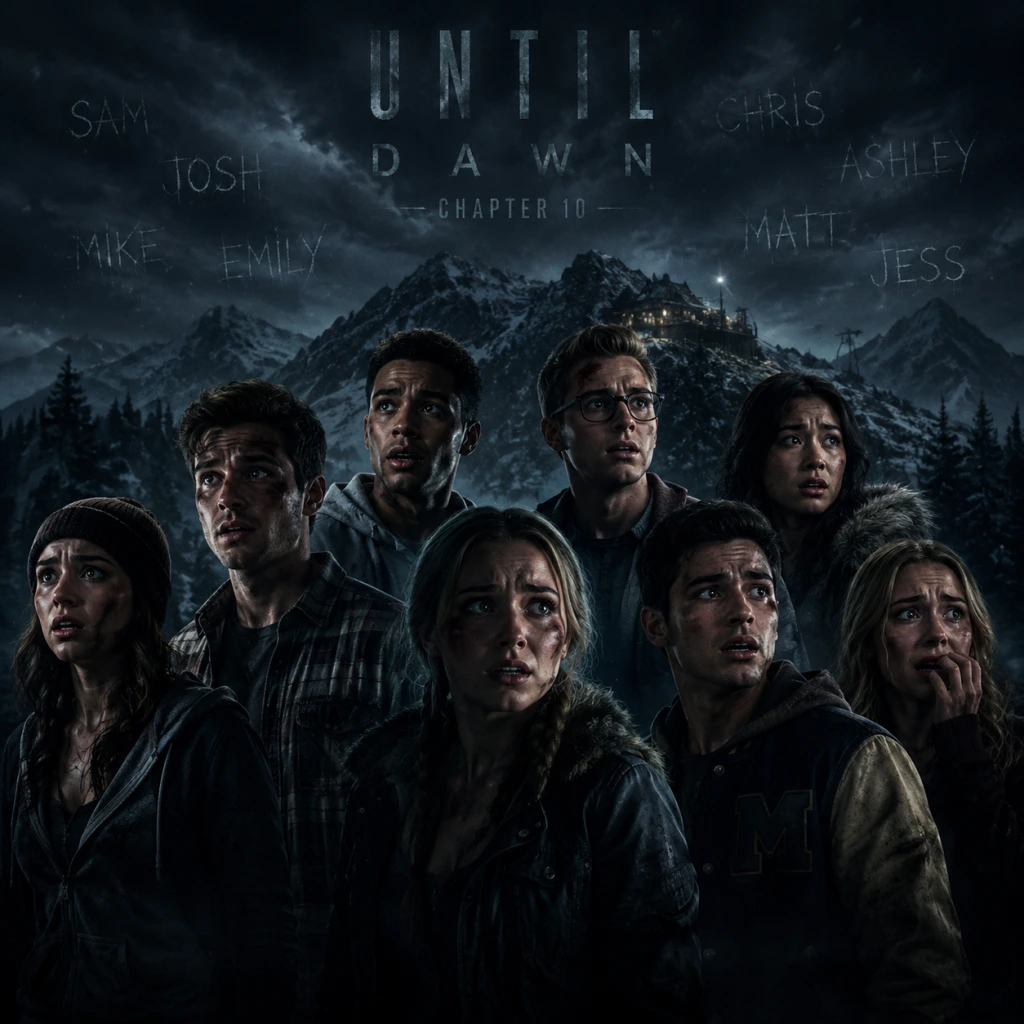
Characters & Roles
Characters & Roles Guide for Until Dawn
This guide covers all eight main playable characters in Until Dawn, detailing their backgrounds, inherent strengths and weaknesses, optimal playstyles, available chapters, recommended key items, and how they interact with each other. Note that characters cannot be unlocked or leveled up; their fates are determined entirely by player choices and quick-time events (QTEs).
---
1. Sam (Samantha Giddings)
- Background: The caring, loyal friend of the group. Sam was close to the twins Hannah and Beth and is the one who convinces everyone to return to Blackwood Mountain for the memorial. She is environmentally conscious and athletic.
- Strengths: High stealth capability; she is the fastest runner and has the best chance of hiding from enemies. Her relationship with Mike can grant bonus dialogue options.
- Weaknesses: Physically weaker in direct confrontations; she cannot fight off the wendigo easily. Her compassion can lead to risky decisions.
- Playstyle: Prioritize hiding and staying quiet. Run when necessary, but avoid combat. Use her environmental awareness to find safe paths.
- Available Chapters: Prologue (as Beth/Hannah scene), Chapter 3 (awakening), Chapter 4 (as part of group), Chapter 8 (cabin), Chapter 10 (final chase).
- Recommended Equipment/Items: The don’t-move mechanic is crucial for her survival during the final chapter. Collecting the key to the basement (Chapter 8) helps if Mike is not present. The flare gun can be used to distract or kill a wendigo, but it’s optional.
- Team Synergy: Works best with Mike when exploring the lodge. Her presence can calm him down. Avoid separating from the group if possible; if alone, emphasize stealth.
- Background: The confident, impulsive jock. Mike is wild and often acts without thinking, but he has a strong protective instinct, especially toward Jess. He was involved in the prank that led to the twins’ disappearance.
- Strengths: Bold and physically strong; capable in combat against wendigos if armed. He can take decisive actions quickly. He has a dog, Wolfie, who can help in certain chapters.
- Weaknesses: Recklessness can lead to dangerous situations. He tends to rush into danger, which can get him or others killed. His relationship with Jess influences his mental state.
- Playstyle: Aggressive – move fast, shoot when possible, and use Wolfie for distractions. Complete QTEs aggressively. In Chapter 9, the flamethrower is a game-changer.
- Available Chapters: Chapter 1 (prologue), Chapter 2 (with Jess), Chapter 3 (stranded outside), Chapter 5 (search for Jess), Chapter 6 (sanatorium), Chapter 9 (final confrontation), Chapter 10 (ending).
- Recommended Equipment/Items: Flamethrower (Chapter 9 – kills wendigos instantly). If you choose to go after Jessica in the mines, you can secure a pocket knife for her. The flare gun can be used in the sanatorium.
- Team Synergy: Pairing Mike with Sam in the lodge works well; he can cover her while she uses stealth. If Jess is alive, his concern may slow him down. Leave Wolfie behind in Chapter 9 to save him.
- Background: The bubbly, outgoing party girl. Jessica is Mike’s girlfriend and is often seen as shallow, but she shows resilience. She was part of the prank and feels guilty.
- Strengths: Quick reflexes; she can dodge and run well. Her emotional intelligence helps in dialogue choices. If she survives the initial attack, she becomes more resourceful.
- Weaknesses: Physically fragile; she is the most likely to die in Chapter 2 if QTEs are failed. She has no combat skills. Her fear makes her prone to panic.
- Playstyle: Survival mode – avoid confrontation, hide, and rely on Mike or Sam for protection. In Chapter 10, staying quiet is key.
- Available Chapters: Chapter 1 (prologue), Chapter 2 (cabin with Mike), Chapter 10 (mines) – only if she survived the cabin attack in Chapter 2 and Mike found her in Chapter 5.
- Recommended Equipment/Items: If you save her in the mines, she can find a flashlight to navigate. No weapons. Use the hide mechanic constantly.
- Team Synergy: Very dependent on Mike early on. If Mike is killed, Jess’s survival odds drop sharply. Sam can assist her in the final chapter if they meet.
- Background: The intelligent, ambitious, and somewhat manipulative former girlfriend of Matt. Emily is a planner and often tries to take control of situations. She was the mastermind behind the prank.
- Strengths: Highly analytical; she can deduce puzzles and find clues faster than others. She is a capable runner and climber. Her sharp tongue can intimidate others.
- Weaknesses: Arrogance can alienate allies; she is not very empathetic. In dangerous situations, she may prioritize self-preservation over others, leading to conflict.
- Playstyle: Proactive – search everything, solve puzzles, and use logic. In chase sequences, move quickly through QTEs. Avoid antagonizing her if you want to keep group morale high.
- Available Chapters: Chapter 1 (prologue), Chapter 3 (diner), Chapter 4 (resort), Chapter 6 (fire tower), Chapter 7 (mines), Chapter 10 (finale).
- Recommended Equipment/Items: The key to the shed (Chapter 3) gives access to a weapon. The flare gun can be used to kill a wendigo in the mines. The lantern helps in dark areas.
- Team Synergy: Works well alone; she is self-sufficient. Conflicts with Matt if they argue. She can provide useful information to the group. If Ashley is present, their rivalry can cause tension.
- Background: The quiet, loyal jock and Emily’s boyfriend. Matt is a peacemaker but often feels overshadowed. He is strong and dependable.
- Strengths: Physically powerful; he can break down doors and lift heavy objects. He is protective and will put himself in danger for others. Good at QTEs requiring strength.
- Weaknesses: Indecisive when under pressure; he may hesitate. His loyalty to Emily can cloud his judgment. He is not stealthy.
- Playstyle: Defensive – use strength to create distractions or open pathways. Support teammates by providing safety. In combat, use melee if necessary.
- Available Chapters: Chapter 1 (prologue), Chapter 3 (diner), Chapter 4 (resort), Chapter 6 (fire tower), Chapter 8 (lodge massacre), Chapter 10 (finale).
- Recommended Equipment/Items: Shotgun (Chapter 4 – if you find the key and unlock it). The flare gun can be used to save Emily in the mines. No other weapons are necessary.
- Team Synergy: Works best with Emily, though their relationship can hinder survival if they argue. He can protect weaker characters like Ashley. If separated, he is vulnerable but strong in one-on-one encounters.
- Background: The shy, bookish friend. Ashley is intelligent but anxious, often doubting herself. She has a crush on Chris and is deeply affected by the prank.
- Strengths: High perception; she can spot clues and hidden items. She is methodical and can solve puzzles. Her cautious nature can avoid traps.
- Weaknesses: Extremely easily frightened; she will panic in chase sequences. She has no combat ability. Her fear can lead to fatal mistakes if QTEs are missed.
- Playstyle: Cautious – explore thoroughly, read every note, and make safe choices. Avoid confrontation at all costs. In Chapter 9, listening carefully to the voice in the lodge can be deadly.
- Available Chapters: Chapter 1 (prologue), Chapter 3 (diner), Chapter 4 (resort), Chapter 7 (mines with Chris), Chapter 9 (lodge with Chris), Chapter 10 (finale).
- Recommended Equipment/Items: No combat items; focus on collectibles. The camera can take pictures for clues. The key to the drawer (Chapter 3) reveals a secret. Use the hide mechanic frequently.
- Team Synergy: Strong pairing with Chris; they support each other emotionally. If left alone, she is at high risk. Sam can help calm her.
- Background: The witty, loyal best friend of Josh. Chris is a comedian and the moral compass of the group. He has a crush on Ashley but is also protective of Josh.
- Strengths: Resourceful; he can use tools and improvise. He is a good shot with a gun if necessary. His humor can diffuse tense situations.
- Weaknesses: Not very athletic; he gets tired quickly in chases. His loyalty can make him a target. He is indecisive when forced to choose between friends.
- Playstyle: Balanced – use dialogue to build trust, then act decisively. In combat, use firearms but conserve ammo. Help Ashley and Josh when needed.
- Available Chapters: Chapter 1 (prologue), Chapter 3 (diner), Chapter 4 (resort), Chapter 7 (mines with Ashley), Chapter 9 (lodge with Ashley and Josh), Chapter 10 (finale).
- Recommended Equipment/Items: Pistol (Chapter 9 – if you choose to take it). The ax (Chapter 7) can break obstacles. No specific armor.
- Team Synergy: Perfect partner for Ashley; they work well together. He can also support Josh by refusing to play along with the psycho trap. Avoid leaving him alone in the dark.
- Background: The charismatic, troubled mastermind behind the prank. Josh is the older brother of the twins Hannah and Beth. He suffers from severe mental illness due to grief and guilt. He is not a typical playable character.<!-- Until Dawn -->
- Strengths: Intelligent and manipulative; he knows the mountain’s secrets. He can set traps and control situations. He has knowledge of the wendigo.
- Weaknesses: Unstable; his mental state deteriorates throughout the night. He cannot be fully controlled for long. He is physically weak and prone to breakdowns.
- Playstyle: Not directly playable except for brief segments (Chapter 5 as Josh’s “psycho” disguise, Chapter 10 as the “stranger”). The player controls him only in cutscenes or limited interactions. His survival depends on choices made by others.
- Available Chapters: Chapter 1 (prologue), Chapter 4 (meeting the group), Chapter 5 (as the psycho), Chapter 6 (reveal), Chapter 8 (in the shed), Chapter 10 (finale).
- Recommended Equipment/Items: None applicable; his fate is sealed by the end. If he is left in the shed with Hannah (a wendigo), he will be killed. The diary (Chapter 8) can be found to understand his motives.
- Team Synergy: Works as an antagonist/ally hybrid. His actions affect relationships between other characters. If the group forgives him, they may help him survive, but it is difficult.
---
2. Mike (Michael Munroe)
---
3. Jessica (Jessica Riley)
---
4. Emily (Emily Davis)
---
5. Matt (Matthew “Matt” Grimes)
---
6. Ashley (Ashley Brown)
---
7. Chris (Christopher “Chris” Hartley)
---
8. Josh (Joshua “Josh” Washington)
---
Summary Table
| Character | Role | Strengths | Weaknesses | Key Chapters | Best Survival Strategy |
|---|---|---|---|---|---|
| Sam | Stealth Runner | Speed, hide | Weak in combat | 4, 8, 10 | Stay quiet, avoid combat |
| Mike | Aggressive Attacker | Combat, leadership | Reckless | 2, 5, 6, 9 | Use flamethrower, move fast |
| Jessica | Fragile Survivor | Reflexes | Extremely weak | 2, 10 | Stay hidden, rely on others |
| Emily | Analytical Puzzle Solver | Intelligence, climbing | Arrogant | 3, 6, 7 | Solve puzzles, run when chased |
| Matt | Strong Defender | Strength, protection | Indecisive | 4, 6, 8 | Use shotgun, support group |
| Ashley | Cautious Explorer | Perception, caution | Easily frightened | 3, 7, 9 | Hide, read clues, avoid traps |
| Chris | Balanced Support | Improvisation, shooting | Low stamina | 7, 9, 10 | Use gun, protect Ashley |
| Josh | Mastermind (Limited) | Knowledge, manipulation | Unstable | 5, 6, 8, 10 | Forgiveness from group, but doomed |
Final Tips for Team Composition
- No fixed classes – each character’s fate is tied to player choices, not stats. However, understanding each character’s innate traits helps make better decisions.
- Synergy matters – keeping characters together (e.g., Chris+Ashley, Mike+Sam) improves survival odds. Splitting up often leads to deaths.
- The only way to “unlock” a character’s full potential is to keep them alive and make choices that align with their strengths. For example, letting Mike take the flamethrower makes him nearly invincible; letting Sam use her stealth saves her in the final chase.
- Remember: Every character can die permanently. No character is essential to complete the game, but their deaths affect the story ending and trophy unlocks.
Cheats & Secrets
Cheats & Secrets Guide for Until Dawn
No Traditional Cheat Codes
Until Dawn does not include any standard cheat codes, console commands, or unlock codes that grant invincibility, infinite items, or skip chapters. The game is a narrative-driven interactive drama where player choices and quick-time events (QTEs) determine outcomes. However, the developers at Supermassive Games intentionally layered numerous Easter eggs, hidden secrets, and alternative story paths that act as the game's true hidden content.
Secret Commands & Hidden Features
#### The "Don't Move" Glitch Exploit (Legal Use)
While not a cheat, players can exploit a known behavior: during "Don't Move" segments (where you must hold the controller perfectly still), you can place the controller on a flat surface or set it down gently. This is a legitimate strategy and not considered cheating—it simply bypasses the motion control challenge. The game does not penalize this.
#### Changing Save Files to Revisit Chapters
On PlayStation 4/5, you can manually copy save files from USB storage to revert to earlier chapters, effectively enabling a form of replay without restarting. This is not a developer-intended feature but is often used by players to fix mistakes or see alternative outcomes.
Easter Eggs & Hidden Content
#### 1. The Wendigo Sighting in the Prologue
In the Prologue (Chapter 1), if you look closely at the trees during the chase scene with the twins, you can spot a Wendigo briefly appear in the background. This is a hidden hint warning of the antagonist.
#### 2. The Psycho Mask Mannequin
During Chapter 2 (Sam's segment), when exploring the lodge basement, you can find a mannequin wearing the same mask as the "Psycho" (the prankster). Interacting with it triggers a line from Sam about her friend playing pranks. This is a subtle nod to the identity of the original prankster.
#### 3. The Totem That Predicts the Future
Collect all 48 totems (11 white, 11 black, 11 brown, 5 red, 10 blue, and 1 gold) to unlock each character's death vision. The gold totem—once all others are found—appears in the final chapter and shows a vision of everyone surviving. This is the only way to see the “everyone lives” outcome without guessing.
#### 4. The Stranger's Letters
Spencer Washington (the Stranger) leaves hidden journal pages and letters throughout the mines. Some contain cryptic references to future events. Reading all of them before Chapter 10 reveals a dialogue option with him that warns you about the cave’s Wendigos.
#### 5. The Balloon Animal Easter Egg
In Chapter 6 (Mike and Jessica's segment at the cabin), you can find a blue balloon animal tucked behind a pipe near Jessica’s room. Interacting with it causes Mike to say a humorous line and triggers no consequence—it's purely for laughs.
#### 6. The "No One Died" Trophy Cheat
To unlock the "They All Live" trophy without dying, you must keep all eight characters alive until the final credits. This is not a cheat but a hidden achievement. However, there is an exploit: if you finish the game and then immediately reload a chapter before any death, you can prevent it. Use the manual save backup trick mentioned above.
#### 7. The Wendigo Statue in the Asylum
During Sam's nightmare sequence (Chapter 3), there is a brief shot of a Wendigo statue inside the asylum. If you pause the game at the exact frame, you can see the name of the statue is carved with a small hint: "WEN-DI-GO" misspelled as "WEN-DI-GOW"—an intentional mistake by the developer for lore purposes.
#### 8. The Secret Ending (Until Dawn Remake Only)
In the 2024 remake for PS5 and PC, there is an optional hidden cutscene that triggers if you collect all vintage coins (25 total) and finish the game with at least one character alive. The scene shows a group of rescue workers finding a Wendigo corpse and talking about a future expedition. This was cut content from the original that was restored.
Unlockable Secrets via Trophies/Achievements
While not cheat codes, some trophies act as unlockable secrets:
| Trophy Name | Requirement | Reward |
|---|---|---|
| The Butterfly Effect | Complete the game with all characters alive | No in-game unlock, but earns Platinum on PS |
| Tell Me a Story | Find all 10 clues in the Prologue | Unlocks the storyboard concept art in the extras menu |
| Master of the Totems | Collect all 48 totems | Unlocks a gallery of all totem visions for viewing |
| The Wrong Brother | Let Josh die (Chapter 10) | Unlocks a secret developer commentary about Josh’s fate |
| Surprise! | Kill all characters in a single playthrough | Unlocks a funny outtake video in the credits |
Developer-Intended Hidden Features
#### The Radio Chatter
Throughout the game, if you interact with certain radios (e.g., in the mining facility during Chapter 9), you can trigger random audio clips of a child’s song or a news broadcast about missing hikers. These are tied to game progress and are easy to miss.
#### The Secret Package in the Basement
In Chapter 5 (Mike’s segment at the sanitarium), there is a locked metal cabinet. To open it, you must have found the key earlier (hidden under a pile of rags in a room with a wolf). Inside is a Wendigo tooth necklace that provides no gameplay benefit but adds to the lore.
#### The Wolf Petting Minigame
During Chapters 7–8 (Mike and Sam segments with the wolf), if you repeatedly pet the wolf at the right moments, the wolf will later help you during QTE sequences by biting enemies. This is a hidden relationship mechanic—no official documentation mentions it.
Important Notes About Cheats
- No external cheat devices (e.g., GameShark, Action Replay) are available for Until Dawn on PS4/PS5 or PC.
- Trainers or save editors for the PC version (2024 remake) do exist on unofficial sites, but using them violates the game's terms of service and may corrupt your save or ban your account on platforms like Steam.
- Legitimate secrets (Easter eggs, hidden items, totem collection) are the only intended ways to access hidden content.
Conclusion
While Until Dawn lacks traditional cheat codes, its rich world hides numerous secrets for observant players. Explore every nook, read every note, collect every totem, and pet every wolf to experience all the hidden content the developers carefully designed.