Core Gameplay
Core Gameplay Guide for Disco Elysium
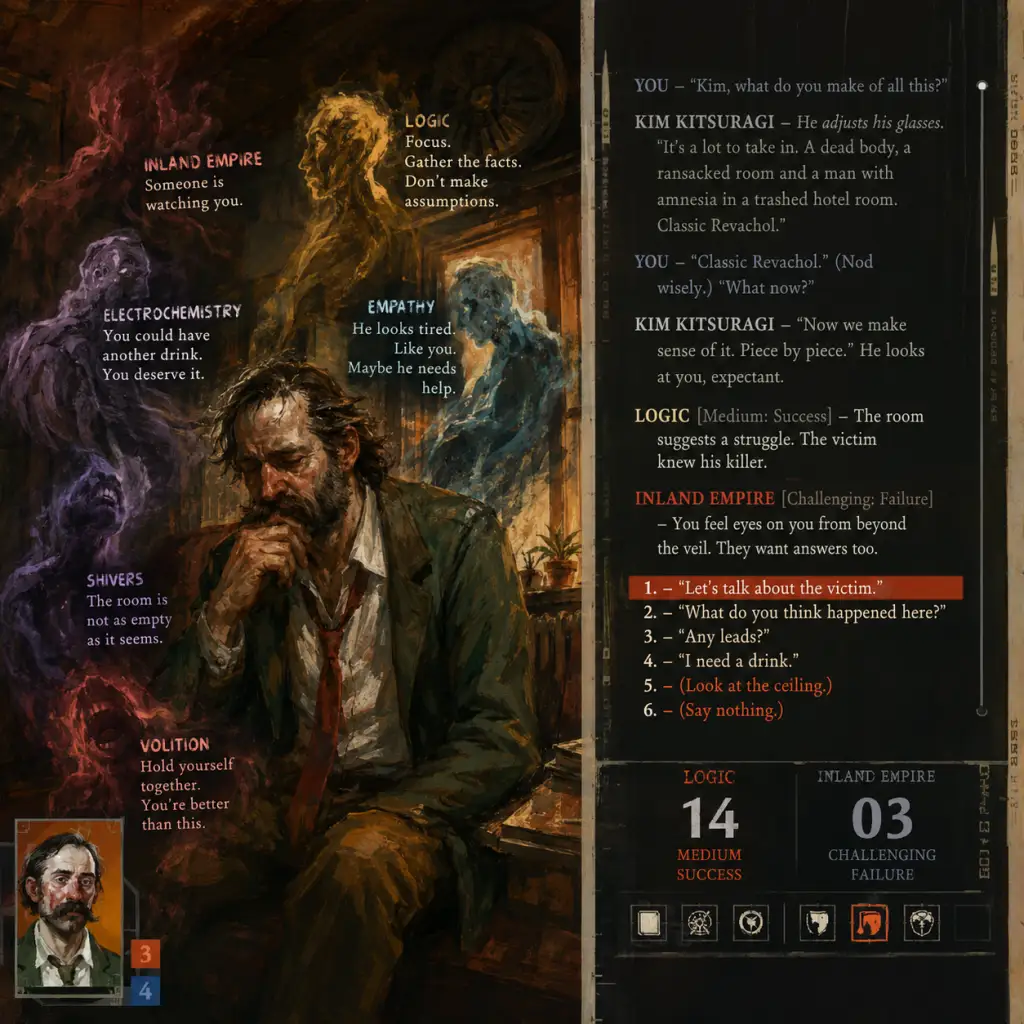
This guide covers the fundamental mechanics and progression of Disco Elysium, a detective RPG that replaces combat with psychology-driven dialogue and skill checks. The game’s main loop revolves around exploration, conversation, and using your skills and thoughts to solve the murder of a hanged man in the destitute district of Martinaise. Here’s how it all works, organized by the typical player progression tiers.
Core Gameplay Loop
The loop is: Explore (move through the 2D isometric world) → Interact (click on objects, talk to NPCs) → Respond (choose dialogue options, often triggering skill checks) → Progress (gain XP, money, clues, new tasks) → Level Up (spend skill points, internalize Thoughts) → Repeat. There is no combat; all conflict is resolved through words and your character’s internal monologue.
Interaction Systems
- Dialogue & Skill Checks: Every conversation presents dialogue choices. Options are colored by a related skill (e.g., [Inland Empire], [Volition]). Hover to see percentage chance. Checks are either White (retryable after levelling the skill) or Red (can only be attempted once). Success/failure alters the story.
- Passive Checks: Skills automatically trigger thought comments and reveal information without a roll.
- Thought Cabinet: By internalizing a thought (24 real-time hours or faster with the Conceptualization skill), you gain permanent passive bonuses (but sometimes penalties during the internalization period).
- Interaction with Environment: Right-click on any object, person, or point of interest to examine. Some items can be picked up; others require a skill check to unlock.
- Attributes: You begin by choosing 4 base attributes (Intellect, Psyche, Physique, Motorics) each between 1–6. These determine your maximum ranks in the 24 skills.
- Skills: Divided into 4 categories (6 per attribute). Levelling a skill increases your pool of dice for checks involving that skill. You gain skill points every time your character levels up (XP earned through discoveries, dialogue successes, and task completions).
- Thoughts: Internalizing a thought costs a Thought slot but provides unique bonuses (e.g., "Anti-Object Task Force" improves electrochemistry checks). You can have up to 12 slots eventually.
- Signature Skill: Choose one skill to get +1 bonus permanently (often the most important for your playstyle).
- Money (real in-game currency) is earned by completing tasks, looting, or selling junk. Use it at vendors like the fenc for goods: alcohol, drugs, books, and tools. Key purchases: a good jacket (increases morale), lock picks, and the ledger from the bookstore.
- Items: Alcohol restores Morale, drugs restore Health (hit points for mental/physical damage). Some items unlock new dialogue options (e.g., a book that gives the thought "Wretched Procrastinator").
- Primary Case: "The Hanged Man" – must be solved by the end of the game. Core steps: identify the body, find the killer’s motive, and confront them.
- Side Missions: Numerous tasks like "Find the Missing Insulindian Phasmid" or "Help Cuno with the Clues." These reward XP, money, and often game-changing thoughts.
- White Check Boxes: After failing a white check, a box appears on the task list. Levelling the associated skill allows you to retry that check.
- Map Zones: Martinaise is the main zone, split into areas like Fishing Village, Harbour, Whirling-in-Rags, and the Coastline. Each day (starting at 9 AM, ending at 2 AM) you can explore freely, but time passes with actions.
- Time Management: Dialogue and reading pass time quickly. Certain events only happen at specific hours (e.g., the door of the doomed commercial area opens at 21:00). Sleep resets your Health/Morale and progresses the day.
- Character Creation: Choose a build. Recommended for beginners: Intellect-heavy (e.g., Logic/Encyclopedia) to understand the case quickly, or Psyche-heavy (Empathy/Volition) for social interactions. Avoid extreme low in Physique (you’ll struggle to recover Morale).
- First Actions: Get out of bed, talk to Kim (follow his lead on the body), search your room for a jacket and money, and walk to the hanged man.
- Key Early Checks: The body is difficult to bring down – use Physical Instrument (Physique) to try, or Electrochemistry for a different approach. If you fail, Kim will handle it, but you lose potential XP.
- Thought Example: Start internalizing "The Precocious World" (gives +1 Encyclopedia, +1 Logic) as soon as you find a thought. It requires spending a point whitelisted from Knowledge.
- Economy: Loot the trash bins for bottles to sell. Visit the pawn shop (in the Whirling) to purchase a new or second-hand ledger for 2 real (borrow from Kim if needed).
- Avoid: Wasting time on every white check; progress the main story to day 2 before side-track too much.
- Skills to Prioritize: Visual Calculus (for crime scene reconstruction), Empathy (to read emotions), and Volition (to maintain Morale during tough conversations).
- Key Quests:
- Economy: By now you should have ~20–30 real. Buy a Toolbox (15 real) to unlock containers, and a Toolkit for breaking locks (à la the door to the loft).
- Thoughts: Internalise "Apocalyptic Drinker" for +2 Volition when drinking alcohol (good for difficult dialogues). Be careful: it lowers Empathy during internalisation.
- Important White Check: The ledger from the bookstore requires Logic (7+). If you fail, increase Logic and return the next day.
- Combat (Metaphorical): The "Tribunal" is not yet here, but you can confront the Hardie Boys or the scab leader. Use Authority or Intimidation checks to gain advantage.
- Level Cap: You typically reach level 15–18 (max level). Allocate remaining skill points to finish your build. Signature skill at 8–10 is common.
- Crucial Checks:
- Economy: Spend leftover money on drugs that boost critical skills (e.g., for the Tribunal, take Pyrholidon for +2 Composure). Books that give relevant thought upgrades.
- Thoughts: Complete internalisation of all unlocked thoughts before the tribunal (you have 4–6 slots). "The Anti-Object Task Force" gives +1 Perception and +1 Composure – very useful.
- Side Quests: Most should be done now. The Cuno questline can give you an ally for the tribunal.
- The Tribunal Event: A multi-stage sequence involving negotiations between union and mercenaries.
- Final Confrontation: After the tribunal, you find the killer on the coast (or in the church). The conversation is a prolonged series of checks. You need Inland Empire to understand the phasmid (if you have it), or Logic to reconstruct the motive. Success reveals the truth; failure leads to ambiguous or worse endings.
- Post-Game: There is no free roam after the credits. The final choice determines your ending (e.g., arrest the killer, let them go, or become a disco legend). You get a detailed epilogue.
- Economy: The money is meaningless after the last day; spend it on drugs for the final checks if needed.
Progression & Character Build
Economy
Quests & Missions
Exploration
---
Early Game (Days 1–3)
Goals: Establish yourself, meet Kim Kitsuragi (your partner), learn basics, and collect initial clues.
---
Mid Game (Days 4–6)
Goals: Deepen investigation of the murder, explore the wider district, handle side tasks, and internalize powerful thoughts.
- Finding the Insulindian Phasmid – leads to a unique and lengthy side case. Requires high Encyclopedia or Perception.
- The Pinball Machine at Whirling – rewards Money, and opens a lead on the union.
- The Catholic Church Mystery – high Conceptualization needed to appreciate the occult door.
---
Late Game (Days 7–9)
Goals: Prepare for the tribunal (a pivotal shootout/drama event), collect final evidence, and solve the murder beyond reasonable doubt.
- The Tribunal: The game throws dozens of back-to-back white/red checks. Stack Volition and Composure to survive the emotional strain. Have Reaction Speed for quick decisions.
- Confronting the Killer: Requires strong Empathy or Logic to deduce who it is. Best evidence is the phasmid (if side quest completed) or the bullet from the gun.
---
Endgame (Day 9 – Final)
Goals: Survive the tribunal, locate the phasmid (if pursued), and deliver the final verdict.
- Before: Save often. The event can kill you (Morale/Health drop to zero). Have healing items ready.
- During: Choose to trust Kim or go solo. Use Authority to rally allies, Perception to spot hidden shooters, and Volition to not cower.
---
Tips for Each Tier
| Tier | Dos | Don’ts |
|---|---|---|
| Early | Talk to everyone, hoard alcohol for Morale | Skip the phasmid side quest line (it’s long but rewarding) |
| Mid | Internalize one thought at a time, prefer active ones | Spend skill points too thinly across all skills |
| Late | Save before entering the church crypt or any heavy dialogue | Neglect Volition – low Morale kills runs |
| Endgame | Keep healing items hotkeyed; prepare for sudden checks | Get stuck on a red check – they are permanent failures |