Core Gameplay
Core Gameplay
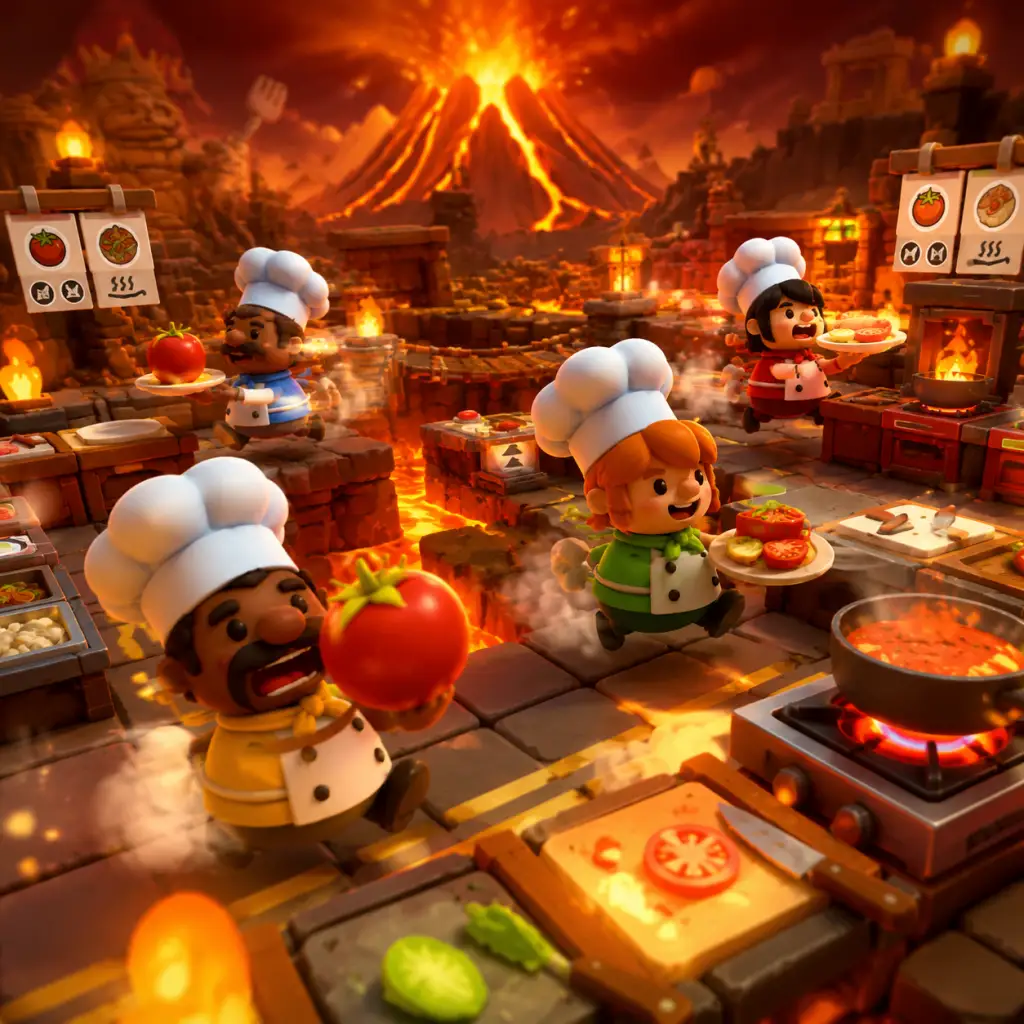
Overcooked! 2 is a cooperative cooking simulation game where up to four players work together in increasingly chaotic kitchens to prepare and serve orders under time pressure. The core gameplay loop revolves around communication, coordination, and efficient task management. This guide breaks down the systems and progression tiers.
Main Gameplay Loop
1. Receive an Order – A ticket appears showing a recipe (e.g., "Burger" or "Tomato Soup"). Orders have a time limit; failing to serve in time loses points and can end the level early.
2. Gather Ingredients – Chefs move to ingredient stations (e.g., fridge, pantry, fish crate) and pick up raw items.
3. Prepare Ingredients – Chop vegetables on cutting boards, cook meat on grills or in pots, combine items on plates or in bowls.
4. Assemble and Serve – Place prepared ingredients on a plate in the correct order (e.g., bun > patty > lettuce > bun), then carry the plate to the serving window. Success clears the order and adds score.
5. Wash Dishes – Used plates pile up; dirty plates must be washed at a sink before reuse. Neglecting dishes causes shortages.
6. Adapt to Hazards – Levels feature moving platforms, teleporters, conveyor belts, fire hazards, rats, and shifting kitchen layouts. Players must adjust routes and strategies.
7. Repeat – The cycle continues until the time or order limit is reached. Score determines star rating (1-3 stars) and unlocks next levels.
Combat / Interaction Systems
Overcooked! 2 has no traditional combat. The "interaction" system is central:
- Pick Up / Drop (A button/X etc.): Grabs ingredients, plates, or tools. Dropping items can intentionally pass them to other chefs.
- Chop (A on cutting board): Rapidly press to chop vegetables or meat. Timing matters – holding the button is faster but risky.
- Cook / Stir (A on stove, pot, or grill): Place raw ingredients on heat sources. Some recipes require stirring (e.g., soup) or flipping (e.g., grilled cheese).
- Wash (A at sink): Cleans dirty plates.
- Throw (Hold R2/RT + aim + release): Toss ingredients or plates to distant chefs. Requires precision; missing can waste items.
- Dash (B/O): Quick movement to dodge hazards or reach stations faster. But overuse can cause collisions.
- Interact with Hazards: For example, extinguishing fires with fire extinguishers or closing oven doors.
- 1 star per level: minimum to progress.
- 2 stars: score threshold that unlocks bonus levels or secret areas.
- 3 stars: highest rating; needed for some achievements.
- Arcade Mode: Replay levels with set difficulty modifiers.
- Versus Mode: Compete against another team.
- Kevin Levels: Bonus levels hidden in each world (accessed by finding keys). They are harder, with fewer ingredients and tighter spaces.
- Score per order: Depends on recipe complexity and speed. Bonus points for "Tips" (serving orders faster than required).
- Star thresholds: Each level has three score targets. Meeting them unlocks stars.
- Unlockables: Stars unlock new worlds and bonus content; no purchases.
- Completing all levels in a world (unlocks world-specific chef).
- Reaching 3-star rating on all levels (unlocks secret chef, e.g., the Unicorn).
- Some DLC/updates add more.
- 100% Completion: Earn 3 stars on every level (including Kevin levels). This is the primary long-term goal.
- Arcade Mode with Modifiers: Replay levels with speed increases, fewer dishes, or extra hazards. Leaderboards track high scores.
- Local Multiplayer: Play with friends for fun; no additional content.
- DLCs/Expansions: Each adds new worlds, recipes, and mechanics (e.g., Surf 'n' Turf adds rowboats).
- Focus: Learn basic controls, simple recipes (tomato soup, burgers, salads). Kitchen layouts are static; hazards are minimal (e.g., moving platforms).
- Gameplay Loop: Simple: one chef chops, another cooks, third serves. No advanced techniques.
- Example Level 1-1 ("The Lost Morsel"): Kitchen has a fridge, cutting board, stove, sink, and serving window. Recipe: Tomato Soup (tomato + pot). Strategy: One chef picks up tomato from fridge, chops it, drops into pot, stirs, plates, and serves. Second chef can wash dishes. No need for dashing or throwing.
- Tip: Communicate roles. New players often crowd the same station – designate a chopper, a cooker, and a server.
- Stars: Easy to get 2 stars; 3 stars requires efficient teamwork.
- Focus: Multi-step recipes, complex movement (conveyor belts, teleporters, fire pits). More ingredients (fish, cheese, lettuce, tomatoes, corn, etc.) and utensils (pots, pans, grills, ovens).
- Gameplay Loop: Must manage multiple orders simultaneously. Example: Burger + Fish & Chips. Requires cooking patty on grill, chopping lettuce, frying fish in pan, cutting potatoes for fries. Need to coordinate timing to avoid burning.
- Example Level 3-3 ("The Blazing Desert"): Conveyor belts move ingredients around. A chef must stand on a pressure plate to keep a bridge up. Hazards include fire erupting from stoves. Strategy: Assign one chef exclusively to manage the pressure plate and throw ingredients across.
- New Mechanics: Throwing becomes essential for passing items across gaps. Dashing helps avoid fire.
- Progression: Unlock new chefs (e.g., Fox, Raccoon). Stars needed: about 12-15 per world.
- Focus: Extreme chaos – multiple hazards (rats, moving floors, teleporting stations), recipes requiring 4+ ingredients (e.g., Pizza: dough + sauce + cheese + toppings). Boss levels have unique mechanics (e.g., a giant monster flips the kitchen).
- Gameplay Loop: Must adapt on the fly. Orders come fast. Often need to prioritize high-value orders or ones about to expire.
- Example Level 6-4 ("The Ever-Peckish Castle"): The castle kitchen has a central platform that rotates, making stations accessible only at certain times. Two ovens, a sink, and a serving window that move. Recipe: Pizza and Grilled Cheese. Strategy: One chef stands on a moving platform and throws ingredients to others. Use dashing to cross burning tiles.
- Advanced Techniques: Double chopping (two chefs chop same ingredient to speed up), pre-plating (prepare plates ahead), and coordinated throws.
- Progression: Unlock last chef (e.g., Dragon). 3-star req. ~15-18 stars per level.
- Focus: Mastery and perfection. Play through Kevin levels (hidden bonus levels) and Arcade Mode with all modifiers enabled. Attempt 3-star ratings on every level.
- Gameplay Loop: Extremely tight timings. Example: Kevin Level 2 ("Kevin's Kitchen") is a tiny kitchen with no sink – have to reuse plates without washing, leading to dirty plates pile-up. Must serve orders in exactly the right order to avoid blocking.
- Examples: Replay level 1-1 with "speed increase" modifier – orders expire in half the time. Team must execute perfect rotations.
- Goal: Unlock all achievements (e.g., "Stop, Drop, and Cook" – extinguish fires while cooking). No new content beyond this unless DLC.
Progression
Progression is level-based and linear within the six main worlds (e.g., Lost Morsel, The Peckish Isles). Each world has 6-8 levels plus a boss level. Unlocking the next world requires earning a total of stars from previous levels. Typically:
Additionally, completing levels unlocks new recipes, kitchen layouts, and chef characters (though all chefs are cosmetic only).
Exploration
Exploration is minimal – each level is a self-contained kitchen. However, levels often have hidden shortcuts, teleporters, or movable platforms. For example, in "The Lost Morsel" (level 1-4), a conveyor belt can be reversed by stepping on a button. Finding these aids efficiency. The overworld map lets players revisit completed levels for higher scores.
Quests / Missions
The game has no traditional quests. Instead, "levels" function as missions with specific order sets and a time limit. Boss levels (e.g., "Kevin's Kitchen") feature unique challenges like a giant crab stealing ingredients. The "Story Mode" is the primary campaign. There are also optional challenges:
Economy
There is no in-game currency or shop. The only "economy" is score-based:
Character / Build Growth
Characters are purely cosmetic – no stats or abilities. Players can unlock new chefs by:
There is no leveling, skill trees, or gear. Growth comes from player skill: learning recipes, mastering shortcuts, and improving team coordination.
Endgame Structure
After completing the main story (all worlds, includes final boss level "The Ever-Peckish Castle"), endgame consists of:
Player Progression Tiers
#### Early Game (Levels 1-1 to 1-6 or first world)
#### Mid Game (Worlds 2-3 to 4-6)
#### Late Game (Worlds 5-6 and Boss Levels)
#### Endgame (Post-story)
Summary Table of Progression Tiers
| Tier | Key Levels | New Mechanics | Typical Star Targets | End Goal |
|---|---|---|---|---|
| Early | 1-1 to 1-6 | Basic movement, pickup, chop, cook, serve | 1-2 stars per level | Unlock world 2 |
| Mid | 2-1 to 4-6 | Throwing, dashing, multiple stations, teleporters | 2-3 stars per level | Unlock world 5 |
| Late | 5-1 to 6-6, Boss | Complex recipes, rotating kitchens, hazards | 3 stars on most | Complete story |
| Endgame | Kevin levels, Arcade | All previous + modifiers | 3 stars on all | 100% completion |