Important Notes
Important Notes
Warnings and Pitfalls
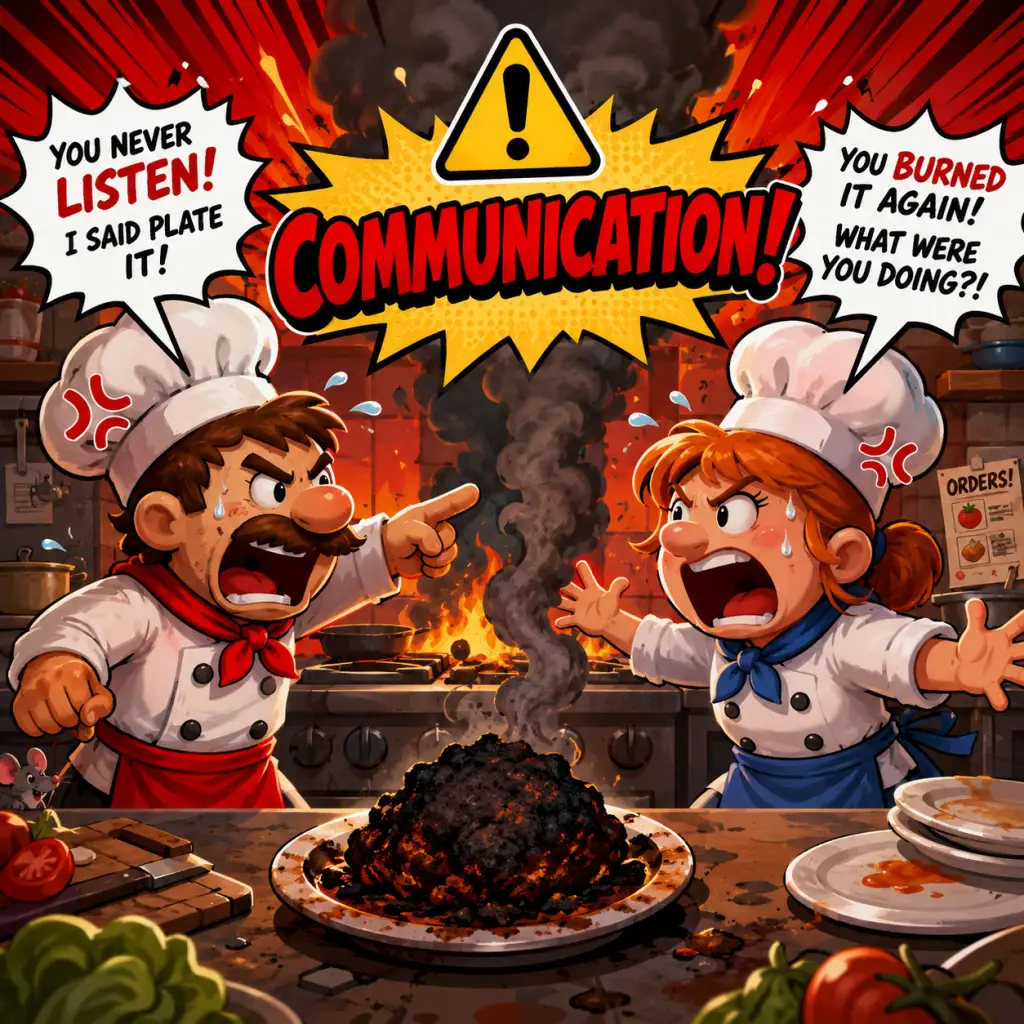
- Team Communication is Non-Negotiable: Overcooked! 2 is chaotic by design. Without constant communication (voice chat or callouts), orders will pile up, and you’ll likely fail even simple levels. Miscommunication causes 90% of failed runs. Use push-to-talk if needed.
- Beware of Friendly Fire (Literally): You can throw ingredients at other chefs. While this can be useful for passing items across gaps, accidentally hitting a teammate with a dirty plate or raw meat can stun them and waste precious seconds. Don’t throw unless necessary.
- Order Timer is Relentless: Every order has a countdown. If an order expires, you lose points (and can fail the level). Prioritize completing started orders over starting new ones. Never serve a wrong order – it deducts points and wastes time.
- Kitchen Hazards Are Instant Run-Killers: Moving platforms, portals, lava, ice, and shifting floors are not just set dressing. One misstep can send you into the void (insta-kill) or drop your ingredient. Always scan the arena before moving, especially on levels like "Carnival of Chaos" or "The Lost Morsel."
- Don’t Hoard Ingredients: Grabbing every ingredient you see is a common mistake. Stick to what the current orders need. Cluttered counters cause confusion and lost items.
- Fire and Burning: Leaving a pot or pan unattended will start a fire. Fires spread and can ruin multiple stations. Always know who is watching stoves. Extinguish fires with the fire extinguisher (press Interact on the extinguisher) – but that takes time. Prevention is better.
- Dirty Dishes Slowly Accumulate: You cannot reuse a dirty plate. If you have no clean plates, you cannot serve orders. Assign one person (or rotate) to wash dishes during lulls. Neglecting dishes leads to a cascade failure.
- Story Progression Is Linear with No Return: Once you complete a world and move to the next, you cannot replay that world’s levels unless you select them from the main menu’s "World Select." However, you can always replay any previously cleared level at any time. There is NO permanent missable content – but note that stars earned are permanent. You can always go back to earn 3 stars even after finishing the game.
- Unlockable Chefs and Cosmetics Are One-Time: Some chefs and cosmetic items are unlocked by completing specific tasks (e.g., getting a certain number of stars or clearing a hidden level). If you miss unlocking a chef during the initial playthrough, you can go back and meet the requirements later – nothing is permanently locked.
- Kevin Levels (Hidden Levels): Each world has a hidden "Kevin" level accessible through a secret exit in a normal level. These levels are missable if you don’t find the hidden exit. Example: In World 1-3, throw an ingredient into the blue portal to unlock the hidden level. If you skip it, you can still replay the level and find the exit later. No true missable content, but easy to overlook.
- DLC and Downloadable Content: If you purchase DLC (e.g., Surf ‘n’ Turf, Carnival of Chaos), those levels are separate and can be played anytime. No missable DLC content unless you delete your save (see Save Management).
- World 3 (The Lost Moth) and World 4 (The Last Chomp) Are Sudden Hurdles: The game’s difficulty ramps sharply in World 3 with moving platforms and conveyor belts. Expect to fail several times. World 4 introduces portals and multiple floors, requiring higher coordination. Tip: Watch a video walkthrough for these worlds to plan routes.
- Kevin Levels (Hidden Levels) Are Much Harder: These are designed for veteran players. Do not attempt them before mastering the main world’s levels. They often have gimmicks requiring precise timing.
- 3-Star Requirements Are Tight: Getting 3 stars on later levels demands near-perfect execution. You may need to replay levels dozens of times with the same team. The jump from 2 to 3 stars is huge.
- DLC Levels: Surf ‘n’ Turf and Carnival of Chaos: These DLC packs are notably harder than the base game. Carnival of Chaos has a difficulty spike with fire hazards and narrow paths. Play these only after finishing the main campaign.
- No Character Progression or Skill Trees: There is no leveling up or grinding for stats. All progression is star-based: the more stars you earn, the more worlds and chefs you unlock. If you are stuck, you do not need to grind – instead, replay earlier levels to improve your score.
- Star-Based Unlocks Are Linear: You need a cumulative star count to unlock the next world. If you are 5 stars short, you must replay any level you previously completed with 1 or 2 stars to earn the missing stars. Do not attempt to brute-force by replaying the hardest level – farm easier ones for quick stars.
- Hidden Chefs Require Specific Star Counts: Some chefs unlock at, say, 40 or 100 total stars. This encourages revisiting levels for higher scores. There is no shortcut – you must earn the exact number.
- Avoid Perfectionism Early: Do not obsess over 3-stars on your first playthrough. It’s better to progress and unlock new levels, then return later with better strategies and unlocked chefs (chefs do not change gameplay, but cosmetic variety can motivate). Grinding for 3 stars on early levels when you are new is inefficient.
- Online Play Is Peer-to-Peer: There is no dedicated server; latency depends on the host’s connection. If you experience lag, suggest a host change or check your own connection. The game has no anti-cheat because there is no competitive ranking – cheating is pointless.
- Voice Chat Etiquette: If playing with randoms, use the in-game ping system (press the designated button to call attention to an ingredient or task). Avoid shouting over mic – it distracts. If someone is not pulling their weight, politely ask them to focus on one station.
- Drop-in/Drop-out Respect: The game allows players to join or leave mid-level. If you decide to leave, wait for the level to end or at least place a “Pause” if you are host. Abrupt disconnects ruin the run for others.
- No Friendly Fire Punishment: You can intentionally throw items at teammates to sabotage, but this is toxic and defeats the cooperative spirit. If you encounter griefers, leave the lobby and find a new one. The game has no reporting system.
- Modding on PC: Some players use mods for cosmetic changes or to unlock all levels. This is fine for single-player/private games but not recommended for public lobbies as it may cause desync. Use mods at your own risk – not officially supported.
- Manual Saves Do Not Exist: Overcooked! 2 auto-saves after every level completion, including star progress and unlock status. There is no manual save or backup feature. Be careful:
- Save File Corruption Is Rare but Possible: To protect against it, periodically back up your save file manually on PC (located in %USERPROFILE%\AppData\Local\Overcooked2). Copy the entire folder to a safe location. On consoles, no manual backup possible.
- Sharing Progress with Friends: If you play on a friend’s console/PC and log in with your profile, your star progress might overwrite theirs (or vice versa) if cloud sync is on. Avoid sharing profiles. Use the guest option instead.
- Reinstalling the Game: Your save is typically preserved if you reinstall (cloud sync). But if you manually delete it before uninstalling, it’s gone. Always check cloud status before uninstalling.
- You Can Reroll Orders by Serving a Wrong Dish? NO – Do Not Do That: Serving an incorrect order causes a point penalty and wastes time. There is no purpose in intentionally messing up. The order queue refreshes only after you complete or let an order timeout.
- The Throw Mechanic Is Essential: Many players ignore throwing in the first few hours. Throwing ingredients across gaps or to a teammate saves running time. Practice throwing by holding the Interact button (default: Y on Xbox, Triangle on PS) and releasing with direction.
- The Order Screen Shows Upcoming Orders: The top of the screen shows the next order’s ingredients. Use this to prepare ahead. For example, if the next order is a burger, start chopping lettuce and tomato before the current order is served.
- Pause Menu During Online Play Pauses for Everyone (If Host): Only the host can pause the game (by opening the menu). If you are not the host and need a break, you cannot pause – you have to wait or risk disconnecting. Communicate with the host if you need a respite.
- Levels Have Hidden “Tips” in the Intro: Before a level starts, the text often hints at a strategy (e.g., “This kitchen moves!”). Pay attention – these tips are gameplay-relevant.
- You Can Skip the Level Intro Cutscene: Press Start/Spacebar to skip the brief intro that explains the kitchen hazards. Saves a couple of seconds but not critical.
- Turning Off in-game Music Can Improve Focus: Some players find the frantic music distracting. Lowering music volume in settings may help with concentration.
- Playing with the Same Partner Builds “Chef Chemistry”: Coordinating with one consistent partner is far more effective than playing with strangers. Find a friend and stick with them for the whole campaign.
- No Penalty for Failing a Level: You can retry as many times as you like. There is no punishment, so do not get discouraged. Each failure teaches you the kitchen layout and timing.
- The Game Does Not Tutorialize Advanced Techniques: Things like throwing, using fire extinguisher, or the “pass through” mechanic (holding a plate while running past a counter to drop it) are not explained. Watch a guide video after the first world.
Irreversible Choices & Missable Content
Difficulty Spikes
Grinding Traps & Unlock Progression
Online Etiquette & Anti-Cheat
Save Management Advice
- If you delete your local save file, you lose all progress – stars, unlocked chefs, and DLC progress. Cloud saves (if enabled on Steam or console) will sync, but if you delete from both ends, start over.
- On consoles, cloud saves are usually automatic if you have PlayStation Plus or Xbox Live Gold. On PC, Steam Cloud is default, but disable it only if you understand the risk.
Things Players Commonly Regret Not Knowing Earlier
> Final Advice: Overcooked! 2 is a game of teamwork, patience, and practice. The chaos is intentional – embrace it, laugh at mistakes, and communicate constantly. Nearly every pitfall can be avoided with clear roles and prior planning. Good luck, chefs!