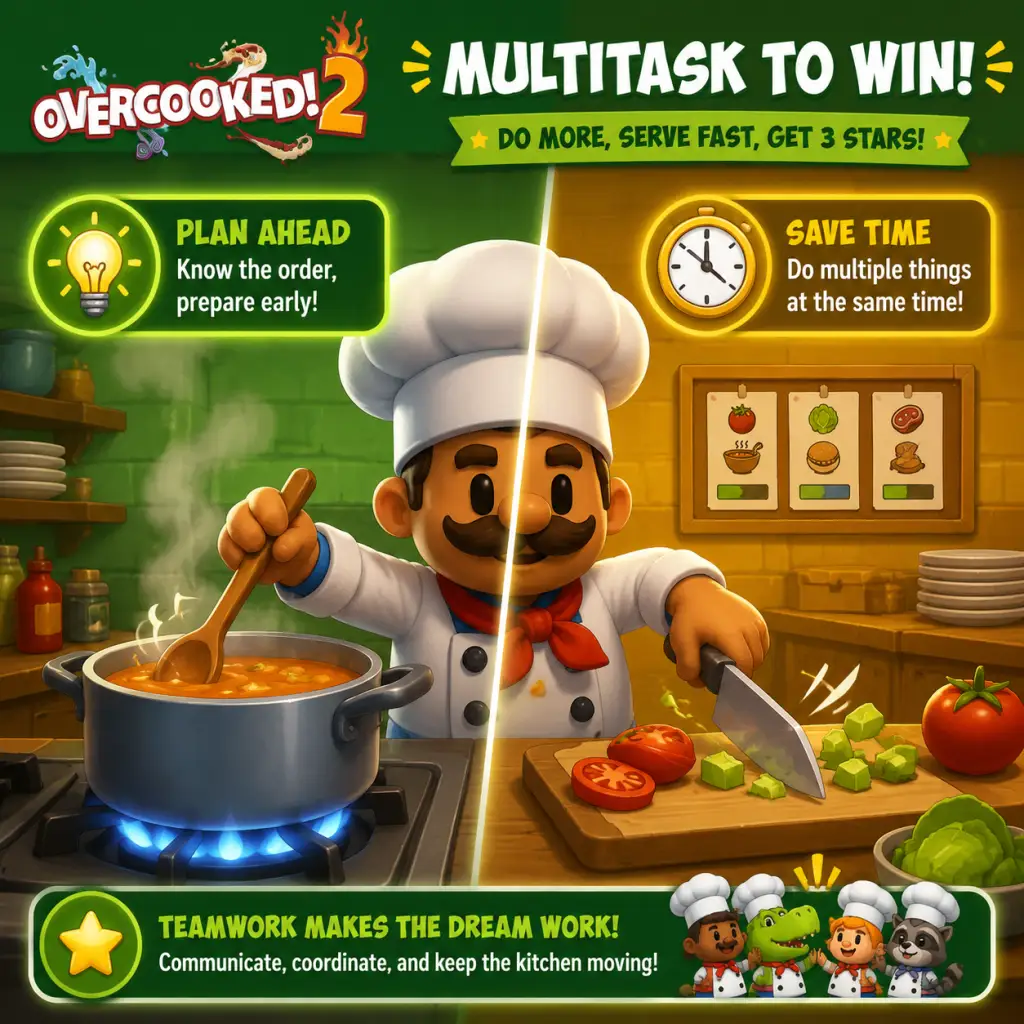
Game Tips
Game Tips
Beginner Tips
1. Master the Basics First - Focus on chopping, cooking, and plating one order at a time. Avoid trying to do everything at once. Use the tutorial levels to practice.
2. Communicate Constantly - Use voice chat or quick callouts. Say what you need ("I need tomatoes!", "Plate ready!") and what you're doing ("I'm on washing dishes").
3. Learn Each Kitchen Layout - Spend the first 10-20 seconds of a new level exploring: where are ingredients, stations, delivery points? Identify conveyor belts, moving platforms, and shortcuts.
4. One Chef on Washing Dishes - Dedicate one chef to washing and stacking plates initially. Dirty plates pile up fast; having a steady supply is crucial.
5. Don't Over-Collect - Only grab ingredients you will use immediately. Leaving raw ingredients on counters creates clutter and confusion.
Intermediate Strategies
1. Divide and Conquer Roles - Assign each chef a role: one on chopping, one on cooking, one on assembling/plating, one on washing/expediting. Swap roles as needed.
2. Pre-Chop Ingredients - When there's a lull, chop extra tomatoes, lettuce, onions. Stockpile chopped ingredients in clean bowls or on the counter for quick assembly.
3. Use the Trash Can - If you mess up an ingredient (e.g., burnt food), instantly throw it in the trash to free up space. Don't hold onto mistakes.
4. Serve in Order of Priority - Serve orders that are closest to expiry first. Check the order ticket queue; if two orders have the same time, serve the more complex one first.
5. Corner Cutting - Learn to cut corners by dashing (run button) at angles. Many kitchens have diagonal paths that can save seconds per trip.
Advanced Optimizations
1. The "Rolling Throws" Technique - You can throw ingredients to other chefs across distances. Master the timing to toss items from one station to another without moving.
2. Multi-Tasking Stations - Use two stoves or pans simultaneously if the kitchen allows. Have one chef manage two cooking stations (e.g., start a burger on one, then a pizza on the other).
3. Fire and Ice - When fire hazards or ice patches appear, anticipate their movement. For example, if a swinging fire hazard is about to block your path, time your dash through it.
4. Ghosting (Platform-Specific) - On PC, you can use the ghosting glitch (rapidly pressing interact on certain surfaces) to move through objects briefly. Use with caution; may be patched.
5. Perfect Order Routing - Plan the entire path of an order: from ingredient storage → chopping → cooking → assembly → plate → serve. Minimize backtracking.
Communication & Coordination
- Call Out Ingredient Needs – "Need more cheese!" or "Tomato ready!"
- Use the Pointing Emote – Tap the interact button (or emote wheel) to point at a location, ingredient, or hazard to alert teammates.
- Assign a "Captain" – One chef should keep track of the order queue and prioritize. Others trust the captain's calls.
- Silence is Failure – If no one is talking, mistakes multiply. Encourage constant low-level chatter.
- Learn One-Way Paths – Many kitchens have loops or one-way conveyor belts. Always move with the flow; don't try to go against it.
- Use Moving Platforms Efficiently – Stand near the edge where you'll jump off immediately. Don't wait for the platform to fully stop.
- Shortcuts through Hazards – Sometimes it's faster to run through a short fire burst than to go the long way around (if you have health to spare).
- Batch Cooking – Cook multiple burgers or pizzas at once if the order queue allows. But don't cook too many extra; they may go to waste.
- Bun & Patty Preparation – For burgers, prep buns and patties separately. Keep buns on plates, patties on the grill.
- Soup Stations – For soups, keep the pot filled with broth. Add chopped ingredients as soon as they're ready. Don't let the pot sit empty.
- Fire Extinguishers – Know where the extinguisher is if a fire starts. If no extinguisher, use dash to put out fires (in some versions). Better to avoid fires by not leaving food unattended.
- Moving Floors – On levels like "The Rocket" with moving platforms, time your steps to avoid falling off.
- Teleporters – Use teleporters for long distances, but be careful: some teleporters drop you into hazards.
- Serve Orders Quickly – Each order has a time bonus. Faster serving = higher score.
- Avoid Wasting Ingredients – Every unused ingredient costs points at the end. Only grab what you need.
- Combo Chain – Serving orders back-to-back quickly builds a combo multiplier. Have plates ready to serve immediately after last order.
- Star Requirements – To get 3 stars, you need a high score. Focus on speed and accuracy. Sometimes serving all orders but slower can still get 3 stars if no mistakes.
- All Chefs Are Equal – No character has different stats. Pick whatever skin you like; it's purely cosmetic.
- No Upgrades – Overcooked! 2 does not have character upgrades. All progression comes from player skill.
- The Dog (Kevin) – In some DLCs, a dog appears and may help or hinder. Learn its pattern.
- Campfire Cook Off – Use the log to chop and toss ingredients. Keep an eye on the fire; it can die out.
- Night of the Living Bread – Zombies grab ingredients. Plan routes around them; you can lure them away.
- Carnival of Chaos – Use the water pistols to put out fires quickly.
- PC (Keyboard & Mouse) – Rebinding keys can improve efficiency. Consider mapping "Throw" to a convenient key like Q or E.
- Console (Controller) – Use the D-pad for quick emote selection. Practice throwing with the right stick (RS click or R3).
- Nintendo Switch – Use Joy-Con gyro for pointing? Not really. Just use standard controls.
- Online Multiplayer – Ensure stable internet. Lag can ruin timing. Use a wired connection if possible.
Kitchen Navigation & Layout
Ingredient & Recipe Flow
Hazard Management
Score & Star Tips
Character & Ability
DLC & Special Level Tips
Platform-Specific Tips
Why These Tips Work
Each tip addresses a common failure point in Overcooked! 2: poor communication, inefficient movement, mismanaged resources, or panic under pressure. By systematizing roles and routines, you reduce cognitive load on each player, allowing faster decision-making. Mastering throws and hazard timing transforms chaotic kitchens into predictable systems, making even the hardest levels manageable.