Important Notes
Important Notes for Sid Meier's Civilization VI
Warnings and Pitfalls
- Over-expansion without infrastructure: Settling cities too quickly without building up their core districts (especially the Aqueduct, Commercial Hub, and Industrial Zone) can cripple your economy. New cities cost increasing amounts of gold maintenance as your empire grows. Always couple expansion with builders to improve tiles and internal trade routes to boost new cities.
- Ignoring the Culture Victory potential: Even if you are pursuing a Domination or Science victory, neglect of Theater Square districts and Great Works can allow an AI opponent to race ahead on Culture and win a surprise Culture Victory in the late game. Keep an eye on the Culture Victory progress screen and use Rock Bands (late game) or spies to disrupt enemy tourism if needed.
- Not understanding district adjacency bonuses: Placing districts haphazardly loses massive yields. For example, Campus districts get +1 Science per adjacent mountain tile, so cluster them near mountains. Commercial Hubs and Harbors get bonuses from rivers and sea resources. Use the map tacks (pin tool) to plan your cities; a well-planned Industrial Zone can pump out +10 Production with the right adjacency (Aqueduct, Dam, Canal, other districts).
- Trading with the AI carelessly: The AI often offers unfair trades. Never accept a deal just because you want a resource. Always check what you are giving away, especially gold per turn or strategic resources. The AI might trick you into selling a luxury that later causes unhappiness when you need it.
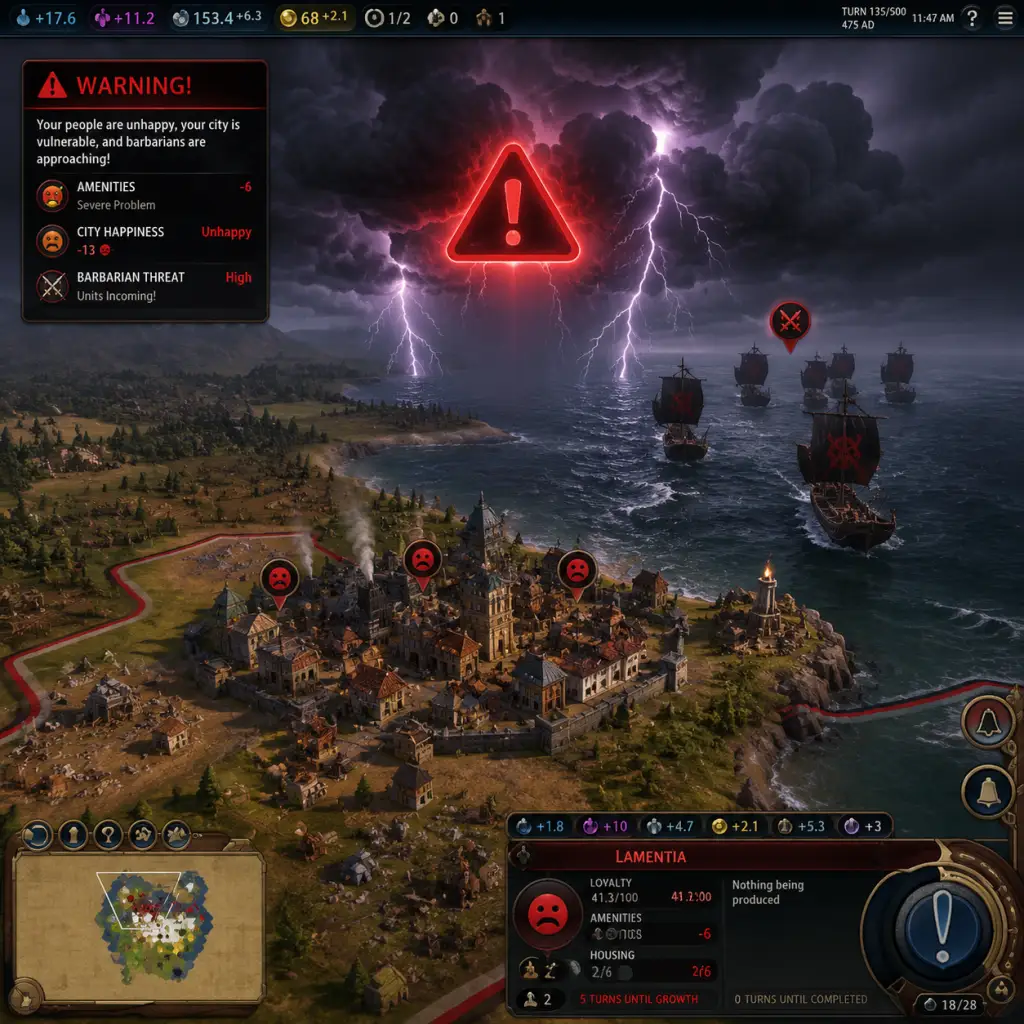
- Neglecting barbarians early: Barbarian camps that are not cleared can spawn units that pillage your trade routes and attack your settlers. Always keep a ranged unit and a melee unit near your exploring units. The ‘Barbarian Clans’ game mode (if enabled) makes barbarians even more dangerous because they can evolve into city-states.
- Choosing a Pantheon: The first pantheon you adopt (from earning enough Faith) is permanent for the whole game. Choose carefully: which belief best suits your strategy? For a Religious Victory, the best is often Divine Spark (+1 Great Person points from Holy Sites, Campus, Theater Square) or Settler (bonus to settler production early). For a Domination victory, God of War (faith from kills) or Religious Settlements (extra settler) are common. You cannot change or remove a pantheon later.
- Great Person recruitment: Once you recruit a Great Person, that specific one is gone for all players. If you spend the resource (e.g., Great Scientist points) on a weak one, you cannot get the same points back. Save Great Person points for the ones that truly benefit your current victory path (e.g., Ada Lovelace for Science, Michelangelo for Culture).
- Government policies and forms of government: While you can switch governments later in the game (via civics), each government type offers specific policy slots and sometimes unique abilities. Changing government requires an anarchic turn (unless you use certain Great People or the Alhambra wonder). Choose your government based on your current goals. For example, Monarchy is good for an empire with many cities, Theocracy for faith-based victories, and Democracy for science. Switching too often costs production.
- Alliance types: When you form an alliance, you choose a specific type (e.g., Research Alliance, Military Alliance). This cannot be changed for the duration of the alliance (30 turns). Pick accordingly: you may lock yourself out of a different bonus.
- Wonders allocation: Many wonders have global effects and are unique (only one can be built). If you start a wonder and someone else completes it first, you lose all production invested. Plan wonders ahead; never start a wonder you cannot finish quickly unless you have a production stockpile.
- Religious Beliefs: Your founded religion's beliefs (e.g., Choral Music, Work Ethic, Religious Community) are chosen once and cannot be changed. Some beliefs, like Work Ethic (Production from Holy Site adjacency), are incredibly powerful for any victory. Choose beliefs that synergize with your civ and intended strategy.
- First contact with city-states: When you first meet a city-state, sending them a small amount of gold immediately makes you the Suzerain (if no other player has already sent envoys). This early influence can be lost if you delay. Also, city-states have unique quests; completing them grants envoys. Miss these early quests and you may fall behind in city-state bonuses for the rest of the game.
- Goody huts (Tribal Villages): These scatter across the map and disappear once claimed. They give bonuses like free tech boosts, gold, scouts, or eurekas. Rush your scout to explore early–those bonuses are time-sensitive and can accelerate your early game significantly.
- Heroes and Legends game mode: If enabled, there are 12 legendary heroes who can be summoned only once per hero across the entire game. If you do not recruit a hero, they are gone. Each hero has unique abilities and can be recalled later but with increased cost. Missing a hero like Hercules or Mulan is a big loss.
- Natural Wonder discoveries: Some Natural Wonders (e.g., Mount Everest, Eye of the Sahara) grant special bonuses when you discover them (e.g., +1 to movement, +3 Science). They also provide adjacency bonuses to the campus and holy site if you settle nearby. Explore to find them early before other civs block your path.
- Secret Societies game mode: If active, you are offered a choice to join one of four secret societies. This is a one-time permanent choice; you cannot change it later. Each society offers unique abilities and buildings. The bonuses are locked to that society; missing the chance to choose early (or choosing unwisely) can lead to regret.
- King and above: The AI gets free starting bonuses (extra Settler, additional military units, boosted yields). For new players, staying at Prince (Normal) until you understand district planning and warfare is advisable. The jump to King is noticeable because the AI expands faster and earlier wars are harder.
- Barbarian Clans mode: If you enable barbarian clans, they can evolve into city-states, creating new diplomatic powers. This makes early exploration and barbarian suppression more urgent.
- Apocalypse game mode: Frequent disasters (comets, floods, volcanoes) can devastate your carefully planned districts and improvements. New players should avoid this mode until they master standard rules.
- Deity difficulty: AI gets +1 free Settler, +2 free builders, +40% production toward wonders, +20% combat strength, and other huge bonuses. Your first 100 turns will be defensive. Extensive experience with district planning and timing attacks is required.
- Building every district in every city: Not all cities need every district. Focus on a few specialized cities. For example, a city on a river with high adjacency might become a Commercial Hub + Industrial Zone core. Another city near mountains becomes a Campus city. Building unnecessary districts drains production and population growth.
- Chasing all great people: You cannot get all Great People. Those points are competitive; if you spend your limited points on a weak Great Person, you lose out on more valuable ones later. Prioritize those that advance your chosen victory path.
- Overbuilding units in peacetime: Maintaining a huge army when not at war costs massive gold and strategic resources. Build only enough to defend or deter aggression; supplement with walls and garrisoned ranged units. Use the garrison discount policy when at peace.
- Endless wonder-chasing: A common trap is trying to build every Ancient/Classical wonder. Many wonders are not essential, and failing to finish them wastes production. Build wonders only if they directly support your strategy and your city can complete them before an AI.
- Multiplayer etiquette: In multiplayer games, especially with strangers, communicate ahead of time about speed and victory conditions. Use in-game chat to avoid misunderstandings. Do not constantly reconnect or slow down the game; be present when it's your turn.
- No mods allowed in multiplayer by default: Most online games require a ‘no mods’ rule to avoid cheating or imbalance. If you use mods that change gameplay (like UI mods that reveal hidden tiles), you may be banned from multiplayer lobbies.
- Exploits that are considered cheating: Exploits like the ‘lens bug’ (which revealed hidden units) or ‘sell all luxuries every turn’ are not allowed in competitive play. The community uses the ‘Play as Intended’ rule. Avoid any exploit that gives you an unfair advantage.
- Leavers/quitting early: In team games, leaving before the game ends is considered bad form unless you are clearly defeated. Communicate your surrender to opponents.
- Anti-cheat features: Civilization VI has no active anti-cheat software (e.g., no PunkBuster). However, players can report suspicious behavior or use mods to see logs. The honor system prevails in most lobbies.
- Use multiple save slots: Civilization VI autosaves every turn (by default) but keep at least 3-5 manual saves at key moments: before a major war, before choosing a pantheon or religion, after a golden age. The autosave interval can be set to every 5 or 10 turns in options.
- Hotseat mode: If playing in hotseat multiplayer, ensure each player has their own saves and labels them clearly to avoid confusion.
- Ironman mode: There is no official Ironman mode, but you can self-enforce (no reloading). For achievements, be aware that reloading a turn before a decisive battle may invalidate the achievement (e.g., winning without reloading). Check the achievement requirements.
- Back up save files: On PC, Civilization VI saves are in your Documents/My Games/Sid Meier's Civilization VI/Saves folder. Back this up if you plan to reinstall or use different mods. Corrupted saves can happen after updates; having a backup prevents loss of long campaigns.
- Mod compatibility: Before applying major mods, make a clean save with no mods active. Loading a modded save without the mod can cause errors. Always note which mods are active in a particular save.
- You can pin tile improvements (Map Tacks): Right-click on the map while in the city view to place pins for planned districts, wonders, and improvements. This helps you visualize adjacency bonuses and avoid overlapping districts. Many new players ignore this tool and later regret poor district placement.
- Roads are only built by traders: Traders automatically build roads between your cities (upgrading over time). You cannot manually build roads. Use internal trade routes to connect your capital to new cities to speed up movement and production.
- Great Scientists and Engineers can be used to speed up wonders: Using a Great Engineer on a wonder gives instant production towards it. This is critical for wonders that are about to be stolen. Save appropriate Great Engineers for that situation.
- The Religion screen has a purchase menu: You can buy Missionaries and Apostles directly from the Holy Site district screen, not just from the city. The Religion lens shows religious pressure; check this often to spread your religion efficiently.
- You can rename units: Click on a unit's name in the bottom bar to rename it. This is useful for organizing armies or giving thematic names.
- City-state envoys stack: Sending 1 envoy to a city-state gives the bare minimum bonus. Sending 3 gives a major bonus (Suzerain) and unlocks additional yields (like +2 food to all cities, etc.). Always aim for 3 envoys if you want the city-state's bonus.
- Selling strategic resources makes sense even if you have a surplus: You can sell excess Horses, Iron, Oil, etc. to the AI for gold per turn. This is a major source of income. But be careful not to sell too much—you might need them later for units or buildings.
- The ‘Disband Unit’ command exists: If a unit becomes obsolete or you need to reduce unit maintenance, you can disband it (button in unit actions). This saves gold per turn.
- Natural Wonders provide adjacency bonuses even if not discovered?: Actually, you must discover them to activate the adjacency bonus for campuses/holy sites. So explore thoroughly.
- The ‘Civilopedia’ is searchable: Press F1 or click the question mark icon to access the Civilopedia. It explains every concept, district, tech, civic, and unit. Many beginners avoid it, but it is the best single resource for understanding game mechanics.
- Save often: A single misclick (like moving a settler into danger) can ruin 100 turns. Reloading an autosave is fine for learning. In single-player, there is no penalty for reloading.
- Victory progress is visible: You can see exactly how close each player is to each victory condition. Use this information to prioritize counter-strategies (e.g., if an AI is close to a Religious Victory, kill all their Apostles and start an inquisition).
- Do not overvalue early aggression: While early warfare can cripple a neighbor, it also discourages trade and alliances. Sometimes peaceful coexistence yields better long-term results.
- Check the strategic resource report: In the top-right menu, open the Resources pane to see your current and projected strategic resources (Iron, Horses, Niter, etc.). Running out mid-construction is frustating.
- Updates and DLC change the game significantly: The Rise and Fall, Gathering Storm expansions, and all Leader Passes add mechanics like Loyalty, Governance, Eras, and additional civs. If you own these, learn about the changes early. Loyalty pressure can cause city flipping; keep a garrison and policy cards to manage it.
Irreversible Choices
Missable Content
Difficulty Spikes
Grinding Traps
Online Etiquette & Anti-Cheat Notes
Save Management Advice
Things Players Commonly Regret Not Knowing Earlier
Final Reminders
This guide covers the most common traps and revelations experienced by Civilization VI players. Use it to avoid frustration and accelerate your mastery of the game.