Core Gameplay
Core Gameplay in Age of Empires II: Definitive Edition
Overview of the Gameplay Loop
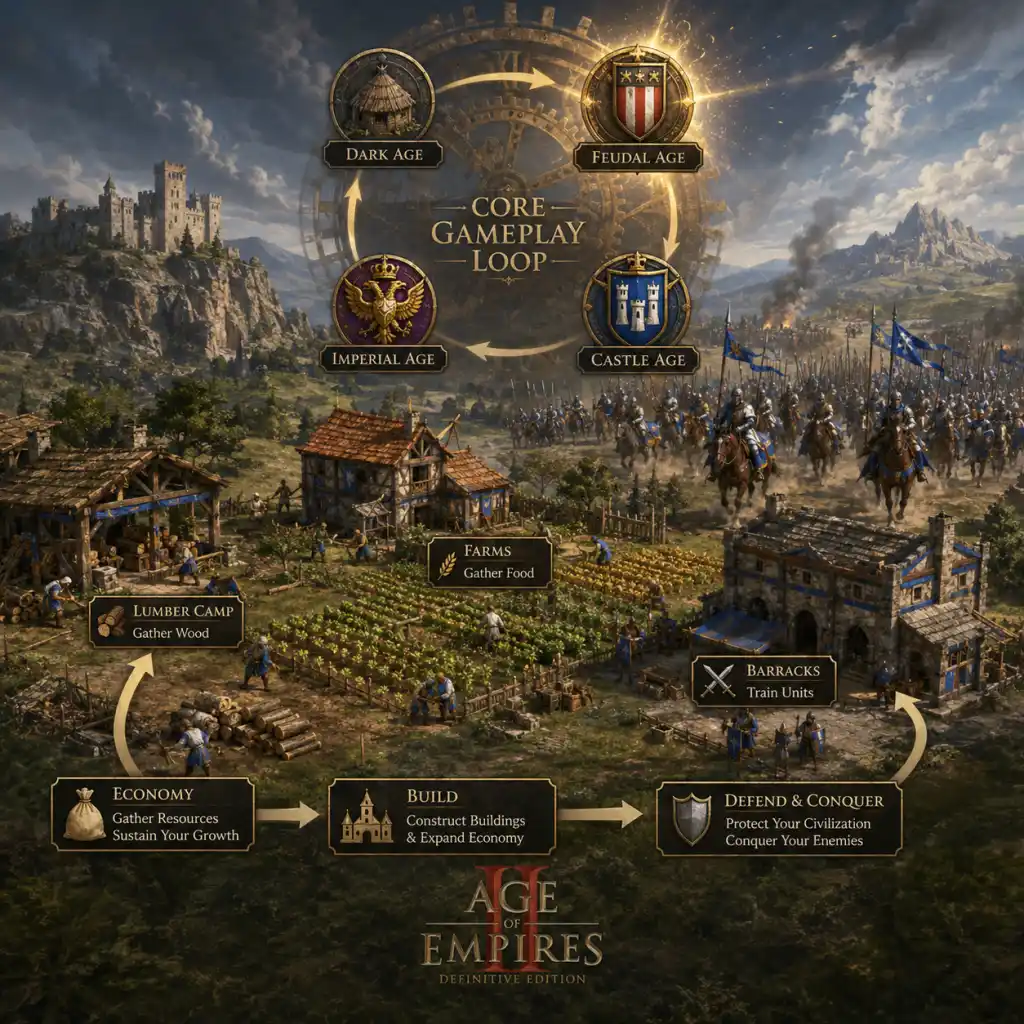
Age of Empires II: Definitive Edition is a real-time strategy (RTS) game centered on building a civilization from a handful of villagers to a mighty empire. The core loop is cyclical: gather resources → build structures → train military units → research technologies → attack or defend → expand or trade. Victory is achieved by destroying all enemy buildings (Conquest), building and defending a Wonder (Wonder victory), collecting all Relics on the map (Relic victory), or by controlling the majority of the map's starting population (in some King of the Hill variants). The game is divided into four Ages (Dark, Feudal, Castle, Imperial) that gate unit, building, and technology access. Players must advance through these Ages by spending resources at the Town Center.
Core Systems Explained
- Combat/Interaction: Units have rock-paper-scissors interactions: Spearmen beat cavalry, Skirmishers beat archers, Archers beat infantry, etc. Siege units deal massive damage to buildings but are fragile. Micro (manual control) improves unit efficiency—e.g., dodging arrows with archers, flanking with cavalry.
- Progression (Ages): Advancing an Age costs food and gold (Dark→Feudal: 500F, 0G; Feudal→Castle: 800F, 200G; Castle→Imperial: 1000F, 800G). Each Age unlocks new buildings, units, and upgrades.
- Exploration: Scouts (initial cavalry or scout line) reveal the map. Fog of war hides enemy activity; line of sight (LOS) from units and buildings reveals. Good scouting finds resources, enemy base, and relics.
- Economy: Resources are Wood (for buildings and archers), Food (for villagers and infantry), Gold (for advanced units and techs), Stone (for defensive buildings and castles). Collect via villagers (chopping, farming, mining) or trade (Trade Carts in Castle+). Eco upgrades (e.g., Horse Collar, Bow Saw) improve gather rates.
- Quests/Missions: The single-player campaigns (e.g., William Wallace, Joan of Arc) have scripted scenarios with objectives. In multiplayer skirmish, there are no quests—only the win condition.
- Character/Build Growth: Civ-specific bonuses and tech trees define strengths. For example, Franks have stronger cavalry; Britons have longer-range archers. Players choose a "build order" (e.g., Fast Castle, Drush-FC, Archer rush) that dictates early game actions.
- Endgame Structure: Once Imperial Age is reached, post-imperial gameplay focuses on trade (gold generation), massing elite units (e.g., Paladins, Arbalests, Siege Onagers), and map control. Relic and Wonder timers add pressure.
- Objective: Build economy, scout surroundings, choose a build order, and advance to Feudal Age.
- Economy: Start with 3 villagers. Immediately queue more, send to sheep, then wood, then berries/boar. Build two houses (avoid pop cap). Lure boar with scout under Town Center. Maintain constant villager production (ideal: 22–24 villagers before advancing).
- Exploration: Scout with initial cavalry (or scout for Mongols). Find sheep, boar, deer, gold/stone patches, and enemy location. Build a Feudal Age building (Blacksmith, Market, etc.) when 500 food is ready.
- Combat: Minimal. If enemy drushes (Dark Age militia rush), wall with houses/palisades. Otherwise, focus on economy.
- Progression: Click Feudal Age at ~500 food. While advancing, assign villagers to wood (for buildings) and farms (for future food).
- Example Build Order: "23-Pop Drush" = train 3 militia before advancing, harass enemy economy, then Fast Castle or archer rush.
- Objective: Build a military, secure map control, wall key areas, advance to Castle Age.
- Economy: By Feudal, have 2–3 lumberjacks, 1–2 miners (gold), and farms (5–10). Build a Blacksmith or Market to advance to Castle. For Castle Age, save 800 food, 200 gold. Use market to buy/sell resources if needed.
- Combat: Feudal rushes: archers (Britons, Mayans), scouts (Franks, Huns), spearmen (defense vs scouts). Use towers to pressure stone. Build a "range" or "stable" to produce units. Micro archers to retreat from spearmen; use scouts to raid exposed villagers.
- Exploration: Send scout to enemy base to spot military buildings and gold/stone piles. Wall incomplete gaps with houses or palisades.
- Progression: Click Castle Age. Aim for a "fast Castle" timing (~16 minutes). Once in Castle, drop two Town Centers for booming (mass villagers) or a castle with unique unit.
- Example: Fast Castle into Knights + Crossbow (Spanish, Franks). Build a market to buy food for Castle, then create knights to raid.
- Objective: Max out economy (100+ villagers), mass elite military, upgrade to Imperial Age, build trade.
- Economy: 8–10 lumberjacks, 6+ gold miners, 30+ farmers, 2–3 stone miners (for castles). Start trade on maps with allies (Trade Carts generate gold). Relics (each gives gold per minute).
- Combat: Use unique units (e.g., Longbowmen, Paladins, Jaguar Warriors). Add siege: battering rams (vs buildings), mango/onager (vs clumped units). Use Castles as defensive anchors. Upgrade armor (Chain Mail, Plate Barding) and attack (Bodkin Arrow, Chemistry).
- Exploration: Use light cavalry or scouts to scout enemy army composition. Monitor trade routes.
- Progression: Click Imperial Age when you have 1000 food, 800 gold. While aging up, build a University (for ballistics, siege upgrades) and extra military buildings.
- Endgame Structure: If post-Imperial: build Wonders (if enabling Wonder victory), collect all Relics, or destroy enemy buildings. Trebuchets (Imperial Age unique siege) are key for castle breaking.
- Example: Britons in Imperial: mass Arbalests (cheap range upgrade), Siege Onagers, Halberdiers (trash). Buy food from market to sustain production.
- Objective: Secure the win condition: either destroy all enemy buildings, hold the Wonder for 200 years (game time), or control Relics (all 5) for 200 years.
- Economy: Continuous trade (25+ trade carts on a long route). Keep farming (if no food) or rely on markets. Villager count may drop due to raiding—rebuild.
- Combat: Full tech tree: all upgrades, elite unique units, bombard cannons (anti-siege), trebuchets. Use "trash units" (Halberdier, Skirmisher, Hussar) to conserve gold. Gold units (Paladin, Heavy Cavalry Archer) are finishers.
- Exploration & control: Use Caravels or Scouts to patrol. Build forward bases (Castles, towers) to secure relics or deny enemy gold.
- Quests/Missions: None; only the win condition matters. Campaigns have scripted events but not in multiplayer.
- Example: In a 4v4 Black Forest game, late game: trade heavily (trade carts between bases), wall off chokepoints, mass Siege Onagers and Paladins, send Hussar raids to snipe enemy trade.
Gameplay by Tiers
Early Game (Dark Age, ~0–12 minutes)
Mid Game (Feudal & Early Castle Age, ~12–25 minutes)
Late Game (Castle & Early Imperial, ~25–40 minutes)
Endgame (Post-Imperial, ~40+ minutes)
Key Progression Examples
| Age | Typical Timing (1v1 Arabia) | Landmark Units | Economic Focus |
|---|---|---|---|
| Dark | 0:00–10:00 | Scout, Militia | Food/wood |
| Feudal | 10:00–17:00 | Archer, Skirm, Scout | Farms, gold |
| Castle | 17:00–28:00 | Knight, Crossbow, Monk | Boom (multiple TC) |
| Imperial | 28:00+ | Paladin, Arbalester, Treb | Full eco (trade, relics) |
Final Notes
Mastering the core gameplay requires efficient build orders, constant unit production (no idle time), and adaptation to enemy strategy. Use the in-game tech tree (F12) for every civilization. Practice multitasking by economy while raiding. The best players maintain constant villager production until 120+ villagers, then switch to pure military.