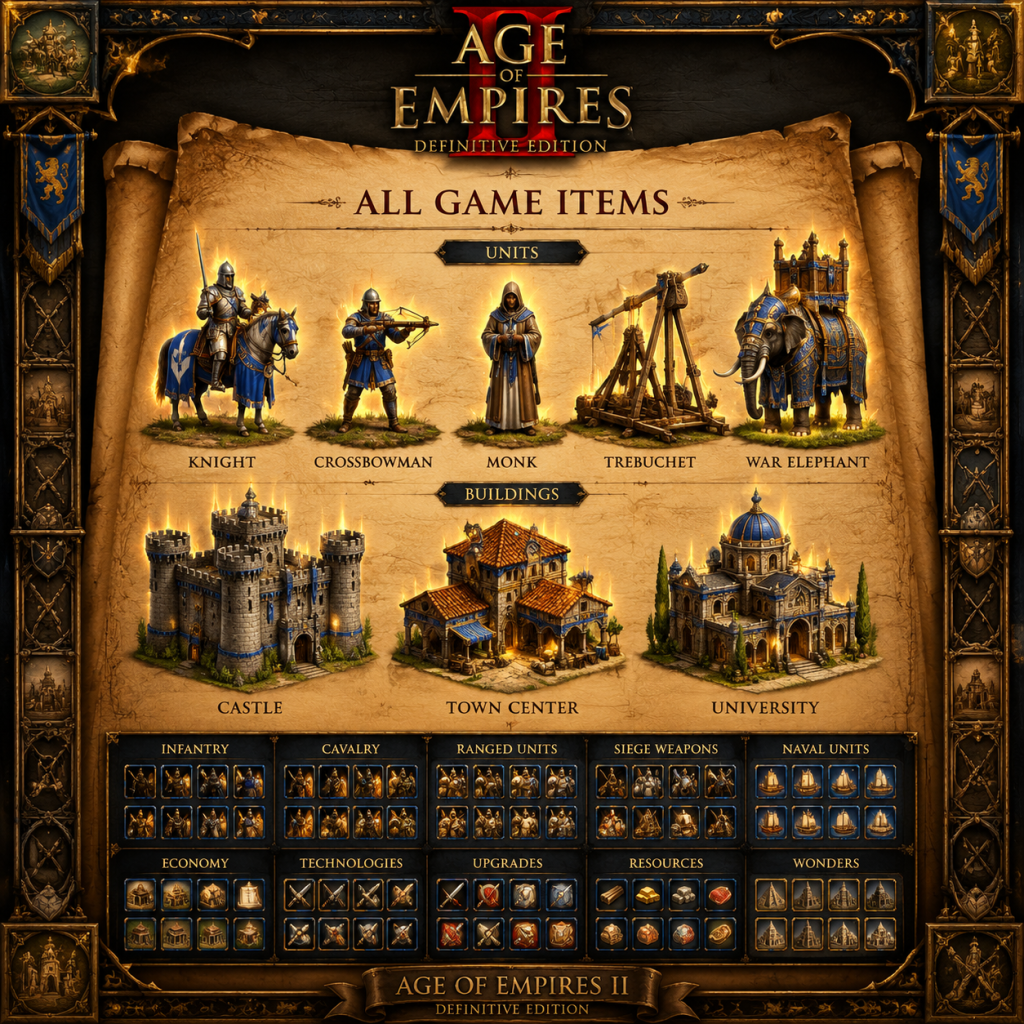
All Game Items
All Game Items in Age of Empires II: Definitive Edition
Age of Empires II: Definitive Edition (AoE2:DE) is a real-time strategy game, not an RPG. As such, it does not feature traditional items like weapons or armor that you equip on a character. Instead, the game uses resources, collectible relics, unique units, technologies, and trade goods as its core "items." This guide categorizes and explains every major game element that functions as an item or currency within the mechanics of AoE2:DE.
---
1. Resources (Core Currencies)
Resources are the lifeblood of your economy. You gather them to train units, construct buildings, research technologies, and advance through the Ages.
| Resource | Source | Primary Use | Notes |
|---|---|---|---|
| Food | Huntables (deer, boar, sheep), farms, berries, fish | Training villagers, military units (especially infantry and cavalry), advancing to next Age | Fastest gather from boar (under TC fire) and deer. Farms are renewable but require wood investment. |
| Wood | Trees (forests), sometimes from destroyed buildings | Building construction (houses, barracks, etc.), ships, archery units, rams, farms | Critical early game. Always keep lumberjacks near TC until you have a safe wood line. |
| Gold | Gold mines (surface & deep), trade, relics, some tribute | Training expensive units (knights, archers, unique units), advancing to Castle and Imperial Ages, blacksmith upgrades | Limited on map – trade or relic collection essential in late game. |
| Stone | Stone mines (surface & deep), some relics | Building stone walls, castles, towers, town centers (only with certain civs like Teutons) | Usually only gather as needed for defensive structures or Castle Age advancement. |
When useful: All stages of the game. Balancing resource collection is key.
Synergies: None directly, but you can trade surplus resources at the Market for gold.
---
2. Trade Goods (Currency Generation)
Trade Goods are produced by Trade Carts (land) and Trade Cogs (water) when they move between your Market (or Dock) and an ally’s or neutral’s equivalent building. They generate gold over the journey.
- Trade Cart: Trains at Market → moves to another Market (ally’s or same player’s) → returns with gold. The longer the distance, the more gold per trip (up to ~30 gold per trip).
- Trade Cog: Trains at Dock → travels to another Dock (ally’s or neutral) → returns with gold. Same distance-based bonus.
- How to obtain: Found on the map (usually neutral or guarded by wild animals). A Monk picks up a relic and brings it to your Monastery.
- Maximum: 5 relics per player can be held (limited by Monastery capacity; only 1 relic per Monastery, so you need 5 Monasteries to collect all).
- Synergies: Relics are critical for a gold-reliant civilization like Turks or Saracens. Combine with the Atonement technology to convert enemy monks holding relics.
- When useful: Mid-to-late game when mines deplete. Free gold allows you to maintain an expensive army.
- How to obtain: Move a military unit (often a hero unit) over the artifact; auto-transport to target area.
- When useful: Only within those specific missions.
How to obtain: Train from Market (land) or Dock (water) after they are built.
When useful: Late game when gold mines are exhausted. Essential for a gold-heavy army (e.g., Paladins, gunpowder units).
Important: Trade units are slow and vulnerable to raiding. Protect trade routes with walls or patrols.
---
3. Collectible Artifacts & Relics
#### Relics
Relics are gold-generating collectibles placed inside a Monastery. They provide a passive income of gold (roughly +1 gold every 2-3 seconds per relic) and can trigger conversions when garrisoned.
#### Campaign Artifacts
Many single-player campaigns (e.g., Joan of Arc, Saladin, Genghis Khan) require you to collect specific Artifacts (e.g., the Holy Grail, a crown, a banner) to achieve victory conditions. These are map-specific items that must be brought to a designated location (usually your base or a monument).
---
4. Unique Units (Weapons)
Each civilization has one or two unique units that serve as powerful, specialized combat troops. These can be thought of as "weapons" you can deploy. Below are some notable examples, but all 42 civilizations have unique units.
| Civilization | Unique Unit | Type | Effective Against | Weak Against |
|---|---|---|---|---|
| Britons | Longbowman | Archer | Infantry, buildings (with upgrades) | Skirmishers, cavalry rushing |
| Franks | Throwing Axeman | Infantry (anti-cavalry) | Cavalry, buildings | Archers, heavy infantry |
| Mongols | Mangudai | Cavalry Archer | Siege units, slow units | Skirmishers, spearmen |
| Spanish | Conquistador | Gunpowder Cavalry | Infantry (high damage) | Skirmishers, pikemen |
| Persians | War Elephant | Heavy Cavalry | Buildings, all units (high damage) | Monks (conversion), spearmen, camels |
| Saracens | Mameluke | Camel Archer (anti-cavalry) | Cavalry | Skirmishers, archers |
| Mayans | Plumed Archer | Archer (fast, strong vs infantry) | Infantry, buildings | Skirmishers, heavy cavalry |
When useful: Based on your opponent’s composition and map. For example, Longbowmen dominate on open maps with hills; War Elephants are devastating but gold-heavy.
Upgrades: Blacksmith upgrades (attack/armor), unique technologies (e.g., Britons’ "Yeomen" gives +1 range to Longbowmen).
---
5. Technologies (Armor & Upgrades)
Technologies at the Blacksmith, University, and other buildings function like armor and weapon upgrades for your units and buildings. The most critical ones are listed below.
#### Blacksmith Upgrades
| Technology | Effect | Cost (Food/Gold) | Age Available |
|---|---|---|---|
| Forging | Infantry and cavalry +1 attack | 100F, 50G | Feudal Age |
| Iron Casting | +1 infantry/cavalry attack (requires Forging) | 200F, 100G | Castle Age |
| Blast Furnace | +1 infantry/cavalry attack (requires Iron Casting) | 300F, 200G | Imperial Age |
| Scale Mail Armor | Infantry +1 melee armor | 100F, 50G | Feudal Age |
| Chain Mail Armor | Infantry +1 melee armor (requires Scale Mail) | 200F, 100G | Castle Age |
| Plate Mail Armor | Infantry +1 melee armor (requires Chain Mail) | 300F, 150G | Imperial Age |
| Padded Archer Armor | Archers +1 pierce armor | 100F, 50G | Feudal Age |
| Leather Archer Armor | Archers +1 pierce armor (requires Padded) | 200F, 100G | Castle Age |
| Ring Archer Armor | Archers +1 pierce armor (requires Leather) | 300F, 200G | Imperial Age |
| Scale Barding Armor | Cavalry +1 melee armor | 150F, 50G | Feudal Age |
| Chain Barding Armor | Cavalry +1 melee armor (requires Scale Barding) | 250F, 100G | Castle Age |
| Plate Barding Armor | Cavalry +1 melee armor (requires Chain Barding) | 350F, 200G | Imperial Age |
#### University Technologies (Functional Consumables? Not really, but key)
- Ballistics: Projectiles lead targets – increases hit chance for archers and gunpowder (150W, 200G, Castle Age).
- Chemistry: +1 attack for all gunpowder and archer units, enables gunpowder units (200F, 100G, Imperial Age).
- Siege Engineers: Increases blast radius and range of siege weapons (250F, 100G, Imperial Age).
- Fortified Wall: Doubles HP of stone walls (200F, 100G, Castle Age).
- Town Center: Train villagers, advance to next Age, drop off resources. Most important structure.
- Barracks: Train infantry (militia line, spearmen line, unique infantry for some civs).
- Archery Range: Train archers, skirmishers, slingers.
- Stable: Train cavalry (scout cavalry, knights, camels).
- Siege Workshop: Train rams, mangonels, scorpions, bombard cannons.
- Monastery: Train monks, research monk technologies, hold relics.
- Castle: Train unique units, research unique technologies, provide strong defense.
- Dock: Train ships, fishing boats, trade cogs.
- Market: Trade resources, buy/sell at variable rates.
- Wonder: Buildable structure for Wonder victory in standard games. Very expensive (1000 food, 1000 wood, 1000 stone, 1000 gold).
- Tribute: Sending resources to an ally via the Market – cost is 20% tax (e.g., send 100 gold, you pay 120 gold). Consumes resources for the giver.
- Spy Technology: Reveal all enemy units for 10 seconds (cost based on enemy units). Used once per match (or multiple times if you have gold).
- Convert Unit (Monk): Monks can convert enemy units, effectively consuming their conversion ability (cooldown per monk).
How to obtain: Research at respective buildings (Blacksmith, University, Monastery).
Synergies: Combining Blacksmith upgrades with unique technologies greatly enhances unit effectiveness. For example, fully upgraded Elite Mangudai with Blast Furnace and Chemistry deal massive damage.
---
6. Buildings as Equipment (Key Structures)
Certain buildings act as "equipment" for your strategy – they provide bonuses or unlock units.
When useful: All buildings are useful at various stages. Placement matters (e.g., forward Castle for siege, defensive Castle near gold).
---
7. Miscellaneous Consumables (Non-existent)
There are no true consumable items like potions or scrolls in AoE2:DE. However, the following mechanics are one-time-use within a match:
These are not items per se, but they function as expendable advantages.
---
Summary Table of All Item Categories
| Category | Examples | Obtain By | Key Use |
|---|---|---|---|
| Resources | Food, Wood, Gold, Stone | Gathering from map nodes | Build, train, research |
| Trade Goods | Gold from trade cart/cog | Trading between Markets/Docks | Infinite gold generation |
| Relics | Religious artifacts | Monk pick-up → Monastery | Passive gold income |
| Campaign Artifacts | Holy Grail, Crowns | Move hero to location | Victory condition |
| Unique Units | Longbowman, Mangudai | Train from Castle | Specialized combat |
| Technologies | Forging, Chemistry, Ballistics | Research at Blacksmith, etc. | Unit upgrades |
| Buildings | Town Center, Castle | Build with villagers | Production, defense |
| Consumables (limited) | Tribute, Spy, Conversion | Various actions | One-time tactical benefits |
This guide covers all major "items" in Age of Empires II: Definitive Edition. Remember that the game is about resource management and unit composition rather than inventory-based equipment. Use this knowledge to optimize your economy and army for every match.