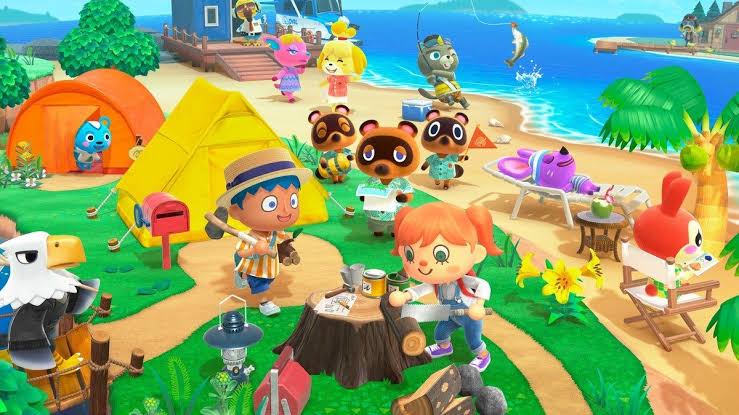
Game Introduction
Overview
Animal Crossing: New Horizons is a life simulation game developed and published by Nintendo exclusively for the Nintendo Switch family of consoles (including Switch Lite and Switch OLED). It is not available on PC, PlayStation, Xbox, or mobile devices (aside from the companion Nintendo Switch Online mobile app). The game was released worldwide on March 20, 2020, and has received continuous free updates adding seasonal events, new features, and special characters. A paid downloadable content (DLC) expansion titled Happy Home Paradise launched on November 5, 2021.
Genre
Life simulation, sandbox, social simulation.
Developer / Publisher
- Developer: Nintendo EPD (Entertainment Planning & Development)
- Publisher: Nintendo
- Initial release: March 20, 2020 (global)
- Major free updates: Throughout 2020–2021 (e.g., summer updates, fall updates, New Year’s celebrations)
- Paid DLC Happy Home Paradise: November 5, 2021
- Final major free update (2.0): November 5, 2021 (added many features alongside the DLC)
- Ongoing: Minor updates and seasonal events continue via free patches.
- Nintendo Switch (standard, Lite, OLED)
- Companion app available on iOS and Android (not the main game)
- Tom Nook – The tanuki entrepreneur who manages Resident Services, sells homes, and initiates island development projects.
- Timmy & Tommy – Tom Nook’s apprentice twin nephews who run the Nook’s Cranny shop.
- Isabelle – The cheerful secretarial assistant who appears in Resident Services to help with ordinances and island evaluations.
- Blathers – The museum curator who accepts donations of fish, bugs, fossils, and artwork.
- Celeste – Blathers’ sister who appears at night to give star-related DIY recipes and explain constellations.
- K.K. Slider – The traveling musician who performs weekly concerts on Saturdays and gives out songs.
- The Nook Miles + Achievement System – While not a character, the Nook Miles program (overseen by Tom Nook) tasks players with daily goals.
- Special visitors – Gulliver/Gullivarrr, Wisp, Flick, CJ, Daisy Mae, Kicks, Label, Sahara, Leif, Kapp’n, and others appear randomly to offer unique services.
- Your villagers – Up to 10 randomly generated animal villagers (varied species) who move to your island over time. They each have distinct personalities, sayings, and homes.
- Customize their island – Terraform, place furniture, decorate paths, and build a unique community.
- Collect and craft – Gather resources to craft tools, furniture, and items; collect fish, bugs, fossils, and art for the museum.
- Engage with villagers – Build relationships with charming animal neighbors, complete their requests, and receive gifts.
- Participate in real-time events – Seasonal holidays (e.g., Halloween, Toy Day), fishing tournaments, and bug-offs happen in real time, encouraging return visits.
- Relax and unwind – No strict goals or fail states; you can play at your own pace, fish by the river, or just watch the sunset.
- All ages – Especially appealing to children, families, casual gamers, and those seeking a stress-free experience.
- Creative players – Those who love design, gardening, interior decorating, and urban planning.
- Collectors – Players who enjoy completing collections (museum, furniture sets, clothing).
- Former Animal Crossing fans – Long-time followers of the series return to experience the deserted island twist.
- Social players – Online multiplayer allows friends to visit each other’s islands, trade items, and explore.
- Single-player – The primary mode: play solo, manage your island, interact with villagers, and develop your home.
- Local multiplayer – Up to 4 players can live on the same island (shared screen via Joy-Con split, each with their own house).
- Online multiplayer – Via Nintendo Switch Online subscription. Visit friends’ islands or have them visit yours (up to 8 players total on one island). Interact, trade, and play mini-games (e.g., fishing, bug catching together).
- Dream Suite (online) – In-game feature allowing you to visit dream versions of islands shared by other players, even when they are offline.
- Offline: Single-player and local multiplayer (up to 4 players on one console) work entirely without internet. Seasonal events are triggered via system clock.
- Online: Requires a Nintendo Switch Online membership. Features include visiting islands, trading, sending messages via the NookLink app, and using the Dream Suite. The Stalk Market (turnip prices) can be shared with friends.
- The companion app (NookLink) – Allows voice chat, custom design import, and in-game keyboard typing via smartphone, requiring an internet connection.
- Free Updates: After launch, Nintendo released several major free updates (versions 1.3 to 2.0) that added:
- Paid DLC – Happy Home Paradise: Available for purchase ($24.99 USD). This expansion allows players to become a vacation home designer on a separate archipelago. You design holiday homes for animal villagers, learn advanced decorating techniques (like partition walls, soundscapes, lighting), and eventually unlock the ability to remodel villager homes on your own island. The DLC integrates seamlessly with the main game and can be accessed after placing a certain number of homes.
Release Timeline
Platforms
Story Overview
You, the player, decide to leave the hustle and bustle of city life behind after purchasing a “Deserted Island Getaway Package” from the enthusiastic Nook Inc. You, along with two randomly selected animal villagers (your first neighbors), arrive on a completely uninhabited island. The game’s narrative is largely driven by the player’s actions: you are tasked with crafting tools, gathering resources, building your tent, and helping to transform the barren island into a thriving community. There is no enforced storyline; instead, you set your own goals, from paying off your home loan to terraforming the landscape. The main “story” loosely follows the progression of Tom Nook’s island development plans, culminating in a 5-star island rating and hosting special events like the Wedding Season or the Bug-Off.
Setting
The game takes place on a tropical island inhabited primarily by anthropomorphic animals. The island initially has basic terrain, with a few trees, rocks, rivers, and a beach. The player can customize the island extensively, placing buildings (e.g., museum, shops, campsite), planting flowers and trees, and terraforming the land (waterfalls, cliffs, paths). The island gradually becomes a unique reflection of the player’s creativity and effort.
Main Characters
Core Appeal
The core appeal of Animal Crossing: New Horizons lies in its relaxing, slow-paced gameplay that encourages creative expression and social interaction. Players can:
The game’s charm is amplified by its soothing soundtrack, charming visual style (soft, whimsical), and the sense of incremental progress as the island evolves.
Target Audience
Game Modes
Online / Offline Support
DLC / Expansion Overview
- Seasonal events (Cherry Blossom, Bunny Day, Halloween, Turkey Day, etc.)
- New items, reactions, and customization options
- The ability to swim and dive for sea creatures
- Redd’s art gallery at the museum
- The Dream Suite and new hairstyles
- Cooking and farming (crops, vegetables)
- Gyroids and Brewster’s café (The Roost) inside the museum
What Makes This Game Unique
Animal Crossing: New Horizons stands out in the life simulation genre for several reasons:
1. Real-time syncing – The game clock matches real-world time, so seasons, day/night cycles, and special events mirror actual calendar dates. This creates a persistent, evolving world that encourages daily play.
2. Creative freedom – Unlike previous entries, players can terraform the island entirely: raise/lower land, create waterfalls, build paths, and arrange everything with unprecedented control.
3. Crafting system – Introduced in this title, crafting allows players to gather wood, stone, and more to create tools, furniture, and decorations, adding depth to resource management.
4. Community-driven economy – The turnip market (Stalk Market) operates with fluctuating prices that players can exploit for bells, often collaborating with online communities to maximize profits.
5. Ever-evolving content – Frequent updates (free and paid) add events, items, and activities, keeping the experience fresh for years.
6. Emotional attachment – The simple, wholesome interactions with villagers and the satisfaction of seeing a barren island bloom into a busy community create a unique emotional bond.
7. Accessibility – Easy to pick up and play for short sessions, yet offers deep customization and long-term goals for dedicated players.
In summary, Animal Crossing: New Horizons is a quintessential cozy game that blends freedom, charm, and social interaction in a package that appeals to a wide audience. Its legacy is defined by the millions of players who found solace and creativity during global lockdowns, and it continues to be a beloved title on Nintendo Switch.