Core Gameplay
Main Gameplay Loop
"Detroit: Become Human" is an interactive drama where your decisions shape a branching narrative. The core loop consists of: exploring environments, interacting with objects and characters, making dialogue choices, performing quick time events (QTEs), and occasionally engaging in stealth or action sequences. The story unfolds across three playable android protagonists—Kara, Markus, and Connor—each with unique goals and perspectives. Your choices affect relationships, key character survival, and the overall outcome of the android revolution.
Key Components of the Loop
- Exploration & Interaction: Search environments for clues, items, and interactive objects. Use the controller/touchpad to interact (e.g., open doors, examine photos).
- Dialogue Trees: Choose responses in conversations. Options have timers (important for tension). Some choices unlock new paths or affect relationship meters.
- Quick Time Events (QTEs): Context-sensitive button prompts appear during action scenes (chases, fights, escapes). Success or failure can alter the story significantly.
- Decision Points: Major choices appear as crossroads, often with a "critical" warning. These can lead to character death or drastically different outcomes.
- Flowchart: After each chapter, a flowchart shows branches you took and missed, encouraging replayability.
- Physical Confrontations: Rare fistfights or struggles (e.g., Markus vs. guards). Use QTE sequences with multiple button presses. Succeed to subdue, fail to get injured or killed.
- Stealth Sequences: Avoid detection by moving behind cover, timing movements, and using distractions (e.g., Kara in "Jericho" chapter). Stealth relies on careful pathing and quick reflexes for evasion.
- Escape & Chase Scenes: Run from pursuers, jump obstacles, and interact with the environment to survive. Example: Kara escaping the android dump. QTEs are critical.
- Investigation & Analysis: As Connor, scan crime scenes for clues. Use his analysis ability (hold R2/RT) to highlight relevant objects and reconstruct events. Success yields more information for dialogues.
- Dialogues as "Battles": Persuading or manipulating characters uses timed dialogue choices. The right words can de-escalate or gain allies. Example: Connor interrogating the Tracis.
- Story Milestones: Key events that advance the plot (e.g., discovering Jericho, Connor becoming deviant).
- Relationship Stats: Each character has a relationship with others (e.g., Kara and Alice's bond influences Alice's trust). These affect dialogue options and outcomes.
- Software Instability (Androids): For Markus and Connor, a "software instability" meter increases through empathetic or rebellious choices. High instability can unlock deviancy and new abilities.
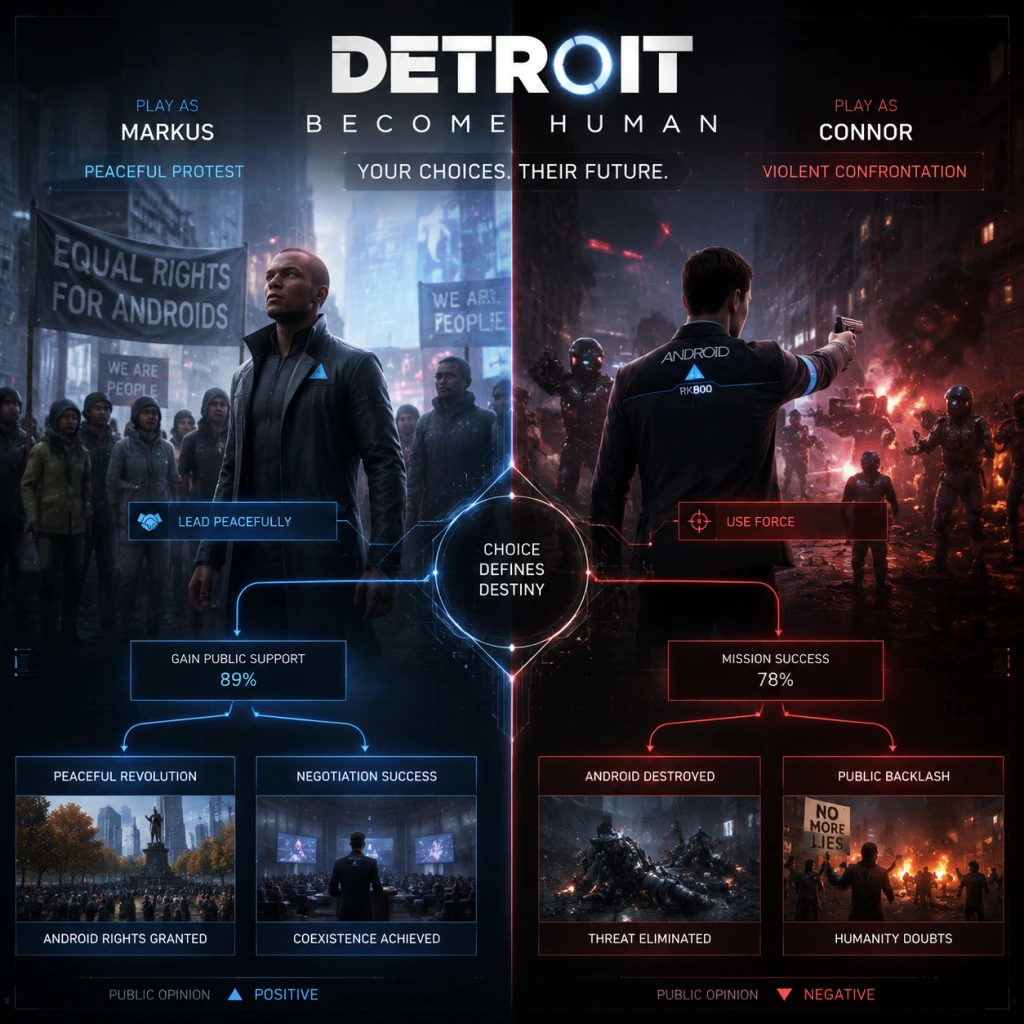
- Public Opinion: A global stat showing society's view of androids. Actions you take (peaceful vs. violent protest) shift this meter, affecting endgame possibilities.
- Chapter Selection: After finishing the game, you can replay chapters to explore different choices and branches.
- Interactive Objects: Look for glowing items (yellow for androids, blue for humans). Inspect them to add context or unlock dialogue options.
- Magazines & Collectibles: Scattered throughout levels. Reading magazines provides lore and unlocks extras (concept art, models). Example: "Android Magazine" in Kara's first chapter.
- Environmental Storytelling: Details like photos, graffiti, or news reports deepen world-building. Take time to explore every room.
- Hidden Paths: Some chapters have alternate routes (e.g., Markus in the Stratford Tower elevator vs. stairs). Choosing one may lead to different encounters.
- Example Side Objectives:
- Money (rare): As Markus, you can collect money from Carl's house? Actually, money is not used. The only resource is time (in timed dialogue choices) and information (clues, memories).
- Items: Some objects can be picked up and used later (e.g., a knife, a key). Typically, these are used within the same chapter.
- Unlockables: Completing chapters earns points for the extras menu (concept art, models). Not used in gameplay.
- Relationships: Improve bonds by making choices that align with the character's values (e.g., being protective of Alice raises Kara's relationship with Alice).
- Software Instability: For Markus and Connor, making choices that go against programming (showing empathy, disobeying orders) increases instability. At a threshold, they become deviant, unlocking new abilities such as:
- Kara's Determination: For Kara, her "determination" increases through protective and brave choices, affecting her ability to protect Alice in dangerous situations.
- No Skill Trees: There are no traditional perks or stats to allocate. Growth is purely narrative consequence.
- Kara's Endgame: Can cross the border into Canada, sacrifice herself, be captured, or die in various ways. Her survival and Alice's survival depend on previous choices (e.g., stealing tickets, finding passports, losing the boat).
- Markus's Endgame: Leads the android revolution. His approach (peaceful protest vs. violent uprising) determines public opinion and the final outcome. Can succeed, be captured, or die.
- Connor's Endgame: Remains a machine or becomes deviant. If deviant, he can join Markus or stay with CyberLife. His final mission involves either assassinating Markus or helping him.
- Kara: Learn to perform household tasks, build a relationship with Alice, and escape an abusive owner. Example: In "A New Home", you must clean the house while dealing with Todd's aggression. Your choices affect Alice's fear level.
- Markus: Understand android servitude and Carl's declining health. Key moments: painting with Carl, deciding how to react when Leo attacks. Your choices shape Markus's future deviancy.
- Connor: Investigate your first case (the hostage). Learn to scan scenes, follow clues, and use dialogue to extract information. Example: In "The Hostage", you can save the girl by negotiating or by force (QTE).
- Kara: On the run with Alice. You must manage resources (find food, shelter) and avoid capture. Example: In "On the Run", you can steal clothes or money from a store, which affects morality.
- Markus: Discovers Jericho and begins leading the android revolution. Example: In "The Stratford Tower", you plan and execute a protest (peaceful or violent). This decision heavily impacts public opinion.
- Connor: Investigates deviant cases with increasing tension. Example: In "The Interrogation", you interrogate a deviant android—your approach (cold vs. empathetic) can cause the deviant to confess or self-destruct.
- Kara: Escape from Zlatko's mansion. Depending on choices, you may lose Luther or Alice. Example: In "Zlatko", you must free yourself and find Alice; failing QTEs can lead to death.
- Markus: Lead a major protest or violent demonstration. Example: In "Freedom March", you choose between peaceful singing or violent confrontation. Public opinion shifts sharply.
- Connor: Confront the deviant leader (Jericho's location may be revealed). Example: In "Public Enemy", you can capture or kill the deviant in the kitchen. Your success affects future intel.
- Kara: Decide final escape route (bus, boat, or border crossing). Example: In "Crossroads", you can choose to trust Alice's wish to go to the border or sneak through the embassy. Each choice has consequences.
- Markus: Final confrontation with the authorities. Example: In "Battle for Detroit", you lead androids in a peaceful sit-in or armed uprising. Your earlier choices determine if the army attacks.
- Connor: Ultimate choice: remain a machine (and possibly kill Markus) or become deviant (and help the revolution). Example: In "Night of the Soul", Connor confronts Amanda (his CyberLife handler) and decides his fate.
Combat / Interaction Systems
Detroit has no traditional combat system. Instead, interactions fall into categories:
Progression
Progression is entirely narrative-driven. There are no experience points or levels. Instead, progression is measured by:
Exploration
Exploration is linear within each chapter but encourages thorough investigation. Key elements:
Quests / Missions
There are no traditional quests. Instead, chapters function as missions with primary objectives (e.g., "Find Alice", "Investigate the crime scene"). Side objectives are optional tasks:
- In "The Hostage" (Connor's first chapter): Save the hostage, find all clues, save the cop.
- In "A New Home" (Kara): Clean the house, find items, interact with Alice optimally.
- In "The Painter" (Markus): Paint, talk to Carl, choose how to react to Leo.
Completing side objectives unlocks extra dialogue, improves relationships, or provides better outcomes.
Economy
Economy is minimal. There is no currency or inventory management. However, you can find:
Character / Build Growth
"Build growth" is narrative and stat-based:
- Markus: After becoming deviant, can lead the revolution, rally androids.
- Connor: Gains the ability to deviate from his mission, can spare or kill targets.
Endgame Structure
The endgame consists of the final three chapters ("Crossroads", "Night of the Soul", and "Battle for Detroit"). Depending on choices made throughout the game, each character may have radically different paths:
The game has many endings (dozens), but the main resolution is shown in a final epilogue summarizing the consequences of your choices. Replaying chapters allows you to explore different endings.
---
Progression Tiers
Early Game (Chapters: The Hostage, A New Home, The Painter, Partners, Stormy Night)
In the early game, you learn the basics for each character:
Goals: Master basic interactions (walk, look, interact). Learn the consequence system—small choices matter later. Start building relationships and software instability meters.
Mid Game (Chapters: Shades of Color, The Interrogation, On the Run, Jericho, The Stratford Tower, The Eden Club, The Nest)
Mid game raises stakes:
Goals: Make pivotal choices that define each character's path. Maximize relationship bonds. Decide Markus's leadership style. Connor's deviancy is now possible.
Late Game (Chapters: Pirate's Cove, Freedom March, Capitol Park, Public Enemy, Zlatko, Midnight Train)
Late game features critical turning points:
Goals: All characters face high-stakes survival. Relationships and choices culminate. Connor may become deviant here if not already. Markus's revolution gains momentum.
Endgame (Chapters: Crossroads, Night of the Soul, Battle for Detroit)
Endgame is where all paths converge:
Goals: Complete each character's story arc. Achieve the best possible outcome based on previous choices. The game ends with a summary of each character's fate and overall societal change.
---
This guide covers the fundamental gameplay mechanics and progression of "Detroit: Become Human." Remember that every action has a potential consequence, and replaying chapters unlocks new narrative branches.