Game Introduction
Game Introduction
Overview
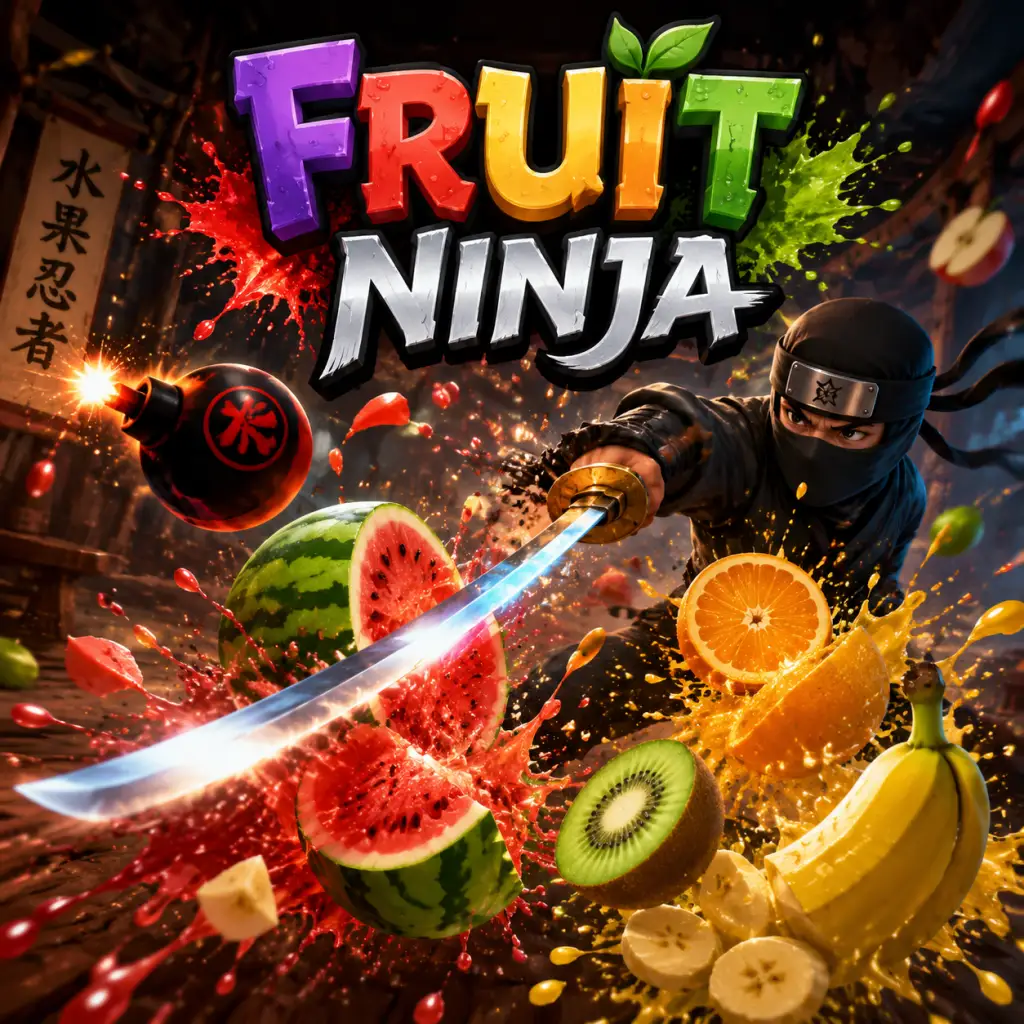
Fruit Ninja is a fast-paced, addictive arcade game that challenges players to slice flying fruit with swipes of their finger (or controller/mouse). Originally launched as a mobile title, it has become a cultural phenomenon with ports to nearly every major platform. The game’s simple premise—slice fruit, avoid bombs—belies its deep replayability and satisfying visual feedback.
Genre
Arcade
Action
Casual
Score Attack
Developer & Publisher
Developer: Halfbrick Studios (an Australian independent game studio based in Brisbane, Queensland)
Publisher: Halfbrick Studios (self-published on most platforms; initial mobile release via Apple App Store and Google Play)
Release Timeline
Original Release: April 20, 2010 (iOS)
Android Release: September 1, 2010
Console/PC Versions: \
- Xbox 360 (Kinect): August 10, 2011 \
- PlayStation 3 (Move): September 20, 2011 \
- Windows Phone 7: December 22, 2011 \
- Wii (MotionPlus): April 19, 2012 \
- Nintendo 3DS: March 14, 2013 \
- PlayStation Vita: March 19, 2013 \
- PC (Steam): August 12, 2015 (Fruit Ninja: The Game) \
- Xbox One: January 7, 2016 \
- PlayStation 4: January 26, 2016 \
- Nintendo Switch: May 10, 2018 (Fruit Ninja: The Game) \
- Oculus Quest: May 21, 2020 (Fruit Ninja VR)
Notable Updates: Many versions received steady content updates adding new blades, backgrounds, and modes. A major re-release, Fruit Ninja 2, was announced for mobile in 2024 but focuses on a different gameplay loop.
Platforms
Mobile: iOS, Android, Windows Phone, Kindle Fire
Console: Xbox 360, Xbox One, Xbox Series X|S (backward compatible), PlayStation 3, PlayStation 4, PlayStation 5 (backward compatible), Wii, Wii U, Nintendo Switch, PlayStation Vita, Nintendo 3DS
PC: Steam, Microsoft Store, macOS (via Mac App Store)
VR: Oculus Rift, Oculus Quest/Quest 2, HTC Vive, PlayStation VR, SteamVR
Other: Windows Mixed Reality, Apple TV, Nvidia Shield
Story Overview
Fruit Ninja does not have a traditional narrative. The “story” is minimal: you are a ninja who practices blade skills by slicing fruit that appears in mid-air. The game world is a dojo or training ground where the ninja perfects their technique. Various themes and backgrounds (e.g., a bamboo forest, a dojo, a carnival) provide context, but the focus is purely on gameplay.
Setting
The primary setting is a traditional Japanese dojo or training area, often shown with wooden floors, sliding doors, and cherry blossom trees. The fruit appears in dynamic patterns, flying in from all sides. Some backgrounds change with special events (e.g., Halloween, Christmas).
Main Characters
The Ninja: The player character, always depicted in silhouette. The ninja has no name, voice, or personality—it’s a blank slate for the player. Different versions (e.g., Fruit Ninja: The Game for consoles) may show a more detailed character, but the core remains anonymous.
The Sensei (mentioned in tutorials): An off-screen teacher who gives tips and encouragement.
Fruit: Not characters per se, but the cast includes apples, peaches, watermelons, bananas (and many more) that react with splashes and sprays.
Core Appeal
Instant Gratification: Each slice produces a satisfying sound, juice explosion, and score pop-up. The feedback loop is immediate and rewarding.
Simple Controls: Swipe to slice—any direction. No complex combos or skills to learn.
Highscore Obsession: The game is built around beating your own best score, earning three-star ratings on levels, and competing on leaderboards.
Zen Mode: For relaxation, with no bombs or time limits.
Variety of Modes: Classic, Arcade, Zen, plus special modes like Survival, Task, and PvP in later versions.
Target Audience
Casual gamers of all ages (ESRB: Everyone 10+ for mild fantasy violence/Fruit juice; PEGI 3)
Mobile gamers looking for quick, pick-up-and-play sessions
Competitive score-chasers who enjoy leaderboards
Fans of arcade-style action and physics-based gaming
VR enthusiasts (Fruit Ninja VR offers immersive slicing)
Game Modes
#### Classic Mode
- Three lives (missed fruit = lost life)
- Bombs end the game immediately
- Goal: achieve the highest score possible
- 60-second timed round
- Three special bananas appear: \
- No lives; just maximize score in the time limit
- 90 seconds with no bombs and no lives
- Pure fruit slicing for relaxation or warm-up
- Endless fruit stream with increasing speed and frequency
- Bombs are present; three lives
- 50 levels with specific objectives (e.g., slice x watermelons, avoid bombs, hit certain fruit in order)
- Each level has three-star rating
- Pass the Blade: Hot-seat competitive play where players alternate turns slicing fruit; highest total wins.
- Fruit Tournament: Up to 4 players compete simultaneously on split-screen (on supported platforms) – slice fruit on your side to send bombs to opponents.
- Online Leaderboards: Asynchronous competition for all modes via internet.
- Juice Physics: Realistic splashing and particle effects that made slicing fruit feel visceral and satisfying.
- Touchscreen Pioneer: One of the first games to showcase the potential of capacitive touchscreens for simple, intuitive interactions.
- Bomb Inclusion: The risk-reward of avoiding bombs while chasing high scores added tension.
- Minimalist Design: No ads (in paid versions) and no clutter—just fruit, blade, and score.
- Cross-Platform Legacy: From phones to VR, the core gameplay translates perfectly without losing its charm.
- Cultural Impact: Memes, references in TV shows, and even a mention in the Oxford English Dictionary for “fruit ninja” as a generic term for slicing games.
#### Arcade Mode
Freeze Banana: slows time \
Frenzy Banana: doubles score per slice \
Double Banana: gives a second point multiplier \
#### Zen Mode
#### Survival Mode (console/PC versions)
#### Task Mode (console/PC versions)
#### Multiplayer Modes (in console/PC versions)
Online/Offline Support
Offline: Single-player modes (Classic, Arcade, Zen, Survival, Task) can be played entirely offline.
Online: Required for leaderboards, achievements/trophies syncing, and some multiplayer modes (e.g., online tournaments in console versions, cloud saves). The mobile version uses online for daily challenges and social features but core gameplay is offline.
Local Multiplayer: Available on console/PC versions via split-screen or hot-seat, no internet required.
DLC & Expansions
Blades and Backgrounds: Cosmetic DLC packs were released for mobile (e.g., Katana Blade, Dojo 2 Background, etc.). Many are earned through in-game currency or purchased.
Fruit Ninja: The Game (2015) – A standalone retail release for consoles and PC that includes all prior DLC and new modes.
Fruit Ninja VR (2016) – A separate VR title with room-scale slicing, different fruit patterns, and multiplayer battles.
Fruit Ninja 2 (2024) – A sequel on mobile with a progression system, loot, and daily quests; not DLC but a new title.
* Seasonal Events: Usually free updates with themed backgrounds, fruit decorations, and limited-time blades (e.g., Christmas, Halloween, Chinese New Year).
What Makes This Game Unique
Final Thoughts
Fruit Ninja is a masterclass in arcade game design. Its simplicity allows anyone to play immediately, yet its depth of scoring mechanics and mode variety keeps veterans coming back for decades. Whether you have 30 seconds or an hour, Fruit Ninja provides a crisp, juice-filled slice of fun.