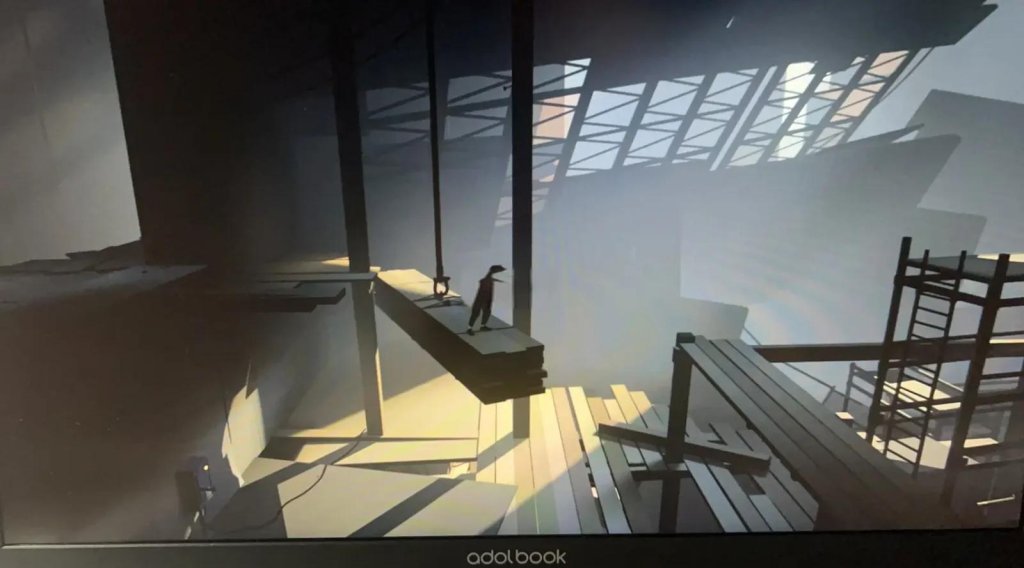
Core Gameplay
Core Gameplay Overview
Inside is a 2.5D cinematic puzzle-platformer with no combat, no dialogue, no inventory, and no traditional RPG elements. The gameplay loop is deceptively simple: move right, interact with the environment, avoid instant death, solve physics-based puzzles, and progress through a linear sequence of hauntingly atmospheric set pieces. The entire experience is a single, uninterrupted journey with no level select or menu hub. Progression is purely environmental and narrative-driven, with new gameplay mechanics introduced through the world itself rather than any skill tree or upgrade system. The only collectibles are 12 hidden glowing orbs that unlock an alternate ending.
Main Gameplay Loop
The core loop can be broken into five repeating steps:
1. Observe – Survey the new screen for hazards (searchlights, guard dogs, water, machinery), movable objects (crates, levers, ladders), and the path forward.
2. Move – Use the left stick/d-pad to run left or right; hold a button (A/X/cross) to sprint. The camera follows automatically.
3. Interact – Press the action button (E on PC, A on Xbox, X on PlayStation) to push/pull objects, climb ledges, operate levers, or trigger mechanisms. Some objects require a sustained press.
4. Solve – Combine movement and interaction to overcome obstacles: e.g., stacking crates to reach a high ledge, using a water pump to raise a platform, or timing a sprint past a spotlight.
5. Avoid Death – Every hazard kills you instantly and resets you to the last checkpoint (auto-saves every few rooms). Death animations are graphic but quick to reload.
Interaction Systems
Inside’s interaction system is entirely context-based. There are no weapons, no attacks, and no inventory. The player character (a young boy in a red shirt) can perform these actions:
| Action | Control | Example |
|---|---|---|
| Walk/Run | Directional stick + sprint button | Sprint toward a closing door before it slams shut |
| Jump | A/X/cross | Vault over small gaps, onto ledges |
| Climb | Auto-grab when near a ladder or ledge | Shimy up a drainpipe or across a horizontal beam |
| Push/Pull | Action button (hold to drag) | Move a crate onto a pressure plate |
| Operate Lever | Action button near a switch | Pull a lever to open a gate |
| Swim | Directional stick (air bubbles nearby) | Traverse flooded rooms; drown if air runs out |
| Control Hostage | Action button near a mind-controlled person | Use the mind-control helmet to guide bodies |
| Merge (Late Game) | Automatic after inhaling the hive | Control the giant flesh blob |
Progression
Progression is linear and story-bound. There are no experience points, levels, or skill unlocks. The only “growth” is the introduction of new abilities through environmental discoveries:
- Early Game: Basic Movement & Stealth – Move right, avoid searchlights and guard dogs, solve simple crate-and-lever puzzles. The boy can only jump, climb, push, and sprint.
- Mid Game: Underwater & Machinery – After falling into an underwater river, the boy learns to swim (limited by air bubbles) and use machinery like water pumps, forklifts, and submersible vehicles. The first major new ability is driving a small submarine deeper into the facility.
- Late Game: Mind Control & Hive – After a shockwave sequence, the boy acquires a mind-control helmet that allows him to manipulate other human subjects to stand on switches, activate levers, or serve as human shields. This is the game’s most complex mechanic.
- Endgame: The Hive Entity – The boy merges with a giant mass of flesh and nerves, becoming a giant blob that can smash through walls, break through fences, and walk through heavy water. This is the only form of “character growth” – a literal transformation.
- Hidden Orbs (12 total) – Yellow glowing spheres found in secret rooms. Collecting all 12 unlocks a hidden ending after the main credits. Each orb is tucked away in a dead-end or behind a breakable wall.
- Alternative Routes – A few puzzles can be solved in two ways (e.g., stacking two crates vs. using a see-saw), but both lead to the same next area.
- Easter Eggs – Vague references to Limbo, hidden notes, and unnerving imagery.
- Setting: A dark forest, a farm with roaming men in blue coats, pig pens, guard towers.
- Mechanics Introduced: Movement, sprint, jump, climb (ladders, ledges), push/pull crates, stealth (avoiding flashlight beams), instant death from dog attacks or falling.
- Puzzle Examples:
- Collectible: Orb #1 in a crate-hidden alcove near the first silo.
- Key Milestone: Falling into the flooded underground bunker after a chase sequence.
- Setting: Dimly lit underwater corridors, massive factory floors, conveyor belts, forklifts, a submerged vehicle bay.
- Mechanics Introduced: Swimming (limited air; surface for bubbles), driving a submersible (dodge obstacles, avoid crushing doors), operating heavy machinery (cranes, forklifts), chain-linked puzzles (pulling two levers in sequence).
- Puzzle Examples:
- Collectible: Orbs #2-#6 hidden in dead-end ducts, behind breakable glass, or inside submerged rooms.
- Key Milestone: Emerge from the factory into an open field with a massive, sky-high structure in the distance.
- Setting: A barren field with wind, a vertical laboratory, rows of armed guards, a giant glowing orb on a tower.
- Mechanics Introduced: The mind-control helmet (activate by standing near a stationary human subject; then you control that subject’s movements). The controller subject can walk, stand still, and be pushed into danger. You can switch back to the boy at any time.
- Puzzle Examples:
- Collectible: Orbs #7-#10 hidden behind movable facility objects or in remote corners of the mind-control area.
- Key Milestone: The shockwave sequence – a frantic auto-scrolling segment where the boy must sprint right without stopping, avoiding collapsing platforms and debris.
- Setting: The inner core of the massive structure, filled with pulsing organic matter, human experiments, and the final hive chamber.
- Mechanics Introduced: None new until the transformation. After merging with the blob, you control a massive, slow-moving entity that can smash through breakable walls, wade through water, and crush obstacles.
- Puzzle Examples:
- Collectible: Orbs #11 and #12 (if missed earlier) are near the hive entrance and in the blob’s escape path.
- Key Milestone: The final cutscene – either the normal ending or the hidden ending if all orbs collected.
There are no checkpoints you can manually save; the game auto-saves every 20-30 seconds.
Exploration
While Inside is strictly linear, it rewards curiosity. Many screens hide secrets off the main path (usually to the left or behind a movable crate). Exploration yields:
Example: In the farm section (early game), at a tall silo, instead of climbing the ladder immediately, you can push a crate left to reveal a shallow pit containing Orb #1.
Quests / Missions
Inside has no quests or missions in the traditional sense. There is no dialogue, no NPCs giving instructions. The only directive is implicit: keep moving right. The game tells its story through environmental storytelling and silent cutscenes. Objectives are purely emergent: “get past the guard dogs,” “escape the flooding room,” or “reach the glowing hive.”
Economy
There is no economy in Inside. The player collects nothing except the 12 optional orbs. There is no currency, no items to buy, no upgrades. The boy has only his red shirt and the clothes on his back throughout the game.
Character / Build Growth
There is no character or build growth in a conventional sense. The boy never learns new skills; instead, the game introduces new tools and environments that change how you interact with the world. The only “growth” is the final transformation into the hive entity, which replaces the boy’s small frame with a massive, unstoppable blob. That transformation is permanent for the final 15 minutes of the game.
Endgame Structure
After collecting all 12 orbs, the ending changes slightly: the boy unplugs the hive entity, releasing a shockwave that (impliedly) resets the world? Without the orbs, the player character slumps into a chair, and the game fades to black. The endgame sequence itself (the final 20-30 minutes) is a continuous, unbroken segment that includes:
1. The Shockwave Run – The boy is forced to sprint right through collapsing structures while being chased by a massive shockwave. This is pure adrenaline and timing.
2. Underwater Tunnels – Drowning danger, tight passages.
3. The Laboratory – Mind-controlled slaves, giant machinery, pressure puzzles.
4. The Hive Chamber – A room full of interconnected flesh and brains. The boy is sucked into the center, initiating the transformation.
5. The Blob Escape – Controlling the giant blob, breaking out through concrete walls, fighting through security forces (who are now helpless against you). The blob eventually stumbles, falls into water, and sinks. The game ends with a bizarre, ambiguous sequence that invites interpretation.
There is no New Game+ or post-game content aside from replaying to collect missed orbs for the alternate ending.
Core Gameplay by Player Progression Tiers
Early Game (First 20 Minutes – Farm, Forest, and Underground Bunker)
- Push a crate to a wall to climb over a fence.
- Stack two crates to reach a window sill.
- Time your sprint past a patrolling searchlight.
- Use a series of levers to drain a pond and reveal a passage.
Mid Game (Minutes 20–60 – Underwater, Factory, Construction Site)
- Navigate a flooded room by pushing a floating crate to create a platform.
- Drive a submarine through narrow pipes while avoiding spinning turbines.
- Use a forklift to lift a crate onto a high platform; then climb the crate.
- Balance a see-saw with multiple crates to raise a gate.
Late Game (Minutes 60–90 – The Field, Shockwave, Mind Control Section)
- Use a mind-controlled slave to stand on a pressure plate while you go through a door.
- Have a slave jump onto a switch, lowering a bridge for the boy.
- Sacrifice a slave to a security dog to distract it while the boy sneaks past.
- Coordinate two slaves to hold buttons simultaneously.
Endgame (Last 20 Minutes – The Hive, Transformation, Escape)
- As the boy: pull a series of levers to open a path to the hive center.
- As the blob: walk through a series of chambers, breaking windows and doors; one room requires you to duck under a descending metal gate (auto-duck).
- Final room: a wall of water – the blob sinks slowly, and you can no longer control the ascent. The game ends with the blob lying on a beach, then a bright flash.
Summary
Inside’s core gameplay is a masterclass in environmental storytelling and minimalist design. There are no menus, no upgrades, no HUD – just a boy, a red shirt, and a relentless push to the right. The player tiers reflect the game’s three distinct acts: stealth and basic puzzles (early), underwater and machinery (mid), mind control and transformation (late/endgame). The experience is short (2–3 hours) but dense, rewarding careful observation and persistence. Every death is a lesson, and every puzzle solved feels organic to the world.