Core Gameplay
Core Gameplay
LEGO Star Wars: The Skywalker Saga blends classic LEGO action-adventure with open-world exploration across the nine main saga films. This guide breaks down the core gameplay systems by player progression tiers, explaining how the loop evolves from your first minutes to post-game completion.
---
Early Game (Tutorial – First 2-3 Planets; Levels 1–4 of any Trilogy)
Main Gameplay Loop:
- Play through linear story levels (each trilogy has 5 levels). During levels, solve puzzles, defeat enemies, collect LEGO studs, and unlock new characters via quests or buying from hubs.
- Between levels, explore the small hub area (e.g., Tatooine for Episode I, Mos Eisley Cantina after starting Episode IV). Unlock free play by replaying levels with any characters.
- Basic mechanics: One attack button (square/X), jump (cross/A), and interaction (circle/B for consoles; E, Space, F on PC).
- Each character has a class-specific ability (e.g., Jedi use Force push/pull, blaster heroes shoot, droids hack terminals). In early game, you mostly use the characters provided in the level.
- Light puzzle solving: stack blocks, use Force to move objects, shoot targets, activate switches.
- No health bars; losing all hearts costs studs (respawns instantly).
- Earn studs to purchase characters, ships, and power-up upgrades in Cantinas (hubs). Early game studs are scarce; focus on buying cheap characters (2,500–5,000 studs) to unlock new abilities.
- Complete story levels to unlock new character tokens and access the next planet in the trilogy.
- Each level has 10 mini-kits (collectible pieces) and a True Jedi award for collecting enough studs. These unlock ships and extras.
- Hubs are small in early game. On Tatooine, you can run around the desert, find a few side quests (often from characters with glowing quest markers), and discover datacards that unlock class ability upgrades.
- No fast travel yet; you run/walk or use a land vehicle (like a speeder) if you buy one.
- Story levels are linear. Side quests appear as glowing quest markers in hubs; they are simple fetch or combat tasks (e.g., “Find 5 missing droids”). Rewards include studs, Kyber Bricks (used for class upgrades), or character tokens.
- Puzzles are straightforward: destroy silver LEGO objects to build new platforms or bridges.
- Currency: Studs (yellow, blue, purple, stud bars). Larger studs are worth more. Also Kyber Bricks (green crystals) from quests/levels, which are used to buy ability upgrades in the Holoprojector menu.
- Cantina shops sell characters (unlocked by tokens found in level or from quests), vehicles, and ship upgrades. Ships cost 10,000–50,000 studs; characters from 2,500–50,000.
- No traditional leveling. Instead, unlock new characters via tokens (found in levels/quests). Each character has a class (Jedi, Hero, Scavenger, etc.) with a unique ability tree.
- The Holoprojector menu lets you spend Kyber Bricks to upgrade class abilities (e.g., Jedi: faster lightsaber attacks, extended Force range). Start with basic upgrades: more health hearts, longer combos.
- In early game, you have few characters; rely on the story-provided ones. Replay levels with different characters to find hidden areas (e.g., use a droid to hack a terminal that opens a door with a token).
- In Episode I: The Phantom Menace, the first level “Theed Palace” has you play as Qui-Gon Jinn and Obi-Wan Kenobi. Defeat battle droids, push blocks, and collect studs. After the level, you return to Tatooine hub, where you can buy Jar Jar Binks for 5,000 studs (if you have enough) and find a datacard for a Jedi upgrade.
- You now alternate between finishing remaining story levels in a trilogy and exploring multiple planets in free roam. Hubs have expanded (e.g., Coruscant, Bespin) with many side quests.
- Replay previously completed levels with any unlocked character to find all collectibles (mini-kits, tokens, Kyber Bricks). This is critical for 100% completion.
- Open-world planets become fully accessible: you can fly between them in space using your unlocked ships. Space combat and exploration (asteroid fields, capital ships) open up.
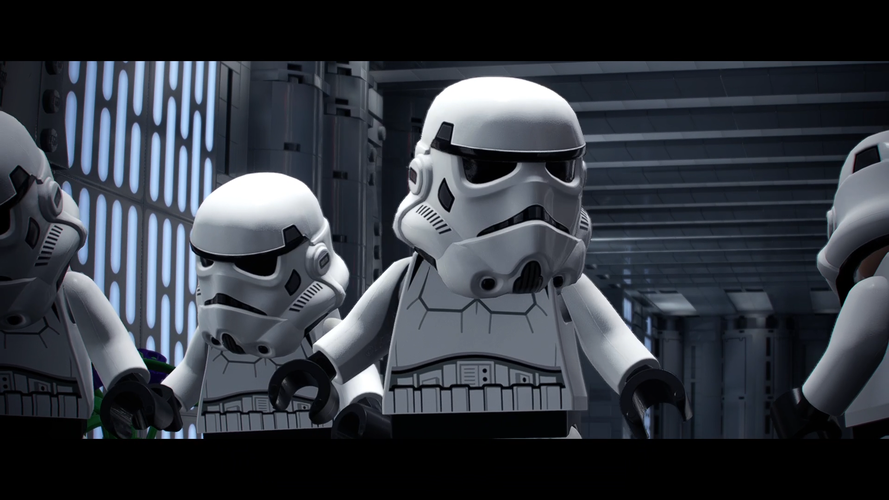
- More enemy variety: Sith, stormtroopers, bounty hunters, etc. You have upgraded class abilities (e.g., stronger Force powers, blaster overcharge).
- Puzzles require combining abilities: a Scavenger (like Rey) can wall-climb, then a Jedi uses Force to move a platform, then a droid hacks a console.
- Vehicle sections (speeder chases, starship dogfights) appear more often in story levels and open world. Use the ship’s weapon and boost to defeat targets.
- Purchase expensive characters (15,000–50,000 studs) to unlock all abilities. Some characters are only available after completing specific quests (e.g., Darth Vader after finishing Episode VI).
- Upgrade class trees fully: for example, the Hero class (Han Solo, Finn) gets a grappling hook ability (purchasable with Kyber Bricks) that lets them climb high ledges and pull objects.
- Unlock Extras like “Disguise” or “Invincibility” by collecting enough mini-kits (e.g., 10 mini-kits from all levels). These provide helpful cheats but may disable stud accumulation.
- Use the Galaxy Map to travel between planets. Visit planets in any order once unlocked.
- Each planet has a collectible counter showing datacards, Kyber Bricks, and side quests. Use the Holoprojector map to locate them.
- In space, you can find hidden space stations, battle enemy squadrons for studs, or dock at capital ships for side quests.
- Side quests multiply. Examples: “A Race Against Time” (speeder race on Tatooine), “Feed Han Solo” (fetch quest in Mos Eisley), “Defeat 50 Stormtroopers” in a planet area.
- Some quests reward new characters (e.g., complete “The Lost Droid” to unlock C-3PO).
- Challenge missions: time trials, combat arenas, or puzzle rooms that reward purple studs (500 studs).
- Stud income increases because you have upgraded stud multipliers (found via datacards). Use the Holoprojector to buy multipliers: 2x, 4x, 6x, 8x, 10x (each costs more Kyber Bricks). These multiply all studs collected, making purchases easier.
- Ships cost 50,000–200,000 studs. Focus on a few key ships like the Millennium Falcon or a fast fighter for space travel.
- Kyber Bricks become more abundant from quests and hidden locations; upgrade all class trees gradually.
- Unlock and upgrade all classes: Jedi (7 abilities), Hero (7), Scavenger (7), Droid (7), Bounty Hunter (7), and Dark Side (7). Each upgrade requires Kyber Bricks. You need about 500 total Kyber Bricks for all class abilities; mid-game you may have 100–200.
- Specific builds: If you favor combat, max out Jedi and Dark Side for strong lightsaber and Force moves. For puzzle-solving, upgrade Scavenger (wall climb, stealth) and Droid (hacking, computer access).
- On Coruscant, you take a side quest from a bounty hunter to defeat 10 droids in the underworld. Use a character with a blaster (like Boba Fett) to shoot from range. Reward: 3 Kyber Bricks. Then, replay Episode I “Theed Palace” in free play as a Scavenger to reach a hidden platform with a mini-kit.
- Almost all story levels are done. Focus shifts to 100% completion: collect every token, mini-kit, Kyber Brick, and datacard across all levels and planets.
- Open world is fully explored; you have fast travel points at each hub. Use the Holoprojector to pin collectibles.
- You have all key characters and upgrades. Now you play as any character to solve any remaining puzzle.
- Combat becomes trivial with high-level upgrades. Use Jedi “Focus” ability to slow time and slice through enemies. Use Dark Side “Fear” to cause enemies to flee.
- Space combat is mastered: use ships with homing missiles or high speed to clear challenges quickly.
- No new gameplay mechanics; instead, focus on efficiency guides for collectibles.
- The only remaining progression is buying all characters (including expensive ones like Darth Sidious for 200,000 studs) and upgrading all characters’ class abilities. You need all Kyber Bricks (around 900 total in the game).
- Unlockable Extras: complete mini-kit collections for each level to unlock cheats like “Faster Build” or “Stud Magnet”. These can speed up farming.
- Use character abilities to access every nook. For example, on Endor, use a Scavenger to wall-climb up trees, then a Bounty Hunter to turn into a thermal vision and find hidden datacards.
- Each planet has a 100% icon in the Holoprojector; completing it requires finding all 5 datacards, 10 Kyber Bricks, and finishing all side quests.
- Remaining side quests are often multi-step: “Help Chewbacca gather porgs” (find 5 porgs across Ahch-To). Use the Holoprojector to track.
- Combat challenges at “Combat Arenas” on each planet: defeat waves of enemies for Kyber Bricks.
- No new story missions; only cleanup.
- Studs are plentiful; you likely have a 10x multiplier. Buying the last characters (like Jabba the Hutt for 1 million studs) still requires farming. Best farm: replay the final level of Episode I (or any level with many studs) with multipliers and a character with fast attack speed.
- Alternatively, fly around in space and destroy enemy squadrons (each ship drops studs worth 500–1000).
- Kyber Bricks become the bottleneck; you need to find them in hidden locations. Use the Holoprojector map to spot green markers.
- All class abilities are maxed. No further growth.
- Some characters have unique passive bonuses (e.g., Lando Calrissian grants double studs from enemies). Equip them when farming.
- To get the mini-kit on the Kashyyyk level “The Battle of Kashyyyk”, you need a droid to hack a terminal, then a Scavenger to climb a wall, then a Jedi to pull a lever. Play in free play with your maxed characters. After getting all mini-kits in that level, you unlock the “Faster Build” extra.
- No new content. The game becomes a sandbox where you can freely explore any planet with any character and use all abilities.
- Relive favorite battles with up to 4 player co-op (local) or replay any level with full character roster.
- Challenge modes: the game includes “Challenge” events in hubs (e.g., a timed obstacle course) that reward cosmetic items like new skins (e.g., “Beach Leia” or “Pajama Han”).
- Achievements/trophies: many require specific actions like “Travel to hyperspace 10 times” or “Defeat 100 enemies with a lightsaber” – easily done in endgame.
- All abilities available. Experiment with character combinations: use a Bounty Hunter’s rocket launcher to destroy large groups, or a Jedi’s “Heal” to keep health high.
- Space combat: you can now fly any ship including the Executor (Darth Vader’s ship) for massive firepower.
- No further progression; purely for fun.
- No progression left. The only missing items are cosmetic skins from the “Galactic Edition” DLC (if purchased).
- You have unlocked all Extras, characters, ships, and upgrades. The game shows a 100% save icon.
- Planetary 100% complete. No hidden areas left. You can still explore for fun, but no rewards.
- Use the debug mode (if on PC) to fly without restrictions, but that’s not official.
- All side quests finished. The only “missions” are replaying story levels with different characters for fun or completing specific challenge achievements.
- For example, “Complete ‘The Battle of Endor’ in under 5 minutes” (achievement). Use a fast character and skip cutscenes.
- Studs are infinite; you have everything purchased. No need to collect more.
- Kyber Bricks have no use once all class upgrades are bought. They become a cosmetic number.
- No growth. You own all 300+ characters (base game + DLC). Each has maxed abilities.
- You can switch any time in the character wheel.
- Cooperative Play: The core endgame is playing with friends in local co-op (2 players, split-screen). Each player picks a character and explores/helps each other in free roam.
- DLC Content: If you have the Galactic Edition, you can play bonus levels from “The Mandalorian”, “Rogue One”, etc., which are separate short campaigns (each about 1-2 hours). These extend endgame playtime.
- Speedrunning: The game has a community for speedrunning; you can practice glitches or optimized routes for 100% completion.
- Creative Play: Build your own scenarios in free play. For instance, set up a battle between 50 stormtroopers vs 50 rebels using the spawn system (only in open-world hubs via glitches, not official).
- Completionist Goals: Earn all achievements/trophies. Some are tricky (e.g., “Get True Jedi on all levels” – easy now with multipliers; “Collect all mini-kits” – tedious but doable).
- In endgame, you and a friend meet on Tatooine. One picks Darth Vader, the other Luke Skywalker. You both replay the Death Star level, trying to see who collects more studs. There’s no reward beyond fun.
- Alternatively, you can fly the Millennium Falcon to every planet and hunt down the remaining Kyber Bricks for that last upgrade, though you likely already have them.
Combat & Interaction:
Progression:
Exploration:
Quests/Missions:
Economy:
Character/Build Growth:
Examples:
---
Mid Game (After Completing 2–3 Trilogies; Free Play Opened on Most Levels; 30–50% Completion)
Gameplay Loop Expansion:
Combat & Interaction:
Progression:
Exploration:
Quests/Missions:
Economy:
Character/Build Growth:
Examples:
---
Late Game (6+ Trilogies Completed; Most Open-World Planets Explored; 70–85% Completion)
Gameplay Loop Refinement:
Combat & Interaction:
Progression:
Exploration:
Quests/Missions:
Economy:
Character/Build Growth:
Examples:
---
Endgame (100% Completion; Post-Game Sandbox)
Gameplay Loop:
Combat & Interaction:
Progression:
Exploration:
Quests/Missions:
Economy:
Character/Build Growth:
Endgame Structure:
Examples:
---
This tiered structure helps you understand how LEGO Star Wars: The Skywalker Saga evolves from a linear story game into an expansive open-world collect-a-thon. Use the early game to learn mechanics, mid game to unlock abilities, late game to clean up, and endgame to enjoy the complete sandbox.