Core Gameplay
Core Gameplay Guide for SOMA
SOMA is a first-person sci-fi survival horror game that prioritizes narrative, atmosphere, and existential themes over traditional combat. There are no guns, no health bars, no skill trees, and no currency. Your progression is entirely story-driven, and your only tools are your wits, your ability to observe and interact with the environment, and a handful of simple inventory items. This guide breaks down the core gameplay loop and systems across four progression tiers, explaining how the experience evolves as you delve deeper into the underwater facility of PATHOS-II.
Main Gameplay Loop
The central loop of SOMA is: Explore → Observe → Solve → Survive → Advance.
1. Explore: You traverse a series of interconnected but distinct areas (e.g., Upsilon, Lambda, Theta, Omicron, Tau). Each area contains multiple rooms, corridors, and outdoor underwater sections.
2. Observe: Pay close attention to environmental details: computer terminals, audio logs, keypads, notes, posters, and the state of the facility. These provide backstory, clues, and objectives.
3. Solve: Most progress is gated by puzzles. These are usually environmental or logic-based: finding a keycard, restoring power, calibrating a device, or connecting cables. There are no complex inventory puzzles; the game uses a simple inventory of one or two items at a time.
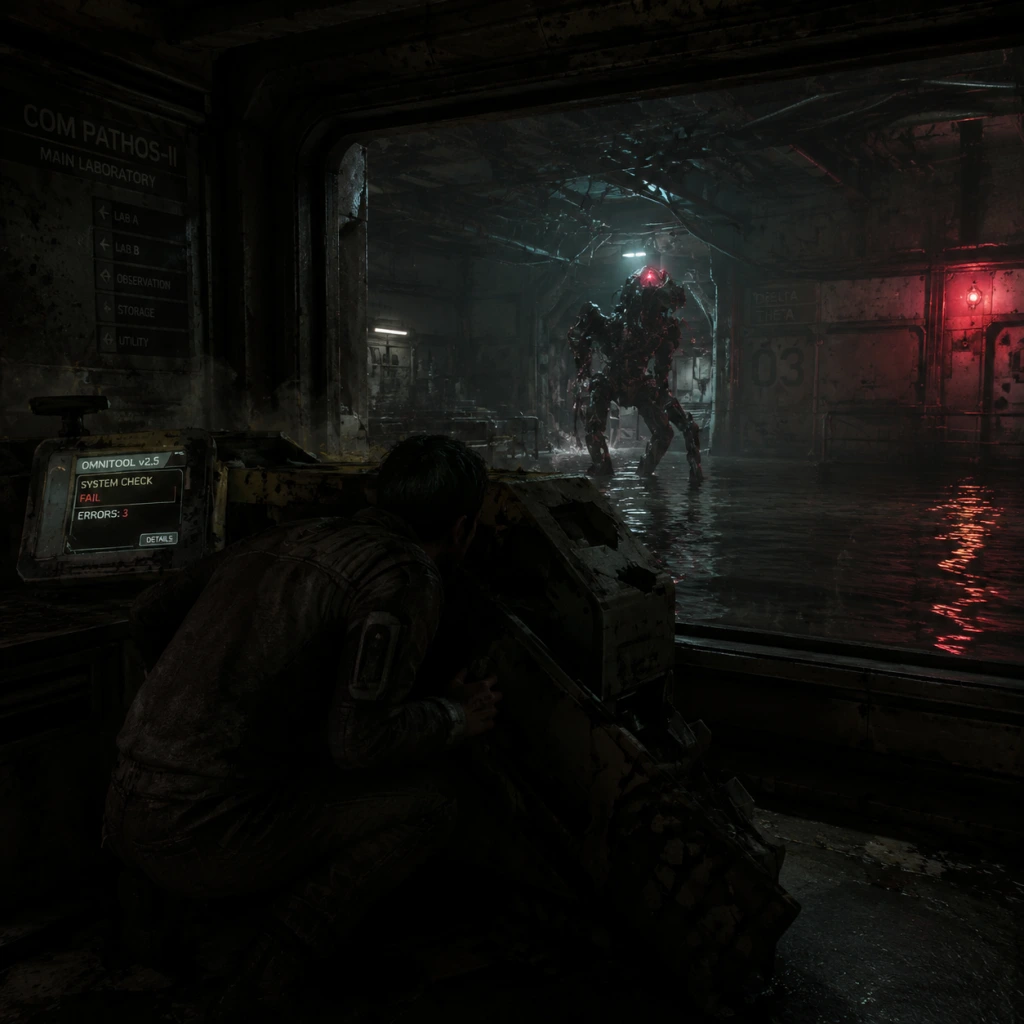
4. Survive: Hostile machines (e.g., the Proxy, the Akers, the Leviathan) and corrupted humans (e.g., the flesher) cannot be killed. You must hide, sneak, or outmaneuver them. There is no combat, only evasion.
5. Advance: After solving the area’s puzzle and surviving any threats, you progress to the next area via a story-triggered event (e.g., riding a transport, entering a deep-sea diving suit, passing through an airlock).
Combat / Interaction Systems
- No Combat: There are no weapons of any kind. You cannot attack enemies. The only way to deal with threats is to avoid them.
- Interaction: Use the mouse button to interact with objects: open doors, pick up items, press buttons, turn valves, etc. The game uses a simple context-sensitive interaction.
- Sneaking and Hiding: When a hostile entity is present, you can crouch (default: Ctrl) to move more quietly and reduce visibility. You can hide behind objects, inside lockers, under desks, or in dark corners. Wait until the enemy’s patrol moves away before proceeding.
- Distractions: You can throw small objects (e.g., a book, a piece of debris) by picking them up and releasing the interaction button while aiming away from an enemy. This can create a sound to lure the enemy away from your path.
- Flashlight: Your flashlight has limited battery. It automatically recharges when in lit areas. Manage its use carefully; in dark areas it’s essential, but it can attract enemies.
- Underwater Navigation: Some sections require swimming. You have a limited oxygen supply (indicated by a bar). Look for air pockets or refill stations. While swimming, you move more slowly and cannot sprint. Certain underwater enemies (e.g., the Jellyfish-like creatures) can be avoided by staying still or moving slowly.
- Checkpoints: The game auto-saves at progress milestones. You can also manually save at designated terminals. Be aware that if you die, you respawn at the last checkpoint, retaining all story progress but losing any unsolved puzzle state.
- No Leveling: Simon does not gain new abilities, health, or stats. Your only growth is understanding the narrative and the nature of your situation.
- Key Items: Occasional inventory items (e.g., a battery, a keycard, a repair tool) are required to solve a puzzle. You cannot carry more than one or two at a time, so you must choose carefully and return items to their original location if needed.
- Audio logs and notes that flesh out the story and characters.
- Alternative paths or shortcuts (e.g., a hidden vent that bypasses a monster).
- Optional environmental puzzles that yield additional story details (e.g., finding Sarah’s backup chip).
- Hidden passages that may contain a collectible or a terminal with backstory.
- Collectibles: There are no traditional collectibles like coins or trophies. The game has a few “story artifacts” (e.g., the K-5 and K-8 bots) that can be interacted with but are not required. The main reward for exploration is narrative immersion.
- Environmental Storytelling: Pay attention to the state of places: a broken window, a bloodied room, a dead scientist. These details tell the story of what happened before Simon arrived.
- Upsilon: “Turn on the communications array to call the other sites.”
- Lambda: “Find the missing crew member.”
- Theta: “Restore power to the tram system.”
- Omicron: “Access the deepest point of the facility.”
- Tau: “Find a way to stop the Structure Gel outbreak.”
- Abyss: “Reach the ARK launch site.”
- No currency (no cash, no credits).
- No shops or vending machines that sell items.
- No trading or bartering.
- Item usage is entirely puzzle-based; you never buy or sell anything.
- The only resources are your flashlight battery (recharges) and oxygen (refilled at stations).
- Early Game: Simon is confused, disoriented, and has no idea what is happening. He believes he is in a hospital and then a nightmare.
- Mid Game: Simon learns the truth about the ARK, the WAU, and the nature of consciousness. He begins to question his own identity.
- Late Game: Simon makes choices based on his understanding of the world. He may decide to trust or oppose Catherine.
- Endgame: Simon confronts the final choice and his own survival.
- Objective: Understand the basic controls, exploration, and stealth mechanics.
- What to expect:
- Example puzzle: At Upsilon, you need to restore power to the workroom by pulling a breaker, then activate a terminal. No enemy interference.
- Survival tip: The first stealth encounter (Proxy) warns you with a low rumbling sound. Hide immediately in a closed locker; wait until the rumbling fades for 10-15 seconds before moving.
- Exploration: Check every room for audio logs—they contain essential story. In Lambda, you can find a hidden audio log about an employee’s final moments; it’s not mandatory but enriches the story.
- Objective: Master evasion and environmental puzzle-solving in larger, more complex areas.
- What to expect:
- Example puzzle: In Omicron, you must find two power cells to open a locked door, then repair a diving suit by swapping a rechargeable battery from another suit. The Akers patrol the area, so you must plan your route.
- Survival tip: Use the “distraction throw” to lure enemies away. When you see an Akers, note its patrol pattern. Wait for it to turn a corner, then quickly move to the other side of the room. Never run unless you are certain the enemy is far away—running makes noise.
- Exploration: Theta has a side room with a terminal that reveals the history of the ARK project. Omicron has a hidden alcove with a final audio log from a crew member. These are easy to miss but provide emotional payoff.
- Objective: Navigate extremely dangerous, claustrophobic environments with limited visibility and more aggressive enemies.
- What to expect:
- Example puzzle: In Tau, you must calibrate a sonar device by turning three knobs to specific frequencies while the Flesher patrols nearby. You must listen to the audio cues and work quickly before the enemy arrives.
- Survival tip: The Flesher can be temporarily disabled by destroying the “heart” of its flesh body (a glowing core) using a pickaxe. This buys you 30-40 seconds of safe time. Use it strategically, not reactively.
- Exploration: Tau contains a back room with a schematic for the ARK; reading it adds context to the ending. Also, you can find a hidden recorder with the final thoughts of a characters.
- Objective: Survive the final gauntlet and make the ultimate narrative choice.
- What to expect:
- Survival tip: In the Abyss, conserve oxygen. If you see an air pocket or a breathing mask, swim directly to it. The Leviathan will not attack if you stay still in the dark—use lights only when necessary.
- Exploration: There is almost no exploration in the endgame; it’s a straight path to the launch chamber. The only optional item is a final audio log near the launch controls.
- Post-endgame: Nothing. The credits play, and the game ends. You can reload the final save to see the alternative ending.
Progression
Progression in SOMA is linear and story-based. You progress through a series of locations (biotopes) in a fixed order. Each area reveals more of the story and increases the tension and existential dread. There is no open world; the game is a guided experience.
Exploration
Exploration is encouraged but not mandatory for completion. However, thorough exploration reveals:
Quests / Missions
SOMA does not have a quest journal or mission system. Instead, the game presents you with a clear overall objective: reach the ARK and launch it. Locally, each area gives you a single primary task. Examples:
There are no side quests or fetch quests that divert from the main narrative. Every puzzle and interaction directly pushes you toward the next story beat.
Economy
There is no economy in SOMA.
Character / Build Growth
There is no character growth in a mechanical sense. Simon Jarrett does not gain skills, perks, levels, or attributes. Your progression is purely narrative. The only change is in Simon’s understanding of his situation:
The moral and philosophical growth is the only “build” in the game. There is no equipment customization or skill tree.
Endgame Structure
The endgame of SOMA occurs after you leave Tau and descend into the Abyss to launch the ARK. It consists of three distinct parts:
1. The Abyss Descent: You navigate a dark, pressure-ridden underwater area with Leviathan-class threats. The goal is to reach the ARK launch chamber.
2. The ARK Launch Site (Omicron’s deep lab): Here you must solve the final puzzle (connecting power cables, managing the power distribution) to initiate the launch sequence.
3. The Final Choice: Once the ARK is ready, you have a narrative decision: enter the ARK yourself (and leave a copy of your consciousness on Earth) or stay behind to maintain the facility. Your choice affects the ending but does not change the credits sequence. There is no post-game content; the credits roll after the ending.
After the credits, you can reload a save to re-experience the ending or see the other outcome, but there is no “endgame loop” or New Game+.
---
Player Progression Tiers
While SOMA is linear, the experience can be divided into four tiers based on the player’s familiarity with the systems and the escalating tension.
#### Early Game (Upsilon & Lambda)
- Linear corridors with few threats. The first enemy (the Proxy) appears near the end of Upsilon; you learn to hide in lockers and wait.
- Simple puzzles: turning on generators, scanning a body, inserting a keycard.
- Heavy exposition: audio logs and terminals explain the WAU and the accident.
#### Mid Game (Theta & Omicron)
- Multiple enemies coexist: the Proxy in Theta, and the “Akers” (a deranged human) in Omicron. The Akers are faster and patrol long corridors.
- Larger maps with branching paths, verticality (multiple floors), and more optional rooms.
- Puzzles that require backtracking or carrying an item from one end of the area to another (e.g., carrying a battery to a power unit).
#### Late Game (Tau & Abyss Entrance)
- The “Leviathan” in Tau is a massive, tentacled creature that demolishes walls. You cannot hide from it—you must sprint through certain sections while it chases.
- The “Flesher” in Tau is a persistent enemy that regenerates and follows you across rooms. It can be temporarily slowed by collecting “jelly” to destroy its flesh mass.
- Puzzles become more involved: connecting cables under time pressure, navigating a dark underwater labyrinth with oxygen constraints.
- Emotional climax: moral choices about the fate of characters like Simon-2 or the WAU.
#### Endgame (The Abyss & ARK Launch)
- The Abyss is a deep, dark underwater section with extreme pressure. Your oxygen runs out quickly; there are limited air pockets.
- The final enemy is a “Leviathan” that cannot be escaped—you must use your knowledge of the environment to avoid it in a chase sequence.
- The final puzzle is a power distribution task: you must route power from three generators to the ARK launch system. No enemies interfere, but you are under subtle time pressure (the station is collapsing).
- After the launch, you face the dialogue choice: “Copy yourself onto the ARK” or “Stay behind.” There is no wrong answer for gameplay, only for story closure.
---
Summary
SOMA’s core gameplay is a linear, narrative-focused experience with stealth and puzzles. There is no traditional RPG progression, no economy, and no combat. Your growth is emotional and philosophical. The tiers above represent the increasing complexity of stealth encounters and puzzles, and the deepening of the story’s existential themes. Embrace the atmosphere, explore thoroughly, and prepare for a haunting journey into the nature of consciousness.