Important Notes
Important Notes for The Witcher 3: Wild Hunt
This section contains critical warnings, pitfalls, irreversible choices, missable content, difficulty spikes, grinding traps, save management advice, and common regrets. Read carefully to avoid losing progress or making locked-in decisions that affect your entire playthrough.
Irreversible Choices & Consequences
The Witcher 3 has several major branching story decisions that have lasting effects on quests, characters, and endings. Always manual save before any choice that feels significant.
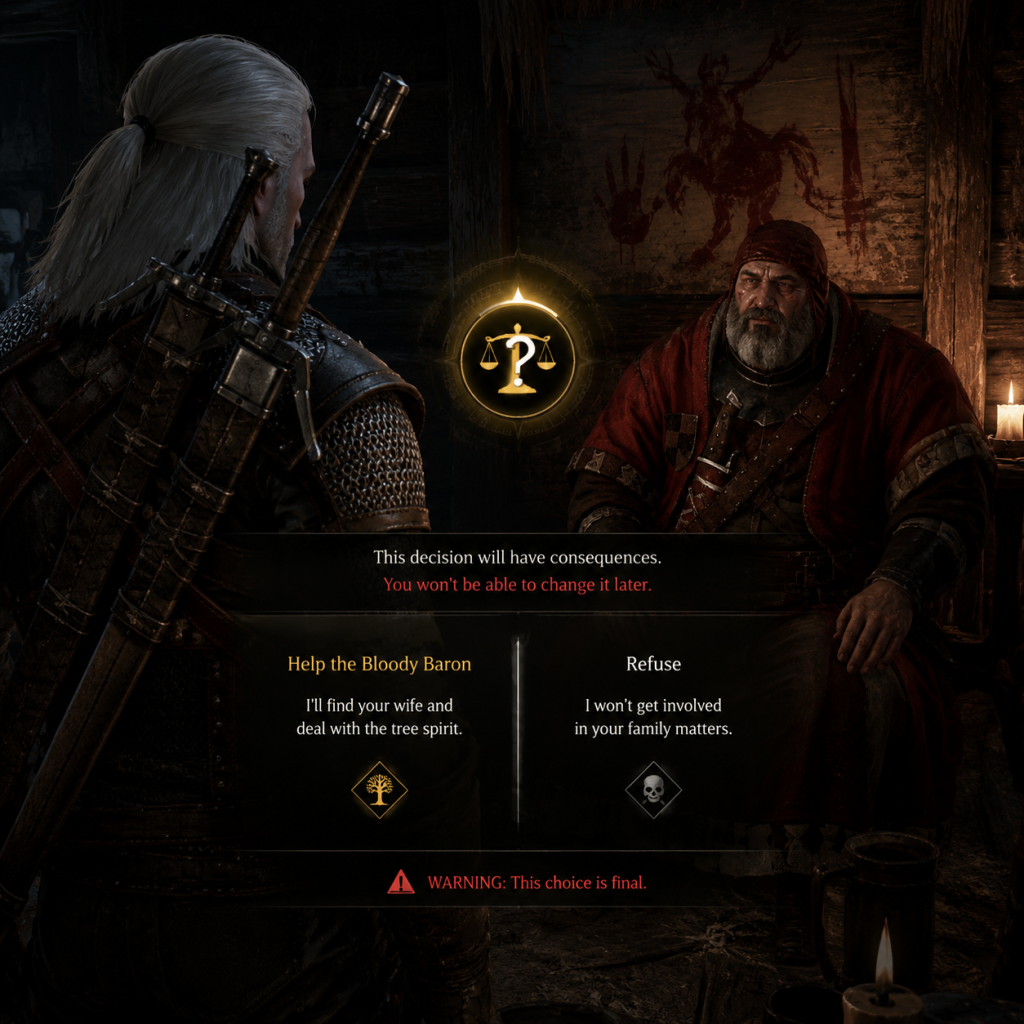
- Bloody Baron Questline (The Family Matters / Ladies of the Wood): Your actions determine the fate of the Baron, his wife Anna, and the orphans. The choice to free the tree spirit or kill it directly affects Anna’s sanity, the Baron’s survival, and the fate of Downwarren. Save before entering the Whispering Hillock.
- Ciri’s Fate: The ending of the game (Ciri becomes a witcher, empress, or dies) depends on five key dialogue choices during main quests. Examples: the snowball fight, visiting Skjall’s grave, encouraging her to calm down, not taking money from Emhyr, and accompanying her to see the Lodge. One wrong choice can lock you into the bad ending.
- Romances: You can only commit to one of the primary romance options (Triss Merigold or Yennefer) if you want a permanent romance. Trying to romance both without completing their quests can lead to being shackled together by Yennefer and then dumped by both. Save before the final romance scene in each path.
- Dijkstra vs. Roche (Reason of State): Your choices during the quest “An Eye for an Eye” and later “Redania’s Most Wanted” determine whether Dijkstra, Roche, or Radovid rules. This choice locks out future quests and affects the Northern Realms’ ending slides. Save before meeting with Dijkstra at the bathhouse.
- Hearts of Stone (Ira Merigold’s fate?): The final decision with Gaunter O’Dimm, and whether you save Olgierd or not, gives unique rewards (e.g., the Viper Venomous silver sword or the Caretaker’s shovel). There is no easy way to reverse this.
- Blood and Wine (Ending): You can let Syanna die, kill Detlaff, or save both. The ending affects the fate of Toussaint and determines whether Dettlaff’s victims survive. Save before entering the final conversation.
- All Side Quests Involving Romance (Triss’s “Now or Never”, Yennefer’s “The Last Wish”): “Now or Never” must be completed before you sail to Skellige for the first time (“The King is Dead” – passage to Skellige). “The Last Wish” must be completed before you head to the Isle of Mists (the point of no return). Failing these locks you out of those romance paths.
- Gwent Collecting: Many Gwent cards are only obtainable during specific quests or from merchants who die or disappear. Playable characters like the Bloody Baron, Lambert, and others have unique cards. If you defeat the Baron before he leaves, you can get his card. Also, the “Gwent: Collect ‘Em All” quest is missable if you skip certain innkeepers.
- Witcher Gear Diagrams: Some diagrams (especially in Toussaint) are in restricted areas that become inaccessible after certain quests. For example, the Grandmaster Wolven gear requires exploring a cave during the “There Can Be Only One” quest. Do these scavenger hunts before finishing the main Blood and Wine story.
- Contract: The Mystery of the Byways Murders (Skellige): This contract becomes unavailable after you complete the main quest “Echoes of the Past”.
- Treasure Hunts: For example, the “Hidden in the Swamp” treasure in Velen is tied to a soldier who may die. Always check the notice board and do quests promptly.
- The “Scavenger Hunt: Wolf School Gear” – one diagram is in a cave near Kaer Morhen that you cannot return to after the final battle.
- Early Game (Level 1–5): Wolves, drowners, and noonwraiths can kill you in 2–3 hits. Always dodge, use Quen, and keep food/potions ready. The Griffin in the “The Beast of White Orchard” fight is tough if you ignore signs and oils.
- The Crones of Crookback Bog (Level ~7): Their minions and the fight itself can be overwhelming if you arrive under-leveled or without specter oil.
- Imlerith (Main Story, Level ~20): This boss has a shield that must be broken, and his teleport attacks require precise dodging. Many players get stuck here.
- Eredin (Endgame, Level ~30): The final boss fight is fast-paced; you need upgraded potions and a dodge-heavy strategy. Using Quen is critical.
- Hearts of Stone: The Caretaker (Level ~34–38): This boss regenerates health and is immune to many tactics. You must hit him consistently and dodge his summons. The Ofieri Mage in the same DLC is also notoriously hard.
- Blood and Wine: Dettlaff (Level ~48+): One of the hardest fights in the game. His bat swarm attack can one-shot you if you don’t dodge properly. Use the “Black Blood” potion to damage him when he bites you.
- Over-Leveling: Completing too many side quests early can cause main quests to turn gray (low XP), but the real trap is wasting time on repetitive monster nests. Focus on quests at or near your level for best XP.
- Buying Gear: Never purchase swords or armor from blacksmiths early on (except maybe the Temerian set in White Orchard). Loot everything and craft Witcher gear instead, which is always stronger.
- Selling Wisely: Sell weapons to blacksmiths (they pay more for weapons), armor to armorers, junk to general merchants. Broken weapons/tools can be dismantled to get rare components like dimeritium or monster teeth.
- Hoard Crafting Materials: Don’t sell monster parts, orens, or crafting components like steel ingots. They are needed for Witcher gear and runes. However, you can safely sell food that you don’t need.
- Gold Management: Money is tight early on. Use collected junks like seashells (which break into pearls) and loot everything that isn’t nailed down. Avoid spending on upgrades until you have Witcher gear diagrams.
- Dismantle vs. Sell: Use the “dismantle” option for items that seem valuable but are actually used in high-end schematics (e.g., monster claws, teeth). Check the craftsman’s wares before selling.
- Manual Saves: Create manual saves at these critical moments:
- Multiple Slots: Use at least 3–5 rotating manual save slots. Autosaves overwrite quickly. The game only keeps a limited number of quick saves.
- Cloud Saves: If you have a GOG account, enable cross-platform saves to transfer between PC and console (PS4/5, Xbox, Switch). This is useful but can lead to confusion if you load a save from another platform with different DLC.
- Do Not Rely on Autosave: Autosaves often trigger after a conversation choice, but not before. If you make a mistake, you may have to replay an entire quest sequence. Always manually save before major decisions.
- Learn Gwent Early: The Gwent card game is entirely optional but a major side activity. If you ignore it until late game, you will miss many unique cards from merchants who die or disappear. Start playing as soon as you reach the White Orchard inn.
- Always Use Oils and Potions: The game’s combat becomes much easier if you consistently apply bestiary oils (which are infinite once crafted) and drink Swallow/Tawny Owl potions. You can meditate to refill potions using strong alcohol (e.g., Dwarven Spirit) – always keep a supply.
- Upgrade Quen: The Quen sign shield is the most versatile defensive tool. Upgrading it (through skill points) allows it to heal you or reflect damage. Many players neglect this and then struggle in boss fights.
- Explore Question Marks (?): Not all map markers are worth it, but many hidden treasures contain diagrams, rare weapons, or recipes. In Skellige, the smuggler caches in the water are tedious but can yield valuable loot to sell.
- Don’t Min-Max Immediately: You can respec your character using the “Potion of Clearance” sold by the merchant in Novigrad (near the Passiflora) for 1000 crowns. So you can experiment with skills without permanent regret.
- Repair Your Gear: Weapons and armor degrade over time. Repair them using your own repair kits (crafted or looted) or at any blacksmith/armorer. A broken weapon deals much less damage and can break mid-combat.
- Use the Bestiary: The in-game bestiary gives enemy weaknesses, which oils, bombs, or signs to use. Check it before taking on a tough monster contract.
- DLC Order: Hearts of Stone can be played anytime after reaching level 30 (but is best after main story). Blood and Wine should be played last, as it is set several years after the main story and offers a fitting epilogue.
- Single-Player Only: The Witcher 3 is a single-player game with no multiplayer components. There are no online etiquette rules aside from sharing saves or mods.
- Mods: The PC version supports mods via Nexus Mods or the in-game mod manager (after next-gen update). Mods do not trigger any anti-cheat. Use common sense: avoid mods that break quest progression unless you have backup saves.
- Console Commands (PC): You can enable developer console via config file. This can be used to cheat (add gold, items, etc.) but can corrupt your save. Always save manually before using commands.
- Cross-Save Account: If you use GOG’s cross-save feature, ensure you are logged into the correct account on all platforms. Sharing saves across platforms is safe but may cause issues with DLC content not installed on all platforms.
- No Anti-Cheat: There is no anti-cheat software. Feel free to use trainers or cheats for personal enjoyment, but avoid using them if you care about achievements; the game does not disable them though.
- PC (Steam/GOG/Epic): The next-gen update (v4.0+) added ray tracing, DLSS/FSR, and increased system requirements. Disable ray tracing on mid-range cards (GTX 1060/RX 580) for stable 60 FPS. Save files are located in `%USERPROFILE%\Documents\The Witcher 3\gamesaves`. Steam cloud saves can conflict with GOG cross-save – disable one to avoid confusion.
- PlayStation 4/5: The PS5 version (next-gen) offers 60 FPS with ray tracing disabled. Save transfer from PS4 to PS5 is supported via the GOG account link. Old PS4 saves cannot be used on PS5 without conversion (use the in-game option).
- Xbox One/Series X|S: Similar to PlayStation – next-gen update available for free if you own the game. Smart Delivery automatically applies. Save transfers work via GOG account.
- Nintendo Switch: Runs at 30 FPS with reduced graphics. No cross-save with other platforms unless you have the GOG account feature (limited). The Switch version does not receive the next-gen update.
Missable Content & Time-Sensitive Quests
Many quests auto-fail after you progress the main story past certain points. Complete these before the associated critical main quest.
Difficulty Spikes & When to Expect Them
The game’s difficulty is not linear. Expect sudden jumps.
Grinding Traps & Economy Pitfalls
Save Management Best Practices
- Before accepting a main quest that seems final (e.g., “The Isle of Mists”)
- Before romancing either Triss or Yennefer
- Before the final battle with the Wild Hunt
- Before any choice that feels morally ambiguous
Common Regrets & What to Know Early
Players frequently wish they had known the following from the start:
Online Etiquette & Anti-Cheat (Platform Specific)
Platform-Specific Notes
Final Tip: Take your time. The Witcher 3 is a long game (100+ hours with expansions). Don’t rush the main story. Immerse yourself in the world, do side quests that seem interesting, and save often. Happy hunting!