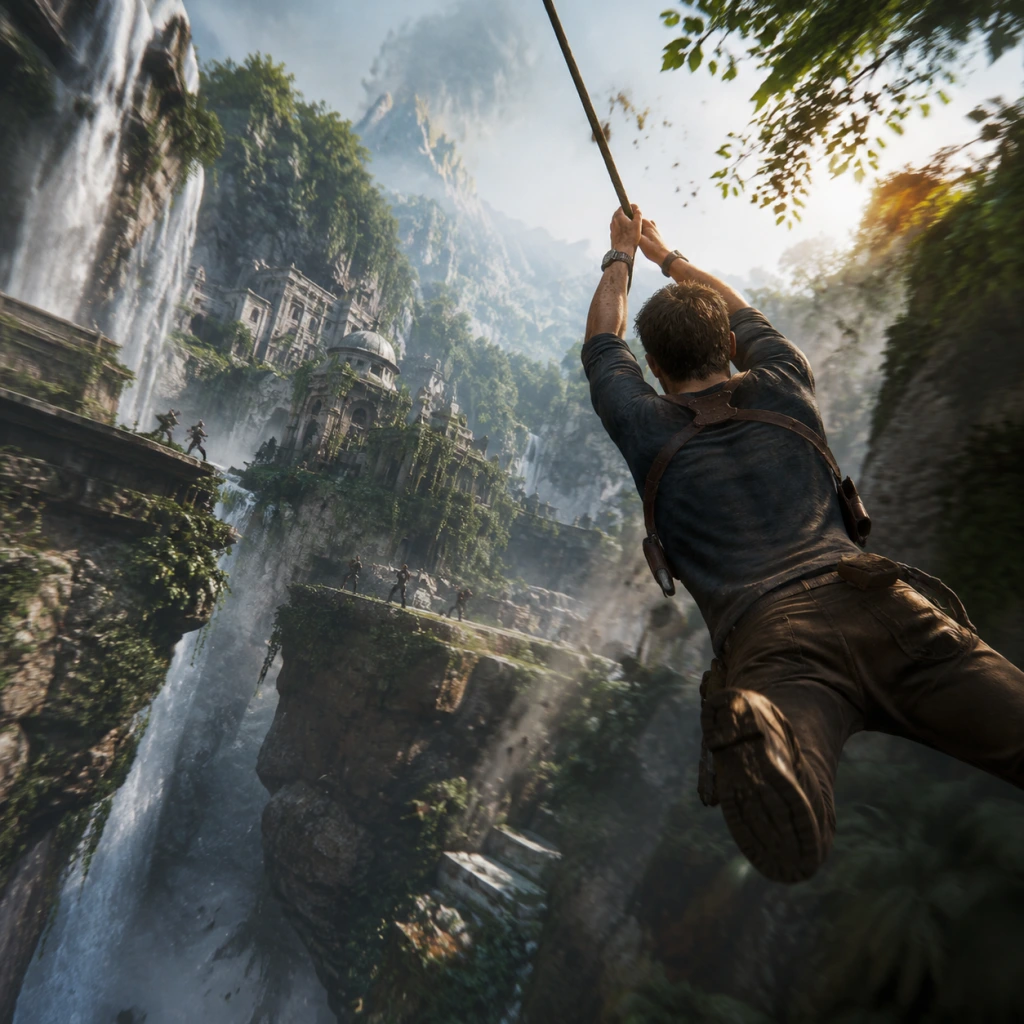
Core Gameplay
Core Gameplay Overview
Uncharted 4: A Thief’s End is a linear action-adventure game with strong cinematic storytelling. The core gameplay loop revolves around three pillars: traversal, combat, and puzzle-solving, interwoven with exploration for collectibles and optional dialogue. There is no experience-based leveling; character growth is tied to unlocking new traversal mechanics (e.g., rope, grapple) as the story progresses, and you can upgrade weapons through the black market shop using treasure collected from the environment. The game is divided into 22 chapters, each offering a mix of exploration, platforming, gunfights, and set-pieces. There is no traditional endgame loop after the main story; you can replay chapters via Chapter Select to clean up collectibles or try different combat approaches.
Main Gameplay Loop
The typical sequence in any chapter is:
1. Traverse – Climb, jump, swing, shimmy, and use tools (rope, grapple, car) to move through environments.
2. Explore – Search for treasure, journal entries, optional conversations, and variance points.
3. Engage – Overcome obstacles (locked gates, puzzles) or enemies (stealth or combat).
4. Narrative Beat – Watch cutscenes and character dialogue that advance the story.
5. Repeat – Progress to the next area.
Combat/Interaction Systems
Stealth
- Use tall grass, corners, and shadows to avoid detection.
- Marking: Tap R3 to tag enemies; they appear as icons even through walls.
- Silent takedowns: Approach from behind and press Circle to eliminate without alerting others.
- Vertical stealth: Hang from ledges and pull enemies off, or take them out with a silenced pistol (acquired later).
- Distractions: Throw bottles (L1) to lure enemies away.
- Gunplay: Third-person over-the-shoulder shooting. Weapons include pistols, rifles, shotguns, grenade launchers. Each has different recoil and damage.
- Cover system: Snap to cover with circle, lean out with L2 to aim and fire. You can blind-fire with R2 while under cover.
- Mobility: While aiming, you can roll or vault over obstacles. Firefights often involve moving between cover as enemies flank.
- Melee: Close-range attacks with triangle; heavy and light combos. Enemies can block, so quicktime counters appear when they rush.
- Weapon pickup: Dropped weapons from enemies; you can carry one sidearm and one long gun.
- Ammo: Scattered on ground, from enemies, or in treasure chests. No manual reloading (auto when magazine empty).
- Rope (late Early Game): Swing across gaps, rappel down cliffs, or create makeshift swings to kick enemies.
- Grapple (Mid Game): Zip-line tool for faster travel and vertical movement.
- Car driving (Chapter 12 & 13): Drive the Jeep through Madagascar, winch through mud, and engage in chase sequences.
- Puzzles: Rotate statues, align symbols, activate mechanisms. All have visual clues; none are extremely complex.
- Story progression: Unlocks new traversal abilities (e.g., rope in Chapter 4, grapple in Chapter 8, car in Chapter 12). These persist only within that chapter’s context, but you keep the ability for subsequent chapters once unlocked (except the car which is limited to certain chapters).
- No skill tree or upgrades: Nathan’s physical abilities are fixed; you cannot increase health, stamina, or damage. However, you can buy weapon upgrades via the pause menu black market.
- Treasure: Over 100 hidden collectible items such as coins, rings, vases. Found in hidden alcoves, cave systems, or via rope swings. Each is worth a specific amount of points used for unlocking concept art or in-game bonuses (e.g., filters, models). Treasure does not affect gameplay directly but feeds the black market (see Economy).
- Journal Entries: Optional notes that expand lore. Usually near treasure.
- Optional Conversations: When you see a blue speech bubble icon near Nathan or Sam/Elena, press Triangle to trigger dialogue that reveals backstory.
- Variance Points: Hidden areas that alter the path slightly; not required but reward you with a brief different animation or dialogue.
- There are no side quests; the entire game is a single main quest across 22 linear chapters. However, within chapters, you have multiple optional objectives (e.g., finding all treasure, having all conversations) that are tracked per chapter.
- Some chapters have branching paths (e.g., during Madagascar open world sections) but they loop back to the critical path.
- Currency: Treasure points (not gold or cash). Each treasure you collect adds a point value (e.g., 2–10 points).
- Black Market: Accessed from pause menu; you can spend treasure points to unlock weapon modifications:
- No money or shop for consumables; all ammo and weapons are found in the field.
- As said, no RPG growth. However, you unlock new tools at specific story milestones:
- These are permanent once acquired, but their use is contextual (you won’t have the car indoors). There is no build variety; you play the same Nathan Drake throughout.
- After Credits: You can continue exploring the final chapter environment (no post-game content).
- Chapter Select: Replay any completed chapter to find missed collectibles, achieve hidden trophies, or simply experience set-pieces again. Progress from each chapter (treasure found, conversations had) is saved individually.
- New Game+: Not available in Single Player. However, you can carry over your black market purchased weapons? Actually, no – black market purchases are per save. Once you beat the game, you can start a fresh story or replay chapters.
- Multiplayer: Uncharted 4 has a separate multiplayer mode (competitive and co-op) but that is outside the scope of this core gameplay guide which focuses on single-player.
Combat
Interaction
Progression
Exploration
Quests/Missions
Economy
- Weapon types: Buy the silenced pistol, automatic rifle, grenade launcher, etc. (locked until certain chapters).
- Weapon mods: Extended magazine, recoil reduction, scope, etc.
- Costs: Early mods cost 5–15 points; late-game mods require 30+ points.
Character/Build Growth
- Rope: Chapter 4 (Scotland) – swing, rappel, pull enemies.
- Grapple: Chapter 8 (Italy) – zip-line, quick vertical climb.
- Silenced Pistol: Available via black market purchase after Chapter 8 (requires treasure).
- Car: Chapter 12 – driving, winching.
Endgame Structure
---
Player Progression Tiers
Early Game (Chapters 1–7: Libertalia awakening, young Nate, prison, Scotland)
Traversal: Basic climbing, jumps, ledges. Rope introduced in Chapter 4. No grapple yet.
Combat: First gunfight in Chapter 4 (Elena). Mostly pistols and rifles. Emphasis on stealth because ammo is scarce and Nathan is fragile. Learn to use cover and silent takedowns.
Exploration: Focused on linear paths with hidden treasures in crevices. Scotland castle has large areas with multiple optional conversations.
Economy: You start with 0 treasure. First treasures appear in Chapter 2 (young Nate) and Chapter 3 (prison). By end of Scotland, you may have 20–30 points. Black market unlocks after Chapter 4 (first desk). Early purchases: extended magazine for pistol (15 pts) or a scoped rifle (20 pts) if you prefer range.
Character: No new tools beyond rope. No driving. Stealth is critical.
Example: In Chapter 4, you infiltrate a castle. Use rope to swing across moats, drop down from rafters to perform stealth takedowns on guards. Explore every corner – there are 5 treasures hidden in the towers. Mark enemies before engaging. If you trigger alarm, enemies reinforce and combat becomes harder.
Mid Game (Chapters 8–15: Italy, Madagascar, Scotland again, Chapter 11-12)
Traversal: Grapple unlocked in Chapter 8 (Italy bell tower). Use it to zip across large gaps and ascend quickly. Car driving in Chapter 12 (Madagascar). Rope and grapple combine for complex vertical puzzles.
Combat: Enemy variety increases – armored shotgunners, snipers, dogs in Madagascar. Access to silenced pistol (if purchased) allows for stealthier approaches. Gunfights are larger scale, with more enemies and vehicles. Use grenades and explosive barrels.
Exploration: Madagascar has semi-open sections — a large valley with multiple locations (bazaar, ruins, cliffs). You drive the Jeep, and can explore optional ruins and find treasures. Many optional conversations in the car with Elena/Sam.
Economy: Treasure haul increases – by end of Madagascar you could have 60+ points. Black market expands with mods for assault rifle and shotgun. Recommended purchase: recoil reduction for AK-47 (25 pts) or extended magazine for MP34 (20 pts).
Character: Now you have rope, grapple, car, and potentially silenced pistol. You are more mobile and lethal. No new abilities until end of Mid Game.
Example: Chapter 12 – open world Madagascar. Drive to three main objectives, but you can deviate to find treasure in a cave (use winch to pull a gate). Use grapple to reach a high balcony with a treasure chest. In combat, use silenced pistol to clear a camp before starting the car chase. If you alert all enemies, you’ll face a firefight with reinforcements on trucks.
Late Game (Chapters 16–20: Libertalia, Avery’s ship, island interiors)
Traversal: No new abilities, but mastered combos: rope swing into grapple launch, climbing complex structures with multiple handholds. Certain areas require quick timing.
Combat: Intensity peaks – massive battles with dozens of enemies, including armored heavies. You have access to full weapon arsenal through drops. Use blind-fire and rolling to survive. Melee combo is effective against single enemies.
Exploration: Nonlinear within chapters – many vertical paths. Hidden treasures are behind breakable walls (use explosive). Optional conversations are fewer but deeper. Many puzzles (turning wheels, matching symbols) that require critical thinking.
Economy: By now you likely have 100+ treasure points. All black market mods are available; buy the grenade launcher (40 pts) or mod for the M14 (35 pts). Treasure points become less crucial unless you want all concept art unlocks.
Character: At peak capability – all tools, comfortable with every system. No further growth.
Example: Chapter 18 – Avery’s ship. Navigation through intricate rigging, using rope to swing across masts, then a large gunfight on the deck. Use grenade launcher to clear clusters of enemies while staying on the move. Puzzle to open the captain’s cabin involves aligning three dials based on clues in the journal.
Endgame (Chapters 21–22 + Epilogue)
Traversal: Final escape sequences – frantic climbing under pressure. No new tools.
Combat: Minimal combat; mostly traversal and platforming. Chapter 22 has one stealth section with two guards.
Exploration: Limited. Focus on narrative. You can still find remaining treasures (some are easy to miss here, like in the final chapter’s cave).
Economy: If you missed treasures, Chapter Select allows retrieval. No additional unlocks from black market except for concept art.
Character: Same as Late Game.
Endgame: After credits, you can return to chapter select for cleanup. There is no true endgame loop; the story is finished. However, you can replay the entire game on a new save to make different black market purchases (no New Game+). The only endgame activity is chasing trophies or 100% completion.
---
Summary Table
| Progression Tier | Chapters | Key Abilities Unlocked | Typical Combat Style | Exploration Focus | Black Market Priority |
|---|---|---|---|---|---|
| Early Game | 1–7 | Rope | Stealth, pistol, rifle | Linear interiors, castle | Extended mag, scoped rifle |
| Mid Game | 8–15 | Grapple, Car, Silenced Pistol | Mixed stealth/gunfight, vehicle chases | Semi-open Madagascar, Italy | Recoil reduction, silenced pistol mod |
| Late Game | 16–20 | None new | Heavy combat, grenades, melee | Vertical ruins, puzzles | Grenade launcher, assault rifle mods |
| Endgame | 21–22 | None | Minimal combat, escape | Narrative-driven | N/A – collect treasures for completion |