Important Notes
Important Notes for Baldur's Gate 3
Warnings & Common Pitfalls
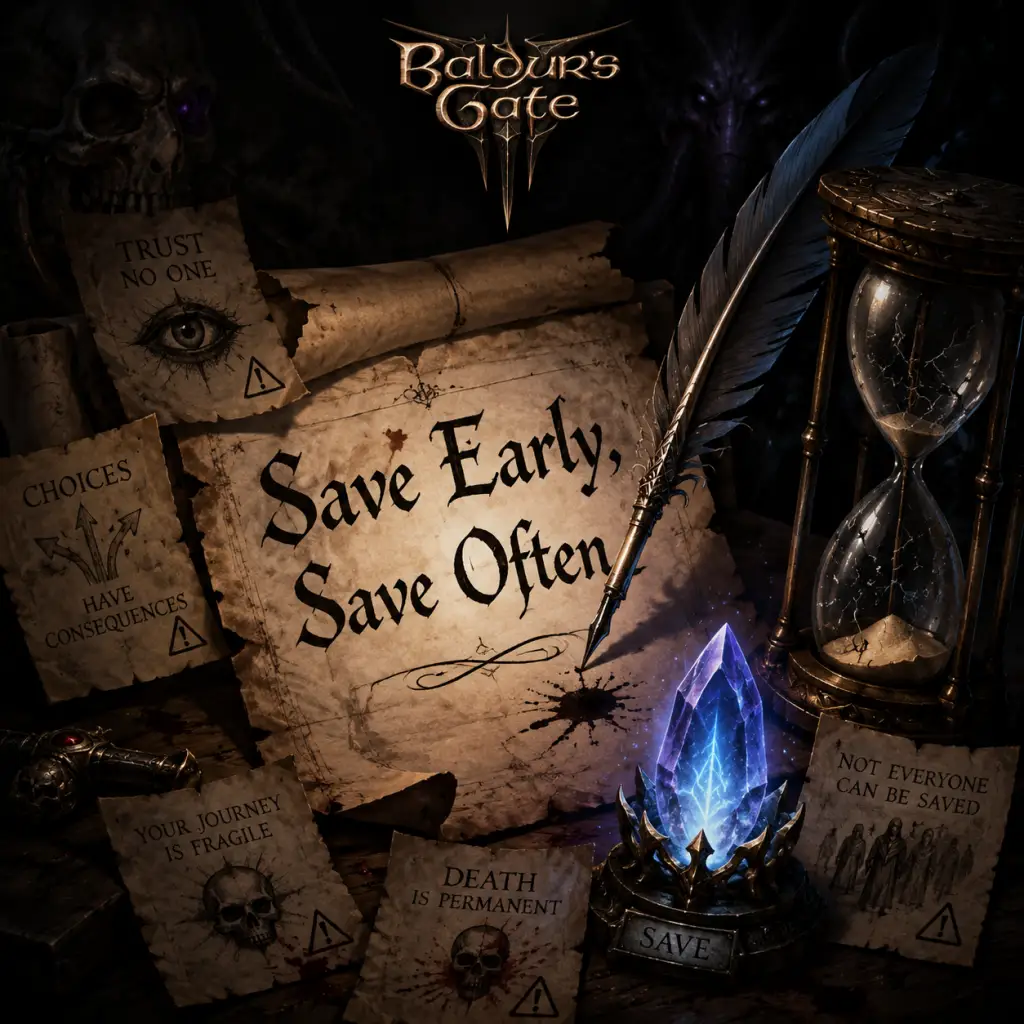
Save Early, Save Often: The game has an auto-save feature, but it's not always reliable. Manual quicksave (F5 on PC) before every major encounter, dialogue, or risky move. Use multiple save slots, not just one, to avoid corrupt saves or being stuck.
Don't Rush the Main Quest: Act 1 is deceptively open. Exploring side areas, talking to everyone, and completing companion quests is essential. Rushing the main story can lock you out of content or make Act 2 brutally difficult.
Party Composition Matters: A balanced party is crucial. Healers (Cleric, Druid, Bard), a frontliner (Fighter, Paladin, Barbarian), a damage dealer (Rogue, Ranger, Warlock), and a caster (Wizard, Sorcerer) is recommended. Avoid going all-melee or all-squishy.
Long Rest Often: Camp supplies are plentiful. Don't hoard them. Long resting advances companion stories, triggers cutscenes, and reveals important lore. If you skip rests, you miss content.
Stealth is Not Always Safe: Even with high stealth, some areas have magical detection, environmental hazards, or scripted encounters that trigger on proximity. Save before trying to sneak past enemies.
Check Your Inventory: The game's inventory can become cluttered. Dispose of junk, sell extra gear, and keep only what you need. Your carry weight limits movement speed.
Read Everything: Books, notes, and item descriptions often contain lore, puzzle hints, and quest clues. Ignoring them leads to confusion and missed opportunities.
Irreversible Choices & Missable Content
Character Creation is Permanent: Your race, class, background, ability scores, and appearance are locked at the start. You can respec your class and abilities later (via Withers), but not race or appearance. Choose wisely.
Companion Deaths: If a companion dies in combat and you don't revive them quickly (via scrolls, spells, or Withers), they may leave permanently. Some story decisions can also kill companions off-screen.
Grove vs. Goblins: In Act 1, you must choose sides between the Tiefling refugees and the goblins. This decision locks out entire quests and companions. Think carefully, and save before committing.
Dark Urge Origin: The Dark Urge has unique, often dark choices that can lead to permanent companion death or story branches. If you play this origin, be prepared for moral consequences.
Mind Flayer Parasite Usage: Using illithid powers (tadpole abilities) influences your character's appearance and story. Certain dialogue choices can make you partially or fully illithid, affecting the ending. You cannot undo this transformation.
Romance Lock-In: You can pursue multiple romance options, but later in the game, you must choose one. You cannot romance everyone in a single playthrough without mods. Save before major romance dialogues.
Act Transitions: Moving from Act 1 to Act 2, or Act 2 to Act 3, is a point of no return for many quests. The game warns you, but it's easy to miss. Complete all side content before progressing. Missable quests include the Hag's quest, the Adamantine Forge, and some companion personal quests (e.g., Lae'zel's creche, Astarion's spawn hunt, Shadowheart's Shar temple, etc.).
Endings: Your choices throughout the game determine which ending you get. There is no simple "good" ending. Many decisions lock out certain endings. Save often in Act 3.
Difficulty Spikes & Gatecheck Encounters
Level 1-2: Very fragile. Encounters like the Prologue nautiloid, the ruins near the beach, and the first goblin camp can wipe you if you're reckless. Use stealth, positioning, and consumables.
Level 3-4: The Hag's swamp (Act 1) is a major spike. The Hag has powerful illusions and can one-shot low-HP characters. Bring the Heavensward? No, bring anti-magic or an elf to avoid sleep. Prepare for crowd control.
The Githyanki Crèche (Level 5-6): This optional area is full of tough, high-damage enemies. The inquisitor fight is brutal. Save before entering. If underleveled, leave and come back later.
Act 2 - Shadow-Cursed Lands: The curse deals damage over time. Without the Pixie's blessing (from the Moonlantern quest), you'll die slowly. Enemies here have high magic resistance.
Act 2 Boss - Thorm: Ketheric Thorm has multiple phases, and his second form is devastating. Ensure you have some form of radiant damage (e.g., Cleric spells, Holy Weapon) to prevent his healing.
Act 3 - The Foundry: This area has many high-level constructs with heavy damage. Bring bludgeoning weapons and lightning resistance.
Act 3 - Cazador's Palace: The final boss of Astarion's quest can be very punishing if you don't use sunlight spells or avoid his legendary actions.
House of Hope (Act 3): Raphael's domain is a massive difficulty spike. Enemies have legendary actions and high stats. Come fully prepared with a solid party and strategy.
Grinding Traps & XP Waste
No Traditional Grinding: BG3 is not an MMO. You cannot grind random enemies for XP efficiently. Most XP comes from quests, exploration, and boss kills. Killing random mobs multiple times gives minimal XP (only first kill matters).
Lockpicking and Traps: There is no separate XP for opening locks or disarming traps. Don't waste time attempting to pick every lock unless there's loot behind it. Use cantrips like Knife in the Heart? No, use guidance.
Save Scumming for Skill Checks: Reloading after every failed persuasion or lockpick attempt is tedious and unnecessary. Gameplay is balanced for failure; you can often find alternative paths. Let the dice roll.
Vendor Shopping: You don't need to grind gold for gear. Most items can be found, crafted, or quest-rewarded. Only buy powerful consumables (scrolls, potions, elixirs) from vendors.
Online Etiquette & Anti-Cheat Notes
Game Mode: BG3 is entirely single-player or co-op (up to 4 players). Multiplayer can be open or invite-only. There is no competitive multiplayer, so no anti-cheat software is used. Modding is allowed; Larian supports it.
Ettiquette for Multiplayer: Communicate with your party. Respect others' choices. Don't initiate dialogues that affect the whole party without consent. Avoid stealing from party members without permission. Use turn-based mode if players are in combat.
Modding: If you play with mods, be aware that they can cause instability, especially after patches. Keep a vanilla save backup. If you use mods that affect game balance (e.g., weightless items, infinite jump), it might trivialize the experience.
Crossplay: Cross-platform play is available between PC and consoles, but not all features exist on all platforms. Expect occasional latency in co-op if playing with high ping.
Save Management Advice
Use Multiple Save Slots: The game has a limited number of auto-save slots (usually 3-5). Manual saves are unlimited. Create a new manual save every hour or before major decisions.
Label Saves: On PC, you can rename save files. Use descriptive names like "Before Underdark", "After Grove Decision", "Pre-Raphael Fight" to help reload later.
Cloud Saves: Enable cloud saves (Steam/GOG/Epic) to back up your progress. However, be cautious: cloud sync can sometimes overwrite local saves. Turn off cloud saving if you have many manual saves.
Modded Saves: If you uninstall a mod, your save may become corrupted or non-loadable. Always back up saves before removing mods.
Save File Size: Save files are relatively small (~20-50 MB), but many saves can accumulate. Periodically clean out old ones to avoid clutter.
Things Players Commonly Regret Not Knowing Earlier
1. You can respec your class and abilities for a small fee (100 gold) at Withers, found early in Act 1 (in the ruins near the beach). This means you can fix bad stat allocations or try different builds.
2. Camp supplies are abundant; you can long rest after every major fight without worrying about running out. The game even lets you use "partial rest" without supplies (but no spell slot recovery).
3. Jumping is a bonus action and can cover surprising distances. Use it to reach higher ground, avoid traps, or get into combat advantage.
4. Throwing healing potions at allies heals them for the potion's value. You can throw potions at the ground to heal multiple characters. Also, you can throw other items (poisons, alchemist fire, etc.) for area effects.
5. The environment is your weapon: Use barrels, chandeliers, and explosive surfaces. Shooting a fire arrow at a grease puddle ignites it. Push enemies off cliffs or into hazards.
6. You can talk to animals with the spell Speak with Animals (available to Rangers, Druids, Bards, or via potion). This unlocks many side quests and secrets. Prioritize getting it.
7. Illithid tadpole powers are optional. You do not have to use them. If you want to avoid transformation, just ignore the tadpoles in your inventory.
8. The game respects your time: There are no endless fetch quests. Most quests have multiple solutions, and you can often skip areas entirely without penalty. Don't feel pressured to 100% everything.
9. Control + click (PC) or hold and select (console) lets you select multiple units to move as a group. Use this to avoid splitting your party.
10. Reclass your companions: You can respec companions using Withers. If you don't like Shadowheart's default Trickery Domain, change it to Life Domain. You can change Astarion to a Bard if you wish. This opens up many party compositions.
11. The game has a built-in quest journal that updates your log with new objectives. But it doesn't always tell you where to go. Use the map markers and read quest descriptions carefully.
12. Merchant prices are affected by your Charisma and the Friends cantrip can be cast on vendors to reduce prices, but after the spell ends, they may become hostile (depending on their dialogue). Use Friends cautiously.
13. Legendary Actions (introduced in Honor Mode and some bosses in Tactician) make boss fights much harder. Always expect the unexpected.
14. You can hide during combat using the Hide action (if you're not in enemy line of sight) to break focus and sneak attack.
15. Steal with caution: If you get caught stealing, the entire faction may turn hostile. But if you can't be seen, there are no consequences. Use spells like Invisibility or Pass Without Trace.
Final Advice
Baldur's Gate 3 is a game about adaptation and creativity. There is no single correct path, and failure often leads to memorable stories. Embrace the dice rolls, explore fearlessly, and never be afraid to reload if you make a choice you truly regret. But also, allow yourself to live with consequences – some of the best moments come from unexpected outcomes. May your rolls be natural 20s!