Core Gameplay
Core Gameplay Guide for Heavy Rain
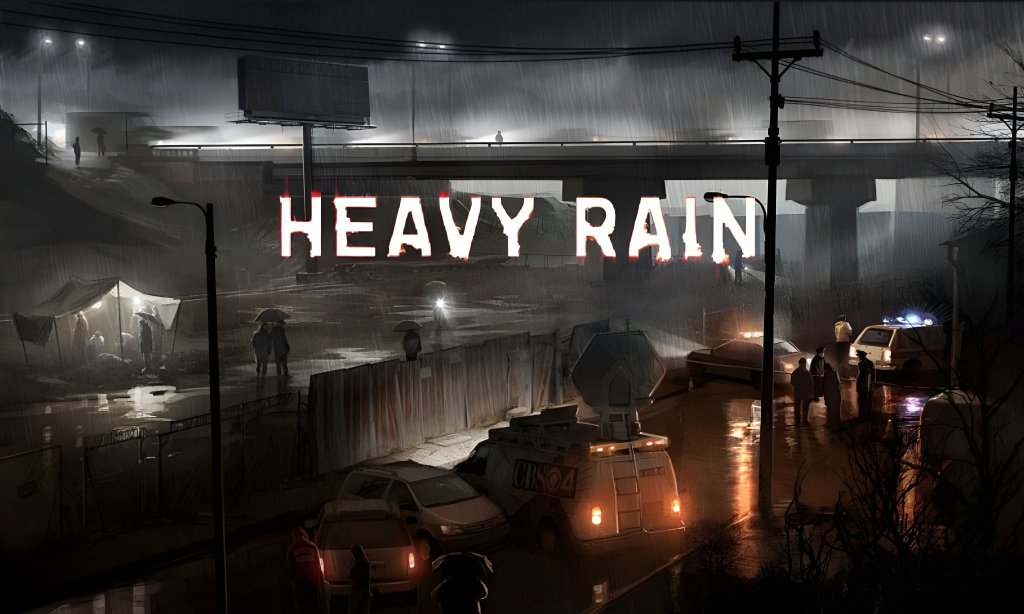
Heavy Rain is an interactive drama that emphasizes narrative choices, quick time events (QTEs), and environmental exploration over traditional gameplay mechanics like combat, leveling, or economy. The core gameplay loop revolves around controlling one of four protagonists, making split-second decisions, and witnessing the consequences unfold in a branching story. Below, the experience is organized by player progression tiers (Early, Mid, Late, Endgame), with each tier detailing the key systems and examples.
Main Gameplay Loop
The loop repeats throughout the game:
1. Explore a confined environment (apartment, warehouse, etc.).
2. Interact with objects (via context-sensitive button prompts) to gather clues, trigger events, or advance the scene.
3. Engage in QTEs – sequences of timed button presses (e.g., □, ○, ×, △) and analog stick movements. These occur during action scenes (chases, fights, rescues).
4. Make choices – dialogue options or actions that alter relationships, unlock paths, or determine character survival.
5. Watch cutscenes – the story progresses based on your actions and choices, leading to the next playable section.
Combat / Interaction Systems
- Quick Time Events (QTEs): The primary action system. Prompts appear on screen (e.g., a direction to tilt the right stick or a sequence of face buttons). Success/failure directly impacts the narrative. Examples:
- Interrogations / Dialogues: Choose from up to four responses (mapped to face buttons). Each choice affects character relationships or unlocks new information. Example: During the interrogation of the suspect at the police station, choosing to threaten or plead changes the outcome.
- Environmental Interaction: Walk around and press a button near highlighted objects (e.g., examining a photo, opening a drawer). Some interactions are optional but yield additional context or clues.
- Story chapters completed: Each chapter advances the plot (e.g., "The Mall", "The Bear Trap", "The Doctor's Office").
- Character relationships: Choices affect how characters perceive each other, influencing later scenes (e.g., if Ethan and Madison trust each other, they cooperate better).
- Ending branches: The final chapter’s outcome depends on cumulative choices and QTE successes/failures throughout the game.
- Limited, linear environments: Each chapter presents a small, hand-crafted area (e.g., Ethan’s house, a construction site). You cannot freely roam a large world.
- Clue gathering: In Ethan’s chapters, exploring reveals origami figures, photos, or addresses that lead to the next objective. Missing a clue can close off certain paths.
- Optional details: Many objects are purely atmospheric (e.g., reading a newspaper, looking at a drawing). They enrich the story but are not mandatory.
- Early Game: Chapter 1 (Ethan) – objective: "Wake up and take a shower" (yes, a mundane task that sets the tone).
- Mid Game: Chapter "The Lizard" – objective: "Survive the bear trap" (a harrowing QTE sequence where Ethan must cut off his own finger).
- Late Game: Chapter "The Rat" – objective: "Defeat the killer" (a fight sequence with multiple QTE branches).
- No stat growth or skill trees: Characters do not level up or learn new abilities. Their physical capabilities are fixed (e.g., Ethan has a weak heart; Madison can climb).
- Character development through choices: Your decisions define personality. For example:
- Relationship system: Trust between characters (Ethan & Madison, Jayden & the P.I.) influences whether they help each other in critical moments.
- Multiple endings based on:
- No post-game content: Once the credits roll, the game returns to the main menu. You can replay individual chapters from the menu to try different outcomes.
- True ending: There is no definitive "true" ending; all are equally canonical. The game encourages replaying to experience different branches.
- Focus: Establish characters, the mystery of the Origami Killer, and initial investigations.
- Typical activities: Learn basic controls (walk, look, interact), perform simple QTEs (e.g., Ethan taking a shower). First major choices: naming your child, choosing how to react to tragedy.
- Example: Chapter "The Mall" – search for your son, talk to security, and chase a red balloon (QTE). Failure leads to losing the boy temporarily.
- Skills: No growth. Just understand the rhythm of QTEs and that choices have consequences.
- Focus: Intensifying trials, deeper character backstories, and high-stakes QTE sequences.
- Typical activities: Complex QTEs (driving a car, fighting a thug), moral dilemmas (cut off finger or not), and cross-character investigations.
- Example: Chapter "The Bear Trap" – Ethan must remove his own finger using a scalpel. The QTE involves pressing a button repeatedly to saw through the joint. Failure results in Ethan passing out and failing the trial.
- Skills: By now, players are expected to be proficient with rapid QTE sequences. Relationships begin to form (e.g., Madison finds Ethan’s hideout).
- Focus: Convergence of all characters, final confrontations, and climax.
- Typical activities: Interrogating suspects, solving the final clues, and survival QTEs.
- Example: Chapter "The Rat" – Ethan fights the killer in a flooded warehouse. The QTE includes dodging punches and countering with timed strikes. A single mistake can get Ethan killed.
- Skills: No new mechanics, but difficulty of QTEs peaks. Choices here heavily influence endings (e.g., deciding to trust or fight).
- Focus: Resolution of all story threads, final showdown, and multiple endings.
- Typical activities: Make final moral and strategic decisions. The game offers limited control during the climax; cutscenes dominate.
- Example: Chapter "The Final Showdown" – Depending on earlier choices, you may have to: shoot the killer, save a character, or let the killer escape. QTEs involve aiming a weapon (right-stick movement) and pulling the trigger (button press).
- Skills: No further growth. The endgame is pure consequence processing.
- Ethan’s fight with the drug dealer at the motel: A series of rapid □ and × presses, plus a right-stick dodge. Failure results in Ethan being knocked out and failing to save a character.
- Madison’s chase through the subway: A combination of left-stick movements and button presses to avoid obstacles. Missing too many prompts leads to injury or death.
Progression
Progression is entirely story-driven, divided into chapters (about 35 total), each focusing on one or more characters. The game does not use experience points, levels, or skill trees. Instead, progression is measured by:
Exploration
Quests / Missions
There are no traditional quests. Each chapter has a primary objective (e.g., "Find the next clue", "Rescue the child", "Escape the warehouse"). The game tracks objectives via a subtle UI prompt. Examples:
Economy
Heavy Rain has no economy system. There is no currency, no shops, no items to buy or sell. All progression is narrative; resources are not managed.
Character / Build Growth
- Ethan can become increasingly desperate (willing to harm himself) or maintain composure.
- FBI agent Norman Jayden can rely on his ARI glasses (augmented reality) effectively or be hindered by addiction.
Endgame Structure
The endgame begins during the final chapters ("The Old Warehouse" and "The Final Showdown"). Key features:
- Who survives (Ethan, Madison, Jayden, or the killer).
- Whether the father-son relationship is resolved positively or negatively.
- Whether the killer is caught or escapes.
Progression Tiers (Early, Mid, Late, Endgame)
Tiers are based on story progression, not player level.
#### Early Game (Chapters 1–8)
#### Mid Game (Chapters 9–20)
#### Late Game (Chapters 21–28)
#### Endgame (Chapters 29–35)
Summary Table
| Aspect | Details |
|---|---|
| Main Gameplay Loop | Explore → Interact → QTE → Choose → Watch |
| Combat | QTE sequences only; no manual attack or defense |
| Exploration | Linear levels with interactive objects |
| Progression | Story chapters (35 total) |
| Economy | None |
| Character Growth | No stats; relationship/development via choices |
| Endgame | Multiple endings; replay chapters for different outcomes |