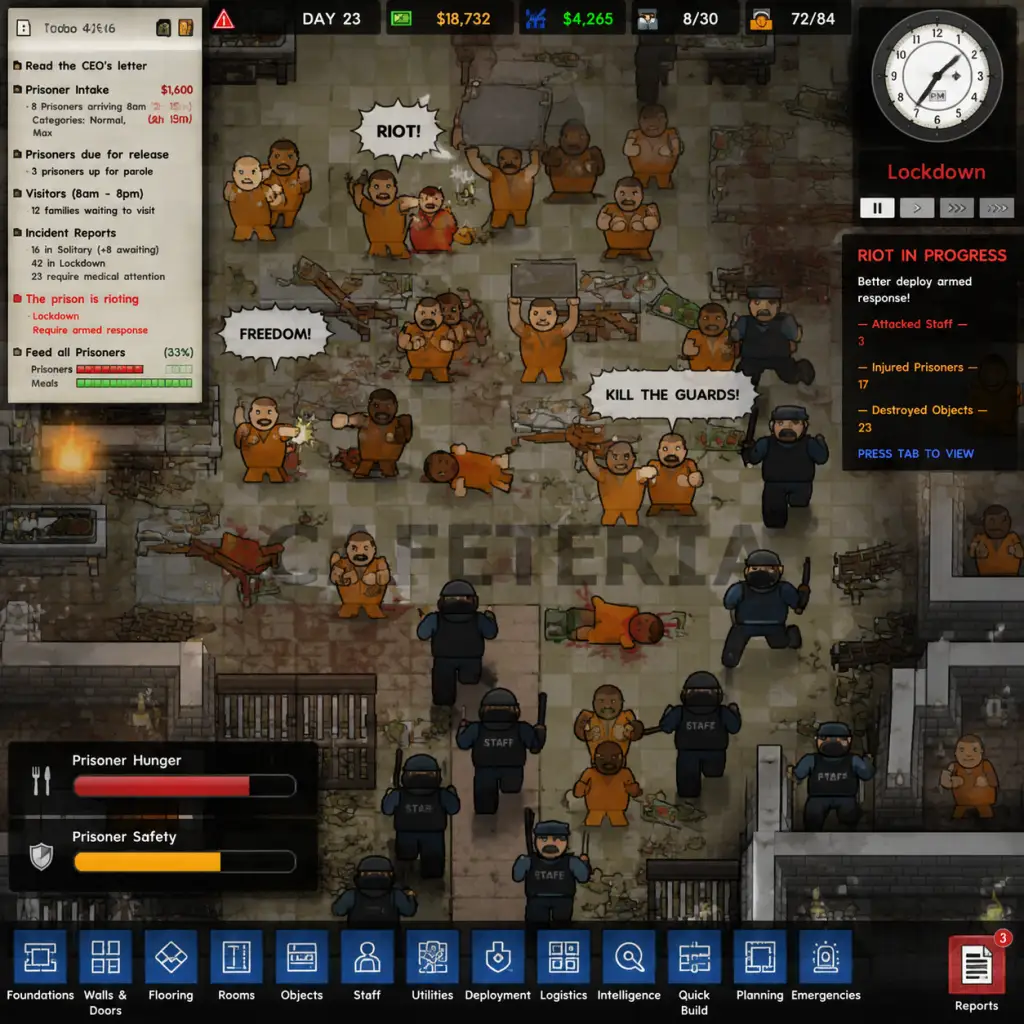
Core Gameplay
Core Gameplay
Prison Architect is a top-down prison management simulation. Your goal is to design, build, and operate a secure, efficient, and (optionally) rehabilitative prison. The game offers a deep, layered experience that evolves through distinct progression tiers. Below we break down the core gameplay systems and how they change as you advance.
Main Gameplay Loop
The fundamental loop is:
1. Intake Prisoners – You accept new inmates from a daily intake or via grants/story missions. Prisoners have varying security ratings (Low, Medium, High, Supermax, Legendary).
2. Provide Facilities – Build cells, canteens, showers, yards, workshops, classrooms, etc. Satisfy prisoner needs (hunger, hygiene, sleep, recreation, family).
3. Maintain Security – Hire guards, deploy CCTV, metal detectors, dog patrols, and manage contraband. Respond to incidents (fights, riots, escapes).
4. Earn Income – Daily government grant per prisoner ($85 for Low, $105 for Medium, $130 for High security as of base game). Sell workshop goods, exports, or use parole programs for bonuses.
5. Expand & Upgrade – Build new wings, improve security, unlock new rooms (e.g., Workshop, Classroom, Chapel) via the Policy and Research tabs (though the game doesn't have a tech tree; it's more about experience through Grants and unlocking specific room types).
6. Manage Staff & Prisoners – Schedule work, recreation, sleep. Meet prisoner needs to reduce reoffending risk and avoid riots.
The loop repeats with increasing complexity and scale.
Progression Tiers
Progression in Prison Architect is not tied to character levels but to prison size, prisoner mix, security level, and financial stability. It is also shaped by the Grants system (missions) and the optional Story Mode campaigns (e.g., "Prison Architect: Island Bound" DLC story). Below is the typical tier breakdown.
---
Early Game
Goal: Stabilize a small, low-security prison with basic facilities and positive cash flow.
What You Have
- Starting funds: ~$10,000 (varies by grant or scenario).
- A small plot of land (often 30x30 or slightly larger).
- A handful of low-security prisoners (first intake usually 6–10).
- Only basic rooms available: Cells, Canteen, Kitchen, Showers, Yard, Staff Room, Offices.
- Limited staff: 1–2 guards, 1 warden, 1 cook, 1 janitor.
- Income primarily from the daily per-prisoner grant. Example: 10 low-security prisoners = $850/day.
- Outgoings: staff salaries ($50–100/day each), food costs, electricity/water bills.
- Grants provide quick cash injections (e.g., "Startup Grant", "Cell Block Grant"). Complete objectives like "Have 10 cells" or "Build a canteen".
- Minimal. Occasional fight between prisoners. Your guards will break it up. No player-controlled combat – you direct staff via right-click.
- Contraband is rare but appears via visitors or thrown over walls. You can search cells manually (click prisoner, search cell) or use metal detectors later.
- Limited to expanding your land (buy adjacent plots if you have cash). No classic exploration.
- Grants serve as tutorials and objectives. Early grants: "Build a Prison", "First Prisoners", "Basic Needs". Complete them to unlock more.
- Story Mode (available in some versions) gives a campaign with specific targets (e.g., escape an island).
- No player character progression. Your prison's Security Rating stays low. Prisoner reoffending risk starts high because of lack of programs.
- Staff don't level up, but you can hire specialists later (e.g., Dog Handlers, Armed Guards).
- Build a 10-cell block (each cell: bed, toilet, door). Build a small canteen with serving tables and benches. Build a kitchen with cookers, fridges, and a sink. Connect utilities (power, water).
- Hire 2 guards, 1 cook, 1 janitor. Set prison policy to "Low Security" for intake.
- Complete the "First Prisoners" grant by accepting 6 low-security inmates. Then do "Basic Needs" grant by ensuring all have food, sleep, and hygiene.
- Watch cash flow; keep don't overspend on luxury items. Your first expansion might be a workshop to generate income.
- A stable prison with 50–100 prisoners, mix of low and medium security.
- Expanded facilities: Workshop, Classroom, Chapel, Parole Rooms, Infirmary, Visitor Booths.
- More staff: 6–10 guards, 2–3 cooks, 2 janitors, a doctor, maybe a few dog handlers.
- Deployment system – You can assign staff to specific sectors (e.g., Armed Guards only in high-security wing).
- Workshops produce license plates or furniture for export profit. Example: 10 work tables + release value ~$200/table if sold. Factory schedule.
- Parole board grants bonus $1,000–$5,000 for successful parolees.
- Income can exceed $5,000/day. You'll have surplus to build high-tech security.
- Riots can occur if prisoner needs aren't met. Medium-security prisoners may start fires or attack guards.
- Tunnels – Prisoners dig; you need dog patrols (sniff) or periodic cell searches.
- Gangs (if DLC enabled) – Prisoners form gangs, which cause more organized fighting and contraband smuggling.
- Expand land significantly. Use the Road Gates to create secure vehicle access.
- Foundation tool – Build foundation walls, multiple floors (add stairs).
- Grants branch into chains: "Rehabilitation" grants, "Security" grants (e.g., "Install 10 Metal Detectors").
- Story mode might involve a high-risk transfer or a prison break scenario.
- Reoffending Risk – Lower by providing education (Classroom), counseling (Chapel), work (Workshop). Track each prisoner's risk level.
- Prisoner Grading – Each prisoner has a grade (A+ to F) based on behavior. High grades reduce risk and increase parole chances.
- Staff – You can unlock new roles via the Policy tab: Warden with traits (e.g., "Old Bill" reduces fights), Chief, Foreman (in DLC).
- Build a workshop with 10 workstations. Assign prisoners to work during their Work regime. Sell license plates on the market (export).
- Add a classroom with 10 chairs and a chalkboard. Run education programs (three levels: Basic, Advanced, Literacy). This lowers reoffending and improves prisoner behavior.
- Install metal detectors at kitchen and workshop entrances. Add CCTV in hallways. Deploy armed guards only near high-traffic areas to avoid accidental shootings.
- Build a perimeter wall (stone) around the prison – prevents contraband throws and tunnel escapes.
- Accept medium-security prisoners. They need more intensive regimes (more free time, separate canteens or yards to reduce conflict).
- Prison capacity over 200. Multiple cell blocks (low, med, high, supermax).
- Full security suite: Snipers on towers, armed guards, dog patrols, perimeter walls, many CCTV stations.
- Special rooms: Solitary, Execution Chamber (if DLC), Psych Ward, Large Kitchen and Canteen.
- Legendary prisoners – Extremely tough, resistant to suppression, often start riots. They require supermax isolation.
- Workshops now produce high-value items (e.g., furniture, electronics) with maxed production lines. Export can bring $10,000+/day.
- Parole rates higher if you have full rehabilitation programs.
- Maintenance costs scale: staff salaries, utilities, building repairs. Need high income to sustain.
- Legendary prisoners – Immune to tasing, very strong; need armed guards and close-quarters patrol.
- Mass riots – Can spread if not suppressed quickly. Use call-to-arms (emergency button) to summon all guards with batons.
- Escape attempts – Prisoners coordinate digging tunnels or break through walls. Use dogs to sniff tunnels, search cells with snipers covering yard.
- Fire – Prisoners can start fires in canteen or workshop; need fire sprinklers (researched via utilities panel) and firemen (emergency services).
- Fully expand your land. Build multiple floors (up to 4+). Use staircases and staff-only elevators.
- Tunnels – late-game prisoners dig deeper; need ground radar (if DLC) or flooding to detect.
- Late-game grants: "Maximum Security", "Supermax Wing", "Police Partnership". May require building execution chamber or solitary wing.
- Story mode final chapters often involve a massive breakout or a transfer of a VIP prisoner.
- Prisoners can reach A+ grade if programs are comprehensive – they become model inmates,eligible for early parole.
- Reoffending risk can be reduced to 0% for some prisoners.
- Staff Traits – Warden with +security or +rehab traits make a big difference. Hire multiple wardens (if DLC).
- Achievements – Unlock various trophies for perfect security, no escapes, etc.
- Build a supermax wing: tiny cells with concrete walls, solitary doors, armed guard station, separate canteen with serving hatch. Keep legendary prisoners here.
- Set up a CCTV control room with 20 monitors – assign officers to watch high-risk areas.
- Create a secure entrance with metal detectors, dog patrols, a holding cell for sweeps.
- Maximize workshop profit: assign 30 prisoners to work in a large workshop with supervised manufacturing.
- Use deployment to flood high-security wings with guards; regularly call shakedown (mass cell search) to find contraband.
- Manage regime schedules carefully: high-security prisoners need more free time in yard (separate from low-security) to reduce fighting.
- A fully built-out prison with all room types, 500+ prisoners, all security levels, complex regimes.
- All grants completed. Economy stable with high profit.
- Staff: dozens of guards, multiple armed guards, dog handlers, cooks, janitors, doctors, and maybe a psychologist.
- Full research (though limited, you can unlock all room types).
- Mainly passive income from large prisoner count (hundreds) plus workshop exports. Example: 500 prisoners at mixed security = $50,000/day income – costs ~$30,000/day, profit $20,000/day.
- No need for grants; you can ignore them or do for fun.
- Very rare – if you manage well, you can go days without a fight. However, legendary prisoners can still cause issues.
- You can trigger emergency events for fun (e.g., unlock all doors, spawn criminals) via the Extreme Event tool (if enabled in settings).
- No new land to explore, but you can demolish and rebuild entire sections for efficiency.
- No new story content unless you start a new scenario. You can replay the Escape Mode (play as a prisoner) or Sandbox unrestricted.
- Maxed: all staff roles, all room types, all grants done. You can fine-tune prisoner rehabilitation to get high parole completion rates.
- Legacy – You can save your prison as a blueprint for new games.
- Build a rehabilitation-focused prison with no solitary, high-quality cells, full programs, and liberal parole – resulting in high ratings and minimal security cost.
- Alternatively, build a maximum security hellhole – supermax only, constant punishment, armed guards everywhere. This tests your crisis management.
- Challenge yourself: no armed guards, no walls (only fences), 100% prison funding efficiency, or achieve 0% reoffending for all prisoners.
- Guards automatically engage: baton hits, taser (if researched), or lethal force (armed guards). You can manually order an attack by clicking the prisoner with a guard selected.
- Staff can be injured. When a guard is knocked out, you need to rescue them or call paramedics (if DLC).
- Incoming contraband: visitors, thrown over walls, deliveries, staff corruption.
- Detection: Metal detectors (search when triggered), dog patrols (sniff), CCTV, periodic shakedowns.
- Each prisoner has a set of needs: Food, Sleep, Hygiene, Toilet, Recreation, Family, Safety, Temperament, etc. Satisfy these via facilities and regime schedule.
- High unmet needs cause bad behavior.
- Create custom schedules per security level (e.g., Low: sleep 0–6, eat 6–7, work 8–12, eat 12–1, etc.). The schedule is essential for controlling prisoner movement and reducing conflict.
- Define staff deployment per sector (e.g., Guard percentage, armed guard patrols, dog patrol routes). Critical for late-game security.
- Set rules: punishment severity (e.g., solitary time, lockdown length), parole conditions, search policy.
- Staff need breaks; place staff rooms to avoid burnout.
Core Systems in Early Game
Economy:
Interaction/Combat:
Exploration:
Quests/Missions:
Character/Build Growth:
Example Early Game Strategy:
---
Mid Game
Goal: Expand to medium security prisoners, increase capacity to 50–100, and start rehabilitation programs. Security threats become more complex.
What You Have
Core Systems in Mid Game
Economy:
Interaction/Combat:
Exploration:
Quests/Missions:
Character/Build Growth:
Example Mid Game Strategy:
---
Late Game
Goal: Manage a large, high-security prison (150–300+ prisoners, including high security and supermax). Maximize profit and security while dealing with legendary prisoners and coordinated escape attempts.
What You Have
Core Systems in Late Game
Economy:
Interaction/Combat:
Exploration:
Quests/Missions:
Character/Build Growth:
Example Late Game Strategy:
---
Endgame
Goal: Achieve a self-sustaining, flawless prison. No escapes, minimal incidents, high happiness, and massive daily profit. This is when you can experiment with creative designs or challenge runs.
What You Have
Core Systems in Endgame
Economy:
Interaction/Combat:
Exploration:
Quests/Missions:
Character/Build Growth:
Strategies:
---
Additional Core Systems Across All Tiers
Combat Resolution:
Contraband Management:
Prisoner Needs:
Regime Scheduler:
Deployment System:
Policy:
Staff Room:
---
This guide covers the core gameplay loop and progression tiers of Prison Architect. Use it as a roadmap to build your perfect correctional facility.