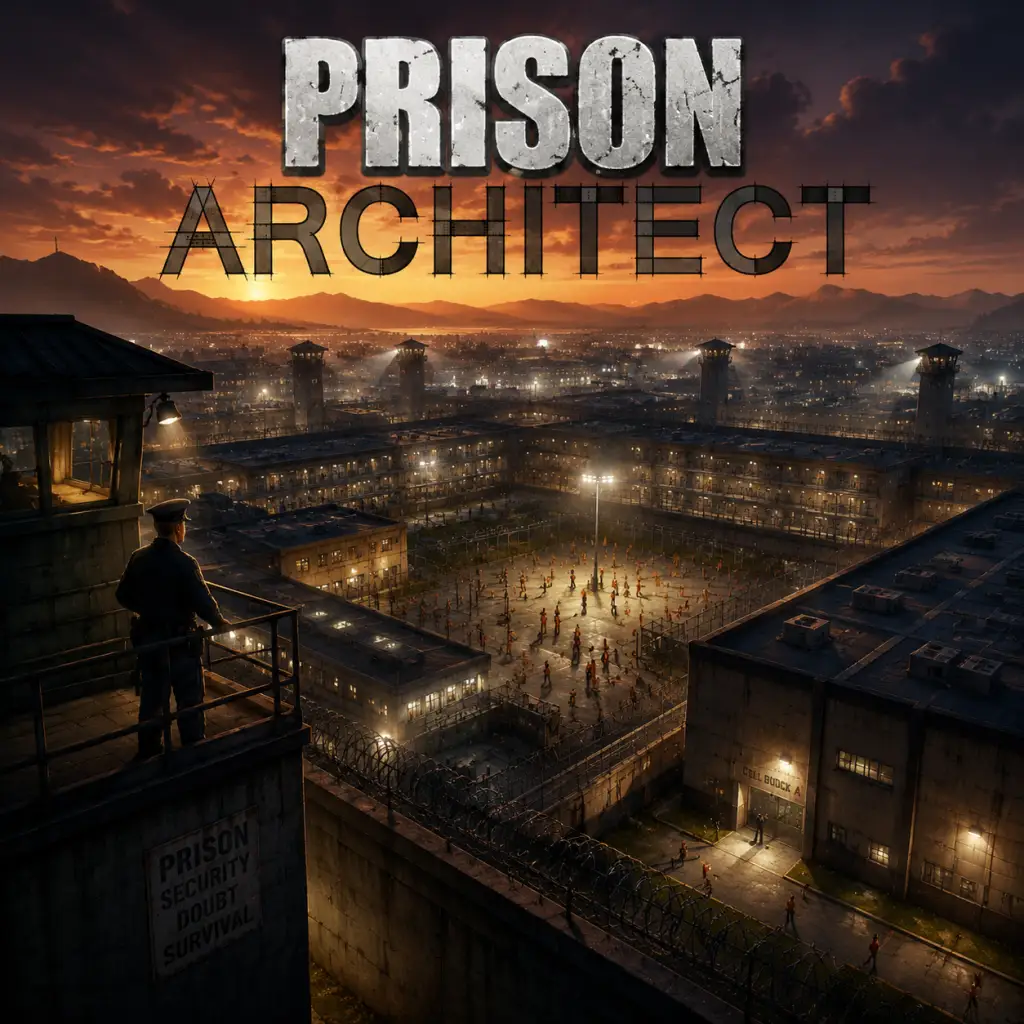
Game Introduction
Game Introduction
Prison Architect is a deep, top-down management simulation game developed by Introversion Software and published by Paradox Interactive. The game was first released in Early Access on Steam for Windows on September 25, 2012, and officially launched version 1.0 on October 6, 2015. It has since been ported to Linux, macOS, PlayStation 4, Xbox One, Nintendo Switch, iOS, and Android. The mobile and console versions are handled by Double Eleven.
Story Overview & Setting
While primarily a sandbox simulation, Prison Architect includes a narrative Campaign mode titled The Prison Architect. You follow the story of Edward Wright, a man convicted of murder after his wife’s death. The campaign takes you through the construction and management of multiple prisons — each level representing a chapter in Edward’s life — and gradually reveals a plot involving conspiracy, betrayal, and redemption. The setting is a stylized, isometric prison system inspired by American penitentiaries, with a darkly humorous tone and a grim aesthetic that emphasizes the harsh realities of incarceration.
Main Characters (Campaign)
- Edward Wright: The protagonist and player character. An architect who becomes a prisoner and later a prison manager. His motivations and past are slowly uncovered through campaign missions.
- Inspector Booth: A recurring character who evaluates your prisons and provides guidance.
- Prisoners: Named inmates (e.g., John “Snitch” Smith) appear in campaign missions, each with unique traits and backstories.
- Needs System: Prisoners have needs like hunger, sleep, hygiene, family contact, and safety. Unmet needs cause tension and riots.
- Staff Management: Hire guards, cooks, doctors, janitors, armed guards, and snipers. Assign patrol routes and deployment.
- Contraband & Security: Metal detectors, dog handlers, cells, solitary confinement, and prisoner classification (from minimum to supermax).
- Events & Emergencies: Random events such as fires, escapes, riots, and deaths require immediate player response.
- Permadeath (on some modes): Prisoners and staff can die permanently, adding weight to decisions.
- Campaign: A narrative-driven tutorial that teaches mechanics through story missions.
- Sandbox (Freeplay): Unlimited funds and resources to build the prison of your dreams with no goals.
- Prison Stories: Pre-built scenarios with specific objectives and constraints (e.g., “Escape Mode” where you control a prisoner trying to break out).
- Online & Offline Support: Prison Architect is primarily a single-player offline game. There is no multiplayer or co-op. However, the console and PC versions support cloud saves (Steam Cloud, etc.) and mods via Steam Workshop. The online component is limited to downloading community-made prisons and blueprints. The mobile versions are entirely offline, with no online features beyond optional cloud backup.
- Prison Architect: Total Lockdown — A bundle that includes the base game and all major DLCs (excluding the most recent).
- Prison Architect: Going Green (2023) — Focuses on sustainable living: renewable energy, recycling programs, farming, and workshops. Adds solar panels, wind turbines, crops, and animal husbandry.
- Prison Architect: Perfect Storm (2022) — Introduces extreme weather events like tornadoes, blizzards, and heatwaves. Requires new emergency management systems, weatherproof zones, and disaster response.
- Prison Architect: Psych Ward (2022) — Adds mental health mechanics, psychiatric staff, therapy rooms, padded cells, and a new prisoner type with unique needs.
- Prison Architect: Gangs (2021) — Implements gang factions, turf wars, and gang leaders. Adds unique security challenges and reputation systems.
- Prison Architect: Second Chances (2020) — Focuses on prisoner rehabilitation through education programs, parole hearings, and return-to-citizen pathways.
- Prison Architect: Island Bound (2019) — Enables building on separate islands within a single save, using a new transport system (boats, helicopters). Also adds luxury amenities and tourism.
- Prison Architect: Cleared for Transfer (2018) — Allows you to operate multiple prisons and transfer inmates between them, sharing resources.
- Prison Architect: Escape Mode (2015) — A standalone DLC that flips the perspective: you play as a prisoner trying to escape a randomly generated prison, using stealth, violence, and cunning.
Core Appeal & Unique Mechanics
What makes Prison Architect stand out is its granular control over every aspect of a prison’s design and operation. You lay out foundations, assign rooms, schedule prisoner routines, manage staff, finance, and security — all in real-time. The game features a two-dimensional (x, y) grid with a z-layer for foundations and objects, giving a pseudo-3D feel to construction. Key systems include:
Target Audience
Prison Architect appeals to management simulation enthusiasts, city-builder fans, and players who enjoy emergent storytelling. It is rated M for Mature (ESRB) or 16+ (PEGI) due to themes of violence, drug use, and penal system issues. The steep learning curve and complex systems attract dedicated strategy gamers, while the sandbox mode offers creativity without pressure.
Game Modes
DLC & Expansions
Several major DLCs expand the gameplay, often adding new systems, rooms, and architectural themes:
Additionally, there are numerous content packs (e.g., Future Tech Pack, Rock Pack, Tailor Pack) that add cosmetic items and furniture themes.
What Makes This Game Unique
Prison Architect is one of the few simulation games that tackles the morally complex subject of mass incarceration with a mix of dark comedy and serious undertones. Its ASCII-art-inspired graphics (later rendered in a clean 2D isometric style) and procedural sound effects create an immersive, almost cinematic atmosphere. The ability to design every cell, workshop, and canteen down to the placement of light fixtures and drains is unparalleled. The game also has a vibrant modding community, with thousands of custom maps, objects, and scenarios on the Steam Workshop. Its combination of city-building with prisoner psychology and emergent story generation ensures that no two prisons ever operate identically.