Game Introduction
Game Introduction
Genre
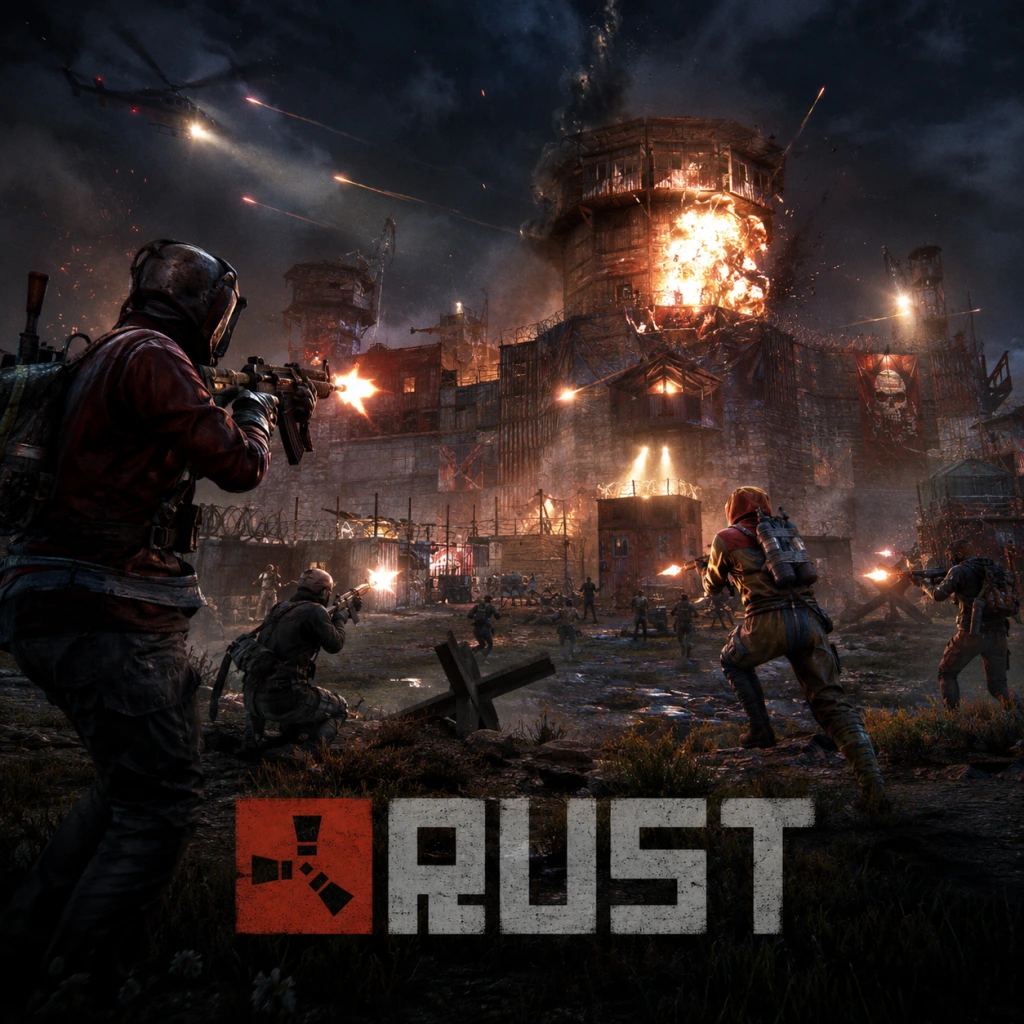
Rust is a hardcore multiplayer survival game that blends elements of open-world sandbox, first-person shooter, and crafting/building genres. It emphasizes player-driven conflict, resource management, and persistent world decay.
Developer and Publisher
- Developer: Facepunch Studios (PC version) — the studio behind the original Garry's Mod. The console version is co-developed by Double Eleven.
- Publisher: Facepunch Studios (self-published on all platforms).
- Original Early Access (PC): December 11, 2013 (Steam Early Access).
- Full Release (PC): February 8, 2018.
- Console Edition (Rust Console Edition): May 21, 2021 (PlayStation 4, Xbox One, and later optimized for PS5/Xbox Series X|S via backward compatibility).
- PC: Windows, macOS, Linux (via Steam).
- Console: PlayStation 4, PlayStation 5 (backward compatible), Xbox One, Xbox Series X|S (backward compatible).
- Note: No mobile or Nintendo Switch versions exist. Cross-play is not available between PC and console.
- Unforgiving Survival Mechanics: Players must manage hunger, thirst, radiation exposure, body temperature, and health. Death is permanent — you lose everything on your person (except items in secure storage).
- Player-Driven Conflict and Cooperation: The game’s heart is its social dynamics — form a clan to build fortified bases, raid enemy compounds, and dominate the server, or go solo as a stealthy scavenger. Trust is rare; betrayal is common.
- Deep Crafting and Base Building: Gather resources (wood, stone, metal, sulfur) to craft tools, weapons, armor, and complex structures. Build from simple shacks to multi-story, automated fortresses with traps and turrets.
- Procedurally Generated Maps: Every server wipe (usually monthly or bi-weekly) generates a new, unique map with varied terrain, monuments, and resource distribution, keeping the game fresh.
- No Safety Net: There are no save points, checkpoints, or safe zones (except the tutorial area, which is limited). PvP is enabled everywhere, all the time.
- Official Servers: Run by Facepunch, mostly vanilla settings (default gather rates, decay, etc.). Split into low, medium, high, and “softcore” (where sleeping bags are protected from looting) population servers.
- Community Servers: Player-run servers with custom configurations — faster gather rates, PvE-only (no player damage), roleplay (RP), modded (plugins like teleport, shops, mini-games), and creative (build without resources).
- Modded/Third-Party Servers: Use Oxide (now Carbon) modding framework. Examples: “2x” gather, “1000x” modded, battle royale-type modes, etc.
- Console Edition Servers: Similar structure but limited to official and community servers. No full modding support on console.
- Training/Combat Tags: Separate servers for aim practice (Combat Tag) where death has no penalty.
- Online Only: Rust is a persistent, multiplayer-only game. There is no offline/single-player mode. Even on private servers, you must be connected to the internet.
- No Local LAN: All server connections require internet access. However, you can host your own server (PC) on a dedicated machine or rent one, allowing you to play with friends privately — but still online.
- Server Wipes: Most official servers wipe player data (blueprints, inventory, and sometimes map) every month or every two weeks. This prevents permanent domination and forces fresh starts.
- Skin Packs and Instrument Packs: Cosmetic DLC that includes weapon wraps, building skins, and musical instruments (e.g., guitar, bagpipes, piano). These do not affect gameplay.
- Rust+ Companion App: Free mobile app that lets you monitor your base status (door open/alarms) and control smart devices (lights, alarms) if you have the appropriate in-game electrical components.
- No Season Pass or Battle Pass: Facepunch has avoided pay-to-win or subscription models. All gameplay-affecting features are free.
Release Timeline
Platforms
Story Overview and Setting
Rust does not have a traditional narrative or campaign. The setting is a post-apocalyptic island (or a procedurally generated map) where players awaken naked, alone, and with only a rock and a torch. The world is littered with the ruins of a collapsed civilization — abandoned monuments, military tunnels, power plants, and makeshift settlements. The lore is minimal and emergent, told through environmental details (e.g., radioactive zones, crashed helicopters, and roaming scientists) rather than scripted storylines. The driving force is survival against nature, radiation, hunger, thirst, and other players.
Main Characters
There are no predefined characters in Rust. Every player creates their own identity through in-game actions, clothing, weapons, and reputation. The “character” is your customizable survivor — a nameless, voiceless avatar whose only backstory is the moment they wake up on the beach.
Core Appeal
Target Audience
Rust is designed for hardcore survival enthusiasts who enjoy high-stakes PvP, endless replayability through wipes, and emergent storytelling. It appeals to players who have patience for steep learning curves, are comfortable with hours of grinding and being killed by others, and enjoy the rush of raiding or defending a base. It is not suitable for casual gamers or those who prefer single-player experiences or cooperative-only play without threat.
Game Modes
Online / Offline Support
DLC / Expansion Overview
Rust does not have major paid expansions that add new regions or storylines. Its post-launch content is delivered through free updates (bi-weekly patches) that introduce new monuments, weapons, vehicles, mechanics, and QoL improvements.
What is available for purchase:
What Makes Rust Unique
1. Total Player Freedom with Total Vulnerability: No safe zones, no NPC vendors, no quests — the only rules are physics, the game’s decay system, and other players’ decisions.
2. The Wipe Cycle: Unlike most survival games (e.g., Minecraft, The Forest), progress is periodically erased. This keeps competition fair and forces players to adapt to new map layouts and shifting alliances.
3. Complex Base Raiding Mechanics: Use explosives (C4, rockets, satchel charges) or clever bypasses (e.g., building high to jump across, using ladders) to breach fortified bases. Defenders use traps (shotgun traps, landmines), electricity (auto-turrets, sensors), and honeycombing.
4. Persistent World Even When Offline: Your base remains in the world while you’re away. Other players can raid it, loot it, or grief it. This creates real consequences for downtime.
5. No Tutorial Hand-Holding: The game intentionally leaves you to figure out crafting, survival, and social dynamics through trial and error (or online guides). The first few hours are brutal but memorable.
6. Active Development and Community: Facepunch releases weekly or bi-weekly patches with new content, balance changes, and bug fixes. The community creates mods, custom maps (via Map Editor on PC), and extensive content on YouTube and Twitch.
In summary, Rust is a relentless, uncompromising survival sandbox where the only constant is change — and the biggest threat is always another player.