Core Gameplay
Core Gameplay
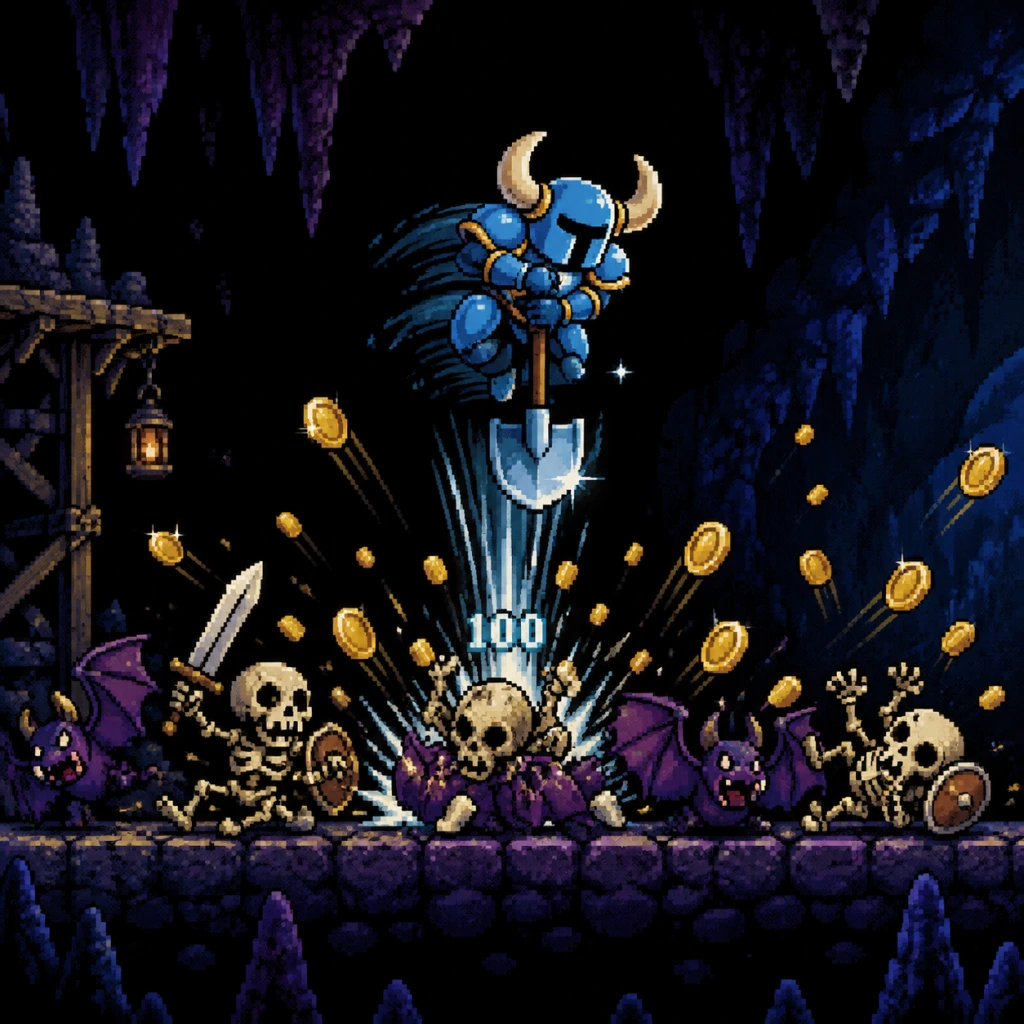
Shovel Knight's core gameplay is a refined blend of classic 2D action-platforming, with a strong emphasis on precise movement, combat using a unique shovel mechanic, and exploration of interconnected stages. The game is structured around four distinct campaigns, all sharing similar foundational systems but with unique twists per character. This guide focuses primarily on the main campaign, Shovel of Hope, as the baseline, with notes on how other campaigns diverge.
Core Gameplay Loop
The loop for Shovel of Hope is:
1. Select a stage from the World Map (e.g., Pridemoor Keep, King's Knight’s stage).
2. Traverse the stage left-to-right (or top-to-bottom) while defeating enemies, avoiding hazards (spikes, pits, falling blocks), collecting treasure, and discovering secret rooms.
3. Defeat the stage boss (an Order of No Quarter member) to earn a new Relic or ability.
4. Return to the hub (The Village) to spend gold on upgrades, health, and magic upgrades, or to buy items from the traveling merchant.
5. Advance the story by defeating more bosses, eventually facing the final boss in the Tower of Fate.
This loop applies to all campaigns, but each character has unique movement and combat mechanics (e.g., Plague Knight’s bomb jumping, Specter Knight’s dash slash, King Knight’s shoulder bash and pogo).
Combat and Interaction Systems
- Primary Attack (Shovel Blade): Shovel Knight swings his shovel horizontally. Holding the attack button performs a downward thrust (pogo) while in the air. Pogoing on enemies allows you to bounce off them, reach higher platforms, and break certain blocks. The pogo is the most versatile tool for both combat and platforming.
- Relics: Items found in stages that consume Magic (blue meter). Examples: Phase Locket (invincibility + health regen), Throwing Anchor (projectile), Dust Knuckles (wall climb), Chaos Sphere (bouncing projectile). Relics are equipped via the pause menu and used with the Relic button (default: R2/RT or keyboard Z).
- Magic Meter: Recharges by collecting magic jars (blue) dropped by enemies or found in stages. Max magic can be increased by buying upgrades from the hub.
- Sub-Weapons: In other campaigns, characters have distinct tools: Plague Knight’s bombs (with customizable casings/fuses/powders), Specter Knight’s Will Skulls (projectiles with special effects), King Knight’s Heirlooms (thrown items).
- Interaction: Most objects are struck with the shovel. Candles, pots, and breakable walls yield treasure. NPCs can be talked to by pressing the action button.
- Collecting Music Sheets (unlockable songs).
- Finding Cipher Coins (unlockable cheat codes).
- Completing Feats (achievement-like challenges).
- Backer NPCs to defeat for extra lore.
- Troupple Chef provides temporary power-ups (Troupple Chalice, Troupple Ales for health/magic).
- The Village Smithy: Upgrade Shovel Blade damage (tiers: copper -> silver -> gold).
- The Armorers: Buy armor sets that provide special effects (e.g., Conjurer’s Cloak for doubled magic, Old Man’s Hoe for faster digging).
- The Potion Merchant: Buy health and magic upgrades (max hearts and max magic bottles).
- Traveling Merchant: Appears in stages after clearing, sells limited-use items like food, armor sets, relics.
- Chester (Peddler): Sells Rare Relics for high prices.
- Weapon Upgrade: Increases damage per swing.
- Armor Sets: Equip one armor for passive bonuses. Examples: Spinning Golem (spin attack), Knight’s Plate (no knockback), Propeller Knight’s armor (double jump).
- Health/Magic Upgrades: Increase maximum health (hearts) and magic bottles.
- Relic Selection: Choose which relics to equip (up to 3 at a time via pause menu).
- New Game Plus: Harder version with increased enemy health/damage, no healing items, permadeath-style difficulty.
- Feats of Strength: Challenge stages (e.g., The Void).
- Boss Gauntlet: Defeat all bosses consecutively.
- Body Swap Mode: Play as Shield Knight with unique abilities.
- Goals: Learn basic movement (run, jump, pogo, shovel swing). Defeat the first boss (e.g., King Knight’s stage) to acquire the first Relic (usually the Phase Locket or Dust Knuckles). Collect enough gold for the first shovel upgrade (Copper) and one health upgrade.
- Exploration: Stick to main paths. Discover that pogoing on spikes is possible with Phase Locket later. Find a few hidden treasure rooms.
- Combat: Enemies are weak. Use basic shovel attacks. Pogo chain is not yet needed.
- Example: In "Pridemoor Keep", avoid the fire spears, use pogo on shielded knights to flip them. Defeat King Knight by pogoing his shoulder bash.
- Goals: Obtain multiple relics (Dust Knuckles, Throwing Anchor, etc.). Upgrade weapon to Silver. Purchase at least two health upgrades and one magic upgrade. Unlock the Musical Map and find the first secret feats.
- Exploration: Use Dust Knuckles to climb vertical shafts, Phase Locket to walk through magenta blocks. Discover hidden music sheets. Solve simple puzzles with relics.
- Combat: Enemy types diversify (flying, ranged, shielded). Use relics strategically (e.g., Chaos Sphere for crowd control). Bosses require pattern recognition (e.g., Propeller Knight’s air duel).
- Example: In "Clockwork Tower", use Dust Knuckles to climb the gear room, equip Throwing Anchor to hit distant switches. Boss: Tinker Knight (small form easy, giant form requires pogo patience).
- Goals: Max out shovel damage (Gold upgrade). Full health (8 hearts) and 6 magic bottles. Collect all relics. Equip a powerful armor set like Propeller Knight’s (double jump) or Spinning Golem. Defeat all Order of No Quarter members.
- Exploration: Revisit earlier stages with new relics to access previously unreachable rooms (e.g., using the Phase Locket to walk through magenta blocks for hidden treasure). Find the Hall of Champions (3 rematches).
- Combat: High enemy density. Use relics freely. Tower of Fate features gauntlet rooms with multiple enemies. Boss fights are intense (e.g., Shield Knight, Enchantress).
- Example: In "Tower of Fate" ascending sections, combine Phase Locket to dodge lasers, then use Throwing Anchor to destroy spawners.
- Goals: Complete all remaining Feats (e.g., No Damage Bosses, Speed Run). Collect all Music Sheets, Cipher Coins. Purchase all armor sets and upgrades. Attempt New Game Plus. Try Body Swap mode.
- Exploration: Fully explore every nook of every stage. Use Map to confirm 100% item collection. The Village now has new NPC dialogue.
- Combat: New Game Plus: enemies take reduced damage, drop no health. Use perfect pogo timing and relic management. Boss rematches are more aggressive.
- Example: The Feat "True Shovel Knight" requires completing the game with no health upgrades, perfecting early game strategies throughout.
- Plague of Shadows: Plague Knight’s bomb-jumping replaces pogo. His progression involves crafting bombs from ingredients. Economy includes purchasing bomb parts. Exploration relies on bomb trajectory puzzles.
- Specter of Torment: Specter Knight can dash mid-air, cling to walls, and has a scythe slash. Relics are replaced by Will Skulls. Progression unlocks new abilities via the hub (curse upgrades). Endgame includes a final boss gauntlet.
- King of Cards: King Knight’s shoulder bash and pogo (via Heirlooms). Progression includes card collecting (Joustus mini-game). Economy involves betting and card trading.
Progression
Progression is primarily non-linear but gated by story events. The World Map has branching paths. Defeating each boss unlocks a new Relic and often opens new routes or access to hidden stages (e.g., the optional Hall of Champions). The main story progression is tracked by the number of Order of No Quarter members defeated. After defeating a set number (usually 5), the final stage, the Tower of Fate, becomes accessible. The endgame requires defeating all eight main bosses and then the final boss.
Exploration
Each level is filled with hidden areas, alternate paths, and secret rooms. Many secrets require specific Relics like the Dust Knuckles (wall climbing) or Phase Locket (walk through obstacles). Gold is hidden in breakable walls, behind waterfalls, or in secret nooks. The Musical Map (obtained after first boss) reveals hidden paths on the World Map. In the Village, you can find NPCs to unlock optional challenges and the Body Swap mode (post-game).
Quests and Missions
There are no traditional quest logs. The main "quest" is to defeat the Order of No Quarter and rescue Shield Knight. Side objectives include:
Economy
Currency is gold. Collect gold from enemies, breakables, secret treasure. Spend gold at:
Gold is also lost on death unless you collect your dropped bag (which disappears if you die again).
Character / Build Growth
Shovel Knight has no leveling system. Growth is entirely equipment-based:
In other campaigns, character growth may include customizing bomb loadouts (Plague), upgrading scythe abilities (Specter).
Endgame Structure
After defeating the final boss (the Enchantress), you can continue playing to collect remaining relics, upgrades, and complete all Feats. The post-game unlocks:
Progression Tiers
#### Early Game (First 2-3 Stages)
#### Mid Game (Stages 3-6)
#### Late Game (Stages 7-8 and Tower of Fate)
#### Endgame (Post-Enchantress)
Cross-Campaign Notes
Regardless of campaign, the core loop of stage select -> platforming + combat -> boss -> upgrade persists. The synergy of movement (pogo/dash/bomb) and relic usage defines mastery.