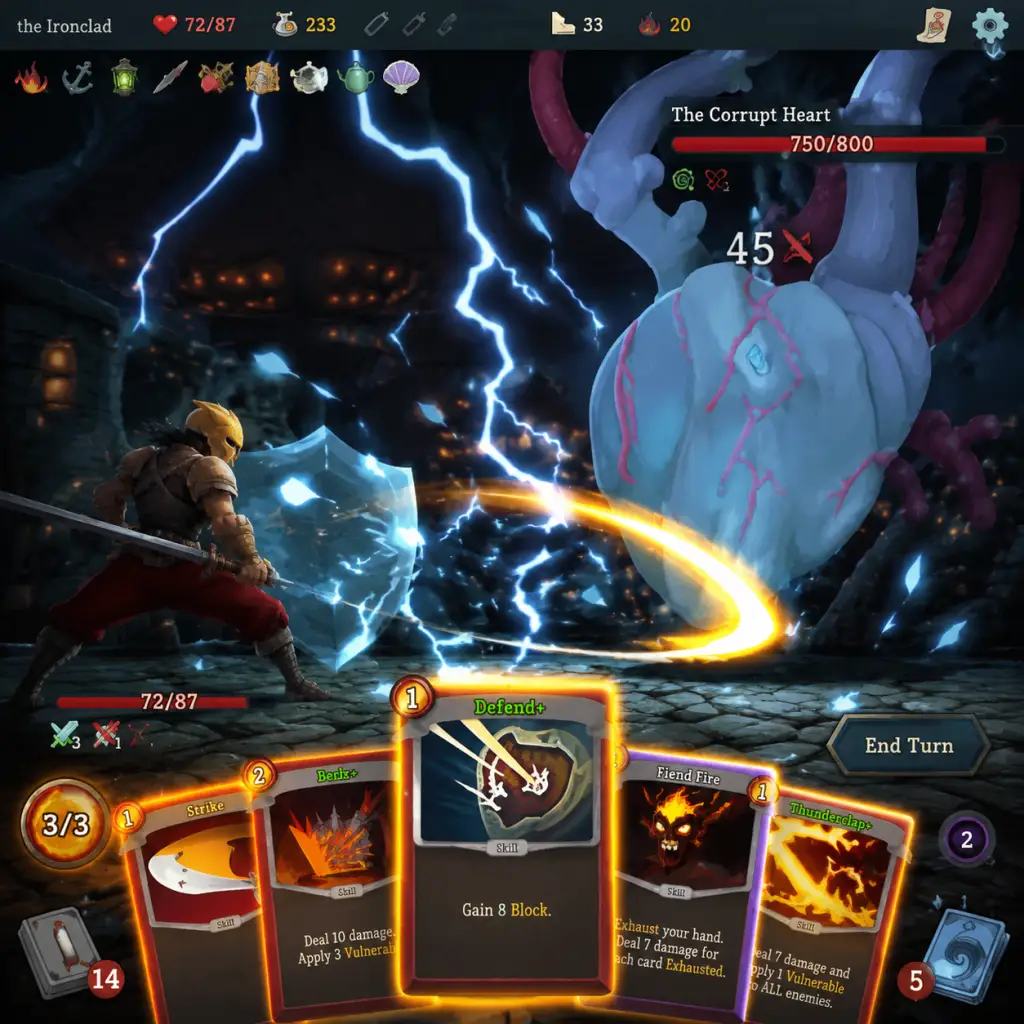
Core Gameplay
Core Gameplay Guide for "Slay the Spire"
This guide dives deep into the core gameplay systems of Slay the Spire, organized by the typical player progression tiers. You will learn the main gameplay loop, combat, progression, exploration, economy, character building, and endgame structure with concrete examples for each stage.
Introduction to Core Gameplay
Slay the Spire is a roguelike deck-building card game. Each run is a fresh attempt to climb the Spire, a procedurally generated tower filled with monsters, elites, bosses, and events. You start with a basic deck of 10 cards (5 Strikes, 5 Defends, plus a character‑specific starter relic and card). Your goal is to reach the top and defeat the final boss of Act 3, with an optional extra challenge (Act 4) to slay the Heart. Death means you lose everything and must start over, but you permanently unlock new cards, relics, and characters between runs.
Core Gameplay Loop
The loop is simple but infinitely replayable:
1. Select a Character – You choose from Ironclad, Silent, Defect, or Watcher. Each has a unique starter deck and relic.
2. Climb the Spire – Each act presents a map with branching paths. You choose nodes: monster fights, elite enemies, rest sites, merchants, treasure chests, or ?? events.
3. Combat – Turn‑based battles. You draw 5 cards per turn, spend energy (3 per turn base) to play cards, and manage your HP, block, and resources.
4. Build Your Deck – After each fight, you are offered a card reward (choose 1 of 3). You can also obtain relics, potions, and gold from events, chests, and merchants.
5. Prepare for the Boss – At the end of each act, you face a powerful boss. You can choose to rest or upgrade cards at campfires.
6. Die and Repeat – When you die, you return to the main menu. Completion unlocks new cards/relics and raises your Ascension level (difficulty modifier).
Combat & Interaction Systems
Energy & Cards – Every card costs energy (0‑3). Attacks deal damage, Skills provide block or utility, Powers persist for the fight. Examples:
Strike (1 energy, 6 damage)
Defend (1 energy, 5 block)
Flame Barrier (1 energy, 12 block, deals 6 damage when attacked)
Status Effects & Buffs/Debuffs – Enemies apply Vulnerable (takes 50% more damage), Weak (deals 25% less damage), Frail (75% effective block), etc. You apply Poisons, Strength, Dexterity, etc.
Relics – Permanent passive bonuses acquired during a run. Example: Burning Blood (Ironclad’s starter relic) heals 6 HP after each combat. Other relics grant energy, draw, or special effects like Snecko Eye (randomizes card costs but draws 2 extra cards per turn).
Potions – One‑time use consumables that heal, deal damage, or provide buffs. You can carry up to 2 (more with relics).
Orbs (Defect only) – Passive abilities that trigger at the end of turn. Lightning orb deals damage, Frost orb gives block, Dark orb stores damage, Plasma orb generates energy. You can evoke orbs for powerful effects.
Cards Unique to Each Class – Ironclad focuses on Strength scaling and block; Silent on Poison, Shivs, and card draw; Defect on Orbs and focus; Watcher on stance‑changing (Wrath/Calm) and retain.
Progression (Meta-Progression)
Character Unlock – You start with Ironclad. After your first run, you unlock Silent. Defect requires beating the game (or getting to Act 3) with both, and Watcher requires beating the game with the other three.
Card & Relic Unlocks – Each character has a pool of cards and relics that are locked initially. Unlock them by completing runs (winning or dying on higher acts) and spending points earned from achievements.
Ascension Levels – After you beat the game once, you unlock Ascension mode. Levels 1‑20 add increasing difficulty: more damage from enemies, less starting HP, harder elites, etc. Ascension 20 is the ultimate challenge.
* Endless Mode – Unlocked after beating the game once. You can choose to continue beyond the Heart, with escalating “blights” that make the run harder.
Exploration & Pathing
Each act’s map is a grid of nodes. Your path choice determines your rewards and difficulty.
| Node Type | Effect | Example Strategy |
|---|---|---|
| Monster | Standard fight. Gain gold, card reward, maybe a potion. | Early on, take as many as possible to build deck. |
| Elite | Harder fight with a guaranteed relic drop, plus more gold. | Only fight if your deck can handle it – skipping is often wise. |
| Rest Site | Choose: Rest (heal 30% HP) or Smith (upgrade a card). | Upgrade key damage dealers or scaling cards. |
| Merchant | Spend gold to buy cards, relics, potions, or remove cards. | Remove Strikes/Defends to thin your deck. |
| Treasure | Free relic. | Always take; but watch out for curses from chests (with Chest key). |
| ? | Random event – could be positive, negative, or both. | Read the options carefully; many have trade‑offs (e.g., lose HP for a relic). |
| Campfire (Act 4) | Similar to rest site, but unique events. | Prioritize upgrade if your deck is strong. |
Quests & Missions (Within‑Run Objectives)
Slay the Spire has no traditional quests. The only mission is to survive and reach the top. However, there are in‑run objectives:
Keys (Act 4) – To unlock Act 4 (The Heart), you must collect three keys during a run:
1. Red Key – At a rest site, recall (sacrifice the rest/upgrade) to obtain.
2. Green Key – Defeat a burning elite (marked with flame icon). Harder than normal elite.
3. Blue Key – Open a chest instead of taking a relic. Miss out on that relic.
Achievements – Some achievements like “Minimalist” (5‑card deck win) or “You Are Nothing” (boss kill on turn 1) provide a sense of mission but are not required.
Daily Climbs – A seed‑generated, modified run with special modifiers (e.g., all enemies have double HP). Leaderboards for fastest time and highest score.
Economy (Gold & Resources)
Gold is the main currency. Use it at merchants:
Buy Cards – 50‑150 gold each. (Avoid buying commons; hunt for uncommons/rares.)
Buy Relics – 100‑400 gold. Very powerful, but gold is scarce.
Buy Potions – 50‑100 gold. Useful for elites.
Remove a Card – 75 gold (cost increases each removal). Essential to strip basic Strikes/Defends.
Transform/Upgrade – Some events offer transformation (communal bonfire) or upgrade at relic price.
Gold Tips:
- Save gold for removing cards before buying relics.
- In Act 1, prioritize removing strikes over buying cards (deck thinning).
- Events like “The Ssssserpent” or “The Cleric” cost gold for big rewards.
- Deck: Starting deck of 10 (5 Strike, 5 Defend). Look for a single strong damage card to carry early fights (e.g., Carnage, Poisoned Stab, Ball Lightning).
- Pathing: Prioritize 2‑3 normal fights to get card rewards, then a rest site to upgrade your key damage card, then try an elite (if your HP is high). Skip elites if low on HP.
- Example Build: As Ironclad, take Uppercut (2 energy, 13 damage, apply Vulnerable and Weak). Upgrade it at the first campfire. Now you can kill early elites like Lagavulin (which has low HP but debuffs you) by applying Vulnerable and bursting.
- Economy: Spend gold only on card removals or a critical relic like Boot of Speed (unlikely). Avoid buying potions unless you face an elite.
- Boss Preparation: Act 1 boss examples: Slime Boss (split into two at 50% HP; needs AoE), Guardian (starts in defensive mode, you must break its shield), Hexaghost (extremely high HP, burns cards). Build accordingly (AoE for slime, single heavy for Guardian, block for Hexaghost).
- Enemies: More dangerous: Book of Stabbing (fast multi‑attack), Gremlin Leader (spawns minions), Snecko (confuses costs). You need reliable block or scaling damage.
- Pathing: Fewer fights, more rest sites. Consider taking ? events that may give rare relics (e.g., The Library offers 10 random cards to choose 1, or the Face Trader event).
- Build Evolution: Now you commit to a specific strategy. For Silent Poison: add Catalyst, Corpse Explosion. For Defect Orb: add Electrodynamics (lightning hits all enemies). Example: Defect builds towards Echo Form (double all cards) + Creative AI (generates powers each turn).
- Elite Strategy: Act 2 elites require burst or consistent block. Book of Stabbing attacks for 6x3 or 12x2; you need at least 15 block per turn or high damage to kill turns 2‑3.
- Merchant: Save gold for removing Strikes (now removal costs 150+ gold). Also look for scaling relics: Kunai, Shuriken, Orichalcum (block at end of turn if you have <2 energy).
- Boss Preparation: Act 2 boss: Champ (starts in defensive mode, then at 50% HP becomes aggressive and gains Strength), Bronze Automaton (summons minions, deals huge AoE), Collector (spawns torches that buff him). Need damage over time or burst for second phase.
- Enemies: Repulsor, Giant Head (very high HP), Nemesis (intangible every other turn). You need consistency: high card draw, energy generation, and scaling.
- Deck Size: By now, you should have removed most Strikes and Defends (aim for 10‑15 total cards plus powers). If your deck is bloated (25+ cards) you will draw inconsistently.
- Scaling: Your deck must produce increasingly large numbers. Examples:
- Pathing: You likely seek a rest site to upgrade one last card, or a merchant for a critical relic (Ice Cream, Bag of Preparation). Avoid unnecessary fights unless you need a specific card reward.
- Boss Preparation: Act 3 bosses: Awakened One (gains Strength when you play powers – so limit powers or kill fast), Time Eater (adds a turn counter, can end your turn early – small decks or high draw), Donu & Deca (two bosses: one buffs strength, the other defends. Need AoE). Adapt your deck before the boss: e.g., remove a power if facing Awakened One.
- Collecting Keys: If going for Heart, you must recall at a rest site (red key), fight a burning elite (green key), and skip a relic at a chest (blue key). This is a sacrifice in a run; you lose potential upgrades/relics. Plan accordingly: fight the burning elite early in Act 3 when you are strong, recall at a rest site before the boss (usually the last rest site).
- Heart Fight: The Heart has 800 HP (more on Ascension). Its turn pattern:
- Ascension 20: The final difficulty. In Act 3, you face two bosses back‑to‑back (e.g., Time Eater then Awakened One). Your deck must be versatile enough to handle both. Example: a Poison Silent can kill both with enough scaling, but the Time Eater’s 12‑card turn limit can hinder. High draw decks like Defect with Snecko Eye + Meteor Strike can manage.
- Endless Mode: After beating the Heart, you may continue to endless. Each subsequent act, enemies become stronger and you acquire “blights” (debuffs like -1 max HP per turn, enemies have +50% HP). Eventually you will die; the goal is to see how far you can get. Best builds: infinite combos (e.g., Dropkick with dual wield for infinite actions, or Flash of Steel + Finesse with Unceasing Top).
- Mods: Once you’ve exhausted base content, try mods like “The Cursed” or “The Animator”. Many mods add new characters with unique mechanics (e.g., “The Hermit” uses Dead On and Concentration).
- Synergy over Power: A single strong card (like Claw) is useless without support (card draw, energy).
- Know When to Skip: Often the best card pick is no pick. Adding a mediocre card dilutes your deck.
- Match the Act: Act 1 needs early damage; Act 2 needs block and AoE; Act 3 needs scaling and consistency.
- Practice: Each character plays very differently. Watch high‑level streamers (e.g., Jorbs, Baalorlord) to learn decision‑making.
Character / Build Growth
Every run you aim to build a deck that can handle the increasing difficulty. This is done by:
Picking cards that synergize – Avoid taking every card; focus on a theme. Examples:
Ironclad – Strength Scaling – Cards like Spot Weakness (gain 3 Strength), Limit Break (double Strength), Heavy Strike (high base damage). Pair with block cards like Shrug It Off.
Silent – Poison – Crippling Poison, Catalyst (multiply poison), Envenom (poison on attack). Use Dagger Spray for AoE.
Defect – Orb Focus – Claw scales with each Claw played; Cold Snap creates Frost orb; Echo Form duplicates all cards.
Watcher – Stance Dancing – Eruption (enter Wrath stance, double damage but take double damage), Vigilance (enter Calm, gain energy). Use Ragnarok to burst.
Removing Starter Cards – Strikes and Defends become dead draws late game. Remove them aggressively.
Upgrading Key Cards – An upgrade can double effectiveness: e.g., Bash (Vulnerable for 2 turns → 3 turns), Catalyst (triple poison → quintuple poison).
Relic Synergies – Snecko Eye makes expensive cards cheap, but adds randomness. Kunai gives Dexterity on playing 3 attacks (great for Shiv Silent). Tungsten Rod reduces incoming damage by 1.
Endgame Structure
After Act 3, you face one of three bosses: The Awakened One, The Time Eater, or The Donu & Deca. If you have collected all three keys, you proceed to Act 4.
#### Act 4 – The Heart
Path – A single node: a campfire (rest or upgrade, no recall), then an elite fight (Spear and Shield), then the Heart.
Heart’s Abilities – Hearts start with 13x9 (more on higher ascensions), halves your damage per turn, and after 4 turns deals a massive attack that hits all characters (Blood Rage? actually it does a single big attack each turn: “Beat of Death” and a scripted turn pattern). Example: Turn 1: Buff; Turn 2: Big Attack; Turn 3: Debuff; Turn 4: Invulnerable+Attack; repeat. You need immense scaling to burst or survive.
Key Strategy – Stack block or intangible cards (e.g., Dark Shackles, Incense Burner). Scaling poison, strength, or orbs is essential.
#### Ascension Levels (Post‑Game)
Win with Ascension 1, then 2, up to 20. Each level adds a modifier:
A1: More elites
A2: Less starting HP (by 5 per level? Actually A10 -25% HP, but check)
A10: Enemies have more HP
A20: Two bosses in Act 3 (you fight both sequentially!)
A20 Heart is unlocked by beating A20 with all four characters.
Example: At A20, you need a deck that can defeat two Act 3 bosses plus the Heart. Only the strongest builds survive.
#### Endless Mode
After unlocking, you can toggle Endless Mode at main menu. After defeating the Heart, you may continue to “Act 5+” where you fight escalating elite blights. This is purely for fun and high score, not for progression.
#### Mods & Customization
The Steam Workshop offers hundreds of mods that add new characters, cards, relics, and even full overhauls. Popular mods: “Downfall” (play as the monsters), “The Hermit” (new character). Mods can drastically change core gameplay.
Progression Tier Breakdown
#### Early Game (Act 1, first 15 minutes of a run)
Goal: Survive the first few fights and build a basic game plan.
#### Mid Game (Act 2, roughly minutes 15‑40 of a run)
Goal: Refine your deck’s synergy, increase scaling, and survive the act’s punishing elites.
#### Late Game (Act 3, minutes 40‑60)
Goal: Finalize your deck to be near‑invincible, scale to absurd levels, and defeat the Act 3 boss.
- Ironclad: Limit Break + Spot Weakness -> 40+ Strength. Barricade + Entrench -> 999 block.
- Silent: Catalyst + Crippling Poison (99 poison, then 5x = 495). Use Nightmare to duplicate the Catalyst.
- Defect: Echo Form + Creative AI -> 10 powers → 44 focus, 60 block per orb. Or Claw deck with All For One (retrieve all zero‑cost cards) – each Claw does 40+ damage.
- Watcher: Master Reality + Establishment -> retain and reduce cost. Omega (deal 60 damage per card played) but hard to set up.
#### Endgame (Act 4 & Beyond, Ascension 20, Mods)
Goal: Defeat the Heart and/or climb Ascension levels.
Turn 1: Applies a buff (invulnerable? Actually, the Heart starts “invulnerable” – can’t be damaged for the first 2 turns. It then gains 9 Strength on turn 3, then deals 60 damage on turn 4. You must survive the massive attack and then burst it down in the next few turns. Use Lizard Tail or Fairy in a Bottle to cheat death.
Strategy: Needs either insanely high block (Barricade + Entrench for 999 block) or intangible (e.g., Ghost in a Jar potion, Apparition cards). Offense must be fast: Catalyst to multiply poison to 500+, or Limit Break loop for infinite strength, or Echo Form + Meteor Strike (generate 3 energy per cast).
Final Tips
Now go climb the Spire—and don’t forget your keys!