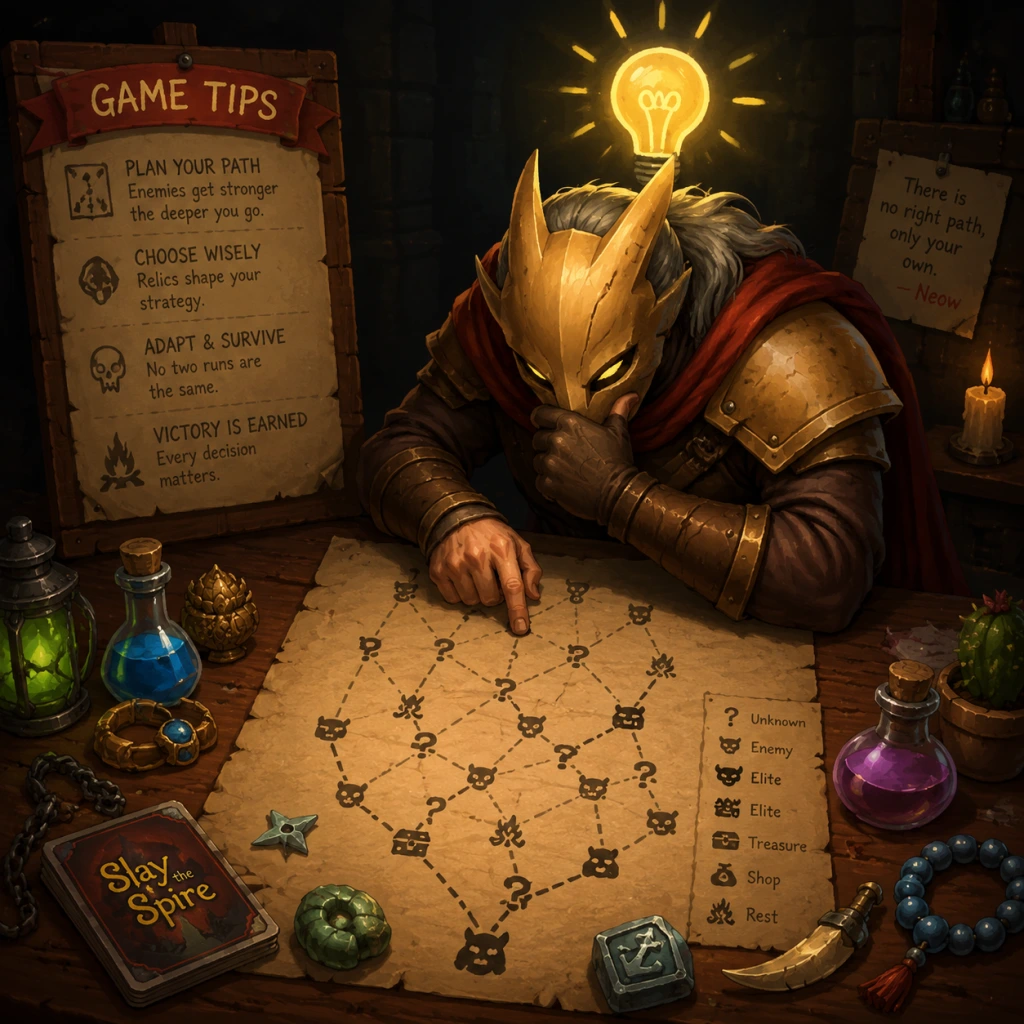
Game Tips
Game Tips for Slay the Spire
This guide compiles essential tips for mastering Slay the Spire, organized by category. Tips are suitable for beginners, intermediate players, and advanced optimizers.
Beginner Tips
1. Keep Your Deck Small
- Aim for 10–15 cards in your deck by the end of Act 1. Every card draw matters; diluted decks reduce consistency.
- Remove Strikes and Defends whenever possible (at shops, via events). The base cards are weak; replacing them with better cards improves your average hand.
2. Rest or Smith?
- In the first few floors, it’s often better to Smith (upgrade) a key card than to Rest. Upgrading a strong attack or block card can save more HP over the run.
- Rest only if you are at critical health (below 50% max HP) and a difficult fight is imminent.
3. Plan Your Route on the Map
- Look ahead to see where campfires, shops, and ? rooms are. Aim to hit at least 2–3 campfires per act to upgrade cards or rest.
- Early act, favor ? rooms for chances at free relics or card removal. Later, prioritize elites for relics if your deck can handle them.
4. Don’t Over-pick Cards
- Adding a card just because it’s rare is a trap. Evaluate if it fits your current strategy. Skip cards that don’t improve your deck.
- A small, synergistic deck outperforms a large collection of good standalone cards.
5. Learn Enemy Attack Patterns
- Most enemies have predictable intents (attack, block, buff). Memorize common patterns (e.g., Lagavulin buffs then attacks; Gremlin Nob attacks hard then debuffs).
- Use this knowledge to time your blocks and attacks efficiently.
6. Use Potions Generously
- Potions refill every act, so don’t hoard them for the “perfect” moment. Use them in tough fights or to secure elite kills.
- Swap potions at the start of an act if you have two identical ones—always a free swap.
Combat Tips
1. Play Cards in the Right Order
- Apply Vulnerable before your big attack. Apply Strength before multi-hit attacks. Draw cards before playing powers that benefit from card play.
- Example: If you have a Flex (gain 4 Strength this turn) and a Pummel (4x damage), play Flex first to boost Pummel.
2. Block More Than You Think
- New players often underestimate blocking. Even if you plan to kill next turn, taking 10 damage now reduces your campfire flexibility.
- A good rule: block every turn you can, except when you can kill the enemy this turn.
3. Manage Energy Wisely
- Don’t waste energy on weak attacks when you need to block. Plan your energy usage around enemy intent.
- Cards like Adrenaline (gain 2 energy) are excellent for burst turns. Save them for when you have a strong hand.
4. Stun and Debuff Enemies
- Abilities that apply Weak reduce enemy damage output effectively. Vulnerable increases your damage. Use debuffs to control fights.
- Example: Silent’s Bouncing Flask applies 3 Poison; with catalyst, it’s deadly. Ironclad’s Shockwave applies Vulnerable and Weak—ideal for tough fights.
5. Understand Scaling
- Simply adding damage cards won’t win later acts. You need scaling mechanisms: Strength (Ironclad), Poison (Silent), Orbs (Defect), Watcher’s stance cards.
- Build your deck around one or two scaling engines.
6. Use Relic Synergies
- Some relics change how you play. For example, The Boot adds 5 damage to low-damage attacks—kills great if you have many 0-cost attacks. Incense Burner gives intangible every 6 turns—you can plan to take one big hit.
Exploration Tips
1. Path Choice Trade-offs
- More fights = more gold, cards, potions. More ? rooms = relics/events but less reliable power. Balance based on your deck’s needs.
- If you lack a key card, prioritize ? rooms that offer card rewards.
2. Elite Fights: Risk vs Reward
- Act 1 elites (Lagavulin, Gremlin Nob, Slime Boss) are beatable with a decent deck. They reward powerful relics often pivotal for later acts.
- Skip elites if your deck is weak or you’re low on HP. The relics aren’t worth a death.
3. Event Room Decisions
- Many events have multiple outcomes. Check the Slay the Spire wiki for detailed choices, but general rules:
- Act 1: “The Cleric” heals 15 HP for 50 gold—often worth it. “The Living Wall” can remove a card for HP—good if you have a Strike to remove.
- Act 2: “The Library” lets you add a card for free or upgrade for gold—choose based on deck needs.
- Act 3: “Maw Bank” gives gold if you have 400 gold—great to save.
4. Treasure Rooms
- Always take the relic from treasure rooms. The choice is usually between a relic and gold; relic is almost always better.
5. Shops as Resource Hubs
- Save at least 100 gold for the first shop. Buy a strong uncommon card, a relic, or remove a card.
- Potions are cheap and effective. Buy them if your deck lacks block or damage for the next elite.
Resources & Economy Tips
1. Gold Management
- Gold scales with Act: Act 1 save for shop, Act 2 spend on critical upgrades, Act 3 buy potions for the final boss.
- Avoid wasting gold on weak relics. Prioritize card removal and high-impact relics like Kunai, Shuriken, or Ice Cream.
2. Card Removal Cost
- Removing a card costs more each time (start at 75 gold, increase by 25). Remove Stikes and Defends early when cheap.
- If you have many basic cards, remove them over several shop visits. A lean deck is powerful.
3. Potions as Currency
- You can swap potions at the start of each act for a free different potion. Use this to adapt to upcoming challenges (e.g., get an explosive potion for Act 2 multi-enemies).
4. Max HP Management
- Events and relics can increase max HP. That’s often a trap: it doesn’t help scaling. Prefer relics that add power.
- However, if your deck relies on taking damage (e.g., Ironclad Flame Barrier), extra HP can be useful.
5. Key Relics to Prioritize
- Energy relics (like Smiling Mask, Snecko Eye, Runic Dome) are powerful but have drawbacks. Only take them if your deck can handle the downside (e.g., Snecko Eye high-cost card synergy).
- Damage relics (Kunai, Shuriken for Silent; Vajra for Ironclad) boost scaling.
Build & Deck Strategies
1. Know the Character Archetypes
- Ironclad: Strength + multi-hit (e.g., Limit Break + Hemokinesis), or armor/block (Barricade + Body Slam).
- Silent: Poison stacking (Crippling Cloud, Catalyst), or shivs (Blade Dance, Accuracy).
- Defect: Focus on Orbs (Frost + Lightning, combined with Capacitor/Glacier).
- Watcher: Stance dancing (Wrath + Calm, with cards like Flurry of Blows and Rushdown).
2. Don’t Force a Build
- Let the offered cards guide you. If you see a strong power early (e.g., Defragment for Defect), build around it. Don’t stick to a preconceived plan.
- Adapt to relics: if you get Pen Nib, look for high-damage attacks; if you get Torii, take block cards.
3. Remove Strikes Before Defends?
- Generally remove Strikes first because they are weak attacks that stay in your hand and waste draw. Defends block slightly better.
- Exception: if your deck already has strong block, remove Defends first.
4. The Importance of Draw
- Cards that draw more cards (like Escape Plan, Backflip, Preposterous Pummel) improve consistency. Always consider adding a draw card if your deck lacks it.
5. Scaling for Act 2 and 3
- Act 2 enemies have high HP and start with buffs. Your deck must scale quickly (e.g., Ironclad’s Inflame, Silent’s Noxious Fumes).
- Act 3 bosses (e.g., Time Eater, Awakened One, Donu & Deca) require specific strategies: Time Eater punishes 12-card plays; Awakened One punishes powers—plan accordingly.
Advanced Optimizations
1. Infinite Combos
- Some decks can loop infinitely, drawing and playing cards endlessly. Examples: Ironclad: Dropkick + Dual Wield + Necronomicon. Silent: Tactician + Reflex + Finisher.
- To achieve infinite, you need 3–6 cards and a reliable way to generate energy or draw. Remove all other cards.
2. Heart Kill Prep
- To fight the Heart, you must collect the three key relics (Ruby Key, Emerald Key, Sapphire Key) by defeating the corresponding bosses. Plan your route to get all keys.
- The Heart has 800 HP, a multi-attack that scales with your strength debuffs, and a beat of death that deals damage per card played. You need massive block or damage reduction (e.g., Intangible, the Calipers relic, or high block via Barricade).
3. Speedrunning Techniques
- Speedruns often favor high-damage, aggressive decks that end fights quickly. Use cards like Whirlwind with a strength potion to one-shot multiple enemies.
- Skip ? rooms that waste time; fight elites for relics that boost damage.
4. Use Save & Quit to Your Advantage
- If you make a misplay, you can exit to main menu (on PC) and resume the fight from the start of the turn. This allows you to retry difficult battles with perfect play.
- On mobile/console, there may be no such option; but on PC it’s a legitimate tool.
5. Ascension Learning
- Ascension levels add difficulty (more enemies, less hp, tougher elites). Don’t start Ascension until you can consistently beat Act 3. Each Ascension forces you to improve: learn enemy patterns, optimize pathing, and streamline deck building.
6. Keyboard Shortcuts (PC)
- Use number keys (1-9) to select cards quickly. Space bar ends turn. Escape cancels actions. These save time during fast runs.
7. Data Visualization
- Use third-party tools (like Spirelogs or the in-game run history) to analyze your win rates and card usage. Identify which cards you over- or under-use.
Final General Advice
- Patience is key. Slay the Spire rewards careful planning and adaptation. Each run is a puzzle; accept losses as learning opportunities.
- Watch high-level players (e.g., Jorbs, Baalorlord, Rhapsody) on YouTube/Twitch to see advanced strategies and decision-making.
- Experiment! Try off-meta strategies—sometimes a weird relic combo leads to a surprising win.
Remember: The spire is always changing. Your adaptability is your greatest weapon.