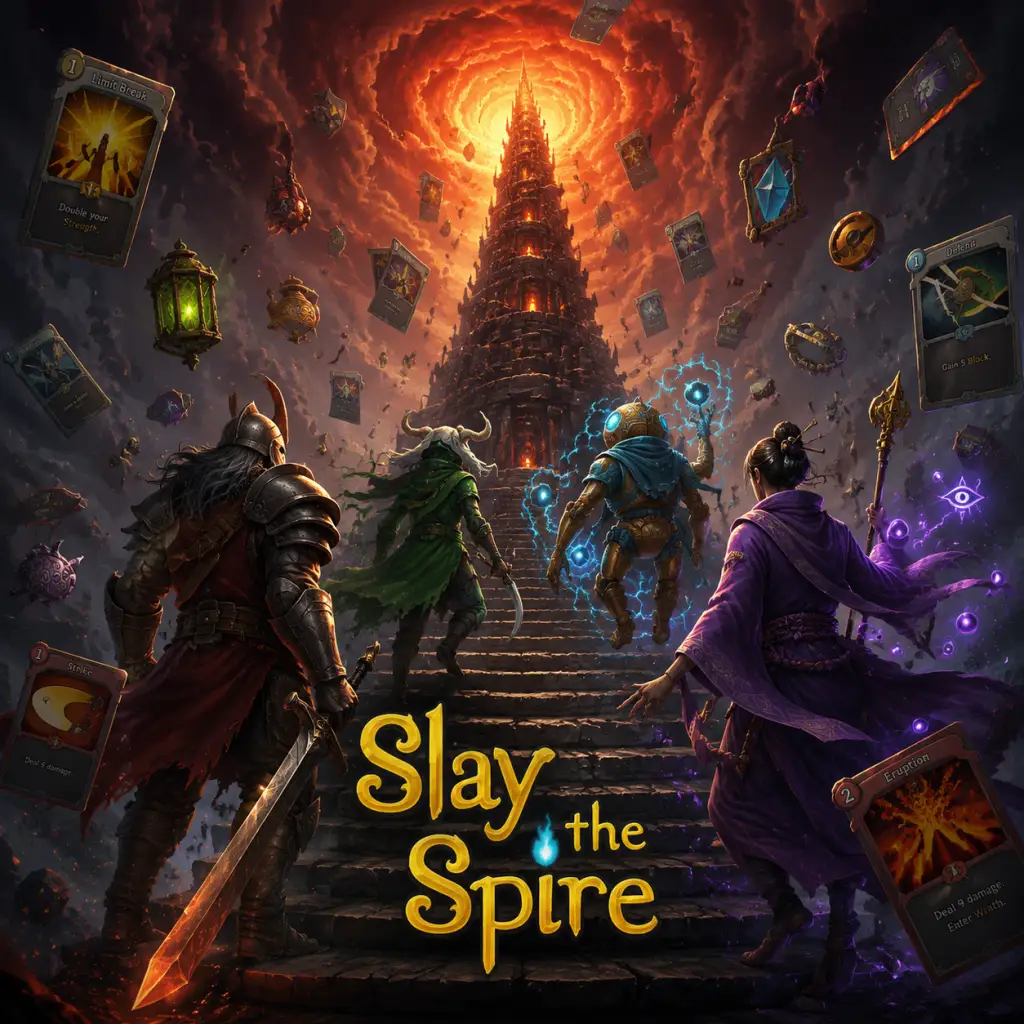
Game Introduction
Game Introduction for "Slay the Spire"
Genre and Developer/Publisher
Slay the Spire is a groundbreaking roguelike deck-building card game that blends the strategic depth of collectible card games with the procedural replayability of roguelikes. Developed and published by the independent studio Mega Crit Games (founded by Anthony Giovannetti and Casey Yano), the game was first released in Early Access on November 15, 2017, and fully launched on January 23, 2019.
Release Timeline and Platforms
- Early Access: November 15, 2017 (Windows, Mac, Linux via Steam)
- Full Release: January 23, 2019 (Windows, Mac, Linux)
- Console Releases:
- Mobile Releases:
- Current Platforms: Windows, macOS, Linux, Nintendo Switch, PlayStation 4, PlayStation 5 (via backward compatibility), Xbox One, Xbox Series X|S, iOS, Android
- Innovative combat system: Turn‑based battles where your deck is your life. Cards cost energy, and you draw a hand each turn. Hand management, discard, and deck thinning are crucial.
- Relic system: Permanent items that grant passive bonuses, often synergizing with your deck archetype. Relics can completely change your strategy.
- Procedural events: Story encounters (e.g., the Mysterious Circle, the Knowing Skull) offer choices that can help or hinder you—no moral alignment, just tactical dilemmas.
- Infinite replayability: Over 350 cards, 200+ relics, and multiple difficulty levels (Ascension system) provide hundreds of hours of content.
- Strategy enthusiasts who enjoy tactical turn‑based combat.
- Card game fans (e.g., Hearthstone, Magic: The Gathering) who want a single‑player challenge.
- Roguelike lovers who appreciate permadeath and procedural generation.
- Completionists who aim to unlock all achievements and defeat the highest Ascension tier (20).
- Casual players can enjoy lower difficulty while still feeling progression.
- Standard Run: Climb the Spire from the bottom (Act 1) through Acts 2 and 3, then face the final boss. An optional fourth act (Act 4) is unlocked by collecting three keys from specific encounters.
- Daily Climb: A predetermined seed with special modifiers (e.g., “All enemies have double HP” or “Cards cost 1 less energy”). Players compete for high scores on a shared leaderboard.
- Custom Mode: Enable or disable modifiers (e.g., “Vintage” – all cards are from a single class, “Sealed Deck” – start with a fixed set of cards) to craft unique runs.
- Endless Mode: Continue beyond the final boss, facing increasingly difficult enemies with stacking modifiers. True endless mode requires defeating the Heart multiple times.
- The Watcher (free, 2020): Added the fourth character, new cards, relics, and potions.
- Act 4 and the Heart (free, 2019): Added a fourth act, the true final boss (the Heart), and key mechanics.
- Custom and Endless Modes (free, 2019): Expanded replayability options.
- QoL patches have polished the game over time.
- Nintendo Switch: June 6, 2019
- PlayStation 4: May 21, 2020
- Xbox One: May 21, 2020
- iOS: June 13, 2020
- Android: October 28, 2020
Story Overview and Setting
Slay the Spire’s narrative is minimalist but evocative. You are a nameless adventurer who ascends a mysterious, ever-changing tower known as the Spire. The Spire is a place of ancient power, filled with monsters, traps, and remnants of a forgotten civilization. Each climb is a new attempt to reach the top and confront the ultimate evil at its summit. There is no prolonged cutscene—story is delivered through short, cryptic event text, relics with lore, and the final boss encounters. The setting is a dark fantasy world where the tower itself seems alive, shifting its layout and inhabitants with every run.
Main Characters (Playable Classes)
The game features four primary playable characters, each with a unique starting deck, exclusive cards, and distinct mechanics:
1. The Ironclad – A brute-force warrior who focuses on Strength scaling, block, and self-damage synergies. His starter relic, Burning Blood, heals 6 HP after each combat.
2. The Silent – A nimble rogue who relies on Poison and Shiv (cheap 0-cost attack cards) mechanics. Her starting relic, Ring of the Snake, draws 2 additional cards on turn 1.
3. The Defect – A robotic automaton that uses Orbs (Lightning, Frost, Dark, Plasma) for offensive and defensive capabilities. Its starting relic, Cracked Core, channels 1 Lightning orb at the start of combat.
4. The Watcher (added in a free update) – A divine monk who switches between Wrath (double damage but double damage taken) and Calm (energy gain) stances. Her starting relic, Pure Water, adds a Miracle card to hand at the start of combat.
Core Appeal and What Makes It Unique
Slay the Spire’s core appeal lies in its perfect marriage of roguelike randomness and deck‑building strategy. Each run is procedurally generated: map paths, enemy encounters, events, relics, and card rewards vary, ensuring no two climbs are identical. You must adapt your deck on the fly, balancing synergy, risk, and resource management (health, potions, gold). The game is brutally difficult but incredibly rewarding—losing is part of the learning process, and each defeat teaches you something new.
What makes Slay the Spire unique:
Target Audience
The game appeals to a broad audience:
Game Modes
Online / Offline Support
Slay the Spire is primarily a single‑player game with no multiplayer or co‑op. It can be played entirely offline on all platforms. The only internet‑dependent feature is the Daily Climb leaderboard, which submits scores upon run completion. Mobile versions require an initial download but can be played offline thereafter. No account registration is needed for basic play, though Steam or platform accounts are used for cloud saves.
DLC / Expansion Overview
There is no paid DLC or expansion for Slay the Spire. All additional content has been released as free updates:
Mega Crit Games has announced a sequel, Slay the Spire 2, but as of 2025, the original remains complete and self‑contained.
Conclusion
Slay the Spire is a masterclass in game design—accessible yet deep, punishing yet fair. Its blend of strategic deck‑building, roguelike randomness, and tight resource management has inspired an entire sub‑genre (the “deck‑building roguelike”). Whether you’re a veteran card‑game tactician or a newcomer looking for a fresh challenge, the Spire awaits. Every run is a new story, and every death is a lesson.