Core Gameplay
Core Gameplay Overview
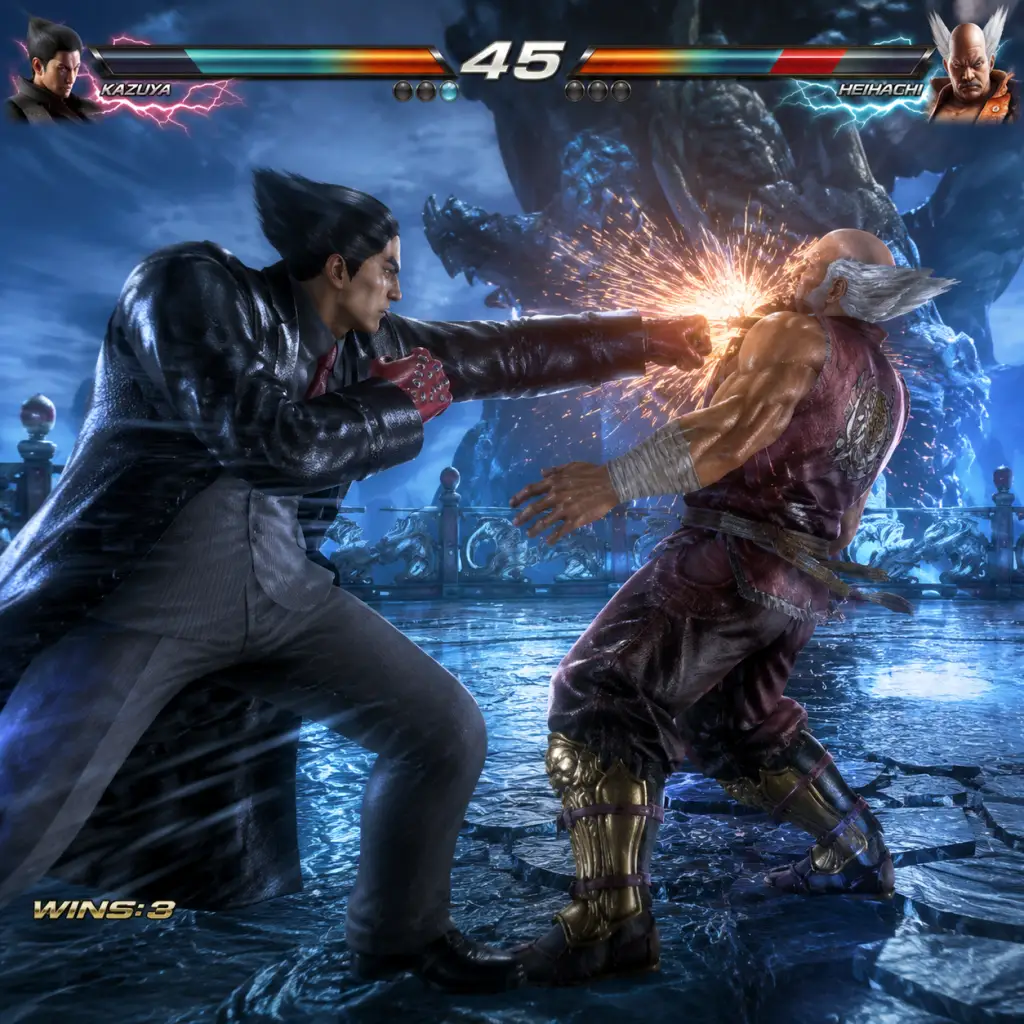
Tekken 7 is a 3D fighting game where two players engage in a best-of-three-rounds match. The main gameplay loop consists of: 1) Entering a match (offline or online), 2) Executing a strategy using movement, attacks, and defense, 3) Winning or losing rounds based on health depletion, 4) Analyzing results and adjusting tactics, 5) Repeating to improve skills and climb rankings. Unlike many RPGs, there is no open-world exploration; instead, exploration occurs through learning character move lists, training mode, and unlocking customization items via various modes.
Combat & Interaction Systems
- Movement: 8-way run (dash forward/backward), sidestep (tap up/down), backdash cancel (Korean backdash advanced technique), and jumping. Proper movement creates whiff punishes and spacing.
- Attacks: Each character has dozens of moves: jabs, kicks, launchers, strings, throws (front, back, command throws), and unique special moves. Combos are executed by linking launchers to air combos using the Screw system (bound that spins opponent upright for extended combos).
- Rage System: When health drops below ~25%, you enter Rage mode. You can use Rage Art (high-damage cinematic special, works once per match) or Rage Drive (enhanced version of a specific move, consumes Rage but no limit on use).
- Power Crush: Moves with armor properties that absorb one hit and continue, useful for challenging opponent’s pressure.
- Wall/Floor Interactions: Stages have walls, floors, and balconies. A wall splat allows follow-up combos; floor breaks and wall explosions add extra damage and repositioning.
- Reversals & Parries: Some characters have specific reversal or parry moves to counter attacks.
- Fight Money: Earned from offline matches (Treasure Battle, Story Mode, Arcade, Character Episodes) and online wins. Used to purchase custom items (costumes, accessories, items) in the customization shop.
- Rank: Online mode has a ranking system from Beginner to Tekken God Omega. Winning matches increases rank; losing decreases. Rank determines matchmaking skill level.
- Player Level: Overall account level increases with experience from any mode. Higher levels unlock certain character titles and customization rewards (no gameplay advantage).
- Customization: Items are unlocked via Fight Money, Treasure Battle loot boxes, and online rewards. Cosmetics are purely visual.
- Story Mode: "The Mishima Saga" is a cinematic campaign with scripted battles and cutscenes. Completing it grants fight money and unlocks some gallery content.
- Character Episodes: Each character has a short story with 3-4 fights. Provides lore and fight money.
- Arcade Mode: Standard 8-fight ladder with a boss and ending. Earn fight money.
- Treasure Battle: Endless AI matches where you earn treasure chests containing customization items. Higher win streaks yield rare items. This is the primary mode for unlocking cosmetics.
- Practice Mode: Customizable training to learn combos, punishment, and frame data. No rewards but essential for skill growth.
- Fight Money (gold): In-game currency earned from all modes. Use in customization shop to buy character-specific items, player cards, and avatar elements.
- Premium Currency: Can purchase with real money but only for cosmetic bundles (no pay-to-win). Not required for any content.
- Treasure Chests: Drop from Treasure Battle; contain random items or a small amount of fight money. No microtransactions for chests.
- No Leveling or Stat Boosts: All moves are available from the start; there is no character progression that alters stats or unlocks abilities. Growth is purely player skill: learning frame data, combos, matchup knowledge, and execution.
- Customization: Character appearance can be changed, but it does not affect gameplay. You can equip different costumes, accessories, and weapons (visual only).
- Rank: While not a "build," your online rank reflects your proficiency with a character. You can focus on one character to master or spread across the roster.
- Online Ranked: Core competitive mode. Climb ranks, earn exclusive titles and fight money at season end. Continuous learning of matchups and advanced techniques (Korean backdash, electric wind god fist consistency, wall carry optimization).
- Tournament Mode: Local or online 16-player bracket. Good for practicing bracket pressure.
- Player Match & Lobby: Casual online play, often used for mirror matches or practicing specific scenarios.
- Tekken World Tour: Official competitive circuit with real-world events. Top players compete for prizes; even casuals can watch replays to learn.
- Practice Lab: Constant refinement of combos, punishment training, and frame data study. Many top players spend hours here per day.
- Objective: Learn basic controls, complete single-player content, unlock initial customizations, and choose a main character.
- Activities:
- Combat Focus:
- Progression:
- Example: A new player picks Jin. They complete Story Mode, then do Jin's episode. They learn the basic combo: electric -> 1,2,4,3 screw -> dash -> uf+1, 2,3. They fight Treasure Battle AI and earn a cowboy hat.
- Objective: Transition to online play, learn fundamental game systems, build matchup knowledge, and refine execution.
- Activities:
- Combat Focus:
- Progression:
- Example: A mid-game Lei player can now consistently break throws and cancel backdashes. They lab punishment for Hwoarang’s flamingo moves. They win Treasure Battle streak of 15, unlocking a rare mask.
- Objective: Achieve high online rank, master one character’s advanced techniques, and develop deep matchup knowledge.
- Activities:
- Combat Focus:
- Progression:
- Example: Late-game Jin player consistently lands electrics 9/10 times. They have optimized combos for every stage situation, and they punish -12 moves with 1+2. They enter a local Sunday tournament and place top 8.
- Objective: Reach highest online rank (Tekken God Omega), compete at high-level tournaments, and master multiple characters.
- Activities:
- Combat Focus:
- Progression:
- Example: Endgame player with Kazuya can do PEWGF (perfect electric wind god fist) in lane, consistently breaks 1+2 throws, and has a 70% win rate in ranked. They travel to Evo and make top 64.
Progression Systems
Quests/Missions & Exploration
Economy
Character/Build Growth
Endgame Structure
---
Core Gameplay by Player Progression Tiers
Early Game (Hours 1–20)
- Play Story Mode to experience narrative and earn easy fight money (~20,000 gold).
- Complete Character Episodes for your chosen main to get lore and ~5,000 gold each.
- Run Arcade Mode to practice against AI and earn ~3,000 gold per clear.
- Enter Treasure Battle for first 10 matches to get a feel for infinite-mode AI and unlock basic items.
- Master basic movement: forward dash, backdash, sidestep.
- Learn 2-3 simple combos from a launcher (e.g., Kazuya: Electric Wind God Fist -> Rising Sun -> Twin Pistons).
- Understand Rage Art activation and timing.
- Identify your character's best pokes (e.g., Paul's Deathfist, Law's junkyard kick).
- Unlock enough items to customize your character’s look slightly.
- Online rank may start at Beginner and climb to around Fighter (green ranks) if you go online early.
Mid Game (Hours 20–100)
- Mainly Online Ranked matches (aim for yellow ranks like Brawler or Warrior).
- Start using Practice Mode to lab punishment for common moves (e.g., punishing blocked lows, whiff punishes).
- Participate in Player Match to test new strategies without rank pressure.
- Continue Treasure Battle for items and fight money; now farm higher win streaks for rare loot.
- Learn Korean backdash (essential for spacing).
- Understand the Screw system fully; optimize wall carry and damage.
- Practice whiff punishing and block punishing (frame data basics).
- Incorporate Rage Drives into combos (e.g., for some characters Rage Drive is a combo extender).
- Learn basic throw breaks (1, 2, 1+2).
- Online rank reaches Vanguard or Warrior (green to yellow).
- Fight money accumulates (~500,000 gold) enabling purchase of multiple costume sets.
Late Game (Hours 100–500)
- Ranked climb to red ranks (Genbu, Suzaku, etc.) or higher.
- Attend local tournaments (online or offline) to test skills under pressure.
- Watch replays (in-game replay system) to analyze mistakes and opponent tendencies.
- Create a practice routine focusing on specific scenarios (e.g., oki setups, wall combos, stage break strategies).
- Execute perfect electrics consistently (if using Mishima).
- Master sidewalking and backdash blocking to evade pressure.
- Optimize combos for maximum damage, wall carry, and ender selection.
- Learn character-specific tech (e.g., Bryan’s Taunt -> Jet Upper, King’s advanced chain throws).
- Understand frame traps and plus on block moves.
- Online rank reaches Byakko/Ou/Brawler (red/purple).
- Fight money is essentially infinite from hundreds of Treasure Battle matches; all items unlocked.
- Character customization becomes about personal style, not necessity.
Endgame (500+ hours)
- Ranked only at peak hours to find high-skill opponents.
- Join Tekken World Tour events or online qualifiers.
- Analyze professional matches and incorporate top-player strategies.
- Secondary character development – pick up an off-main to cover matchups.
- Lab against top-tiers (Geese, Akuma, Leroy, Fahkumram after DLC) to overcome cheese.
- Perfect execution: 100% electrics, 100% throw breaks, 100% optimal combos.
- Yomi: Predict opponent’s moves and adapt mid-match.
- Advanced movement: Electric sidestep, subtle spacing to induce whiffs.
- Stage awareness: Use wall and floor breaks deliberately to maximize damage and positioning.
- Rank: Tekken God Omega (the highest).
- No more unlockable content; focus purely on competitive achievement.