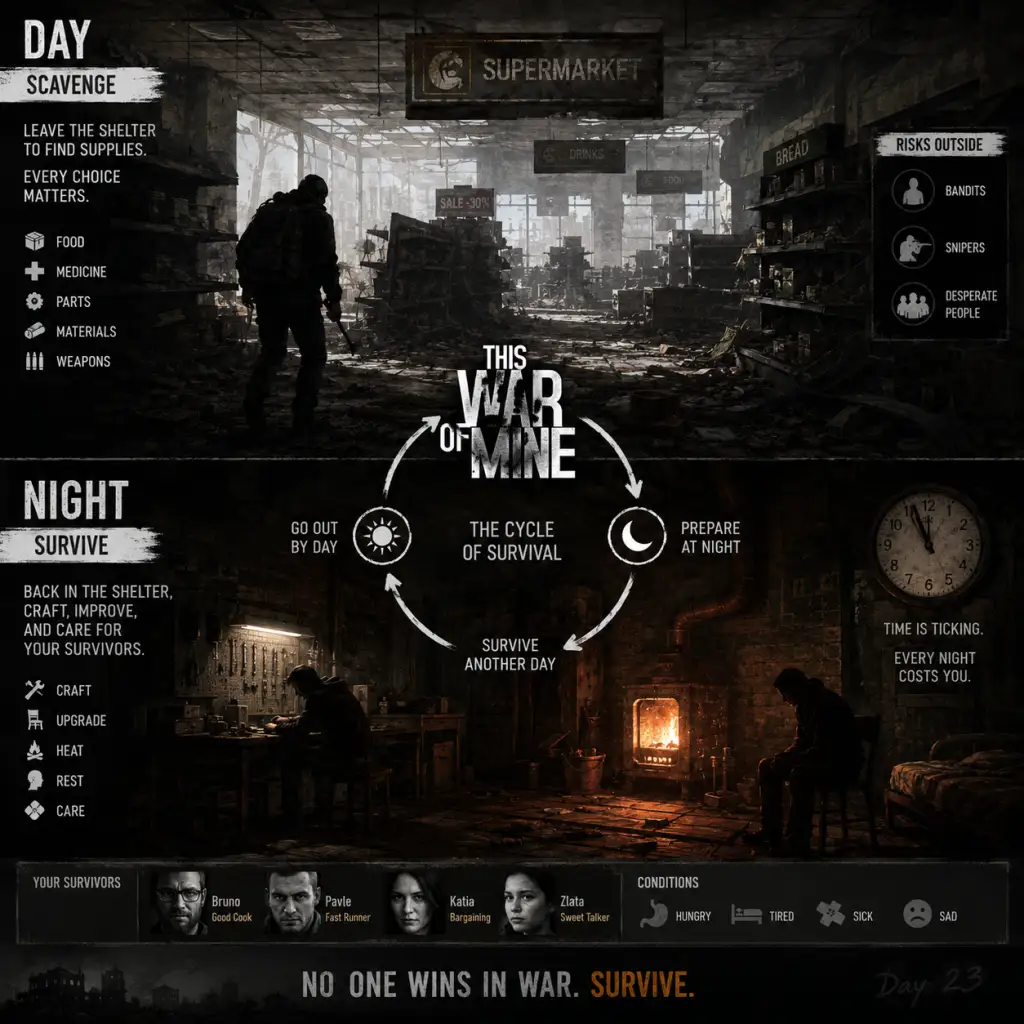
Core Gameplay
Core Gameplay: This War of Mine
This guide breaks down the core gameplay loop, systems, and progression across four distinct tiers: Early Game, Mid Game, Late Game, and Endgame. Each tier highlights shifting priorities, available tools, and typical challenges.
Core Gameplay Loop
The loop revolves around day/night cycles (approximately 20–25 minutes each).
- Daytime (0700–2000): Manage shelter, craft, trade, tend to wounded/sick characters, guard the door (if equipped with weapons), and rest. Movement is restricted to your home base.
- Nighttime (2000–0700): Choose one survivor to scavenge a location. Others stay behind—they sleep (if beds exist), guard (if armed), or do nothing. Scavenging yields resources, loot, and narrative encounters.
- Morning: Check for new visitors (traders, requests), manage inventory, and prepare for the next night cycle.
- Stealth: Crouch (default `C`) to move silently, avoid broken glass (crouch reduces noise), and hide in shadows.
- Attacks: Melee weapons (shovel, crowbar, knife, hatchet) and ranged weapons (pistol, shotgun, rifle) are used by clicking an enemy while your character is armed. Damage depends on weapon, target state (alert/sleeping), and character traits.
- Panic: If you kill someone, all survivors may suffer emotional trauma. Non-lethal takedowns (knockout) exist but are risky; they require sneaking behind a target and using a blunt weapon.
- Traps: Can place bear traps in shelter (catch looters) or on scavenging maps (damage enemies).
- Guarding: Assign a survivor to guard at night—they will attack intruders (if armed) or at least wake others up.
- Search: Click on piles, cupboards, bodies to find items. Some require tools (crowbar for locked doors, saw blade for barred windows).
- Trade: At your door or with Franko (the trader), you click items to trade.
- Dialogue: NPCs at locations may offer help, request help, or threaten you. Choices affect moral and resource gains.
The ultimate goal: Survive until the war ends (typically Day 30–45 depending on scenario). There is no save-scumming in standard mode; permadeath is permanent.
---
Combat / Interaction Systems
No direct combat control – This War of Mine uses point-and-click interaction, not real-time combat.
Interaction types:
---
Progression (Time & Shelter Upgrades)
Progression is not level-based but resource-and-shelter-dependent.
| Shelter Component | Requirements | Benefit |
|---|---|---|
| Bet (upgrade) | Components, Wood | Heals sleep faster, better rest |
| Stove (upgrade) | Components, Metal | Uses less fuel per cooking cycle |
| Rain Collector | Components, Metal | Produces water after rain (day) |
| Workshop I/II/III | Components, Wood, Parts | Unlock advanced crafting |
| Armchair | Components | Reduces sadness |
| Radio | Components, Electrical parts | Get news (e.g., cease-fire days) |
| Booze Still | Components | Craft alcohol → medicine/trade |
| Herb Garden | Plant, Soil, Water | Grow herbs → medical supplies |
1. Basic: Crowbar, lockpick, shovel, hatchet, bed, stove.
2. Improved: Weapons (knife, pistol), better stove, rain collector, radio.
3. Advanced: Shotgun, rifle, mechanical tools, moonshine still, upgraded beds.
---
Exploration (Scavenging Locations)
Nighttime exploration is the main source of resources. Locations vary by scenario and day number.
Location types:
- Residential (houses, apartments): Moderate loot, few enemies (mostly unarmed civilians).
- Public Buildings (hospital, school, church): High loot but often patrolled by soldiers or bandits.
- Military Outposts (Garrison, guard post): Very dangerous, heavy weapon loot.
- Ruins & Warehouses: High components/parts, scavenged bodies, may have looters.
- Time limit: You must return to the shelter by 0500 (5 AM) or risk death (if maps are far). On some maps you can stay until 0200 or later.
- Noise: Opening doors, smashing walls, using tools (saw, crowbar) alerts nearby enemies.
- Inventory: Each survivor has limited carry capacity (base 8–10 weight units, some +1 with upgrades). Dropped items can be left if full.
- Hidden loot: Sometimes behind locked doors, in cupboards, under floorboards (use crowbar).
Key exploration mechanics:
---
Quests / Missions (Narrative Requests)
Questgivers appear at your door or at scavenging locations. Most are time-sensitive.
| Quest Type | Example | Reward |
|---|---|---|
| Neighbor Request | “Help an old woman with food” | Food, components, reputation |
| Trader Visit | Franko offers to buy/sell | Trade |
| Refugee Visit | Ask for shelter/medicine | Morale boost, possible gear |
| Location Encounters | “A soldier is bullying civilians” | Loot (weapons) or moral injury |
| Bunker / Basement | Solve puzzles (e.g., gas chamber) | Unique loot (gas mask, code) |
---
Economy (Scarcity & Trade)
Economy is based on barter—no currency. Key resources:
| Resource | Source | Use |
|---|---|---|
| Wood | Scavenge, furniture dismantle | Fuel, building, trade |
| Components | Scavenge, furniture | Crafting, building |
| Parts | Dismantle electronics | Advanced crafting |
| Food (Canned, raw, herbs) | Scavenge, grow, trade | Cook meals (needs fuel) |
| Water | Rain collector, scavenge | Cooking, drinking, gardening |
| Medicine (Bandages, pills, herbs) | Scavenge, trade | Healing wounds, sickness |
| Weapons & Ammo | Scavenge (military locations), trade | Combat, guarding, trade |
| Alcohol / Tobacco | Craft (booze still), trade | Trade goods |
| Jewelry / Gems | Scavenge | High-value trade |
---
Character / Build Growth
Characters have traits (e.g., Good cook, Traumatized, Slow runner) that affect efficiency. There is no skill tree—growth is purely through morale and condition.
- Morale (Mood): Affects hunger rate, movement speed, willingness to work. Low morale → sad thoughts → possible depression → suicide or desertion. Boost morale with alcohol, tobacco, coffee, nice chairs, books, musical instruments.
- Condition (Health): Wounds, sickness, starvation, cold all drain health. Curing requires medicine, bandages, clean water, warm shelter, rest.
- Endurance: No stamina bar; instead, actions cost time. A tired survivor moves slower and becomes less efficient.
- Resource depletion: Food, water, and medicine become extremely scarce. Trade becomes critical.
- Winter: Around Day 20–30, temperatures drop; you need more fuel and warm clothes (scavenge or craft).
- Bandit raids: Increase later in the war; better weapons and defenses are needed.
- Survivor death: Losing a key character can cripple the group. New survivors may join (rare) or you struggle with fewer people.
- Scavenge immediate neighborhood for food, wood, components.
- Build basic beds (2 beds minimum), stove, rain collector.
- Craft a crowbar (unlock locked doors) and a shovel (dig through rubble).
- Establish a small wood-fuel supply.
- Very limited inventory—choose wisely.
- Marauding bandits may attack shelter at night; if no weapons, hide.
- Medical supplies are scarce; treat wounds carefully.
- Day 1: Scavenge nearest location (e.g., “Small Apartment”). Gather food, wood, components. Build one bed at home.
- Day 2–4: Rain collector (critical for water), stove, second bed. Craft crowbar before lockpick (crowbar reusable).
- Day 5–8: Trade with Franko for extra food if needed. Explore a second location. Upgrade stove to use less fuel.
- Upgrade workshop to Level 2 (unlock saw blade, better weapons).
- Build a metal workshop if possible for advanced tools.
- Establish a small herb garden for medicine.
- Improve shelter warmth (better heater, warm clothes).
- Trade for weapon parts and ammo.
- Bandit raids become regular—need at least one armed guard (pistol or shotgun).
- Survivors may become depressed; build armchair, get radio.
- Scavenging locations become more dangerous (soldiers, traps).
- Day 9–12: Upgrade workshop to III if possible for shotgun crafting. Build a radio to hear about ceasefire and weather forecasts.
- Day 13–16: Craft a moondoor (saw blade) for locked areas. Explore military outposts (very risky but high reward).
- Day 17–20: Plant herbs in garden if soil available. Trade moonshine (if still built) for medicine.
- Stockpile fuel for winter (at least 40 wood).
- Upgrade all beds to “Nice Bed” (better rest).
- Craft a rain collector (already done) but add a second if water demand high.
- Ensure every survivor has warm clothes (craft or trade).
- Keep a steady supply of food (canned and cooked).
- Winter hits hard: fuel consumption doubles. If you have no warm clothes, survivors get sick quickly.
- Raiders become more organized—they may break down your door. Build a reinforced door (requires components, metal).
- Scavenging locations start to dry up; you must rely on trade or revisit previously looted areas (which respawn some loot after a few days).
- Day 21–24: If winter hasn’t started yet, collect all wood possible. Use a saw blade to expand shelter if space needed.
- Day 25–28: Craft or trade for a warm hat (increase comfort). Upgrade heater if possible (advanced heater consumes less fuel).
- Day 29–30: Scan radio for ceasefire announcements. If ceasefire is near, you might need to survive just another week.
- Survive day by day.
- Use all remaining consumables wisely.
- Avoid unnecessary risks (don’t scavenge extremely dangerous locations).
- Keep morale high enough to avoid suicide.
- Resource scarcity peaks. Trade becomes almost impossible if you have nothing valuable left.
- Survivor morale can plummet if they are hungry, cold, or traumatized. Use alcohol/tobacco sparingly to boost mood.
- If you lose a character, you may not get a replacement. Plan for multi-day shortages.
- Each morning: Check if ceasefire announced. If yes, the final night counts down. Make sure everyone is fed and warm for the last day.
- If not yet ceasefire, continue routine: scavenge only if you have at least 2 days of food left. Otherwise, stay home to avoid injury.
- At night: Only send out the most healthy survivor. Equip them with a knife or pistol in case of encounter.
- Guard duty: Assign the strongest survivor to guard with a loaded weapon.
- Learn the cycle: Rain makes the collector work overnight. Place it outside but near the door.
- Damage control: If a survivor becomes wounded, prioritize treatment—infection can kill in days.
- Trade timing: Franko visits every 3 days approximately; save high-value items (jewelry, crystals) to trade for essentials.
- Scavenging order: In early game, visit locations with nearby houses first; later, move to warehouses and military posts.
- Use two survivors: In late game, you can have one scavenge and one guard; but if you have three survivors, two can scavenge different locations on the same night (if allowed via multiple locations in some scenarios).
Build strategy: There is no “build,” but you can focus on one character as the primary scavenger (give them a backpack upgrade) and another as the crafter/cook. Traits like “Strong” or “Runner” benefit combat/exploration; “Good cook” stretches food.
---
Endgame Structure
The war ends when the daily radio announces a ceasefire (green papers fluttering). Typically around Day 35–50, but variable. Once the ceasefire occurs, a final night counts down—then the game slides to credits.
Endgame challenges:
What carries to endgame: The same characters, same shelter upgrades—no reset. The goal is simply to outlast the war.
---
Progression Tiers Breakdown
#### Early Game (Days 1–8)
Goals:
Typical challenges:
Actions:
Example scenario: Starting with three survivors: Pavle (fast runner), Bruno (good cook), Marko (skilled scavenger). Assign Marko as primary scavenger because of his large backpack.
---
#### Mid Game (Days 9–20)
Goals:
Typical challenges:
Actions:
Example: You find a broken shotgun and ammo at the Supermarket. Repair it at workshop (metal parts). Now your guard can effectively kill raiders.
---
#### Late Game (Days 21–30)
Goals:
Typical challenges:
Actions:
---
#### Endgame (Days 31 – Ceasefire)
Goals:
Typical challenges:
Actions:
Example: Day 38, radio says ceasefire tomorrow. You have 3 cans of food, 2 water, 10 wood. Use the wood to heat a final meal. No need to scavenge. Survivors have high morale because you kept them comfortable. War ends – you win.
---
Advanced Tips for All Tiers
This tier structure helps you plan resource management, technology upgrades, and survival strategies as the war progresses. Adapt based on survivor traits and random events. Good luck.