Important Notes
Important Notes for Alan Wake
General Warnings
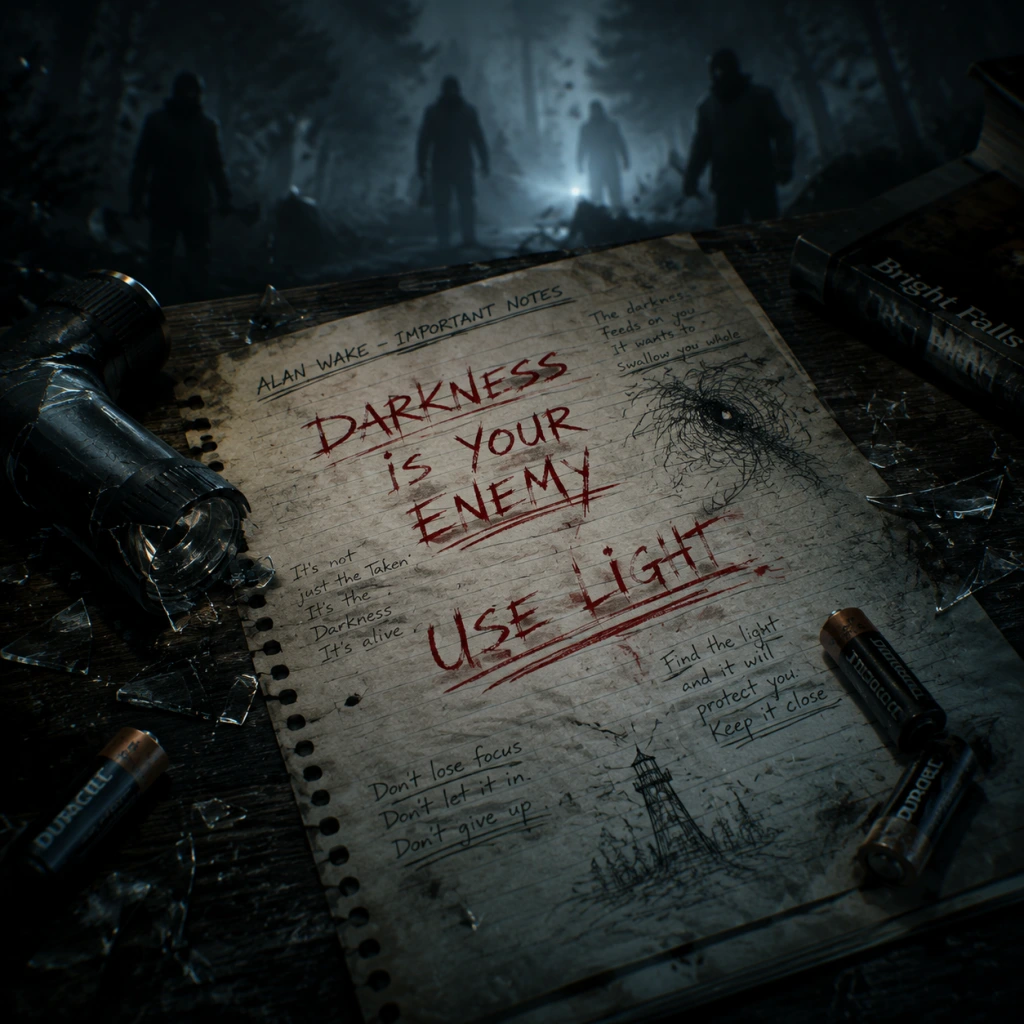
- Darkness is your enemy: The Taken are vulnerable only when their darkness shield is removed by light. Always keep your flashlight charged and use flares, flashbangs, and environmental light sources (street lamps, generators, car headlights) to break their defenses.
- Battery management: Your flashlight consumes batteries rapidly. Prioritize finding batteries in the environment and conserve flashlight use when not in combat. Only use the boost (LB/L1/LShift) when you are about to shoot.
- Dodge is essential: Press the dodge button (A/X/Space) to avoid melee attacks and projectiles. Master the timing—dodging at the last second can save you from damage and interrupt enemy lunges.
- No manual saves: The game uses an automatic checkpoint system. You cannot manually save progress. Quitting mid-chapter will return you to the last checkpoint. Be sure to reach a checkpoint before closing the game.
- No story-altering choices: Alan Wake is a linear story with no branching dialogue or moral decisions. Your playthrough will always follow the same plot.
- Collectibles are per-chapter and missable:
- Chapter replay: You can replay chapters from the main menu to collect missed items, but you cannot carry collected items into a new game+ (the game has no New Game+). You must start a fresh playthrough for 100%.
- Chapter 2 – The Taken farmhouse: The first large indoor fight with multiple Taken. Manage your light and ammo carefully; retreat to lit areas.
- Chapter 4 – The bulldozer scene: A powerful, invulnerable enemy until you use environmental light. Stay mobile and use flares to keep it away.
- Chapter 5 – The Elderwood National Park: Multiple waves of Taken, including the fast "Bird" enemies. Use the environment to funnel them.
- Chapter 6 – The Mine: Tight corridors with many enemies. Flashbangs and shotguns are your friends.
- No leveling or skill points: There is no grinding in Alan Wake. Your character does not become stronger; your skill improves. Do not waste time farming enemies—they do not drop resources.
- Resource scarcity: Ammo and batteries are limited. Do not hoard them excessively—use them when needed—but avoid wasteful firing. The game is balanced so you can finish each encounter with careful play.
- Checkpoints are frequent but not everywhere: Checkpoints trigger after story events, entering new areas, or completing combat sequences. If you die, you respawn at the last checkpoint with the health and resources you had at that point.
- Before quitting: Ensure you have reached a checkpoint by seeing the autosave icon (spinning circle in the corner) or by pausing and checking that "Quit to Menu" is available without warning. Quitting during combat may set you back.
- Do not turn off the game during saving: If the autosave icon is visible, wait until it disappears.
- You can sprint by holding the run button (left stick click / Shift). This drains stamina but is vital for escaping tight spots.
- Flashlight boost recharges over time when not in use. Use it sparingly.
- Aim for the head: Once the darkness shield is stripped, headshots with the revolver or shotgun deal maximum damage.
- Environmental lights can be temporarily activated (e.g., gas station generators) to create safe zones. Always check for generators near fuse boxes.
- Pause recharges your flashlight: If you are out of batteries, pause the game. The flashlight will slowly recharge while paused (a known quirk).
- Do not skip cutscenes on your first playthrough – they contain critical story context and collectible hints (e.g., manuscript page locations are often highlighted in cutscenes).
- Read all manuscript pages – they reveal story elements, enemy weaknesses, and lore. Ignoring them hurts narrative understanding.
- Original 2010 PC version: May have compatibility issues on modern systems. Use the official patch and consider the remastered version for better performance. The original PC version has no achievements on Steam (only the remastered does).
- Remastered version (PC/consoles): Runs smoother, includes all DLC (The Signal, The Writer), and has achievements/trophies. No major bugs. Save data is cloud-synced on Steam and consoles (if subscribed to PlayStation Plus or Xbox Live).
- Console versions: On Xbox, achievements unlock without issue. On PlayStation, save data can be backed up to USB or cloud via PS Plus. Avoid deleting local saves accidentally.
- The Signal and The Writer DLC are set after the main game. They are accessed from the main menu after completing the story. They are not missable but are recommended to be played after finishing the campaign for story continuity.
- DLC difficulty: The DLC is harder than the main game. Stock up on strategy and expect fewer resources. Save often (through checkpoints).
Irreversible Choices & Missable Content
- Manuscript pages (90 total) – found in specific locations each chapter; once you progress, you cannot return.
- Coffee thermoses (100 total) – hidden throughout Bright Falls; missable if you skip areas.
- Radios & TVs – interact with all radios and TVs you encounter; they provide backstory and achievements.
- Signs & posters – some achievements (e.g., "Gone Reading") require reading specific signs; many are missable.