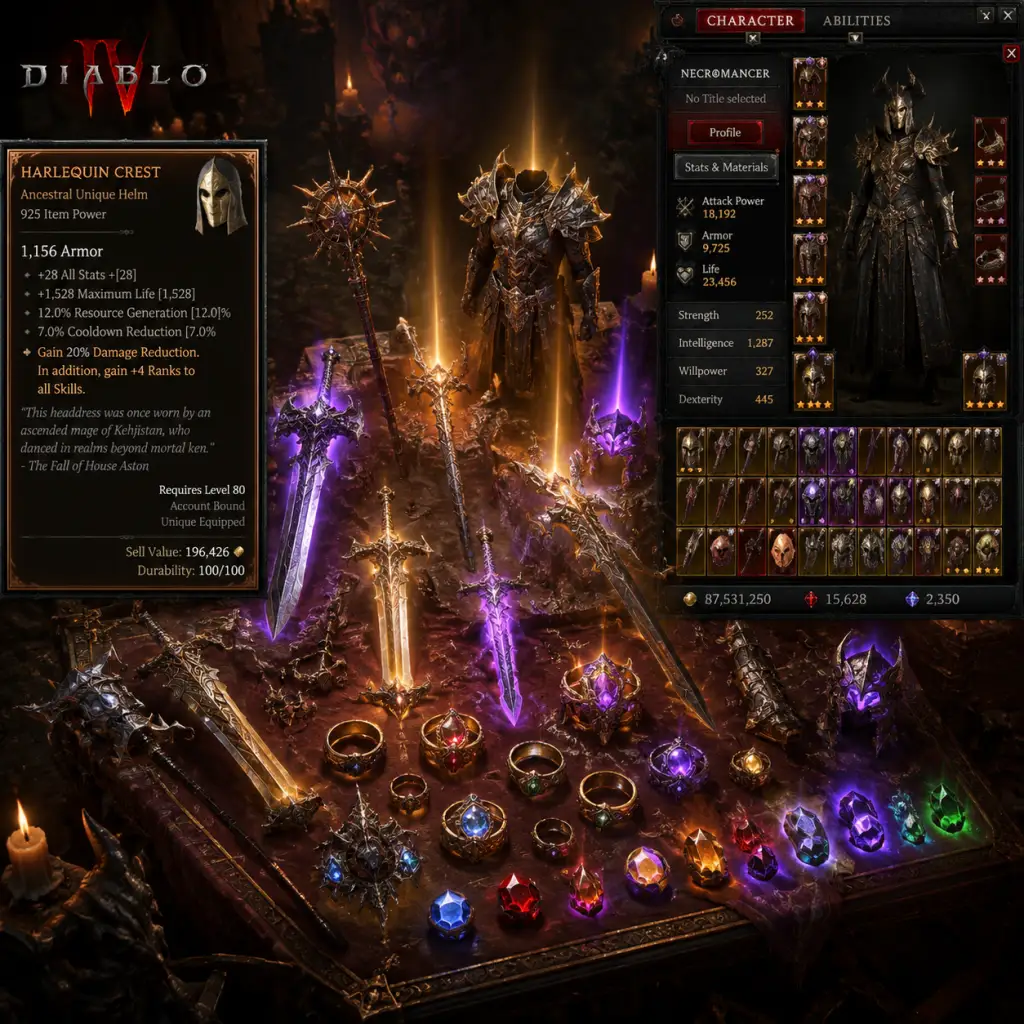
All Game Items
Diablo IV – All Game Items Guide
This guide provides a comprehensive overview of all major item categories in Diablo IV, including weapons, armor, consumables, materials, currencies, collectibles, and key equipment systems. Items are grouped logically with explanations on what each does, how to obtain them, when they are useful, and important synergies or upgrades.
Item Rarity and Tiers
Items in Diablo IV have six rarity tiers:
- Normal (white) – basic stats, no affixes.
- Magic (blue) – 1-2 affixes.
- Rare (yellow) – 2-5 affixes, can be upgraded to Legendary via imprinting.
- Legendary (orange) – includes a Legendary Aspect with a unique power.
- Unique (gold) – fixed affixes and a unique power; cannot be enchanted or tempered but can be upgraded and socketed.
- Mythic Unique (purple) – extremely rare, with multiple fixed affixes and a game-changing power (e.g., Harlequin Crest).
Additionally, items have Item Power ratings (1–925+). Higher item power means higher base stats and affix ranges. In World Tiers 3 and 4, items can drop as Sacred (requires level 60) or Ancestral (World Tier 4), providing even higher stats.
Weapons
Each weapon type has a base damage, attack speed, and inherent affix (e.g., critical strike damage, overpower damage). Class restrictions and specializations apply.
| Weapon Type | Inherent Affix | Classes | Notes |
|---|---|---|---|
| Swords | Critical Strike Damage | Barbarian, Rogue, Necromancer | Fast, balanced |
| Axes | Critical Strike Chance | Barbarian, Druid, Necromancer | High damage, slow |
| Maces | Overpower Damage | Barbarian, Druid, Necromancer | Highest single hit damage |
| Polearms | Damage to Healthy/Injured | Barbarian, Necromancer | Long reach |
| Scythes | Damage to Healthy/Injured | Necromancer only | High damage for minions |
| Bows | Damage to Distant Enemies | Rogue only | Ranged, fast |
| Crossbows | Vulnerable Damage | Rogue only | Higher damage, slow |
| Staves | Damage to Crowd-Controlled | Sorcerer, Druid | Two-handed, high damage |
| Wands | Lucky Hit Chance | Sorcerer, Necromancer | Fast, low damage |
| Daggers | Damage to Close Enemies | Rogue, Necromancer | Fast attack speed |
| Focus (Offhand) | Cooldown Reduction | Sorcerer, Necromancer | Not a weapon but equippable in offhand |
| Totem (Offhand) | Resource Generation | Druid | Offhand for shapeshifting builds |
When useful: Weapon choice depends on your build. Example: a Bone Spear Necromancer benefits from a high-damage two-handed scythe or sword; a Rogue uses a bow or crossbow for ranged or daggers for melee.
Armor
Armor reduces damage taken and provides defensive affixes. Pieces include:
- Helm – Defensive, cooldown reduction, lucky hit chance, resource affixes.
- Chest Armor – High armor, damage reduction, defensive stats.
- Gloves – Attack speed, critical strike chance, lucky hit, ranks of core skills.
- Pants – Maximum life, damage reduction, resistances.
- Boots – Movement speed, evade charges, damage reduction while injured.
- Shield (Barbarian, Necromancer, Druid?) – Actually shields are for Barbarian and Necromancer? In Diablo IV, shields are exclusive to Necromancer and Barbarian? Let's confirm: Shields drop for Barbarian and Necromancer. They provide block chance and armor.
- Offhands (Foci, Totems) – Not armor but offhand items that grant offensive/utility affixes.
- Rings – One slot, provide offensive/defensive affixes such as critical strike chance, vulnerable damage, max resource, resistance.
- Amulets – One slot, higher affix rolls, can grant +3 to a passive skill, movement speed, cooldown reduction.
- Healing Potions – Restore health. Potion quality improves with potion upgrades at the Alchemist (e.g., Light Healing Potion → Super Healing Potion).
- Elixirs – Temporary buffs (30 minutes): Elixir of Ironbark (armor), Elixir of Shadow Resistance, Precision Elixir (critical chance), etc. Crafted or dropped.
- Incense – Party-wide buffs (30 minutes) that persist after death: Song of the Mountain (resistances), Chorus of War (damage). Crafted with materials.
- Sigils – Used to start Nightmare Dungeons. Dropped from regular dungeons, Helltides, or crafted at the Occultist.
- Scrolls – Escape Scroll (teleport out of a dungeon), Town Portal (instant teleport), Amnesia Scroll (reset paragon board). Dropped or purchased.
- Helltide Enigmatic Chest Keys – Used to open specific Helltide chests.
- Greed’s Splendor Caches – Opened for gold and materials (from Whispers).
How to obtain: Same as weapons; enemies, dungeons, gambling, crafting.
Synergies: Set bonuses do not exist, but Legendary Aspects on armor can drastically change a build (e.g., Aspect of the Protector on pants grants a shield when damaging an elite).
Jewelry
Unique examples: Ring of Starless Skies (spend resource to reduce cost), Melted Heart of Selig (health becomes resource shield).
Consumables
How to obtain: Potions from Alchemist; Elixirs crafted or drop; Incense from Alchemist; Sigils from dungeons/Occultist; Scrolls from vendors or random drops.
Materials
Crafting materials are used to upgrade, imprint, enchant, and craft items.
| Material | Use | Source |
|---|---|---|
| Veiled Crystal | Enchanting, upgrading (Tier 1-4) | Salvaging rare items |
| Abstruse Sigil | Upgrading armor/weapons (Tier 5) | Salvaging legendary items |
| Baleful Fragment | Upgrading jewelry (Tier 5) | Salvaging legendary jewelry |
| Coiling Ward | Upgrading weapons (Tier 5) | Salvaging legendary weapons |
| Forgotten Soul | Enchanting, upgrading, tempering | Helltides, salvaging legendaries, Whispers |
| Fiend Rose | Alchemist elixirs/incense | Helltides |
| Angelbreath | Alchemist elixirs/incense | Dungeons, Helltides |
| Iron Chunk | Basic upgrade material | Salvage weapons/armor (white/blue) |
| Rawhide | Basic upgrade material | Salvage armor (white/blue) |
| Silver Ore | Upgrade jewelry | Salvage jewelry (white/blue) |
| Gem Fragments | Upgrade gems | Dropped from elites, goblins, world events |
| Scattered Prism | Socketing items (adds socket) | Dungeon reward, Helltide, Whisper cache |
| Looted Scepters/Sigils of Power | Temper manuals | Nightmare Dungeons, world bosses |
Currencies
- Gold – Primary currency for vendors, crafting, enchanting, upgrading. Farmed from enemies, salvaging, selling items.
- Murmuring Obols – Gambling currency at the Purveyor of Curiosities. Earned from events, dungeons, world bosses. Caps at 500 (can be increased with potion upgrade? Actually capacity is 500, but you can hold up to 5000 via Obol caches? No, cap is 500 for base, but some rewards increase cap? Double-check: Obol cap is 500, but you can spend to hold less.
- Seal of the Primal – Used in World Tier 4 to access Tormented bosses? Actually Seals are for opening Grace of the Mother doors. More precisely: Dust of the Fallen? Not.
- Wandering Soul – Seasonal currency used with Alchemist for specific seasonal content.
- Sorcerer’s Elemental Cores – Not a global currency; class-specific resource.
- Paragon Points – Not a currency but rewarded on level-up and via renown. Used in Paragon Board.
- Altars of Lilith – Permanent stat boosts (max life, paragon points, etc.). Found across Sanctuary. Account-wide once collected.
- Renown Rewards – Complete zone activities (waypoints, dungeons, strongholds, side quests). Reward skill points, paragon points, potion capacity, obol capacity, and gold.
- Waypoints – Fast travel points, unlocked by proximity.
- Dungeon Aspect Codex – Complete a dungeon to unlock a guaranteed Legendary Aspect that can be imprinted an unlimited number of times (but with minimum stats).
- Scosglen Statues – Small collectible statues that grant a short buff when activated.
- Demonic Fortune Chest – Rare spawn in Helltides with high-value loot.
- Legendary Aspects – Found on legendary items or unlocked via Codex. Can be imprinted onto a rare item at the Occultist, turning it into a legendary. Aspects from items are consumed; Codex aspects are reusable.
- Unique Items – Fixed affixes and powers. Cannot be tempered. Can be upgraded and socketed. Examples: Harlequin Crest (Mythic Unique), Temerity (pants that turn healing into barrier).
- Mythic Unique Items – Extremely rare, powerful, and class-agnostic (e.g., The Grandfather, Doombringer). Only drop in World Tier 4 from level 85+ enemies and bosses.
- Tempering (Introduced in Season 4) – Modify affixes on equipment using Temper Manuals. Requires special materials (Neathiron, Ingolith).
- Upgrading – At the Blacksmith, increase item power up to 5 times using materials (Veiled Crystals, Abstruse Sigils, etc.). Higher item power raises base stats and affix values.
- Enchanting – At the Occultist, reroll one affix on a non-unique item using Gold and Forgotten Souls.
- Socketing – Add a socket to an unsocketed item using Scattered Prisms (max one per item). Gems (Ruby, Sapphire, Emerald, Topaz, Skull) provide additional stats (e.g., Ruby adds armor, Skull adds life on kill).
- Build-focused gearing: Always prioritize affixes that match your core damage type. Example: a Rogue using Twisting Blades wants Damage to Close Enemies, Critical Strike Chance, Basic Skill Damage.
- Aspect synergy: Combine aspects for multiplicative effects. E.g., Aspect of the Umbral (resource on crowd control) + Exploiter’s Aspect (damage to unstoppable enemies).
- Upgrading priority: First upgrade weapons for damage, then armor for survivability. Jewelry upgrades are less impactful but still useful for affix scaling.
- Gems: Use the highest-grade gem available. Rubies in armor for max life, Emeralds in weapons for critical strike damage (if using vulnerable), Sapphires for crowd control builds.
- Sigil for Nightmare Dungeons: Use appropriate sigil level for your power. Higher tiers drop better item power gear.
- Helltides: Farm Forgotten Souls and Fiend Roses for high-end crafting.
How to obtain: Gold from drops and selling; Obols from events; seasonal from seasonal activities.
Collectibles
Key Equipment Systems
Important Synergies and Upgrades
This concludes the comprehensive overview of all game items in Diablo IV. For specific class builds or seasonal changes, refer to the GameIntroduction and CoreGameplay sections of this guide.