Core Gameplay
Core Gameplay Overview
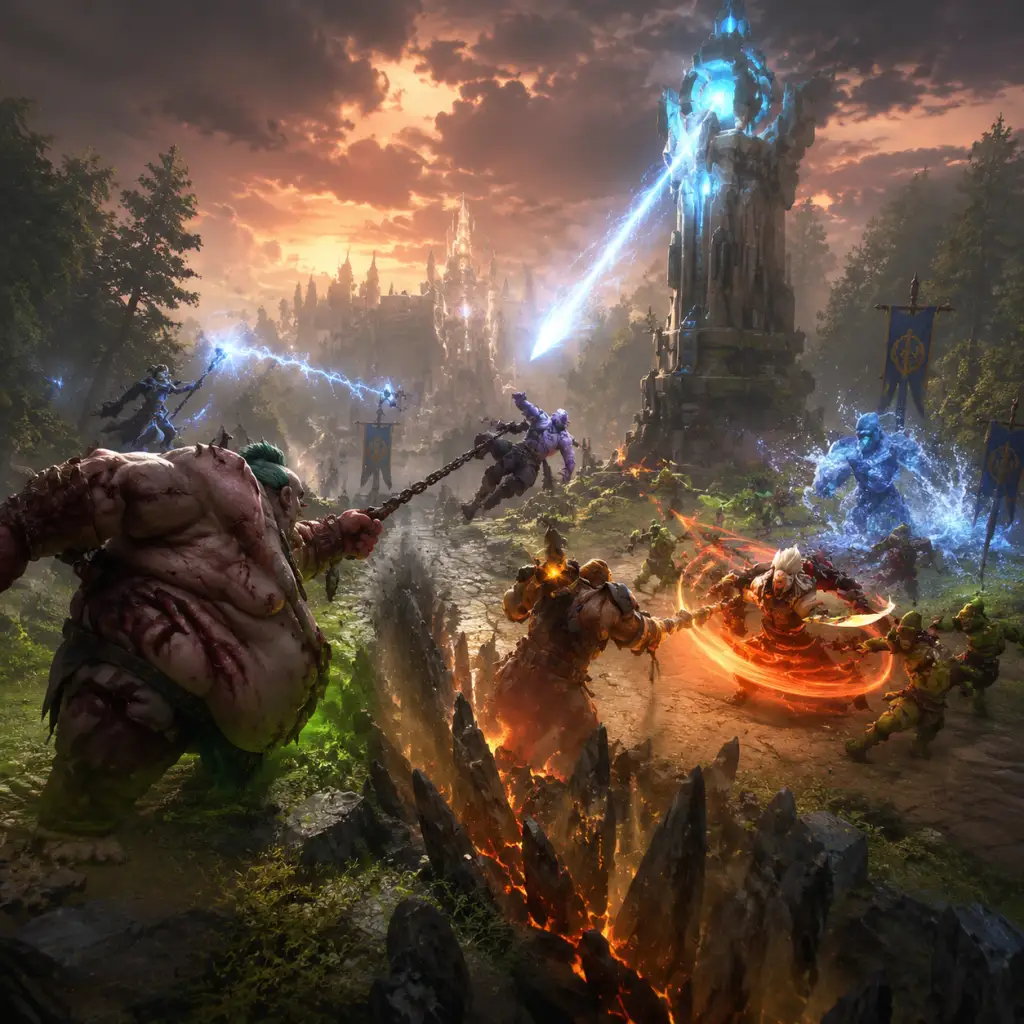
Dota 2 is a 5-versus-5 multiplayer online battle arena (MOBA) where two teams—the Radiant and the Dire—compete to destroy the enemy’s Ancient, a massive structure located in their base. Each player controls a single Hero, a powerful unit with unique abilities, and levels up over the course of a match, acquiring gold to purchase items that enhance their power. The match is divided into four distinct progression tiers: Early Game, Mid Game, Late Game, and Endgame. Understanding each tier’s goals, mechanics, and priorities is critical for success.
---
Early Game (0–15 minutes)
The early game focuses on laning, resource accumulation, and establishing a foundation for the mid game. Each team has three lanes (top, middle, bottom) where Heroes gather to farm creeps, deny the enemy, and contest objectives.
Main Gameplay Loop
- Laning: Two Heroes per lane (offlane and safe lane) plus a mid laner solo. One player on each team roams as a support (often the 4-position or 5-position) to assist lanes.
- Creep Equilibrium: Players last-hit enemy creeps for gold and experience, and deny their own creeps to reduce enemy gains. Proper creep agro management (attacking enemy hero near creeps to pull them) is key.
- Runes: At 0:00, 2:00, 4:00, etc., Bounty Runes spawn at the river rune spots (top and bottom) and power runes (e.g., Haste, Double Damage) spawn at the same times. Supports often secure runes for their team’s mid or carry.
- Lane Aggression: Supports harass the enemy offlaner, while carries focus on last-hitting. Denies deny experience (if within 500 range, denies 50% XP).
- Auto-Attacks: Standard attacks deal physical damage. Attack range, damage, and speed vary by hero.
- Spells: Each hero has four abilities (Q,W,E,R) + a passive. Spell damage types: Physical, Magical (reduced by magic resistance), Pure (ignores armor/resistance), HP Removal (bypasses magic immunity).
- Denies: You can deny an allied unit (creep, hero under ~50% HP) by right-clicking when the enemy hero is not nearby. Denying a hero prevents the enemy from getting gold and full XP.
- Creep Aggro: Attacking an enemy hero causes nearby creeps to attack you after a 2.5-second delay. Use this to pull creeps away from the enemy to secure last hits.
- Gold: Earned through lane creeps (last-hit, deny deny), hero kills, assists, tower kills, neutral creep kills, and passive gold (~1 gold/sec). Supports have lower gold priority; carries maximize last-hits.
- Experience: Gained from being near enemy creep deaths (750 radius), denying own creeps (gives 20% XP to denier), kills, and towers. Leveling unlocks skill points and later talent choices.
- Early-Ground Items: Starting with a few basic items (Tango, Quelling Blade, etc.). First major goals: Power Treads/Phase Boots, Magic Wand, and a cheap sustain item (e.g., Bottle on mid).
- Neutral Items: Not yet available (Neutral items drop after 7:00 in-game, but they are not a primary early-game focus).
- Minimap Awareness: Constantly look at minimap for enemy movements, missing calls, and rune pings.
- Jungle Camps: Starting at minute 1:00, neutral camps spawn in the jungle between lanes. Supports stack camps (pulling them away at :55 second mark) to increase gold/XP for carries. Carries may clear camps after lane creeps.
- Warding: Observers Wards placed to grant vision in key areas (river, jungle paths). Sentry Wards detect invisible enemies and mines.
- No formal quests in standard Dota 2. The equivalent is objectives like securing the first Bounty Rune at 0:00, contesting the power rune at 2:00, and attempting an early kill on the enemy mid laner or offlaner. supports may also attempt a pull or stack.
- Level 1-6: Learn basic abilities. Most heroes unlock their ultimate (R) at level 6. Ideal level distribution varies by hero (e.g., Juggernaut maxes Blade Fury before stats).
- Items: Choose a starting build based on role. Example: Carry (Phantom Assassin) buys Quelling Blade, 2x Tango, 1x Sentry, 1x Iron Branch. Support (Lion) buys Courier, Ward, 2x Clarity, 2x Tango, 2x Iron Branch, 1x Observer Ward.
- Talents: Not available until level 10, so no talent decisions yet.
- Farming Patterns: Carries farm lanes and jungle stacks to accelerate their item timings. Offlaners and midlaners push waves and rotate to gank. Supports roam to secure kills or place deep wards.
- Objective Contest: The first Tier 1 towers begin to fall. Teams group up to take towers, especially the mid tower to reduce enemy vision and map control.
- Roshan: The powerful neutral monster in the river pit. Killing Roshan drops the Aegis of the Immortal (grants one respawn) and a Cheese (full heal when consumed). Typically attempted when you have a pickoff advantage or after a teamfight win.
- Bounty Runes: Spawn in the river every 5 minutes after 0:00. Supports and midlaners fight over them. They give gold to entire team.
- Teamfights: Larger skirmishes with 3-5 heroes per side. Key abilities like Black Hole (Enigma), Ravage (Tidehunter), or Chronosphere (Faceless Void) can win fights. Coordination on initiations and counter-initiations is critical.
- Smoke of Deceit: A consumable that grants invisibility to the entire team for a short duration, allowing stealthy rotations and ganks. Essential for catching enemies off guard.
- Buyback: If you die, you can pay gold to instantly revive in your fountain with a cooldown (once per 7 minutes). Use sparingly because it costs gold and eventually leads to increased death timers.
- Gold Spikes: Carries complete their first major item around 15-20 minutes (e.g., Battle Fury, Manta Style, Blink Dagger). Supports finish boots and utility items (e.g., Force Staff, Glimmer Cape, Aether Lens).
- Experience: Heroes typically reach level 10-15. Talents become available at 10, 15, 20, 25. Example: At level 10, Anti-Mage chooses between +20 attack speed or +10 strength.
- Neutral Items: After minute 7, jungle creeps drop tokens that can be turned into neutral items. Tiers 1 (7–15 min), Tier 2 (15–25 min), Tier 3 (25–35 min). These free items (e.g., Dragon Scale, Vampire Fangs) provide stat bonuses.
- Warding Upgrades: Observers placed deeper into enemy jungle (e.g., near their ancient camp, shrine). Sentries to deward common spots.
- Pulling & Stacking: Supports continue to stack camps for their carries. Combined farming: a carry clears a stack of 3-4 ancients for huge gold.
- Tormentor: A neutral camp that grants Aghanim’s Shard (upgrades a hero’s ability) when killed. Usually taken around 15-20 minutes by a small group.
- Major Objectives: 1) Take all Tier 1 towers. 2) Secure Roshan (Aegis). 3) Establish control of the jungle to starve enemy farm. 4) Kill the enemies’ Tier 2 towers to push into their base.
- Skill Builds: Maxing a primary ability by level 7 (e.g., Zeus’s Arc Lightning maxed first). At level 10, choose a talent (e.g., +30 movement speed).
- Itemization: Adjust based on enemy team. Example: If enemy has silences, carry buys Manta Style to dispel; supports buy Eul’s Scepter for self-dispel or hard dispel.
- Luxury Items: Start building toward Aghanim’s Scepter (upgrades ultimate) or Refresher Orb (reset spell cooldowns) for late game.
- Siege Pushing: With Aegis, team groups up to push high ground. Carries attack towers while supports use abilities to defend or disengage. (Example: Dragon Knight’s Elder Dragon Form to melt tower.)
- Defense: The defending team tries to clear waves with AoE spells, catch a hero out of position, or force a fight under their own tower.
- Roshan: The Aegis becomes a priority. If one team secures it, they nearly guarantee a successful high ground push. After Roshan dies, the Aegis holder has 5 minutes of respawn protection.
- Divine Rapier: A high-risk item that drops on death. Sometimes bought as a Hail Mary when base is about to fall.
- High Ground: Attacking uphill gives a 25% miss chance for ranged attacks, and the defender has vision advantage from their towers and barracks. Teams must break the enemy’s base by destroying barracks (range and melee) to spawn mega creeps.
- Chipping: Instead of full commit, sometimes teams use long-range spells (e.g., Zeus’s Thundergod’s Wrath) or illusions to damage towers safely.
- Buyback Usage: In late game, buying back after a wipe can turn a lost fight. But doing so costs a huge amount of gold (scales with level). Timing is everything.
- Near Full Slots: Carries have 5-6 completed items (e.g., Satanic, Daedalus, Black King Bar, Butterfly). Supports have their core utility items plus a luxury (e.g., Octarine Core, Lotus Orb).
- Levels: Most heroes are 20-25. Talents at 20 and 25 drastically alter power. Example: Level 25 Invoker can choose +2 Chaos Meteor duration, enabling multi-target nukes.
- Gold Income: Slows because camps are hard to farm safely. Primary income comes from kills and towers.
- Warding the Base: Offensive wards placed inside enemy base to see their movements. Defensive wards protect your own base from flanking Smoke ganks.
- Outposts: Capturable at minute 40 (Radiant and Dire outposts) give global XP and teleport location. Contest them after fights to boost team levels.
- Breaking Base: Destroy at least one set of Barracks (melee and ranged) to establish a lane of Mega Creeps, which are stronger than normal creeps and have splash damage. Two lanes of Mega Creeps win the game almost certainly.
- Final Roshan: If Aegis expires, team takes final Roshan to get a second Aegis (and potentially Cheese and Refresher Shard).
- Talent Upgrades: At level 20, choose a powerful tier 20 talent (e.g., +40% XP for Pudge). At level 25, a game-changing talent (e.g., +300 base damage for Magnus).
- Item Swaps: Some items become less useful in ultra-late (e.g., early Glimmer Cape replaced by Lotus Orb). Players may sell cheap components to buy more expensive items (e.g., replace Magic Wand with Moon Shard).
- Aghanim’s Blessing: After minute 60, Aghanim’s Scepter can be consumed to free up an inventory slot, while retaining the upgrade.
- Base Race: Teams trade objectives. One team pushes a lane while the other defends. Alternatively, if both teams have strong high ground defense, they may try to bait a fight with Roshan.
- Mega Creeps Defense: If a team has Mega Creeps, the defending team must constantly clear waves with AoE spells or risk losing lanes. One missed wave can lead to a sudden barracks falling.
- Roshan: Aegis becomes crucial. Many games are won by a team that has Aegis, Cheese, and Refresher Shard (from Roshan). The Refresher Shard gives one reset of non-ultimate abilities (used by some cores).
- Pro-Level Fights: Everything is on cooldown. Black King Bars (BKB) may be used at the start, then enemies bait out BKBs. Supports buy Linken’s Spheres to block single-target spells. Carries have Satanic lifesteal to survive burst.
- Kiting: Melee carries rely on Blink Daggers or Force Staff to close distance. Ranged carries stay behind tanky initiators.
- Dying Late Game: Death timers are >60 seconds at level 25. A single pickoff can result in an immediate loss because the dead hero cannot defend. Thus, positioning and caution are paramount.
- Full Inventory: All heroes have 6 items. Additional items (e.g., BoTs Boots for movespeed, Moon Shard consumed, Agh’s Blessing consumed) free up slots for luxury items like Heart of Tarrasque or Mjollnir.
- Neutral Item Tier 5: After minute 60, Tier 5 neutral items drop (e.g., Mirror Shield, Book of Shadows, Pirate Hat). These are extremely powerful (e.g., Mirror Shield gives 100% spell reflection). Teams may intentionally wait to contest them.
- Gold Overflow: No more upgrades; gold may be used for buybacks only.
- No New Areas: Map is fully revealed. Only unwarded spots remain for Smoke ganks.
- Sacrificial Wards: Supports place vision in enemy base to spot defenses or watch for the enemy team leaving high ground.
- Final Objective: Destroy the Ancient. The game ends when the enemy Ancient is destroyed. The winning team typically takes Roshan, then pushes the lane with Mega Creeps and Aegis, forcing a fight at the Ancient.
- Complete Builds: Example carry build: Boots of Travel 2, Black King Bar, Satanic, Daedalus, Manta Style, Moon Shard (eaten). Example support: Tranquil Boots, Aether Lens, Blink Dagger, Glimmer Cape, Force Staff, Lotus Orb.
- Talent Maxed: All talents chosen, often optimizing for survivability or damage (e.g., Phantom Assassin takes +50% lifesteal at 25).
- No Further Growth: No more levels or gold upgrades. The game is purely tactical.
- Progression Across Tiers: The same mechanics (last-hitting, denies, spells, items) persist but their importance shifts. In early game, individual skill matters; in late game, team coordination and item choices dominate.
- No Traditional Exploration: The map is fixed; exploration means map control through warding and dewarding, not discovering new areas.
- No Story Quests: Dota 2 has no PvE missions; the only "quest" is the objective to destroy the enemy Ancient. Bounty Runes, Roshan, and towers serve as mini-objectives.
- Economy Depth: Gold and XP are zero-sum; every last hit or deny is a resource denied to the enemy. Supports sacrifice personal farm for team vision and utility.
- Builds Are Not Static: A hero like Slark can be built as a right-click carry (Shadow Blade, Skadi) or a magic damage builder (Ethereal Blade, Dagon). Adapt to your team and enemy.
- Endgame Decision Making: In Dota 2, the endgame often rewards the team that communicates well, forces Roshan, and executes high-ground pushes without overextending.
Combat/Interaction Systems
Progression & Economy
Exploration
Quests/Missions
Character/Build Growth
---
Mid Game (15–30 minutes)
The mid game transitions from laning to team-oriented play. Heroes gain power spikes from items and levels, and the map opens up with more aggressive rotations.
Main Gameplay Loop
Combat/Interaction Systems
Progression & Economy
Exploration
Quests/Missions
Character/Build Growth
---
Late Game (30–45 minutes)
Teams have nearly full builds and are pushing toward the enemy base. Rosh fights become more frequent, and every mistake can cost the game.
Main Gameplay Loop
Combat/Interaction Systems
Progression & Economy
Exploration
Quests/Missions
Character/Build Growth
---
Endgame (45+ minutes)
This is the ultra-late phase, often >50 minutes. Both teams have max levels and six-slotted items. One final teamfight decides the match.
Main Gameplay Loop
Combat/Interaction Systems
Progression & Economy
Exploration
Quests/Missions
Character/Build Growth
---
Additional Notes on Systems
This guide covers the core gameplay loop across all stages of a Dota 2 match. Mastery requires practice in each tier, understanding power spikes, and adapting your strategy as the game evolves.