Core Gameplay
Core Gameplay Overview
Firewatch is a first-person narrative adventure with no combat, leveling, inventory management, or traditional RPG mechanics. The core gameplay loop revolves around exploration, interaction, and dialogue choices that shape a branching story set in the Shoshone National Forest.
- Exploration: Walk through a semi-open world environment, discover paths, landmarks, and hidden areas.
- Interaction: Inspect objects, read notes, pick up items (e.g., keys, maps, supplies), and pull levers.
- Radio Communication: Use the handheld radio to talk to your supervisor, Delilah. Your dialogue choices affect her reactions and the story's direction.
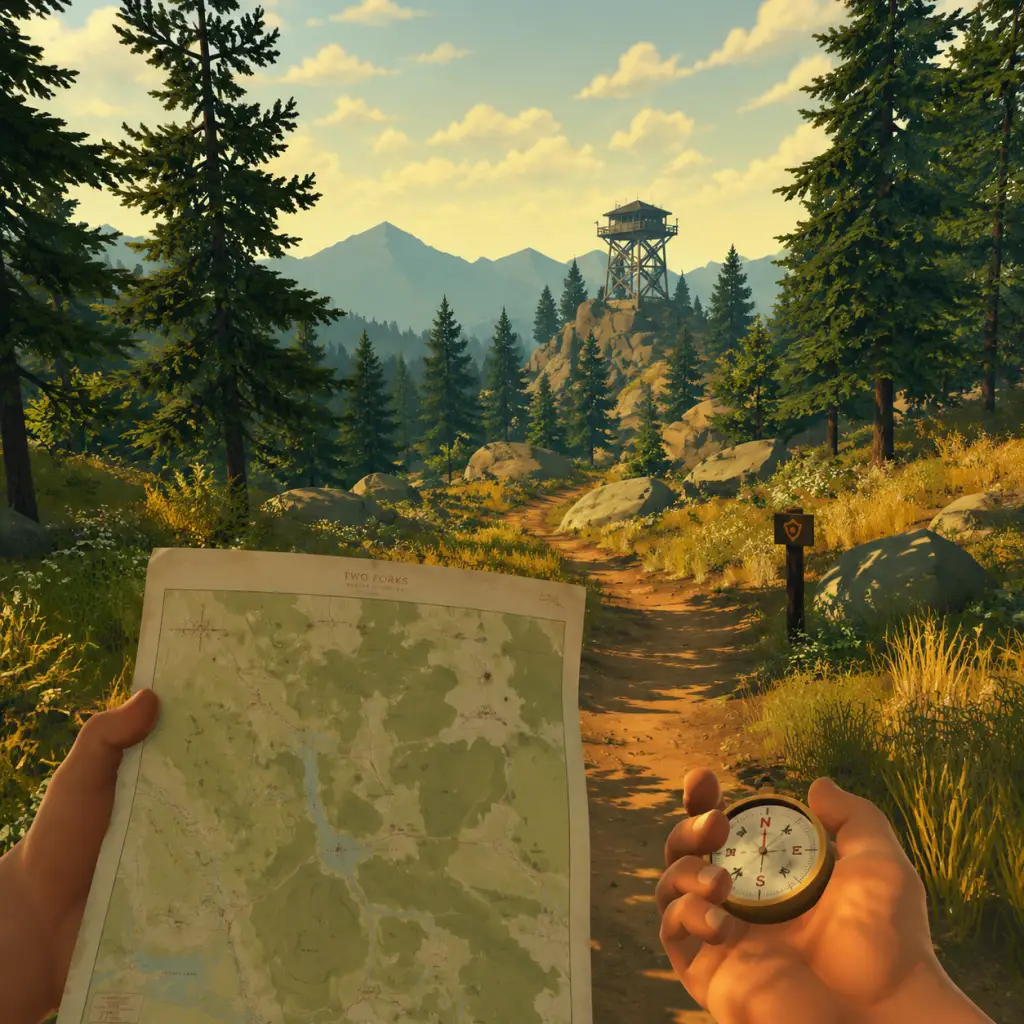
- Map & Compass: Navigate using a physical map and compass; no quest markers or waypoints.
- Story Progression: Advance through narrative triggers—reaching specific locations, finding clues, or completing objectives.
- No experience points, skill trees, or stats.
- The only persistent element is the state of your relationship with Delilah (influenced by dialogue choices).
- New areas become accessible as the story unfolds; some paths are blocked until you complete certain objectives.
Progression System
Progression in Firewatch is purely narrative-driven. The game is divided into Days (from Day 1 to Day 79). Each day begins with a sunrise and ends when you return to your tower at night or reach a story milestone. Progress is saved automatically at checkpoints.
Interaction & Controls
| Action | Keyboard/Mouse | Controller |
|---|---|---|
| Move | WASD | Left stick |
| Look | Mouse | Right stick |
| Interact | E | A (Xbox) / X (PlayStation) |
| Sprint | Left Shift | Left stick click |
| Crouch | Left Ctrl | B (Xbox) / Circle (PlayStation) |
| Use Radio | Tab | Up on D-pad |
| Map | M | View button (Xbox) / Touchpad (PlayStation) |
| Compass | Hold M | Hold View button |
| Walk slower (toggle) | Caps Lock | Right stick click (toggle) |
- Interact contexts: Examine objects, open doors, pick up items, read documents.
- Radio: Press the radio button to initiate contact with Delilah. Some conversations are automatic; others require you to radio her at the right moment.
- Map & Compass: Essential for navigation. The map is hand-drawn with landmarks labeled. Use the compass to orient yourself. No GPS – you must interpret the environment.
- Day 1: Complete the prologue (a flashback scene).
- Day 2: Arrive at the Two Forks Lookout. Meet Delilah via radio. Perform your first tasks: inventory supplies, record weather, check the lake.
- Day 3: Investigate mysterious fires and strange occurrences (e.g., a broken fence, a note left for you).
- Follow Delilah's instructions to explore the immediate surroundings of your tower.
- Use the radio to ask questions and report findings.
- Interact with objects (thermometer, logbook, supply box) to complete simple objectives.
- Navigate using the map and compass for the first time. Example: Delilah says "Head southeast to the lake" → you must read the map, orient with compass, and walk there.
- Always check the supply box behind your tower (Day 2) for a map and compass.
- Save often—autosave triggers only at major beats. Manual save is not available (checkpoint system).
- Your dialogue choices early on set the tone for your relationship with Delilah (friendly vs. guarded).
- Investigate anomalies: Teenagers setting off fireworks, a secret campsite, a broken research device.
- Follow narrative leads: Discover the old cache, the Wapiti Station, the fenced-off cave system.
- Radio conversations: Delilah provides context and emotional support. Your choices affect how she reacts to dangerous situations.
- Environmental puzzles: Some areas require you to find a key (e.g., to a locked gate) or use a combination (e.g., for a locker).
- The map now includes multiple named areas: Jonesy Lake, The Creek, Three Sisters, Cottonwood Creek, etc.
- Trails are not always marked; you may need to bushwhack through terrain.
- Some paths are blocked by fallen trees or locked gates; you must find alternate routes or solve a nearby puzzle.
- There are no enemies to fight. The only threats are environmental (falling, getting lost).
- If you fall off a cliff, you respawn at the last safe point (no health system).
- No currency or shop system. You cannot buy items.
- You find key items (e.g., map pieces, keys, notes) that unlock story progress.
- One time-limited resource: Water. You must refill your canteen at streams or your tower. If you run out, you cannot sprint and your vision blurs. You can always find water—just explore near rivers.
- There is no traditional character growth. The only progression is your relationship with Delilah. This influences:
- Dialogue decisions are the only "build" you can control. Example: If you consistently joke with her, she responds playfully; if you are dismissive, she becomes cold.
- The conspiracy around the missing hiker and the government surveillance station (Wapiti) takes center stage.
- You receive threatening notes, find hidden cameras, and uncover a cover-up.
- Delilah's behavior becomes erratic—your past choices determine her trust.
- Less open exploration; more scripted sequences.
- Puzzle solving remains: e.g., finding a combination to unlock a bunker, or navigating a cave without a light source (you find a flashlight).
- Quick-time events? No. All interactions are at your own pace.
- Radio conversations become more frequent and emotionally charged.
- There is no repeatable content. Once you reach Day 79, the story reaches a climax.
- The final day is a continuous, linear sequence from your tower to a helicopter landing zone. No side objectives.
- You reunite with Delilah at an overlook. The conversation here determines the ending's specifics.
- You face a moral choice: stay with Delilah or go to confront the truth (the choice is presented via dialogue options).
- After the final conversation, a cutscene plays. The credits roll.
- The game has two main endings (based on your final choice). Smaller variations occur based on your earlier dialogue choices.
- There is no New Game+ or post-game content. Once credits roll, you can only replay from the beginning.
- You can load chapter select from the main menu to revisit specific days (after completing the game once).
- Your relationship with Delilah matters most in the final conversation. If you were consistently supportive, she offers to stay; if you were combative, she distances herself.
- The ending is a direct payoff to your role as a fire lookout. No gameplay after the credits.
---
Core Gameplay by Progression Tier
Early Game (Days 1–3)
The tutorial period where you learn basic mechanics and establish your role.
Main Objectives:
Gameplay Loop:
Important:
---
Mid Game (Days 4–50)
The bulk of exploration and mystery unfolds. The core gameplay expands as you venture farther from your tower.
Main Activities:
Exploration Depth:
Example Mid-Game Sequence (Day 20-ish):
1. Delilah radios that she saw someone near a fence.
2. You go to the fence, find a note with a code (on a whiteboard inside the ranger station).
3. Travel to the fenced area, use the code on the lock.
4. Inside, discover a hidden research site and a tape recorder.
5. Play the tape and report to Delilah; she reveals history about the previous rangers.
No Combat:
Economy & Resources:
Character/Build Growth:
- Whether she shares personal stories.
- Her willingness to help you in dangerous moments.
- The ending's tone (amicable vs. strained).
---
Late Game (Days 50–79)
Tension escalates. The mystery deepens, and the narrative becomes more linear.
Story Focus:
Gameplay Shift:
Example Late Game Objective (Day 65):
1. Radio Delilah about a red envelope you found.
2. She instructs you to meet her at a cabin.
3. Travel to the cabin (new area).
4. Inside, you find a note from a ranger named Ned. This triggers a flashback scene (controlled by you, walking through memory).
5. After the flashback, you must find a key to escape the cabin (interact with a locked drawer, find key under a rug).
No Endgame Grind:
---
Endgame (Final Day – Day 79)
The conclusion of the narrative. The game's only "endgame" is the ending sequence.
Structure:
Replayability:
Endgame Tips:
---
Summary: Comparison to Traditional Gameplay Systems
| Traditional RPG Element | Firewatch Equivalent |
|---|---|
| Combat | None (environmental hazards only) |
| Progression/Leveling | Story-based (days pass, new areas unlock) |
| Quests/Missions | Narrative objectives (radio instructions, find clues) |
| Economy | No currency or inventory management (only key items) |
| Character Build | Dialogue choices that affect relationship with Delilah |
| Endgame | Final narrative sequence → ending → credits |
| Exploration | Semi-open world with map & compass; no fast travel |
Practical Advice
- Always carry your map – use the toggle (Hold M) to bring up map overlay while moving.
- Listen carefully to Delilah – she often gives directional hints like "follow the creek upstream" or "look for a red gate."
- Explore off the path – many notes, photos, and story details are hidden in nooks.
- Refill your canteen at every stream or lake. You can drink by pressing Interact (E/A) near water.
- Save your game? Autosave is frequent, but if you quit mid-day, you'll restart at the last checkpoint (usually after a major conversation). For safety, complete a day before exiting.
- The game world changes – some weather (rain, fog) affects visibility but not gameplay mechanics.
Firewatch is a short, focused experience (roughly 4-6 hours). The core gameplay is about immersion, storytelling, and choice. Enjoy the journey.