Core Gameplay
Core Gameplay Guide for Gang Beasts
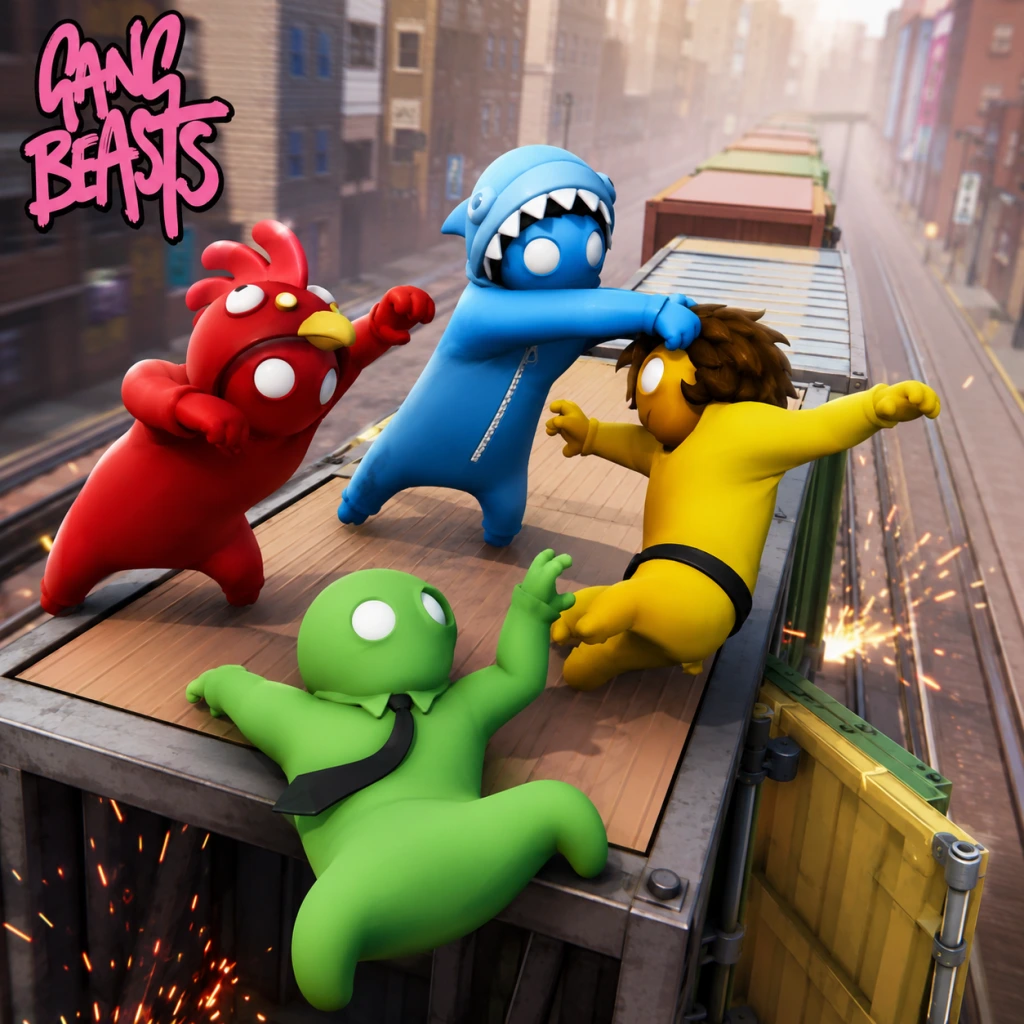
Gang Beasts is a physics-based multiplayer brawler where the primary goal is to throw, punch, and knock your opponents off dynamic stages into hazards (spinning fans, grinders, fire pits, water, etc.). There is no traditional progression system, no quests, no economy, and no character stats. Instead, the game revolves entirely around moment-to-moment physics interactions, environmental awareness, and player skill. This guide breaks down the core gameplay into skill-based progression tiers, reflecting how players naturally evolve from clumsy beginners to competitive masters.
The Main Gameplay Loop
The loop is simple and repetitive: Select a stage → Match starts → Fight other players using physics-based attacks → Avoid falling or being thrown into hazards → Survive as the last player standing → Win the round → Repeat. Each match consists of several rounds (customizable number) on randomly selected or chosen stages. Between rounds, players can change costumes (cosmetic only) and adjust settings. The loop relies entirely on emergent chaos from the physics engine; no two fights play out the same.
Combat and Interaction Systems
- Basic Controls (all platforms):
- Physics Interactions:
- No Health Bars: There is no health; victory is achieved by eliminating all opponents from the stage or into hazards. A player is eliminated when their character model touches the death zone (green mist, void, or hazard effect).
- No leveling, XP, skill trees, or ability unlocks. Every player has exactly the same physics attributes.
- No quests or missions. There is no single-player campaign or story mode.
- No in-game economy. No currency, items, or loot. All cosmetics (masks, costumes) are unlocked via random drops from playing matches or purchased via DLC.
- Exploration is limited. The game has no open world; you only explore the small, destructible stages during fights. Each stage has hidden nuances (e.g., moving platforms, breakable floors), but these are discovered through gameplay, not through exploration systems.
- Appearance only. You can customize your character’s outfit and mask before matches. These are purely cosmetic and do not affect gameplay.
- No builds. Every character is identical in abilities; no weight, strength, or speed variations. The only differentiator is player skill.
- Custom Games: Create private lobbies with adjustable settings: round count, stage selection, time limits, and even silly modifiers (e.g., low gravity, super punches).
- Local Multiplayer: Up to 4 players locally on a single screen. Endgame often involves group tournaments or drinking game additions.
- Online Multiplayer: Quick play or private matches with matchmaking. Ranked mode does not exist; however, player communities (Discord, Steam groups) organize tournaments with unofficial ladders.
- Achievements/Trophies: Unlock achievements for specific feats (e.g., win 100 rounds, get knocked out 50 times, perform certain throws). These serve as optional long-term goals.
- Modding (PC only): Community-created stages, costumes, and physics tweaks via Steam Workshop extend replayability indefinitely.
- Controls: Fumbling with button layout; often accidentally falling off edges by running too fast or jumping incorrectly.
- Combat: Spam punches randomly; rarely use grabs. Struggle to recognize staggering or throwing opportunities.
- Awareness: Unaware of hazards; frequently walk into crushers or stand near grinders. Do not anticipate opponent throws.
- Goal: Survive longer than others through luck rather than skill. Learn basic movement and how to get up after being knocked down.
- Example: A beginner on "Furnace" will run straight at an opponent, spam punch until both fall into the fire, then wonder why they died.
- Controls: Comfortable with punch, grab, and throw. Can consistently lift and throw standing targets.
- Combat: Use grab more often; know to hold opponents while walking toward hazards. Begin chaining punches into grabs.
- Awareness: Know major hazards on each stage; avoid obvious death spots. React to opponents’ grab attempts by mashing grab to break free.
- Goal: Actively eliminate opponents by throwing them off; not just survive. Start using environment (e.g., throwing into crusher on "Grind").
- Example: On "Wheel", a mid-game player will grab an opponent, drag them toward the spinning blade, and release at the right moment to ensure elimination.
- Controls: Mastery of advanced techniques:
- Combat: Can predict opponents’ actions; fake a grab to bait a dodge then throw. Use the environment as a weapon (e.g., slam opponent into ceiling spikes on "Incinerator").
- Awareness: Know every stage’s destructible parts and timing of hazards (e.g., when the fan in "Vent" changes direction). Can maintain balance on narrow beams while fighting.
- Goal: Win consistently against average players. Develop a personal style (aggressive, defensive, or environmentalist).
- Example: On "Trampoline": a late-game player will run to the edge, wait for an opponent to jump, then grab them mid-air and fling them into the void using the trampoline bounce.
- Controls: Subconscious execution; perform advanced techniques fluidly. Use keyboard/mouse (PC) for precise aiming of throws.
- Combat: Read opponents’ intent based on their movement and foot placement. Counter throws by using the opponent’s momentum against them. Use the “instant throw” trick (grab + jump + throw in one smooth motion).
- Awareness: Perfect hazard timing; know exactly where safe spots are during stage transitions (e.g., falling building platforms). Use the crowd as a distraction (in local play) to misdirect opponents.
- Goal: Dominate in custom lobbies, win community tournaments. Create house rules for extended replayability (e.g., no headbutts allowed, or must throw into only specific hazards).
- Example: In a competitive endgame match on "Grind", a player will use the conveyor belt to drag opponents toward the grinder, while simultaneously dodging incoming throws by sliding under the crusher at the exact moment it rises.
- Punch: Press the attack button (default: X/Square on controllers, left mouse click on PC) to throw a slow, heavy punch. Punches can be aimed by moving the control stick/mouse.
- Grab: Press the grab button (default: A/Cross on controllers, right mouse click on PC) to latch onto any part of an opponent or object. While grabbing, you can hold, drag, or throw.
- Lift: While grabbing, press the jump/lift button (default: Y/Triangle, spacebar on PC) to lift the grabbed character into the air.
- Throw: While grabbing, push the control stick in a direction and release grab to fling the opponent. The throw distance depends on physics momentum.
- Jump: Press jump (B/Circle, spacebar on PC). Jump height is fixed but can be used to dodge or climb.
- Headbutt: A special move by pressing the attack button while in mid-air or while grabbing (context-dependent). Used for close-range interruption.
- Staggering: Hits cause your character to stagger and flail. While staggering, you have reduced control and can be thrown easier.
- Grabbing vs. Clinging: You can grab ledges, edges of platforms, and opponents. Opponents can also grab you. You can shake free by rapidly pressing the grab button.
- Environmental Hazards: Each stage has unique hazards (e.g., crushers in "Grind", fans in "Vent", fire in "Furnace"). Interacting with these is often instant death or severe damage.
- Knockout: A heavy hit or fall can knock a character unconscious (limp). While unconscious, they are defenseless and easily thrown to death.
Progression, Exploration, Quests, and Economy
Gang Beasts features zero progression mechanics:
Character/Build Growth:
Endgame Structure
Endgame refers to the competitive and social aspects after mastering basics:
Player Progression Tiers (Skill-Based)
Since there is no traditional progression, tiers are defined by player understanding and technique:
#### Early Game (First 1-2 hours)
#### Mid Game (2-10 hours)
#### Late Game (10-50 hours)
- Ragdoll manipulation: Use headbutts to break grab holds or interrupt throws.
- Climbing and aerial grabs: Jump and grab airborne opponents to redirect them off stage.
- Physics exploitation: Plant feet on moving objects to gain momentum for longer throws.
#### Endgame (50+ hours / Competitive Play)
Summary
Gang Beasts is a pure physics-based skill game with no RPG elements. Progression is entirely about learning physics interactions, stage layouts, and advanced throw techniques. The core gameplay loop of fight-throw-survive remains constant, but depth comes from the chaotic interactions and emergent strategies that players develop over time. The endgame is self-defined through multiplayer communities and custom rule sets.