Core Gameplay
Core Gameplay Guide for Life is Strange (Original 2015)
Overview of Core Gameplay Systems
Life is Strange is an episodic graphic adventure. Its core gameplay centers on narrative exploration, dialogue decisions, environmental interaction, and the unique time-rewind mechanic. There is no combat, no traditional stat-based progression, and no in-game economy. Instead, progression is measured by story advancement, relationship development, and the cumulative impact of player choices. The main gameplay loop is: Explore → Observe & Interact → Make Decisions (with possible rewind) → Advance Narrative. The game is structured into five episodes. Each episode offers a self-contained story chapter with a climax and cliffhanger. Player actions carry over between episodes via save data.
Main Gameplay Loop
1. Explore the Environment: The player controls Max Caulfield through detailed 3D environments (e.g., Blackwell Academy campus, Chloe’s house, the Prescott barn). Movement is third-person with a fixed camera that can be rotated using the right stick (controllers) or mouse (PC). Key objects, characters, and points of interest are highlighted by a subtle shimmer or sparkle when approached. The player can also examine posters, photos, notes, and personal items to gain lore, foreshadowing, or emotional context.
2. Interact with Objects and Characters: Press the interact button (e.g., E on PC, X on PlayStation, A on Xbox) to pick up items, read documents, turn on radios, or trigger dialogue. Dialogues present multiple-choice responses, often with a time limit (indicated by a shrinking circle around the options). Some choices lead to branching outcomes or affect character relationships.
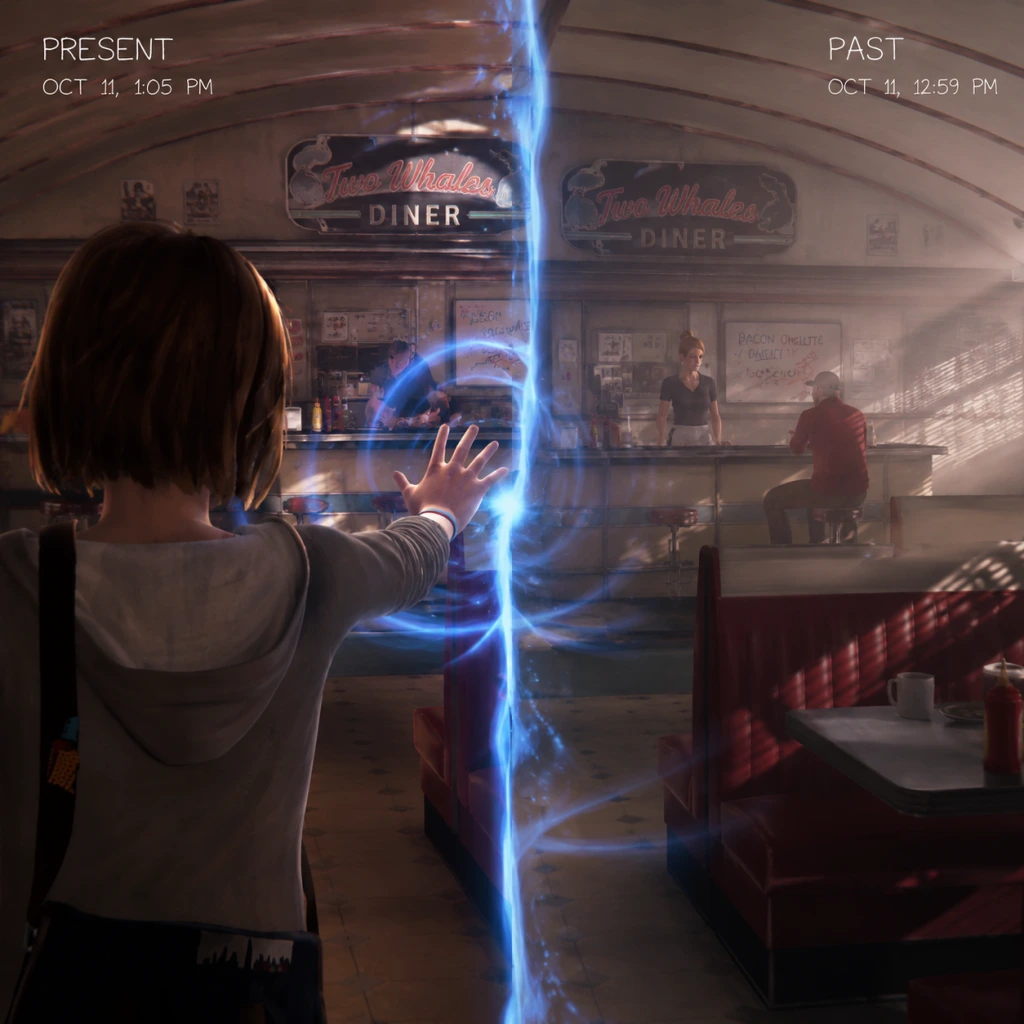
3. Use the Rewind Power: Max’s rewind ability allows the player to undo recent actions or dialogue choices. Hold the rewind button (e.g., Left Shift on PC, L2 on PlayStation, LT on Xbox) to reverse time up to a certain point. This is used to see alternative outcomes, pick different dialogue options, or fix mistakes. Important: some critical story moments prevent rewinding (marked by a lock icon).
4. Witness Consequences: After key decisions, the game displays an on-screen message like "This action will have consequences…" and later a summary screen at the end of each episode shows how your choices compare with global player stats. The story adapts dynamically; characters remember your past actions.
Interaction Systems (No Combat)
- Dialogue System: Branching dialogue trees. The player selects from up to four responses. Some responses are emotion-coded (e.g., “Comfort”, “Investigate”, “Deflect”). Time limits add tension. Rewinding can be used before the timer expires to change the selection.
- Environmental Puzzles: Simple, narrative-driven puzzles. Examples: in Episode 2, you must find a way to distract a janitor by triggering an alarm; you can rewind to undo a failed attempt. Common puzzle types: combining items in inventory (e.g., using a tool on a lock), finding correct sequences (e.g., turning valves in order), and locating hidden objects (e.g., a key in a pile of clothes).
- Photo Capturing (Episode 4-5): Max’s camera is used to take photos of specific scenes for optional objectives tied to achievements and story flavor. This is not combat but a minigame requiring finding the correct angle and timing.
- No Combat: The player never fights enemies. Threats come from environmental hazards (e.g., a falling debris sequence in Episode 4) or tense evade-and-hide sections (e.g., hiding from a gunman in Episode 3). These rely on quick-time events (QTEs): press a button prompt (e.g., Space repeatedly to kick a door, F to hide). Failure results in a “rewind” checkpoint or a different outcome (e.g., being caught and needing to retry).
- Reporting Nathan Prescott to the principal?
- Taking the blame for Chloe’s accident with the car?
- Ep. 2: How to comfort Kate on the roof? Your choices decide if she jumps. This is the first major consequence; saving Kate requires previous supportive interactions.
- Ep. 3: Choosing to break into the principal’s office with Chloe (or not) and how you respond to Chloe’s flirtation.
- Choosing to side with Warren or not during a heated argument with a teacher.
- Deciding whether to reveal Chloe’s past to her mother.
Progression
Progression is linear through episodes. Each episode has a beginning, middle, and end. The only character progression is the evolution of Max’s relationships (primarily with Chloe, Kate, Warren, etc.) and the accumulation of player-chosen memories that affect dialogue and events in later episodes. There are no experience points or level-ups. However, certain abilities unlock naturally: the rewind becomes available in Episode 1 after a dream sequence; later, Max gains the ability to “focus” to slow time during specific QTEs (Episode 3 onward). The end of each episode presents a major choice (often with a binary “save” or “sacrifice” decision) that persists into the next episode.
Exploration
Exploration is encouraged but not mandatory. The environments are relatively small and handcrafted. The player can find collectibles: optional photo opportunities (one per episode, plus hidden optional photos throughout). Finding all optional photos unlocks an achievement but does not affect story. Exploration reveals journal entries (Max’s diary automatically updates with notes, photos, and character profiles). Reading the journal provides deeper narrative context and sometimes clues for puzzles. Areas remain open only within the current episode; revisiting previous episodes is not possible after progression, but you can restart an entire episode from the main menu.
Quests / Missions
There is no traditional quest log. The game presents a single overriding objective per scene (e.g., “Find Chloe”, “Help Kate”). These are displayed as a hint in the top-left corner of the screen (on PC) or accessible via the pause menu under “Objectives”. The objectives are always linear and story-driven. Side objectives exist only as optional photo locations. Example side objective in Episode 2: take a photo of the butterfly in the bathroom—finding it grants an achievement and a small narrative nod.
Economy
There is no currency, no items to buy or sell, no inventory management beyond holding a few key items. Max’s backpack is used to carry story-critical items (e.g., a hammer, a letter). These items are automatically added and removed as needed. No trading or crafting exists. The only “economy” is the moral weight of choices—you cannot buy your way out of consequences.
Character / Build Growth
Max’s only growth is narrative. Her confidence, empathy, and ability to rewind remain constant mechanically. However, the player’s relationship with Chloe can evolve from friendship to romance or rivalry based on choices. Similarly, Max’s relationship with Kate Marsh affects whether Kate survives Episode 2. There is no skill tree or gear. The only “build” is the player’s moral alignment as perceived by characters (e.g., being supportive vs. confrontational). This is tracked silently in the background and influences late-game dialogue options (e.g., if you were kind to Warren, he may trust you more in Episode 5).
Endgame Structure
The endgame is Episode 5. The final episode condenses the narrative, culminating in a climatic sequence at the lighthouse during the storm. The player cannot rewind at the final decision point. The endgame offers two distinct final choices: Sacrifice Arcadia Bay (let Chloe live) or Sacrifice Chloe (rewind and let Chloe die). This choice locks in the ending. After the credits, there is no post-game content. The only replayability comes from starting a new game and making different choices to see alternative scenes. The game does not have a New Game+ or any additional difficulty modes.
---
Player Progression Tiers
#### Early Game (Episode 1 - "Chrysalis")
Scope: Introduction to mechanics, world, and core relationships.
Gameplay Loop: Linear corridor of exploration around Blackwell Academy and the town. The player learns basic movement, interaction, and the rewind power (gained after the dream sequence in the bathroom). Early puzzles: finding a camera, sneaking past a teacher to retrieve a report. No combat, but a QTE when Max is shoved by Nathan in the bathroom (simple button press to stand up).
Exploration: The dormitory, the main hall, the parking lot, and the lighthouse. Optional photos: a self-portrait in Max’s room, a dead bird in the parking lot. Collecting them is straightforward.
Key Decisions:
Progression: End of Episode 1 presents the first major cliffhanger—Chloe and Max discover Rachel Amber’s hidden funding—and sets up the mystery. No character growth yet; Max is portrayed as shy and introverted.
Example: In Episode 1, the player must rewind a conversation with Chloe to avoid her getting angry about not being told about the photo. This teaches the utility of the rewind for social navigation.
#### Mid Game (Episodes 2 & 3 - "Out of Time" & "Chaos Theory")
Scope: Character development deepens; puzzles become multi-step; relationship consequences appear.
Gameplay Loop: Episodic structure splits into two distinct arcs. Episode 2 focuses on Kate’s crisis; Episode 3 involves exploring Chloe’s house and the junkyard. Rewind is essential for solving puzzles like turning on valve sequences in Episode 2 (finding the correct order of three valves) and in Episode 3 (stealing a key from Chloe’s stepdad while avoiding detection). More QTEs: in Episode 3, a rooftop chase sequence requires rapid button pressing.
Exploration: Larger areas: the hospital (Episode 2), the Prescott barn (Episode 3). Optional photos become trickier: in Episode 3, you must photograph a train while avoiding its path—timing is key.
Key Decisions:
Character Growth: Max becomes more assertive; player choices shape her personality. For example, if the player often defends Chloe, Chloe trusts Max more and reveals personal secrets.
Progression: End of Episode 3 reveals that the town’s strange weather is connected to Max’s powers and the storm. No level-gates; progression is purely story-based.
Example: In Episode 2, the player must rewind multiple times to find the correct sequence of things to say to Kate during the rooftop scene. Each option changes Kate’s emotional state; the right combination prevents her suicide.
#### Late Game (Episode 4 - "Dark Room")
Scope: Heightened tension, more complex environmental puzzles, and a major narrative twist.
Gameplay Loop: The main goal is to rescue a kidnapped character. Puzzles involve: finding a password from a computer, locating a hidden key in a junkyard, and navigating a dark bunker using a flashlight. The rewind is used to avoid detection by security cameras (e.g., rewinding after walking into a laser grid). One QTE involves dodging a truck during a chase.
Exploration: The junkyard is open but has linear goals; the bunker is claustrophobic. Optional photos: one in the bunker showing a wall of photographs.
Key Decisions:
Character Growth: Max becomes more confident and desperate. Relationships with supporting characters (e.g., Warren, Joyce) solidify based on earlier choices. The player’s continuous support of Chloe or focus on investigating alone determines late-game dialogue options.
Progression: End of Episode 4 features a gut-wrenching cliffhanger where Max is drugged and has a vision of the storm. No new abilities unlock; the rewind remains the same but is used more creatively.
Example: In Episode 4, the player must solve a puzzle where they need to use a copper wire and a battery to create a spark. The puzzle involves combining items in the inventory: first pick up the wire, then combine with the battery from a flashlight. If the wrong order is attempted, a rewind is needed because the wire burns out.
#### Endgame (Episode 5 - "Polarized")
Scope: Final climax, no new exploration, heavy reliance on previous choices, and a binary ending.
Gameplay Loop: The episode is short and linear. It begins with Max trapped in a nightmare sequence that tests memory of earlier choices (e.g., selecting the correct answer about a conversation from Episode 1). Then a walking sequence through the storm-ravaged town with environmental obstacles (fallen trees, debris). No combat; the only interaction is dialogue with a few NPCs and the final decision.
Exploration: Very limited; the player can walk through the town but there are no optional photos or collectibles. Exploration is mostly scripted.
Key Decisions: The final decision: Save Arcadia Bay (sacrifice Chloe) or Save Chloe (let the town be destroyed). This decision locks the ending and there is no rewind possible. The game ends immediately after the choice, with a post-credits summary of the player’s major choices (e.g., saved Kate or not, who was blamed, etc.).
Character Growth: Max’s growth culminates in a moment of ultimate responsibility. The player’s moral framework throughout the game—selfish vs. selfless—influences which ending feels more consistent, but the game does not penalize either choice. No new abilities.
Progression: No further progression; after credits, the player can reload the last save to see the other ending or start a new game. There is no post-game content, and the save file is final.
Example: In the nightmare sequence, Max must recreate the exact order of photos from her bedroom wall that she took earlier. If the player collected all optional photos, the puzzle is easier because the sequence is clear. This reinforces the value of exploration.
---
Summary of Core Gameplay by Tier
| Tier | Episodes | Key Mechanics | Exploration Focus | Major Decisions | Character Growth |
|---|---|---|---|---|---|
| Early Game | 1 | Basic movement, rewind introduction, simple interaction | Small environments (dorm, parking lot) | Reporting Nathan, blaming Chloe | Max timid, relationships forming |
| Mid Game | 2-3 | Multi-step puzzles, QTEs, focus ability (from Ep3) | Campus, hospital, junkyard, barn | Kate’s fate, breaking into principal’s office | Max gains confidence, relationships solidify |
| Late Game | 4 | Complex puzzles (code, key, flashlight), hide-and-seek sections | Junkyard, bunker | Side with Warren, reveal past | Max aggressive/protective, trust with Chloe tested |
| Endgame | 5 | Nightmare quiz, storm traversal, final binary choice | Linear storm path | Save town or save Chloe | Max’s final growth in responsibility |