Core Gameplay
Overview
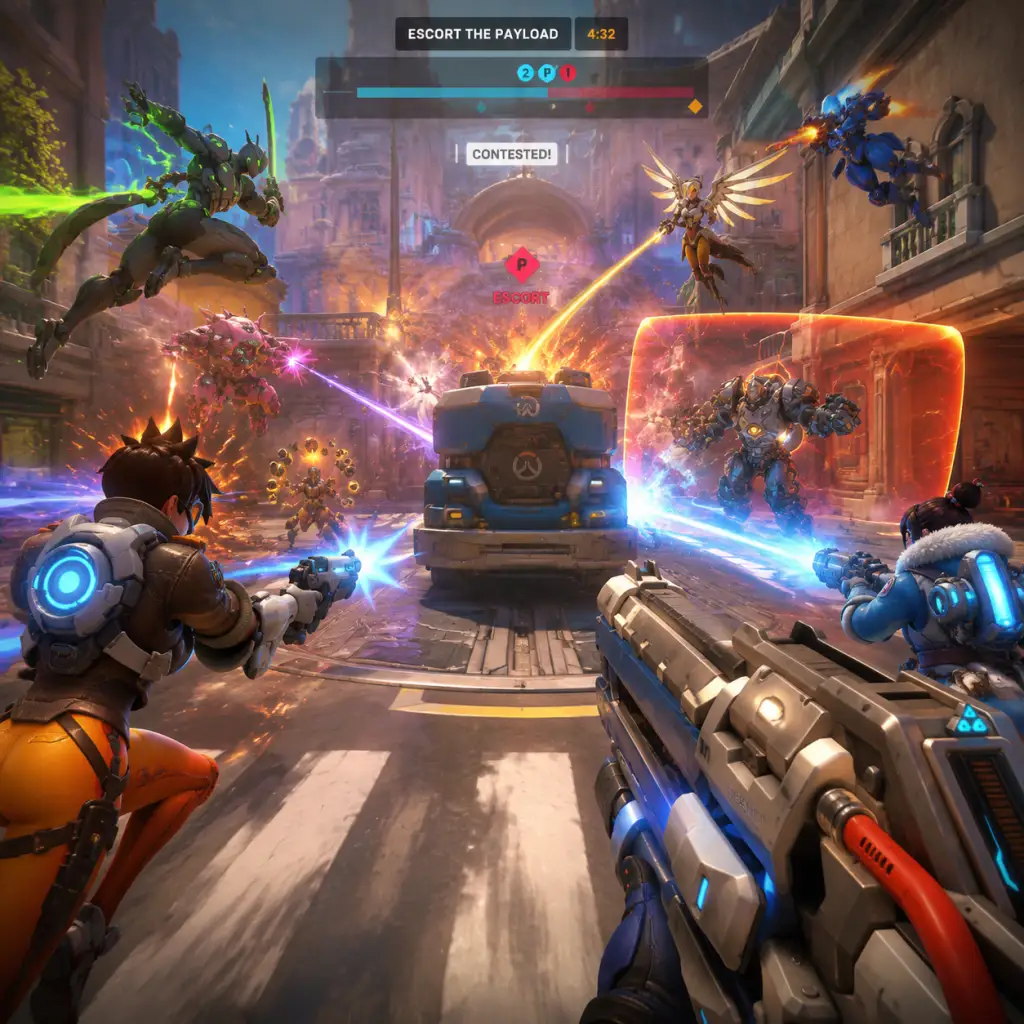
Overwatch 2 is a team-based hero shooter where two teams of five players compete in objective-driven game modes. The core gameplay loop revolves around selecting a hero from over 36 unique characters, coordinating with your team to capture or defend objectives, and using each hero’s distinct abilities and ultimate to outplay the enemy team. Unlike traditional shooters, there is no single best weapon or build—success hinges on hero composition, teamwork, and mastery of individual hero mechanics.
This section breaks down the game’s core systems and progresses through the player journey—from your first matches to high-level competitive play—explaining how the gameplay loop, progression, economy, and endgame evolve as you improve.
---
1. Core Gameplay Loop
The fundamental loop in Overwatch 2 is simple but deep:
1. Select a Hero – Each match you pick from three main roles: Tank, Damage, or Support. Your choice defines your team role and responsibilities.
2. Fight for the Objective – Almost every mode (Escort, Control, Push, Flashpoint) has a central objective. You must either capture, push, or defend it.
3. Use Abilities and Ultimates – Each hero has four abilities (including an ultimate). Managing cooldowns and positioning is key.
4. Team Fights and Respawns – When your hero is eliminated, you respawn and rejoin the fight. The team that wins more fights controls the objective.
5. Win the Round – Win by completing the objective (e.g., pushing the payload to the end, capturing two control points).
Example Early Game Experience: As a new player (say level 1–25), you’ll play Quick Play. You pick Soldier: 76 (a straightforward damage hero). Your goal: stay with your team, shoot enemies, use your Sprint and Biotic Field to survive, and use Tactical Visor for easy eliminations. You’ll learn the basic flow: spawn, fight, die, respawn, repeat.
---
2. Combat and Interaction Systems
Overwatch 2 is fundamentally a shooter, but every hero has unique weapons and abilities. Combat is about aim, ability management, and positioning.
- Primary Fire – Most heroes have a standard attack (e.g., Ashe’s rifle, Reinhardt’s hammer). Some are hitscan (instant bullet), others projectile.
- Secondary Fire – Many heroes have alternate attacks (e.g., Sigma’s accretion rock, Hanzo’s Storm Arrows).
- Abilities – Each hero has up to three cooldown-based abilities (e.g., Tracer’s Blink, Ana’s Sleep Dart). These provide utility, mobility, or damage.
- Ultimate – Charged by dealing damage, healing, or other actions. Powerful, game-changing abilities (e.g., Zarya’s Graviton Surge, Lucio’s Sound Barrier).
- Role Passive Abilities:
- XP – Earned by completing matches, challenges, and daily/weekly tasks. Each 10,000 XP = 1 level.
- Battle Pass – Free and Premium tracks. Levels give cosmetics (skins, emotes, voice lines, player icons). Premium includes exclusive skins and faster XP gain.
- Role-specific Challenges – Unlock heroes (e.g., new players start with limited roster; play ~50 games to unlock all original heroes).
- Competitive Unlock – Account level 50 required to unlock Competitive mode.
- Each hero has a separate level (1–100+). Leveling a hero earns exclusive loot boxes (called “Hero Boxes”) and cosmetic items (sprays, icons, name cards).
- No stat increases—purely cosmetic.
- Early Game: Account level 1–50. Learning roles, heroes, basics.
- Mid Game: Level 50–150. Unlock Competitive, start ranking in Bronze–Platinum.
- Late Game: Level 150–500+. Deep hero pool, advanced strategies, high elo (Diamond–Grandmaster).
- Endgame: Level 500+ and high Competitive rank (GM, Top 500). Focus on meta mastery, team coordination, scrims.
- Health Packs – Small and large packs scattered across maps. Knowing their locations is crucial for survivability, especially for supports and flankers.
- High Ground – Controlling high ground gives damage advantage. Many fights revolve around maintaining or contesting elevated positions.
- Chokepoints and Flanks – Each map has natural chokepoints (e.g., the bridge on King’s Row) and flank routes (side alleys, windows). Learning these allows you to surprise enemies.
- Environmental Hazards – Some maps have pits or ledges (e.g., Well on Ilios). Heroes with knockback (Lucio, Pharah) can secure environmental kills.
- Quick Play – Casual, role queue or open queue. 5v5 matches with random map.
- Competitive – Ranked play. 5v5 role queue. Seasons last ~2 months. Win/loss affects SR.
- Arcade – Rotating modes (e.g., 6v6 Mystery Heroes, 1v1 Limited Duel, PvE events).
- PvE Story Missions – Limited-time co-op missions (e.g., King’s Row Uprising, Underworld). Not permanent core gameplay.
- Challenges – Daily and weekly objectives (e.g., “Win 3 games as Support”, “Deal 30,000 damage”). Earn XP, Battle Pass progress.
- In-Game Currency – Credits (earned from Battle Pass, challenges) for buying rare and epic skins; Overwatch Coins (premium currency) for seasonal legendary skins, Battle Pass, pick-up bundles. Hero Boxes from hero progression also drop cosmetics.
- Loot Boxes – Removed from Overwatch 2. Instead, direct purchase in the shop or earn through Battle Pass.
- Battle Pass – 80 tiers. Free track gives 1–2 skins, coins, and icons. Premium track ($10) gives many skins, including a mythic skin at tier 80.
- No Pay-to-Win – You cannot buy damage, health, or abilities. Competitive advantage comes only from skill.
- Hero Mastery – You improve your mechanics (aim, movement) and game sense (positioning, ability timing, ult economy). This is your “build”.
- No Perks/Items – Each hero is fixed; there is no customization of abilities. However, you can switch heroes mid-match on respawn to counter the enemy team.
- Role Flexibility – Learning multiple heroes in your role is essential. For example, a Support main might learn Ana, Kiriko, and Lucio to adapt to different team comps and map types.
- Meta Shifts – Balance patches (every few months) change hero viability. Adapt your hero pool accordingly.
- Competitive Ranks – Bronze (1–1499 SR) → Silver → Gold → Platinum → Diamond → Master → Grandmaster (4000+) → Top 500 (highest SR players in region).
- Seasonal Rewards – Competitive points (earn golden weapons), player titles, and sprays.
- Scrims and Tournaments – Third-party leagues (e.g., Overwatch Collegiate, amateur tournaments). Players join organized teams and practice weekly.
- Role Queue and Open Queue – Two separate competitive ladders. Role Queue is standard for OWL-style 2-2-1 (now 1-2-2? Overwatch 2 uses 1-2-2). Open Queue allows any composition.
- eSports Spectacle – Watch Overwatch League (OWL) or contenders to learn high-level teamwork, meta trends, and map rotations.
- Tanks: Reduced knockback and ultimate charge from enemies (role passive).
- Damage: Speed boost on elimination (role passive).
- Supports: Automatic health regeneration after not taking damage for a short time.
- Role Queue (Competitive) ensures each team gets 1 Tank, 2 Damage, 2 Supports.
Example Mid Game Combat: A mid-level player (approx. account level 50–100, skill rating Silver–Gold) understands ability combos. You play Ana (Support). You learn to land Sleep Dart on an ulting enemy (e.g., a charging Reinhardt) and communicate “Rein slept!”. You also use Biotic Grenade to anti-heal enemies and boost team healing. Your positioning behind natural cover improves.
---
3. Progression Systems
Progression is account-wide and hero-specific, but not power-based. It gives cosmetics and unlocks competitive modes.
Account Progression (Levels and Battle Pass)
Hero Progression (Leveling Heroes)
Player Level Ranks (Early, Mid, Late, Endgame)
---
4. Exploration and Maps
Overwatch 2 maps are designed for verticality, flank routes, and sightlines. Exploration is about learning map layouts and resource spawns.
Example Late Game Exploration: A Diamond-ranked player on Eichenwalde knows exactly when to push past the first choke using a Dive composition (Winston, Genji, Lucio). They use the castle’s upper windows to bypass the main gate and attack the backline.
---
5. Quests and Missions
Overwatch 2 has no traditional story quests. The primary “mission” structure is game modes:
Example Late Game Mission Focus: A Master-ranked player’s “mission” is climbing the Competitive ladder. They play 10 placement matches each season to get a rank, then grind SR. They review their replays, practice specific hero mechanics in aim trainers.
---
6. Economy System
Overwatch 2 uses a free-to-play economy with no pay-to-win elements. All gameplay-affecting content is free.
Example Early Game Economy: A new player might save their free Battle Pass coins to buy a legendary skin for their main hero (e.g., Mercy). They complete daily challenges to earn XP and passes.
---
7. Character and Build Growth
Heroes do not have levels, skill trees, or gear. Build growth is about player skill progression, not character progression.
Example Endgame Growth: A Top 500 Tank player has at least 500 hours on Reinhardt, Winston, and Sigma. They know exact cooldown rotations, shield breakpoints, and when to swap. They analyze pro matches and integrate advanced techs (e.g., Reinhardt’s “super jump” shatter).
---
8. Endgame Structure
The endgame in Overwatch 2 is Competitive ranked play at high levels, combined with community-driven events.
Example Endgame Activity: A Grandmaster player logs in, queues for Competitive Role Queue (Damage role). They play 3–5 matches, review their VOD (video on demand) with a coaching tool like Overanalyzer, and practice widow headshots in custom games. They discuss meta picks (e.g., Sojourn, Tracer) with teammates on Discord.
---
Summary Table by Progression Tier
| Tier | Account Level | Competitive Rank | Focus | Example Hero Mastery |
|---|
| Mid Game | 50–150 | Silver–Gold | Understand ability combos, map knowledge, role synergy. | Ana, Tracer, Winston.
| Late Game | 150–500 | Platinum–Diamond | Master 2–3 heroes per role, ult economy, advanced positioning. | Lucio, Genji, Zarya.
| Endgame | 500+ | Grandmaster / Top 500 | Perfect execution, pro strats, team coordination, meta adaptation. | Sojourn, Echo, Kiriko, Ball.
---
Conclusion
Overwatch 2’s core gameplay is a layered system of hero selection, combat, and objective control. Progression is skill-based, not stat-based. The journey from new player to Top 500 relies on learning heroes, maps, and teamwork. The endgame is pure competitive climbing and community engagement, supported by a cosmetic economy that never impacts gameplay power. By understanding these tiers and systems, you can plan your own growth and enjoy the depth Overwatch 2 offers at every level.