Core Gameplay
Core Gameplay Guide for Overwatch 2
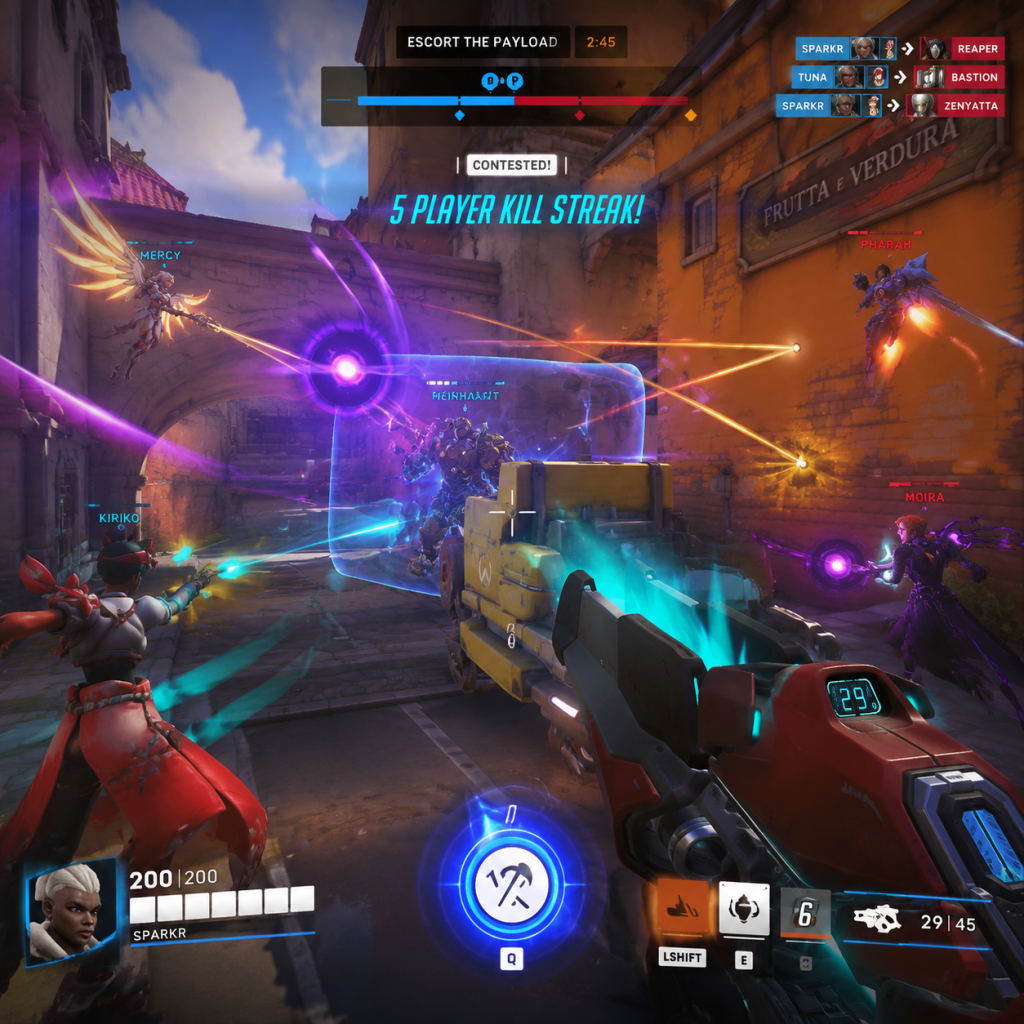
This guide breaks down the core mechanics of Overwatch 2 by player progression tiers. Unlike traditional RPGs, Overwatch is a purely PvP experience with no single-player campaign or open world. Its core loop revolves around 5v5 team battles across objective-based modes. Progression is tied to account level, hero unlocks, competitive ranking, and cosmetic rewards. Below is a detailed explanation of each tier.
Early Game (Level 1–25)
#### Main Gameplay Loop
The early game focuses on learning the fundamentals:
1. Matchmaking: Queue into Quick Play or Arcade modes (e.g., Mystery Heroes, Deathmatch).
2. Role Selection: Each match you pick a role (Tank, Damage, Support) based on availability if using Role Queue, or any hero in Open Queue.
3. Objective Play: Fight to capture or push objectives (Payload, Control Point, Push Robot).
4. Team Composition: Learn the importance of a balanced team (1 Tank, 2 Damage, 2 Supports).
5. Victory/Defeat: Match ends when objective conditions are met (e.g., payload reaches end, team captures point).
#### Combat/Interaction Systems
- Abilities: Each hero has unique skills (e.g., Reinhardt’s Barrier, Mercy’s Healing Beam). Use mouse buttons, Q for Ultimate.
- Weapons: Primary and secondary fire. Headshots deal double damage on most heroes.
- Ultimate Charging: Deal damage, heal, or block to fill your Ultimate meter. Press Q to unleash a powerful ability.
- Ping System: Use Middle Mouse or G (PC) to ping enemies, locations, or request help. Valuable for communication without voice.
- Health Packs: Small (75 HP) and large (250 HP) packs scattered on maps. Memorize their locations.
- Player Level: Earn XP from matches (plus first-win-of-the-day bonus). Level up to unlock Competitive mode at level 25.
- Hero Pool: All 30+ heroes are unlocked from the start in Overwatch 2 (except new heroes from Battle Pass). New heroes like Kiriko or Ramattra are earned via free tiers of the Battle Pass (tier 55) or bought with Overwatch Coins.
- Battle Pass: Free and Premium tracks. Gain XP to unlock cosmetics (skins, emotes, sprays). The Premium pass ($10) grants instant access to new heroes and bonus rewards.
- Learn common chokepoints (e.g., Hanamura’s first gate).
- Find health pack locations.
- Identify high-ground positions for Damage heroes.
- Weekly Challenges: Earn Battle Pass XP by completing objectives (e.g., “Win 10 games as Tank”).
- Event Challenges: During seasonal events (e.g., Halloween Terror), complete special tasks to earn event-specific cosmetics.
- Overwatch Coins: Premium currency bought with real money ($1 ≈ 100 coins). Used for Battle Pass, golden weapons, and shop skins.
- Legacy Credits: Earn from Battle Pass free tiers. Use to buy select skins from the Hero Gallery.
- Loot Boxes: Removed in Overwatch 2. All cosmetics are now directly purchasable or earned via Battle Pass.
- Hero Proficiency: No skill trees or stats. Growth is purely player skill: aim, positioning, game sense.
- Role Mastery: Practice each role to understand responsibilities (Tank: space creator, Damage: eliminations, Support: healing and utility).
- Example: At level 10, you might main Soldier: 76. Focus on tracking enemy movements, using sprint to reposition, and landing Helix Rockets.
- Team Coordination: Voice chat and pings become crucial. Call out target focus, ability usage, and ult combos.
- Counterpicking: Switch heroes mid-match to counter enemy team (e.g., switch to Sombra to hack a pesky Reinhardt).
- Ult Economy: Track enemy ultimates. Save defensive ults (e.g., Transcendence) to counter offensive ones (Graviton Surge).
- Competitive Points (CP): Earned by wins in Competitive. Use to buy Golden Guns (200 CP per hero).
- Rank Titles: Bronze, Silver, Gold, Platinum, Diamond, Master, Grandmaster, Top 500. Titles shown on career profile.
- Seasonal Rewards: End-of-season sprays and CP bonuses based on highest rank achieved.
- Learn advanced map geometry for each map. For example, on King’s Row, know the flank behind the statue on first point.
- Practice vertical angles for heroes like Pharah or Echo.
- No quests, but each season has themed challenges (e.g., “Get 50 kills with hero X in Competitive”).
- Role-specific missions: Blizzard occasionally adds limited-time competitive events (e.g., “Overwatch Anniversary Remix”).
- Golden Weapons: The primary endgame grind. Earn 3000 CP for one golden weapon. At 15 CP per win, it takes ~200 wins per weapon.
- Shop Rotations: Weekly shop offers limited-time skins for Overwatch Coins.
- Battle Pass Tiers: Continue earning free and premium rewards up to tier 80.
- Hero Pool Expansion: You should be comfortable with 3–4 heroes per role. Example: A Tank player might know Winston (dive), Reinhardt (brawl), and Sigma (poke).
- Cooldown Management: Track your and enemy cooldowns (e.g., Ana’s sleep dart has 12-second CD).
- Ult Tracking: Predict when enemy Zarya has Graviton based on time since last ult usage and her damage.
- High Elo Ranked: Matches become heavily strategic. Map picks, hero synergies, and ult management dominate.
- Scrim Culture: Many players form teams for scrims (practice matches) to improve coordination beyond solo queue.
- Specialist Roles: Players often one-trick (exclusively play one hero) or become experts on niche picks (e.g., Torbjörn).
- Peak Mechanics: Flick shots, pixel-perfect positioning, and instant reaction times. For example, a Genji player perfectly deflects a Graviton into the enemy team.
- Communication: Use explicit callouts: “Mercy one, one shot left side.”
- Team Compositions: Run meta comps like “Brawl” (Reinhardt, Mei, Lucio) or “Double Sniper” (Widowmaker, Hanzo).
- Top 500 Leaderboard: The top 500 players per role per region earn a special icon and spray. Demands consistent high win rate.
- Skill Rating Decay: Inactive accounts lose SR over time.
- Seasonal Titles: Highest rank achieved gives a dynamic title (e.g., “Grandmaster Tank”).
- Learn specific map rotations for heroes. For example, a Winston player on Gibraltar knows when to jump to the ship without dying.
- Use environmental kills: boop enemies off cliffs with Lucio or Orisa.
- Achieve Top 500 on all roles.
- Win 100 games with a specific hero in competitive.
- Obtain all Golden Weapons (over 50 possible).
- Gold Skin Grind: With 35+ heroes, earning all golden weapons requires over 10,000 wins. A year-long goal.
- Limited Cosmetics: Seasonal events (e.g., Summer Games) offer event-exclusive skins only available during that period.
- Mastering a Hero: Reach >70% winrate on a hero in GM. For example, an Ana player must have near 100% sleep dart accuracy on charging Reinhardts.
- Role Flexibility: Ability to switch between multiple heroes seamlessly based on map and enemy comp.
- Replay Analysis: Use the in-game replay system to review deaths and misplays. Many high-level players use external tools like OBS to record.
- Join competitive leagues (e.g., Open Division, Contenders).
- Create content (guides, streams).
- Coach lower-ranked players.
- Absolute Peak: Matches feature the best players per region. Every fight is a high-stakes chess game.
- Pro Scrims & Tournaments: Many Top 500 players scrim with teams aiming for Overwatch League or Path to Pro. The loop expands from solo queue to structured team play.
- Role Specialization: Deepest hero pools—some players are known globally for a single hero (e.g., Dafran’s Soldier: 76).
- Expert Team Coordination: Perfect ultimate combos (e.g., Zarya Graviton + Hanzo Dragonstrike).
- Mind Games: Fake ult use to bait out enemy cooldowns. Blink through shields to land Pulse Bombs.
- Voice Comms: Minimal clutter; only critical callouts. Use “target” callouts for focus fire.
- Top 500 Spot: Only 500 players per role per region. Spot requires high win rate in GM (usually 4200+ SR).
- Leaderboard Prestige: Being in Top 500 unlocks exclusive competitive season rewards (sprays, icons, player icons).
- Discover and utilize map geometry glitches (e.g., unintended super jumps) before they are patched. Note: This is controversial and may be considered cheating.
- Perfect rollouts: For example, a Winston player knows exactly where to land on each map to maximize jump pack damage and avoid stuns.
- Reach #1 on Hero Leaderboard (e.g., “Best Mercy in North America”).
- Win a tournament (e.g., Overwatch Collegiate Championship).
- Accumulate a collection of all golden weapons (requires years of play).
- Golden Weapon Completion: For those who have all golden weapons, the next grind is exclusive event cosmetics. Spending Overwatch Coins on rare skins becomes the main sink.
- Account Prestige: Showcase rare skins like “Pink Mercy” (charity event) or “BlizzCon tickets” to display legacy status.
- Complete Hero Mastery: Not just mechanical skill, but leadership and shotcalling. Some Top 500 players act as in-game leaders, dictating rotations.
- Adaptation to Meta Shifts: Constantly learning new heroes as they release and patch changes occur. For example, when Lifeweaver launched, top supports had to unlearn habits from previous supports.
- Coach/Stream: Many endgame players transition to coaching or content creation, passing knowledge to the community.
#### Progression
#### Exploration (Map Awareness)
Maps are linear but have flank routes, high ground, and cover. Key early goals:
#### Quests/Missions
Overwatch 2 has no traditional quests. Instead:
#### Economy
#### Character/Build Growth
#### Endgame Structure (Time Investment)
Endgame is not reached until after competitive ranking. In early game, the goal is to unlock Competitive mode. Typically 10–15 hours of play to reach Level 25.
---
Mid Game (Level 25 – Platinum/Diamond Rank)
#### Main Gameplay Loop
After unlocking Competitive, the core loop shifts to ranked matches:
1. Placement Matches: Play 10 qualification games to get an initial Skill Rating (SR) from Bronze (1–1499) to Grandmaster (4000+).
2. Role Queue SR: Each role has its own rank. Climb by winning matches.
3. Seasonal Cycle: Every 2 months a new season begins with a soft SR reset, new Battle Pass, and gameplay patches.
4. Adapting to Meta: Some heroes become stronger due to balance changes (e.g., Sojourn in Season 2).
#### Combat/Interaction Systems
#### Progression
#### Exploration (Map Mastery)
#### Quests/Missions (Competitive Specific)
#### Economy
#### Character/Build Growth
#### Endgame Structure
Mid game endgame is reaching masters or higher. At this stage, you’re refining mechanics, working with a consistent group, and studying replay reviews.
---
Late Game (Diamond+ – High GM/Top 500)
#### Main Gameplay Loop
#### Combat/Interaction Systems
#### Progression
#### Exploration (Advanced Tactics)
#### Quests/Missions (Endgame Grind)
No missions, but hardcore players set personal challenges:
#### Economy
#### Character/Build Growth
#### Endgame Structure
At late game, endgame is maintaining rank and grinding cosmetics. Players often:
---
Endgame (Top 500+ and Beyond)
#### Main Gameplay Loop
#### Combat/Interaction Systems
#### Progression
#### Exploration (Map Exploits)
#### Quests/Missions (Self-Imposed)
Endgame goals are often self-directed:
#### Economy
#### Character/Build Growth
#### Endgame Structure (Time Investment)
Endgame never truly ends due to seasonal resets and new content. The structure is cyclical:
1. New season starts → grind placements → climb to Top 500 → maintain rank → earn season rewards → repeat.
2. Special events (e.g., Anniversary) offer limited-time grinds for exclusive cosmetics.
3. Ongoing balance patches shake up the meta, requiring re-learning.
Conclusion
Overwatch 2’s core gameplay evolves dramatically from early game introduction to endgame mastery. While the basic shoot-and-capture loop remains constant, depth is added through role responsibilities, counterpicking, ult tracking, and team coordination. Progression is skill-based, not stat-based, and the economy drives cosmetic goals. Whether you’re a newcomer unlocking Competitive or a veteran grinding for Top 500, the core loop rewards constant improvement and adaptation.