Core Gameplay
Core Gameplay: Tetris
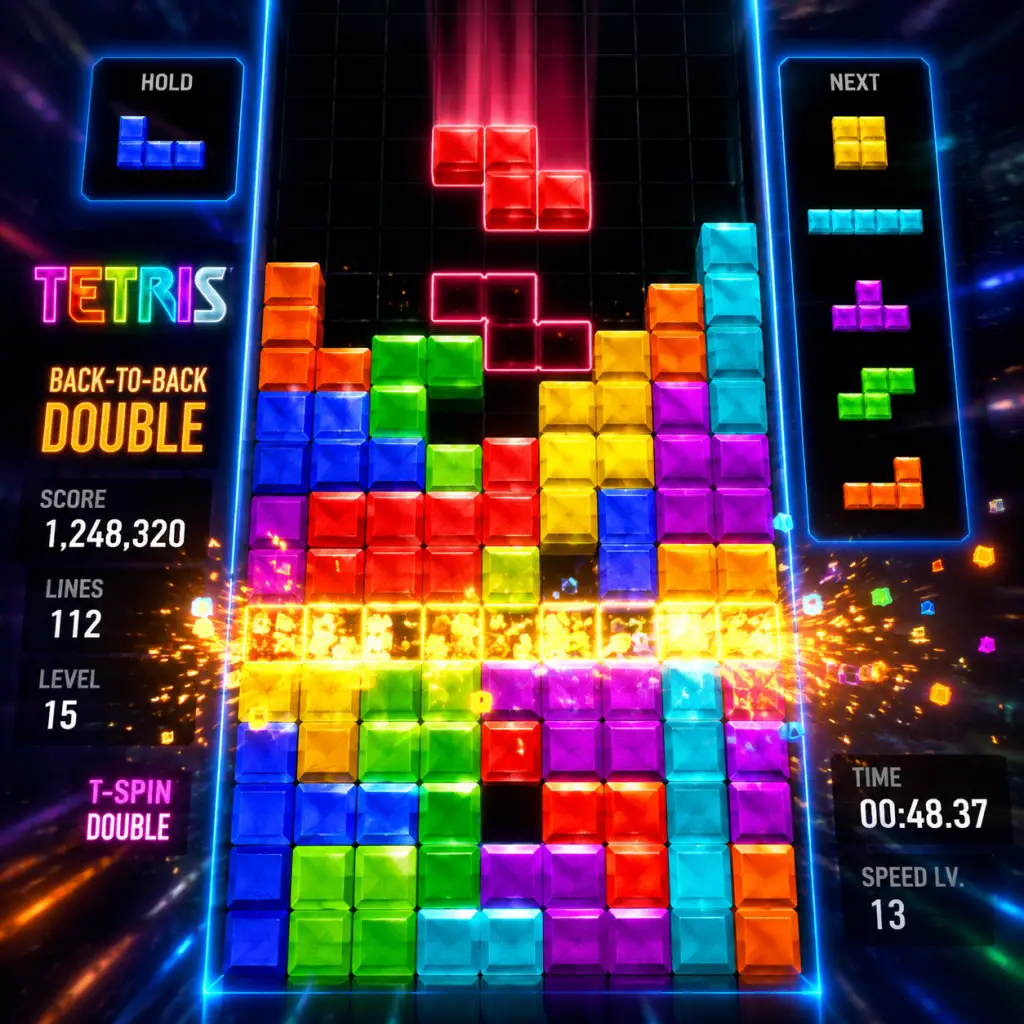
Tetris is a tile-matching puzzle game where the core loop is constant: a sequence of geometric shapes called tetrominoes (or pieces) fall from the top of a rectangular playfield. The player must rotate and move each falling piece to create complete horizontal lines without gaps. When a line is completed, it disappears, the stack above drops down, and the player scores points. The game ends when the stack reaches the top of the playfield. This guide breaks down the gameplay by progression tiers, adapting standard RPG concepts to Tetris’s unique mechanics.
The Main Gameplay Loop
1. Piece Spawn: A random tetromino (I, O, T, S, Z, J, L) appears at the top center.
2. Player Action: Use directional controls to move left/right, rotate (clockwise or counterclockwise), and soft drop or hard drop the piece.
3. Placement: The piece locks into place when it lands on the bottom or on another piece.
4. Line Clear: Any fully filled horizontal row is removed; pieces above settle down.
5. Scoring & Gravity: Points are awarded based on number of lines cleared at once (Single, Double, Triple, Tetris for 4 lines). The falling speed increases over time or after a certain number of lines.
6. Next Piece Preview: Most versions show the next piece (sometimes several) to aid planning.
7. Game Over: When a new piece cannot spawn because the stack blocks the top of the playfield.
Combat / Interaction Systems
In Tetris, "combat" refers to how players affect each other in multiplayer or how the game responds to player performance.
- Single-Player (Marathon Mode): The only enemy is gravity and the rising stack. The game increases speed at fixed line counts (e.g., every 10 lines in classic NES Tetris). No direct player-to-player interaction.
- Multiplayer (VS Mode, Tetris 99): Players send garbage lines (extra filled rows) to opponents by clearing multiple lines at once. Strategies include:
- Tetris Effect: Connected: Includes Zone mechanic where players can fill a meter to freeze time and clear many lines, sending massive garbage to opponents.
- Tetris 99: Battle royale with up to 99 players. Attack others by targeting players with badges or high attacks. Last player standing wins.
- Score: Accumulated from line clears, combos, T-Spins, etc.
- Lines Cleared: Total number of rows removed.
- Level: Typically increases with lines cleared (e.g., every 10 lines in classic Tetris) and raises falling speed.
- Unlockables (Modern Titles): Some games unlock new visual themes, soundtracks, or game modes as you complete goals (e.g., Tetris Effect’s Journey Mode levels).
- Rank / Badges: In Tetris 99, earning attack badges increases your offensive power permanently for that match.
- Learning Piece Patterns: Recognizing how pieces fit together optimally (e.g., setting up T-Spin slots, leaving S/Z pieces for later).
- Mastering Mechanics: Experimenting with different rotating strategies, wall kicks, and soft/hard drops.
- Discovering Game Modes: Modern versions offer Marathon, Sprint (40 lines), Ultra (3 minutes high score), and Puzzle modes (clear specific line patterns).
- Tetris Effect Journey Mode: 30+ levels with themed music and background visuals. Each level is a short mission like “Clear 10 lines using only Tetrises” or “Survive until the music ends.”
- Tetris 99 Events: Limited-time missions like “Clear 100 lines in one match” or “Earn 5 Tetrises in a single game” to unlock cosmetic items.
- Tetris (Puyo Puyo Tetris): Story mode with boss battles where you must meet line-clear conditions while AI sends garbage.
- Achievements / Trophies: Platform goals like “Clear 1000 lines total” or “Get a 15-combo in VS mode.”
- Cosmetic Unlocks: Themes, backgrounds, music tracks earned through gameplay or purchased with real money (e.g., Tetris Effect’s “Effect” skins for pieces).
- Tetris 99 Tickets: Earned by playing, used to enter themed events or buy cosmetic decals.
- No Pay-to-Win: All gameplay elements are available to all players; no purchasable advantages.
- Early Game Skills: Basic stacking (keeping columns even), simple line clears (Singles, Doubles). Fast rotation of single pieces.
- Mid Game Skills: Advanced techniques like T-Spin setup (minimal dependency on I-piece), 6-3 and 5-4 stacking patterns, wall kicks (SRS – Super Rotation System). Learning to read the “bag” of 7 pieces (randomizer) to predict upcoming shapes.
- Late Game Skills: Perfect clear setups, multi-step T-Spin combos, “All-Spin” recognition, maintaining high speed (e.g., over 1 piece per second). Ability to clean messy stacks under pressure.
- Endgame Skills: Competitive-level play: 4-wide combos (clearing continuously from a 4-column well), left-handed vs right-handed stacking, minimizing piece placement time (sub-1 second decisions). Muscle memory for all piece rotations and hard drops.
- Classic Tetris (NES / Game Boy): Ceiling is reaching “kill screen” (level 29 on NES) where pieces fall so fast that human reaction is nearly impossible. Top players aim for max score or farthest level.
- Sprint (40 Lines): Speedrun mode. Master times drop below 20 seconds (world record ~16 seconds). Endgame is optimizing piece placement and rotation efficiency.
- Ultra (3 Minutes): Goal is highest score in 3 minutes. Endgame involves chaining T-Spins and Tetrises with perfect economy.
- Multiplayer (Tetris 99 / Puyo Puyo Tetris): Endgame is competitive ladder play (ranked mode). Top ranks require knowledge of all-spin techniques, advanced defense (downstacking), and reading opponent patterns.
- Tetris Effect: Connected: Boss battles in Zone mode where players must cooperate to defeat a giant boss (e.g., clear lines to lower its HP) or compete for highest score in special time-limited events.
- Goal: Understand controls, piece names, and basic stacking.
- Strategy: Build flat stacks; avoid leaving single holes. Focus on clearing lines one at a time (Singles). Learn to rotate pieces intentionally.
- Typical Score Range: 1,000 – 10,000 in Marathon.
- Common Mistakes: Stacking too high on one side, not rotating enough, panicking when pieces arrive quickly.
- Game Mode Suitability: Marathon (slow speed), 40-line sprint (no pressure on time).
- Goal: Set up T-Spins, use wall kicks, understand bag randomizer. Clear lines in multiples (Doubles, Triples).
- Strategy: Maintain a “well” on one side (usually left) for Tetrises. Practice 6-3 stacking (6 columns left, 3 right). Learn to downstack (clear lines from a messy stack) efficiently.
- Typical Score Range: 50,000 – 200,000 in Marathon.
- Common Mistakes: Over-focusing on T-Spins while ignoring piece starvation; not using the “hold” piece feature (available in modern games).
- Game Mode Suitability: Sprint (aim for sub-1 minute), Ultra (experiment with combos).
- Goal: Consistent Tetris rates (multiple Tetrises per game), fast-downstacking, and continuous play at high speeds (Level 15+ in classic). Master T-Spin Triple and Perfect Clear setups.
- Strategy: Use 4-wide combos extensively in multiplayer. Develop “openers” – predetermined first 4-6 piece placements that guarantee high score. React quickly to garbage in VS mode.
- Typical Score Range: 500,000 – 1,500,000+ in Marathon.
- Common Mistakes: Neglecting piece placement precision at high speed; failing to read opponent’s sending patterns.
- Game Mode Suitability: Tetris 99 (survive until top 10), competitive Puyo Puyo Tetris (ranked 1v1).
- Goal: Top-tier tournament performance, world record speeds, or flawless play (zero lines wasted).
- Strategy: Perfect knowledge of all spin mechanics (including SRS wall kick tables). Ability to execute complex setups under 0.5 seconds. “Reading” opponent’s next piece via piece tracking (cheating in some environments).
- Typical Metrics: Sprint under 25 seconds, Marathon score over 5 million, Tetris 99 win rate >30% in lobbies.
- Common Mistakes: Hesitation due to overthinking; emotional tilt after mistakes.
- Game Mode Suitability: Ranked ladders (top 1%), speedrun.com leaderboards, official tournaments (e.g., Tetris World Championship).
- T-Spins: Using a T-piece to clear lines by rotating into tight spaces, often sending more garbage than normal clears.
- Perfect Clears: Clearing the entire playfield with one piece (rare but powerful).
- Combo System: Clearing lines consecutively without pause increases garbage output.
Progression
Progression in Tetris is skill-based and can be measured by:
Exploration
Tetris has no traditional exploration, but players "explore" in the sense of:
Quests / Missions
In many modern Tetris games, objectives replace traditional quests:
Economy
Tetris does not have a traditional in-game economy (currency, shops). However, some modern titles include:
Character / Build Growth
Since there is no character leveling, "growth" refers to player skill and strategic repertoire:
Endgame Structure
In Tetris, endgame is not a final boss but the ultimate expression of skill:
Player Progression Tiers
#### Early Game (Beginner – Learning Basics)
#### Mid Game (Intermediate – Pattern Recognition)
#### Late Game (Advanced – Speed & Efficiency)
#### Endgame (Expert – Competitive Mastery)
Conclusion
Tetris’s core gameplay loop is deceptively simple but continually challenging due to increasing speed and the need for spatial foresight. Progression is entirely skill-driven: early players learn to survive, mid players learn to optimize, late players learn to dominate with advanced techniques, and endgame players achieve near-perfection. Whether playing solo for relaxation or competing against 98 others in Tetris 99, the game offers endless depth through its elegant mechanics.