Core Gameplay
Core Gameplay – Total War: Warhammer III
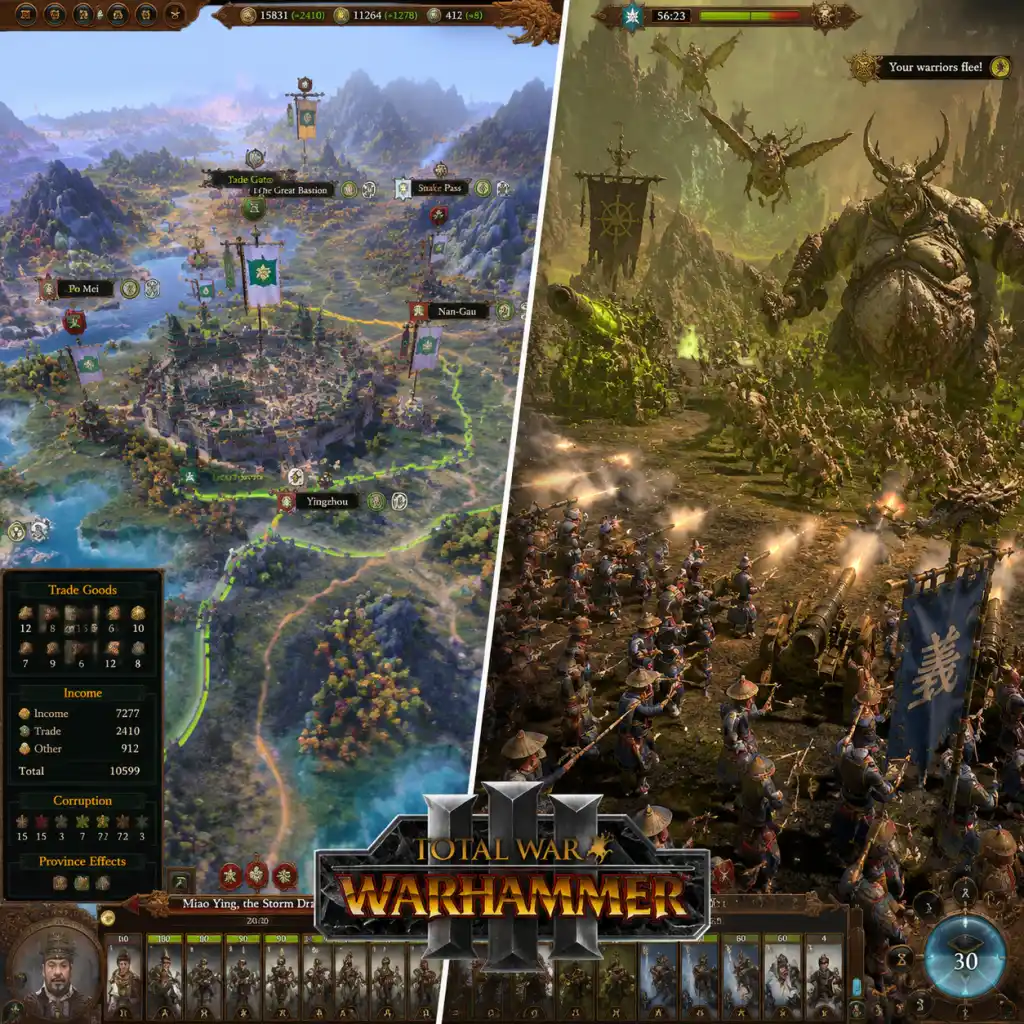
Total War: Warhammer III combines turn-based empire management on a grand campaign map with real-time tactical battles. The core gameplay loop revolves around expanding your territory, developing your economy, raising armies, fighting enemies, and completing victory objectives unique to your faction. The progression is divided into four distinct tiers, each with shifting priorities.
---
Main Gameplay Loop
1. Campaign Map (Turn-Based) – Manage settlements, recruit units, research technology, conduct diplomacy, move armies, and initiate battles or quests.
2. Battle Map (Real-Time) – Command armies in tactical warfare using unit formations, spells, abilities, and terrain. Victory or defeat affects campaign progress.
3. Aftermath – Occupy, raze, or sack settlements; loot, replenish armies, gain post-battle options (e.g., confederate, recruit captives).
4. Repeating Cycle – Each turn, you react to AI movements, pursue objectives, and push toward your victory conditions.
---
Player Progression Tiers
#### Early Game (Turns 1–30)
Goal: Secure your starting province, build a stable economy, and recruit a core army.
- Combat/Interaction: Focus on small-scale battles (20–30 units total). Use your starting legendary lord’s unique skills and a balanced core of infantry, ranged, and cavalry. Learn to use the pause and slow-motion features for tactical control. Example: As Kislev, use Katarin’s Ice magic to slow enemies while your Kossars shoot from range.
- Progression: Build growth buildings (e.g., Mage Tower in Kislev) to increase population, allowing settlement upgrades. Research early technologies that boost income (e.g., “State-Controlled Trade” for Empire).
- Exploration: Scout nearby provinces with heroes or a small army. Discover resource settlements (gold, wood, stone) and ruins that may trigger quests.
- Quests/Missions: Faction-specific quest chains appear (e.g., “The Great Game” for Daemons of Chaos). Complete them for powerful items, units, or bonuses. Generic missions (e.g., “Defend a settlement”) grant gold and influence.
- Economy: Prioritize income buildings (markets, docks, mines) and a second army only after securing your home province. Keep armies cheap – spearmen and archers are cost-effective.
- Character/Build Growth: Level your lord by fighting battles. Pick skills that enhance your core strategy (e.g., movement range, assassination chance). Heroes (e.g., Witch Hunters) can wound enemy agents or boost income.
- Example for Cathay: Secure the Bastion Gates (Wei-Jin, etc.), build yin-yang balance buildings, recruit Jade Warriors and Crossbowmen. Research “Celestial Bureaucracy” for improved diplomacy with other Cathayan factions.
- Combat/Interaction: Battles involve 40–60 units total. Use combined arms: artillery, monsters, and magic. Learn to counter enemy army compositions (e.g., large units require anti-large cavalry or magic). Use army abilities (e.g., Skaven’s Warp Lightning) and terrain (forests for flanking). Example: As Lizardmen, use a frontline of Saurus Warriors supported by a Slann Mage-Priest casting Comet of Casandora.
- Progression: Build tier 3–4 settlements with military buildings to recruit elite units (e.g., Phoenix Guard for High Elves). Research line-of-arms technologies (e.g., “Dwarven Rune Craft” for Dwarfs).
- Exploration: Send heroes or small armies to explore the Chaos Wastes, Dark Lands, or Lustria (depending on campaign). Interact with special landmarks (e.g., Black Pyramid) for bonuses.
- Quests/Missions: Faction quests become longer, often requiring multi-stage battles (e.g., “The Ice Court’s Challenge”). Optional dilemmas appear, offering temporary bonuses or penalties.
- Economy: Manage multiple provinces – build trade ports, specialise (e.g., one province for food, another for military). Use global recruitment sparingly (costs more). Maintain 2–3 full armies, funded by conquest sacking.
- Character/Build Growth: Lords reach level 15–25; unlock unique skills (e.g., Grimgor’s “Da Immortal Zog” ability). Focus on red-line skills to buff your preferred unit types. Heroes gain additional abilities (e.g., blocking enemy movement).
- Example for Skaven: Expand under-empire (underground cities) in rival territories for food. Build artillery buildings (Warp Lightning Cannons). Use Ikit Claw’s workshop to upgrade weapons. Sacking settlements for massive gold.
- Combat/Interaction: Large-scale battles (6,000+ troops). Use multi-army coordination – reinforce with a second army. Employ advanced micro: cycle charging cavalry, focus-fire high-value targets, intercept enemy lords. Use magic and monstrous abilities (e.g., Dragon breath) to break elite lines. Example: As Khorne, combine Skarbrand's charge with a horde of Bloodletters to rout enemy morale instantly.
- Progression: Build tier 5 settlements with landmark buildings (e.g., Nagashizzar for Vampire Counts). Research final technologies for factionwide buffs. Confederation mechanics (e.g., Empire consolidation) absorb allied factions, gaining their armies and territories.
- Exploration: Most of the map is revealed. Occupy strategic chokepoints (mountain passes, sea routes) and resource-rich areas (e.g., Galleon’s Graveyard for treasure).
- Quests/Missions: Final quest battles appear, often against legendary enemies (e.g., Chaos Dwarfs must defeat the Great Maw). Completing these rewards unique items and unlocks ultimate victory conditions.
- Economy: Massive income from 10+ provinces. Build reduced upkeep buildings (e.g., “War Camp” for greenskins) to support 5+ full stacks. Use raiding stance to generate money while damaging enemy regions.
- Character/Build Growth: Lords reach level 40+; unlock yellow-line skills for personal combat power (e.g., “Impossible to Kill”). Heroes become agents for assassination or support during battles (healing, debuffs).
- Example for Vampire Coast: Noctilus sails to occupy the Galleon’s Graveyard turn 1, then expands to Ulthuan. Late game, build coves in high-income ports (Lothern). Use Necrofex Colossi as frontline. Complete “Dreadfleet” quest to unlock the legendary ship.
- Combat/Interaction: Crisis events trigger AI super-stacks (e.g., 20+ armies of Chaos Warriors). Prepare multiple defensive armies and fortify key settlements. Use garrisons and ambush stance to whittle down enemies. Epic coordinated attacks using multiple armies from different directions. Example: The “Infernal War” crisis spawns allied Daemon armies that require unique counters (e.g., use warding magic against magic damage).
- Progression: No new settlement tiers; focus on military buildings for instant recruitment. Use global recruitment for high-tier units (e.g., Star Dragons) with accelerated build time from technologies.
- Exploration: Limited; all territories are claimed. Move armies to defend borders or launch final offensives against crisis spawn points.
- Quests/Missions: Final faction-specific quests often involve destroying the crisis source (e.g., “Assault the Northern Wastes”).
- Economy: Optimise income by demolishing redundant buildings and replacing with money-producing ones (e.g., “Bank” for Empire). Trade agreements with surviving allies. Save large treasury for accelerating recruitment.
- Character/Build Growth: Max-level lords and heroes (level 50). Equip legendary items from quests. Use ancillaries (e.g., “Dragon Fang Necklace”) to boost stats. Assign heroes to act as assassins or block enemy reinforcements.
- Example for Tomb Kings: Settra unites Nehekhara, then faces the “Black Pyramid” crisis where Nagash unleashes undead hordes. Use multiple stacks of Ushabti and Hierotitans. Complete “Final Book of Nagash” to unlock the “End of All Things” spell, wiping out half the enemy army.
---
#### Mid Game (Turns 31–80)
Goal: Expand beyond your starting province, unlock elite units, and begin major war campaigns.
---
#### Late Game (Turns 81–150)
Goal: Eliminate major threats, confederate allies, and work toward Victory Conditions (Short/Long Campaign victory, Domination, or Control of the Forge).
---
#### Endgame (Turns 151+ – Victory or Crisis)
Goal: Survive the “Endgame Crisis” (e.g., Chaos Invasion, Vermintide, Black Pyramid activation) and achieve final victory condition (Domination, Narrative, or Score-based).
---
Core Systems Overview
| System | Description | Example Interaction |
|---|---|---|
| Turn-Based Campaign | Move armies, manage settlements, diplomacy every turn. | Recruit a new army, move to attack an enemy settlement. |
| Real-Time Battles | Tactical control with pause, formations, and unit abilities. | Cast “Wind of Death” as Vampire Counts to kill 6 units. |
| Magic & Winds of Magic | Resource pool for casting spells, regenerates each battle. | Use “Fireball” (2 WoM) vs. Apotheosis (5 WoM). |
| Settlement Management | Build chain buildings (military, income, growth, defence). | Tier 3 barracks unlocks “Greatswords” for Empire. |
| Tech Tree | Unlock units, buffs, and economic upgrades. | Research “Elven Smithing” for +5% armour. |
| Lord & Hero Skills | Three skill trees: blue (campaign), red (buffs), yellow (combat). | Allocate points to red line for “+10% missile damage”. |
| Diplomacy | Trade, alliances, war coordination, confederation. | Sign non-aggression pact with Dwarfs to focus on Greenskins. |
| Faction Mechanics | Unique features like Skaven food, Kislev devotion, Chaos Dwarf labour. | Maintain high devotion to unlock Ice Guard units. |
Exploration & Quests
- Exploration: Discover province capitals (settle), resource deposits (mines, ports), landmarks (special buildings), and sea-routes (fog of war). Use proxy agents (e.g., Empire Witch Hunter) to scout ahead safely.
- Quests: Appear as dilemmas (e.g., “Aid the Caravan” = +gold, -relations) or chain quests (e.g., “The Warden’s Hunt” for Eltharion). Complete for unique items (e.g., “Sword of Khaine” gives massive power but penalties).
- Example for Kislev: Quest “Save the Ungol Pilgrims” sends Katarin to a ruined village to fight Norscans. Reward: “Ice Crown of the North” (healing passive).
- Primary income: Trade tariffs (per active trade route), taxation (from settlements), sacking/looting. Secondary: hero actions (assault garrison), raiding stance.
- Growth: Buildings (e.g., “Grainery” +20 growth per turn) and technologies increase population, enabling higher-tier unlocks.
- Example for Dark Elves: Use Slave economy – build slave pens and make slaves work in mines. High slave count boosts income but increases public order penalty.
- Lord builds: Focus on red-tree buffs for your core units (e.g., “+10 weapon strength for Dreadspears”). Blue-tree for campaign bonuses (mobility, recruitment cost). Yellow-tree for survival if your lord fights on front line.
- Hero builds: Assign to armies as embedded (battlefield support) or agent (map actions). E.g., Life Wizard hero embedded heals units; a Shadow Wizard agent can assassinate enemy lords.
- Example for Wood Elves: Orion gets red tree buffs for Wildwood Rangers. Spend points on “Forest Spirit Resilience” to make Dryads tanky.
- Triggered crisis: Usually activates around turn 100–200 (depending on difficulty) with a global warning (e.g., “The Forces of Chaos stir in the north”).
- Crisis types: Chaos Invasion, Vermintide, Greenskin Waaagh!, Undead Rising, or custom (in “The Lost God” campaign).
- Response: Build defensive lines, ally with surviving factions, recruit emergency armies. Diplomatic coalitions can be formed against the crisis.
- Victory: Achieve Short Campaign Victory (e.g., control 12 provinces + eliminate rival), Long Campaign Victory (30 provinces + destroy major factions), Domination Victory (control 50% of all settlements), or Score Victory (most points after turn 200).
---
Economy & Growth
---
Character/Build Growth – Advanced Tips
---
Endgame Structure
---
This guide covers the fundamental core gameplay of Total War: Warhammer III across all progression tiers. Adapt your strategy based on faction strengths, and always keep an eye on your victory conditions to prioritise actions.