Core Gameplay
Core Gameplay Guide for Until Dawn
Until Dawn is an interactive drama survival horror game where your choices and quick reflexes determine the fate of eight teenagers trapped on Blackwood Mountain. Unlike traditional action games, there is no experience points, skill trees, or inventory management. Instead, the core gameplay loop revolves around exploration, decision-making, quick-time events (QTEs), and the "Don't Move" mechanic. The narrative is divided into 10 chapters, with each chapter representing a shift in the story and the intensity of threats. Below, the core systems are explained and then organized by player progression tiers.
---
Core Gameplay Systems
#### 1. The Gameplay Loop
1. Explore a fixed environment (e.g., lodge rooms, mines, forest paths) from a third-person perspective. The camera is often fixed but occasionally follows over-the-shoulder.
2. Interact with objects (books, drawers, doors, machinery) to find clues, tools, or trigger events.
3. Make choices via dialogue wheels or action prompts (e.g., "Slap" vs. "Kiss" Josh). These affect relationships and the butterfly effect.
4. React to QTEs during chase sequences, climbing, or fights (e.g., mash X to pull a lever; press A repeatedly to run).
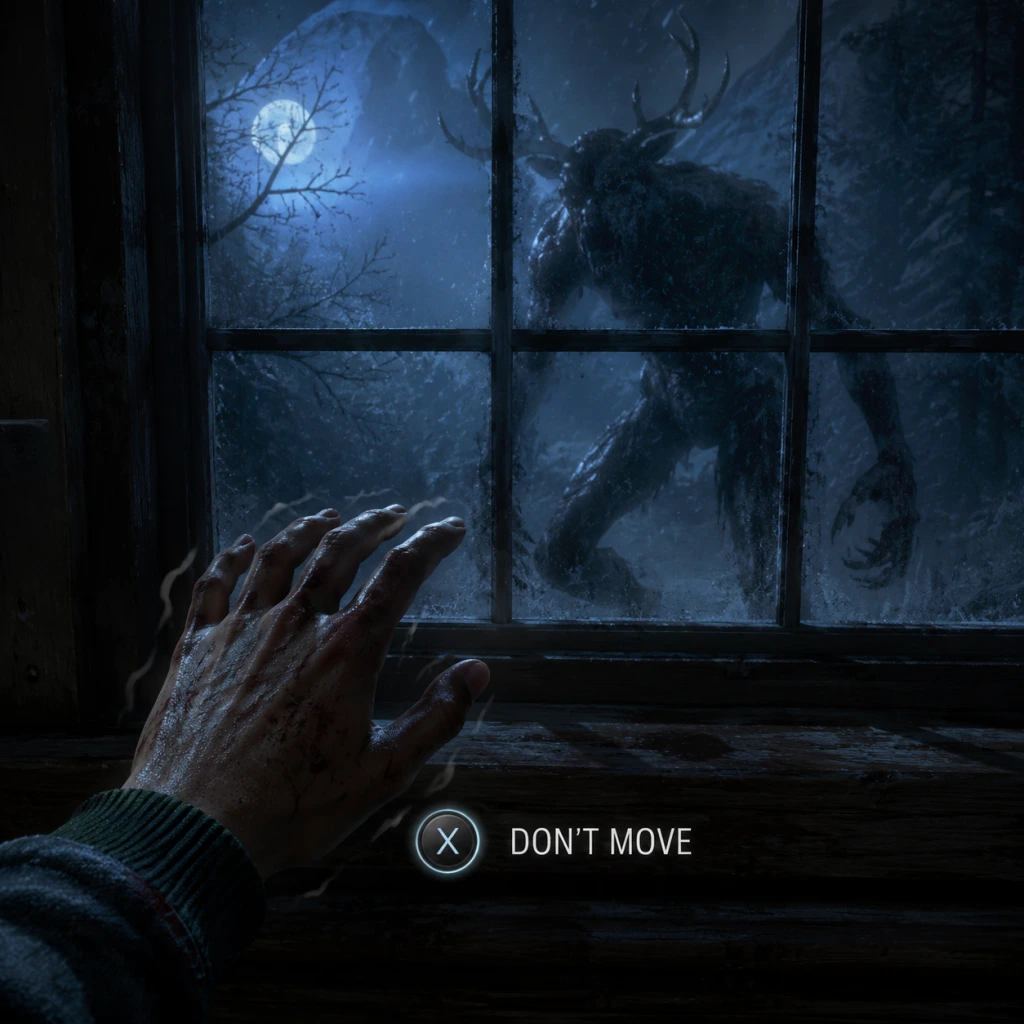
5. Use the "Don't Move" mechanic – hold the controller absolutely still when prompted (or use gyro on PS5/PC). Any movement can alert enemies or cause instant death.
6. View consequences – after major choices, the game shows a “Butterfly Effect” icon, and totem visions may hint at future outcomes.
#### 2. Combat / Interaction Systems
- No traditional combat. You cannot attack enemies with weapons; you must outrun, hide, or use environmental traps (e.g., shooting a barrel in the sawmill).
- Interactions include pushing, pulling, pressing buttons, and shooting (e.g., Mike aiming a gun in the sanatorium – controlled by aiming reticle and pressing R2).
- Dialogue choices use a wheel with two to four options, often with a time limit (e.g., "Be Nice" / "Be Mean" / "Stay Silent").
- QTEs vary: button mashing (circle), single presses (X, square), stick wiggling, and timed holds.
- The story progresses linearly through chapters. You cannot return to previous areas after leaving them (except via chapter select after completion).
- Butterfly Effect means your choices cause branches: characters can die at various points, altering later scenes and dialogue.
- The game tracks your decisions in a menu, but there is no level or skill progression.
- Clues: 60 collectible items scattered across environments. Finding them adds to the mystery (e.g., Hannah’s diary, newspaper clippings).
- Totems: 30 carved wooden totems that show premonitions of possible future events – helpful for making informed choices.
- Some areas are only accessible when playing as a specific character (e.g., Chris can use the service elevator).
- Each chapter has an implicit objective (e.g., “Find the key to the secret room” or “Survive the psycho’s trap”).
- There are no side quests; every action advances the main story.
- No currency or shops. The only collectibles are clues and totems, which unlock trophies/achievements and affect the ending (e.g., collecting all clues reveals the full truth).
- Relationships: Your choices influence how much characters trust each other. For example, Mike and Jess’s relationship can be strong or strained. High trust can unlock cooperative actions (e.g., Mike saves Jess more easily).
- Character Traits: Some dialogue options are locked behind traits gained during play (e.g., being “brave” or “cautious”). For example, if Chris chooses to shoot himself during the saw trap, he gains a “Heroic” trait that unlocks a different response later.
- Totems as "build": Collecting specific totems (e.g., Danger, Guidance) gives you hints that act as a limited form of meta-progression, but they are optional.
- The final chapter (Chapter 10) features a massive chase sequence where surviving characters try to escape the burning lodge. Multiple death opportunities occur.
- After the credits, a brief epilogue (1–2 minutes) shows the surviving characters and a police investigation. The ending depends on who survives and whether the wendigo curse is understood (based on clues found).
- No post-game content other than chapter select to replay and change outcomes.
- Focus: Introduction of characters, exploration of the lodge and grounds, first deaths possible.
- Length: Approximately 2–3 hours.
- Tone: Light horror with pranks and mild suspense; the “psycho” (Josh) is the main threat.
- Exploration of the lodge (main hall, bedrooms, basement).
- Simple QTEs (pressing buttons to catch falling objects, open doors).
- First “Don’t Move” sequence (during Beth’s dream at the start of Chapter 2).
- Dialogue choices affecting relationships (e.g., Mike and Jess argue over the phone message).
- Finding clues: Hannah’s makeup room, the owl totem, initial newspaper clippings.
- First Totem (premonition) in Chapter 2 – shows a character falling.
- Chapter 2: As Sam, choose to slap or kiss Josh. Slapping him makes him suspicious, and later he may act more hostile. Kissing creates trust but may lead to a trap.
- Chapter 4: Playing as Mike in the basement during the “light switch” puzzle. QTEs for avoiding the psycho’s trap – if you fail, Ashley might be startled later.
- First Death: Jess can die in Chapter 4 if you fail the chase QTEs and Don’t Move while hiding. This is the earliest permanent death.
- Explore thoroughly – clues in early chapters affect the ending (e.g., the “Stranger’s” identity).
- Prioritize building relationships between characters who will later be paired (e.g., Mike & Jess, Chris & Ashley).
- Practice holding the controller perfectly still during Don’t Move – the slightest vibration counts as movement on PS5/PC (use a level surface if needed).
- Focus: Exploration expands to the sanatorium, mines, and sawmill. The wendigo is revealed as the real threat.
- Length: Approximately 3–4 hours.
- Tone: Darker, with more gore and jump scares. The “psycho” trick is exposed.
- Stealth sections: Sneaking past the psycho (Josh) or wendigos (e.g., Sam in the tunnels).
- Aiming mechanic: Mike uses a gun in the sanatorium – you must aim with the right stick and press R2 to shoot. Ammo is limited (only certain encounters).
- Character switching: You control multiple characters in the same chapter (e.g., Chapter 6 switches between Mike in sanatorium and Ashley in the lodge).
- Environmental traps: Triggering a winch or dropping a chandelier to kill the psycho – requires precise QTEs.
- Relationship consequences: If Chris trusts Josh too much, he may die in the saw trap because Ashley doesn’t let him in.
- Chapter 5: As Mike in the sanatorium, you must shoot attacking wendigos (QTEs with aiming). Missing shots can lead to injury or death.
- Chapter 6: As Ashley, you hear a noise outside the library – you can choose to investigate or ignore. Investigating leads to a QTE chase and possible death.
- Chapter 7: The stranger (Floss) explains the wendigo in detail, but only if you found his journal earlier. If you didn’t, the explanation is vague.
- Chris’s trap: In the sawmill, you must choose to shoot Josh or yourself. Shooting yourself shows selflessness, which makes Ashley more likely to save you later.
- Hiding from the psycho: As Sam, staying completely still when Josh appears determines if he finds you.
- In shooting sections, keep the crosshair still – movement alerts enemies. Aim for center mass.
- Use headphones to detect ambient sounds (e.g., wendigo growls) for better timing in Don’t Move segments.
- Collect all totems – the Guidance totem is especially helpful (shows where to hide).
- Focus: The final confrontation with the wendigo, escape from the lodge, and resolving all character fates.
- Length: Approximately 3–4 hours (including final chase).
- Tone: Intense, high stakes, constant threat. Many characters can die in quick succession.
- Multiple NPC deaths: In Chapter 9, Matt and Emily can die in the mine based on prior actions (e.g., if Matt didn’t find the flare gun, Emily can’t signal for help).
- Final Don’t Move gauntlet: As Sam in Chapter 10, you must remain completely still while the lodge burns. Any movement triggers a wendigo attack.
- Relationship payoff: High trust can unlock dialogue options that save characters (e.g., Ashley can convince Chris to flee instead of fighting).
- Clue-based endings: If you found all clues and totems, you can prevent certain deaths (e.g., Mike can know that fire hurts wendigos).
- Chapter 8: When Mike searches the lodge basement for Sam, you must solve a puzzle (match wires) under time pressure. Failure electrocutes him.
- Chapter 9: The encounter with the wendigo in the mine – Matt must choose to save Emily or jump to safety. If he tries to save her, both may survive if you pass QTEs.
- Chapter 10: The final scene – you control Sam as she navigates the burning lodge. The “Don’t Move” sections are extremely long (up to 30 seconds). Moving even slightly kills Sam instantly.
- The flamethrower: In Chapter 8, Mike can pick up the flamethrower. This allows him to burn wendigos, saving characters like Sam later.
- Open the door: As Sam, deciding to open the lodge door lets the wendigo in but gives others an escape route. Depends on whether you want to save everyone.
- Before Chapter 9, review your totem visions – they often hint at the final chase route.
- During the final Don’t Move sequence, place the controller on a flat surface and do not breathe heavily. On PC, disable the controller’s rumble if possible.
- Use chapter select after the ending to redo earlier choices that led to deaths; the game saves your choices globally.
- After the final credits, you see a police investigation scene where the survivors recount the events. The ending is based on how many characters survived (0–8) and whether the truth about the wendigo curse is uncovered.
- There is no new game+, but you can replay any chapter via the main menu (changes overwrite previous choices for that playthrough).
- Epilogue: A 2-minute cutscene showing survivors’ fates (e.g., the police arrest Josh or he becomes a wendigo).
- Trophy/Achievement cleanup: You can reload chapter select to find missed clues or totems. A list in the menu shows how many you have per chapter.
- Multiple endings: The “best” ending (all 8 survive) requires very specific choices from Chapter 2 onward. No post-game activities beyond replaying.
- Everyone survives: Requires choosing the “right” options (e.g., Sam hiding, Mike saving Jess, Chris not shooting himself, etc.). The lodge burns, and all friends are rescued.
- No one survives: If you fail every QTE and make poor choices, all eight die. The epilogue shows the police finding no survivors, and the wendigo curse continues.
- Josh becomes a wendigo: If you collect the “Hannah’s Diary” clues and Josh survives, he becomes a wendigo in the mines after being captured.
- Use a guide for the exact combination of choices needed for the “all alive” ending – one wrong move in Chapter 2 can cascade.
- The “Butterfly Effect” menu shows all your decisions; reload chapters to tweak them without restarting the whole game.
- To see all endings quickly, use chapter select focusing on the final two chapters (9 and 10) after choosing different lead-ups.
#### 3. Progression
#### 4. Exploration
#### 5. Quests / Missions
#### 6. Economy
#### 7. Character / Build Growth
#### 8. Endgame Structure
---
Player Progression Tiers
The experience is divided into four tiers based on chapter progression, new gameplay elements introduced, and increasing difficulty of QTEs and stealth sections.
---
Early Game: Chapters 1–4
#### Overview
#### Key Systems Active
#### Examples
#### Tips for Early Game
---
Mid Game: Chapters 5–7
#### Overview
#### Key Systems Introduced
#### Examples
#### Critical Choices
#### Tips for Mid Game
---
Late Game: Chapters 8–10
#### Overview
#### Key Systems Exacerbated
#### Examples
#### Critical Choices
#### Tips for Late Game
---
Endgame (Post-Chapter 10)
#### Overview
#### Endgame Content
#### Example Endings
#### Tips for Endgame Mastery
---
Summary Table: Progression Tiers
| Tier | Chapters | Key Mechanic Introduced | Main Threat | Estimated Playtime |
|---|---|---|---|---|
| Early Game | 1–4 | Exploration, QTEs, Don’t Move, Dialogue choices | The “psycho” (Josh) | 2–3 hours |
| Mid Game | 5–7 | Stealth, aiming, environmental traps, co-op puzzles | Wendigo (revealed) + Psycho | 3–4 hours |
| Late Game | 8–10 | High-stakes chase, final Don’t Move gauntlet, relationship payoff | Wendigo horde | 3–4 hours |
| Endgame | Post-Chapter 10 | Epilogue, chapter select, trophy hunting | None | Variable (for collectibles) |
Final Advice
Until Dawn is a game where your choices and reactions matter more than any grind or build. The best way to enjoy it is to play blind first, then use chapter select to perfect your outcome. Memorize the location of totems (they save lives) and always keep your controller still during Don’t Move. Treat every QTE as life-or-death, because in this game, they literally are.