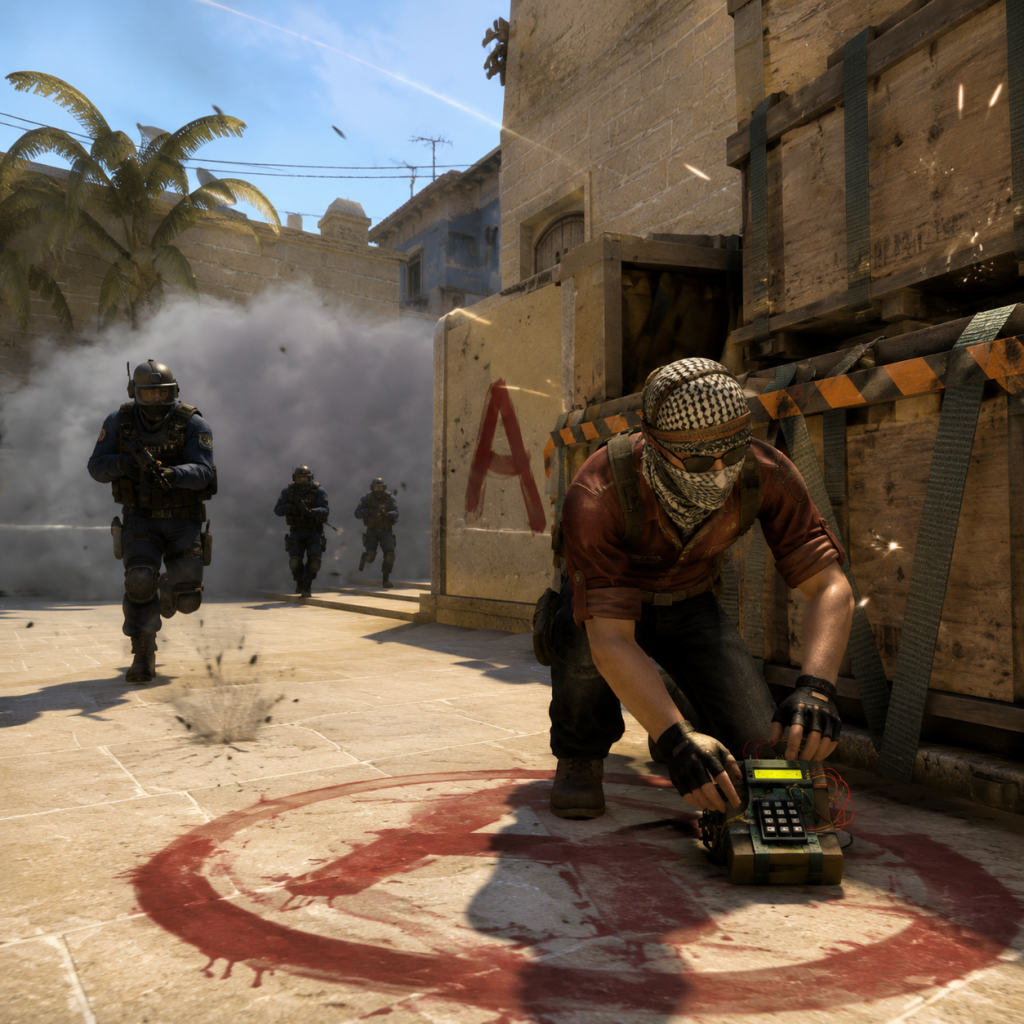
Core Gameplay
Core Gameplay Guide for Counter-Strike: Global Offensive (now Counter-Strike 2)
This guide covers the fundamental gameplay loop, systems, and progression of Counter-Strike: Global Offensive (CS:GO), which has evolved into Counter-Strike 2 (CS2). The game is a round-based tactical first-person shooter where two teams—Terrorists (T) and Counter-Terrorists (CT)—compete to achieve objectives. Progression is skill-based, with no traditional RPG levels or gear; growth comes from mastering mechanics, map knowledge, teamwork, and game sense.
Main Gameplay Loop
Each match consists of up to 30 rounds (15 as T, 15 as CT), with the first team to 16 rounds winning (with overtime if tied). The core loop for each round:
1. Buy Phase (15–45 seconds) – Use earned money to purchase weapons, armor, grenades, and defuse kits. The default start gives $800 for pistols.
2. Execution Phase – Teams move toward objectives using strategy and utility. The T side must plant the C4 bomb at one of two bomb sites; CTs must prevent the plant or defuse it.
3. Combat Encounters – Gunfights occur as teams push, hold angles, or retake sites. Accuracy, positioning, and recoil control determine outcomes.
4. Post-Plant/Post-Defuse – After the bomb is planted (T win if it explodes; CT win if they defuse), teams battle for the remaining time. If all players on one side die, the other wins.
5. Round End & Reset – Money is awarded based on kills, objective completions, and round outcome. The next round begins.
Combat and Interaction Systems
- Weapon Damage & Recoil – Each weapon has unique damage falloff, armor penetration, and spray pattern. For example, the AK-47 kills in 1 headshot against unarmored or helmeted opponents; the M4A4 requires 2 headshots. Recoil patterns (e.g., AK-47: upward then right-left) must be learned through practice.
- Movement – Movement speed affects accuracy. Walking (shift) is silent but slow; running (no key) is loud and inaccurate. Counter-strafing (quickly tapping the opposite movement key) allows instant accurate shots.
- Utility – Grenades: Flashbangs blind enemies, Smoke blocks vision, HE grenade deals damage, Molotov/Incendiary denies area, Decoy mimics gunfire. Each has specific throw mechanics (left/right click for underhand/overhand).
- Interaction – Close to an objective (bomb site, hostage) and press E to plant/defuse (hold E for defuse). Press G to drop your weapon, E to pick up dropped weapons. Right-click to switch fire mode (e.g., M4A4 to burst).
- Profile Rank – Earn XP from wins, kills, and missions to level up your profile, unlocking service medals and small cosmetic rewards.
- Prime Status – A one-time purchase (or free in CS2 if you had CS:GO) that queues you only with other Prime players, reducing cheaters.
- Operation Passes – Periodic operations (e.g., Operation Riptide) offer mission-based progression: complete weekly challenges to earn stars, which unlock exclusive weapon skins, stickers, and cases.
- Daily/Weekly Missions – Award bonus XP for specific tasks (e.g., win 2 matches in Deathmatch, get 10 headshots in Competitive). These accelerate profile leveling.
- Operation Missions – During an active operation, missions are tiered (easy, medium, hard) and grant stars. Stars can be used in the operation’s reward shop for skins, graffiti, and cases. Example: "Win 20 rounds on Dust II in Competitive matches."
- Achievements – Over 150 Steam achievements (e.g., “The Global Elite” for reaching max rank) – purely cosmetic but show dedication.
- Lose bonus: $1,400 for losing first round, $1,900 for losing second, $2,400 for losing third+ consecutive.
- Win bonus: $3,250 (T bomb plant) or $3,200 (CT objective).
- Kill reward: $300 for regular kills, $600 for headshots (only with pistol/knife).
- Additional: $300 for bomb plant, $300 for defuse.
- Global Elite – The highest official matchmaking rank. Requires consistent wins against high-level opponents.
- Third-Party Platforms – Faceit and ESEA (now merged into Faceit) offer ranked ladders with monthly seasons, Anti-Cheat, and higher skill ceilings. Level 10 Faceit is equivalent to semi-pro.
- Tournaments – From local amateur events to Majors (Valve-sponsored) like the BLAST Premier, ESL Pro League, and PGL Majors. Players join teams, practice strats, and compete for prize pools.
- Coaching & Demos – Reviewing own demos (clips) to analyze mistakes, learn from pros, and refine tactics.
- Cosmetics – The endgame grind often involves collecting rare skins (via cases, trade-ups, or the Steam Market) or reaching high rank for recognition.
- Goal: Learn basic mechanics, controls, and map layouts.
- Activities: Play Casual, Deathmatch, and Arms Race to practice gunfights without penalty. Complete 10 placement matches for first rank.
- Combat Focus: Master movement (counter-strafing), crosshair placement at head-level, and spray patterns of common weapons (AK-47, M4A4, USP-S, Glock).
- Economy: Understand when to buy armor vs. grenade, and why saving is okay.
- Progression Milestone: Reach Silver Elite – indicates basic game sense.
- Goal: Consistency in Competitive matches, developing teamplay and basic strategies.
- Activities: Solo or duo queue in Competitive; learn 2–3 maps deeply (e.g., Mirage, Dust II, Inferno). Practice grenade lineups for smokes and flashes.
- Combat Focus: Improve reaction time, learn peekers’ advantage, and integrate shoulder peeking to bait shots.
- Economy: Coordinate team buy rounds; understand force buys (e.g., buying SMGs after a loss).
- Progression Milestone: Reach Master Guardian (MG1/MG2) – indicates solid mechanics and map awareness.
- Goal: High-level consistency, advanced tactics, and leadership.
- Activities: Join a 5-stack team (via Discord, in-game friends, or forums). Play on third-party platforms (Faceit) for stricter anti-cheat and better competition.
- Combat Focus: Master all weapon classes (AWP, rifles, pistols) and situation-specific decisions (e.g., when to use Deagle vs. Tec-9). Retake drills, coordination of pop-flashes and executes.
- Economy: Read opponent economy to predict force buys; manage team bank for shared buys (e.g., dropping a rifle for a teammate).
- Progression Milestone: Reach Distinguished Master Guardian (DMG) to Legendary Eagle (LE) – indicating strong team coordination and game sense.
- Goal: Professional or semi-professional level; compete in leagues and tournaments.
- Activities: Only play Faceit Level 10 or ESEA Advanced/Intermediate. Scrim with tier-3 teams, review demos religiously. Seek coaching or join academy teams.
- Combat Focus: Sub-100ms reaction time, perfect spray transfers, ability to clutch 1vX under pressure. Analyze pro player decisions frame by frame.
- Economy: Perfect team economy management – know exactly when to force, save, or double-eco. Adapt strategies based on opponent’s buy patterns.
- Progression Milestone: Reach Global Elite in MM and Level 10 on Faceit. Compete in open qualifiers for Majors.
Progression (Skill-Based)
CS:GO/CS2 has no XP-based level-up for stats; progression is tied to matchmaking rank and skill group. Initial placement matches (10 wins) determine your rank (Silver I through Global Elite). As you win against higher-ranked opponents, your rank improves. Additionally:
Exploration
Exploration is minimal in a linear objective-based shooter. However, map knowledge is critical: every callout (e.g., "A Long", "Catwalk", "B Apps") must be learned. Players can explore maps in offline mode with bots, but the main focus is learning common angles, lineups for grenades, and timing of rushes.
Quests and Missions
Economy System
Each player starts with $800 in the first round. Money is earned per round:
Spending decisions: Full buy (rifle + armor + grenades) costs ~$4,700; force buy (SMGs/Pistols + light armor) when low on money; eco (save money, buy nothing) to afford a full buy next round. Team economy coordination is vital – if three players save, the team should eco together.
Character/Build Growth
There are no character classes, stats, or skill trees. Growth is entirely player-driven: improving aim (practice sprays, crosshair placement, reaction time), movement (bunny hopping, air strafing), map knowledge (callouts, utility lineups), and communication. Loadouts are per-round purchases, not persistent builds.
Endgame Structure
Endgame in CS:GO/CS2 is competitive mastery:
Player Progression Tiers
#### Early Game (Hours 0–100)
#### Mid Game (Hours 100–500)
#### Late Game (Hours 500–1500)
#### Endgame (1500+ hours)
---
This guide outlines the core gameplay loop and progression path. Remember, CS:GO/CS2 is a game of continuous improvement; every death is a learning opportunity. Focus on fundamentals first, then layer in advanced techniques.