Core Gameplay
Core Gameplay
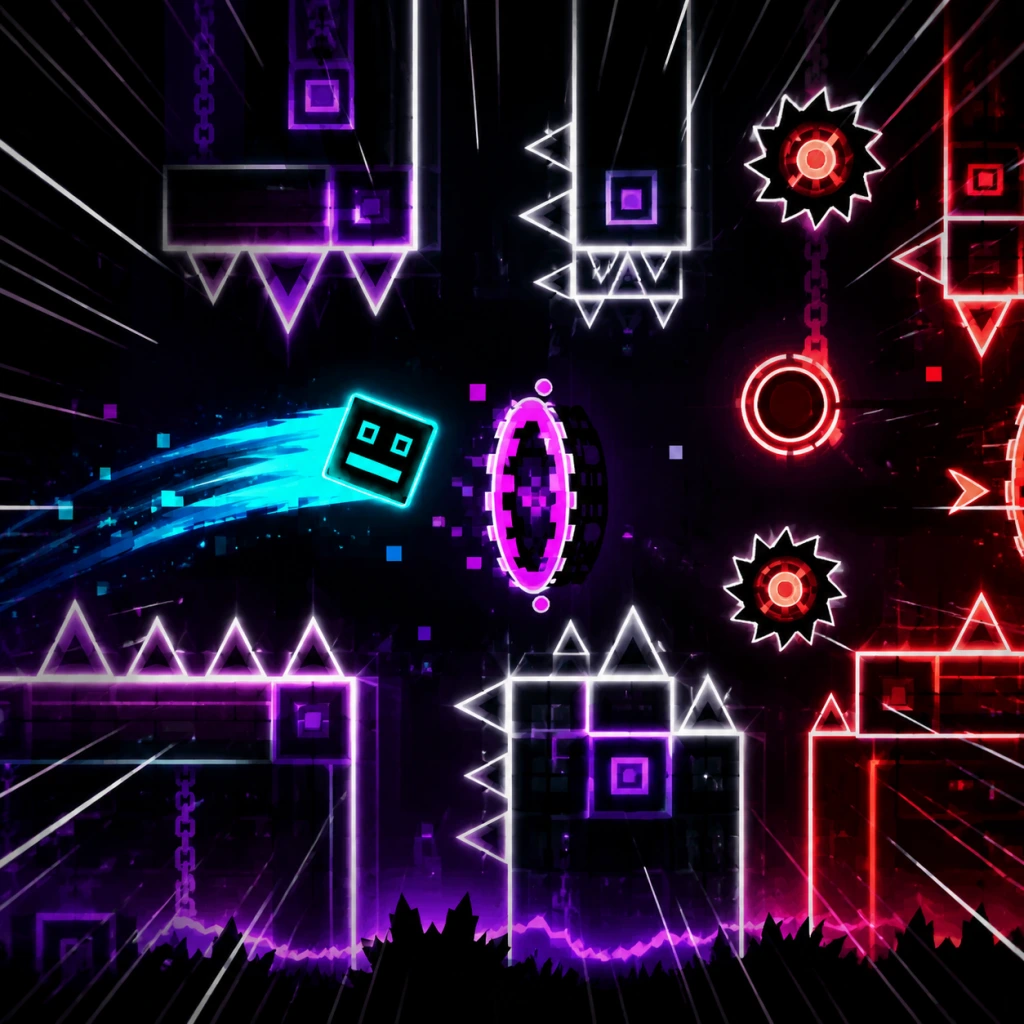
Geometry Dash is a rhythm‑based platformer with a distinct, high‑difficulty gameplay loop centered entirely on timing, memorization, and persistence. There is no combat, no RPG builds, no open exploration, and no traditional economy. Instead, the game focuses on the following core systems:
- Main Gameplay Loop: Tap/click to jump (or hold for certain vehicle modes) through obstacle‑filled levels synced to music. Each failure instantly resets you to the last checkpoint (if any) or the very beginning. Success requires precise timing and near‑perfect repetition.
- Interaction: The only player interactions are jumping and switching vehicle modes (cube, ship, ball, UFO, wave, robot, spider) when the level design forces a change. There is no combat, dialogue, or inventory.
- Progression: The primary progression is completing official levels in order. Each level has up to three secret coins (collectibles) that unlock later gates. Completion of all main levels (including the final Demon levels) is the ultimate milestone.
- Exploration: True exploration is minimal, but players can browse user‑created levels via the Online section, which contains millions of levels tagged by difficulty (Auto, Easy, Normal, Hard, Harder, Insane, Demon). “Exploration” consists of discovering new creators and level styles.
- Quests/Missions: The game has a built‑in Quest system (daily and weekly quests) that rewards diamonds, mana orbs, and keys. Achievements (unlockable via in‑game accomplishments) serve as long‑term objectives.
- Economy: There is no currency in the traditional sense. Instead, collectibles include:
- Character/Build Growth: There is no character level or stat progression. Growth is entirely tied to unlocking new icons (over 1,500) and color schemes. Icons include cubes, ships, balls, UFOs, waves, robots, spiders, and swing copters – each unlocked via specific criteria (star count, diamond count, achievements, etc.). This is purely cosmetic.
- Endgame Structure: After beating all official levels, endgame consists of: completing every secret coin, achieving 100% (including all map packs and gauntlets), beating extremely difficult user‑created Demons, challenging the Demon Progression hierarchy (Easy Demon → Medium → Hard → Insane → Extreme Demon), creating and publishing your own levels, participating in the Weekly Demon and Daily Level events, and striving for leaderboard positions.
- You start with the Cube form. The first level, Stereo Madness, is extremely short (~1:30) with simple obstacles. You die countless times, learn the rhythm, and eventually reach the end.
- Each level introduces a new vehicle: Ship in “Back On Track,” Ball in “Polargeist,” UFO in “Dry Out,” Wave in “xStep,” Robot in “Clutterfunk,” Spider in “Theory of Everything,” and Swing in “Fingerdash.” The game tutorials are minimal; you learn by failing.
- Follow the Main Menu → Play → Official levels. Complete a level to unlock the next. Gain Stars (1–3 per level depending on difficulty) and possibly secret coins.
- Secret coins require exploration: usually hidden off‑screen paths or tricky jumps. Coins are not mandatory early on but are needed later for gate‑locked content.
- The Quests button appears after you finish your first level. Early quests are simple: “Complete X levels,” “Get Y stars,” “Collect Z mana orbs.” Rewards are small but helpful (mana orbs, diamonds).
- The Secret Vault in the settings is inaccessible until you unlock a key, which is rare early on. Focus on the daily chest (appears every 24 hours) for free orbs and diamonds.
- You unlock your first new cube colors and icon by completing Stereo Madness (simple icons). The Shop (in the Customize menu) offers cheap items costing 50–200 mana orbs. Early game should unlock the Cube 2 icon and a basic color.
- Avoid spending mana orbs on expensive color trails until you have a solid stockpile.
- You now tackle the hardest official non‑Demon levels: Electroman Adventures, Clubstep, Theory of Everything 2, Hexagon Force (classified as Insane). These require extreme precision and hours of practice. You use Practice Mode liberally (place checkpoints).
- Map Packs become available after you collect enough stars (e.g., 10 stars → first pack). Packs are collections of three user‑created levels that must be beaten in sequence. Rewards include unique icons and colours.
- The Map Pack gate at 10 stars (Mist Mountain) gives a reward. Continue unlocking packs as you reach higher star thresholds (50, 100, 150, ...).
- Secret Coins from official levels are needed to unlock The Challenge (a special level that grants a classic icon) and the Demon level Deadlocked (requires 100 secret coins).
- Collect all secret coins in the first 10 official levels; the later ones are very hard.
- Weekly Quests appear every Monday, offering larger diamond rewards. Daily Quests refresh every 24 hours. Always complete them.
- The Treasure Room in the Diamond Shop allows you to spend diamonds on mystery chests (good for rare icons). Save diamonds for this.
- Mana orbs accumulate quickly; use them to unlock all cheap items in the Shop (under 500 orbs each).
- Unlock the Ship and Ball icons via star milestones (e.g., 50 stars → Ship 14). The Color Shop has many palettes under 500 orbs – prioritize colors you like for easier levels.
- Experiment with different icon sets to find a “groove” that feels right. Icon shape does not affect performance; choose based on visual clarity.
- Your focus shifts to user‑created content. The Online tab is your primary playground: search for Easy/Medium Demons. Levels like “The Nightmare,” “The Lightning Road,” “The Hall of Fame” are popular entry Demons.
- Demon Progression: Build a list of Demons and attempt them in order of difficulty (use the Demon Spreadsheet or community ratings). Patience is key – a single Medium Demon can take 1000+ attempts.
- Gauntlets (e.g., Fire, Ice, Poison, etc.) are unlocked after you have enough stars – each Gauntlet contains 5 levels of increasing difficulty, ending with a Demon. Completing them gives exclusive icons.
- Star Leaderboard: You now aim for high star count (500–2000). User‑levels with higher star ratings (8–10) are the most efficient for star farming.
- Secret Coins: All 100 official coins are required to unlock The Lost Gauntlet and the Ultimate Demon title? Actually, 100 coins unlock a special secret reward (an icon and a level). Once you have that, focus on the Diamond Shop for remaining exclusive icons.
- Mana orbs are abundant; you can spend millions on random Store items. Diamonds become the bottleneck. Weekly Quest gives 10–20 diamonds, Daily Chest gives 5–10. Save diamonds for the Mystery Chest in Treasure Room (costs 100 diamonds per key chest).
- Keys are rare – always use them on the Locked Chest in the Treasure Room, not the regular chest.
- By now you have unlocked most icons via stars (e.g., Cube 10 at 200 stars). For rare icons, you need to complete specific achievements like “Beat 10 Demons” or “Get 500 stars”. Check the Achievements menu often.
- Completionist icons: Completing all Gauntlets grants unique icons. Finishing Map Pack 21 (Ultimate) gives the Ultimate icon.
- Beating Extreme Demons (e.g., Bloodbath, Cataclysm, Sonic Wave, Tartarus).
- Achieving a high Demon Rank on the Demon Leaderboard.
- Creating and publishing a rated level (get a star rating from the moderation team).
- Participating in community events like GDC (Geometry Dash Community) competitions.
- Demons only. You spend hours (sometimes months) on a single Extreme Demon. The gameplay loop becomes hyper‑focused: memorize every click in Practice Mode, then stitch together runs from 0% to 100%. Deaths in the thousands are normal.
- Weekly Demon events: each week the game highlights a user‑created Demon (usually Medium to Insane). Completing it earns a special badge and an icon.
- Demon Progression charts (like the Demon Ladder) help you climb from Easy to Extreme in a structured way. Many endgame players use external tools like GDDP (Geometry Dash Demon Progression).
- There is no more official content after 100% – progression is personal. You may aim for All Gauntlets All Tiers (the hardest possible completion) or 500 Demon Completion. The Moderation team can award Creator Points if your level gets rated – that’s the ultimate prestige for creators.
- Mana orbs are essentially infinite now. Diamonds and keys still have value for the Treasure Room – you want every possible exclusive cosmetic. Use all keys on the Locked Chest; purchase the Magic Shop items (cost 1000 diamonds each).
- The Daily Chest and Weekly Chest become automatic routines.
- You own virtually every icon, color, and trail. The only missing ones may be extremely rare event icons (e.g., the 13‑year anniversary cube) or from Steam Trading Cards. If you’re a completionist, hunt those down via the Icon Encyclopedia in the game menu.
- Endgame Customization Tips: Change your icon set based on the level background for better visibility (e.g., bright icons on dark levels). This is purely psychological but helps some players.
- Stars – Earned by completing levels (official and user‑created). Used to unlock Map Pack gates and prestige.
- Diamonds – Earned from daily chests, quests, and completing user levels. Used to unlock certain icons.
- Mana Orbs – Earned from any level completion. Spent in the Shop to unlock icons, colors, and other customization.
- Keys – Rare drops from weekly quests or chests. Used to unlock exclusive items.
---
Progression Tiers
Because Geometry Dash does not have explicit levels of character power, progression is defined by skill mastery and completion milestones. Below are the four typical tiers a player will experience.
Early Game (The Ascent of Beginners)
Target Audience: First‑time players; players who have not yet completed all Official Main Levels (the first 21 levels, Stereo Madness through Dash).
Main Gameplay Loop:
Progression:
Quests/Economy:
Customization:
Example Play Session (First Hour):
1. Launch Geometry Dash, watch the intro.
2. Select Play → Official → Stereo Madness. Die ~50 times, slowly memorize the pattern. Finally finish with 0–1 coins. You earn 1 star and mana orbs.
3. Move to Back On Track – learn the ship mechanic (hold to fly). Die ~70 times, finish.
4. Spend the first 20 minutes polishing Stereo Madness to get all three coins (watch YouTube tutorials if stuck).
5. Claim daily chest from the main menu → receive ~100 mana orbs and a diamond.
6. Go to Customize → Shop and buy the “Lime” color for 50 orbs.
7. Attempt a user‑made “Auto” level from the Online tab for fun (no pressure).
8. Complete the first Daily Quest (“Get 10 stars”) by replaying levels you’ve already beaten.
---
Mid Game (Mastering the Official Gauntlet)
Target Audience: Players who have completed all Official Main Levels (21 levels) except the final Demon level (“Deadlocked”) or any optional Map Pack levels. Typically you have ~100–200 stars and have unlocked several vehicle icons.
Main Gameplay Loop:
Progression:
Quests/Economy:
Customization:
Example Play Session (Mid Game):
1. Log in, claim daily chest (today: 25 diamonds + 500 mana orbs).
2. Open Play → Official → Electroman Adventures. Play in Practice Mode for 15 minutes, place 7 checkpoints. Then attempt Normal Mode repeatedly for 30 minutes until completion.
3. Gain 1 star (Electroman Adventures is an “Insane” 9‑star level) and 2 secret coins (find a guide for the third later).
4. Open Map Packs → Mist Mountain (requires 10 stars). Beat the three levels in order – each is around Hard difficulty. After completion, unlock a new UFO icon.
5. Visit Quests tab → accept “Collect 1500 mana orbs” (completes automatically from today’s play).
6. Spend 800 mana orbs in the Shop on a new color trail and a secondary icon (the Bolt Spider).
7. Attempt Clubstep (a 22‑star Demon) for the first time – die roughly 200 times in one hour. Give up and come back tomorrow.
---
Late Game (The Demon Grind and Full Completion)
Target Audience: Players who have beaten all Official Levels (including the Easy Demon “Clubstep” and “Theory of Everything 2” [? Actually those are not Demons; the only official Demons are Clubstep (Easy Demon), ToE2 (Insane+), and Deadlocked (Hard Demon? Deadlocked is Insane+ but often considered a Demon). Late game means you have all Secret Coins (100+), all Map Packs completed, and all Gauntlets from the Gauntlets section (sets of 5 user levels). You may have started beating user‑created Demons.
Main Gameplay Loop:
Progression:
Economy:
Customization:
Example Play Session (Late Game):
1. Start by checking Daily Level – a Hard/Insane user level. Complete it for 1 diamond and mana orbs.
2. Open Gauntlets → Fire Gauntlet (requires 100 stars). The first level is “Fire Temple” (Hard). Beat it after 50 attempts. Continue through the Gauntlet over several days.
3. Attempt Easy Demon #1: “The Nightmare.” Use Practice Mode to learn the ship sections. After 400 attempts, finish in Normal Mode – you earn the Demon achievement and a new icon.
4. Spend 100 diamonds on a Mystery Chest → receive a rare spider icon.
5. Grind stars by playing user‑levels rated 7–9 stars. Play for 45 minutes, earning ~40 stars.
6. Visit Quests – weekly quest is “Beat 5 Demon levels.” You already did 1; try to beat 4 more over the week.
7. Check the Secret Vault (enter a code like ‘mule’ for free mana orbs) – but you need keys from weekly quests. Use the key you have on the Locked Chest – get an exclusive color.
---
Endgame (The Demon Ladder and Mastery)
Target Audience: Players who have completed 100% of the game (all official levels, all secret coins, all map packs, all gauntlets, all achievements). You have a star count of 5000+, possibly 100+ Demon completions. Your main goals are:
Main Gameplay Loop:
Progression:
Economy:
Customization:
Example Play Session (Endgame):
1. Open Weekly Demon – this week’s level is “Acu” (a popular Insane Demon). Spend 2 hours in Practice Mode learning the triple‑spike pattern. Then run it from 0% for another hour – best progress 67%.
2. Take a break by completing Daily Level (an Easy level) in 2 attempts for the diamond reward.
3. Continue grinding Acu. After 3 days (total 8 hours), you finally beat it with 1200 attempts. You get a Weekly Demon badge and a new icon.
4. Next, target a challenging Extreme Demon: Tartarus. Use the Demon Ladder to confirm it’s your next goal. Set a routine: 30 minutes of Practice per day for a week, then start runs.
5. While practicing, view the Leaderboard – you see your Demon count is 87. To reach 100, you plan to beat 13 medium Demons over the next month.
6. Spend your accumulated 200 keys on Locked Chests – you finally obtain the final missing icon (the Void cube).
7. As a break, Create a new level in the Level Editor. Spend an hour building a short Insane‑difficulty level. Publish it to the Online section with appropriate tags. Check back later to see if it gets rated.
8. Log off, satisfied that you’re progressing toward the ultimate goal: 1,000 Demon completions and a spot on the global Demon leaderboard.
---
Summary Table
| Tier | Key Milestones | Typical Star Count | Focus Activities |
|---|---|---|---|
| Early Game | Beat Stereo Madness – Dash<br>Get first 3 secret coins<br>Unlock 3‑4 vehicles | 0–50 | Learn basic controls<br>Complete simple Quests<br>Buy cheap customization |
| Mid Game | Beat all official levels (except Deadlocked)<br>Complete Map Pack 1–5<br>Collect 40+ secret coins | 50–300 | Practice Mode for Insane levels<br>Grind Star for pack gates<br>Attempt Easy Demons (Clubstep) |
| Late Game | Beat Deadlocked (or all official Demons)<br>Complete all Map Packs & Gauntlets<br>Beat 10–30 user Demons | 300–2000 | Star farm high‑star levels<br>Conquer Medium/Hard Demons<br>Maximize diamond income for Treasure Room |
| Endgame | 100% Completion (all official content)<br>100+ Demon completions<br>Perhaps a rated level | 2000+ | Extreme Demon grind<br>Weekly Demon events<br>Level creation, community challenges |