Game Introduction
Geometry Dash: Game Introduction
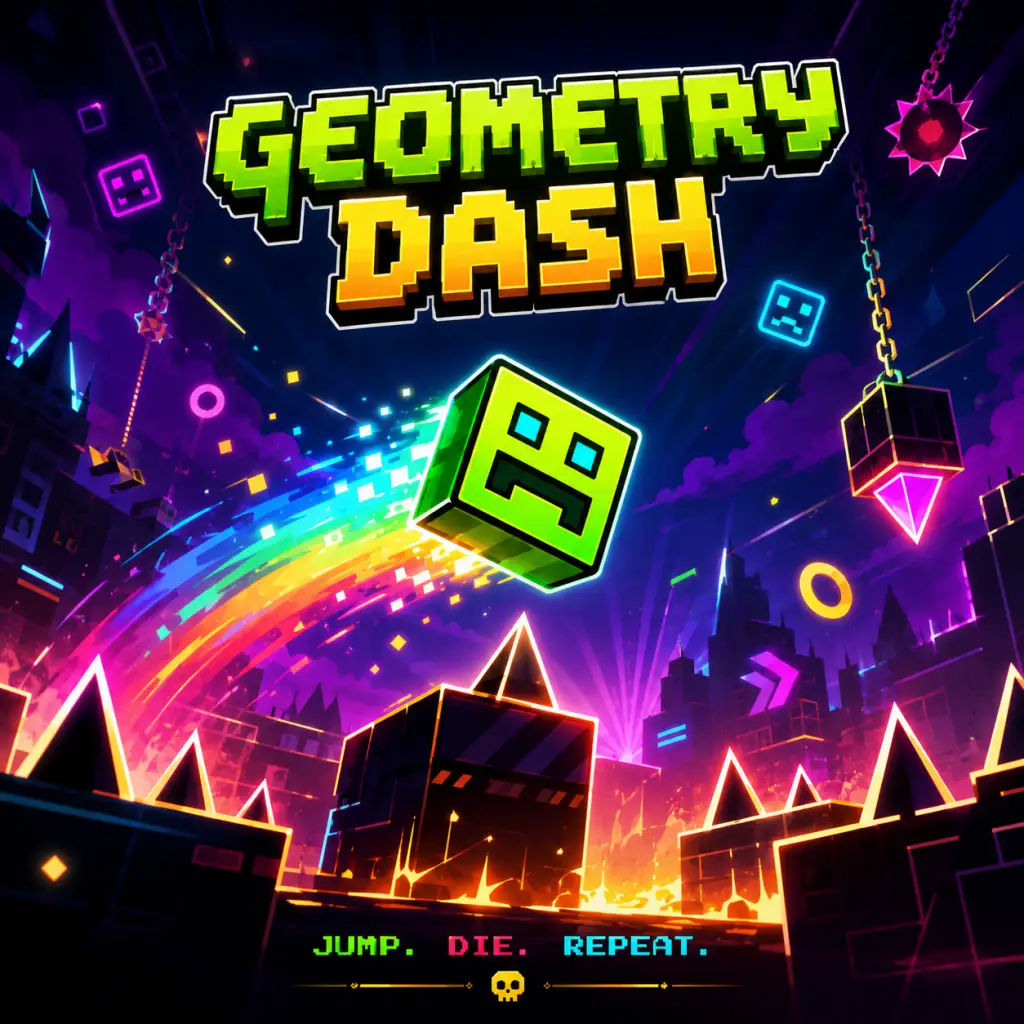
Geometry Dash is a critically acclaimed rhythm-based platformer developed and published by RobTop Games (created by Swedish developer Robert Topala). Originally released as a mobile title in 2013, it has since expanded to multiple platforms, becoming a staple of the rhythm-platformer genre known for its punishing difficulty, vibrant visuals, and deep community-driven content.
Genre
- Primary: Rhythm-based platformer (often classified as a "rhythm platformer" or "hardcore platformer").
- Secondary: Action, arcade, and music-driven experience.
- Developer: RobTop Games (solo developer Robert Topala).
- Publisher: RobTop Games.
- August 13, 2013: Initial release on iOS (as a paid app).
- September 2013: Android release.
- December 22, 2014: Steam (PC/Mac) release via Steam Early Access, followed by full launch.
- June 2015: Official launch of Geometry Dash on Steam.
- 2016–2017: Console ports: PlayStation 4, Xbox One, and Nintendo Switch.
- Ongoing: Regular free updates adding new levels, features, and editor tools (e.g., Update 2.2 in 2023–2024).
- PC/Mac: Steam (Windows, macOS).
- Mobile: iOS (App Store), Android (Google Play).
- Console: PlayStation 4, PlayStation 5 (backward compatible), Xbox One, Xbox Series X|S, Nintendo Switch.
- Note: Each platform version is a standalone purchase; no cross-save or cross-play.
- Precision & Rhythm: Every jump and transformation must align perfectly with the music’s beat. The gameplay is a test of timing and muscle memory.
- Extreme Difficulty: A single mistake often forces a restart from the beginning of a level. This “one hit, instant death” design creates high stakes and immense satisfaction upon completion.
- Addictive Loop: Short levels (30–90 seconds) encourage repeated attempts, and the failure-to-success cycle is highly compelling.
- User-Generated Content: The in-game level editor lets players create, share, and play millions of custom levels, providing virtually endless content.
- Age: Primarily teenagers and young adults (12–30), but accessible to any age.
- Skill Level: Not for casual players; the steep learning curve appeals to those who enjoy challenging games (e.g., Super Meat Boy, Celeste).
- Interests: Rhythm game fans, speedrunners, creative players who enjoy designing levels.
- Main Levels: 21 official levels (as of Update 2.2) ranging from easy to extreme difficulty (e.g., "Stereo Madness" to "Fingerdash" and "Dash"). Each level has a unique song and visual theme.
- Practice Mode: Players can place checkpoints to practice sections, with options to toggle speed, start from any point, and auto-delete checkpoints after completion.
- Level Editor: Full-featured editor allowing users to create custom levels using hundreds of objects, triggers, and effects. Levels can be uploaded online for others to play and rate.
- Online Levels: An extensive catalog of user-created levels sorted by difficulty, popularity, and rating. Players can download and play any level.
- Daily & Weekly Levels: Featured curated challenges that refresh regularly.
- Challenge Modes: Additional gauntlets, treasure room, and other mini-games (unlocked via achievements).
- Multiplayer: No true simultaneous multiplayer; the game features a “Map Packs” mode where players collectively attempt to complete all levels, and leaderboards show fastest completions.
- Offline: All official levels can be played offline. Practice mode and local save data work without internet.
- Online: Required for downloading user-created levels, uploading own levels, viewing leaderboards, and accessing daily/weekly challenges. No online multiplayer matches.
- Cross-Platform: No cross-progression; progress (stars, coins, unlocks) is tied to the platform.
- Update 1.0–2.2: Each update added new official levels, game modes (ship, ball, wave), editor features, and quality-of-life improvements.
- Spin-off Games: RobTop released free standalone titles as promotions: Geometry Dash Meltdown (2016) and Geometry Dash SubZero (2017), which introduced new levels and mechanics. These are not DLC for the main game, but separate free apps/mobile games.
- In-App Purchases: On mobile, players can buy gems (premium currency) to unlock icons, colors, and other cosmetics faster, but all content is earnable through gameplay. The PC/console version has no microtransactions.
- Pure Rhythm-Gameplay Fusion: Unlike most rhythm games where failure is forgiving, Geometry Dash combines rhythm-based inputs with hardcore platforming precision. The music is the level design.
- One of the Most Difficult Mainstream Games: Its reputation for extreme difficulty (some user levels take thousands of attempts) has created a dedicated community of speedrunners and achievement hunters.
- Massive User-Generated Ecosystem: The level editor is so robust that it has spawned its own economy of level ratings, demon lists, and creator rankings. The community creates everything from simple fun levels to near-impossible pixel-perfect challenges.
- No Pay-to-Win: All gameplay-relevant content is either free or earnable. The only purchases are the base game and optional cosmetics on mobile.
- Iconic Soundtrack: The official levels feature original electronic tracks (e.g., "Blast Processing" by Waterflame, "Theory of Everything" by DJ-Nate) that have become iconic in gaming culture.
Developer & Publisher
Release Timeline
Platforms
Story & Setting
Geometry Dash has no explicit narrative or story. The game is entirely focused on gameplay and challenge. The setting is abstract and geometric: each level is a visually distinct world with colorful backgrounds, dynamic elements, and music-driven obstacles. The themes range from neon geometry (e.g., "Stereo Madness") to dark cyberpunk (e.g., "Hexagon Force"). The lack of story allows players to immerse directly in the rhythm-based obstacle course.
Main Characters
There are no named characters or avatars with personality. The player controls a silhouetted square icon (often called the "cube") that transforms into various forms (ship, ball, UFO, wave, robot, spider) depending on the game mode. Players can customize the icon's appearance by unlocking new colors, skins, and trails through achievements and in-game currency. The icon is a blank canvas for self-expression.
Core Appeal
Target Audience
Game Modes
Online & Offline Support
DLC & Expansions
Geometry Dash does not have paid DLC expansions. The game follows a model of free major updates:
What Makes Geometry Dash Unique
In summary, Geometry Dash is a deceptively simple yet brutally challenging rhythm platformer that has thrived for over a decade thanks to its perfect marriage of music and gameplay, a thriving creator community, and an endlessly replayable package. It remains a benchmark for hardcore platformers and one of the most influential indie games of the 2010s.