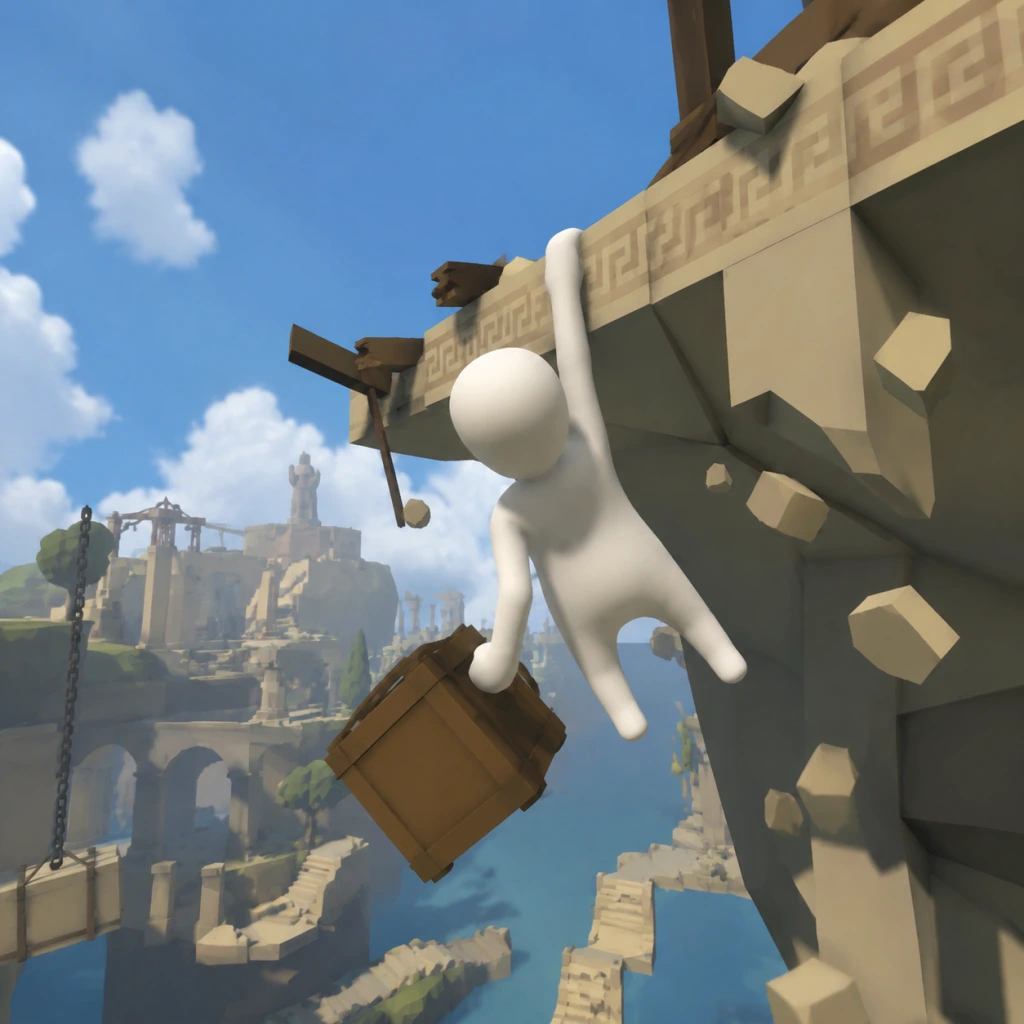
Core Gameplay
Core Gameplay
Human: Fall Flat is a physics-based puzzle platformer with no traditional combat, no currency, no character stats, and no skill trees. Gameplay revolves entirely around manipulating the environment and the player character's wobbly limbs to solve puzzles, reach the level exit, and optionally explore for collectibles. The game's main loop is: observe → grab/climb/push/pull → solve obstacle → progress.
Main Gameplay Loop
- Input: Use two independent grab buttons (left/right) to control each hand. Combine with movement (WASD/left stick) and look (mouse/right stick) to interact with objects.
- Interaction: Grab any grabbable object (crates, levers, wheels, movable platforms, ropes). Drag, carry, swing, or throw. Your character's floppy physics allow creative solutions like using your own body as a counterweight or bridge.
- Puzzle Solving: Each level presents a series of environmental puzzles (e.g., building a bridge, stacking blocks, redirecting water, timing mechanisms). No text clues; all solutions are observation and physics-based.
- Exit: Reach the glowing door at the end of each level zone to save progress. Levels are divided into several linked areas (typically 5-8 per level).
- Grabbing: Holding a button clamps that hand onto a surface (fixed or movable). Release to let go. If an object is heavy, you must use both hands or drag it.
- Climbing: Grab onto ledges, walls, or dangling ropes to climb. Use alternating grabs to shimmy upward. Your body sways, so timing is key.
- Pushing & Pulling: Grab a movable object and move in the desired direction. Heavy objects require cooperation (in multiplayer) or creative leverage (e.g., using a plank as a lever).
- Swinging: Grab a rope or swingable object, then push in a direction to build momentum. Release at the right moment to fly across gaps.
- Throwing: Grab an object, then quickly release and push to fling it. Useful for activating distant buttons or breaking fragile walls.
- Crawling & Rolling: Hold the crouch button and move to roll into narrow spaces. Useful for hiding from rolling hazards or squeezing under obstacles.
- Gravity Manipulation (late game): Some levels (e.g., "Power Plant", "Dynamic") feature gravity switches that flip your personal gravity or the environment’s. You must adapt your movement.
- Linear Level Progression: The game includes 12 core levels (plus DLC levels). They are unlocked sequentially. You must complete each level to unlock the next. Progress is saved automatically at checkpoints (doors).
- No Experience or Leveling: The player character never gains new abilities. The only "progression" is your own skill in understanding physics and creative problem-solving.
- Collectibles: Each level has hidden collectibles (hats, masks, items) that unlock cosmetic outfits. Collecting all in a level is optional but rewards persistence.
- Open-Ended Level Design: Levels are large 3D sandboxes. The main path is obvious but many alternative routes exist (e.g., climbing a bookshelf instead of stacking crates).
- Hidden Areas: Behind cracked walls, under water, or via secret jumps. Look for out-of-place objects or unusual structures.
- Interactable Environment: Everything that can be grabbed can be moved. Try pulling, lifting, or throwing objects to discover shortcuts or hidden collectibles.
- No Traditional Quests: There are no NPCs or dialogue. The only objective per level is to reach the exit door.
- Optional Challenges: Some achievements or in-game goals (e.g., "Beat the level without touching the ground") are self-imposed. No in-game mission log.
- Multiplayer Cooperation: In online or local co-op, you and friends can work together (or troll each other) to solve puzzles more creatively.
- No Economy: There is no currency, no shop, no upgrades. The only “resource” is your own skill and the physics around you.
- No Character Growth: The floppy human never changes stats. No levels, no skill points, no equipment effects.
- Cosmetic Unlocks: By collecting hats and other items, you can customize your character’s appearance in the main menu. These do not affect gameplay.
- Replayability: After completing all levels, you can replay any level with newfound knowledge. Many players attempt speedruns or challenge runs (e.g., no grabbing, one hand only).
- Multiplayer Chaos: The endgame is often multiplayer: playing through levels with friends, causing mayhem, or trying to fail intentionally.
- Modding (PC): The Steam Workshop hosts thousands of user-created levels. These range from simple puzzles to complex Rube Goldberg machines, extending the game indefinitely.
- Achievements: Hunting all achievements (especially the trickier ones like "Climb the mountain in the background of 'Mountain'") can occupy many hours.
- Player Expectations: You are learning the basic controls—how to grab, climb, and carry objects. You'll fall often.
- Example Puzzles:
- Common Mistakes: Over-grabbing (holding both hands while climbing leads to stuck), pushing objects instead of pulling, not using the environment.
- Exploration: Hidden collectibles are behind simple walls or on top of obvious structures. Example: In Construct, a red hat sits on a high shelf—stack two blocks to reach it.
- Player Expectations: You now understand basic physics. The puzzles introduce timing, weight distribution, and multi-step solutions.
- Example Puzzles:
- Exploration: Hidden items are trickier—some are behind locked doors requiring keys or switches. Example: In Train, a hat is inside a locked train car; you must find the key on the roof.
- Checkpoints: Levels get longer; checkpoints (doors) are more frequent. Missing a checkpoint may require redoing several puzzles.
- Player Expectations: You have mastered grabbing and climbing. New mechanics like gravity flipping and slippery surfaces challenge your understanding.
- Example Puzzles:
- Difficulty: The timing for jumps and grabs is strict. Many puzzles require coordinated use of both hands and body weight.
- Exploration: Collectibles are often in hidden, gravity-flipped areas or require precise sequence of actions (e.g., flipping a switch, then quickly running through a door before it closes).
- Player Expectations: You are now a veteran. The core game is easy; you seek challenges.
- Activities:
- Mastery: You can solve the original levels in your sleep. You discover that almost any puzzle has multiple solutions—for example, you can bypass a locked door by stacking objects to climb over a wall instead of finding the key.
Interaction Systems (No Combat)
Progression
Exploration
Quests / Missions
Economy
Character / Build Growth
Endgame Structure
Player Progression Tiers
Progression in Human: Fall Flat is not about character power but about player mastery. The tiers below describe typical player experience and challenges.
Early Game (Levels: Construct, Storage, Excavation, Workshop)
- Construct: Stack three wooden blocks to reach a high platform. Physics: heavy blocks may tip if not aligned.
- Storage: Use a rolling ball to smack a button, then ride a conveyor belt. Learn momentum.
- Excavation: Ride a moving platform, pull levers to raise and lower bridges.
- Workshop: Swing on ropes over a pit, climb a moving ladder.
Mid Game (Levels: Train, Submarine, 'Mountain', 'Sitting', 'Demolition')
- Train: You must move train cars, attach them, and use a crane to load cargo. Requires precise grabbing.
- Submarine: Dive underwater, open hatches, and press buttons while managing buoyancy. New mechanic: underwater movement is slower; you must hold breath (no drowning though).
- 'Mountain': Climb a large rock face with platforms and falling rocks. Requires careful hand-over-hand climbing.
- Sitting: Solve puzzles in a giant living room—flipping furniture, using a vacuum cleaner (which blows air to move objects).
- Demolition: Use a crane to destroy a building by swinging a wrecking ball. Must manage pendulum physics.
Late Game (Levels: Power Plant, Water, Office, Dynamic)
- Power Plant: A room where a button on the ceiling must be pressed. To reach it, you must use a movable box as a platform, then jump and grab. Gravity flips: some rooms invert your gravity.
- Water: Navigate a flooded facility. Use floating platforms (barrels, pallets) to cross water; water currents push you. Boxes sink, barrels float.
- Office: Climb between desks, using paper as temporary platforms (they tear if held too long). Use swivel chairs for momentum jumps.
- Dynamic: Gravity changes dynamically based on colored panels. Blue = normal, orange = flipped. You must quickly adapt movement.
Endgame (After completing all levels + DLCs + Modded content)
- Speedrunning: Attempt to complete levels as fast as possible using glitches, shortcuts, and physics exploits. Popular levels for speedruns: Train, Mountain.
- Challenge Runs: "No grab" runs (use only jumps and body physics), "one hand only" runs.
- Multiplayer Mayhem: Play with up to 8 players (modded) or 4 players (vanilla). Try to complete levels while carrying a friend (cooperative) or sabotaging each other.
- Workshop Levels: Thousands of community levels with varying difficulty. Many are puzzle-heavy, some are parkour, others are pure chaos.
- Cosmetic Completion: Collect all 40+ hats from base game and DLCs. Requires thorough exploration.
This progression is not forced; players can stay in early game by replaying favorite levels. The open physics system ensures that no two playthroughs are identical.