Characters & Roles
The Nameless Boy
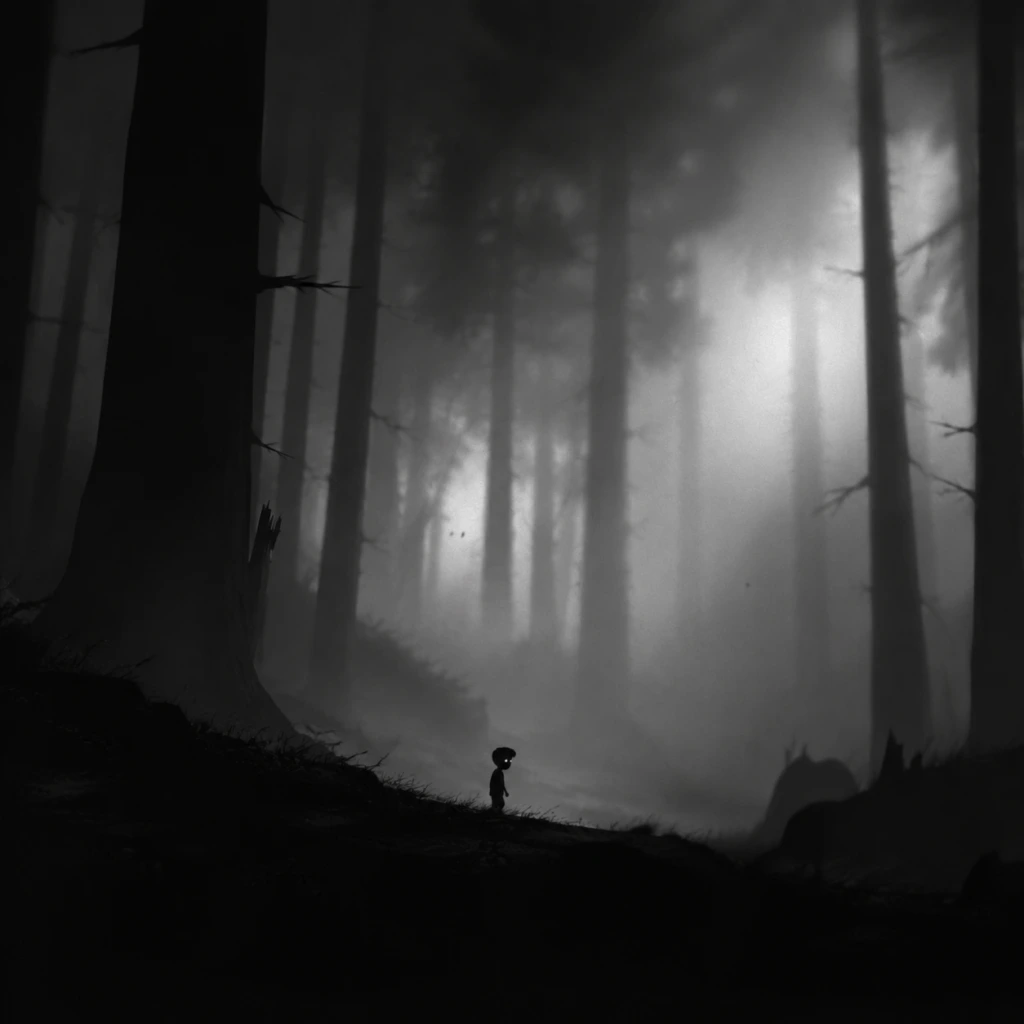
Limbo features a single, silent protagonist: a nameless boy who awakens at the edge of a dark forest. There are no other playable characters, classes, roles, or unlockable units in the game. The entire experience is built around controlling this one boy as he navigates a hostile, monochrome world.
Background
- The boy's identity and motivation are intentionally left ambiguous. The only narrative thread is his search for his missing sister, hinted at by the faint silhouette of a girl seen in the game's opening and final moments.
- He is a child—small, vulnerable, and completely unarmed. He wears a dark shirt and trousers, with no visible equipment or protective gear.
- The world he traverses is a nightmarish, industrial-fantasy landscape filled with traps, machinery, and hostile creatures.
- Agility: The boy can run, jump, climb ledges, push/pull objects, and crawl through tight spaces. His movement is precise and responsive, allowing for controlled platforming.
- Problem-solving mindset: While not a gameplay mechanic, the boy (and by extension the player) is required to observe environmental cues and experiment with interactions to progress.
- Resilience (gameplay): Although he dies frequently, the game respawns him almost instantly at the last checkpoint, encouraging trial-and-error without frustration.
- Extreme fragility: Any hazard—spikes, electric shocks, water, crushing traps, or creatures—kills the boy in one hit. He has no health bar, no shields, no damage mitigation.
- No combat abilities: The boy cannot attack any enemy. He can only avoid, trick, or use the environment to eliminate threats (e.g., dropping a trapdoor on a giant spider).
- Limited interaction: He can only push, pull, climb, and activate levers or buttons. He cannot carry items, use tools, or interact with most objects from a distance.
- No special powers or upgrades: The boy never gains new abilities, skills, or equipment. His moveset remains identical from the first screen to the last.
- Trial-and-error approach: Every puzzle or obstacle requires careful observation and repeated attempts. There is no punishment for dying beyond a momentary checkpoint reload.
- Environmental manipulation: The boy must use objects around him—boxes, counterweights, hooks, magnets, water flows—to create paths or disable traps.
- Patience and timing: Many puzzles involve moving platforms, rolling logs, or timed triggers. Rushing often results in death; pacing and pattern recognition are essential.
- Stealth and evasion: Against creatures like the giant spider or the forest boys, the boy must hide, stay still, or move carefully to avoid detection. Running blindly attracts attention.
- The boy is the only playable character available from the very start of the game. No unlock requirements, secret characters, or alternate versions exist.
- Completing the game does not unlock any new playable characters or modes (aside from the "Eggs" collectible for Steam achievements, which does not change the character).
- None applicable: Limbo has no equipment, upgrade system, or build options. The boy's capabilities are fixed. The only "build" is the player's own observational skill and patience.
- Not applicable: The boy is alone throughout the game. There is no cooperative or multiplayer mode. No NPC allies assist him; the only interactions are with hostile creatures and neutral puzzle elements.
- Appearance: A massive, long-legged spider that stalks the boy in the early forest and industrial areas.
- Behavior: Pursues the boy relentlessly. It can walk on ceilings, climb walls, and impale the boy with its legs. It is immune to most traps.
- How to defeat: The spider can only be killed by luring it into a bear trap or another environmental hazard. Later, the boy must divert its attention using a cart and a counterweight to drop a platform on it.
- Appearance: Humanoid silhouettes of other children, sometimes wearing masks or holding weapons (e.g., a club).
- Behavior: They wander aimlessly but become hostile if the boy approaches or runs near them. They will chase and club him to death.
- Strategy: Avoid their line of sight. Move slowly when they are nearby. They can be distracted by throwing objects or used to trigger traps from a distance.
- Appearance: Long, segmented creatures that hide in shallow water or mud. They erupt when the boy steps on their territory.
- Behavior: They grab the boy and drown him in the mud. They cannot be killed.
- Strategy: Listen for their subtle movement sounds or watch for ripples in the water. Time your runs to cross when they are retracted.
- Description: Various industrial hazards that emit electricity. Contact instantly kills the boy.
- How to handle: Most require the boy to pull crates to block electrical arcs or disable generators before proceeding.
- Description: Faint, humanoid shapes that rise from the water and drag the boy underwater if he touches them.
- Behavior: They appear only in flooded areas. They are attracted to motion and splashes.
- Strategy: Move slowly when submerged. Use floating platforms or ropes to avoid contact. The ghosts cannot be eliminated.
- Description: In later puzzles, the boy encounters rooms where gravity shifts (rotating rooms, anti-gravity fields). No specific character, but the environment becomes an active threat.
- Role: Only visible as a silhouette in the ending sequence. Her existence drives the narrative, but she has no direct interaction with gameplay.
- Only playable character: The Nameless Boy.
- No classes, roles, or builds: The game is pure puzzle-platforming without RPG elements.
- Primary challenge: Environmental hazards and hostile creatures that require observation, timing, and puzzle-solving.
Strengths
Weaknesses
Playstyle
Unlock Conditions
Recommended Equipment or Builds
Team Synergy
Notable Non-Player Characters (Enemies and Entities)
While not playable, several characters play crucial roles as obstacles or puzzle components. Understanding them is essential for progression.