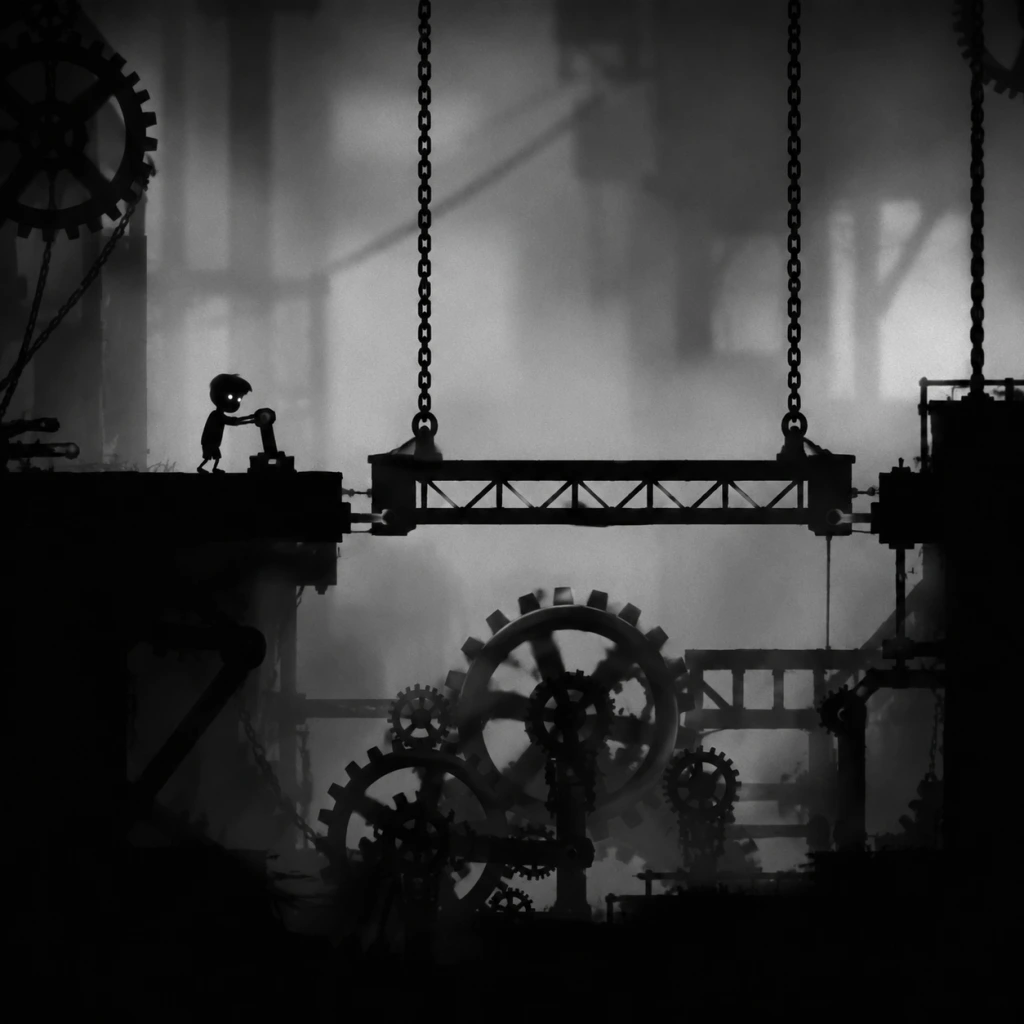
Core Gameplay
Core Gameplay
Limbo is a minimalist puzzle-platformer that focuses entirely on environmental interaction, observation, and trial-and-error problem-solving. There is no combat, no dialogue, no inventory, no experience points, no currency, and no skill trees. The core gameplay loop centers on guiding a nameless boy through a monochrome forest, industrial ruins, and surreal environments, with the sole goal of finding his sister.
Main Gameplay Loop
The fundamental loop is:
1. Observe the environment for clues, threats, and interactive objects (e.g., boxes, levers, switches, ropes, moving platforms).
2. Move left or right (the boy moves left to right by default, but can backtrack).
3. Interact with objects by pushing, pulling, climbing, jumping, or triggering them.
4. Solve puzzles that often require logical sequencing, timing, or using physics-based elements (grates, magnetism, water).
5. Avoid death from numerous instant-kill traps: bear traps, spikes, giant spiders, falling objects, drowning, electrocution, saws, crushing mechanisms, etc.
6. Progress to the next screen or area. The game is divided into 23 distinct, titled chapters (though not explicitly labeled in-game, they are separated by load zones).
Combat/Interaction Systems
Absolutely no combat. The boy cannot attack any enemy. Interaction is limited to:
- Push/Pull boxes, crates, platforms, or switches.
- Climb ledges, ladders, ropes, or chain links.
- Jump (hold button for longer jump, but only horizontal; no wall jump).
- Hang from ledges (automatic when moving off edge).
- Swing on ropes using momentum.
- Grapple (late game): The boy can pull himself using a magnetic grapple device on certain metal surfaces.
- Flip switches (activate machinery).
- Hide (temporary, behind objects to avoid line-of-sight of enemies like the spider).
- Speedrunning (unlocking the “No Point in Dying” achievement for completing in under 0 deaths, or simply beating your own best time).
- Collecting all eggs (for the “Full Egg” achievement).
- The game’s atmosphere and minimalist design invite multiple playthroughs.
- Bear traps (first hazard): You must learn that walking into a bear trap from the side triggers it; you can use them as weights to hold down switches or climb on top.
- Box puzzles: Push a crate to climb to a ledge or to safely cross a gap with a pit.
- The Spider: A large spider will hunt you. You cannot kill it. You must outrun it, bait it into getting stuck (e.g., in bear traps, crushing gears), or use environmental traps (like a falling tree) to immobilize it temporarily to pass.
- Cave darkness: You must follow glowing fireflies or moths to see your path. Touching a certain light source causes a giant worm to spawn; you must run and avoid it.
- Water section: You must navigate floating platforms, avoid underwater spikes, and use a box to weigh down a switch to lower the water level. Drowning is common.
- Gears and crushers: You must climb moving gears; timing jumps precisely. One area requires climbing a series of gear teeth that can crush you.
- Gravity puzzle: Known as the “Gravity Machine,” you must activate a device that reverses gravity. You then walk on ceilings and walls to solve puzzles. This is the only major shift in mechanics.
- Electric traps: Rails with moving electric currents. You must time your jumps to avoid death.
- Contraptions with levers and conveyor belts: You must activate levers at the right time to redirect machinery.
- Final city: You approach a populated area (silhouettes of people in windows). The final puzzles involve using the grapple to navigate large gaps, and avoiding searchlights (instant death if caught).
- Magnetic platform puzzles: Using the grapple to move metal crates and create stairs or bridges.
- Reload the final checkpoint (the screen before the sister) to backtrack and collect all 11 white eggs (if they missed any). Each egg is hidden in a specific earlier level. Finding all rewards an achievement.
- Attempt a deathless run (“No Point in Dying”) which requires finishing with zero deaths. This is extremely challenging because of instant-kill traps.
- Speedrun the game (typical times range from 20-40 minutes). No in-game timer, but external tools can be used.
- Explore the game’s hidden secret: after collecting all eggs, you can interact with the final area in a special way (a hidden room appears?), but it’s minor.
The only "attack" is the ability to “kick” a bear trap to trigger it (by walking into it from the side), which is used as a tool rather than a weapon.
Progression
Progression is strictly linear. The boy moves from left to right (with occasional backtracking within a screen). There are no branching paths, but some areas require solving multi-step puzzles that involve moving objects from one screen to another. Progress is saved automatically at each load zone (when the screen changes or after death). There is no manual saving. Deaths are frequent and immediate; the boy dies with a disturbing animation and respawns at the last checkpoint (usually the start of the current screen).
Exploration
Exploration is limited to the linear path, but each screen encourages thorough examination to find hidden white eggs (there are 11 in total). These are optional collectibles. Finding all eggs unlocks an achievement/trophy. The eggs are often hidden off the main path, requiring backtracking or solving extra puzzles to reach. There are no other secrets or side areas.
Quests/Missions
The only overarching mission is: Find your sister. There is no dialogue, text, or journal. The story is environmental. Each area presents a new obstacle (forest, spider, dark cave, gravity factory, final city). You never receive explicit goals; the game uses visual cues (e.g., a distant silhouette of the sister, a light source) to guide you.
Economy
No economy whatsoever. No items to buy, sell, or collect (except the optional white eggs). No currency. No upgrades. The only resources are the boy’s ability to move and interact, and the items in the environment (which are fixed).
Character/Build Growth
No character growth. The boy has only two states: alive or dead. There are no stats, levels, skills, or equipment. The only "growth" is the player’s increasing familiarity with puzzle logic and trap patterns. The magnetic grapple (acquired in the gravity section) is the only new ability, and it’s a permanent tool, not an upgrade.
Endgame Structure
Endgame occurs after the final puzzle. Once you reach the girl (sister) in the last area, the game ends with a short cinematic. There is no post-game content, no New Game+, no difficulty modes. After credits, you can reload the final save to clean up missed eggs or achievements. The main replayability comes from:
Player Progression Tiers
Early Game (First 20-30 minutes: Forest, Spider, Cave)
The game begins with the boy waking up in a dark forest. You learn basic movement: walking, jumping, and climbing.
Key areas and puzzles:
Typical player death count: 10-30. Many die to the spider, bear traps, or falling.
Example puzzle: After the spider area, you must drop a box onto a button to open a door, then quickly go through before the box is crushed.
Mid Game (First 30 minutes to 1 hour: Water, Gears, Gravity Room)
Puzzles become more complex and require multi-step solutions, often involving timing and physics.
Key areas and puzzles:
New mechanic: The magnetic grapple is acquired here. You can fire a long cable that attaches to metallic surfaces; you can then pull yourself horizontally or swing. This is used for the rest of the game.
Example puzzle: In the gravity room, you must press a button on the ceiling, then gravity flips, and a box falls up. You must then drag the box to a new spot to create a platform to reach a high exit.
Late Game (Final 30 minutes: Factory, Electroshock, Final city)
The atmosphere becomes more industrial and surreal. The puzzles rely heavily on the grapple and precise timing.
Key areas and puzzles:
Example puzzle: You need to pull a crate across a gap using the grapple, but it’s too heavy; you must first climb onto a moving platform, wait for the electric current to be off, then jump to the crate.
Endgame (After completing the game)
No new content post-credits. The game ends. However, the player may:
Note: There is no difficulty setting, no adjustment for accessibility. The game’s trial-and-error nature means death is inevitable. The endgame is truly about mastery and self-imposed challenges.