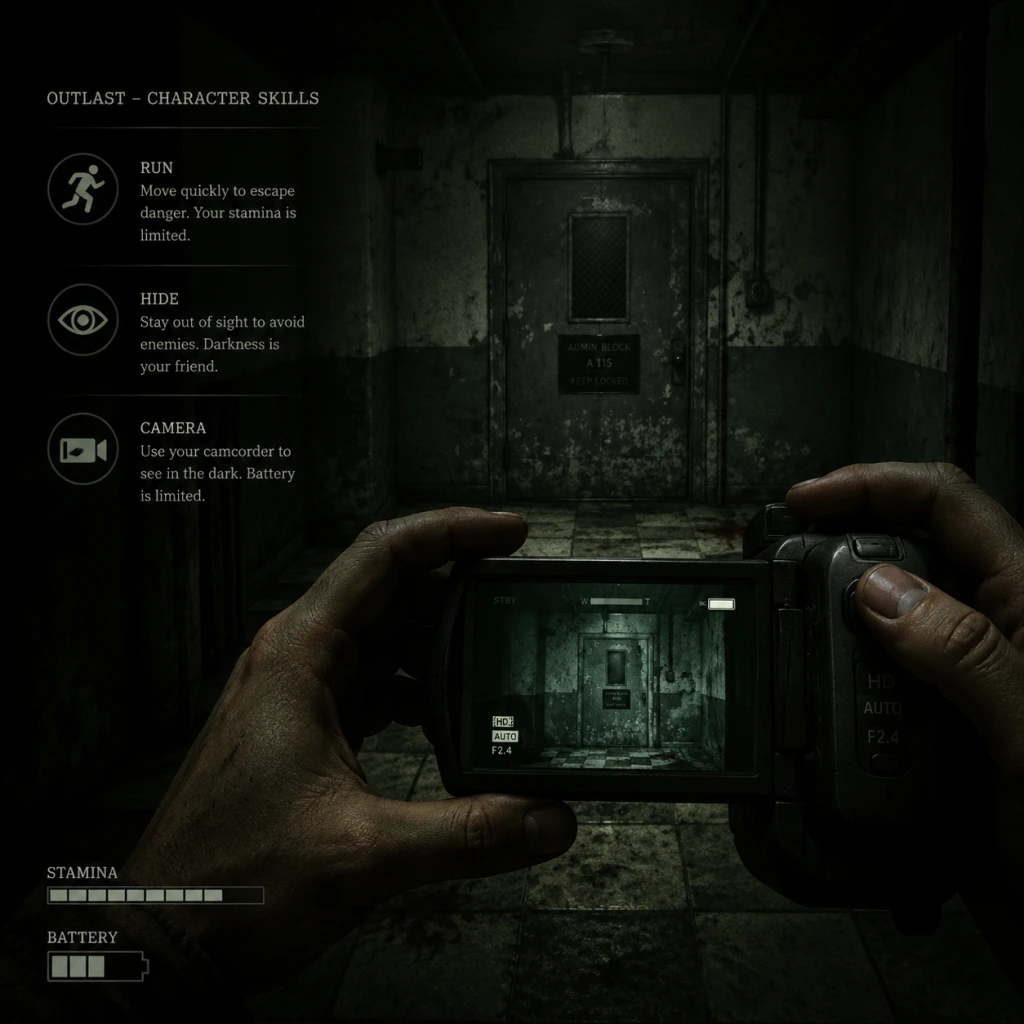
Character Skills
Character Skills Guide: Outlast
Overview
Outlast is a survival horror game with no traditional skill trees, spells, or combat abilities. The player character possesses a set of instinctive and equipment-based actions—here called "skills"—that are used to survive the horrors of Mount Massive Asylum. This guide covers all playable characters and every actionable skill, including movement, stealth, camera functions, and evasion techniques. Since there are no upgrades, cooldowns are minimal and based on stamina or battery regeneration. Combos, synergies, and builds are nonexistent; player effectiveness relies on proper timing and resource management.
---
Playable Characters
Both protagonists share identical skill sets. Differences are purely narrative.
| Character | Game | Availability |
|---|---|---|
| Miles Upshur | Outlast (base game) | Only playable character |
| Waylon Park | Outlast: Whistleblower (DLC) | Only playable character |
---
Core Player Skills
Each skill is described with its effect, any limitations, and tactical usage advice. No skills can be upgraded, altered, or combined.
#### 1. Sprinting (Run)
- Effect: Increases movement speed significantly for a short burst. The player can only sustain a sprint for approximately 3–4 seconds before an audible heavy breathing loop begins, indicating stamina depletion. After stamina is exhausted, the player automatically slows to a walk. Sprinting causes the camera to bob more aggressively, reducing visual clarity.
- Cooldown / Regeneration: Stamina regenerates after 2–3 seconds of not sprinting. No visual stamina bar exists; rely on audio cues (heavy breathing ends).
- Upgrades: None.
- When to Use:
- Tips: Never sprint unnecessarily indoors—noise attracts enemies. Sprint only when you have a clear path to a hiding spot or exit.
- Effect: Default movement speed, quiet enough to avoid alerting most enemies unless you bump into objects. No stamina drain.
- Cooldown: None.
- When to Use: Primary movement mode for exploration and stealth. Use when enemies are nearby but not in direct line of sight.
- Effect: Slows movement to a creep, reduces noise to minimum. Makes the player shorter, allowing hiding behind low obstacles. Crouching does not reduce visibility to enemies (they still see you if in plain sight) but reduces sound detection radius.
- Cooldown: None.
- When to Use:
- Tips: Crouching is essential for passing through areas with multiple enemies (e.g., the male ward). Combine with hiding for maximum safety.
- Effect: Activates the camcorder’s night vision, illuminating dark areas in green monochrome. Required to navigate most of the asylum—without it, you are effectively blind. While active, the camera battery drains at a rate of about 1 bar every 30–40 seconds (depending on brightness setting).
- Cooldown: None—can be toggled on/off instantly. Battery regeneration does not occur; battery life is finite and must be replenished via pickups.
- Upgrades: None.
- When to Use:
- Tips: Conserve battery by turning night vision off when entering well-lit rooms (e.g., near windows, emergency lights, or in the chapel). Use short bursts of night vision rather than leaving it on continuously.
- Effect: Tapping the zoom button (mouse wheel click or default key) brings the camera closer, reducing field of view and allowing distant objects to be seen more clearly. Does not consume battery.
- Cooldown: None.
- When to Use:
- Tips: Zoom can be held while moving slowly, but it disables night vision if toggled simultaneously. Use zoom sparingly to avoid disorientation.
- Effect: Pressing the interact button (F) on specific objects—such as lockers, under beds, cabinets, or closets—makes the player character enter a hiding spot. While hidden, the player is invisible to enemies unless discovered. Detection occurs if an enemy opens the locker or looks directly under the bed during a search. Hiding can also be used to stop enemy detection if you are not holding still.
- Cooldown: None—can exit hiding anytime.
- Upgrades: None.
- When to Use:
- Tips: Not all objects are hiding spots; look for interact prompts. Do not stay in one spot for too long—some enemies (Chris Walker) will check lockers systematically. Avoid hiding directly in the path of a chasing enemy—they may ram the locker and cause a game over.
- Effect: Generic interact button for doors, drawers, documents, batteries, and key items. No special skill—purely functional.
- Cooldown: None.
- When to Use: Constantly, to progress the story and collect resources.
- Tips: Always interact with doors slowly; slamming them can alert enemies. Listen for sounds before opening a door (enemy breathing or footsteps on the other side).
- Effect: Not a skill with a button; the player can hear in-game sounds through speakers/headphones. Outlast relies heavily on directional audio to detect enemy presence. You can hear footsteps, breathing, doors opening/closing, and growls.
- Cooldown: N/A.
- Upgrades: None.
- When to Use: Always—actively listen before moving into unknown area. Use headphones for best results.
- Tips: If you hear heavy breathing or footsteps getting louder, an enemy is near. Stop moving and find a hiding spot.
- Struggle / Grapple Escape: During some chase sequences, enemies like Chris Walker will grab the player. The player must rapidly press the indicated button (F or mouse click) to break free. If successful, you can continue running. If failed, game over.
- Jump / Vault: The player can vault over low obstacles (e.g., over a desk) by running toward them. This is automatic and not a discrete skill.
- Ledge Drop: Some ledges allow you to drop down. Holding forward and pressing interact triggers the drop.
- None. The game does not feature any skill combination mechanics. The only effective synergy is:
- Evading immediate threat when an enemy has spotted you and is chasing.
- Covering open ground between hiding spots.
- Escaping scripted chase sequences (e.g., Chris Walker in the courtyard).
#### 2. Walking (Normal Movement)
#### 3. Crouching (Stealth Walk)
- Moving near patrolling enemies.
- Traversing crawlspaces and vents (mandatory in some sections).
- Staying behind cover (desks, beds) while enemies search.
#### 4. Night Vision (Camera Mode)
- In any area where ambient light is insufficient to see clearly (most of the game).
- During chase sequences in darkness to spot obstacles and hiding spots.
- When examining documents or key items in dark rooms.
#### 5. Camera Zoom (Focus)
- Examining far-away items or writing on walls.
- Reading documents that cannot be approached (e.g., timing puzzles).
- Scouting enemy positions from a distance before moving.
#### 6. Hiding (Interact with Environment)
- When an enemy is approaching and you have no escape route.
- During scripted sequences where enemies are searching (e.g., inside the administration building).
- To wait out a patrol pattern before moving to the next area.
#### 7. Interactive Actions (Open, Pick Up, Read)
#### 8. Listening (Environmental Audio)
---
Special Moves / Scripted Actions
There are no player-controlled special moves. The following are scripted events that happen automatically in certain story beats:
These are context-dependent and cannot be practiced or upgraded.
---
Skill Combos & Synergies
- Crouch + Night Vision: Stealth through dark corridors while conserving battery by turning night vision on only when necessary.
- Listen + Crouch: Detect enemy while staying quiet.
There are no chain combos or bonus effects.
---
Recommended “Builds”
Outlast has no character builds. The only strategic decisions involve resource management (battery conservation) and route planning. There is no skill point allocation.
---
When to Use Each Skill – Quick Reference
| Situation | Recommended Skill(s) |
|---|---|
| Exploring dark area | Night Vision |
| Enemy patrol nearby | Crouch + Listening |
| Being chased | Sprint toward hiding spot or exit |
| Need to see far | Camera Zoom |
| Enemy searching your last known location | Hide (locker/bed) |
| Reading documents | Night Vision (if dark) + Zoom |
| Opening a door slowly | Walk (not sprint), listen first |
---
Final Notes
Since Outlast deliberately removes combat and RPG elements, the "skills" listed are the full extent of player capabilities. Mastery comes from understanding enemy AI patterns, map layout, and battery management—not from unlocking new abilities. Use the skills above with caution and always expect the unexpected.
---
End of Character Skills Guide.