Core Gameplay
Core Gameplay Overview
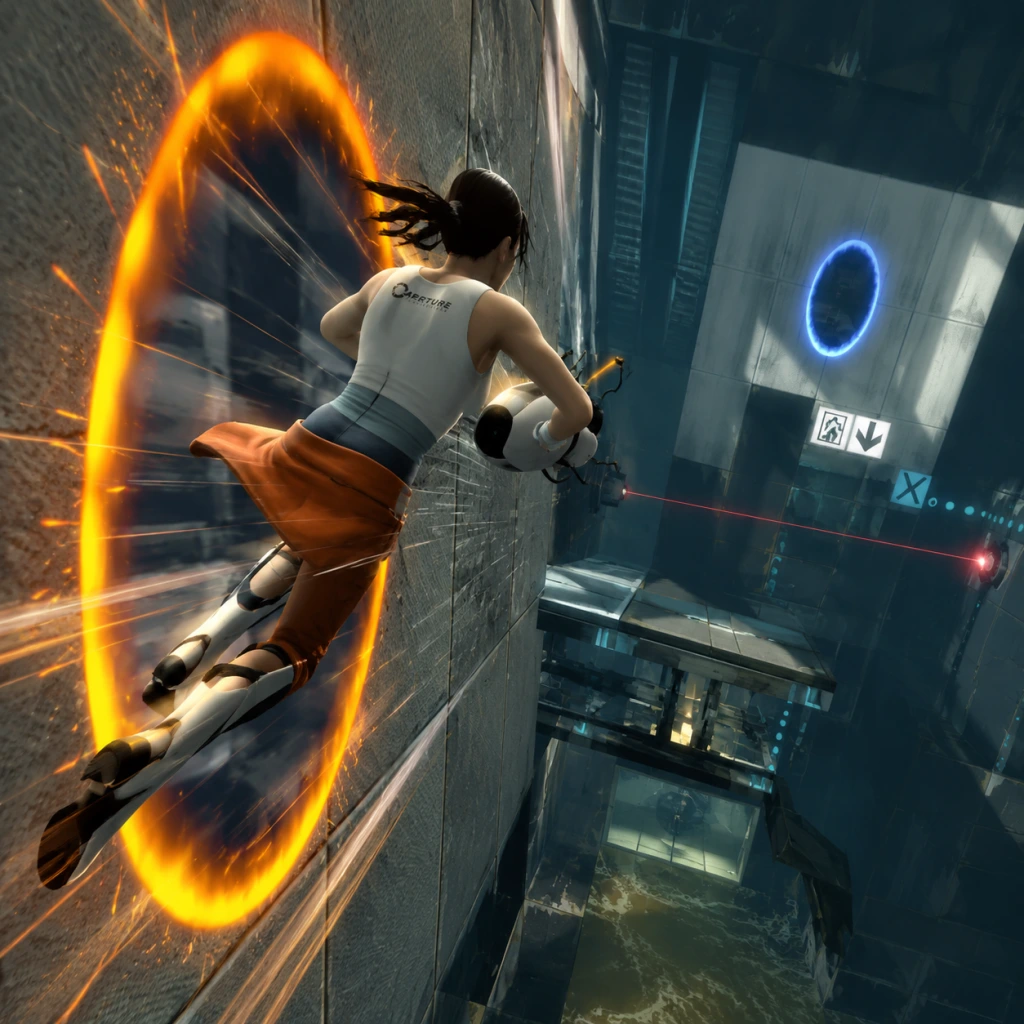
Portal 2 is a first-person puzzle game centered on momentum, spatial reasoning, and physics manipulation. Unlike traditional shooters, there is no combat or health system. Interaction is exclusively puzzle-solving using the Aperture Science Handheld Portal Device (portal gun) and an expanding toolkit of environmental mechanics. The game progresses through a linear story campaign, a separate cooperative campaign, and an endless library of user-created test chambers.
Player Progression Tiers
Early Game (Chambers 00–10)
Core Gameplay Loop:
- Wake up in relaxation vault → listen to GLaDOS’s monologue → escape through a hole → traverse test chambers.
- Each chamber: enter room, observe puzzle elements (buttons, portals, cubes, glass), use portal gun to create blue/orange portals, solve puzzle, ride elevator to next chamber.
- No combat; only environmental hazard? (e.g., turrets can be knocked over, but not killed).
- Portal Gun: Fires two functionally identical portals. Walk/step through from either side. Line of sight and surface type (white painted walls only) restrict placement.
- Movement: Standard WASD + mouse look; crouch, jump, sprint (no stamina). Portal jumps (drop through a portal above you to gain height/acceleration) introduced.
- Objects: Pick up and place Weighted Storage Cubes (WSC), Laser Redirection Cubes (LRC), or discs. Cubes activate floor buttons; lasers power bridge generators or destroy turrets.
- Linear; complete each chamber to advance. No side paths or backtracking in early game.
- Unlock portal gun in Chamber 02. Learn basic portal placement, momentum transfer, and cube mechanics.
- Very limited — each test chamber is self-contained. Light environmental story-telling through background details (old testing elements, graffiti).
- Story-driven: escape the facility. GLaDOS and later Wheatley guide (or misguide) you.
- No side quests; main objective: “Test. Complete test.”
- No currency, items, or character stats. Progression is purely knowledge-based: learning new puzzle mechanics.
- “Build growth” = mental model expansion — understanding portal placement angles, cube weight mechanics.
- After GLaDOS is replaced by Wheatley, you descend into older test shafts. Mechanics diversify: Gels, Light Bridges, Excursion Funnels.
- Puzzles now require combining multiple tools (e.g., funnel to move cube onto gel bridge platform).
- Repulsion Gel (blue): Bounces player and objects extremely high. Used to reach elevated switches or cross large gaps.
- Propulsion Gel (orange): Increases horizontal speed — slide across surfaces. Used to gain momentum for jumps or to move cubes.
- Conversion Gel (white): Coats non-portal surfaces to make them portal-conductive. Opens new placement options.
- Hard Light Bridges: Beam of solid light that can be redirected using laser redirection cubes. Acts as a platform.
- Excursion Funnels: Tractor beam that moves player and objects along a straight path; can be redirected with laser cubes.
- Thermal Discouragement Beams (lasers): Pass through portals; used to destroy turrets or power laser catchers.
- Story beats: Journey through the decaying Enrichment Center, learn about Cave Johnson (CEO). GLaDOS gradually regains control.
- Tutorial chambers for each new element (Gel intro chamber, Light Bridge chamber, etc.).
- More open hubs (e.g., the “Hub” between the early and mid game). Finding hidden graffiti and secret areas in chambers (e.g., developer commentary rooms).
- Some optional puzzles to reach Rat Man dens (story lore).
- Main quest: Restore GLaDOS to defeat Wheatley. Guide: GLaDOS now cooperates (begrudgingly).
- No side missions, but mid-game includes a “boss fight” against Wheatley-controlled turret room (pattern-based dodging).
- None. No collectibles with gameplay impact (hidden apples/radios purely for achievements).
- Player learns chaining: e.g., place portal under a gel dispenser, let gel fall, coat floor, then use funnel to redirect cube. Mental skill progression – puzzle solving speed increases.
- Return to modern test chambers (now under Wheatley’s chaotic control). Puzzles intensify — require all tools simultaneously.
- Final sequences: Turret Opera, GLaDOS’s rehabilitation, final battle with Wheatley using a portal-powered tractor beam.
- All previous tools combined. No new items.
- Gel velocity mechanics: Propulsion gel + portal loops for massive speed; repulsion gel + multi-bounce to reach high heights.
- Cube combos: Use cubes to block lasers, hold button, carry through portals.
- Story climax: Wheatley’s test chamber is a gauntlet of malfunctioning puzzles (spinning rooms, monster turrets).
- Final “boss” is a three-phase mechanics puzzle using portals to redirect the destructive beam (Wheatley’s tractor beam) back at him.
- Limited; final area is mostly scripted. One hidden achievement: “This is Hardcore” (complete without dying).
- Only main story; no branching paths.
- None.
- Peak mastery: player can improvise solutions, recognizing portal synergies (e.g., using gel on a wall to coat airborne objects).
- Single Player Endgame: Credits + final song “Cara Mia Addio” by turrets. After credits, GLaDOS releases you to surface. No post-campaign puzzles; only New Game+ changes (commentary mode).
- Cooperative Mode (Atlas and P-Body): Fully separate campaign with 40+ chambers designed for two players. Each player has two portal guns (so four portals total). Puzzles require coordination, each portal pair is independent.
- Same physics, but with two portals per player. Both players can see each other’s portals (colored differently: blue/orange for player 1, red/purple for player 2).
- Ping system to highlight objects/positions. Spoken or typed communication essential.
- Cooperative actions: one player stands on a bridge while other directs it; one player carries cube through portal held by other.
- Co-op campaign is linear but separate; 9 courses with multiple chambers each. Completing chambers unlocks new courses (e.g., Course 1-1 through 1-4, then Course 2).
- No character levels or unlocks; all tools are available from start (gels, funnels, portals, etc.).
- Co-op has no hub; straight chamber sequence. Hidden areas for developer commentaries and easter eggs.
- Story missions: GLaDOS narrates, tests the robots, eventually reveals her plan (sending them to the moon? Actually, she wants to dismantle them). Co-op story ties into the single-player timeline.
- Achievements for co-op specific actions (e.g., “Portrait of a Robot” – both players in view of camera at same time).
- None.
- Learning collaboration: timing portal placements, calling out moves, understanding partner's perspective. For example, one player creates a portal for other to cross large gap; the other launches a cube through a funnel.
- Community Test Chambers: Steam Workshop and in-game Puzzle Creator (released in 2012). Thousands of user-made chambers with variable difficulty.
- Challenge Modes: Single-player + co-op have optional challenges: Step count, Portal count, Time Trial. Achievements reward speed and efficiency (e.g., “Smash TV” – break 11 test chamber doors).
- No raid/dungeon style content. Game has no grind, no randomization. Endless replay through workshop.
Interaction Systems:
Progression:
Exploration:
Quests/Missions:
Economy & Character Build:
Example: Chamber 05 — place portal on opposite walls to cross a gap. Player must realize portals connect spaces, not just surfaces.
Mid Game (Chambers 11–19 / The Old Aperture Section)
Core Gameplay Loop:
Interaction Systems (new additions):
Progression:
Exploration:
Quests/Missions:
Economy:
Character Build:
Example: Old Aperture chamber with funnels and repulsion gel: Place portal on floor, shoot funnel to redirect it, then use repulsion gel to launch yourself onto a floating platform.
Late Game (Chambers 20–26 / The Final Chambers)
Core Gameplay Loop:
Interaction Systems:
Progression:
Exploration:
Quests/Missions:
Economy:
Character Build:
Example: Chamber 24 — need to use repulsion gel bridge, then propulsion gel on wall, then funnel to carry cube behind laser field, all while portals redirect laser to kill turret.
Endgame (Post-Campaign & Cooperative Mode)
Core Gameplay Loop:
Interaction Systems:
Progression:
Exploration:
Quests/Missions:
Economy:
Character Build:
The “Real” Endgame:
Example: Community chamber “Momentum of Madness” requires quick portal swaps and gel slides; may need multiple attempts to master, akin to a “speedrun” challenge.
Summary Table of Core Systems
| Aspect | Early Game | Mid Game | Late Game | Endgame |
|---|---|---|---|---|
| Mechanics | Portals, Cubes, Buttons | Gels, Bridges, Funnels, Lasers | All combined | All + co-op ping |
| Primary Loop | Enter chamber, solve, exit | Combine 2+ tools in sequence | Orchestrate multi-step solutions | 2-player coordination |
| Story Role | Escape GLaDOS | Restore GLaDOS | Defeat Wheatley | GLaDOS tests robots |
| Difficulty | Tutorial (1-2 steps) | Moderate (3-4 steps) | Hard (5+ steps) | Variable (2-8 steps) |
| Replayability | None | Hidden areas | Achievements | Co-op, Workshop, Challenges |